
Quick Take
- Texas is home to more bats than any other U.S. State.
- The Blue Lacy is the only dog breed to have originated in Texas.
- The Texas Longhorn is the largest mammal in Texas.
When you consider its rich history, world-famous landmarks, wildlife diversity, and Tex-Mex cuisine, you can forgive the unabashed pride with which Texans talk about the Lone Star State. Considered both a Southwestern and a Gulf Coast state, Texas bridges multiple regions: The Eastern part maintains a strong Southern culture, the Western part is decidedly Southwestern, and the Gulf Coast is defined by its coastal lifestyle. The Republic of Texas was admitted as the 28th state of the Union on December 29, 1845. Like other states, Texas has adopted animals that best reflect its history, diversity, and culture. Continue reading to discover the nine official state animals of Texas.
State Bird: Northern Mockingbird
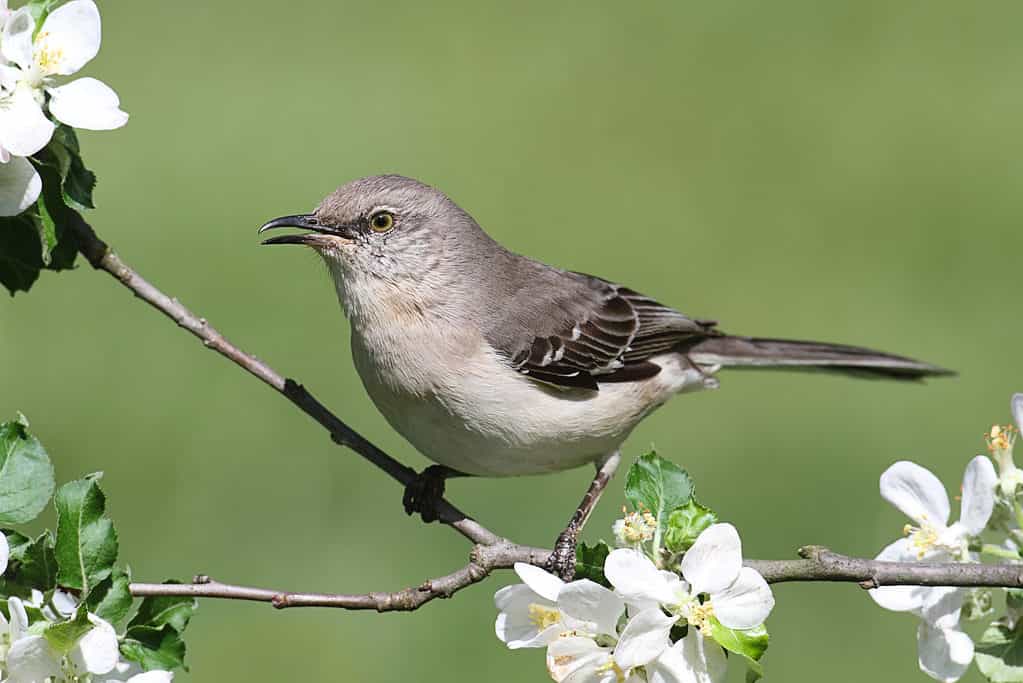
Mockingbirds are year-round residents of Texas.
©Steve Byland/Shutterstock.com
On January 31, 1927, then-Governor Dan Moody signed the proposal for the Northern mockingbird (Mimus polyglottos) to represent Texas as its state bird.
The Northern Mockingbird is a slender, medium-sized songbird, gray and brown in color, between 9 and 11 inches long, with a long tail. It is best identified by large, white patches on its wings and white outer tail feathers, which are visible during flight.
Mockingbirds are year-round residents of Texas. They can be found in all types of environments, including cities, forests, and deserts.
Mockingbirds are known for their imitation prowess. They have been observed to perfectly mimic various sounds they hear, such as other birds whistling, car horns, cackling hens, ringing telephones, and dogs barking. Even electronic analysis cannot distinguish between the mockingbird’s imitation and the original sound.
State Large Mammal: Texas Longhorn
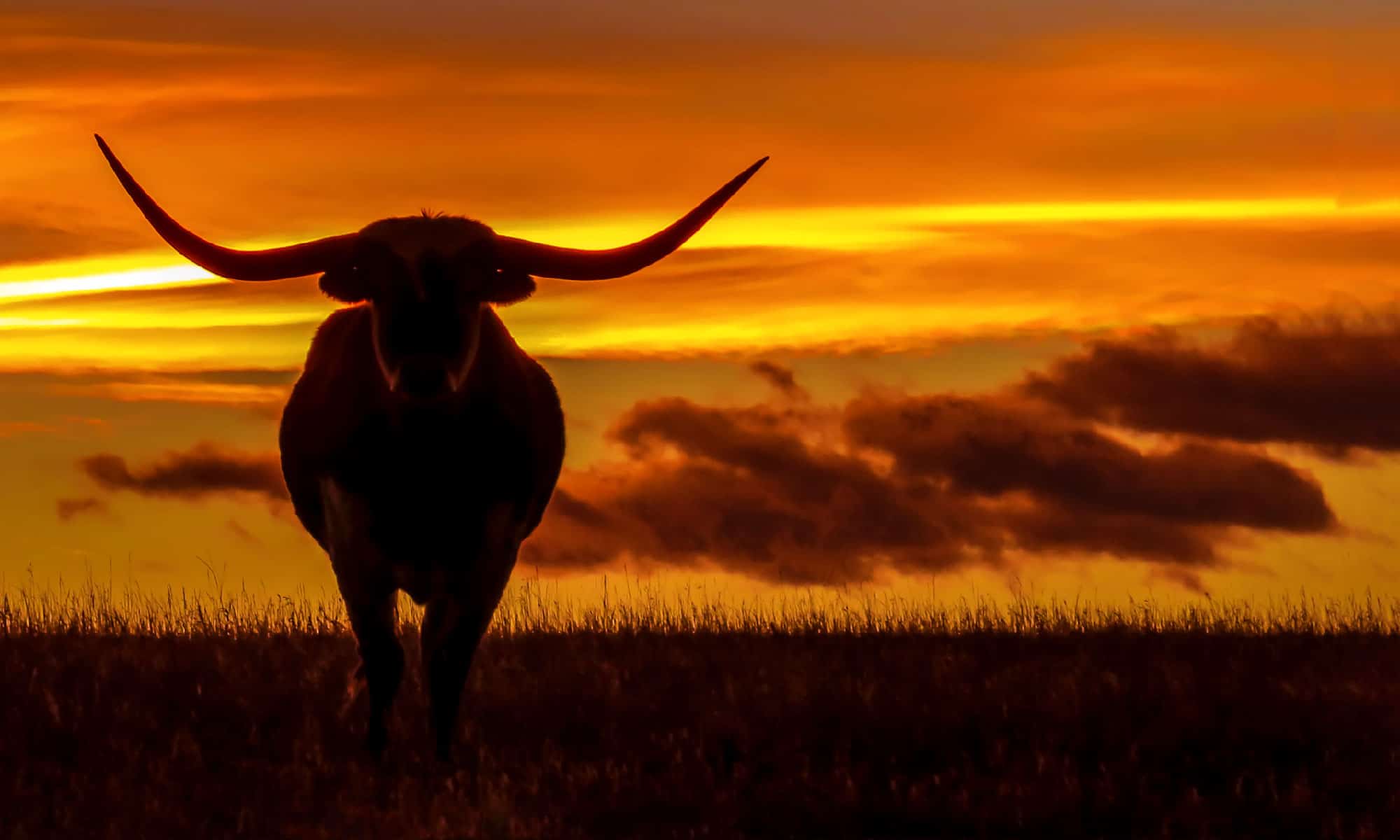
Before designating the Texas longhorn (Bos taurus taurus) as the state’s official large mammal in 1995, this cattle breed had long been a part of the state’s cultural heritage. Originating from Spanish cattle brought to North America by Christopher Columbus, longhorn cattle made their way to Texas with Spanish settlers and missionaries in the late 1600s. They adapted to the harsh environment, evolving into a hardy, disease-resistant breed crucial for the post-Civil War cattle drives.
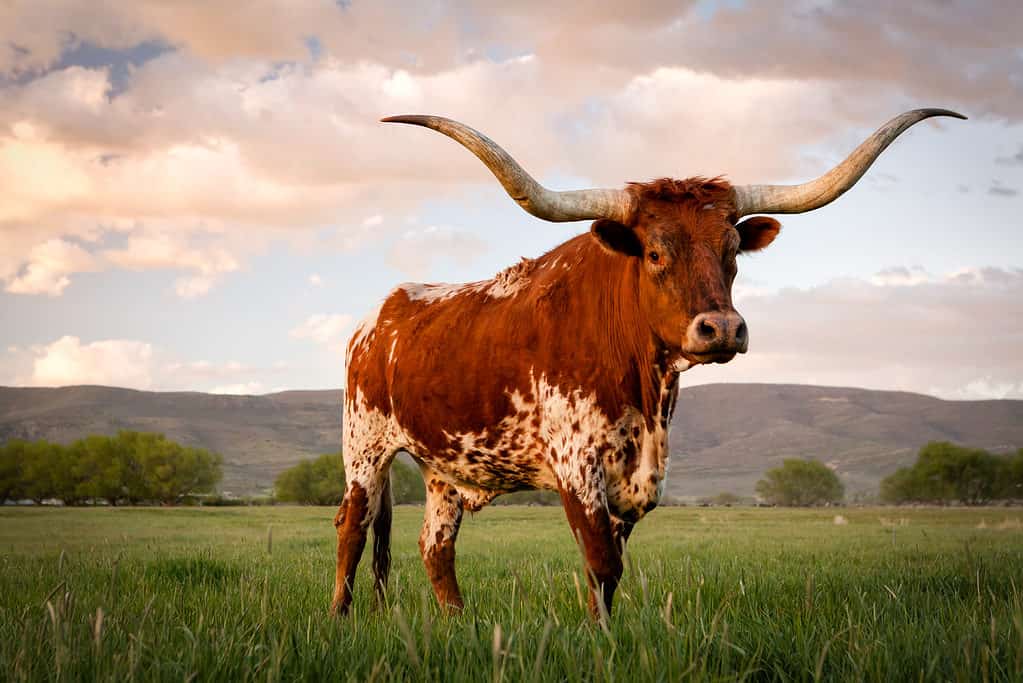
The Texas Longhorn is the official state large mammal of Texas, though the American bison is actually the largest mammal found in the state.
©Quinn Calder/Shutterstock.com
The Texas longhorn is the largest mammal in Texas. Longhorn bulls typically stand four to five feet tall at the shoulder, weigh between 1,400 and 2,500 pounds, and reach body lengths of 8–10 feet. Their signature horns often span six to eight feet from tip to tip.
Longhorn heifers are notably smaller than bulls, weighing between 600 and 1,400 pounds. Their horns are four to five feet from tip-to-tip, with a distinctive outward, twisted, or curled shape.
The rise of railroads, fenced-in ranches, and breeding with faster-maturing cattle, like Herefords, led to a massive decline in purebred, longhorn cattle in post-Civil War Texas.
By the 1920s, the Texas longhorn was on the verge of disappearing, when, in 1927, the U.S. Forest Service established herds to save the breed from extinction. Today, the longhorn population has rebounded to over 330,000 registered animals. This resurgence is driven by an appreciation for their resilience and a consumer-driven market for the longhorn’s leaner beef.
State Fish: Guadalupe Bass
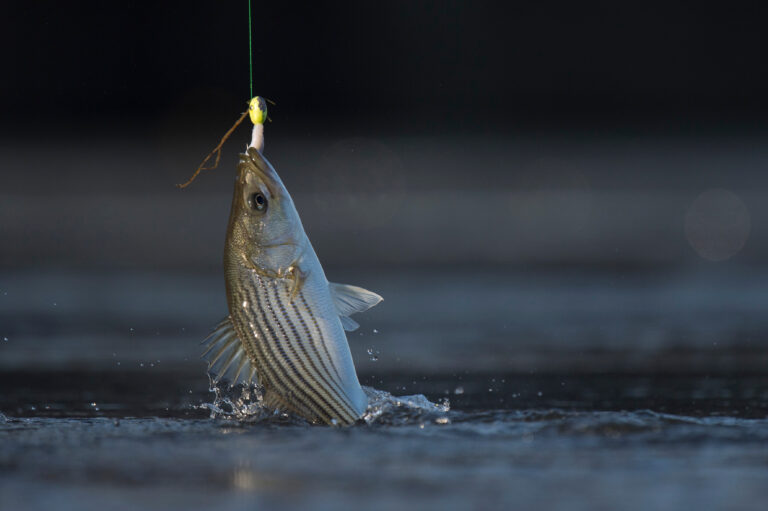
Dubbed the state fish in 1989, the Guadalupe bass (Micropterus treculii) is endemic to Texas. Guadalupe bass are found in the Northern and Eastern regions of the Edwards Plateau. The areas include parts of the Brazos River drainage, the Guadalupe River above Gonzales, the San Antonio River headwaters, and the Colorado River north of Austin.
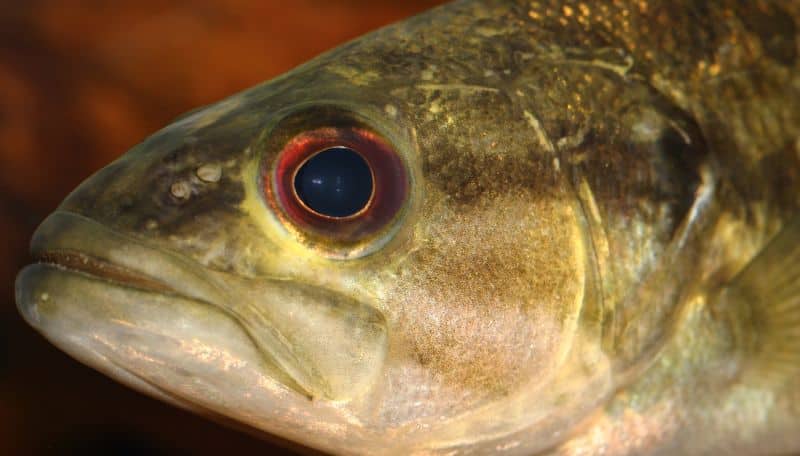
The Guadalupe bass gets its name from the Guadalupe River.
©Clinton & Charles Robertson from Del Rio, Texas & San Marcos, TX, USA / CC BY 2.0 – Original / License
Guadalupe bass belong to the collective group known as black bass. Like most other black bass species, Guadalupe bass are typically lime to olive green in color.
Considered a sport fish, the Guadalupe bass has a reputation for putting up a fierce fight. It is fond of strong currents and eats insects, primarily.
Texas Parks and Wildlife Department (TPWD) and its partners have recovered or preserved fishable populations of Guadalupe bass in 14 central Texas rivers since 1991, despite the significant difficulty in addressing threats to the species. In addition, they stocked over 2.4 million Guadalupe bass fingerlings for conservation, with populations of Guadalupe bass being introduced to the Nueces River and the lower Colorado River.
State Reptile: Texas Horned Lizard

Texas horned lizards can shoot a stream of blood from the corners of their eyes as a defense mechanism.
©Seth LaGrange/Shutterstock.com
The Texas horned lizard (Phrynosoma cornutum) was officially designated as the state reptile of Texas in 1993. The horned lizard is also popularly known as a horny toad, horned toad, or horned frog, despite not being a toad or frog.
The lizard’s round body and blunt snout, which give it an amphibian-like appearance, earned it its well-known nicknames. It can inflate its flat body to deter potential attackers.
A Texas horned lizard’s diet consists primarily of ants, specifically harvester ants (Pogonomyrmex), which make up roughly 70 to 90 percent of their diet. They are specialized predators that use sticky tongues to consume 70–100+ ants daily.
The range of Texas horned lizards spans much of Texas, Oklahoma, Kansas, and New Mexico, as well as the south-central U.S. and northern Mexico. They live in open, sparsely vegetated habitats in dry and semiarid climates. They also enjoy loamy or loose sandy soils because of their penchant for digging.
Although it was added to the state’s protected species list in 1967, the Texas horned lizard was officially designated as a threatened species in Texas in 1977 due to significant population declines caused by habitat loss.
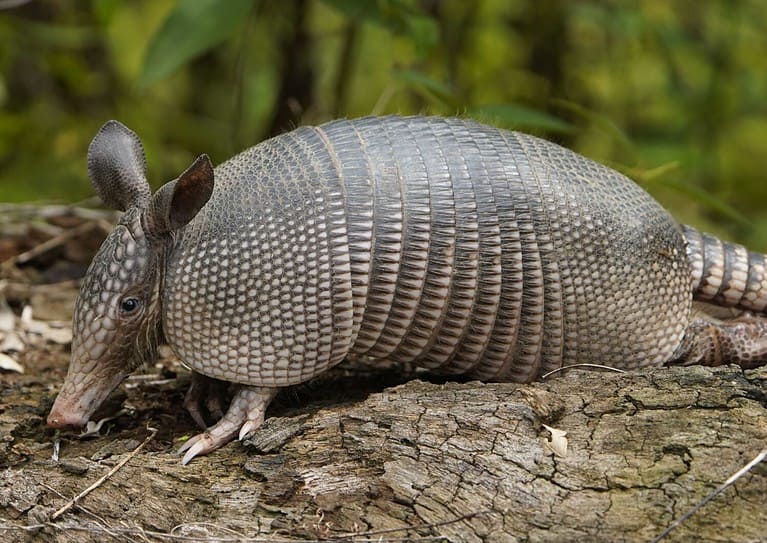
State Small Mammal: Nine-Banded Armadillo
The nine-banded armadillo (Dasypus novemcinctus) is Texas’s official state small mammal. Originating in South America, nine-banded armadillos are found across Texas except for the Trans-Pecos region.
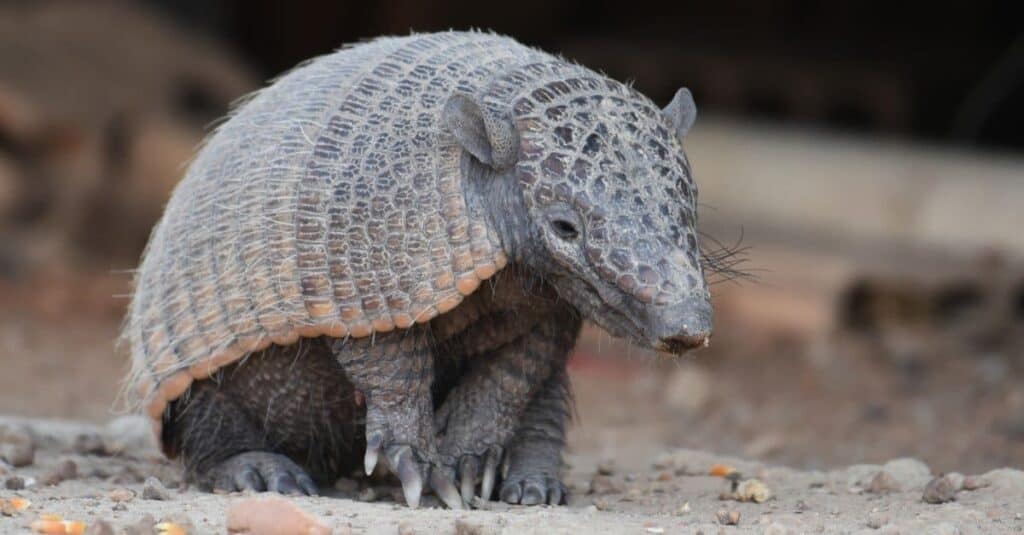
Officially recognized in 1995, the nine-banded armadillo is the only armadillo species with an established population in the U.S.
©iStock.com/Rini Kools
Nine-banded armadillos are 24 to 32 inches long, weigh between 8 and 17 pounds, and males are slightly larger than females. They are covered by a hard, leathery shell composed of bony plates, have a pig-like snout, and possess long claws for digging. Nine-banded armadillos prefer warm, forested, or shrubby areas with moist soil, in which they dig burrows for shelter.
Nine-banded armadillos are considered nuisance pests in Texas because their constant digging for insects destroys lawns, flowerbeds, and gardens. Despite this, they were designated the official small state mammal in 1995 because they are highly adaptable, unique, and symbolize the resilience of Texans. They are also valued for consuming agricultural pests, including beetles and termites.
State Flying Mammal: Mexican Free-Tailed Bat
In May 1995, the Mexican free-tailed bat (Tadarida brasiliensis) was recognized as the official flying mammal of Texas in appreciation of the important role bats play in a healthy ecosystem.
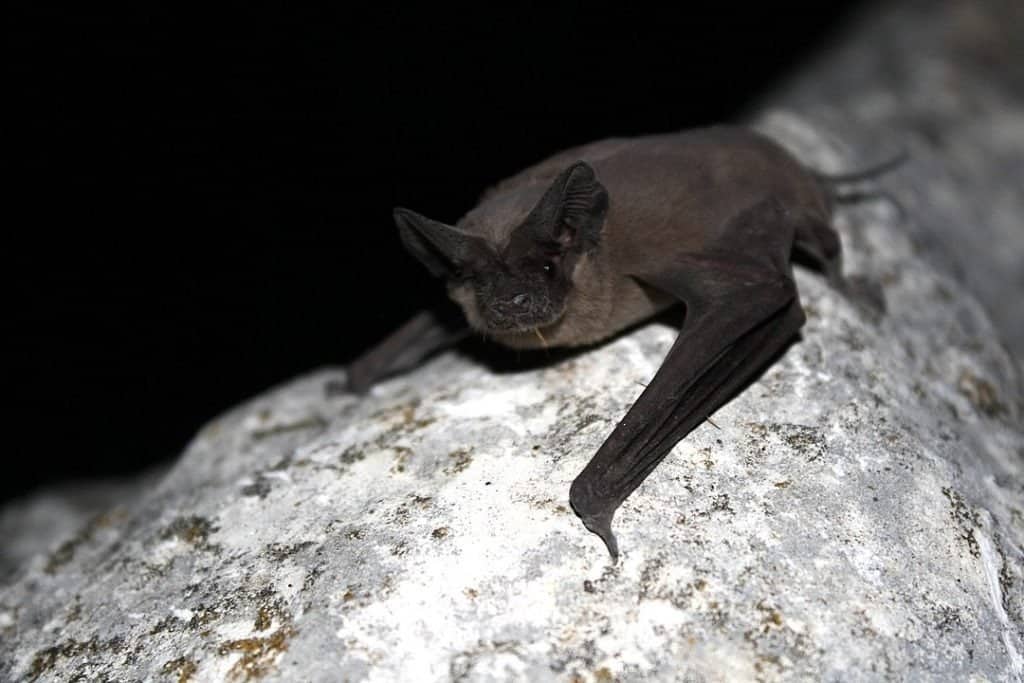
Texas is a popular tourist destination for bat-watching.
©U.S. Fish and Wildlife Service Headquarters / CC BY 2.0 – Original / License
Interestingly, Texas is the nation’s battiest state — 32 of the 47 existing bat species in the U.S. reside there. What’s more, Texas is home to the largest known bat concentration in the entire world in Bracken Cave Preserve. The cave is home to about 20 million Mexican free-tailed bats every summer.
The state also hosts the largest urban bat colony, estimated at 1.5 million bats, at Congress Avenue Bridge in Austin, TX.
In late October or early November, when the first cold fronts hit the Texas Hill Country, the bats migrate to Mexico, where they remain until the following spring.
Texas is a popular tourist destination for bat-watching. Some of the best bat-watching areas include Bracken Cave Preserve, Camden Street Bridge, Devil’s Sinkhole State Natural Area, Stuart Bat Cave, and Waugh Drive Bridge.
State Insect: Monarch Butterfly
Monarchs (Danaus plexippus) are large butterflies with wingspans approaching four inches. They have vibrant orange wings, distinct black veins, and wide black borders dotted with small white spots. Males are slightly smaller than females, with thinner veins and a black scent spot on each hindwing.
Texas acts as a funnel for the Eastern population of monarch butterflies, with nearly all migrating monarchs passing through the state twice annually. In fall, they traverse Texas to reach Mexican overwintering sites, while in spring, they arrive to breed and lay eggs on native milkweed, initiating the next generation’s journey north.
Generation after generation of butterflies has repeated this cycle. The milkweed plant they consume contains a type of toxin that renders the butterfly unpleasant to birds and other animals.
The monarch butterfly was designated as the Texas state insect in June 1995.
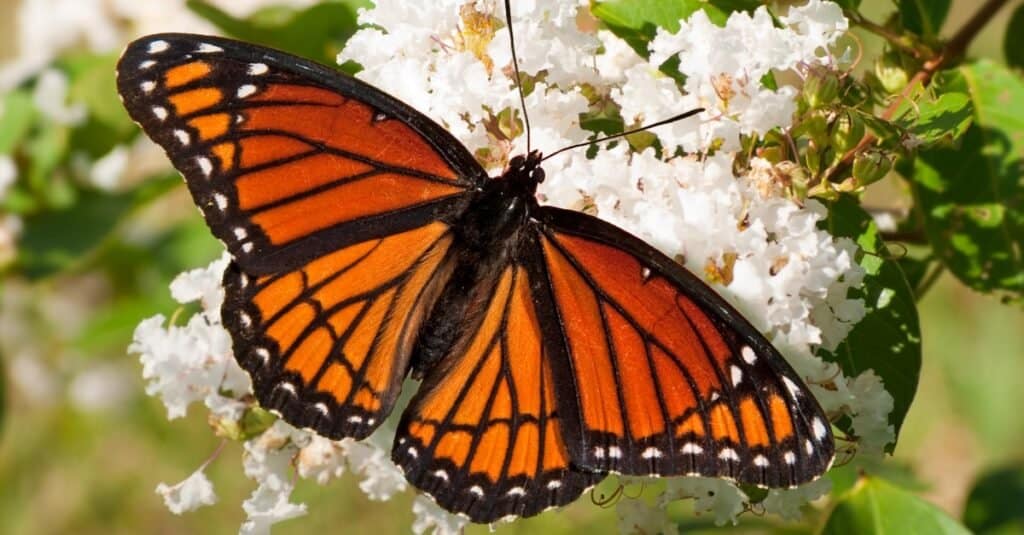
Monarch butterflies traverse the state of Texas twice annually.
©Sari ONeal/Shutterstock.com
State Dog: Blue Lacy
The Blue Lacy (Canis lupus familiaris) is the only dog breed to have originated in Texas. It was developed circa 1858 by brothers George, Ewin, Frank, and Harry Lacy. They created this versatile, high-energy working dog for herding livestock, tracking game, and protecting homesteads. The breed is believed to be a mix of greyhound, scent hound, and coyote.

The unique blue-color gene is present in all lacys, although not all are blue.
©Jessica Lobsinger/Shutterstock.com
The Blue Lacy was officially designated the state dog of Texas on June 18, 2005, by then-Governor Rick Perry. They are recognized for their vital role in ranching, herding, and hunting.
Search-and-rescue teams and government trappers use Blue Lacys, and they also have a reputation as good hunting companions.
The breed came dangerously close to extinction as the number of family-run ranches decreased and all-terrain vehicles were introduced. Preservation initiatives have aided increases in their population since the 1970s.
They are primarily found in Texas, but their rising popularity has led to breeding communities in other states, Canada, and Europe. In Texas, search-and-rescue teams and government trappers use Blue Lacys. They also have a reputation as good hunting companions.
The unique blue-color gene is present in all Lacys, although not all are blue. Blue Lacys come in shades of gray, ranging from light silver to dark charcoal. Red Lacys range from light cream to rust, while the tri-colored ones feature a mix of these colors with the base as blue. Their eyes range from bright orange to yellow.
State Amphibian: Texas Toad
The Texas toad (Anaxyrus speciosus) was officially recognized as the state amphibian of Texas on June 19, 2009. The designation was the result of a campaign led by fourth-grade students from Danbury Elementary School in Danbury, Texas, who worked with Texas Parks and Wildlife.
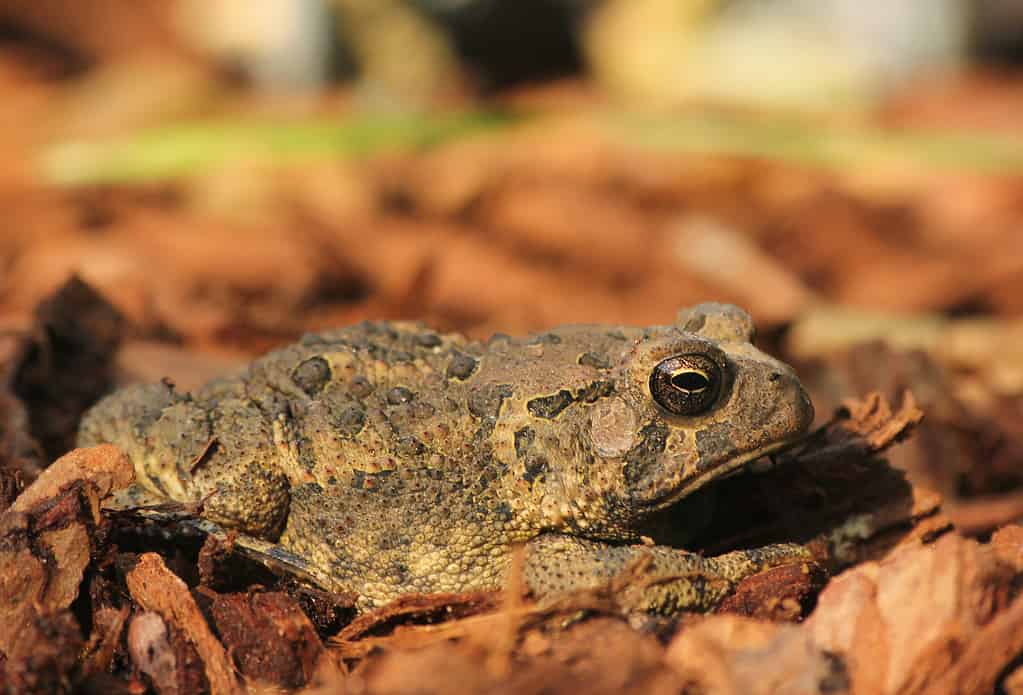
Texas Toads use a skin fold on their neck to remove ants from their face.
©Marti157900/iStock via Getty Images
The students selected the Texas toad for its adaptability and abundance across the state. The most abundant species of toad in the state, Texas toads are found in open woods and grasslands of West Texas, avoiding the piney woods of extreme East Texas, where other toad species are more common.