
Quick Take
- Meerkats are slender mongooses, about 14 inches long (tail adds up to 7 inches) and 1.3–2.1 pounds. They are generally lighter and taller than prairie dogs.
- Both meerkats and prairie dogs burrow to escape predators and regulate temperature, but meerkats form clans with sentinels, while prairie dogs organize towns with coteries.
- Meerkats inhabit Southern Africa across arid habitats; prairie dogs are found in Central North American grasslands west of the Mississippi River.
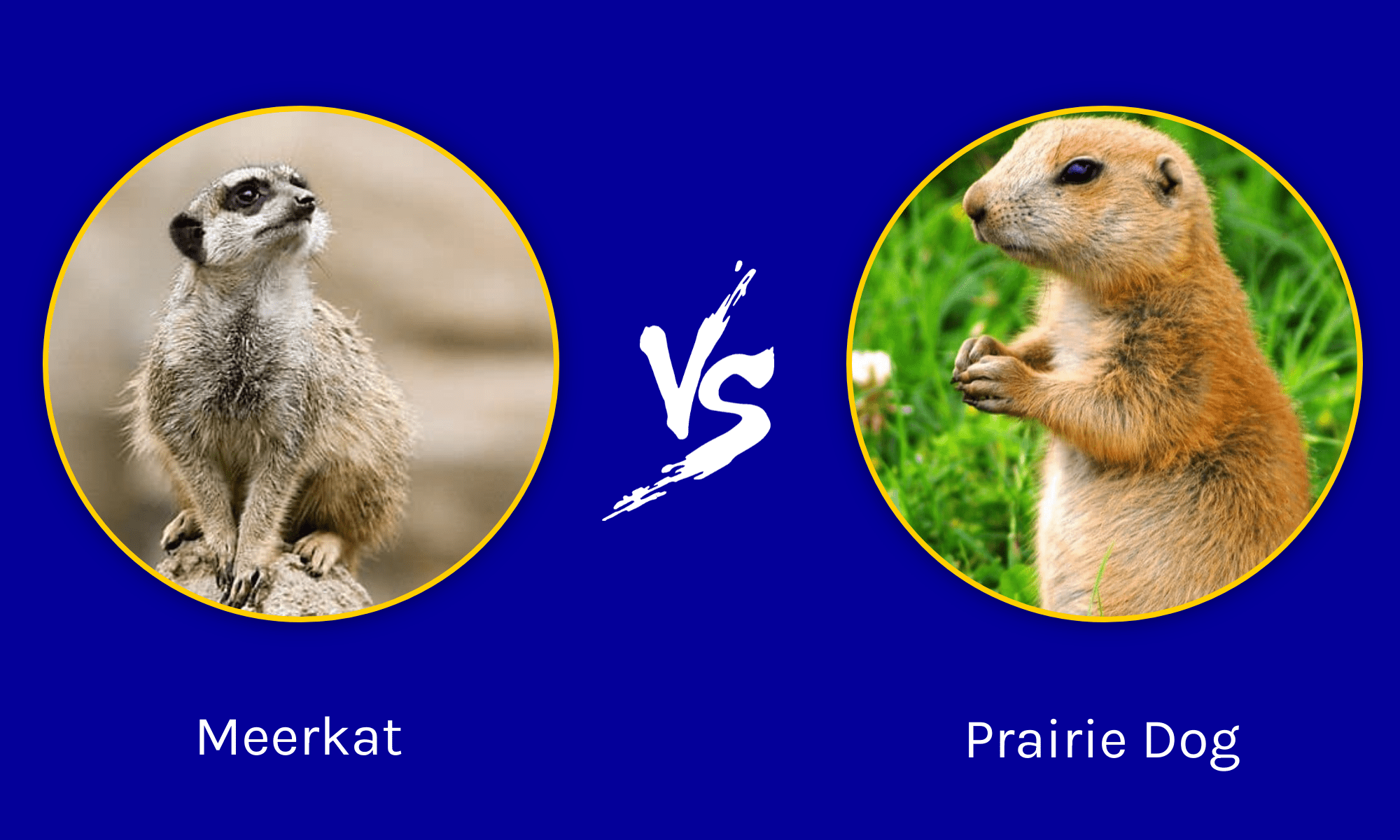
Meerkats (Suricata suricatta) and prairie dogs (Cynomys) are two mammals that are often mistaken for each other due to their similar habitats and behaviors. Meerkats are mongooses, while prairie dogs are rodents belonging to the squirrel family. Despite their different classifications, both are social, burrowing mammals that use sentinels to watch for predators. Although meerkats and prairie dogs share similarities, they differ in five key areas: size, appearance, behavior, lifespan, and distribution. Continue reading to learn more about what separates these two adorable animals.
Size

Meerkats weigh less but stand taller than the average prairie dog.
Prairie dogs are slightly heavier and shorter than meerkats. Adult prairie dogs weigh between one and four pounds and are between 12 and 16 inches long. Adult meerkats weigh between 1.3 pounds and 2.1 pounds. They are 14 inches long, not counting their tail, which can add 7 inches to their length.
Appearance
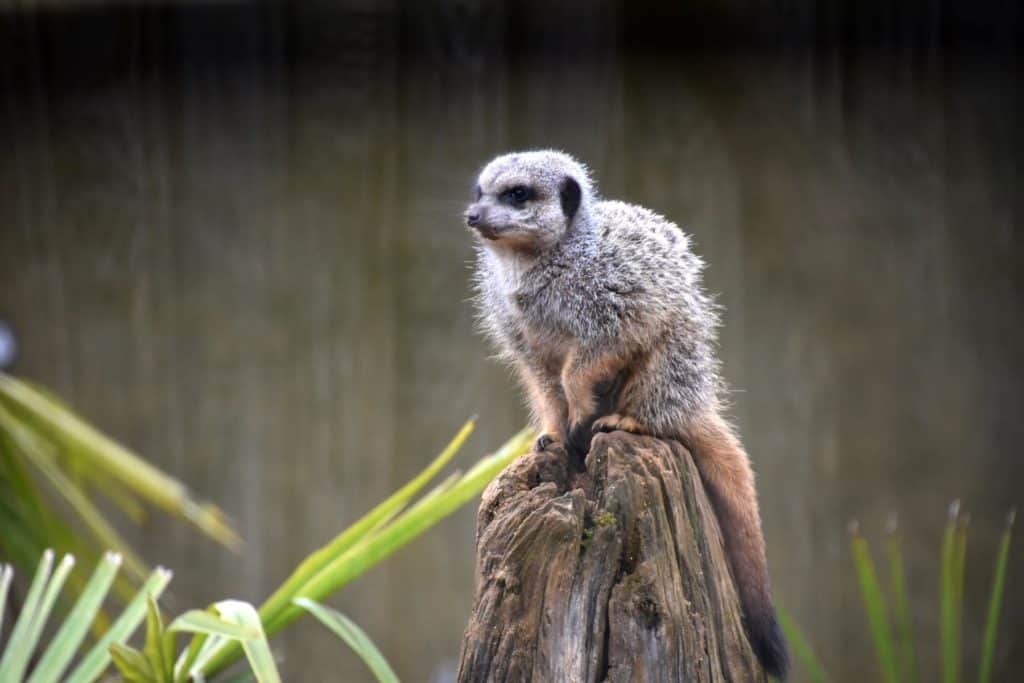
Meerkats are scrawny creatures with long tails.
©Millie Bond – Copyright A-Z Animals
Meerkats are slender, long-limbed mammals with a broad head, pointed snout, and large eyes that have dark patches around them to reduce sun glare. Their fur ranges from light gray to yellowish-brown, with darker brindled bands across their back. A thin layer of fur on their underside helps absorb sunlight for warmth. They have long, non-retractable, curved claws on their forepaws for digging and a long, thin, tapering tail with a dark tip.
Prairie dogs are brownish rodents with small ears set back on their heads, short tails, and short legs with long claws. Their fur is coarse, sandy brown to cinnamon, and they have lighter-colored fur on their bellies and black tips on their tails, depending on the species.
Burrowing Behavior
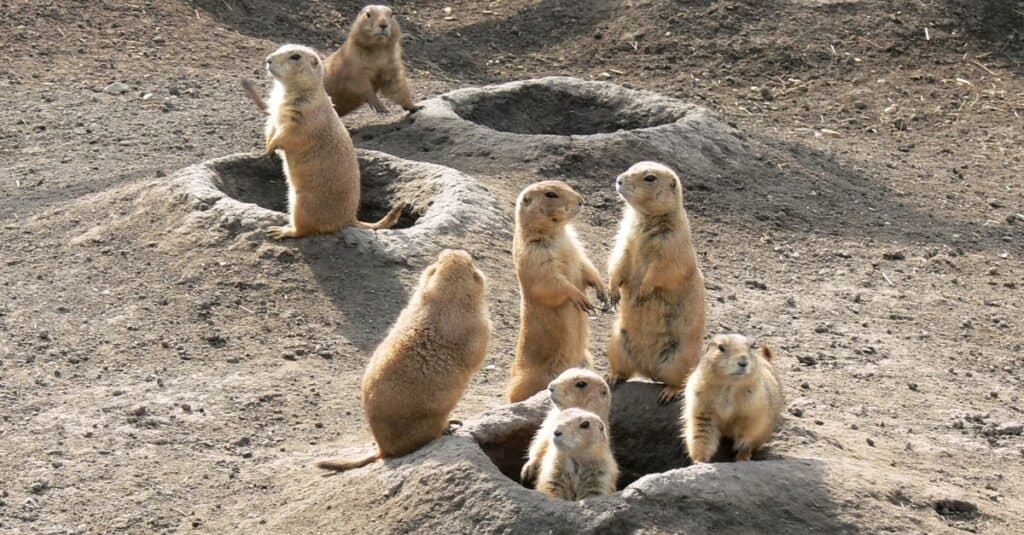
Prairie dogs have large burrow systems.
©Zoltan Tarlacz/Shutterstock.com
Meerkats and prairie dogs both burrow to escape danger and regulate their body temperature in extreme weather. Burrowing is a survival strategy that protects them from predators and harsh weather conditions.
Meerkats create burrow systems in plains areas or inhabit existing rocky crevices. Their burrows can measure 16 feet in diameter and have many openings through which they can escape. Their burrows have several layers, giving them a better chance of escaping encroaching predators.
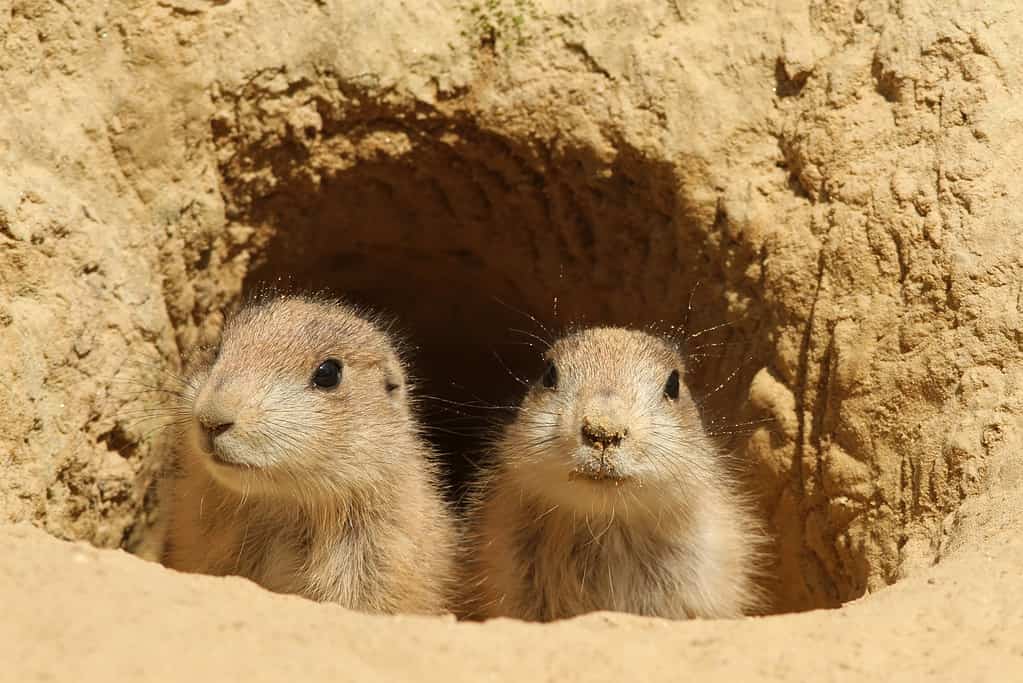
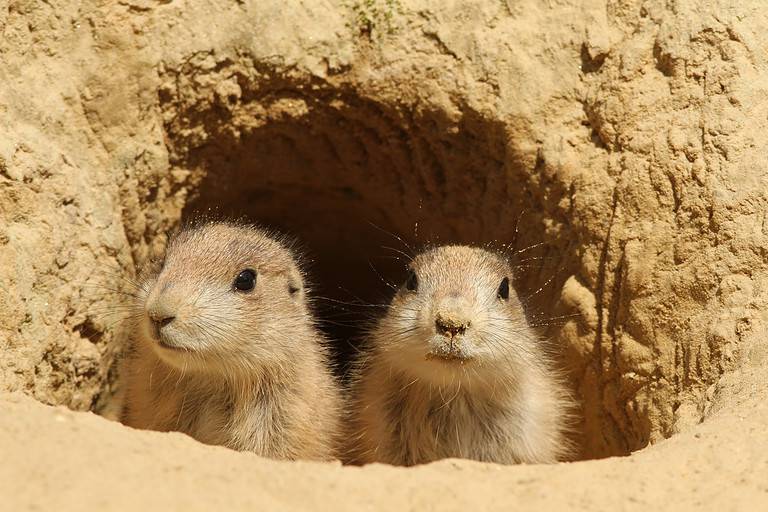
Two young prairie dogs peek out from their protected burrow.
©Henk Bentlage/iStock via Getty Images
Prairie dogs have extensive burrow systems, often called towns, which can cover more than 100 acres. The entire system may extend over 100 feet in length and reach depths of 14 feet, depending on the number of animals present. However, individual burrows are typically about 15 feet long. These systems feature dozens of openings per acre, providing multiple escape routes.
Social Behavior
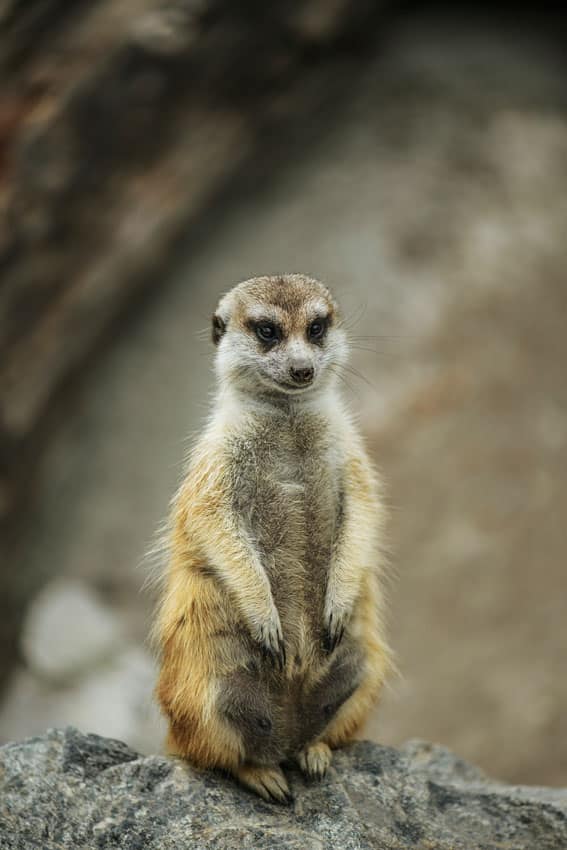
The role of the sentinel rotates through individual adult members of a meerkat clan.
©iStock.com/-101PHOTO- – Original
Meerkats are highly social, cooperative animals that live in groups called clans, gangs, or mobs. They display complex social behaviors, including a matriarchal society led by a dominant female. Subordinate members help raise pups, serve as sentinels to guard against predators, dig burrows, or act as groomers. Within their groups, they are cooperative, but they are also territorial and can be aggressive toward other mobs.
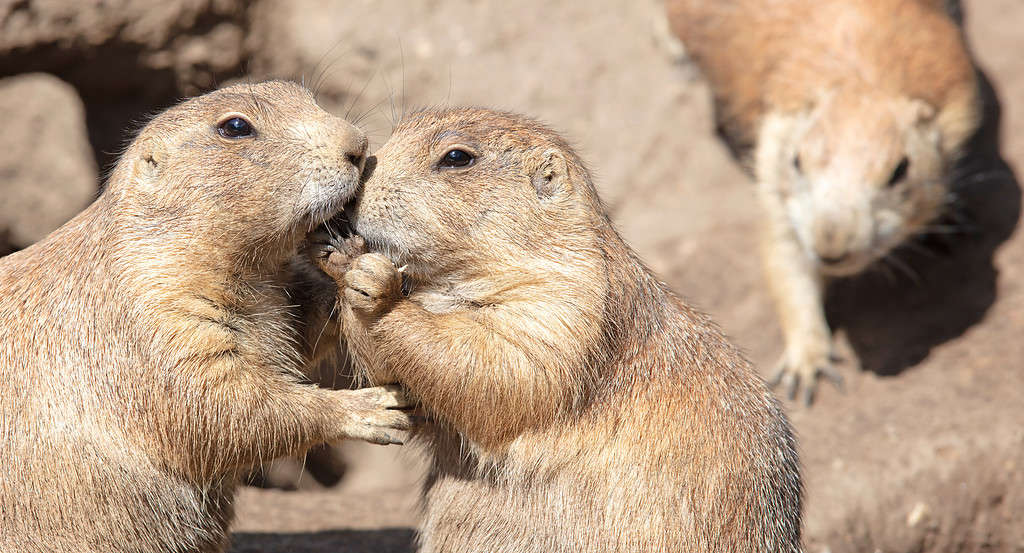
Prairie dogs are highly social creatures that form strong bonds through behaviors like mutual grooming and greeting kisses.
©MyImages_Micha/iStock via Getty Images
Prairie dogs are highly social animals that live in large colonies called towns. Towns are divided into smaller family groups or coteries. Prairie dogs use a complex system of communication, including vocalizations and physical contact like kissing and grooming, to identify members and maintain social bonds. Their social behaviors also include vigilant predator watching and territorial defense.
Lifespan
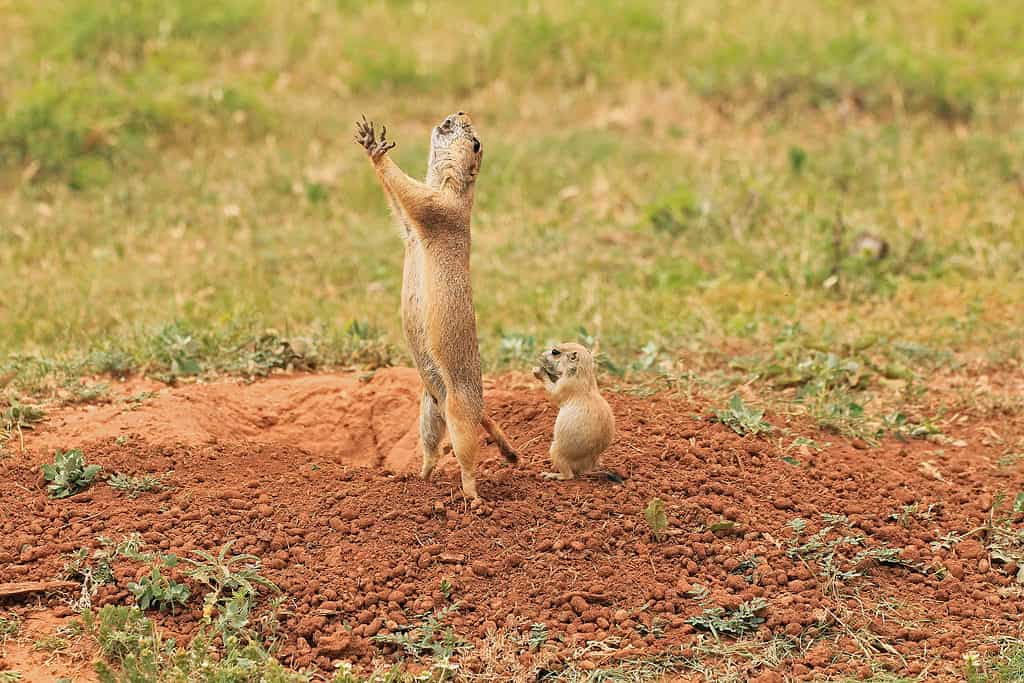
Mother black tailed prairie dog sounding alarm as baby watches and learns.
©Warren Price Photography/Shutterstock.com
Meerkats typically live up to 8 years in the wild and 10 to 13 years in captivity. Prairie dogs generally live 3 to 8 years in the wild, with some individuals reaching up to 8 to 10 years in captivity.
Meerkats have longer lifespans than prairie dogs due to a combination of social cooperation and dominant social status, which protects them from predators, provides access to food, and care for their young. While subordinate meerkats have a much higher mortality rate due to predation, dominant meerkats live longer by benefiting from the group’s vigilance and cooperation.
Prairie dogs have short lifespans primarily due to a high rate of predation. Prairie dogs are preyed upon by many animals, including coyotes, badgers, eagles, and snakes. While their large colony sizes offer some protection through collective vigilance, they also attract predators.
Distribution
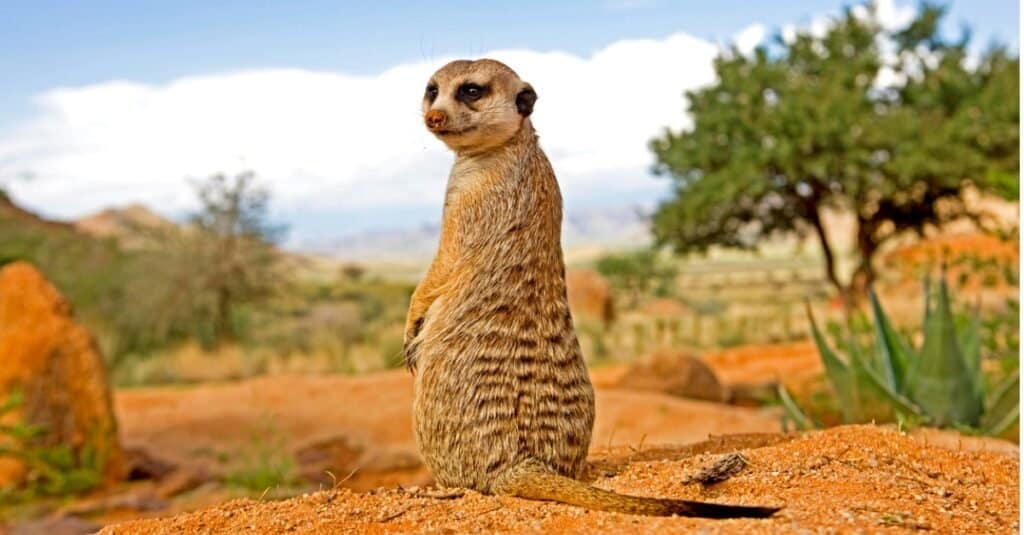
The meerkat’s natural range includes South Africa, Namibia, and Botswana.
©iStock.com/slowmotiongli
Meerkats are distributed across Southern Africa, primarily in arid, open habitats like the Kalahari Desert, with populations found in Botswana, Namibia, South Africa, Zimbabwe, and Mozambique. They inhabit savannas, open plains, and rocky areas with hard, stony ground and are considered common throughout their range.
Prairie dogs are found in the grasslands of Central North America, primarily west of the Mississippi River. The black-tailed prairie dog has the most widespread range, from Southern Canada through the Western United States into Northern Mexico, while other species like the Gunnison’s prairie dog (Cynomys gunnisoni) and the Utah prairie dog (Cynomys parvidens) have more restricted, localized distributions in the Southwestern United States