
Quick Take
- Researchers discovered that Northern resident killer whales hunt by going silent and eavesdropping on dolphin echolocation to locate prey.
- Dolphins act as long-range scouts while orcas deliver the killing blow.
- The partnership benefits both species by conserving energy, increasing access to food, and helping dolphins avoid predation by mammal-eating orcas.
- This rare interspecies alliance highlights advanced intelligence, coordination, and behavioral adaptation in response to environmental pressures.
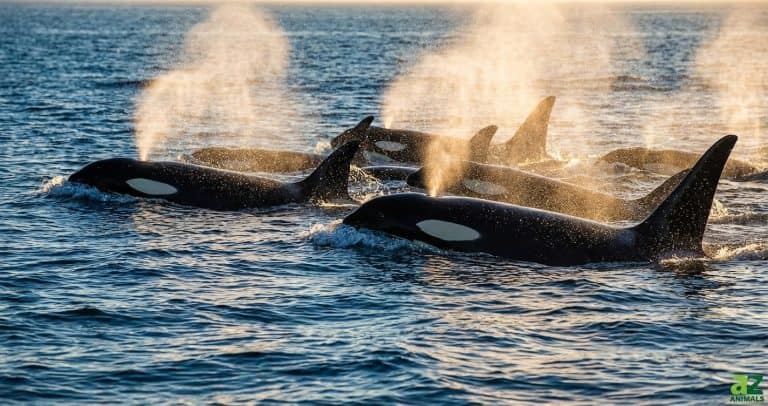
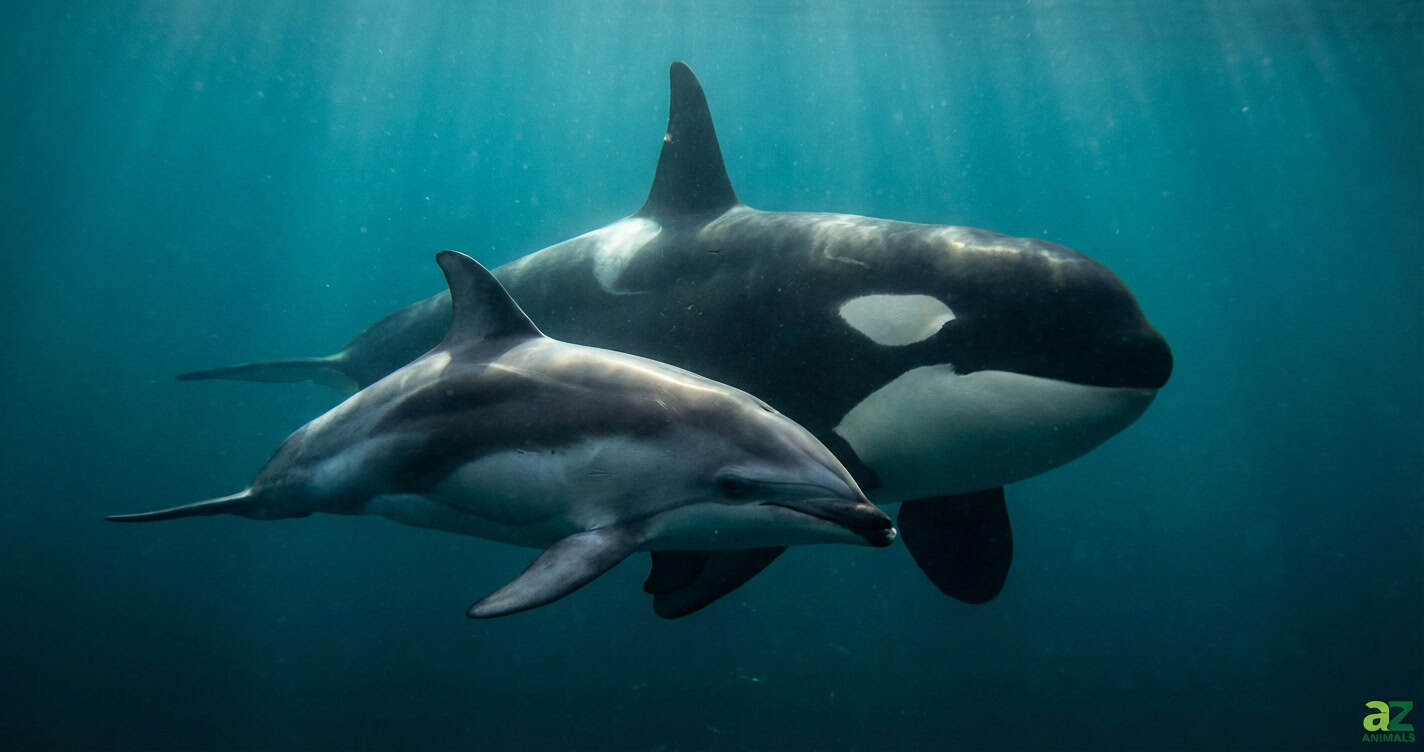
When researchers from the University of British Columbia set out to film the solitary hunting habits of Northern resident killer whales, they expected to see quiet and solitary predators at work. Instead, they encountered hundreds of white-sided dolphins moving alongside the orcas. What initially appeared to be a chaotic encounter was actually a groundbreaking discovery: a deliberately coordinated, interspecies hunting alliance.
For the first time, scientists documented killer whales using a sophisticated “eavesdropping” strategy. Instead of using their own sonar, the orcas fall silent and track prey by listening to the dolphins’ echolocation. This rare partnership offers new insights into animal cooperation, predator strategies, and how marine species are adapting to the rapidly changing soundscape of the Pacific Northwest.
A Tactical Leader-Follower Partnership
In this unlikely alliance, both species cooperate as a coordinated unit. Instead of competing for food, dolphins and orcas divide roles based on their biological strengths, forming a structured leader-follower dynamic.
The dolphins act as scouts. Their large, agile groups can cover much more territory than a pod of orcas, efficiently sweeping coastlines and deep-water zones. Using high-frequency echolocation, they locate Chinook salmon hidden in crevices and deep channels. Surprisingly, the orcas—the ocean’s apex predators—defer to the dolphins’ superior tracking abilities, following their movements rather than leading the hunt.
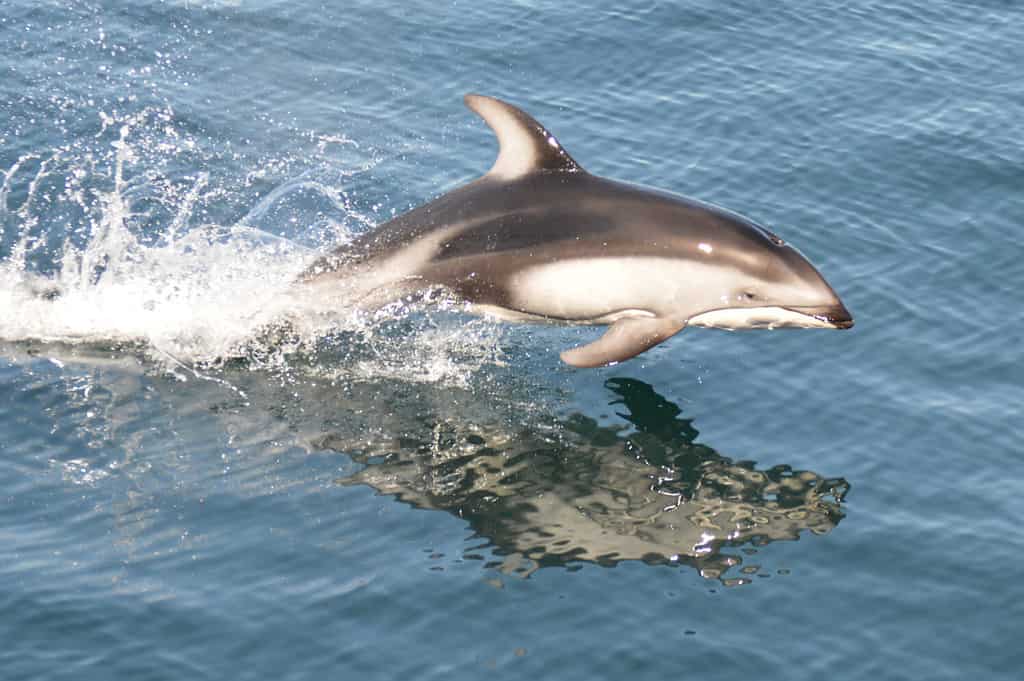
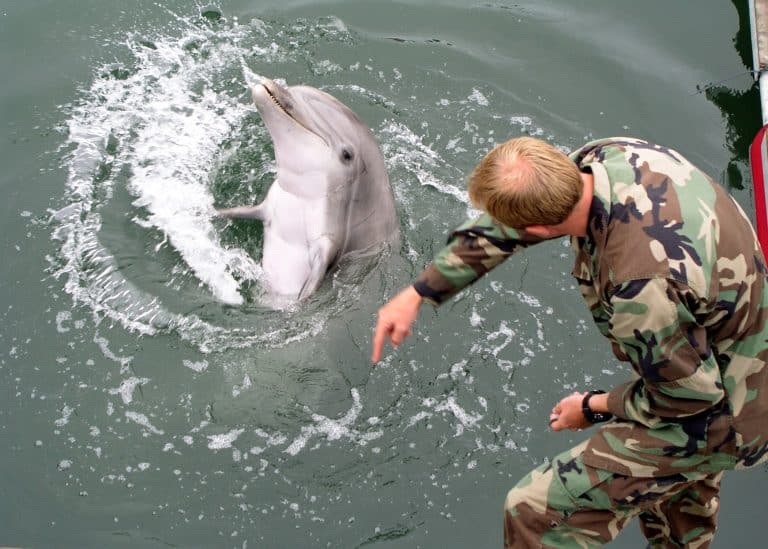
Pacific white-sided dolphins have unique black, gray, and white patterns.
©Maria Harvey/Shutterstock.com
Once the prey is located, the roles reverse. While dolphins are exceptional trackers, they lack the physical power to subdue large salmon. The orcas take over during the final stage of the hunt, driving the fish to the surface and delivering the killing bite. The orcas’ powerful jaws break the massive salmon into manageable pieces, providing food for both species.
This collaboration creates significant advantages for both species. Orcas conserve energy by skipping the exhausting search phase, while dolphins gain access to calorie-rich food and an added layer of protection.
Acoustic Camouflage
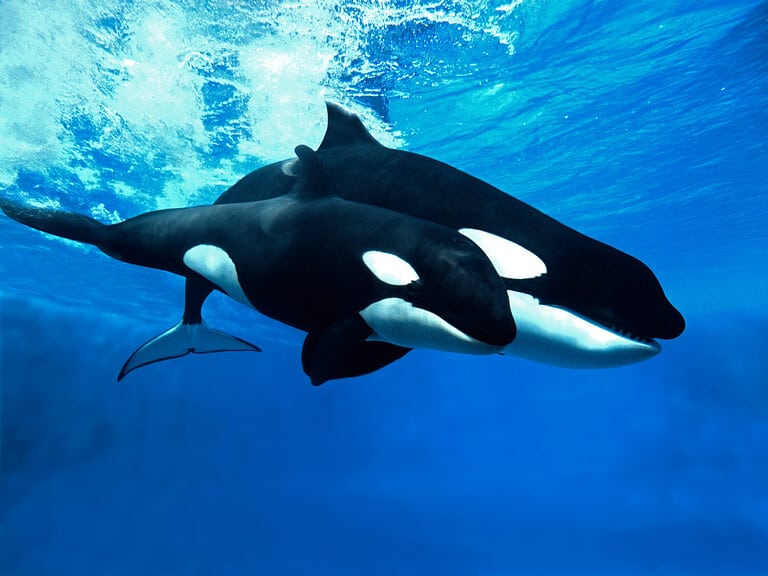
Orcas are typically very vocal animals, navigating their environment through constant sonar clicks. Yet when hunting alongside dolphins, they go completely silent. By muting their own signals, the orcas avoid interfering with dolphin echolocation and prevent alerting sound-sensitive salmon.
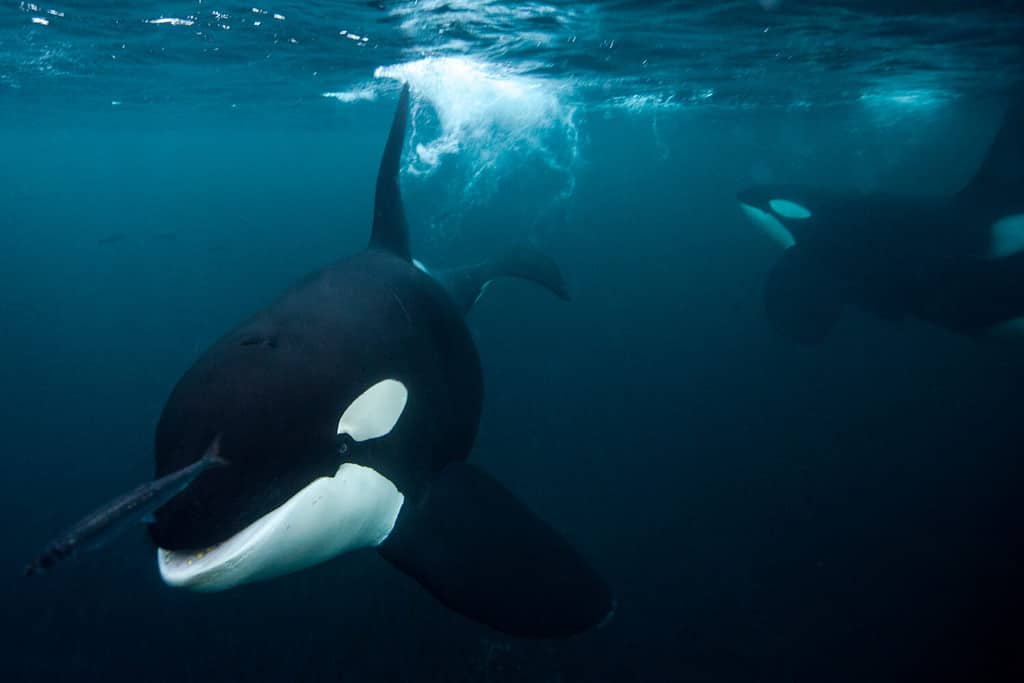
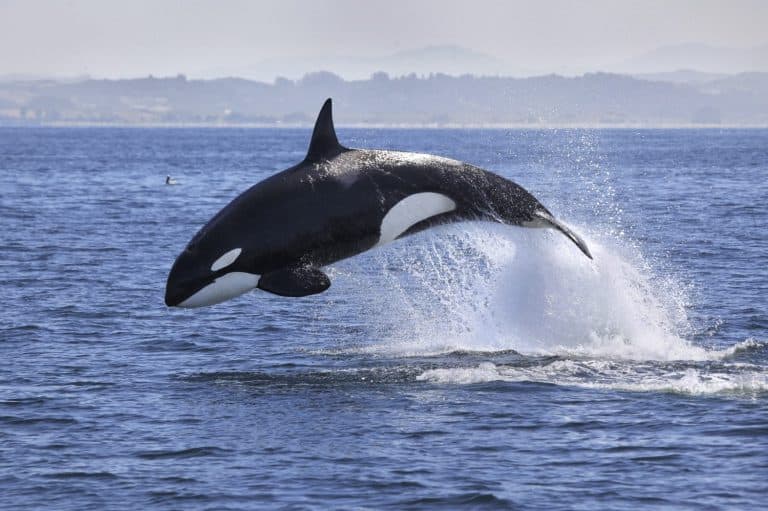
Orcas use a variety of chirps, whistles, squeaks, and other forms of high-frequency bio-sonar to communicate and navigate.
©Petr Slezak/Shutterstock.com
In this state of “acoustic camouflage,” the whales listen in on dolphin sonar — effectively outsourcing the cognitive and energetic cost of tracking prey. Researchers documented at least 25 cases in which orcas deliberately changed their course to follow dolphin movements, sometimes swimming just yards away for hours. They even performed rolling maneuvers, which are believed to help orient their hearing toward dolphin clicks.
Some researchers speculate that such strategies could help marine mammals cope with increasing human-generated noise. By letting dolphins handle the energetically demanding task of environmental scanning, orcas conserve energy while navigating increasingly noisy acoustic environments.
Inside the Hunt with Biologging and Drone Footage
To study this behavior, scientists from the University of British Columbia and Dalhousie University used non-invasive biologging tags — described as “Orca TV” — to capture video, audio, and 3D movement data from the whales’ perspective. The footage revealed dolphins swimming inches from the orcas’ snouts, with audio confirming the precise moments when orcas fell silent.
The 2025 study confirmed that these encounters were not random. Orcas repeatedly altered their course to follow the dolphins, sometimes abandoning their original paths entirely. In multiple deep-sea dives, the whales deliberately mirrored the dolphins’ movements, demonstrating a consistent, intentional hunting strategy rather than merely opportunistic behavior.
Aerial drones also revealed the structure of the hunt: dolphins spread out in a scouting line, driving fish toward the trailing orcas. In every documented kill, the orcas surfaced with the salmon, while the dolphins waited nearby to feed on the leftovers.
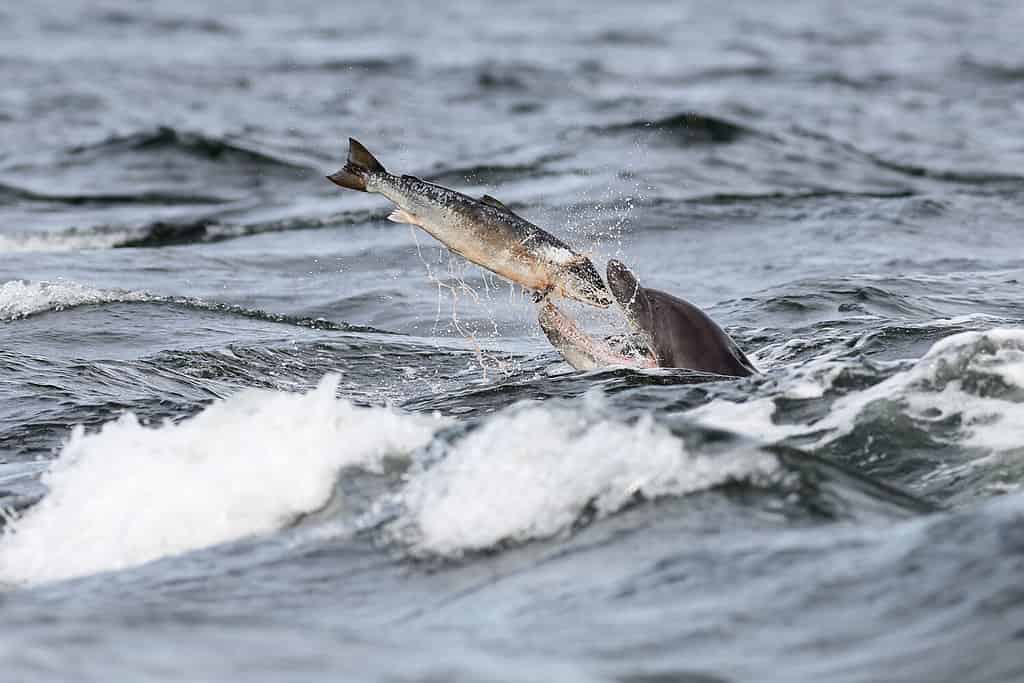
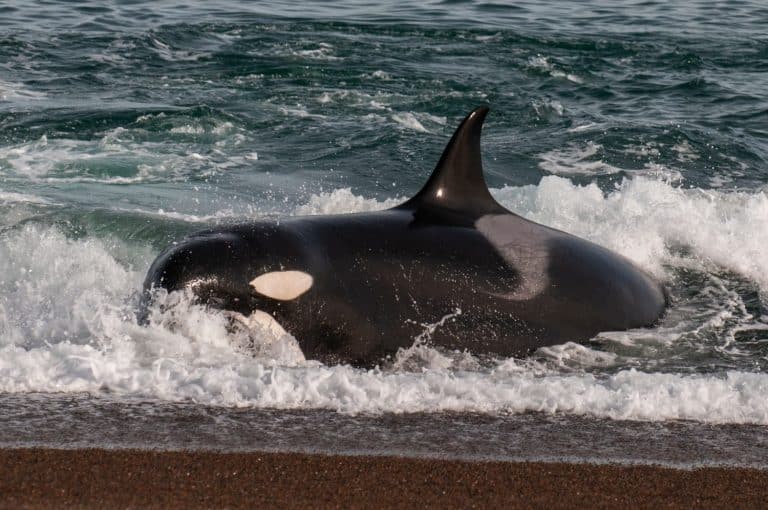
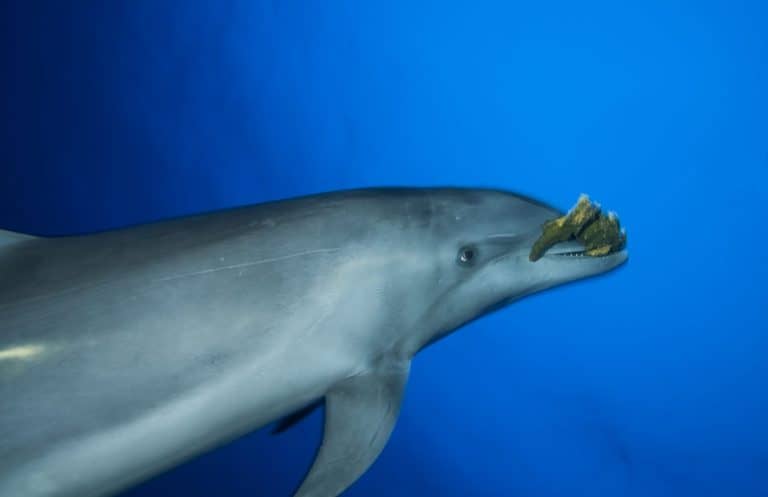
Dolphins use high-frequency echolocation and can cover enormous stretches of ocean.
©Binson Calfort/Shutterstock.com
The Absence of Conflict
Perhaps the most striking discovery was the absence of aggression. Despite being physically capable of killing dolphins, the orcas showed no hostility. This tolerance reflects the strategic value of the partnership: the dolphins’ scouting services outweigh the cost of sharing food.
For dolphins, the benefits go beyond nutrition. By aligning with fish-eating Northern resident orcas, dolphins gain a powerful form of protection. Mammal-eating transient orcas, which actively hunt dolphins, avoid Northern resident orca territories. By traveling with the “wrong” type of killer whale, dolphins effectively disappear from their predator’s radar. This creates a rare ecological loophole: dolphins avoid one group of killer whales by closely following another.
Intelligence, Adaptation, and Interspecies Cooperation
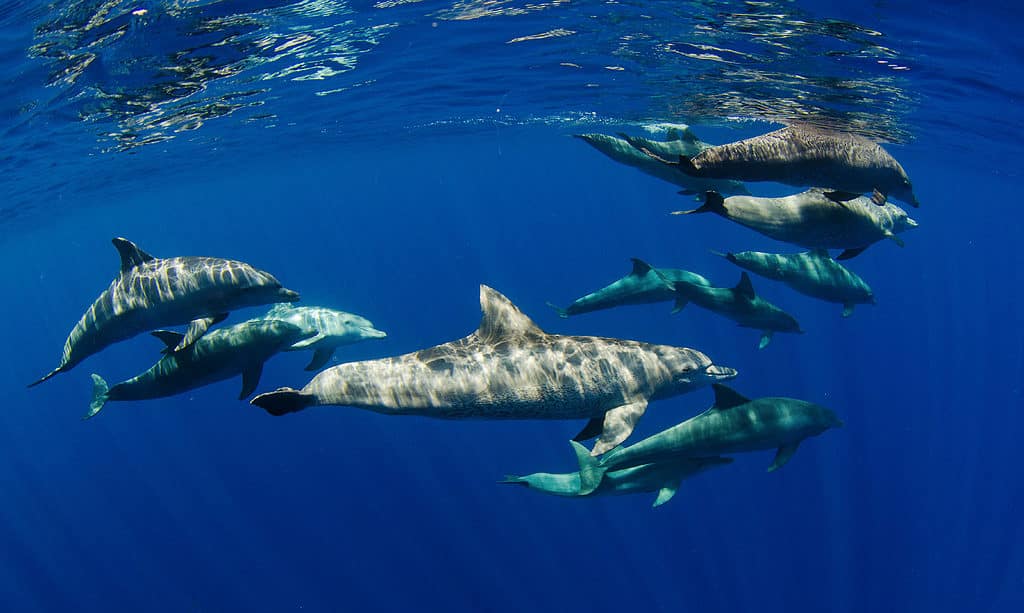
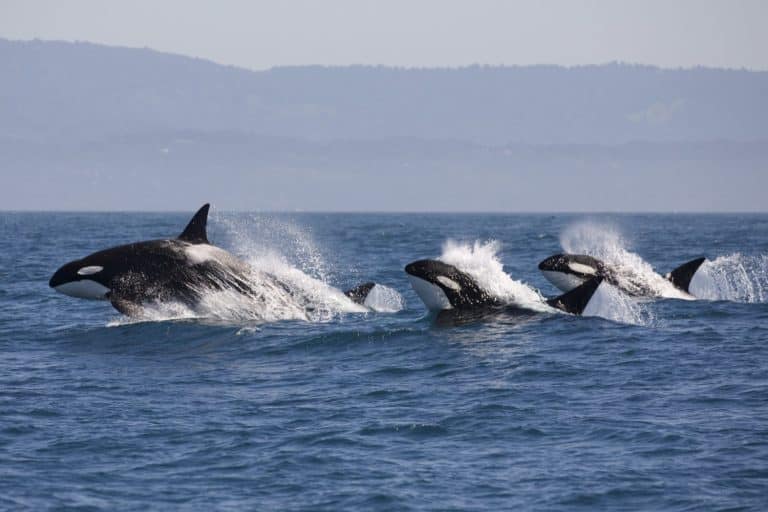
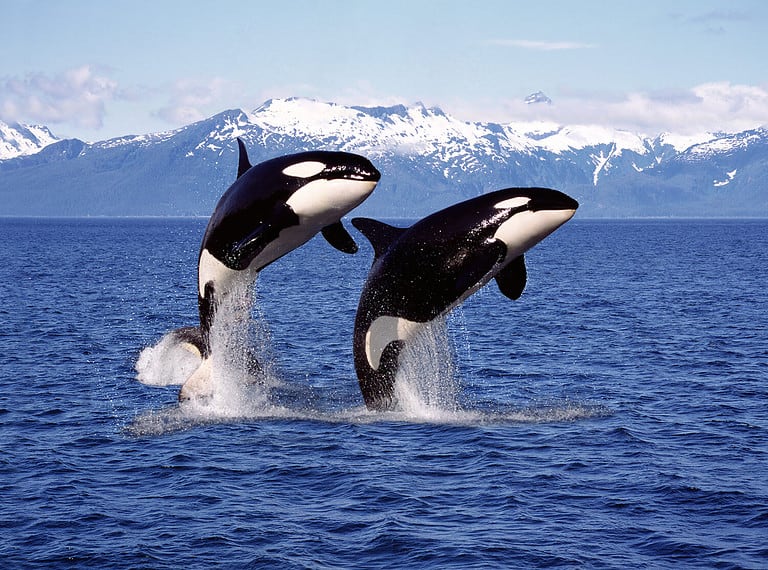
By working together, orcas and dolphins may be better at finding salmon amid the rising noise of ship engines in the ocean.
©Joost van Uffelen/Shutterstock.com
While cooperation within a single species is common, partnerships between different types of whales or dolphins are exceptionally rare. This study suggests that both orcas and dolphins can recognize the value of another species’ kills and adapt their behavior accordingly.
Such coordination suggests a “theory of mind”—the ability to understand another animal’s intentions and capabilities. Orcas must recognize that dolphin sonar leads to food; dolphins must trust that these orcas represent opportunity rather than danger. Together, they transcend species boundaries, forming a biological alliance shaped by intelligence, flexibility, and the need to survive in a rapidly changing environment.
CORRECTION: This article was updated on February 11, 2026, to correct a photograph that misidentified the common dolphin with the Pacific white-sided dolphin.