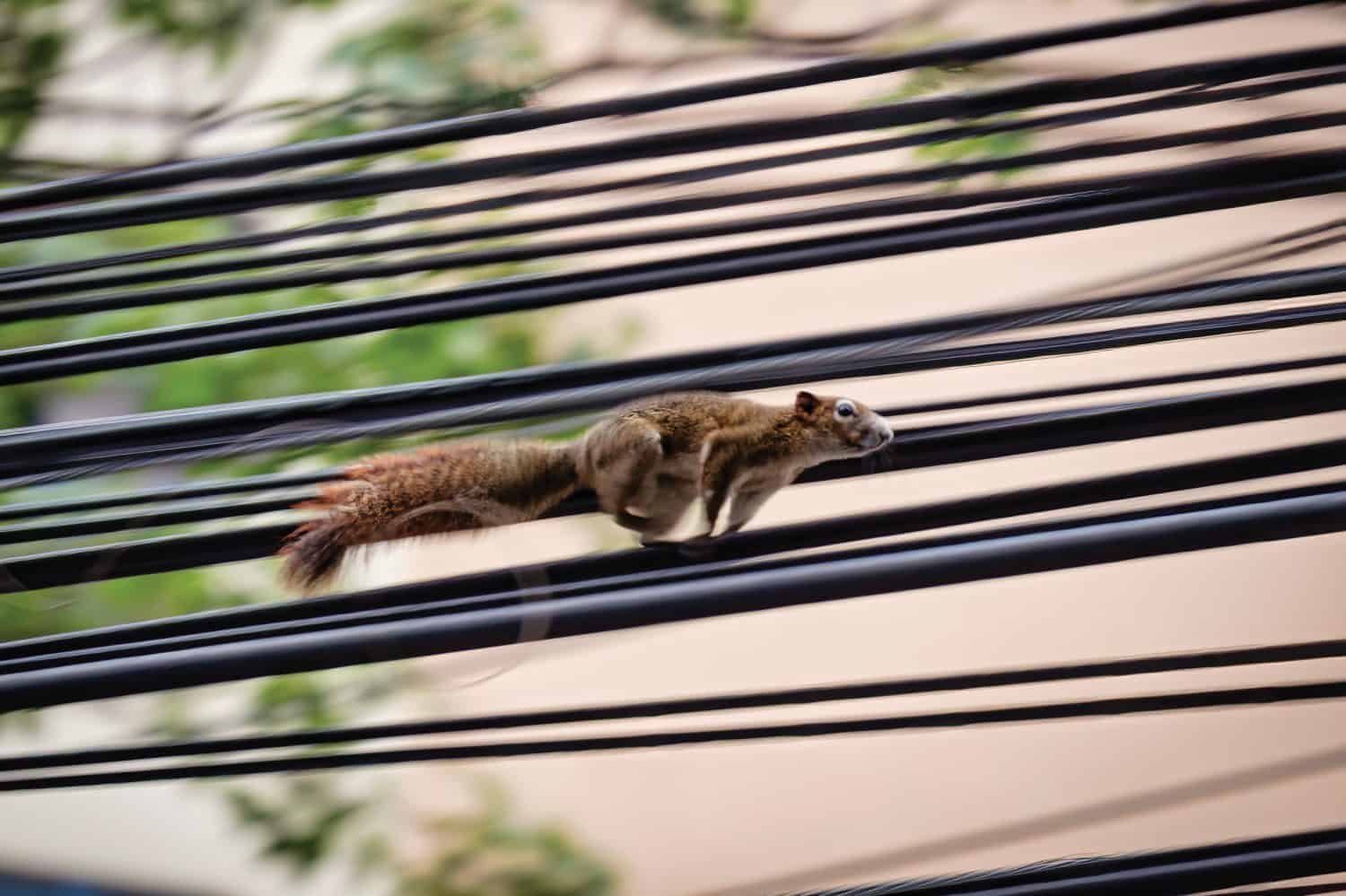

Odds are high you’ve seen a squirrel scampering along a power line like a tiny acrobat; its tail waving, little feet gripping, body bobbing.. This sight is so ubiquitous you likely don’t even stop to question or wonder about it. The squirrel makes it look effortless, but there’s a lot of brains, biology, and a little electricity physics behind this circus act.
The Tail, the Foot, and the Brain
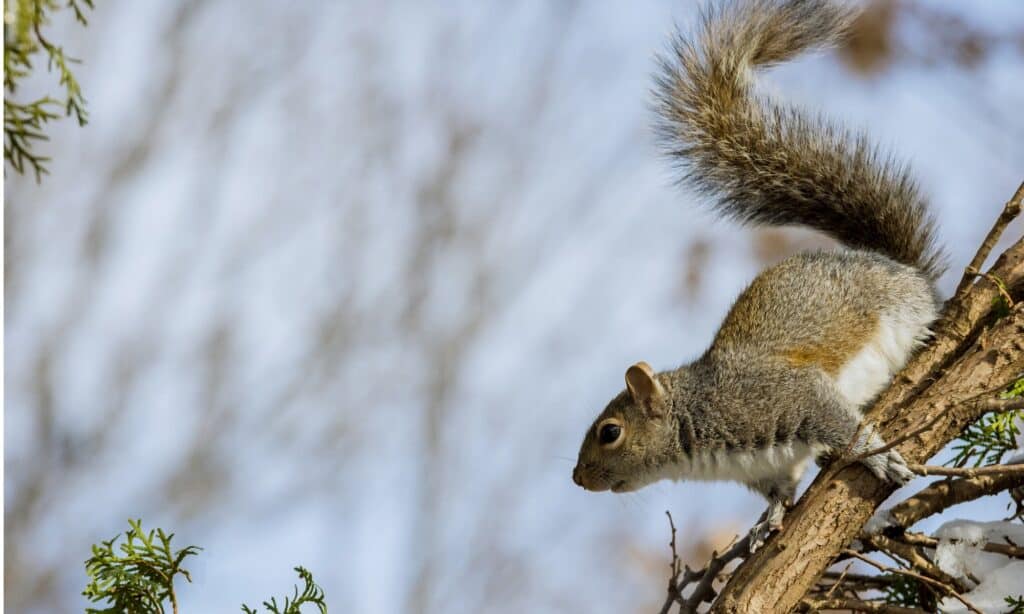
The squirrel’s rotating feet allow it to climb down as easily as it climbs up.
©iStock.com/photovs
A squirrel’s tail is more than just a bushy adornment. When a squirrel moves along a narrow or unstable surface it uses its tail as a dynamic counterweight to keep balance, shifting it to offset body movements, very similar to the way a tightrope walker uses a pole. The tail also helps steer during mid-air jumps and increases air resistance during falls, reducing impact if the flailing squirrel is unable to stick the landing.
Squirrels have highly dexterous front paws with sharp claws that let them grasp bark, cables, and other narrow surfaces. Their hind feet can rotate upward of 180 degrees, which is an incredibly useful adaptation. Most mammals climb up trees far more easily than they climb down. This is because when climbing down, claws point backward relative to the direction of gravity, so when going head-first, they can’t get any traction and slip. Squirrels solve this by rotating their hind feet so the claws hook forward, into the bark. This not only allows for full traction facing downward on vertical surfaces, but controlled steering and braking as they descend. This is why squirrels don’t have to back down a tree like a cat; they can simply zip down head-first, as easily as most animals move across flat ground.
This rotation is also key to their ability to jump onto and balance on power lines. It allows them to plant their feet at unusual angles, spread their weight more safely, and maintain balance even when the surface is too narrow for a typical four-point stance. On a power line, this really matters because their hind feet can rotate to grip from the sides, rather than only from above, allowing them to “hug” the line more securely. This is how they’re able to leap from distances of 8 to 10 feet and latch onto the narrow wire without their momentum sending them plummeting to the ground.
In addition to possessing these helpful physical attributes, squirrels are also clever and good problem solvers. They assess jump distances, choose launch angles, and adjust posture mid-flight. They also modulate limb forces and landing technique based on conditions, which suggests they’re actively thinking and analyzing their movements, not just relying on instinctive reflexes.
Why Don’t They Get Electrocuted?

As long as the squirrel touches the power line and nothing else, it’s in no danger of electrocution.
©Mumemories/Shutterstock.com
Electricity doesn’t automatically zap anything that touches a power line. For a shock to happen, electricity needs a path to flow through, from one point of high voltage to another point of lower voltage, which in a lot of cases is the ground. A squirrel running along a single power line does not create that path, since all parts of its body are at the same electrical ‘level’—in other words, the same voltage. Because there’s no difference in voltage between its paws, electricity has no reason to flow through it.
However, squirrels can get electrocuted if they accidentally become a ‘bridge.’ This can happen if they touching a live wire and a grounded pole at the same time, touching two wires that are carrying different voltages, or touching part of a transformer while still standing on an energized line. When that happens, electricity suddenly has a path, causing both the electrocution and a power outage.
How Common Are Squirrel-Caused Outages?
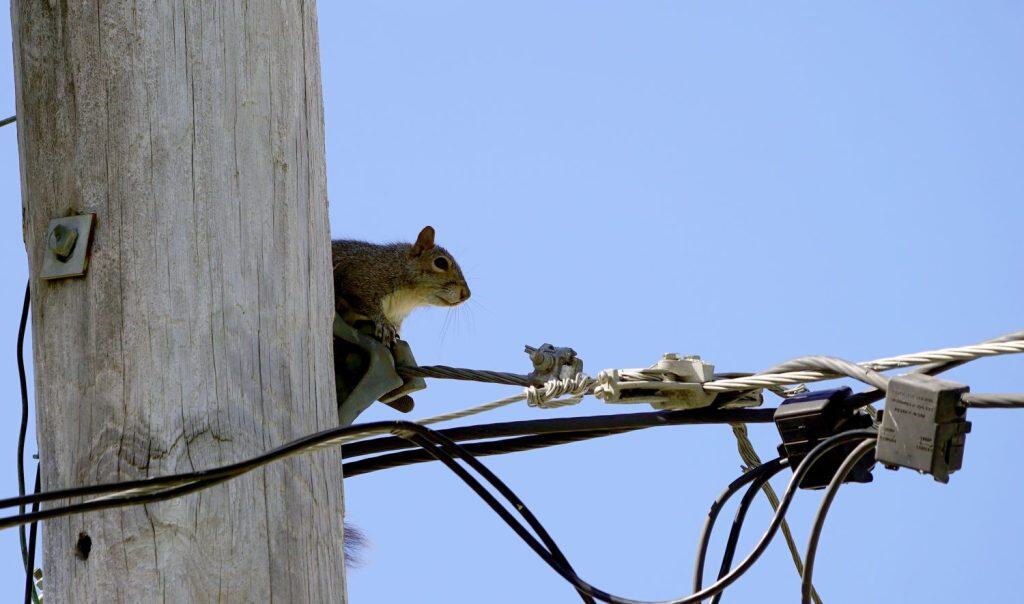
Utilities have taken myriad steps to protect squirrels and the power grid.
©juliandavila/Shutterstock.com
Very. In fact, there are thousands of such incidents each year. Squirrels are a leading cause of animal-related power outages in many parts of the U.S. and elsewhere. This problem is so significant that utility companies have been forced to take action. Because one misplaced paw can cause a costly outage, power companies use an arsenal of devices and design tweaks to keep squirrels away from energized parts of the grid.
Squirrel guards (also called wildlife guards or animal guards) are cone or disk-shaped barriers placed around poles, transformers, and substation entry points. The smooth, often rotating surface makes it impossible for a squirrel to continue climbing once it reaches the guard.
Since most squirrel electrocutions happen when they touch two conductors or a conductor and ground at the same time, utilities install insulating covers over transformer bushings, terminals, and jumpers, blocking direct contact and help prevent short circuits.
Flexible sleeves of insulating material can be fitted over exposed overhead lines where they enter transformers or cross trees. The covers don’t interfere with the wire’s function, but they create a safe barrier in case a squirrel or bird lands there.
Substations attract squirrels with warmth and nesting materials. Many utilities surround these areas with mesh fencing, “skirt” barriers, and wildlife-proof conduit openings. Some even install motion-sensing deterrents to scare off animals before they reach energized gear.
Engineers now design some equipment with extra spacing between high-voltage parts, increasing the gap between energized components and grounded metal, making it physically impossible for a squirrel’s body to bridge the distance.
Power companies can’t keep squirrels from being curious, but they’re doing their best to keep them from making contact. Through insulation, barriers, and smarter design, they’ve turned what used to be a widespread problem into a manageable one. Still, as any lineman will surely tell you, the battle between squirrels and substations is never truly over.
Super Squirrels!
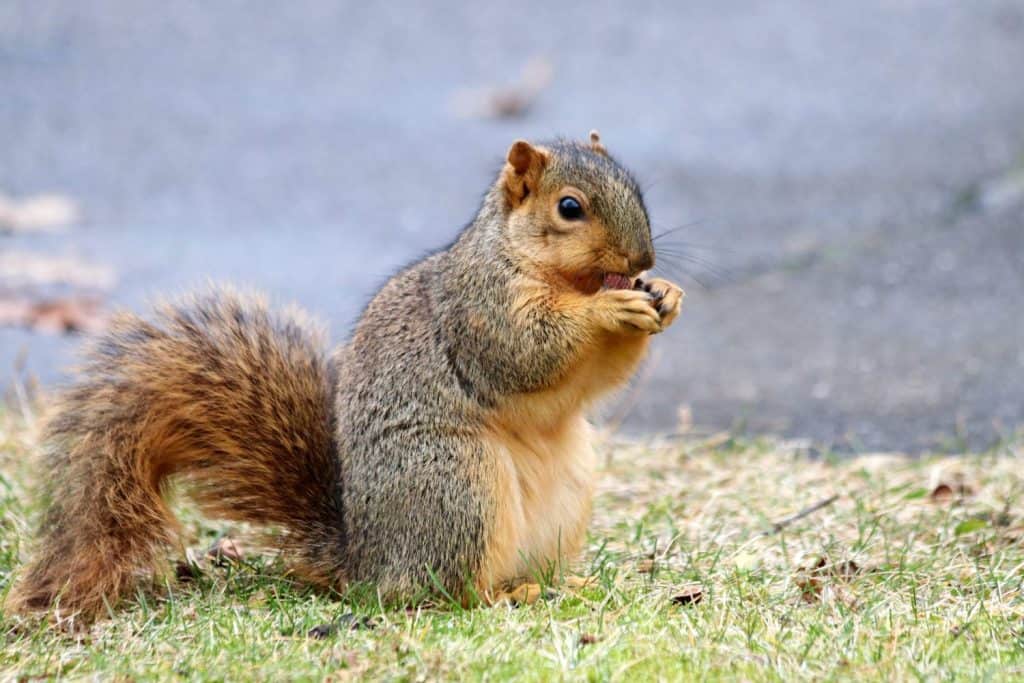
Squirrels are well-suited to climb power lines.
©Martin J. Calabrese/Shutterstock.com
Squirrels may look like tiny daredevils dancing on power lines, but there’s real science behind their swagger. With rotating feet that act like built-in climbing gear, claws that grip like grappling hooks, and a tail that doubles as a balance pole, they’re perfectly engineered for high-wire life. Throw in some quick thinking and a bit of electrical physics, and you’ve got an animal that can sprint safely across electrified cables. Utilities will continue to stay busy trying to keep these furry acrobats out of trouble, but until they find a way to completely keep these critters off the lines, we can expect to continue seeing them up there.. And the next time you do, you can now appreciate just how many superpowers are packed into that little body and mind.