Although it’s home to over five million people, two-thirds of Alabama is forested. With its ample vegetation and hot, humid temperatures, Alabama is the perfect nesting ground for an array of creatures, including some astoundingly large insects. From the Eastern Hercules beetle to the hickory horned devil, the state’s insects have some real pizzazz. Continue reading to discover nine of the largest insects in Alabama and where they lurk.
Eastern Hercules Beetle

Male Eastern Hercules beetles have big horns but aren’t dangerous to humans. However, their legs can scratch you if you pick them up.
©Georges_Creations/Shutterstock.com
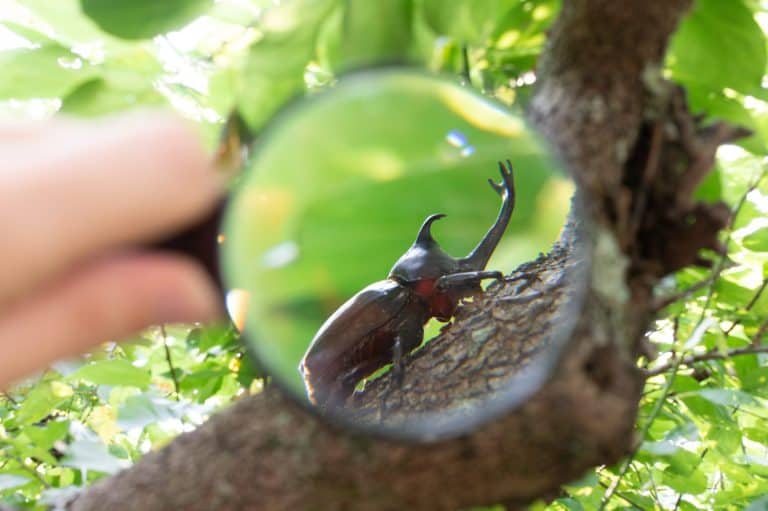
One of the largest insects in Alabama is the Eastern Hercules beetle (Dynastes tityus). Their appearance is characterized by hardened forewings with green, tan, and grey markings. While females of the species are somewhat smaller, males feature elongated horns and can grow up to two and a half inches long. While its larvae usually live in the bases of decaying trees, adult Eastern Hercules beetles live under fallen leaves and logs. Before they reach maturity, larvae eat rotting wood that makes up their homes. Upon reaching adulthood, however, Eastern Hercules beetles typically eat tree sap and rotting fruit. While these beetles have an intimidating appearance, they typically aren’t dangerous to humans, although handling one might result in scratches from their spiny legs.
Giant Silk Moths

Giant Silk Moths, like the Polyphemus Moth, have striking eyeball-like designs on their large wings.
©Jim Lambert/Shutterstock.com
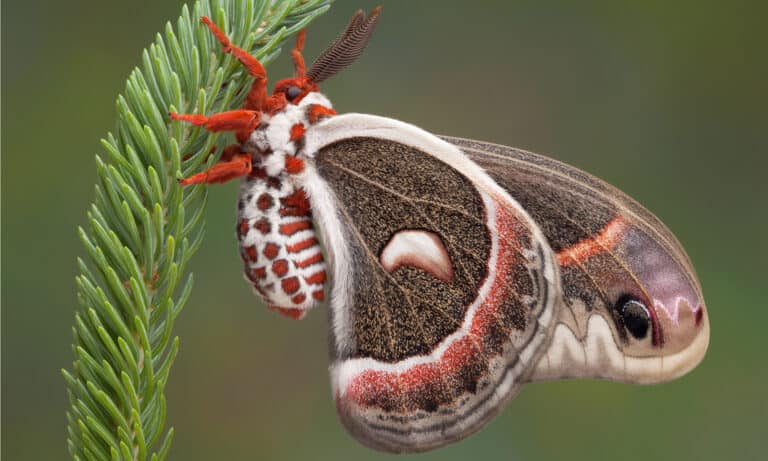
Several large silk moths call Alabama home, including the Cecropia moth (Hyalophora cecropia), the Polyphemus moth (Antheraea polyphemus), and the Luna moth (Actias luna). They are characterized by vibrantly colored wings, often with markings that resemble eyes. The Luna moth, however, has distinctly green wings. In general, giant silk moth wings can span four to six inches.
Most giant silk moths prefer the wooded areas that make up large parts of Alabama. While they may look beautiful, even intimidating, giant silk moths are stars that burn bright; they only live a week or so after reaching maturity. The giant silk moths that live in Alabama aren’t dangerous to humans.
Eastern Dobsonfly

Eastern dobsonflies aren’t venomous, but females can bite if cornered.
©Jay Ondreicka/Shutterstock.com
The Eastern dobsonfly (Corydalus cornutus) is one of the larger members of the family Corydalidae. They are characterized by long, thin bodies and wings with a distinctive grey texture and black stripes. Upon reaching adulthood, Eastern dobsonflies grow to over five inches in length, with wingspans of nearly five inches.
Long-recognized in the Southern Appalachian region of the United States, Eastern dobsonflies are often called hellgrammites, hojacks, and go-devils. Typically, they come out at night and spend the majority of their time near streams and other moving bodies of water where they can lay eggs. They aren’t particularly dangerous, but females are capable of biting. This species lacks venom, rendering their bites harmless.
Hickory Horned Devil (Royal Walnut Moth)

The caterpillar form of the Royal Walnut Moth grows to over five inches and features a cool green color with dark orange and black horns.
©Matt Jeppson/Shutterstock.com
One of the biggest insects in Alabama is the Royal Walnut Moth (Citheronia regalis). It is characterized by orange, red, and grey wings that reach over six inches in width. Considered the largest moth by mass to live in latitudes north of Mexico, the Royal Walnut Moth is relatively common in the Deep South. Often found in forests, these moths typically subsist on hickories, pecans, and black walnut trees.
Interestingly, the caterpillar stage of Royal Walnut Moths almost eclipses the adults in size. Called Hickory Horned Devils, the caterpillars grow up to five inches long and feature a cool green coloring. Both the caterpillar and adult moths may be large, but they are harmless to humans.
Giant Water Bug

Sometimes called toe-biters, giant water bugs are predators that can and will bite humans.
©Vinicius R. Souza/Shutterstock.com
Another one of the largest insects found in Alabama is the Giant Water Bug (Lethocerus americanus), a member of the family Belostomatidae, which includes around 170 species worldwide. Most giant water bugs are characterized by flat legs, ovoid-shaped bodies, and two distinct front claws. Some giant water bugs can grow to just over 4 inches long, though those found in Alabama are typically up to 2.5 inches. While they can’t breathe underwater, they spend most of their time in or near the water.
Giant water bugs hunt a wide variety of aquatic creatures, including tadpoles, insects, small fish, and other arthropods. While they may look like other harmless bugs, giant water bugs are aggressive predators known to kill large prey. Watch out for these water predators, as Giant Water Bugs can and will bite. While these bites aren’t medically dangerous, they can cause extreme pain, so keep an eye out when you’re near bodies of water.
Carolina Leaf-Roller Cricket

Carolina leaf-roller crickets got their name from their tendency to hide in rolled-up leaves during the daytime.
©Vinicius R. Souza/Shutterstock.com
Bugs in deep southern states like Alabama have great names, and the Carolina leaf-roller cricket (Camptonotus carolinensis) is no exception. It’s a type of raspy cricket with brownish-orange coloring and antennae nearly five times as long as its body, which can reach up to two and a half inches. Carolina leaf-roller crickets live primarily in deciduous forests, where they shelter in rolled-up leaves during the day and emerge to hunt aphids at night. Interestingly, those camouflaged leaf shelters are fastened by the silk these crickets weave. Carolina leaf-roller crickets are also the only leaf-rolling cricket species in North America. While they are technically able to bite, their jaws aren’t strong enough to pierce human skin.
Robber Fly

Robber flies are fierce and will not hesitate to defend themselves against any encroaching organism. They can also deliver painful bites to humans.
©Nopri Bw/Shutterstock.com
Also called assassin flies, robber flies (Asilidae family) are members of the true fly order Diptera. Their appearance is characterized by thin, spiny legs, earthy coloring, and three simple eyes surrounding two compound eyes in an indent on the tops of their heads. They also have something of a mustache consisting of bristle-like hairs on their face. A cosmopolitan fly family, robber flies live all across the world, including places like Alabama.
Robber flies prefer dry, open environments where they hunt a head-spinning variety of prey, including beetles, butterflies, bees, ants, wasps, and even some spiders. They get their ‘assassin’ moniker due to their finishing move: stabbing prey with a short proboscis and injecting neurotoxic saliva, which quickly paralyzes. They may be on the smaller side relative to the rest of this list (about one and a half inches), but they are fierce. Robber flies do not hesitate to defend themselves and will provide a painful bite to any human who mishandles them. Otherwise, they are usually not a problem (unless you’re a bug).
Eastern Lubber Grasshopper

Eastern lubber grasshoppers are well-known thanks to their brightly colored, distinctively marked bodies.
©Francisco Blanco/Shutterstock.com
Another one of the sizable insects that call Alabama home is the Eastern Lubber Grasshopper (Romalea microptera). Native to the Southeastern United States, the Eastern lubber grasshopper, also known as the Georgia thumper and the Florida lubber, is recognized by its distinctive, brightly colored body often in shades of yellow or orange and black. Some of the biggest grasshoppers in the United States, Eastern lubber grasshoppers can grow up to three inches long. Eastern lubber grasshoppers typically live in areas with weedy vegetation, fields, and open pine forests.
Eastern lubbers are voracious herbivores. They eat trees, shrubs, and grasses. To ward off predators, Eastern lubber grasshoppers secrete a foul-smelling, bad-tasting odor. When that fails, they produce a loud hissing sound. Eastern lubber grasshoppers are not dangerous to humans. However, they can make dogs sick if they eat one.
American Cockroach

American cockroaches can run the equivalent of 210 miles per hour.
©RHJPhtotos/Shutterstock.com
Last but not least is the American cockroach (Periplaneta Americana). It’s the largest species of common cockroach and a scourge to homeowners everywhere. American cockroaches typically have bodies between 1.2 to 1.6 inches long, with reddish-brown coloring, squat heads, and long, segmented antennae. As one of the fastest-running insects, American cockroaches can reach speeds equivalent to 50 body lengths per second, the equivalent of a human running 210 miles per hour.
This skill, plus a diet that does not discriminate, has helped the American cockroach become a much-loathed pest. Since they live in moist areas or dry areas with access to water, they are often found in basements, crawl spaces, and alleys next to buildings. While they aren’t explicitly dangerous to humans, they can pick up various viruses and protozoans, including Salmonella, which are harmful to people. Despite their name, American cockroaches are native to Africa and the Middle East.