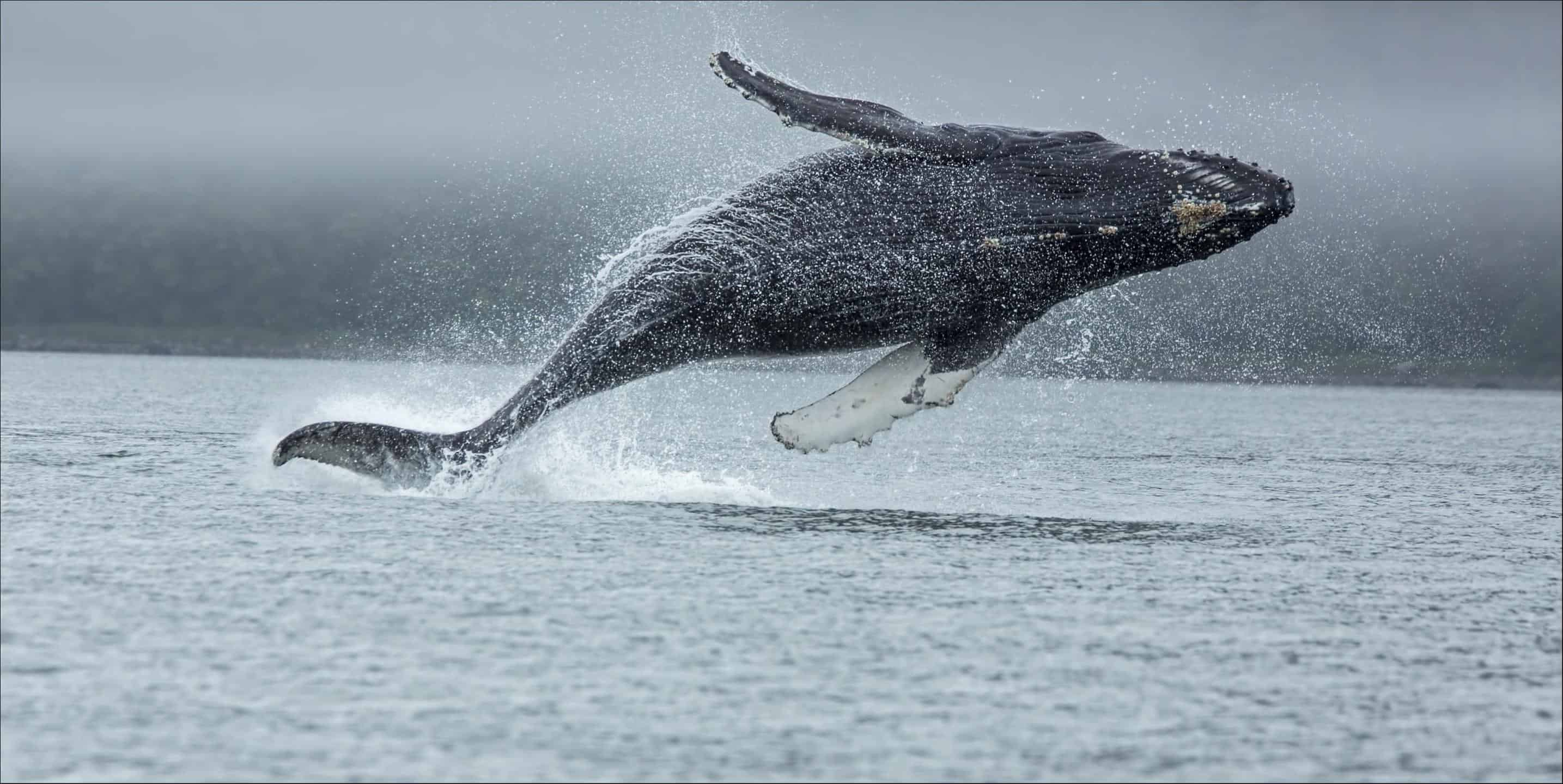

Of all the animals on land and in the sea, there is none heavier than the blue whale (Balaenoptera musculus). Whales are believed to have reached the giant sizes we know today around 4.5 million years ago. The blue whale is often said to be heavier than any dinosaur to have ever lived. However, is it true? How big was the largest blue whale to have ever lived and how do blue whales compare to prehistoric animals? Keep reading to learn the answers to these questions and discover the largest blue whale ever recorded.
How Big Is the Average Blue Whale?
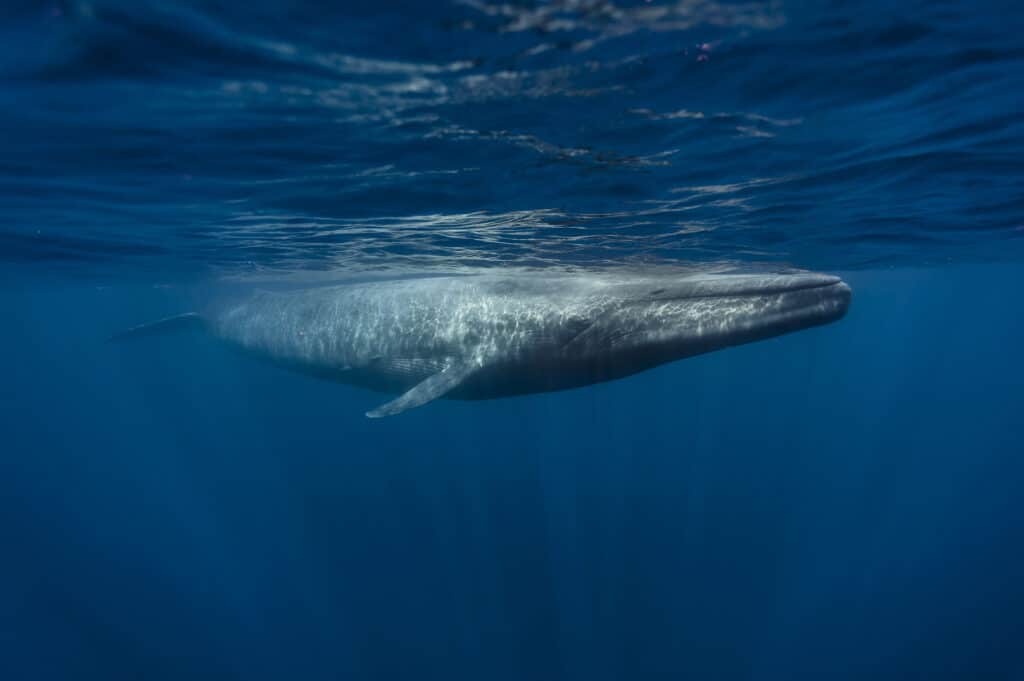
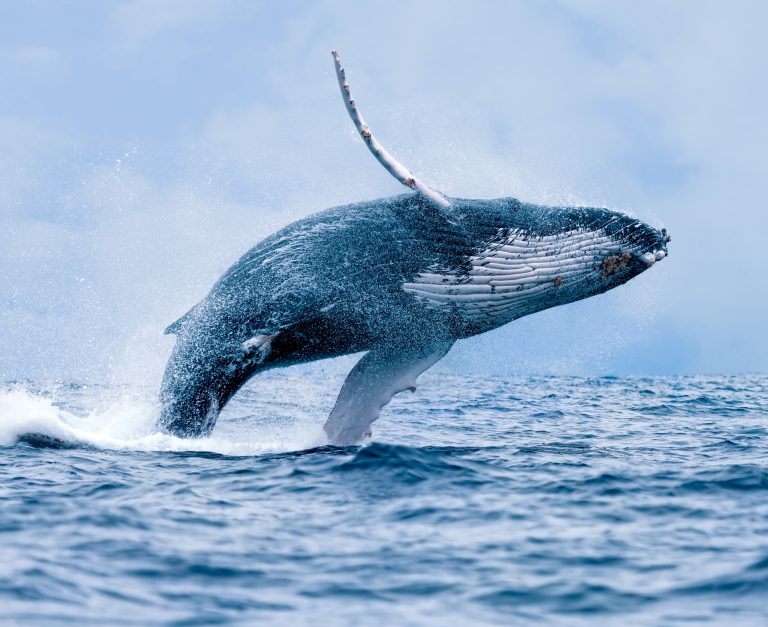
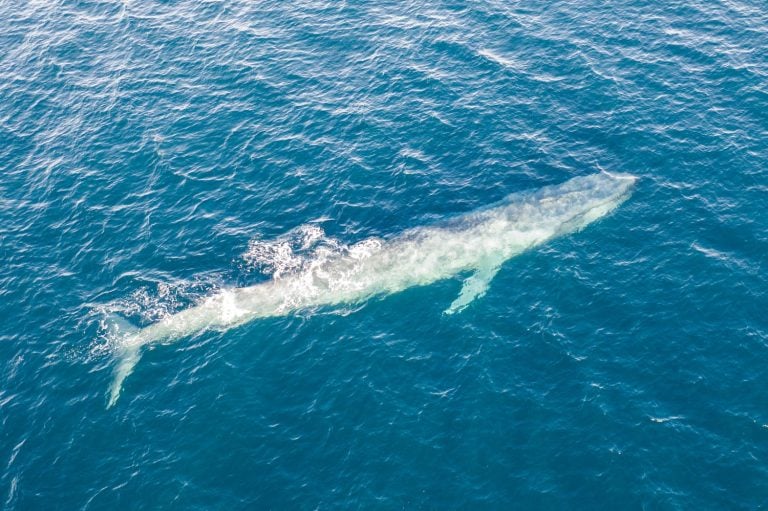
Blue whales swim closer to the shore when a predator is nearby.
©Andrew Sutton/Shutterstock.com
These giants of the sea are found in every major ocean in the world apart from the Arctic Ocean. Not much is known about their location throughout the year. However, it is believed that some migrate to new feeding grounds during the summer and back to warmer waters during the winter. Blue whales typically average 80-100 feet in length and weigh 100,000-330,000 pounds, with whales in the Antarctic being larger. The females are also generally larger than the males.
Blue whales are solitary animals but may occasionally be found in pairs. They don’t form strong bonds except for those between mothers and calves. Females usually give birth every two to three years and carry their young for 12 months. Even blue whale calves are enormous. Calves are usually about 23 feet long and weigh 6,000-8,000 pounds at birth, which is the same weight as some African elephants. Calves gain around 200 pounds per day during their first year, solely only their mother’s milk for the first 6-7 months.
How Much Do Blue Whales Eat to Get So Big?
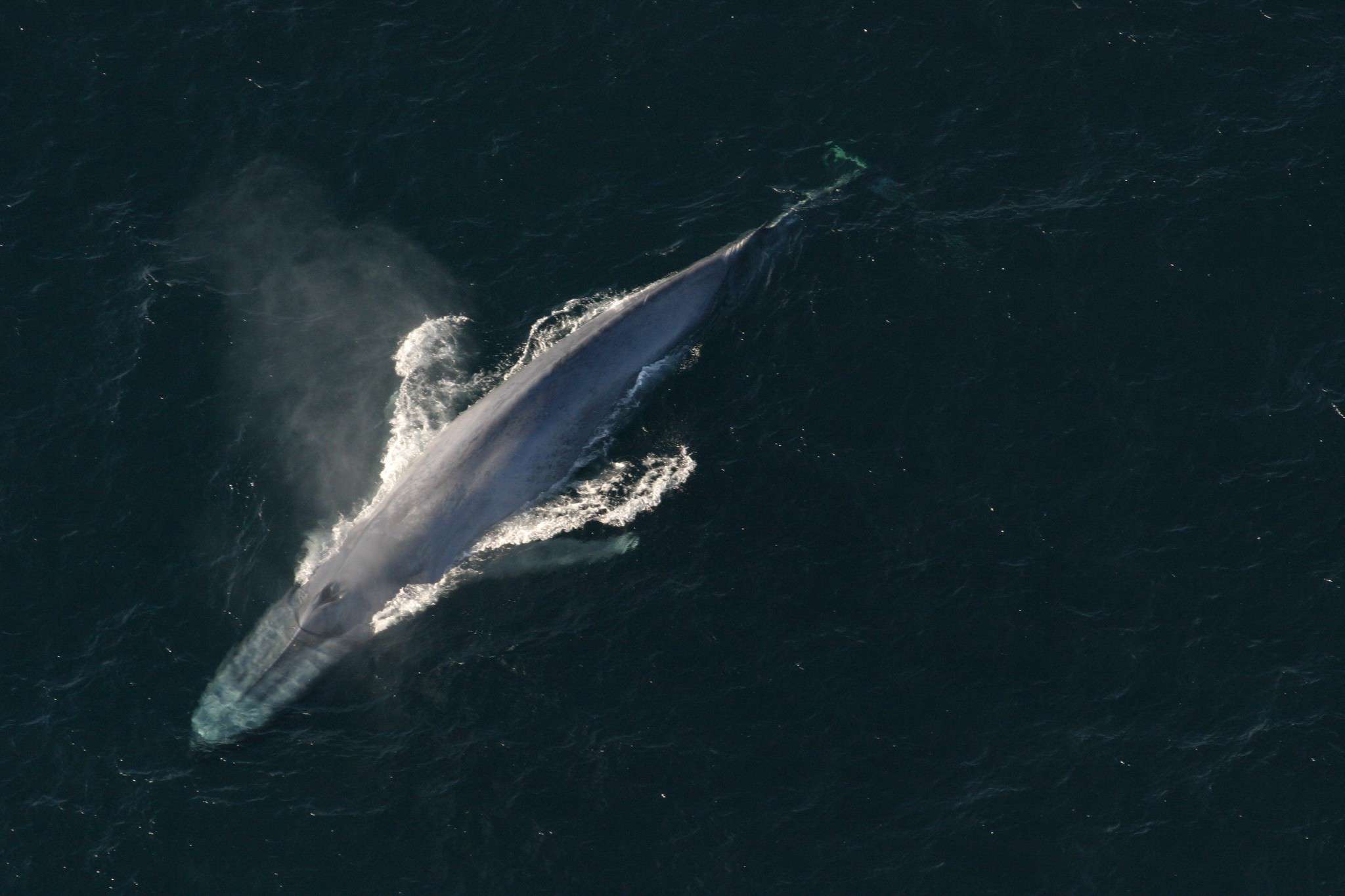
Blue whales have incredibly long and slender bodies.
©NOAA Photo Library / CC BY 2.0, Flickr – Original / License
Despite their length, the blue whale’s body is relatively slender, although they have huge, broad heads. Blue whales belong to the cetacean suborder of baleen whales, which means that they lack teeth to catch and hold prey. Instead, they have huge baleen plates made of keratin, the same substance as our hair and fingernails. They use these plates to filter krill, which are tiny crustaceans similar in appearance to shrimp.
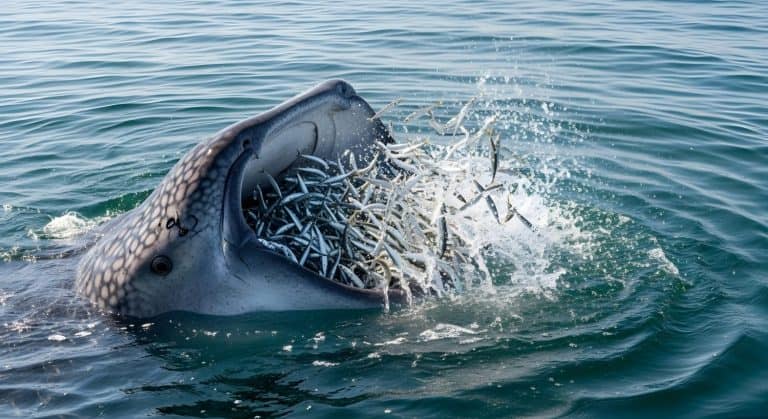
Their large size requires a significant amount of krill every day to survive. One blue whale can eat 16 metric tons, or 17.6 U.S. tons, of krill per day. When feeding, they lunge into clouds of krill at high speed, allowing hundreds of gallons of water to flow into their mouths. Pleats on the undersides of their mouths expand to hold the water, which can be greater in volume than the whale’s own body. Like a strainer, they filter out the seawater while holding in the krill. A blue whale’s esophagus is only 4 inches in diameter, so it can only swallow small prey like krill.
The Largest Blue Whale Ever Recorded
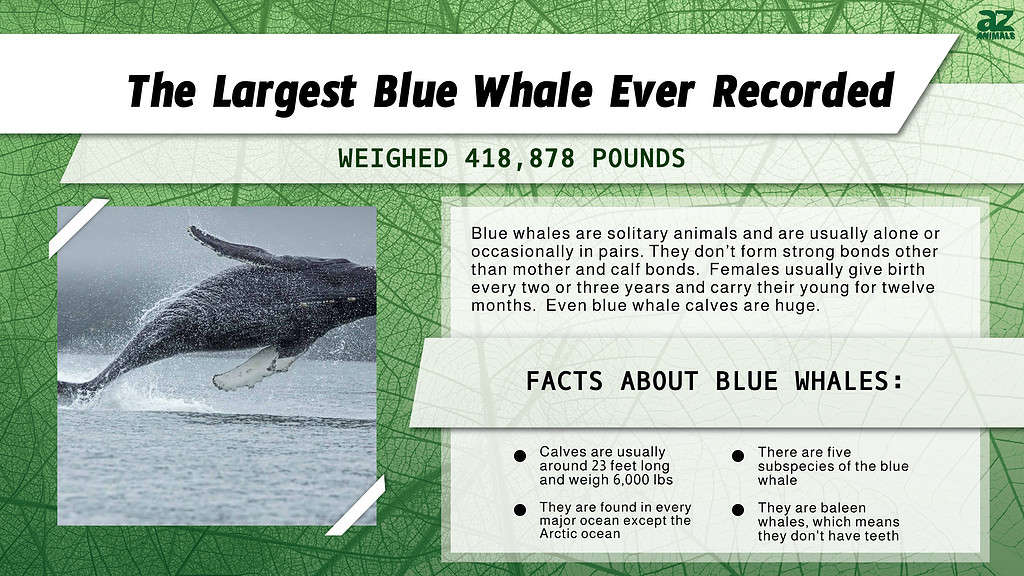
Blue whales are the record holders when it comes to size. The largest blue whale on record by weight was 418,878 pounds. This female blue whale was 90 feet and 6 inches in length. She was caught in the Southern Ocean around Antarctica in 1947.
The largest blue whale by length was a female caught in 1909. The whale was measured at the hamlet of Grytviken, a whaling station on South Georgia Island in the South Atlantic. This massive whale was an incredible 110 feet and 1.6 inches. No weight was recorded for this whale.
Is the Blue Whale the Largest Animal to Have Ever Lived?
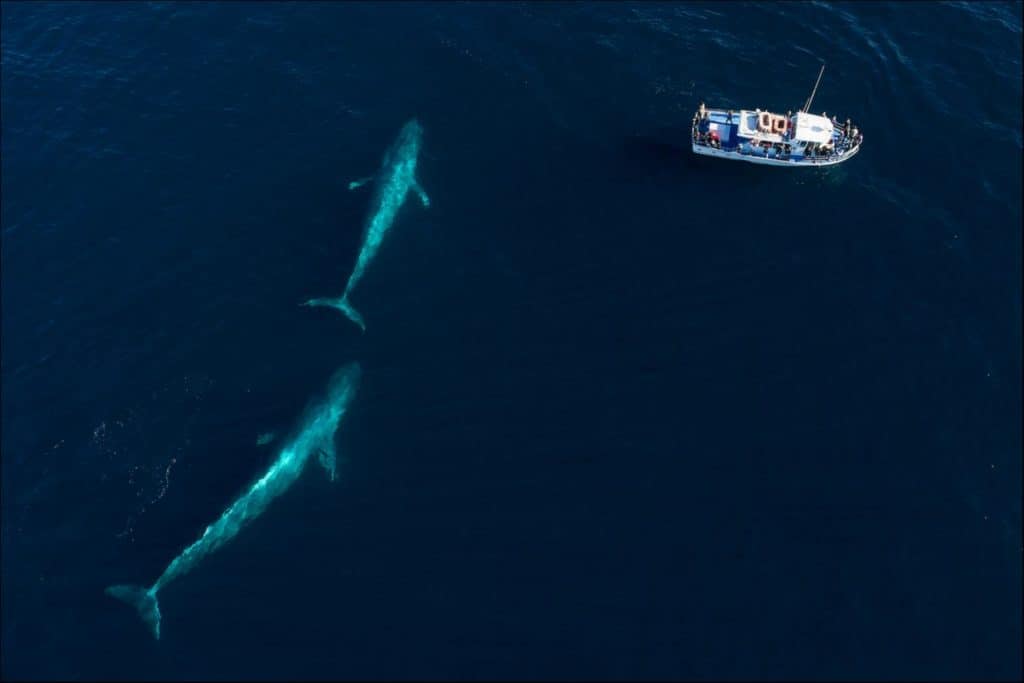
No animal in history has ever weighed as much as the blue whale.
©Chase Dekker/Shutterstock.com
Blue whales are often considered the largest animals that have ever lived. However, some land animals may have been longer. The Patagotitan mayorum, a titanosaur with a long neck similar to that of a brontosaurus, is believed to have reached lengths of 121 feet and weights of around 154,000 pounds. Argentinosaurus is another titanosaur thought to reach lengths of about 120 feet. Some estimates suggest this dinosaur could have weighed up to 200,000 pounds.
While there are also some prehistoric marine animals that may come close in size, so far, the blue whale is still the heaviest animal to have ever lived. An ancient ichthyosaur discovered in Somerset, England in 2016 may be the closest competitor, with estimates placing its size at up to 85 feet in length. The Perucetus colossus was originally thought to have broken the blue whale’s weight record at 340 metric tons, or 749,572 pounds. However, researchers from the Smithsonian and the University of California have revised that estimate to 114 tons, or 228,000 pounds.
It is entirely possible that blue whales even longer, larger, and heavier than the record breakers exist, especially considering that it has been more than 100 years since the record was set. The study referenced above calculated that the largest blue whales could weigh as much as 540,000 pounds when calculating for body weight measured by length. Yet, determining if larger blue whales exist is extremely difficult, simply because they live in some of the coldest, deepest parts of the ocean and are often hundreds of miles away from any coastline.