Quick Take
- Texas is famous for birds, but another state quietly holds the title for the most diverse bird population in the U.S. The answer might surprise you.
- One of Texas's most brilliantly colored birds is also one of its most secretive, so elusive that you could walk right past it without ever knowing. Meet this secretive beauty →
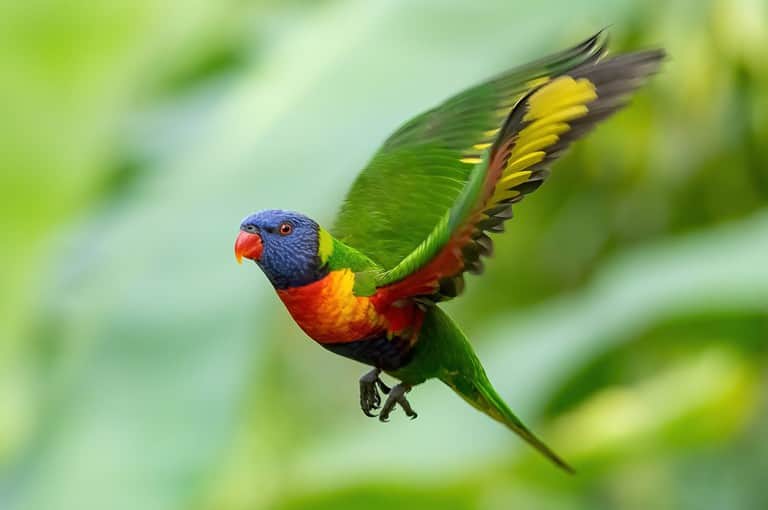
- A tropical-looking parrot has quietly colonized Texas's biggest cities, and its origins are stranger than you'd expect. Discover the urban parakeet →
- One species on this list only exists in a single, hard-to-reach corner of Texas, where missing the elevation by a few hundred feet means you'll never find it. Explore this high-elevation rarity →
While Texas hosts a massive number of migratory birds, California actually holds the title for the highest overall bird diversity in the United States, with approximately 706 distinct species compared to Texas’ 668 species. Texas has a greater abundance of individual birds passing through, but California’s Pacific coastline and unique marine habitats result in higher species diversity. From stunning hummingbirds to the stealthy owls, Texas is a premier destination for birdwatchers, offering vital habitat for millions of migratory and resident birds alike.
Painted Bunting
The painted bunting (Passerina ciris) is a small, sparrow-sized songbird measuring about 4.5 to 5 inches in length and weighing approximately half an ounce.
Adult males have vibrant, multicolored plumage with a deep blue head, bright red underparts, and a contrasting lime-green back, earning them the nickname living rainbows. Females and immature birds are uniformly bright yellow-green.
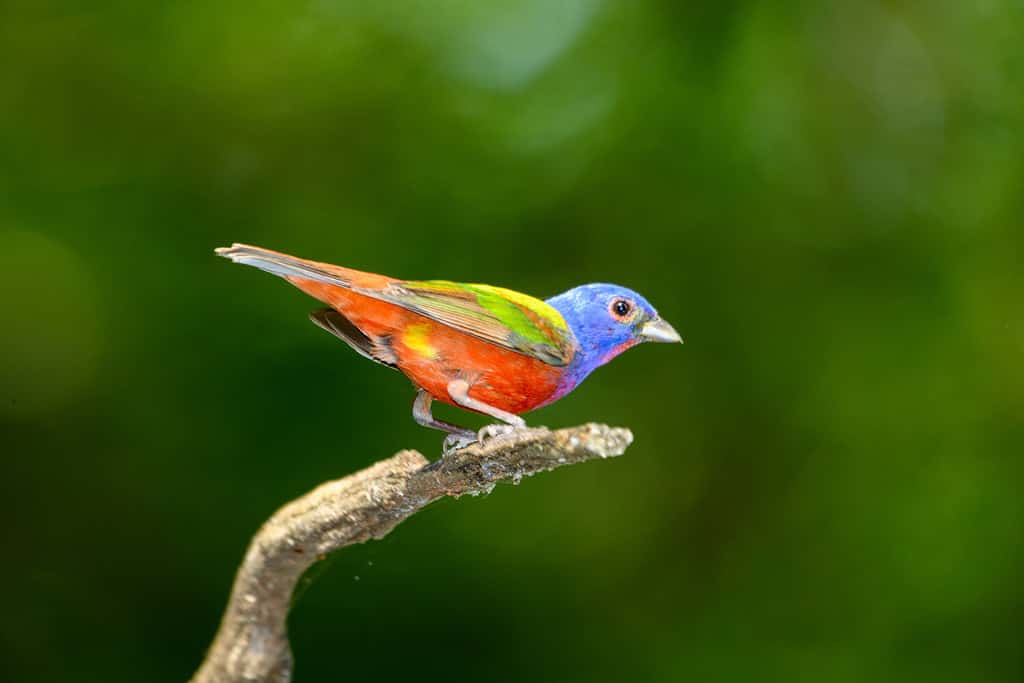
The Painted bunting is a secretive bird that often hides.
©Jeff W. Jarrett/Shutterstock.com
Texas serves as a stronghold for the species’ Western breeding population, hosting more nesting painted buntings than any other state. They are common summer residents across much of Texas, arriving around April and May. They inhabit semi-open areas with dense understory, brushy thickets, woodland edges, and overgrown roadside brush. In the winter, they migrate south to Mexico and Central America.
Vermilion Flycatcher
The vermilion flycatcher (Pyrocephalus rubinus) is a small, strikingly colored bird measuring about 5.1 to 5.5 inches in length with a wingspan between 9.4 and 10 inches. The vermilion flycatcher exhibits strong sexual dimorphism. The adult male is unmistakable with a brilliant neon-red crown and underparts, sharply contrasted by a dark brown-to-black mask, back, and wings. The female is more subdued, with grayish-brown upperparts, a whitish breast, and a soft salmon-pink or yellowish wash on the belly.
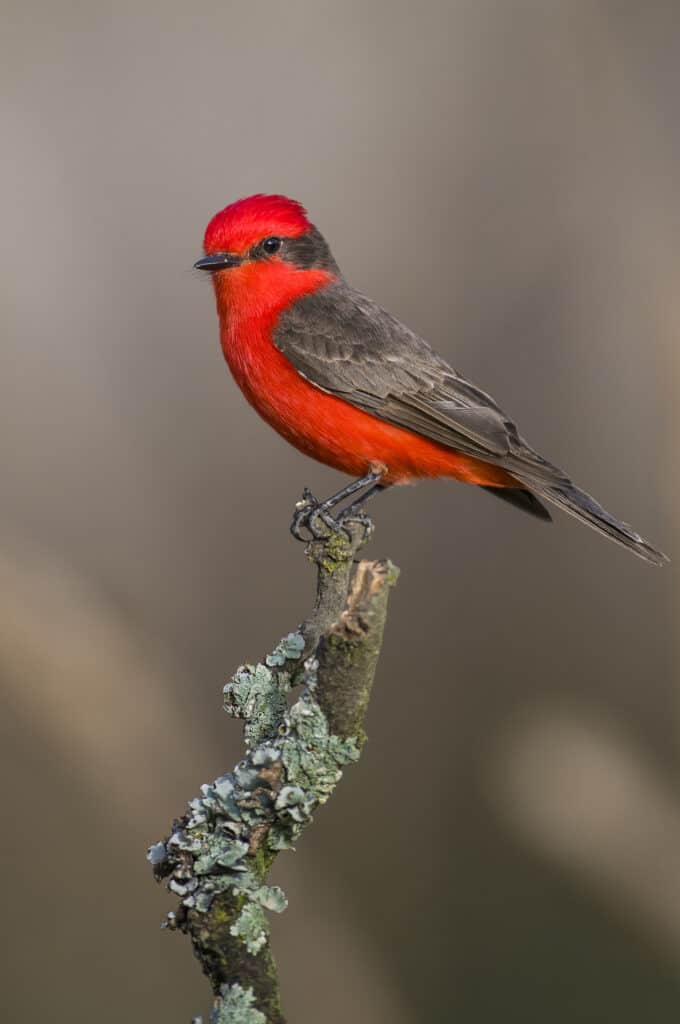
Male vermilion flycatchers are easily recognized by their bright red plumage.
©Foto 4440/Shutterstock.com
The vermilion flycatcher is widely distributed as a resident and breeder, with the highest population densities found in West and South Texas.
Roseate Spoonbill
The roseate spoonbill (Platalea ajaja) is a striking, medium-to-large wading bird reaching a height of about 32 inches with a 50-inch wingspan. It is easily identified by its rose-pink body, deeper red shoulder patches, contrasting white neck and breast, ruby-red eyes, and a specialized flat bill that widens into a spoon shape at the tip.
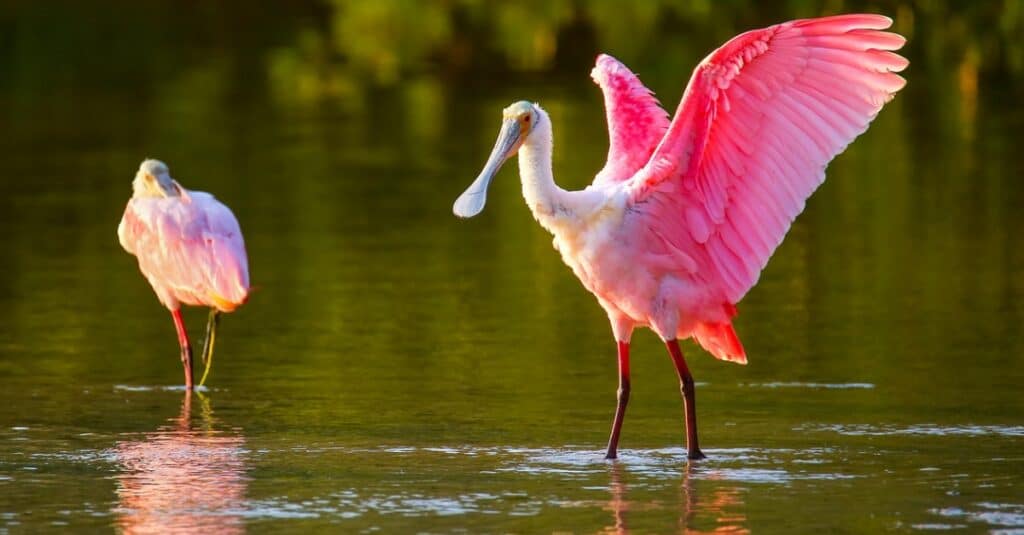
Roseate spoonbills are wading birds.
©iStock.com/Donyanedomam
In Texas, these birds are present year-round along the Gulf Coast, with populations peaking during the spring and summer mating and nesting season. They inhabit shallow marine bays, saltwater lagoons, and coastal marshes, and occasionally wander inland into the eastern third of the state.
Steller’s Jay
The Steller’s jay (Cyanocitta stelleri) is a large songbird measuring roughly 11.8 to 13.4 inches in length with a wingspan of about 17 inches and a weight of 3.5 to 4.9 ounces.
Its striking appearance includes a jet-black head and upper breast and a prominent, forward-pointing triangular crest that transitions into a rich, deep cobalt blue across its lower body, wings, and tail.
In Texas, this bold, vocal bird is found primarily as a resident in high-elevation forests above 5,000 feet within the rugged Guadalupe and Davis Mountains of West Texas.
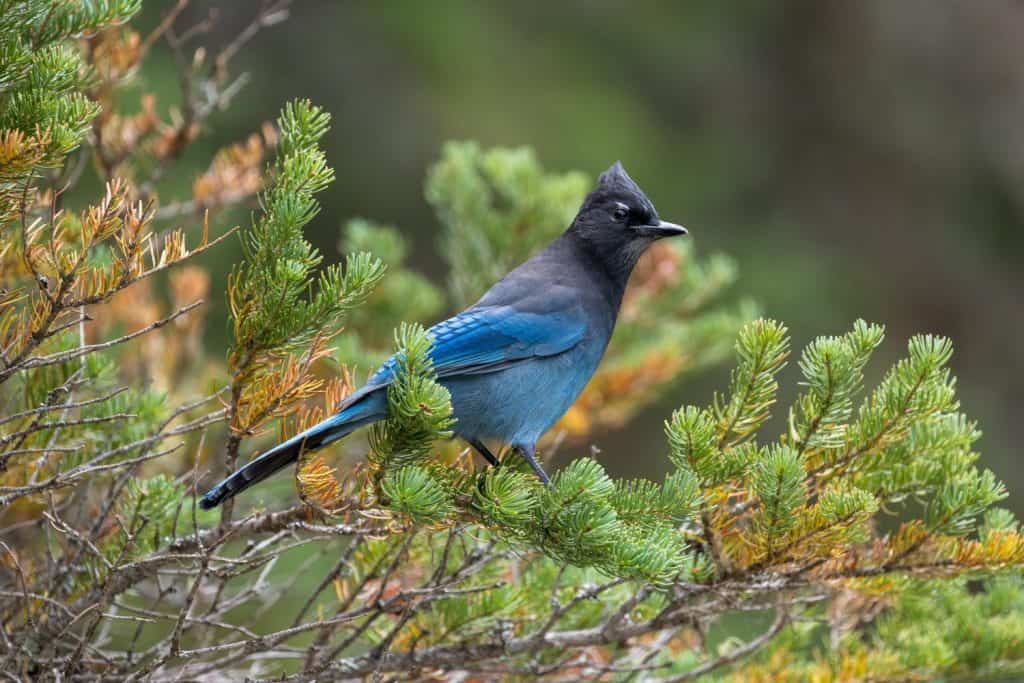
Steller’s jays are opportunistic omnivores that eat a highly varied diet of both plant matter and small animals. They change their food sources by season, consuming roughly three-quarters plant material and one-quarter animal matter throughout the year.
©GC Quarterland/Shutterstock.com
Monk Parakeet
The monk parakeet (Myiopsitta monachus) is a small-to-medium, chunky parrot measuring about 11 to 12 inches in length, with a long, tapering tail and a wingspan of approximately 19 inches. It is easily recognized by its bright green upperparts, pale gray forehead, throat, and breast.
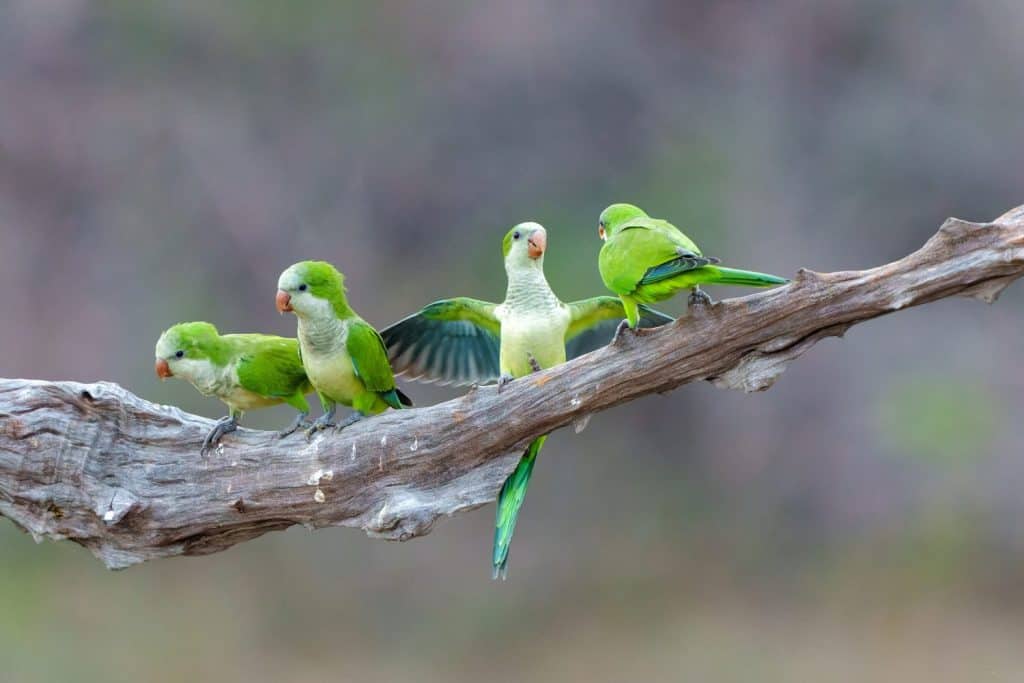
Originally from South America, the monk parakeet has established itself in Texas.
©Henk Bogaard/Shutterstock.com
Although they are native to South America, feral populations originating from escaped or released pets have become established in Texas. They are common year-round urban and suburban dwellers, with large populations in major metropolitan areas and coastal regions including Houston, Dallas, Austin, and the Galveston Bay watershed, where they construct massive, distinctive communal stick nests.
Summer Tanager
The summer tanager (Piranga rubra) is a medium-sized songbird measuring approximately 7.5 to 8 inches in length, with a wingspan of about 11 to 12 inches. This species exhibits strong sexual dimorphism: adult males are known for their brilliant rosy-red plumage, while adult females have olive-green upperparts and warm mustard-yellow underparts. The summer tanager is a widespread breeding resident in Texas, arriving in the spring, and is common across much of the state.
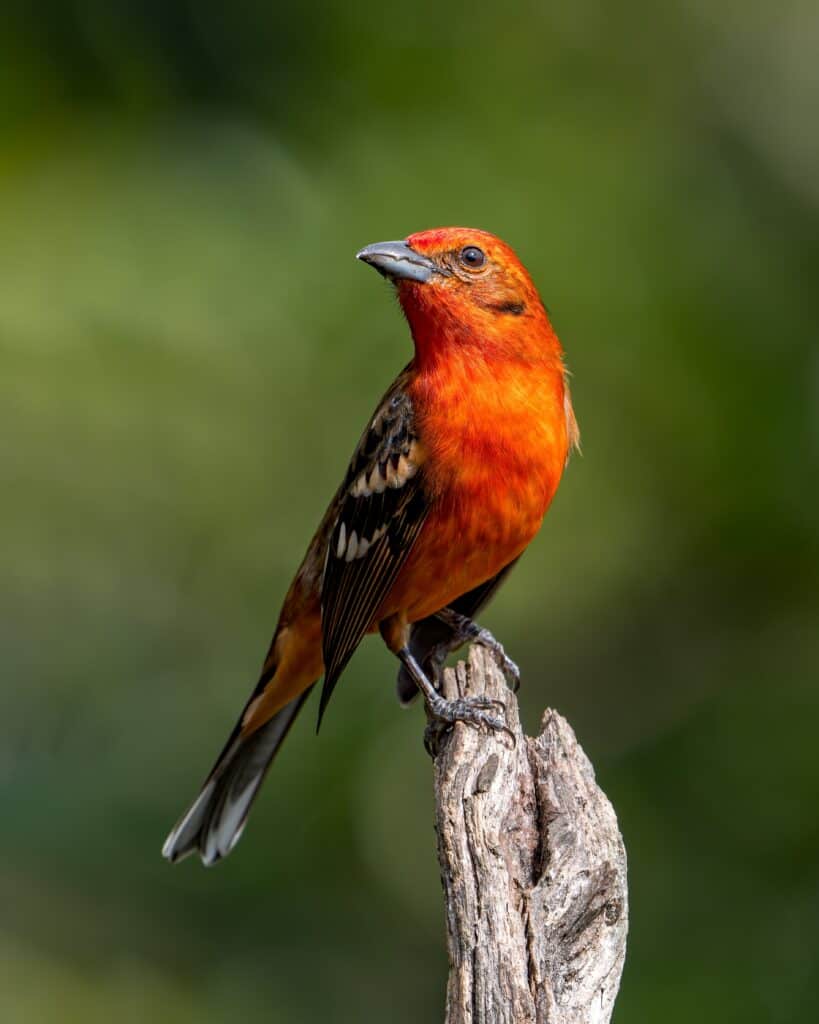
Head to Big Bend National Park in the spring and summer to catch sight of a summer tanager.
©Tyler Wenzel/Shutterstock.com
Great Blue Heron
The great blue heron (Ardea herodias) is the largest heron in North America, standing at 3.5 to 4.5 feet tall with a massive wingspan reaching between 6.5 and 7 feet, yet weighing only 5 to 6 pounds. Visually, it is distinguished by its elegant blue-gray plumage, a slender S-shaped neck, a dagger-like yellowish-orange bill, and a white head accented by a striking black stripe over the eye that extends into sleek head plumes.
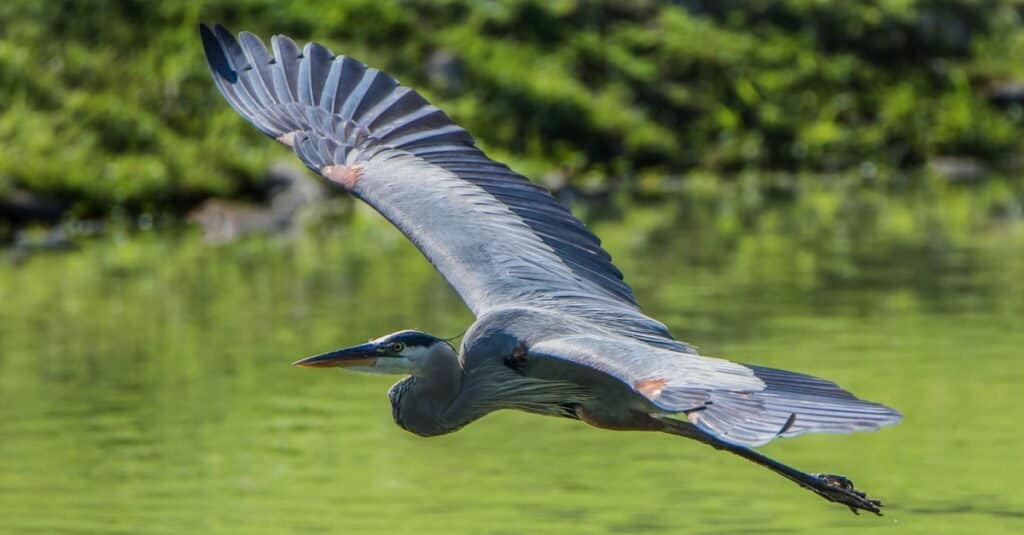
A great blue heron flying over water.
©Tom Franks/Shutterstock.com
This adaptable wader is an abundant, year-round resident found statewide near rivers, lakes, ponds, marshes, and coastal estuaries, with breeding populations concentrated along the eastern half of the state and the Gulf Coast.
Red-tailed Hawk
The red-tailed hawk (Buteo jamaicensis) is a large, stocky bird of prey measuring 18 to 26 inches in length with a 3.8- to 4.5-foot wingspan. Females are roughly 25% larger and heavier than males. Adult red-tailed hawks have rich brown upperparts, a lighter speckled underbelly often marked with a distinct band of dark streaks, and, as their name implies, a signature short, wide, brick-red tail.
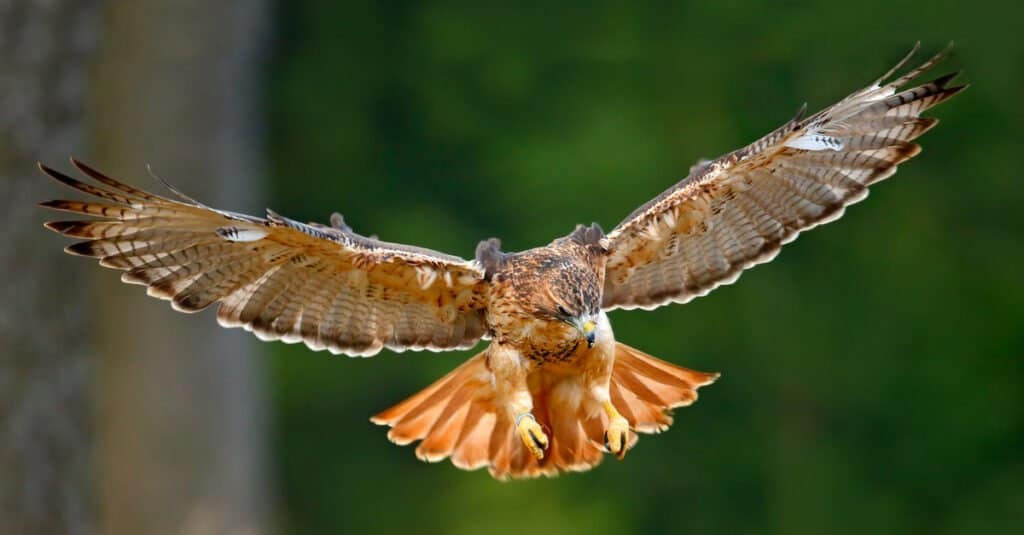
The red-tailed hawk’s distinct tail feathers result from the molting process.
©Ondrej Prosicky/Shutterstock.com
In Texas, the red-tailed hawk is a common year-round resident found across the state from sea level up to mountainous terrain, favoring open woodlands, agricultural areas, and highway corridors where they can easily scan open fields for small prey. Their resident population is heavily augmented during the winter months as additional migrants arrive from northern North America.