
The bushy tail and swift dash across the road tell you that a fox just crossed. However, they’re quick and you couldn’t quite get a good look. You’re driving through West Virginia and you know foxes live here, but which one did you just see? Six species of foxes call America home: the red, grey, kit, Arctic, swift, and island fox. Both the red and the grey fox live in West Virginia. These are the two most common species of foxes found in the United States. In this article, we’ll take an in-depth look at the two species of foxes in West Virginia.
Red Fox (Vulpes vulpes)
In the United States, red foxes are the largest and most common true fox species. North America, Asia, Europe, and parts of North Africa are the native home regions for this fox species, but they’ve also been introduced elsewhere. Often, these introductions were made for recreational purposes, such as sport hunting, as with red foxes in Australia. Red foxes are unusually adaptable, which allows them to live in all sorts of terrains, like deserts, forests, wetlands, and more. In West Virginia, red foxes often inhabit rolling hills, farmlands, and transitional zones where clearings and forest edges meet. They require open fields for hunting mice and other small rodents.
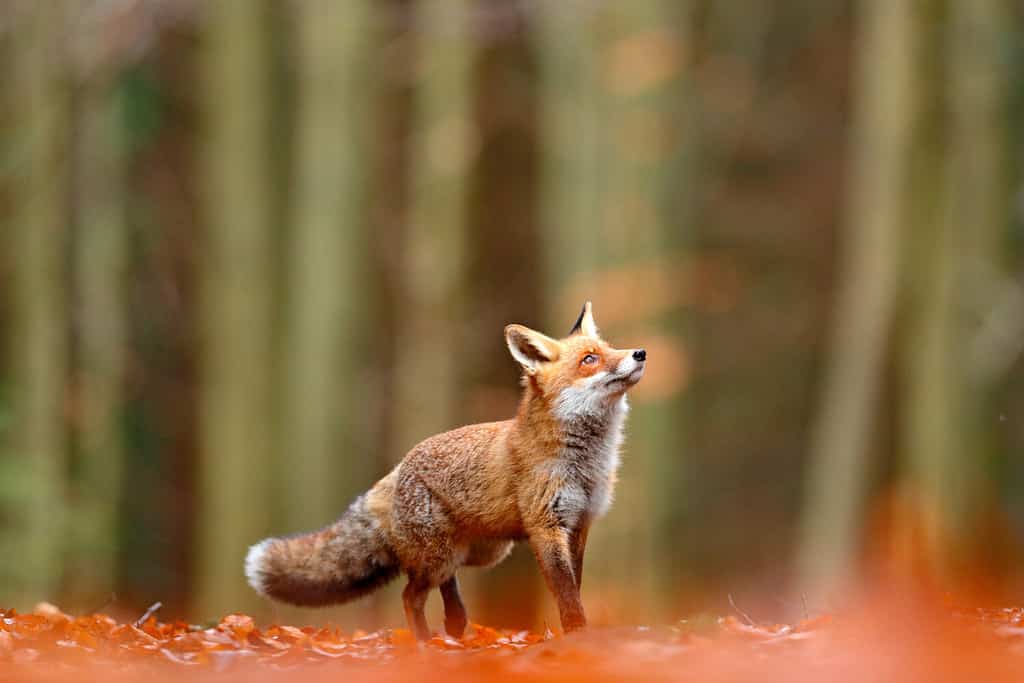
The red fox has that distinctive, giant bushy red tail with a white tip.
©Ondrej Prosicky/Shutterstock.com
Description
With a long body and short limbs, red foxes are primarily known for their long, fluffy tails. The tail is a third to nearly half of the fox’s total length. Red foxes have vertical slit pupils (like a cat’s), with the third eyelids, or nictitating membranes, which move when they close their eyes. Red foxes have five digits on their forepaws, but their hind feet only have four digits, as they lack the dewclaws that other canids have. They also have black “stockings” on their feet. Their ears are large and triangular, with black fur on the edges and the back.
Red foxes are sexually dimorphic, meaning that there are notable differences between the sexes. Females tend to have smaller skulls, wider nasal regions, and weigh about 4% to 8% less than males. Most red foxes average between 7 and 15 pounds, but foxes up to 30 pounds have been recorded. Their body length is usually 22 to 32 inches, plus tails that measure from 14 to 16 inches long.
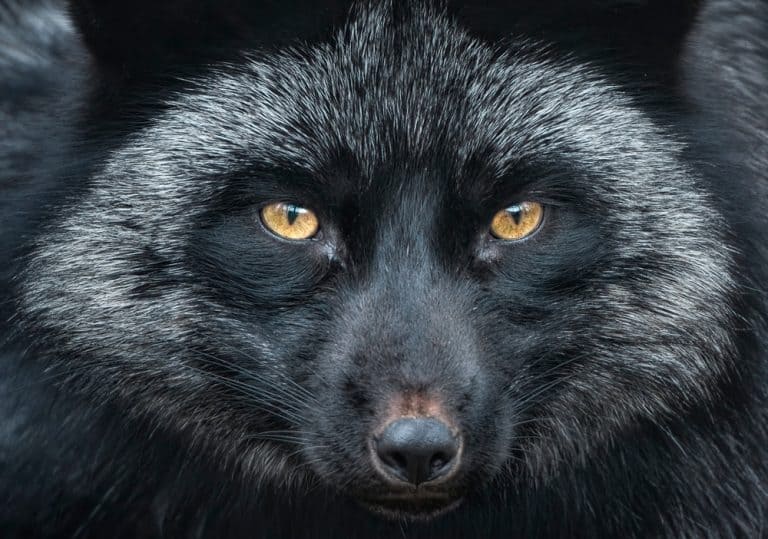
Red foxes in West Virginia tend to have thicker, denser, longer fur to help keep them warm. While we think of red foxes as only being red, they generally have pale chests and undersides. Different color morphs also occur, with black, silver, or a cross between the two on the same fox, which is known as a cross fox. Fox species do not interbreed, so even though some foxes look like a mix between red and grey foxes, these are just color morphs of red foxes. You can tell the difference between red cross foxes and others by the red fox’s distinctive, white-tipped tail.
Behavior
Red foxes mate for life and tend to live as either mated pairs or family units of adults with their young. The semi-social animals raise their offspring together with the help of older offspring, until those young mature enough to start their own family units. Often, males with kinship ties to females will remain in groups with multiple females and create a larger family group.
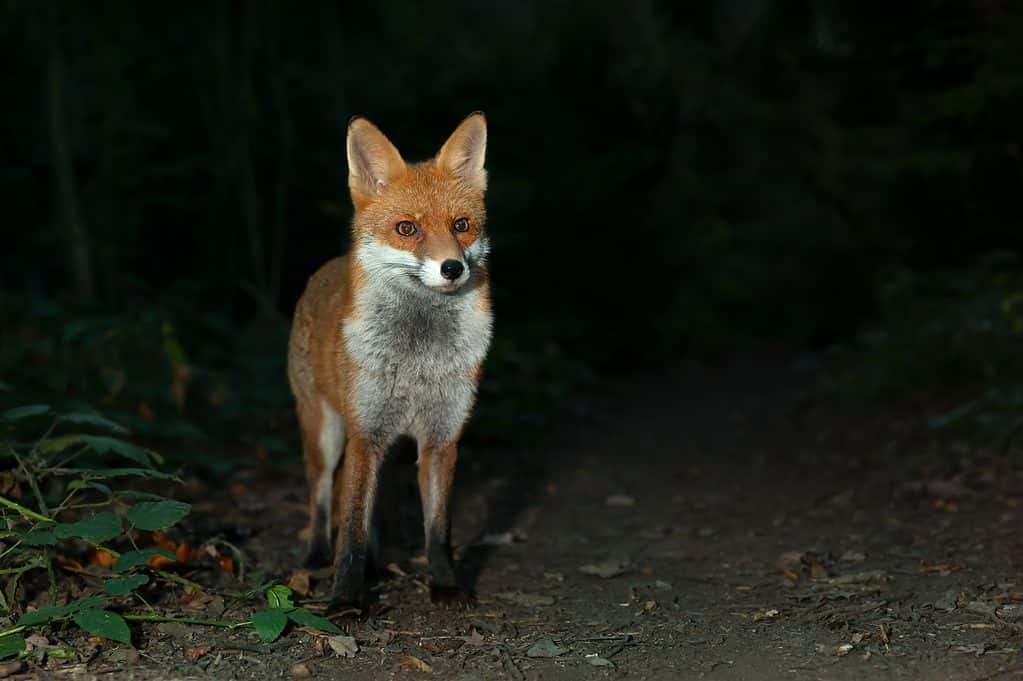
Red foxes are crepuscular or nocturnal hunters.
©Giedriius/Shutterstock.com
These beautiful animals primarily feed on small rodents like squirrels, mice, and rabbits. They also hunt reptiles, birds, and invertebrates. While it may seem extraordinary given their size, they sometimes also hunt sheep and other large hooved mammals. Foxes are technically omnivorous and supplement their diets with vegetables, fruits, and other plant matter.
Red foxes typically live about 3 years in the wild, while they may reach 12 years in captivity in zoos and sanctuaries. Part of this is because although they are predators themselves, they also have natural enemies. Mountain lions and other large cats, predatory birds, coyotes, and wolves all threaten foxes in the wild.
Although some may wish to domesticate foxes, experiments have shown that even foxes that have adapted to urban and suburban environments are not domesticated. They do not make safe pets, even though in many places they will come to people’s yards to eat from bowls set out for them.
Grey Fox (Urocyon cinereoargenteus)
The grey fox is the second most widespread fox species in the United States. They are found throughout North America and Central America. Formerly the most common fox in the eastern United States, the grey fox has been pushed out and the red fox has become more common. Still, the grey fox thrives in both suburban and urban areas.
Grey foxes most commonly reside in rocky, wooded, or brushy regions of West Virginia. Their habitats reach from southern Canada through the United States and down through Venezuela in South America. The grey fox is the only known canid species whose natural range spans North and South America.

Grey foxes have a black-tipped tail.
©iStock.com/zhuclear
Description
It’s easy to tell the grey fox from other canids by the grizzled upper parts. They also have a black stripe down the tail, and their bushy tails have a black tip. They have rusty-reddish fur along their neck, sides, and legs and white on their throats, chests, and undersides. These foxes also have black fur around the eyes, noses, and lips. Their ears and muzzle are angular and pointed, and they have lengthy, curved claws. Another distinction for grey foxes is that they have oval pupils, unlike the slitted pupils of red foxes.
The grey fox is smaller than the red fox. While red foxes demonstrate noticeable sexual dimorphism, it is less pronounced in grey foxes. Female grey foxes tend to be only slightly smaller than males. Typically, grey foxes weigh between 7 and 12 pounds. They generally measure from 35 to 45 inches in length from their noses to the tips of their tails.
Behavior
Strong, hooked claws have given gray foxes the distinctive ability to climb trees. This means they are able to scramble up trees to escape predators like wolves and coyotes. Grey foxes are opportunistic, so this also gives them an advantage on the food chain, as they can feed on squirrels, birds, birds’ eggs, and arboreal fruits. They also hunt rabbits and small rodents. These smaller foxes are adept at climbing limbless trees and are able to reach as high as 50 feet. Then, they leap from branch to branch, across to other trees or climb back down.
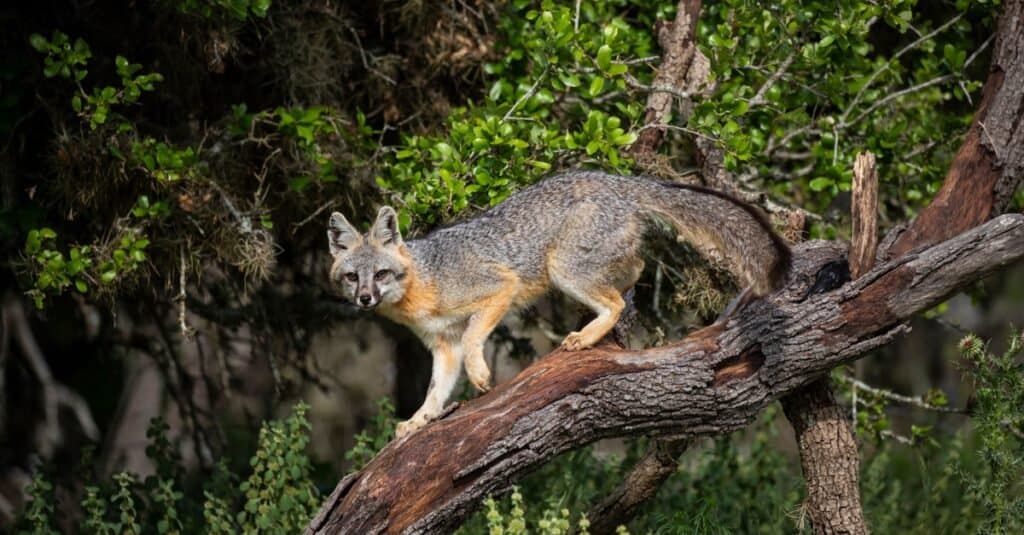
Unlike most other canids, grey foxes often climb trees.
©Danita Delimont/Shutterstock.com
These foxes are crepuscular or nocturnal, making their dens in hollow trees, burrows, or stumps to hide out during the day. Because of their climbing abilities, they may even make their dens up to 30 feet above the ground. Since grey foxes are so small, they have many predators. In addition to wolves and coyotes, bobcats, mountain lions, domestic dogs, and predatory birds all hunt grey foxes.
Grey foxes mate in February or March, with kits born in April or May. Once the kits are weaned, the mother remains in the den while the father provides food for the family. Then, the parents train the kits to hunt. The family typically stays together until late fall, when the kits are mature enough to venture out alone. Grey foxes can live up to 8 years in the wild and 12 years in captivity, but they have high mortality rates in the wild.