
Quick Take
- Even the apex predators of the savanna know when to back down. So what made an entire pride of lions scatter without a fight? Watch the lions scatter →
- Hippos can hit a speed on land that most people would never guess, and knowing it will completely change how you see that lion scramble. See the hippo's land speed →
- Being herbivorous doesn't make a hippo safe. Its bite force puts it in a category of damage most predators can't match. Discover the bite force →
- A medical study on hippo attacks documents outcomes that go far beyond what 'dangerous' even begins to describe. See the attack outcomes →
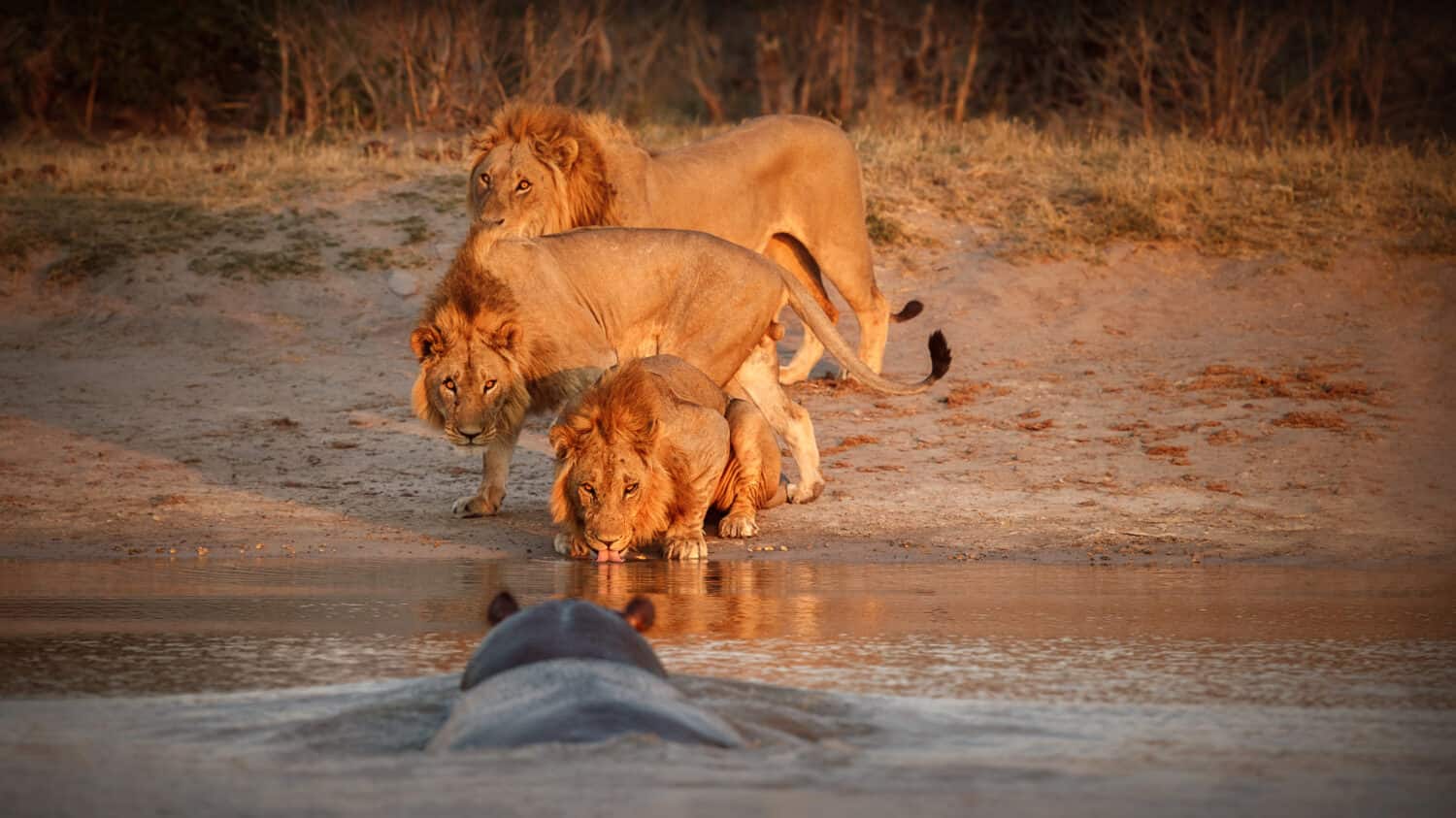
Lions are among Africa’s most feared predators, but even the kings of the savanna sometimes know when to retreat. In this remarkable wildlife encounter, a pride of lions is relaxing near the water when an enormous hippopotamus suddenly comes charging in their direction. Within seconds, several of the big cats are scrambling to get out of its way. But why would an entire group of powerful predators retreat from an animal that primarily eats grass? The answer reveals just how dangerous hippos can be.
Watch This Massive Hippo Send Lions Scrambling!
A Pride of Lions Gets an Unexpected Visitor
Across sub-Saharan Africa, lions share their environment with some of the world’s most formidable animals. From enormous buffalo and powerful Nile crocodiles to rival predators like hyenas and cheetahs, survival often depends on knowing when to stand your ground and when to walk away.
In this encounter shared by Latest Sightings, several lions are gathered near a body of water. It’s unclear exactly what brought them there. They could have been drinking, resting, or simply taking advantage of the shade and cooler surroundings.
Whatever their plans were, they are quickly interrupted when a large hippopotamus approaches the group.
The massive animal moves toward the lions with surprising speed, and several members of the pride immediately retreat. Rather than confronting the approaching giant, the big cats scatter to avoid its path. The encounter is brief, but it demonstrates something that might surprise anyone accustomed to seeing lions dominate their surroundings.
Even an apex predator has good reason to avoid a confrontation with an adult hippo.
Why Would a Hippo Charge at Lions?
Despite their rounded appearance and plant-based diet, hippopotamuses are powerful animals with a reputation for defensive aggression. They are particularly protective of their space in and around waterways, where they spend much of their time resting and staying cool.
According to the International Fund for Animal Welfare, hippos can behave aggressively when defending their territory. Dominant males are especially territorial in aquatic habitats, although both sexes can respond defensively when threatened.
This makes encounters at rivers and watering holes potentially dangerous. Lions may approach water to drink, while hippos depend on those same habitats for shelter and social interactions. When their paths cross, neither species necessarily welcomes the company.
However, the video cannot tell us exactly what motivated this individual hippo. It may have been responding to the lions’ presence, trying to clear a path, or reacting to something else entirely. What we can observe is the result: the hippo approaches, and the lions move away.
How Fast Can a Hippopotamus Run?
One of the most surprising things about hippos is their speed. Despite weighing several thousand pounds and possessing remarkably short legs relative to their massive bodies, these animals are capable of moving at impressive speeds over short distances.
According to the University of Michigan’s Animal Diversity Web, common hippos can reach approximately 30 kilometers per hour, or about 19 miles per hour, on land. Their powerful legs allow them to accelerate rapidly, making them surprisingly agile for animals of their size.
That speed becomes particularly important when a hippo feels threatened. An animal weighing thousands of pounds doesn’t need to pursue something for very long to present a serious danger, especially when its target is already close.
The lions in this video are fast and capable hunters themselves. Their decision to move away is not evidence that lions are inherently afraid of every hippo. Rather, avoiding a potentially dangerous confrontation can be the safest option, even for an experienced predator.
How Dangerous Is a Hippo’s Bite?
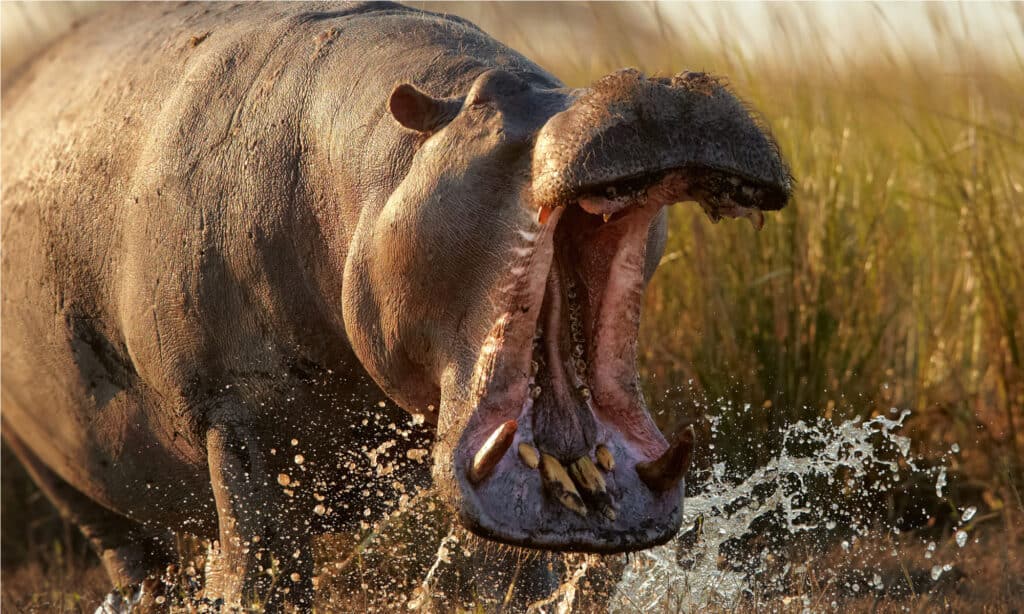
A hippo’s massive jaws and elongated canine teeth make it a formidable opponent.
©Martin Mecnarowski/Shutterstock.com
A hippopotamus doesn’t need to hunt other animals to possess one of the most intimidating sets of jaws in the animal kingdom. The common hippopotamus (Hippopotamus amphibius) has an enormous mouth equipped with elongated canine teeth used primarily for fighting and defense.
A 2020 medical study published in Oxford Medical Case Reports describes the remarkable anatomy of these animals. The authors report that a hippopotamus can open its mouth to approximately 150 degrees, while its lower canine teeth can measure roughly 30 to 50 centimeters, or about 12 to 20 inches, in length.
The study also cites an estimated bite pressure of approximately 12,600 kilopascals, equivalent to around 1,830 pounds per square inch. While estimates of animal bite strength vary depending on measurement methods, there is little question that a hippo’s jaws can inflict catastrophic injuries.
In the same study, researchers examined 11 patients who suffered hippopotamus bites in Burundi. The injuries included extensive tissue damage, serious infections, and cases requiring amputation. The authors emphasized that hippo-inflicted wounds should be treated as major trauma rather than ordinary animal bites.
For a lion, the consequences of such an injury could be devastating. Damage to a leg, jaw, or other vital body part could seriously compromise its ability to hunt, defend itself, or survive in the wild.
What Does This Behavior Mean?
The encounter illustrates an important reality of life in the wild: being an apex predator does not mean an animal is invincible. Lions are powerful hunters capable of bringing down formidable prey, but healthy adult hippos present an especially dangerous challenge because of their tremendous size, strength, and defensive capabilities.
Although lions have occasionally been documented attacking hippos, particularly younger or vulnerable individuals, confronting a healthy adult carries considerable risk. Sometimes the smarter survival strategy is simply to avoid a fight.
The same principle makes hippos dangerous to people. Anyone traveling through hippo habitat should maintain a safe distance, follow the instructions of experienced local guides, and never position themselves between a hippo and the water. Approaching or attempting to provoke a wild animal can endanger both people and wildlife.
As this remarkable encounter demonstrates, the animal at the top of the food chain isn’t necessarily the one everyone else wants to challenge. Sometimes all it takes is one determined hippopotamus to convince an entire group of powerful predators that it’s time to find somewhere else to relax.