
N
Species Profile

Nile Crocodile

Crocodylus niloticus

The Nile's armored ambush master
Rudi Hulshof/Shutterstock.com
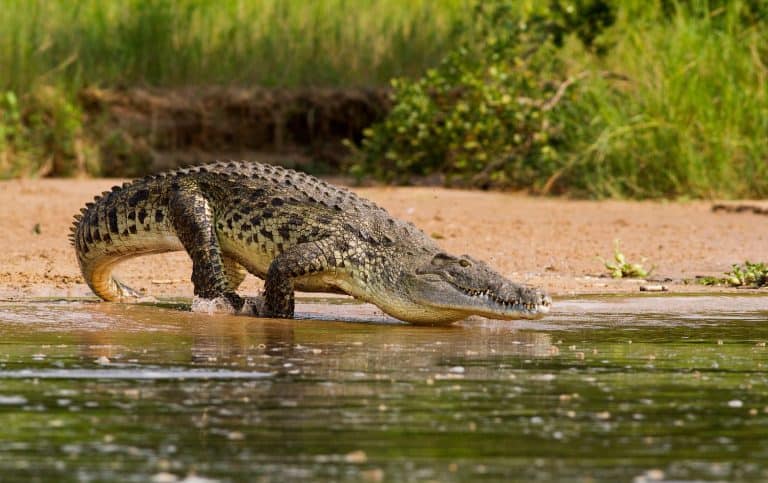
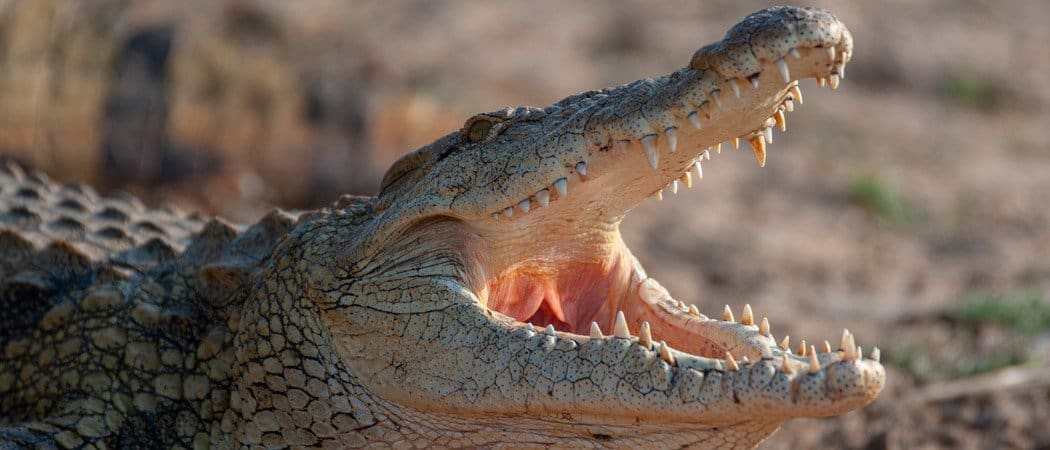
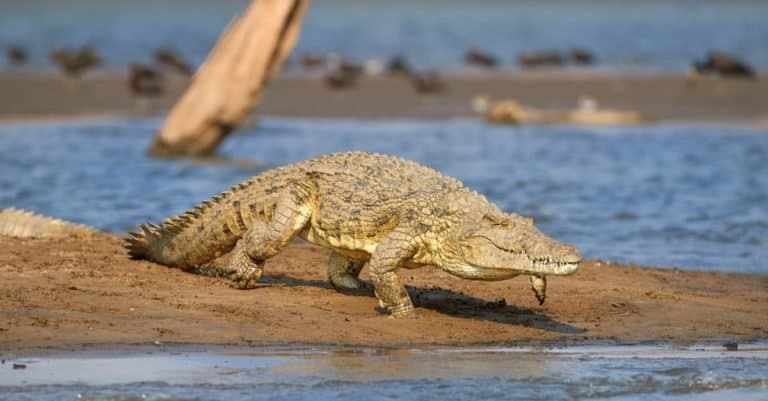
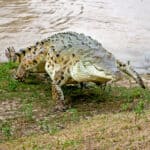
A Nile Crocodile seen on a safari in South Africa

At a Glance

Wild Species
Also Known As African crocodile, Egyptian crocodile, Nile croc, croc, African croc
Diet Carnivore
Activity Cathemeral+
Lifespan 50 years
Weight 750 lbs
Status Least Concern
Did You Know?

Size: adult males commonly ~3.5-5.0 m; females often ~2.2-3.8 m. Very large males can reach ~5.5-6.0 m (reports above this are debated).

Scientific Classification

The Nile crocodile is a large, predominantly freshwater crocodilian native to sub-Saharan Africa (and historically adjacent regions), and is among the largest living reptiles. It is an apex ambush predator that feeds on fish, birds, and mammals, and is well known for powerful territorial behavior and nesting/parental care typical of crocodilians.

Kingdom
Animalia
Phylum
Chordata
Class
Reptilia
Order
Crocodylia
Family
Crocodylidae
Genus
Crocodylus
Species
niloticus

Distinguishing Features

  • Large, robust crocodile with a broadish snout compared to some congeners
  • Heavy dorsal armor (osteoderms) and strongly muscled tail for propulsion
  • Adult coloration typically dark olive/bronze with darker banding; juveniles more distinctly banded
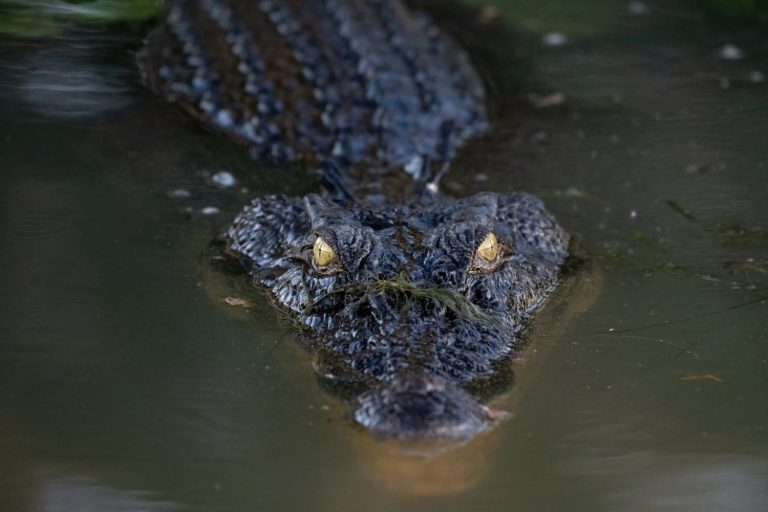
  • Nostrils and eyes positioned dorsally for surface breathing/vision while submerged

Physical Measurements

Males and females differ in size

Length
♂ 13 ft 1 in (9 ft 10 in – 19 ft 8 in)
♀ 9 ft 2 in (7 ft 3 in – 11 ft 6 in)
Weight
♂ 661 lbs (331 lbs – 1,543 lbs)
♀ 176 lbs (88 lbs – 331 lbs)
Tail Length
♂ 6 ft 3 in (4 ft 7 in – 9 ft 2 in)
♀ 4 ft 7 in (3 ft 3 in – 5 ft 11 in)
Top Speed
9 mph
swimming

Appearance

Primary Colors
Secondary Colors
Skin Type Thick, keratinized, heavily armored skin with keeled dorsal scales and prominent osteoderms (scutes).
Distinctive Features
  • Large crocodylid with robust build; adults commonly ~3.5-5.0 m, males larger than females (IUCN species account; standard crocodilian references).
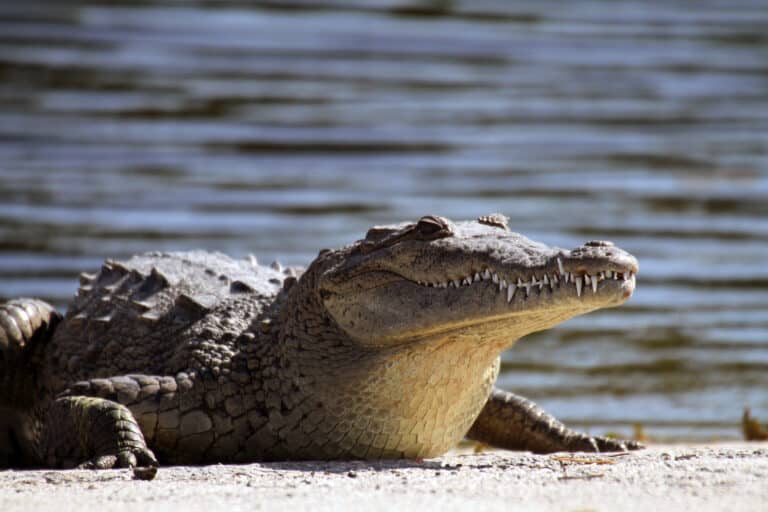
  • Broad, triangular snout; as in Crocodylus, the 4th lower jaw tooth remains visible when mouth is closed.
  • Dark dorsal scute rows forming a strongly armored back; tail laterally compressed with raised dorsal ridges for propulsion.
  • Eyes and nostrils positioned dorsally, enabling near-submerged ambush posture at the water surface.
  • Juvenile patterning shows crisp dark bands and spots; adults tend to darken and lose sharp band contrast.
  • Coloration and pattern provide strong camouflage in turbid freshwater systems across sub-Saharan Africa; older sources may conflate some West African records with Crocodylus suchus.

Sexual Dimorphism

Males grow substantially longer and heavier, with broader heads and thicker necks. Females remain shorter and more gracile, with proportionally narrower snouts and less massive cranial musculature.

♂
  • Typically longer and heavier; commonly ~3.5-5.0 m adults, exceptionally larger in some reports.
  • Broader head and more robust jawline; thicker neck and torso.
  • More prominent overall bulk and tail base thickness.
♀
  • Typically smaller; often ~2.6-3.2 m adult length in many populations.
  • Narrower head and generally more slender body profile.
  • Less pronounced cranial and neck robustness compared with males.

Did You Know?

Size: adult males commonly ~3.5-5.0 m; females often ~2.2-3.8 m. Very large males can reach ~5.5-6.0 m (reports above this are debated).

Mass: large adult males commonly ~225-550 kg; exceptionally large individuals can exceed ~700 kg (field records vary by region and method).

Longevity: typically ~45-70 years; in captivity, individuals can exceed ~70 years (crocodilians are long-lived).

Reproduction: females lay about 25-80 eggs per clutch (often ~40-60); incubation commonly ~80-90 days, with temperature-dependent sex determination.

Diet shift with age: hatchlings/juveniles focus on insects and small fish; adults expand to fish, birds, and mammals (including large ungulates) as gape and strength increase.

Parental care: females guard nests and often assist hatchlings to water; hatchlings use vocal calls to coordinate hatching and elicit protection.

Unique Adaptations

  • Integumentary Sensory Organs (ISOs): tiny pressure-sensitive domes on the jaws that detect minute water movements-useful for hunting in turbid rivers and at night.
  • Palatal valve and secondary palate: allows breathing while the mouth is open underwater and helps keep water out of the throat during captures.
  • Osteoderms (bony scutes): armored skin provides protection and also functions in heat exchange by absorbing and releasing warmth.
  • Powerful tail propulsion and diving physiology: efficient burst swimming plus bradycardia (slowed heart rate) during dives aids stealth and underwater endurance.
  • Crocodilian cardiovascular system: a four-chambered heart with controlled shunting supports both aerobic activity on land and prolonged submergence.
  • Conical, replaceable teeth: teeth are continually replaced through life, maintaining a functional bite despite wear and breakage.

Interesting Behaviors

  • Ambush predation: waits motionless at the surface or submerged at banks, then launches a rapid strike; commonly targets animals drinking or crossing.
  • "Death roll" and tearing: grips prey and rotates the body to dismember or reduce large prey for swallowing.
  • Seasonal concentration at prey bottlenecks: individuals may patrol or station near game trails, river crossings, and fish runs where capture success is high.
  • Territoriality and dominance: large males defend prime basking and feeding areas; confrontations include posturing, tail slaps, and open-mouth displays.
  • Thermoregulation: prolonged basking plus "gaping" (holding jaws open) to shed heat; shifts between sun and water to fine-tune body temperature.
  • Nest defense and nursery-group behavior: females aggressively guard nest sites; hatchlings may form groups in shallow water or vegetated margins under adult vigilance.
  • Acoustic communication: hatchlings emit high-pitched distress/contact calls; adults use low-frequency bellows and water-vibration displays during breeding seasons.

Cultural Significance

The Nile crocodile (Crocodylus niloticus) has long shaped river cultures. In Ancient Egypt, Sobek and mummified crocodiles stood for Nile power and protection. Today they are spiritual symbols, dangers and tourist draws, cause local conflict, and need careful identification to tell them apart from the West African crocodile.

Myths & Legends

Ancient Egypt: Sobek, the crocodile-headed deity, was honored as a god of the Nile's fertile floods and a guardian of pharaohs; temples and priesthoods kept sacred crocodiles adorned with jewelry and later mummified as offerings.

Ancient Egyptian sacred geography: at Kom Ombo and the Faiyum, living crocodiles were treated as embodiments or servants of Sobek, fed by priests and approached with ritual caution as divine but dangerous beings.

At Paga, Ghana, sacred crocodile stories say a crocodile saved an ancestor, leading to a promise to protect crocodiles. Species (like Nile Crocodile, Crocodylus niloticus) vary and were sometimes misidentified.

Madagascar river folklore: in some communities, crocodiles are treated as connected to ancestors or local spirits, with taboos and offerings at waterways to avoid offending powerful river beings.

Nile crocodile Crocodylus niloticus appears as a clan totem in parts of East Africa; oral stories call it an ancestral protector linked to rivers, strength, and life at the water's edge.

Conservation Status

LC Least Concern

Widespread and abundant in the wild.

Population Decreasing

Protected Under

  • CITES: Appendix I for some populations and Appendix II for others (trade regulated; population-dependent listings)
  • National wildlife protection legislation in many range states; hunting/harvest typically controlled via permits/quotas where allowed
  • Occurs in numerous protected areas (e.g., national parks and Ramsar-listed wetlands), offering refuge from persecution and habitat conversion

Life Cycle

Birth 50 hatchlings
Lifespan 50 years

Lifespan

In the Wild
25–70 years
In Captivity
30–100 years

Reproduction

Mating System Polygyny
Social Structure Aggregation Group
Breeding Pattern Seasonal
Fertilization Internal Fertilization
Birth Type Internal_fertilization

Dominant males defend territories and mate with multiple females during a seasonal breeding period, with intense male-male competition. Females nest and provide maternal guarding alone; genetic paternity work indicates occasional multiple paternity, implying some female multiple mating.

Behavior & Ecology

Social Bask Group: 8
Activity Cathemeral, Diurnal, Nocturnal, Crepuscular
Diet Carnivore Fish (dominant prey for juveniles/subadults; adults remain highly piscivorous when fish are abundant)
Seasonal Hibernates

Temperament

Apex ambush predator; adults can be strongly territorial in water and at basking/nesting sites [Cott 1961; Pooley 1989].
Dominance interactions are common at high-density "hub" sites (sandbanks, pools, carcasses); tolerance increases with abundant space/food, but aggression rises when crowded (notably dry season) [Cott 1961].
Breeding-season males are especially aggressive toward rivals; combat and bite-scarring are documented in dense populations [Pooley 1989].
Female parental care is pronounced for a reptile: nest guarding, assistance at hatching, and short-term guarding of nursery groups are reported [Cott 1961].
Life-history context for sociality: maturity is slow (often >10 years), and longevity is high (multi-decade; commonly cited 50+ years) [Pooley 1989; IUCN Crocodylus niloticus assessment].

Communication

Hatchling distress calls (high-pitched chirps) elicit female nest opening and transport to water [Cott 1961].
Adult bellows/roars and grunts increase in courtship/mating contexts; used in spacing and sexual signaling [Pooley 1989].
Hissing and explosive exhalations occur during threat displays and close-range confrontations [Pooley 1989].
Water slaps (head-slapping) and jaw-claps as acoustic/visual threat and display signals [Pooley 1989].
Postural displays: elevated head, arched tail, open-mouth gaping; used to deter approach and assert dominance [Cott 1961].
Tactile communication in parenting: gentle nudging and mouth-carrying of hatchlings; contact maintains nursery group cohesion [Cott 1961].
Chemical cues from cloacal glands and feces likely contribute to territorial marking and individual recognition, as in other Crocodylus species [Garrick & Lang 1977; Pooley 1989].

Habitat

Biomes:
Freshwater Wetland Marine Savanna Tropical Dry Forest
Terrain:
Riverine Valley Plains Coastal Island Sandy Muddy +1
Elevation: Up to 6561 ft 8 in

Ecological Role

Apex aquatic-to-riparian predator and opportunistic scavenger that links aquatic and terrestrial food webs.

Regulates prey populations (fish, waterbirds, and water-edge mammals), helping structure community dynamics in rivers and lakes Scavenging accelerates nutrient recycling from carcasses in aquatic systems Transfers nutrients across ecosystem boundaries via feeding/caching and defecation, enriching riparian and aquatic habitats Creates localized predation risk ("landscape of fear") that can influence herbivore water-use patterns and indirectly affect vegetation and bank erosion Supports biodiversity by maintaining healthy fish assemblages through selective predation on vulnerable individuals (context-dependent, varies by system)

Diet Details

Main Prey:
Fish Aquatic and semi-aquatic birds Medium-to-large mammals Primates and riparian mammals Livestock Reptiles Amphibians Crustaceans and other aquatic invertebrates Carrion of large vertebrates +3

Human Interaction

Domestication Status

Wild

The Nile Crocodile (Crocodylus niloticus) is not domesticated. Humans have long connected it to culture, including religious rituals and mummification in ancient Egypt. Today it is taken by regulated wild harvests, ranches, and farms for skins and meat, but these use wild animals and do not make domesticated breeds. It is CITES-listed (mostly Appendix II).

Danger Level

Extreme
  • Predatory attacks on people at water edges or in shallow water (ambush predation typical of large crocodilians)
  • Drowning during attack (common fatal mechanism)
  • Territorial or nest-defense aggression, especially during breeding/nesting seasons
  • Bites causing catastrophic trauma and infection risk (polymicrobial wound infection possible)
  • High risk around fishing/river crossings/water collection sites and in areas where crocodiles are habituated to human presence

As a Pet

Not Suitable as Pet

Legality: Nile Crocodile (Crocodylus niloticus) is usually illegal or very restricted as a pet. Only licensed zoos, farms, or research centers may keep them with many permits, safety and welfare rules. Trade is controlled by CITES and local laws.

Care Level: Expert Only

Purchase Cost: $50 - $500
Lifetime Cost: $20,000 - $250,000

Economic Value

Uses:
Commercial leather (high-value skins) Meat production (local consumption and export in some regions) Egg/juvenile harvest for ranching operations Ecotourism (crocodile viewing in protected areas/rivers) Human-wildlife conflict costs (livestock losses, injury/death, safety infrastructure)
Products:
  • Tanned crocodile leather (luxury goods: bags, belts, shoes)
  • Crocodile meat
  • Live animals for licensed farms/zoos (regulated)
  • Tourism services (boat safaris, guided viewing)

Relationships

Related Species 9

West African crocodile Crocodylus suchus Shared Genus
Saltwater crocodile Crocodylus porosus Shared Genus
American crocodile Crocodylus acutus Shared Genus
Mugger crocodile Crocodylus palustris Shared Genus
Morelet's crocodile Crocodylus moreletii Shared Genus
Orinoco crocodile
Orinoco crocodile Crocodylus intermedius Shared Genus
Cuban crocodile Crocodylus rhombifer Shared Genus
Dwarf crocodile
Dwarf crocodile Osteolaemus tetraspis Shared Family
Slender-snouted crocodile Mecistops cataphractus Shared Family

A female Nile crocodile has a special pouch in her throat where she hides her young from predators.

An adult Nile crocodile can be as long as 20 feet! They are carnivores that can subdue and eat large mammals. This crocodile lives in various places throughout sub-Saharan Africa as well as in the Nile basin and western Madagascar. These reptiles communicate with one another by hissing and growling. They can live to be at least 45 years old in the wild.
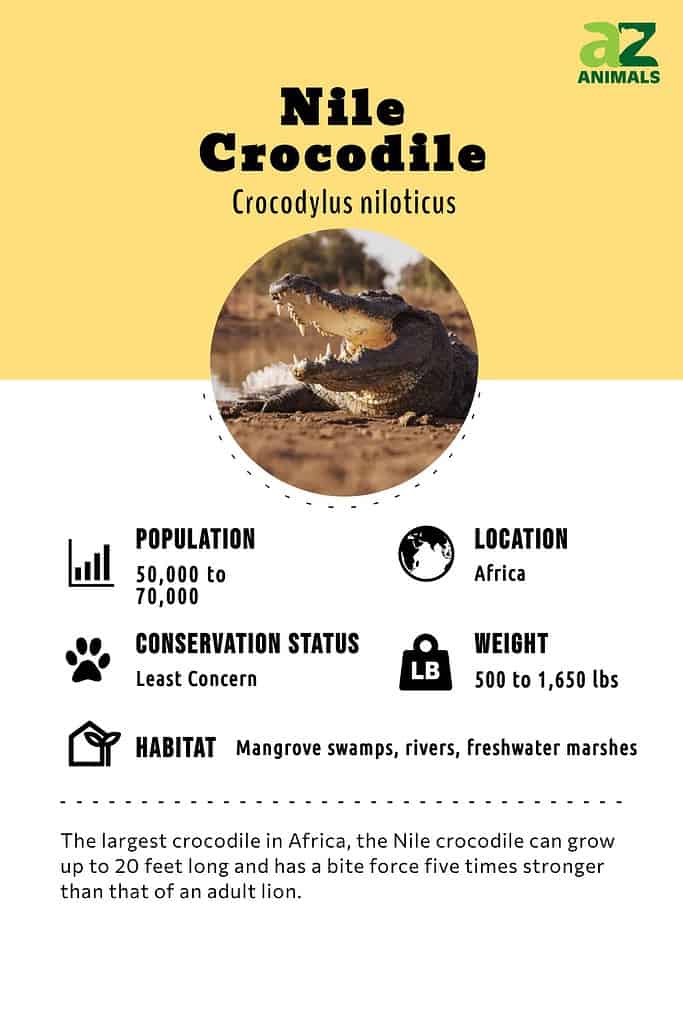
5 Incredible Nile Crocodile Facts!

  • Both crocodile parents stay with their nest of eggs to protect their young from predators.
  • It’s estimated that 200 people are killed each year by Nile crocodiles.
  • These crocodiles can swim at a speed of 22 mph.
  • The bite force of this crocodile is five times stronger than that of a lion.
  • The Nile crocodile is the largest crocodile in Africa.
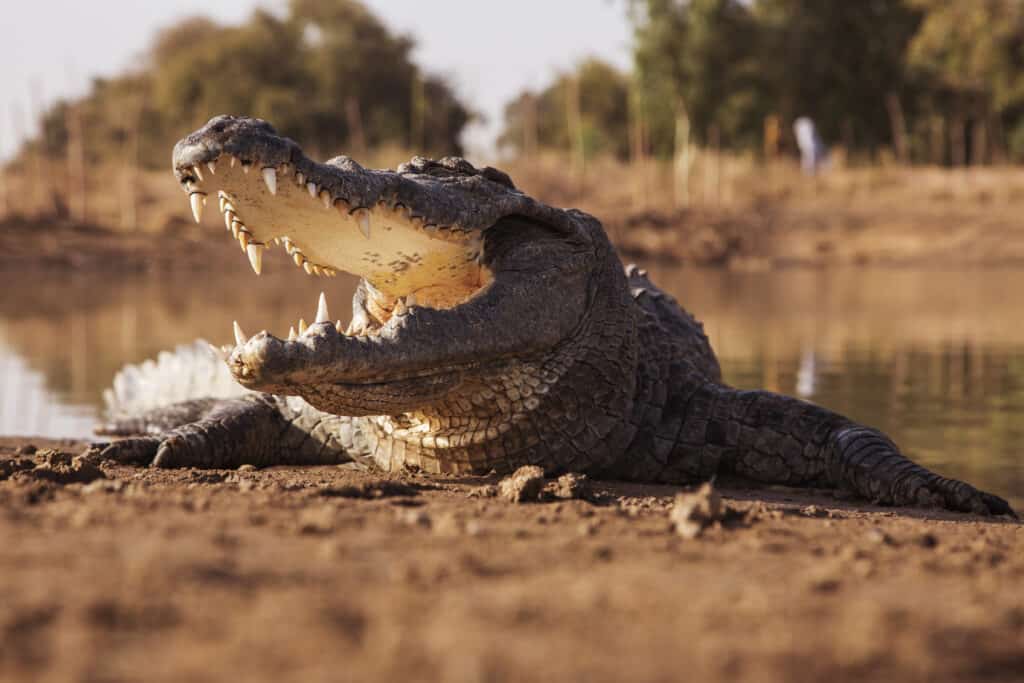
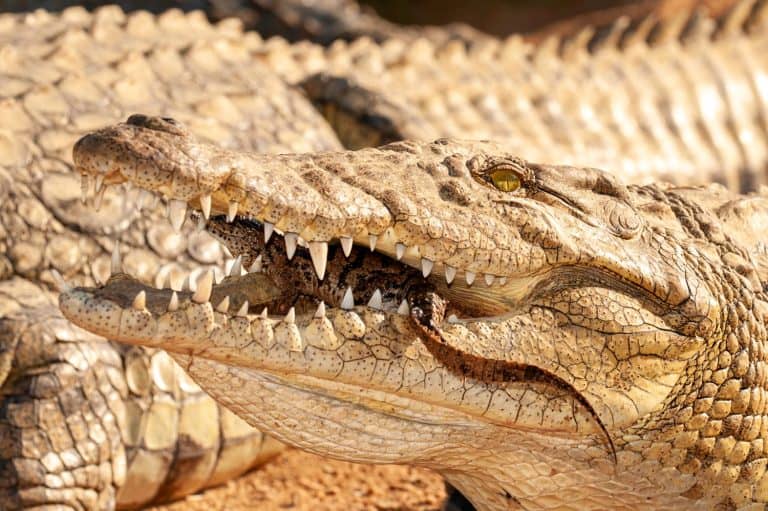
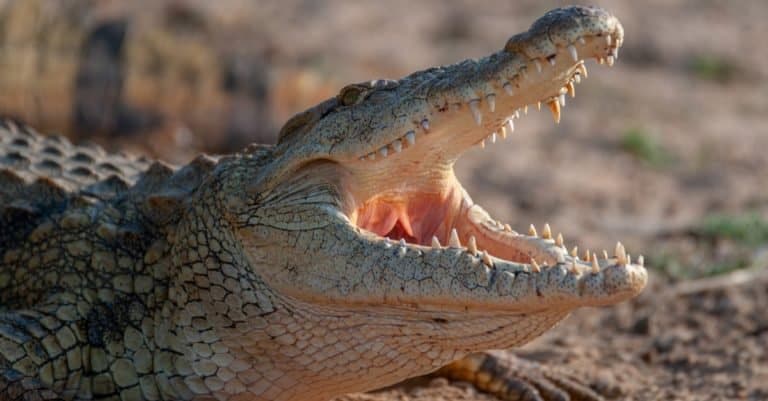
Nile crocodile jaws

The Nile crocodile is the biggest crocodile species in Africa.

Scientific Name

The scientific name of this crocodile is Crocodylus niloticus. Crocodylus comes from the Greek word meaning lizard and niloticus means from the Nile River. It belongs to the Crocodylidae family and the class Reptilia.
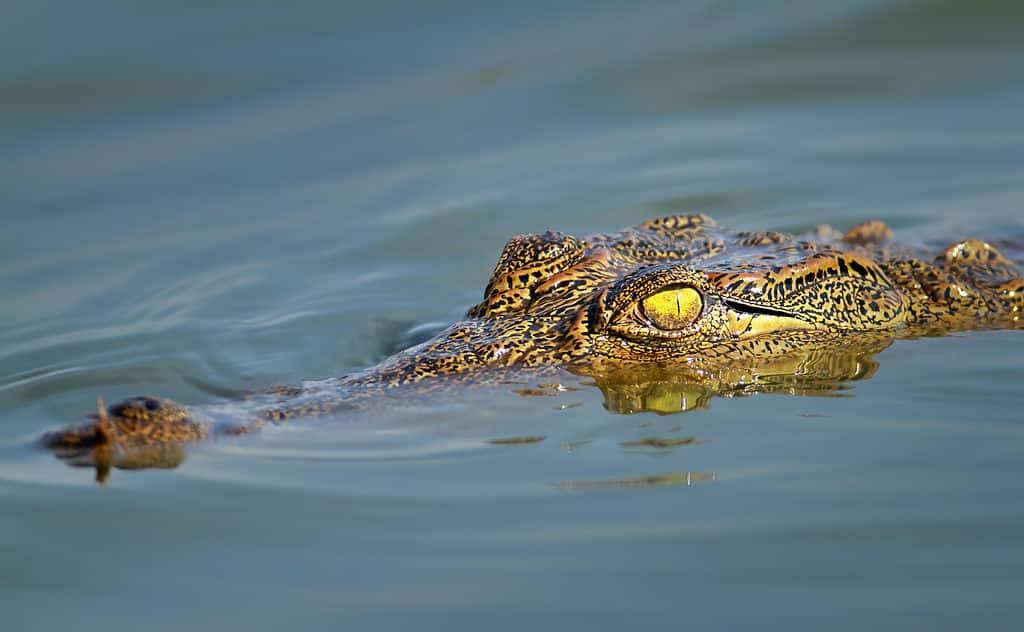
Nile crocodile staying just under the water surface

Its scientific name Crocodylus niloticus refers to the Nile River.

Types of Nile Crocodile

There are no subspecies of the Nile crocodile officially recognized, but up to seven subspecies have been proposed primarily due to differences in appearance and size. These include C. n. africanus (commonly referred to as the East African Nile crocodile), C. n. chamses (called the West African Nile crocodile), C. n. cowiei (the South African Nile crocodile), C. n. madagascariensis (known as the Malagasy or Madagascar Nile crocodile), C. n. niloticus (as the Ethiopian Nile crocodile this would become the nominate subspecies if recognized), and C. n. pauciscutatus (named the Kenyan Nile crocodile). However, none of these have been formally confirmed as subspecies.

In 2011, researchers from Fordham University in New York discovered that crocodiles previously considered Nile crocodiles were in fact from another, distantly related species. This species was the West African crocodile (Crocodylus suchus), also known as the desert crocodile or sacred crocodile.

The scientists conducted DNA analysis of samples and found that the West African crocodile matched the museum-sourced 2,000-year-old mummified crocodile samples, indicating that it was present in ancient Egyptian times. The West African crocodile is smaller and more docile than the Nile crocodile, and its population is declining due to habitat loss and being hunted for its meat and skin.
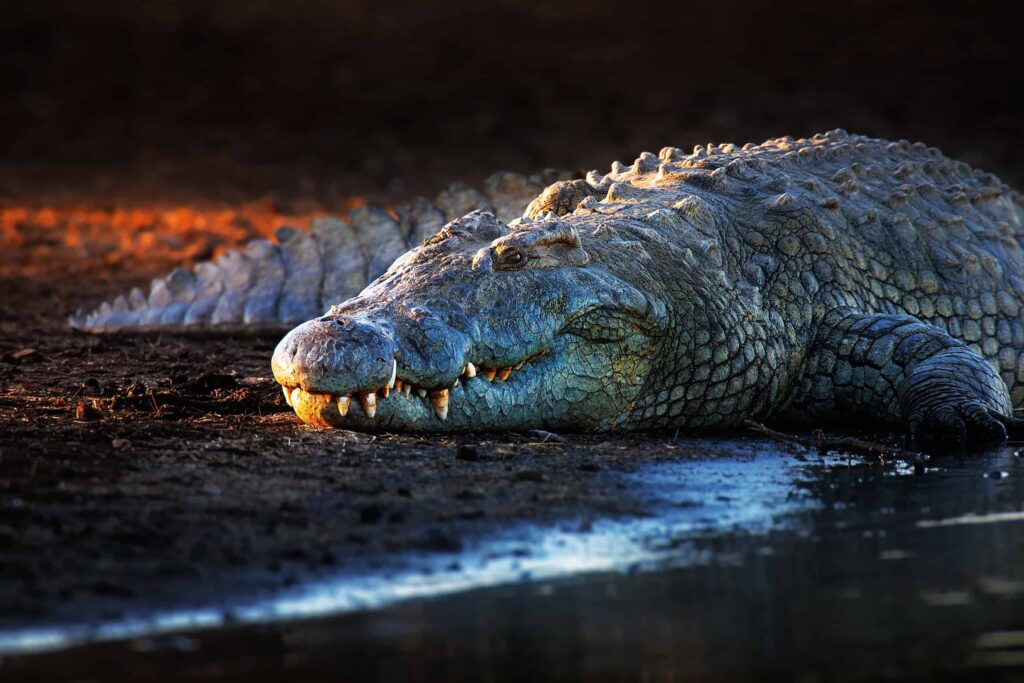
crocodile

Several subspecies of the Nile crocodile have been proposed but none formally recognized.

Evolution and Origins

While many refer to crocodiles as “living fossils” that have not evolved for millions of years, the genetic evidence collected by the Fordham University researchers shows that Nile crocodiles are adaptable like other modern species.

They also discovered that the Nile crocodile’s closest relations are four crocodiles species of the Americas: C. acutus (the American), C. rhombifer (Cuban), C. moreletii (Morelet’s), and C. intermedius (Orinoco).

The researchers believe it was only possibly within the past 3 million years that the genus Crocodylus migrated out of Africa, with the Nile crocodile making its way to the Western Hemisphere by rafting or swimming.

Fossil evidence dating from the Plio-Pleistocene era 5.3 million years ago to 11,700 years ago suggests two extinct Crocodylus species from Africa, C. anthropophagus and C. thorbjarnarsoni, were closely related to the Nile crocodile.
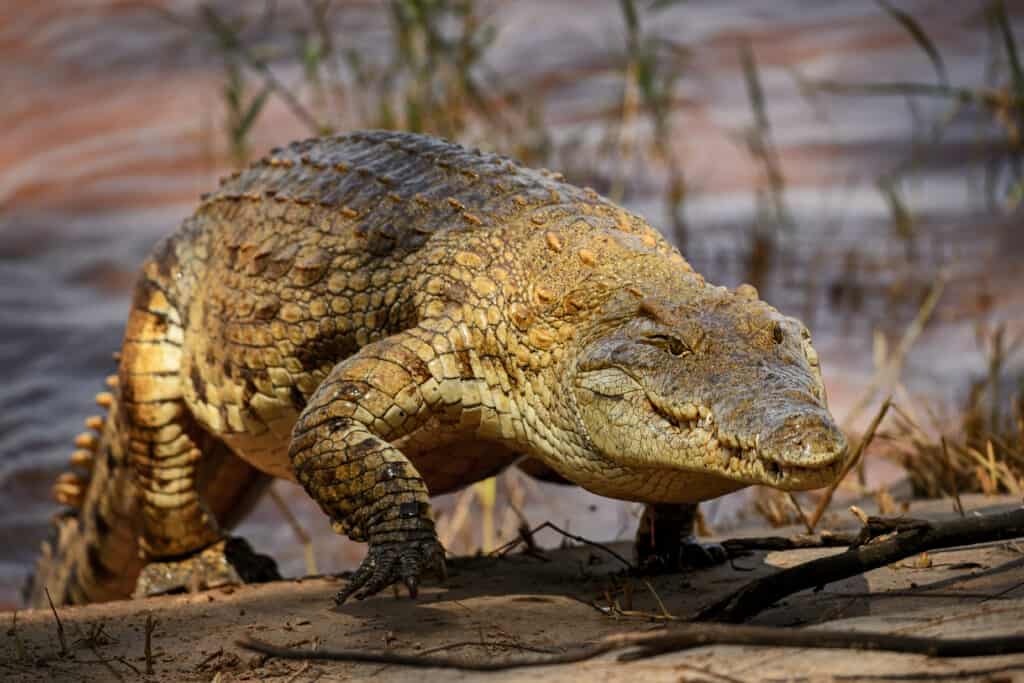
Nile Crocodile

Many refer to crocodiles as “living fossils” but recent research shows this is a misnomer.

Appearance

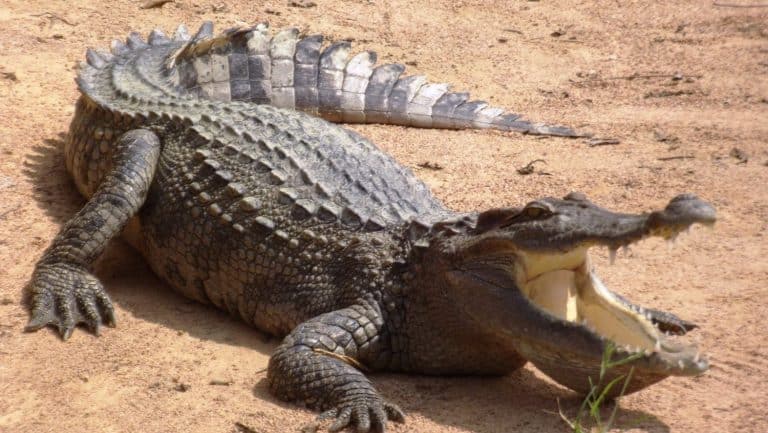
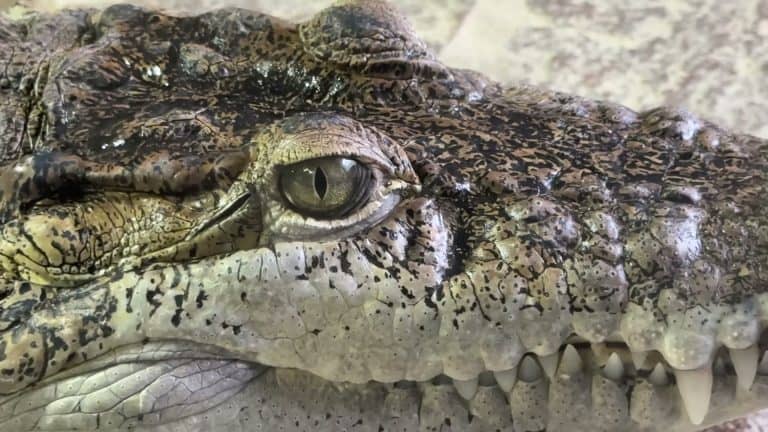
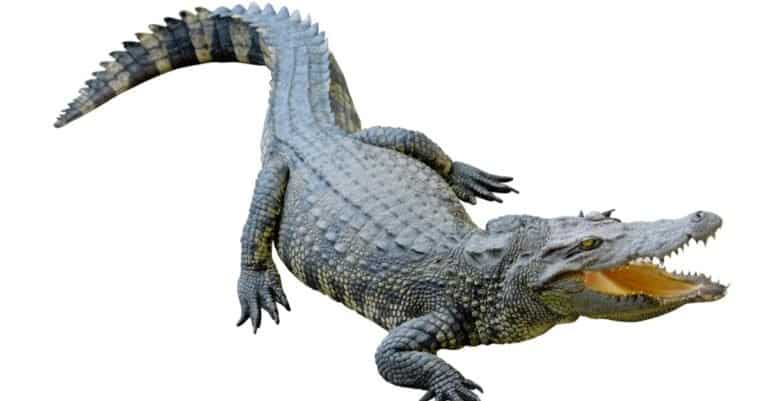
A Nile crocodile looks a lot like a giant lizard. Its body is covered in tough scales that are grayish-brown or olive in color. In addition, this reptile has crossbands of dark scales covering its powerful tail. The Nile crocodile has four short legs along with clawed feet. Their back feet are webbed making them excellent swimmers. They have green eyes with vertical pupils specially designed to help them see in their watery environment at night.

One of the most fearsome things about the Nile crocodile is its size. They grow to an average length of 16 feet but can measure as long as 20 feet. They weigh from 500 pounds to 1,650 pounds. As a comparison, from its nose to the tip of its tail a 20-foot crocodile is the same length as three-quarters of a London bus. A 1,650-pound Nile crocodile is equal in weight to half of an average car. No wonder these reptiles are so confident when attacking large prey!

A Nile crocodile named Gustave is the largest one on record at more than 20 feet long.

The dark scales of these crocodiles help them to blend into their environment. However, adult Nile crocodiles have no predators except humans. Their ability to blend into their environment helps them when stalking and attacking their prey.
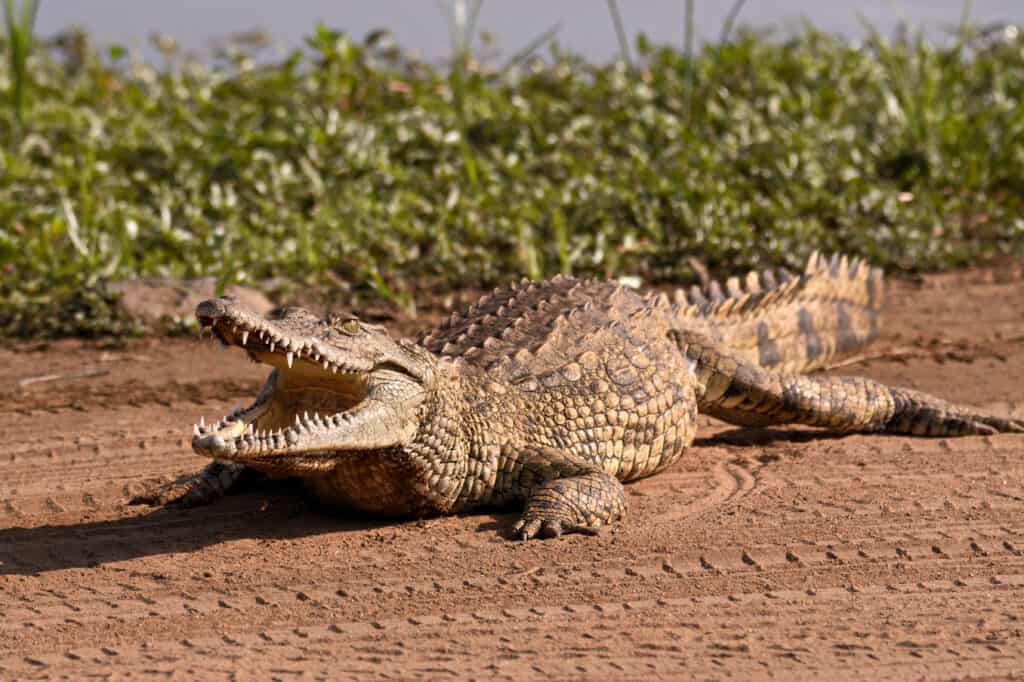
On average, a Nile crocodile can grow to 16 feet and weigh 500-1,650 pounds.

Nile Crocodile vs Saltwater Crocodile

When comparing the Nile crocodile to the saltwater crocodile the first thing to note is the saltwater crocodile is the larger of the two. In fact, the saltwater crocodile holds the title of the biggest crocodile in the world. The Nile crocodile is the second-largest.

Another difference between these two crocodiles is the Nile crocodile lives in freshwater habitats in Africa. The saltwater crocodile lives in southeast Asia, northern Australia, and eastern India.

Not surprisingly, these two gigantic crocodiles have some things in common as well. For one, they both have a diet of fish along with birds and large mammals. Both types can live 45-plus years in the wild and even longer in captivity. Also, both crocodiles have a tremendously strong bite force.
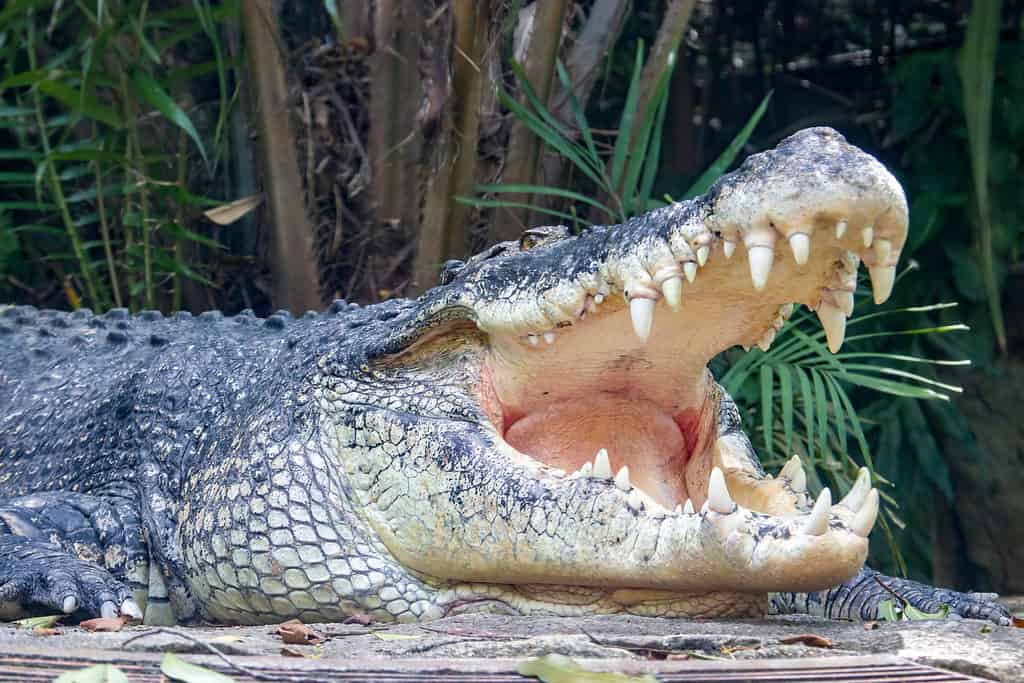
Saltwater crocodile (Crocodylus porosus)

The saltwater crocodile is larger than the Nile crocodile.

Behavior

Nile crocodiles are known for their ability to burrow. They use their clawed feet to burrow so they can go underground if the weather becomes too cold or hot for them to survive. Some of these burrows are 12 feet deep while others are close to 40 feet deep. These reptiles retreat into their burrow and go into a state similar to hibernation called aestivation. During aestivation, a crocodile’s heart beats just twice a minute.

This crocodile uses its teeth and tremendous bite force to grab onto its prey. Its bite force can be as strong as 5,000 Ibf. Lbf refers to the weight of the crocodile and the force of its bite. Think of it this way: The strength of a Nile crocodile’s bite is five times more than the bite force of an adult lion.

One of the most interesting facts about this reptile is it can be both solitary and social. They may hunt alone or work with other Nile crocodiles to trap and eat a school of fish. Also, Nile crocodile parents work together to protect their eggs from predators. These crocodiles can sometimes coexist in the same territory.

A gathering of four or five crocodiles lying in the sun on shore is called a bask. Alternatively, a group of crocodiles swimming together is called a float.

Due to their size, these crocodiles are aggressive and have no hesitation in attacking large mammals and humans near the shoreline.
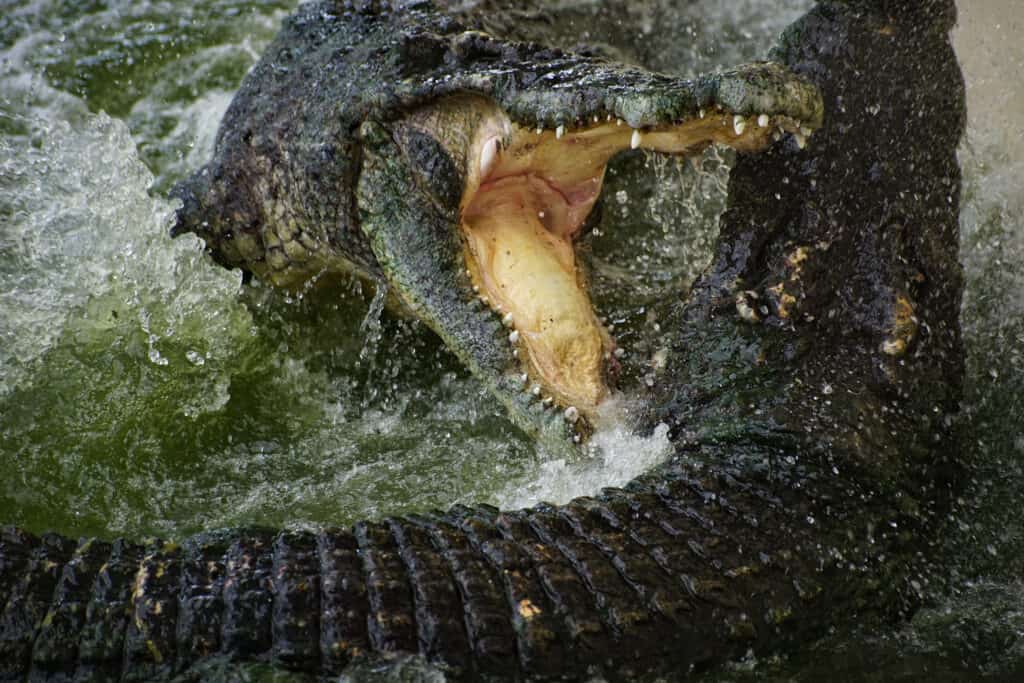
A Nile crocodile’s bite is five times stronger than that of an adult lion.

Habitat

These reptiles live in sub-Saharan Africa, the Nile basin, and western Madagascar. Specifically, they live in freshwater swamps, mangrove swamps, rivers, estuaries, and large lakes.

These cold-blooded reptiles live in a moderate climate and rely on the sun’s rays to keep them warm. They spend most of the day basking in the sun without moving. If a crocodile starts to get too hot in the sun, it opens its mouth to let excess heat pour out and evaporate. In the evening, they go back into the water to hunt and cool off. When the weather gets too cold for them to survive, these reptiles dig a burrow and go into aestivation underground.

Some Nile crocodiles migrate to different areas to find a larger food supply or to find a suitable place to make a nest.

Interestingly, there have been a few of these crocodiles seen and captured in the Everglades in Florida. It seems very strange that crocodiles from Africa should show up in south Florida! Biologists have some theories as to how these crocodiles arrived in the Everglades. The main theory is reptile collectors illegally sold hatchlings to people in the United States. Before long, the crocodiles got too big for their owners to care for. Consequently, they were released into the Florida Everglades.
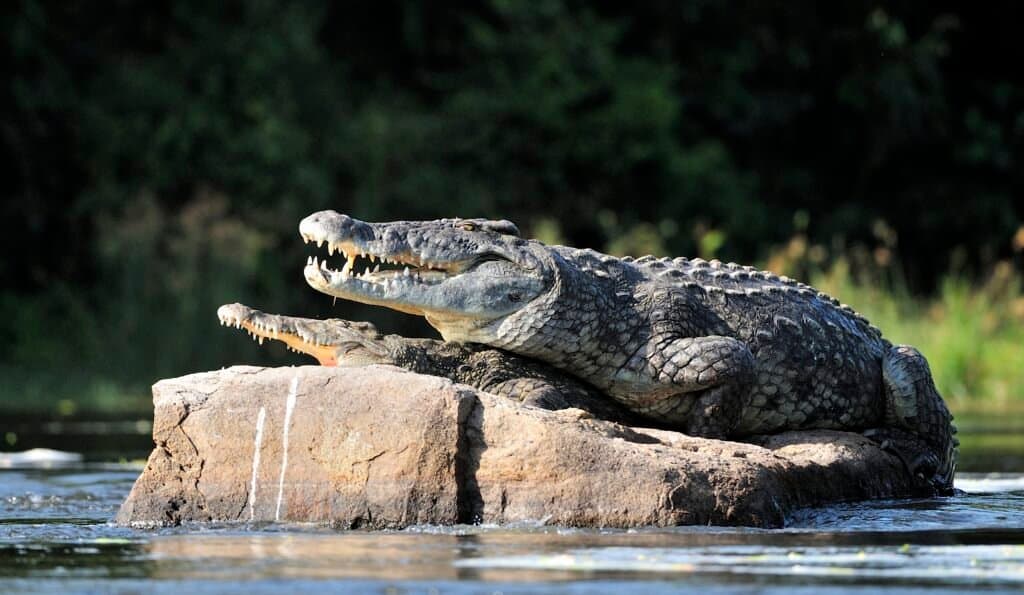
Nile crocodiles spend most of their day basking in the sun to keep warm.

Diet

Nile crocodiles are carnivores. They usually hunt in the evening and at night. This crocodile can consume a supply of food equal to half its body weight. So, a 1,000-pound Nile crocodile could eat a 500-pound zebra in a single meal.

Being the biggest crocodile in Africa means this reptile has a lot of prey to choose from. Nile crocodiles eat a variety of fish. They are also known for attacking large mammals such as zebras, buffalo, antelope, and even small hippos.

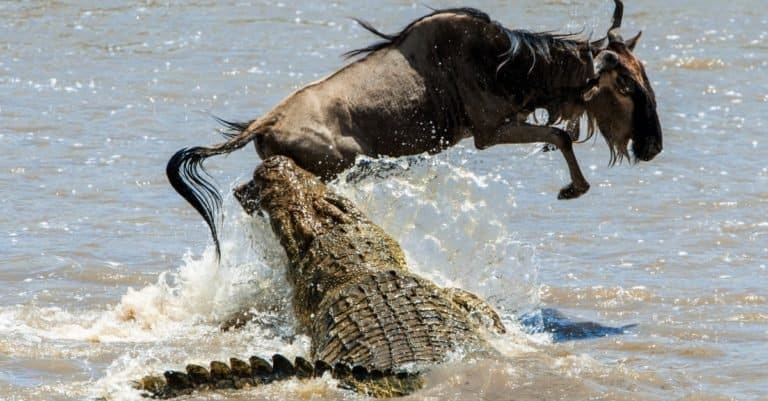
A Nile crocodile is able to remain very still watching a mammal such as a zebra or an antelope taking a drink from a river or lake. Though these crocodiles are large, they are also very fast. They dart up out of the water and clamp down on their prey using their tremendous bite force to hold and subdue it.
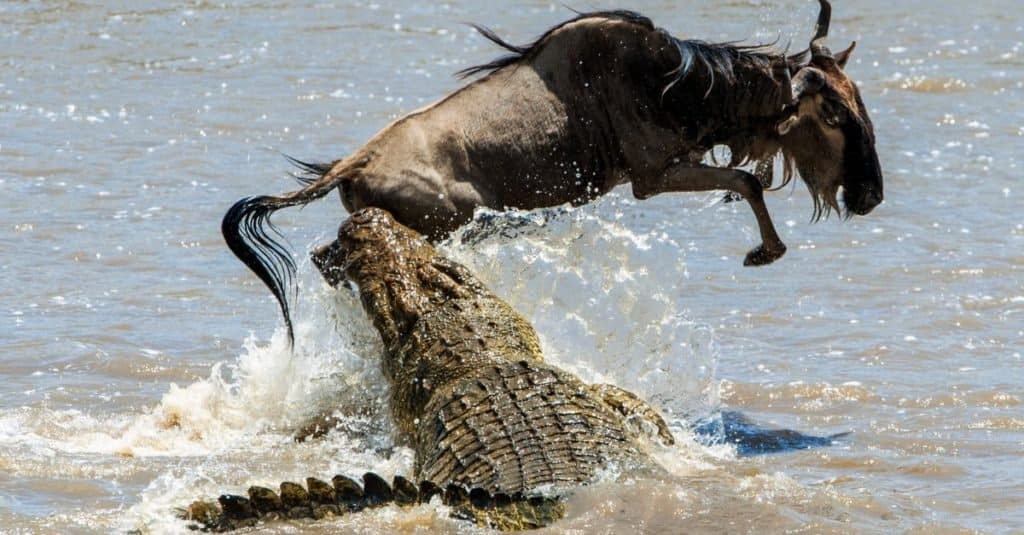
Blue wildebeest ( Connochaetes taurinus ) being attacked by a huge Nile Crocodile.

The Nile crocodile can consume prey that is half its body weight.

Predators and Threats

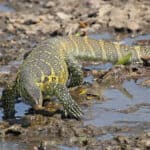
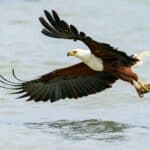
Nile crocodiles don’t have any natural predators. Young Nile crocodiles are targeted by many predators, including Nile monitor lizards, African fish eagles, snakes, and honey badgers.

The main threat to these crocodiles is humans, causing habitat loss due to land development. In addition, the crocs sometimes become entangled in commercial fishing nets and die. Poaching is another threat to these crocodiles, who are hunted for their meat and eggs.
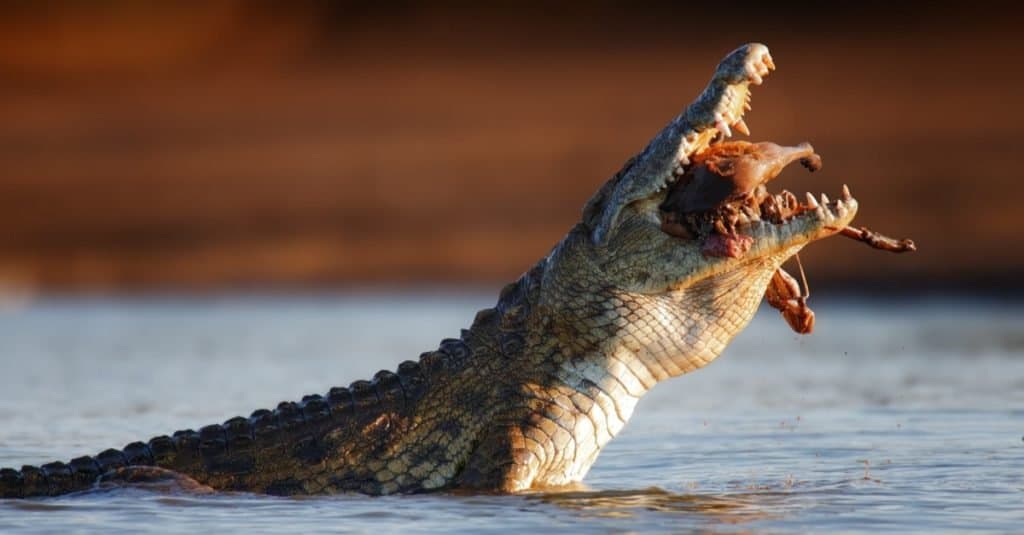
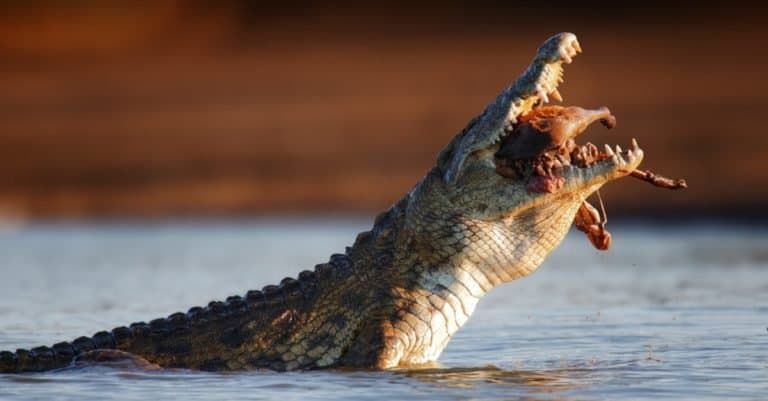
Nile crocodile (Crocodylus niloticus) swallowing an Impala - Kruger National Park (South Africa)

Nile crocodiles are apex predators so do not have any natural enemies in their habitats.

Reproduction, Babies, and Lifespan

The mating period of this crocodile happens during the dry season. Male crocodiles try to attract females by splashing with their snouts, spraying water, and making growling sounds. Once the strongest male drives all the others away, the female and male mate. Most male crocodiles mate with many females during the breeding season. But the male Nile crocodile stays with a female to guard their nest of eggs. That’s one of the most unusual facts about this crocodile. As a general rule, most reptiles lay their eggs and leave them.

The female digs a burrow about 20 inches deep to serve as a nest for her eggs. She lays 25 to 80 eggs in the burrow and pushes sand over them. The eggs are about 3 inches long and weigh a few ounces. The incubation period is around 90 days.

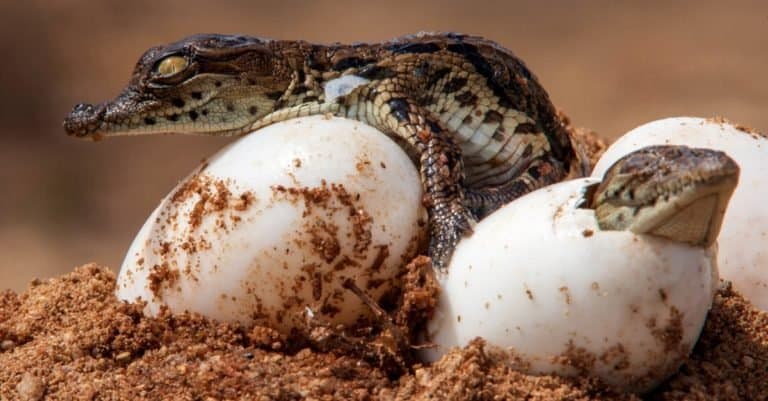
Baby crocodiles are called hatchlings. If a hatchling is having trouble breaking out of its egg, the female crocodile may put it in her mouth and roll it around to help with the hatching process. Once the eggs hatch, the female takes the hatchlings into her mouth and carries them to the water. Hatchlings can see, walk, and swim from birth. They stay with their mother for the first two months of life. During that time, the hatchlings learn to capture insects and small fish. Though the mother crocodile gives them protection, hatchlings are vulnerable to many predators.

The typical prey of these crocodiles increases in size as the crocodile grows. So, by the time this reptile reaches adulthood, it’s eating large mammals.

These crocodiles can live 45 years or more in the wild. These reptiles live even longer in captivity. Henry, a Nile crocodile living in South Africa, is believed to be the oldest at 122 years old in 2022!
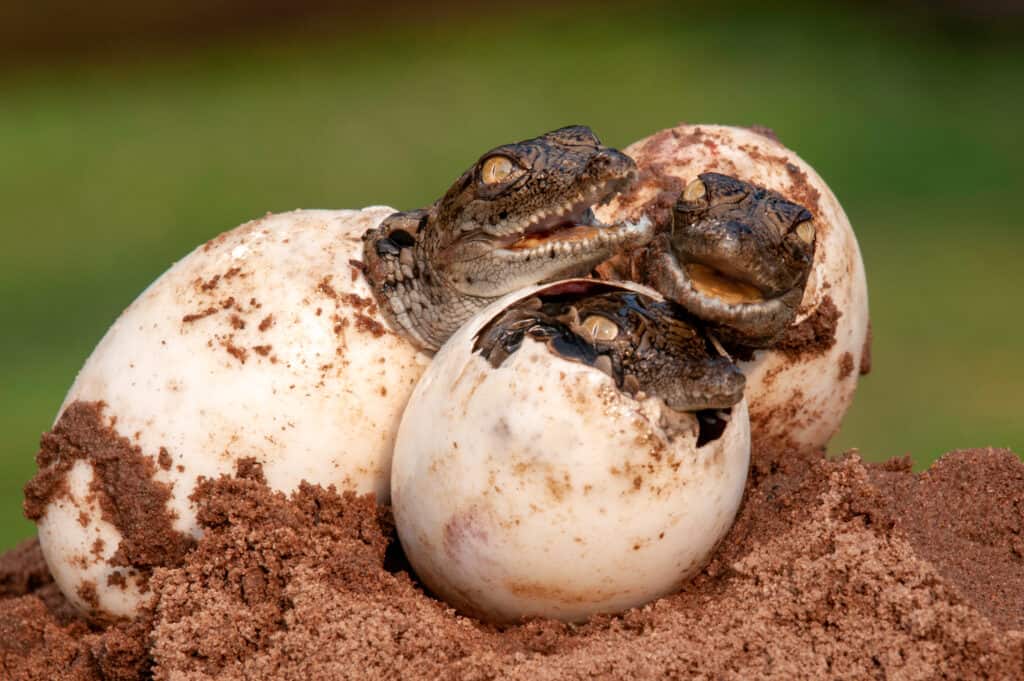
Baby crocodiles are called hatchlings and can see, walk, and swim from birth.

Population and Conservation

Scientists estimate the population of these crocodiles at 50,000 to 70,000 mature individuals.

The International Union for Conservation of Nature (IUCN) lists the Nile crocodile’s conservation status as Least Concern with a stable population.
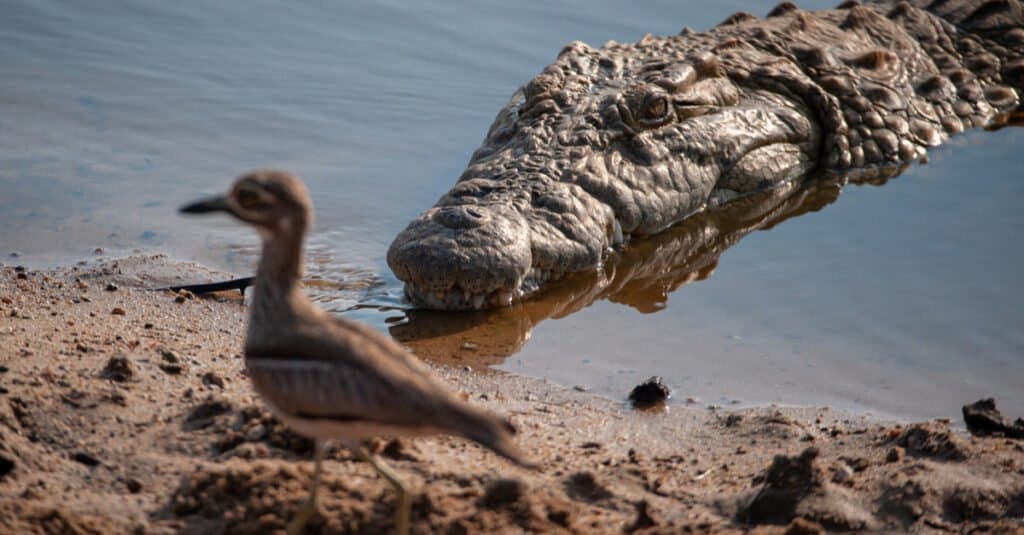
Strongest animal bite – Nile crocodile

The Nile crocodile is listed as Least Concern by the IUCN.

View all 98 animals that start with N

Sources

  1. Wikipedia / Accessed June 12, 2021
  2. Crocodile Specialist Group / Accessed June 12, 2021
  3. Sea World Parks & Entertainment / Accessed June 12, 2021
  4. Ocean Leadership / Accessed June 12, 2021
Catherine Gin

About the Author

Catherine Gin

Catherine Gin has more than 15 years of experience working as an editor for digital, print and social media. She grew up in Australia with an alphabet of interesting animals, from echidnas and funnel-web spiders to kookaburras and quokkas, as well as beautiful native plants including bottlebrushes and gum trees. Being based in the U.S. for a decade has expanded Catherine's knowledge of flora and fauna, and she and her husband hope to have a hobby farm and vegetable garden in future.

Thank you for reading! Have some feedback for us?


Nile Crocodile FAQs (Frequently Asked Questions)

Nile crocodiles are carnivores. They eat fish as well as zebra, buffalo, birds, wildebeest, turtles and more.