
Quick Take
- Running straight at a group of wild seals sounds like the worst possible idea, yet there is a critical reason trained rescuers do exactly that. See why rescuers charge in →
- Entangled seals that reach the water face a far grimmer outcome, and the window to prevent that outcome is smaller than you'd expect. Learn about the water risk →
- Cape fur seals carry a risk most beachgoers have never considered, and it's a serious reason why even a well-meaning rescue attempt can go badly wrong. Understand the dangers involved →
- Fishing gear entanglement isn't just a painful inconvenience for seals. The way it kills is more insidious than most people realize. See how entanglement kills →
Imagine being trapped in something you can’t escape, with every movement potentially making things worse. For a young seal tangled in discarded fishing gear, that danger can become a deadly reality. In this remarkable rescue footage from Namibia, a man suddenly charges toward an entire colony of seals, sending dozens scrambling toward the ocean. At first, his actions might seem alarming. But he’s racing against time to reach one particular animal before it disappears into the water. What happens next is heartwarming, but what could have happened if he hadn’t intervened is the real story.
Watch This Rescuer Race to Save a Trapped Seal!
A Desperate Rescue on Namibia’s Coast
Along the Atlantic coastline of Namibia, enormous colonies of Cape fur seals gather on beaches and rocky shores. These social marine mammals are also found along the coast of neighboring South Africa, often resting together in tightly packed groups.
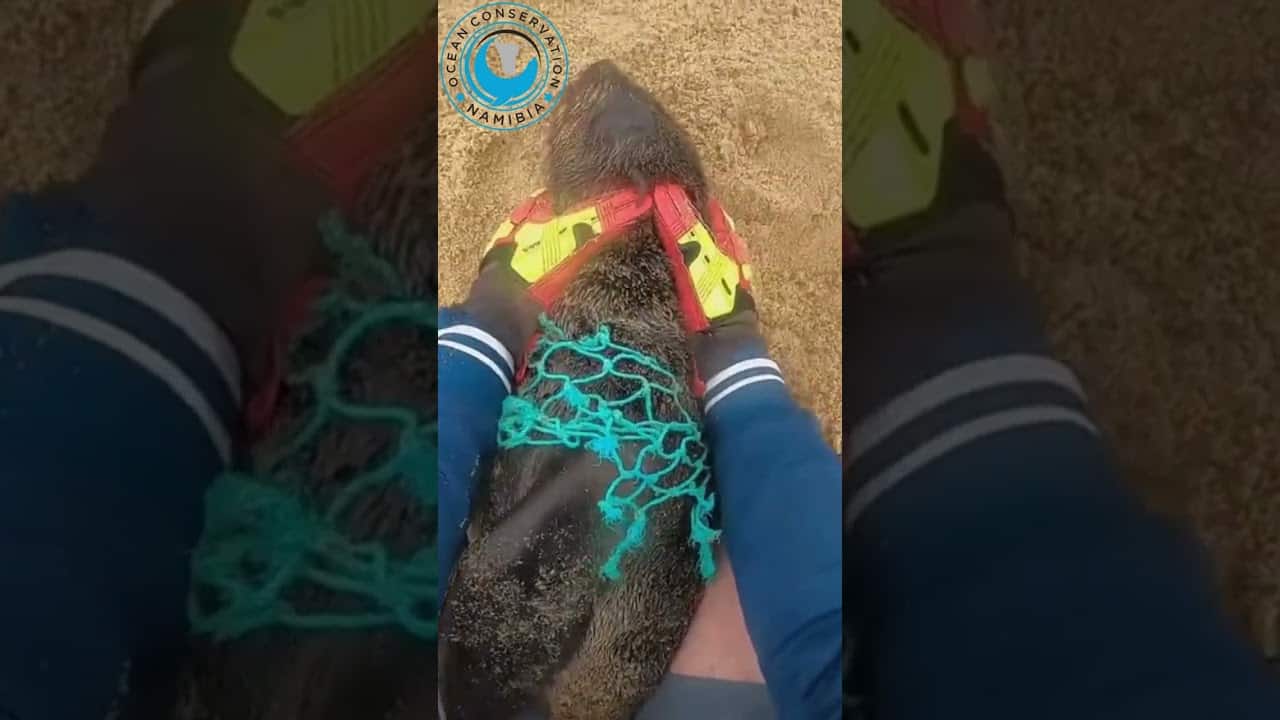
The video comes from Ocean Conservation Namibia, a wildlife conservation organization based in Walvis Bay. Its experienced rescuers regularly patrol coastal seal colonies searching for animals trapped in discarded fishing nets, plastic straps, and other marine debris.
As the footage begins, a rescuer runs directly toward a large group of seals resting on the beach. The animals immediately scatter, many racing toward the safety of the ocean. But the man isn’t chasing them indiscriminately. His attention is focused on one unfortunate seal tangled in green fishing material.
The team must intercept the animal before it reaches the water, where finding and capturing it again could become considerably more difficult. After catching the seal, the rescuers carefully restrain it and begin cutting away the material restricting its body.
Understandably, the animal struggles throughout the ordeal. It has no way of knowing that the people holding it are trying to help. Fortunately, the rescuers are experienced in handling frightened seals and work to remove the dangerous material as quickly as possible.
Once the entanglement is removed, the seal is released. The intervention lasts only a short time, but its potential importance to the animal’s future is enormous.
What Would Have Happened If Nobody Helped?
This is where the rescue becomes much more than a heartwarming wildlife video. When a seal gets tangled in fishing line or netting, the material doesn’t necessarily fall away on its own. In some cases, it can remain wrapped around the animal for weeks or longer, gradually creating increasingly serious problems.
According to the National Oceanic and Atmospheric Administration (NOAA), marine debris entanglements can result in serious injuries and even death. Fishing line and plastic materials may dig into an animal’s skin, restrict its movement, or interfere with essential activities such as swimming and feeding.
For a growing seal, the problem can become particularly severe. As the animal’s body increases in size, a loop of nonstretching plastic or fishing line can tighten around its neck or torso. What initially appears to be a minor entanglement can eventually cause deep wounds, infections, and extensive tissue damage.
If the material interferes with swimming or hunting, the seal may also struggle to obtain enough food. In especially severe cases, entanglement can contribute to starvation, drowning, or fatal injuries.
There is no way to know with certainty what would have happened to this particular seal if rescuers hadn’t found it. Some entangled animals survive for extended periods, and not every incident is immediately life-threatening. However, removing the material eliminates an ongoing hazard that could otherwise become more dangerous over time.
How Common Are Seal Entanglements?
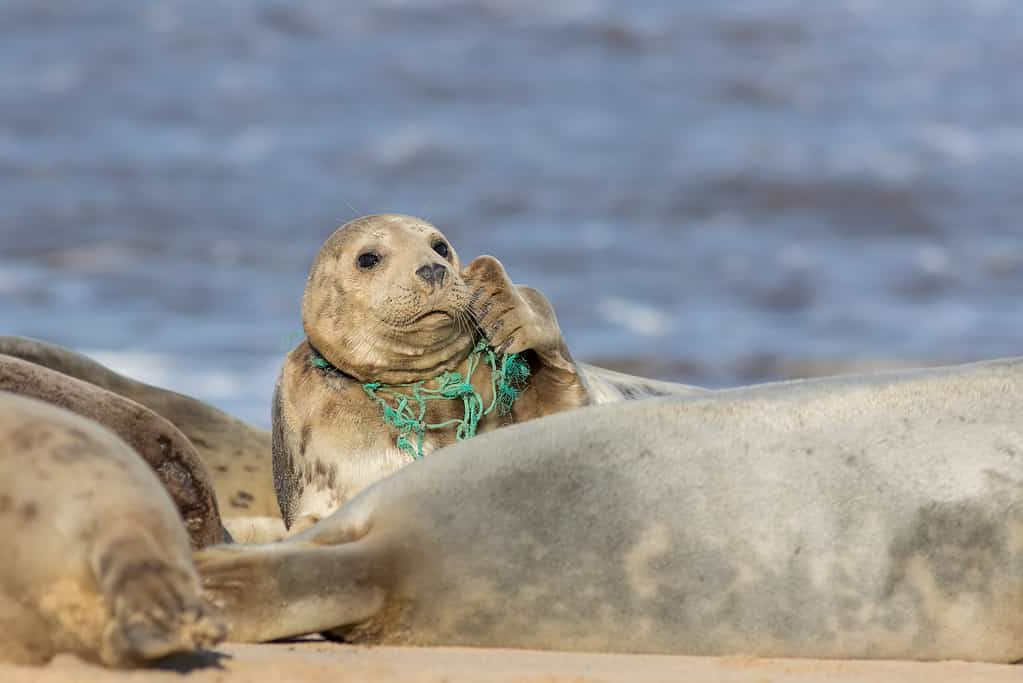
Fishing gear and other marine debris can cause serious or fatal injuries when seals become entangled. Photo: Ian Dyball/iStock via Getty Images.
©Ian Dyball/iStock via Getty Images
Unfortunately, the danger illustrated in this video is far from unusual. Discarded fishing nets, ropes, monofilament line, and plastic packing straps are persistent hazards for marine mammals around the world.
A 2021 study published in Marine Pollution Bulletin examined Cape fur seal entanglements at two colonies in central Namibia. Researchers identified 366 entanglement cases, with fishing-related materials accounting for 53% of the 347 cases analyzed in detail.
The researchers also found that juvenile seals were the most commonly affected age group, and approximately 8% of the analyzed entanglements involved very severe injuries. During the study, 191 animals were successfully disentangled, demonstrating the importance of organized rescue efforts.
These findings highlight a troubling reality. Human-made materials can continue harming wildlife long after they have been lost, discarded, or abandoned.
And the problem extends beyond seals. Other marine animals, including sea turtles, dolphins, whales, and seabirds, can suffer similar injuries. Even birds living far from the ocean can become tangled in discarded material, as demonstrated when Long Island firefighters rescued an osprey caught in fishing wire.
Why Shouldn’t You Attempt a Seal Rescue Yourself?
Watching an animal struggle can trigger an understandable urge to intervene. However, rescuing a wild seal is not something an untrained person should attempt.
Cape fur seals have powerful jaws, sharp teeth, and strong defensive instincts. Even an animal that appears exhausted or helpless may bite when approached or restrained. Like other wild animals, seals generally cannot distinguish between someone attempting to help and someone presenting a threat.
There is also an important disease-related concern. Rabies has been confirmed among Cape fur seals in southern Africa, including Namibia, where cases were confirmed in June 2025. Ocean Conservation Namibia has emphasized the importance of avoiding direct contact with seals and seeking medical attention promptly following any potential rabies exposure.
For these reasons, anyone who discovers an entangled or injured seal should keep a safe distance and contact local wildlife authorities or a qualified marine mammal rescue organization. Trained responders have the experience and equipment needed to assess the situation and determine the safest approach for both the animal and the people involved.
What Does This Rescue Tell Us?
Unlike a predator pursuing its prey or two wild animals competing for territory, this seal’s predicament was caused by something that never belonged in its natural environment. Discarded fishing gear can turn an ordinary day at sea into a prolonged struggle for survival, with animals often unable to free themselves.
Organizations like Ocean Conservation Namibia work to address that danger by locating entangled animals and removing harmful debris before injuries become more severe. Their rescues also draw attention to the importance of properly disposing of fishing gear and preventing plastic waste from entering marine environments.
In this particular encounter, the frightened seal probably had no idea why a human suddenly came charging through its colony. All it knew was that it had been caught, restrained, and eventually released.
But thanks to a few determined rescuers, one dangerous piece of marine debris was removed from its body, giving the animal a better chance at a healthy life. And that is what makes this seemingly chaotic rescue so remarkable: sometimes a few moments of human intervention can prevent suffering caused by human activity in the first place.