
Quick Take
- Some hippos may retain certain deciduous (baby) teeth into adulthood, though this is not typical for all individuals.
- A hippo’s canines are used for defense rather than as tools for grinding food.
- Poachers have started to target hippo ivory.
There are two extant species of Hippopotamuses: the common hippo (Hippopotamus amphibius) and the pygmy hippo (Choeropsis liberiensis). Hippos are native to Africa: the common hippo across sub-Saharan Africa and the pygmy hippo in West Africa. The common hippo has become an invasive species in Colombia, South America, originating from animals once owned by drug lord Pablo Escobar. Although pygmy hippos are rather timid, common hippos are among the deadliest large land mammals, responsible for approximately 500 human deaths annually. Personality differences notwithstanding, these two distinct herbivores have incredibly strong jaws and possess one of the strongest bite forces among all land mammals. Common hippos and pygmy hippos also share similar dental formulas. Keep reading to discover everything you need to know about hippo teeth.

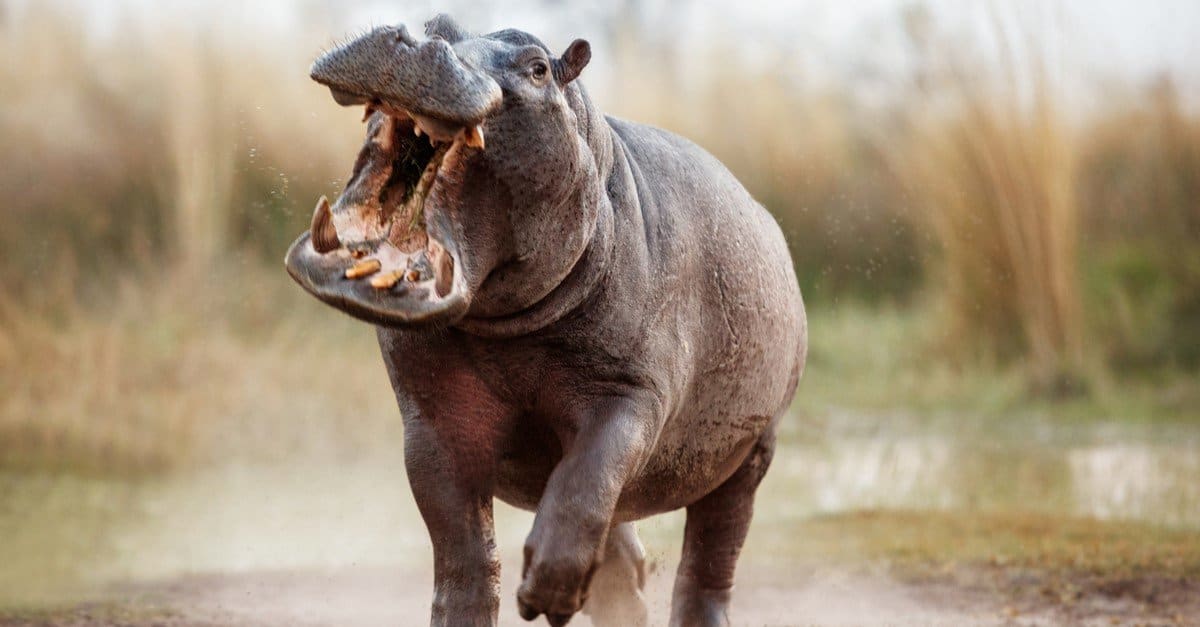
Hippopotamuses have incredibly sharp canine teeth that are used in fighting other hippos.
©iStock.com/mesut zengin
What Kind of Teeth Do Hippos Have?
Common hippos have powerful jaws that can open up to 180 degrees and contain large, sharp, tusk-like teeth. Pygmy hippos cannot open their mouths as wide as common hippos. Still, their bite force is similar, and each species has heterodont teeth that include incisors, canines, premolars, and molars. Hippos have a set of deciduous (baby) teeth and a set of permanent teeth.
How Many Teeth Do Hippos Have?
Common hippopotamuses typically have 36 teeth, while pygmy hippos usually have 34, though the number can vary due to retained deciduous teeth or extra incisors.
The dental formula for the common hippo consists of two incisors, one canine, three premolars, and three molars in each quadrant. In contrast, pygmy hippos have only one pair of incisors. Some hippopotamuses have more than 34 teeth due to the presence of a third pair of incisors and the retention of deciduous teeth.

Hippopotamuses have 36 permanent teeth.
©John Carnemolla/Shutterstock.com
Hippos may retain their deciduous incisors, canines, premolars, or molars long after their permanent teeth have erupted, leading to a higher total tooth count than is typical. This is uncommon in the animal kingdom and is thought to be an adaptation related to managing the significant wear and tear on their teeth caused by grinding tough vegetation.

Pygmy hippos are much less social than common hippos.
©lovelypeace/Shutterstock.com
The structure of the pygmy hippo’s canines and incisors allows for a slight side-to-side grinding motion when eating. Common hippos rely exclusively on a vertical up-and-down jaw movement because their prominent, interlocking incisors prevent significant lateral motion.
What Do Hippos Use Their Teeth For?
Hippo incisors are front and center in their mouths and are used in combination with their canines to grasp food. The common hippo’s canines are large, hypselodont (ever-growing) teeth, called tusks, used primarily for fighting and defense. They interlock and sharpen each other with jaw movement, becoming formidable weapons for display and territorial disputes, especially in males. Pygmy hippo canines are not truly hypselodont like those of common hippos; while they are tusk-like and ever-growing, they are simpler, with rounded tips and lack the interlocking structure used for grazing.
The premolars and molars of both common hippos and pygmy hippos are used for crushing and grinding their food. Common hippos typically eat between 30 and 150 pounds of food per day, while pygmy hippos consume less, with their diet consisting mainly of leaves, roots, and fallen fruits.
What Are a Hippopotamus’ Teeth Made Of?
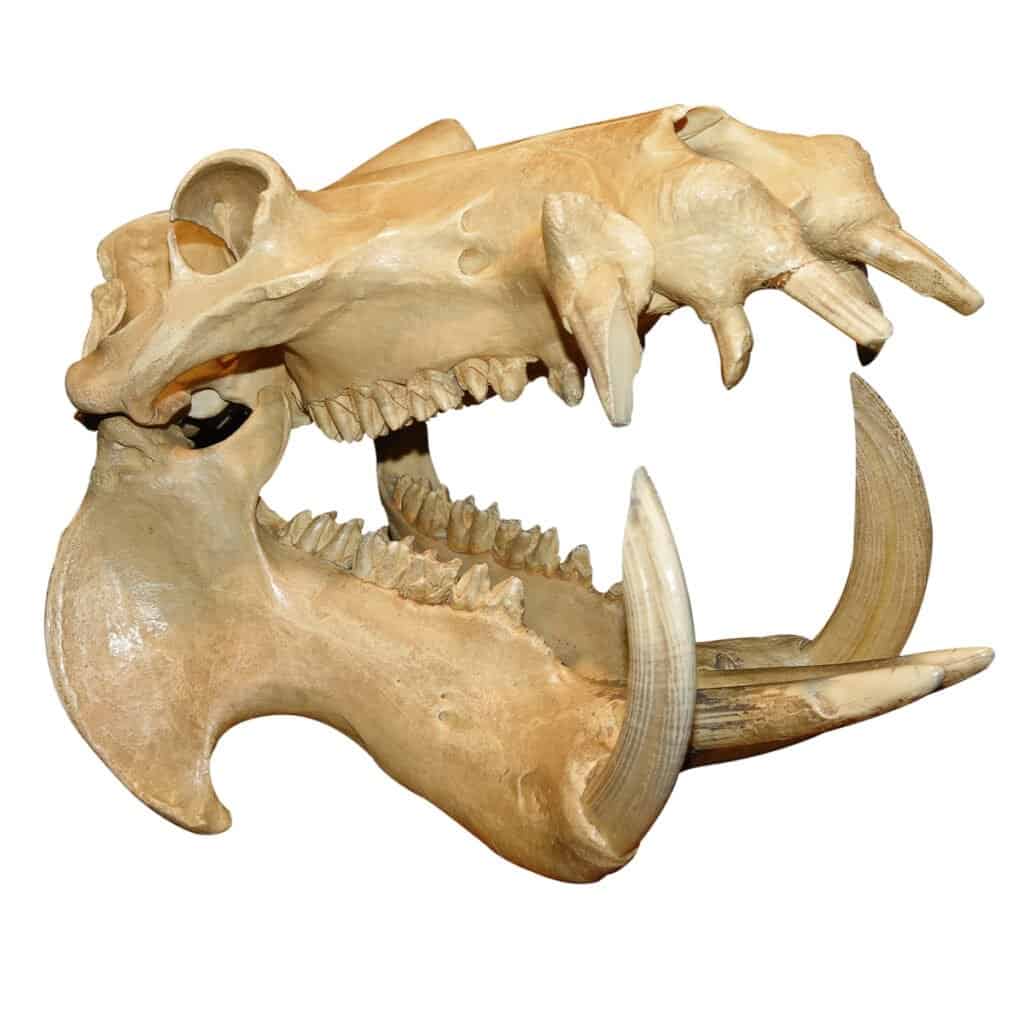
The common hippo’s tusks can grow to lengths of up to 20 inches.
©VINCENT GIORDANO PHOTO/Shutterstock.com
The largest canines in the common hippo’s mouth are called tusks, similar to an elephant’s tusks, and are, in fact, made of the same material. The common hippo’s tusks or canines have ivory resting under layers of dentin and enamel, the same white material that makes up an elephant’s tusks. Although hippos have long been poached for their ivory, the trade in hippo teeth has increased in recent years as bans on elephant ivory have tightened, making hippos a more frequent target for poachers.
While the common hippo’s tusks can grow as long as 20 inches, the pygmy hippo’s canines are much smaller, growing to lengths of up to 2 inches.
How Strong Is a Hippopotamus Bite?
Both the common hippo and the pygmy hippo have one of the world’s strongest bite forces. With a bite force between 1,800 and 2,000 PSI (about 8,000 to 8,900 Newtons), it is over double the bite force of a lion (650 PSI) and stronger than a polar bear’s (1,200 PSI).

Hippos are highly aggressive and unpredictable, and often charge other animals, including humans.
©Karel Bartik/Shutterstock.com