
Quick Take
- A 20-foot anaconda sounds enormous, but the real question is how that size compares to what's actually considered average for the species. See how 20 feet compares →
- Constrictors don't kill by crushing, and what they actually do to prey is far more surprising. See how constriction really works →
- Scientists quietly split green anacondas into two separate species, and the change happened more recently than you'd expect. Explore the 2024 species split →
- Snakes don't actually unhinge their jaws, so what is really happening when one swallows something massive? See what really happens →
Most people who spot a giant snake in murky water would immediately start moving in the opposite direction. Jeremy Wade is apparently not most people.
In this remarkable River Monsters footage, Wade slips underwater beside an enormous green anaconda estimated at roughly 20 feet long. Instead of fleeing, he carefully moves closer until he is almost face-to-face with a snake powerful enough to tackle prey far larger than most people would ever want to encounter in the water.
Quick Take
- Jeremy Wade encounters an enormous green anaconda estimated at roughly 20 feet long.
- A 20-foot green anaconda would be exceptionally large, not an average adult.
- Green anacondas are the world’s heaviest living snake species, while reticulated pythons generally take the length title.
- Constriction does not literally crush prey to death. Research shows it can rapidly interfere with blood circulation.
Watch Jeremy Wade Swim Right Up to the Giant Snake
The encounter comes from Jeremy Wade’s long-running Animal Planet series River Monsters. Wade is better known for tracking enormous freshwater fish, but this time the animal waiting beneath the surface is a snake.
The water is cloudy enough that the anaconda seems to appear almost out of nowhere. Wade keeps his movements controlled and avoids grabbing or disturbing the animal. At one point, the snake’s head comes close enough to his mask that its size becomes much easier to appreciate. Remarkably, the encounter ends without either Wade or the anaconda escalating the situation.
A 20-Foot Anaconda Is Anything but Average
The original version of this story called 20 feet an average length for a green anaconda. That badly undersells what Wade was swimming beside. Guinness World Records says adult female green anacondas more typically measure about 10 to 16 feet long and weigh roughly 65 to 155 pounds. Females grow substantially larger than males.
Exceptionally large females can exceed 20 feet, and reports exist of animals approaching 25 feet or more. Guinness recognizes green anacondas as the heaviest living snake species, while the more slender reticulated python generally grows longer.
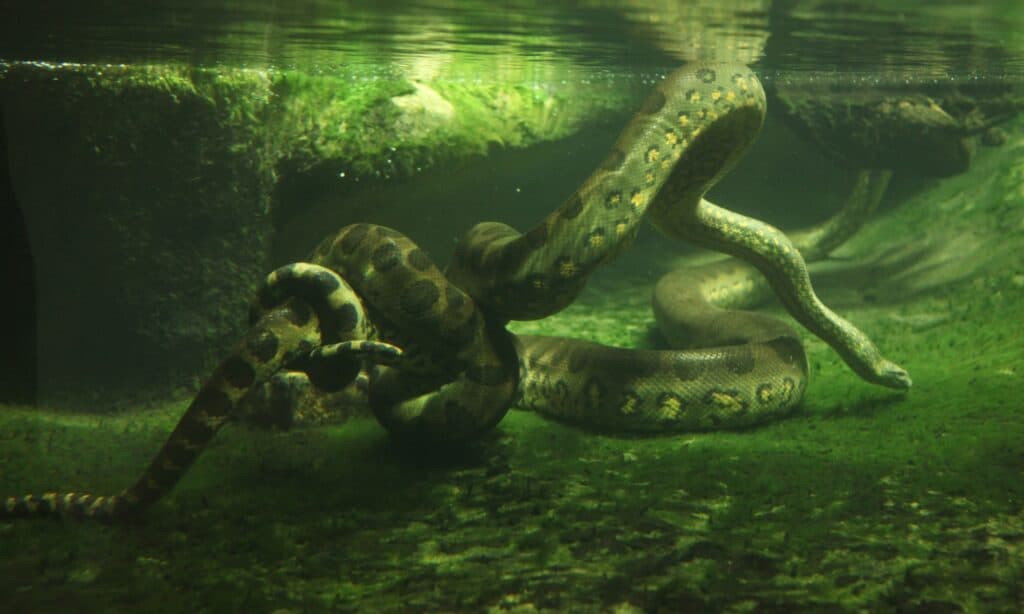
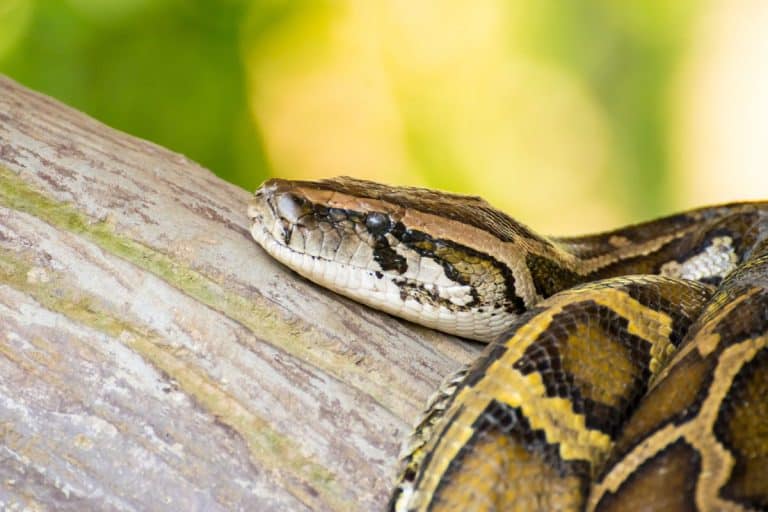
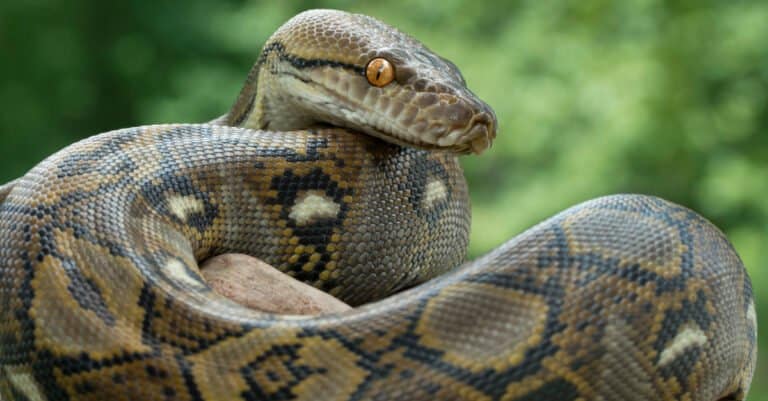
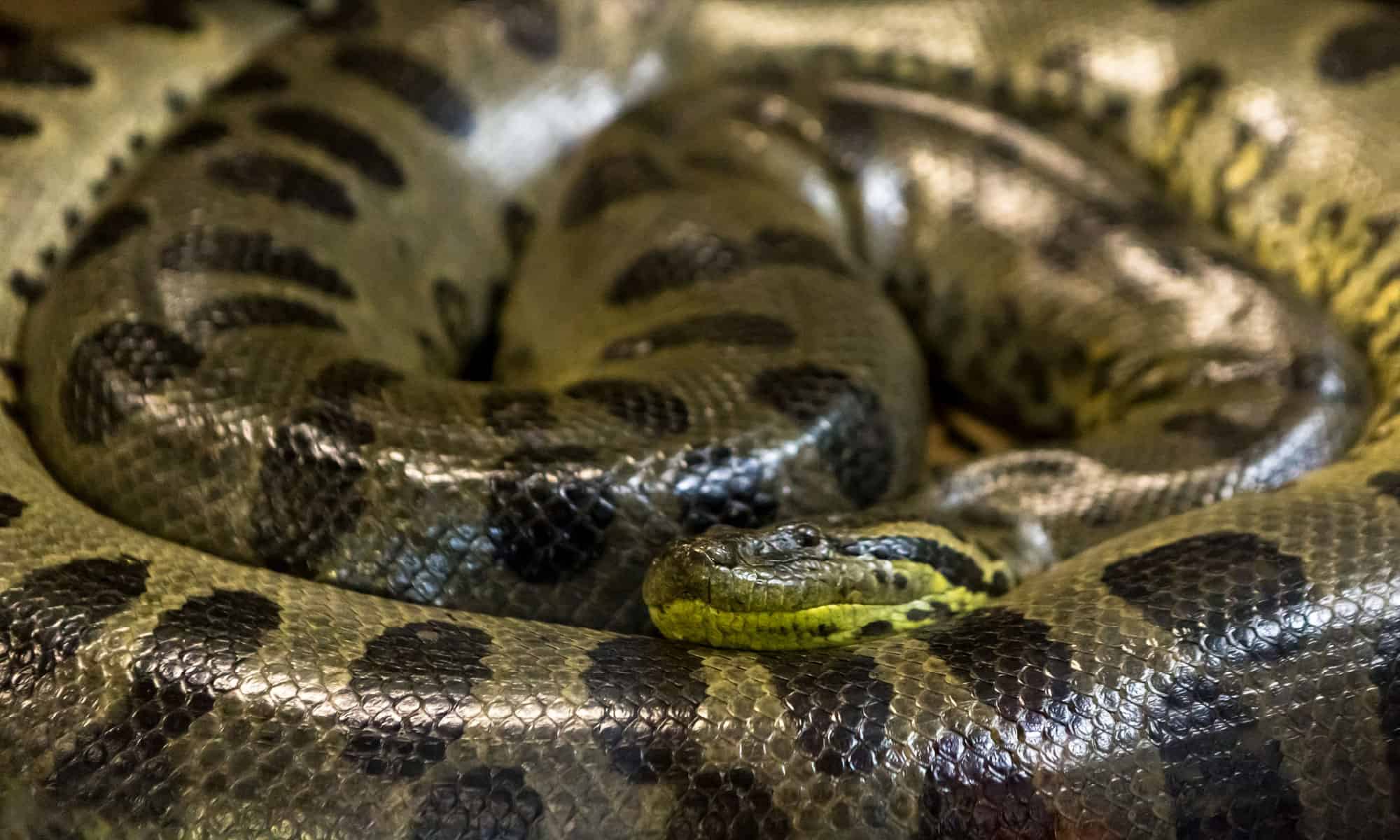
Green anacondas are superbly adapted for spending much of their time in water.
©Vladimir Wrangel/Shutterstock.com
The Famous 30-Foot Anaconda Stories Get Murky Fast
Giant-anaconda stories have circulated for generations, but verified measurements are much harder to come by. One of the largest historically documented green anacondas was reportedly shot in Brazil around 1960 and measured about 27 feet 9 inches long, although even that old record does not have the kind of modern documentation scientists would prefer.
That is why viral claims about 30-foot and 33-foot anacondas deserve skepticism. Photographs can distort scale, preserved skins can stretch, and estimating the length of a coiled snake is notoriously difficult. Guinness notes that the biggest reliably discussed green anacondas are enormous animals, but the internet has a habit of adding several feet before breakfast.
Scientists Now Recognize Two Green Anacondas
There is another wrinkle that did not exist when this River Monsters episode originally aired. In 2024, researchers reported that what had long been treated as one green anaconda species actually contained two deeply separated lineages.
The southern green anaconda retains the scientific name Eunectes murinus, while the northern green anaconda was formally described as Eunectes akayima. Genetic evidence suggests the two lineages diverged millions of years ago. For an older video like Wade’s, identifying which species appears in the footage would require knowing the precise location and confirming which population the animal belonged to, so simply calling it a green anaconda is the safest choice.
Anacondas Are Built for Life in the Water
Wade’s underwater encounter makes more sense when you look at the snake’s anatomy. Green anacondas are highly aquatic and spend much of their time in rivers, swamps, flooded grasslands, and other slow-moving water.
Their eyes and nostrils sit high on the head, allowing much of the body to remain submerged while the snake watches and breathes at the surface. Their heavy bodies are also much easier to support in water than on land. That is a more useful way to understand their movement than repeating questionable claims that anacondas swim at exactly 10 mph.
Constriction Is More Complicated Than Simply “Crushing” Prey
Anacondas are nonvenomous constrictors. They seize prey with the mouth and wrap powerful coils around it, but researchers have changed the way we understand what happens next.
A controlled study of boa constriction found that pressure from the snake caused blood pressure to collapse and interfered with normal circulation within seconds. The same basic mechanism is thought to help explain why large constrictors can incapacitate prey so quickly. In other words, it is less like a snake slowly squeezing the air out of an animal and more like its coils rapidly disrupting the cardiovascular system.
Could an Anaconda Actually Swallow a Person?
A truly enormous green anaconda is physically capable of taking very large prey. Adults have been documented eating animals such as capybaras, deer, caimans, birds, and other substantial prey. Smithsonian notes that their size means a large green anaconda could theoretically consume a human.
That does not mean people are normal anaconda prey. Documented attacks are extremely rare, and Smithsonian reports no confirmed case of a green anaconda actually swallowing a person. The animal in Wade’s video appears far more interested in remaining where it is than proving any of the monster-snake stories true.
Their Jaws Do Not Actually “Unhinge”
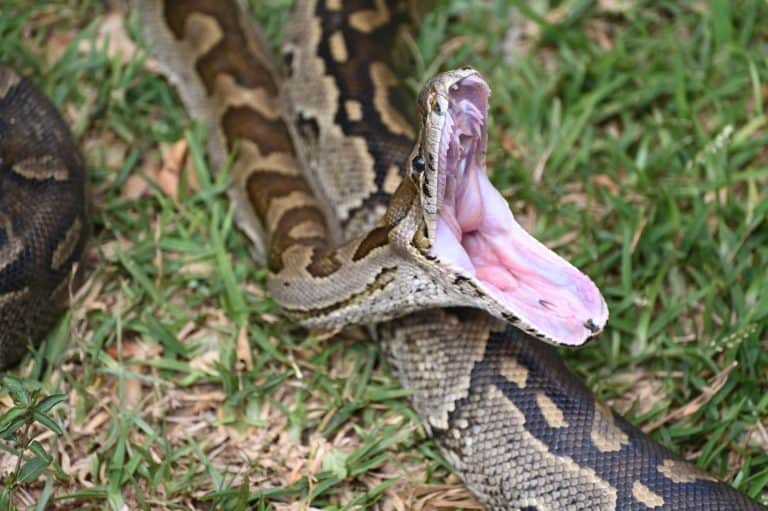
One last snake myth is worth retiring. Anacondas do not detach or dislocate their jaws before a big meal. A snake’s skull is simply built very differently from ours.
The two halves of the lower jaw are connected by flexible tissue, and several joints in the skull can move independently. That lets the mouth spread around prey much wider than the snake’s head without anything literally popping out of place. Which is impressive enough without giving the animal an anatomical superpower it does not actually have.