
Quick Take
- One snake species has eliminated males entirely, and that is not even the most surprising biological trick hiding in this group. Meet the all-female species →
- The reason so many people fear snakes has less to do with instinct than with a specific cultural inheritance most never question. Explore the cultural roots →
- Snakes that disappear from your local ecosystem could affect your health in ways that have nothing to do with a bite. See why snakes protect your health →
- There's a snake that 'flies,' and what it actually does to pull that off is weirder than the myth. Discover how flying snakes glide →
World Snake Day is celebrated on 16th July, and we are going to seize the opportunity to raise awareness of these amazing reptiles, challenge negative stereotypes, and acknowledge how vital they are in ecosystems around the world. Let’s face it, when it comes to animal popularity, these guys are not at the top of the list. So we hope to dispel some of the negativity they labor under and spread some snake positivity around the globe.
Most of us are fairly confident that we’d recognize that limbless, elongated body covered with scales that is so characteristic of a snake. All snakes also have a forked tongue and lack external ears and eyelids. There is still some debate surrounding snake evolution. Some experts think they evolved in the sea, but others think they evolved on land. All snakes are in the class Reptilia and fall under the order Squamata. Some lineages contain only a few species, but others have hundreds. All in all, these guys are one of the most diverse groups of animals you’ll encounter.
Female Only Snakes and the Smallest Snake
For example, take the infraorder Scolecophidia. It consists of thread snakes, worm snakes, and blind snakes. Here, you will find the brahminy blind snake (Indotyphlops braminus), which is the only known parthenogenetic snake species. This means that the female’s eggs can develop without sperm, so there are no males! The infraorder also contains the Barbados thread snake (Tetracheilostoma carlae), which is the world’s smallest snake, measuring under four inches.
Huge Snakes, Flying Snakes, Swimming Snakes
At the other end of the scale is the reticulated python (Malayopython reticulatus) from Southeast Asia, the world’s longest snake, which can reach around 32 feet. The prize for the world’s heaviest snake, however, goes to the green anaconda (Eunectes murinus), from South America, which can weigh around 220 pounds.
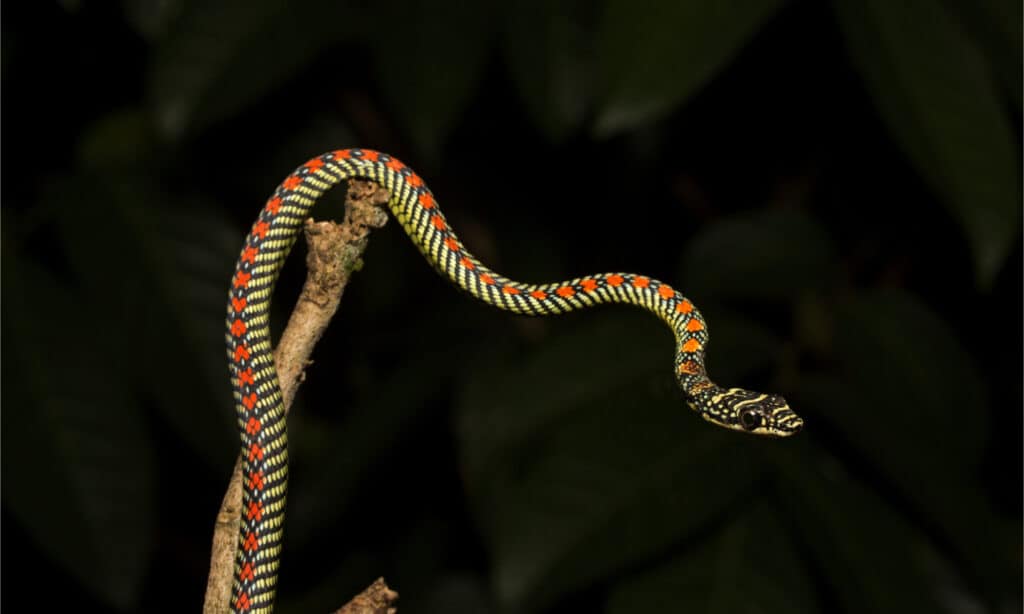
Paradise flying snakes have slender bodies and can glide.
©Vince Adam/Shutterstock.com
We can’t leave out the paradise flying snake (Chrysopelea paradisi) from Asia, which can’t actually fly. However, it can expand its ribs and flatten its body so it forms a sort of parachute and glides from tree to tree. Not to mention the sea snakes that can live underwater and use flat paddle-shaped tails that aid in swimming.
Snake Hunting Strategies Are Awesome
Snakes need to be able to overpower (subjugate) their prey. This is not the same as killing prey, and snakes don’t have a problem with eating prey live. They just need it to keep still so that they can swallow it!
Subjugation can be achieved through constriction and venom injection, but this is not an either/or situation. Some constricting snakes (including most vipers) are also venomous, and many snakes use a combination of strategies. The pythons and boas are probably the most famous constrictors. They are not venomous and have large heads and strong, muscular, long bodies that wrap around their target. Constrictors will bite their prey to keep it still while they wrap their coils around it. These snakes eat large prey, which can keep them going for months.
Vipers are famous for their venom delivery via long, hollow fangs. They bite and inject venom into their prey but then release it, sit back, and let the venom do the hard work for them. Thanks to their explosive strike, the process takes around one tenth of a second.
Why You Should Think Again About Snakes
There are over 4,000 species of snakes on the planet. You’ll find them on every continent except for Antarctica, Iceland, Ireland, Greenland, and New Zealand. In the US, snakes are found in every state except Alaska, and while Hawaii has no native land snakes, a few introduced species are present. Maine has a small number of native snake species. That means that the majority of the world’s population is likely to encounter a snake at some point in their lifetime. Of all the species, around 750 are venomous, but only 250 have venom that presents a significant danger to humans. In the US, between 7,000 and 8,000 people get bitten every year by venomous snakes, and around five die.
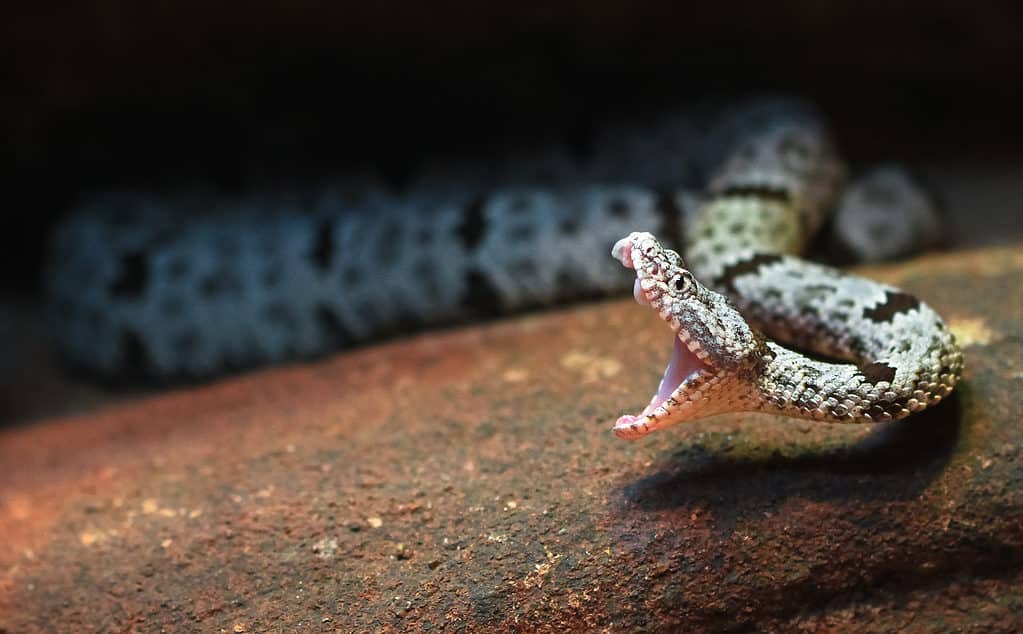
Not all snakes bite.
©Kevin Wells Photography/Shutterstock.com
Despite this very limited risk, many people have a negative view of snakes. Almost half of Americans have at least some anxiety when they see a snake, and 20 percent are terrified by even pictures of snakes! This irrational fear is called ophidiophobia, and it’s not helped by the Judeo-Christian tradition and European beliefs that snakes are devilish and harmful.
This attitude is by no means universal. In ancient Egypt, for example, snakes were associated with royalty. Many East Asian cultures see snakes as symbols of immortality and renewal. In Hopi and Cherokee cultures, they are revered and respected.
Why Public Perception Matters
When people feel negatively about snakes, their first reaction on seeing one is to want to kill it. The myths and misunderstandings surrounding snakes can lead to their persecution.
Dozens of snake species are currently listed as endangered or critically endangered, with many of these being vipers. Habitat loss is one of the key reasons for population declines. So, why should you care?
Firstly, snakes provide a highly effective pest control service. They are good at the job and non-toxic. Depending on the species, snakes hunt rodents, insects, and other small animals that damage our crops, infest our homes, and spread disease. Snakes keep these populations in check. Also, as they are both predators and prey, they play an essential role in keeping their ecosystems in balance. Finally, snake venom has played an important role in creating life-saving drugs for conditions such as high blood pressure and blood clots.
Coexisting with Snakes
For the benefit of humans and snakes, we need to learn how to coexist safely together. Finding a snake on your property is understandably concerning, but bear in mind that these creatures deserve our respect. You can start by researching which native species of snakes live in your area. Learn how to identify those that are venomous (if there are any) and those that are harmless. Your local herpetological society or governmental wildlife agencies can help. Also, be aware of how the climate and season affect a snake’s behavior. Finally, familiarize yourself with local wildlife relocation services and snake experts.
Bear in mind that there are lots of myths about snakes. For example, snakes will not chase you; most are not aggressive, and they would prefer to get away from you than hurt you!
Advice on Snake Encounters
If you see a snake, leave it alone! Do not touch it and keep pets and children away from it. Contact an expert who can identify and relocate it for you.
If someone does suffer a snakebite, keep calm. Do not try to capture the snake (but a photo from a distance can be useful) or suck the venom out of the wound. Instead, keep the bitten person as still as possible, gently wash the wound with soap and water, and get emergency medical help.

First aid for a snake bite.
©Microgen/Shutterstock.com
You can cut down the likelihood of snakes around your home by making it less attractive to them. It helps if you keep paths free of vegetation, trim lawns, and remove clutter. Close up gaps and potential entry points in your home but don’t use plastic sod netting or bird netting because snakes can get stuck in it.
You can also avoid snake encounters by using a flashlight at night, watching where you step, and checking for snakes as you lift up boards or hay bales etc.
Why Not Make a Snake’s Life Better?
If you have a large enough property to create a haven for snakes, away from your living spaces, why not do your bit to help them out? Create a safe hiding space for them from rocks or logs. This gives them a great place where they can regulate their body temperature. Plant some native vegetation to create ground cover and small prey for snakes to feed on. Stop using pesticides and herbicides and maybe install a small, shallow water feature.
But most of all, talk to people about snakes. Tell everyone what magnificent and fascinating creatures they are!