
Quick Take
- That clog-shaped bill isn't just bizarre-looking. It hides a built-in feature that makes escape nearly impossible for even the slipperiest prey. Discover the bill's design →
- A shoebill catches prey just once every eight-plus hours, yet it survives as one of Africa's most effective wetland hunters. The strategy that makes this work is counterintuitive. See the hunting strategy →
- Shoebills depend on hippos and elephants to find food, but not for the reason you might think.
- One of the shoebill's biggest threats isn't habitat loss or natural predators, and the source of that threat is hiding in plain sight. Explore conservation threats →
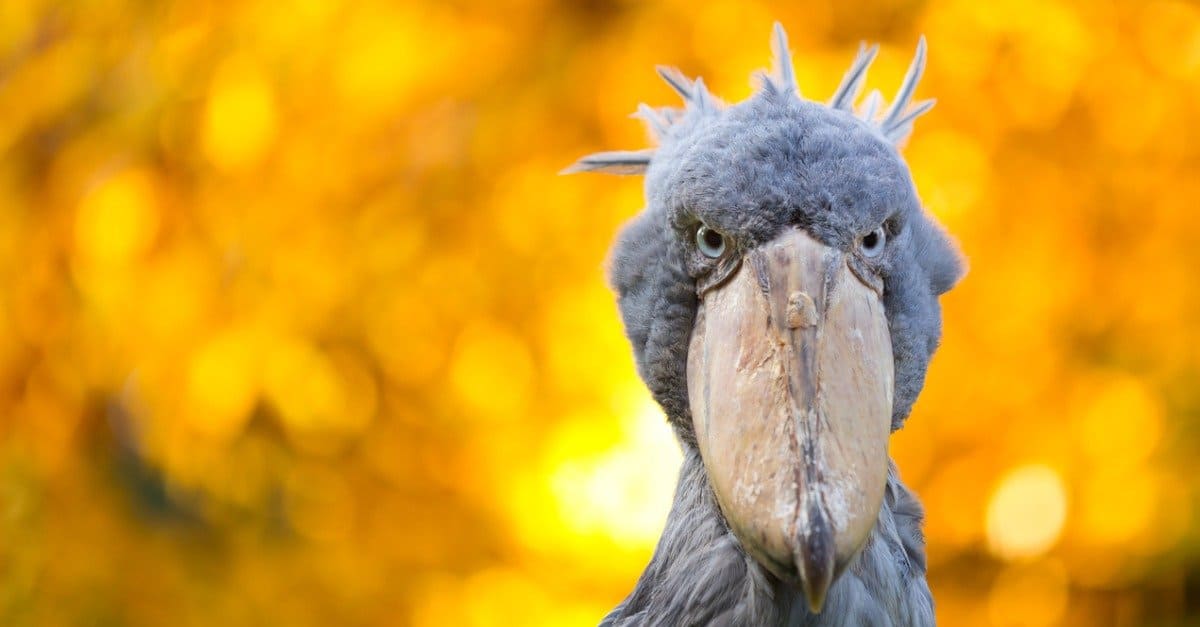
Just the name “shoebill” is a clue that this is a strange bird. The shoebill (Balaeniceps rex) is a type of stork so named for its oversized bill resembling a Dutch clog. Bird beaks can be sorted into categories of shapes, such as straight, curved, conical, and elongate—but “clog-shaped” is not among them. Why does the shoebill have such an unusual beak, which, at 9-12 inches long, ranks third in length among modern birds?
Shoebills, also known as “whale-headed storks,” are wading birds native to Central Africa, including Uganda, Tanzania, and Zambia. They’re huge birds, standing up to 5 feet tall with 8-foot wingspans. They use their impressive bills to feed on freshwater prey, standing still or walking very slowly in the water to find fish, amphibians, water snakes, mollusks, and even young waterfowl or hatchling crocodiles. When a shoebill spots prey underwater, it plunges its wide-open beak into the water to snatch the animal.
Shoebills Are Fierce Hunters
Several adaptations make shoebills formidable hunters. They have sharp vision that allows them to detect even small movements of prey. Their bill is razor-sharp along the edges, allowing them to bite the heads off large prey. Inside the bill is a specialized, prickly tongue that can grasp slippery prey, such as lungfish, by wrapping around it, while the hooked tip of the beak prevents escape. A mouthful of prey often includes vegetation, which shoebills remove by swaying their heads from side to side and spitting the vegetation out.
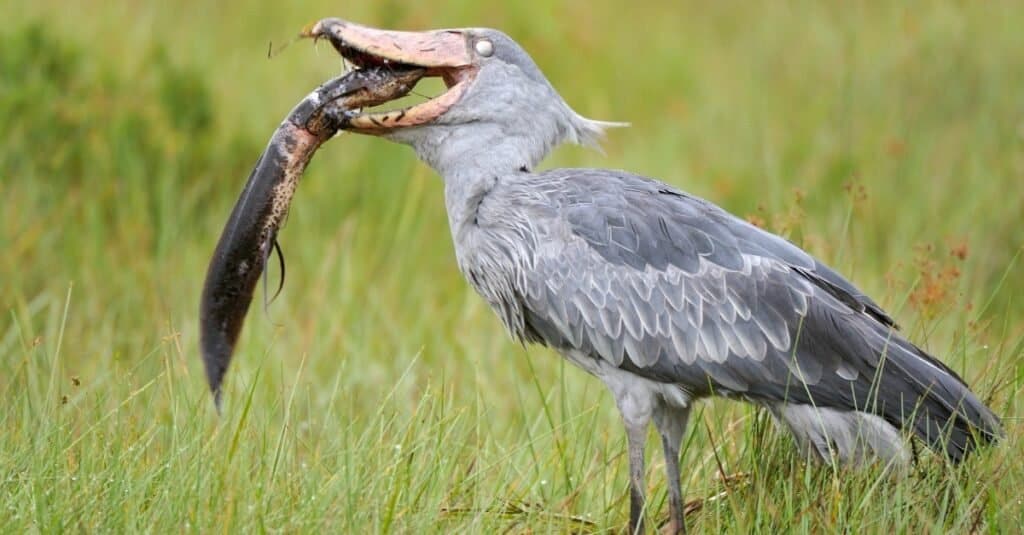
This shoebill stork in the Mabamba Swamp, Uganda, eats a lungfish.
©iStock.com/Michel VIARD
Studies of the natural history of shoebills (Guillet, 1978 and 1979) found that they prefer lungfish, which can grow up to six feet long, but they will also target catfish and tilapia. They favor muddy, poorly oxygenated waters, which force fish to the surface to breathe. However, by 1992, as their habitats were increasingly converted for agriculture (Hancock et al.), shoebills began feeding in flooded crop plantings, such as rice paddies. According to a 2014 study, a shoebill catches only about one prey item in more than eight hours, so the prey must be substantial to meet its needs.
Where Do Shoebills Live?
Shoebills prefer papyrus swamps with tall stands of papyrus sedge, the plant that ancient Egyptians used to make paper. If the vegetation is too dense, however, shoebills cannot see their underwater prey or maneuver their large beaks effectively. Therefore, they tend to look for areas where large mammals like hippos and elephants have opened trails through wetlands, according to a 1992 study (del Hoyo et al.). Shoebills have also been observed perching on floating vegetation to gain a better vantage point for hunting, which allows them to forage in water that would otherwise be too deep for them. Their large feet with long toes help them perch on mats of vegetation.
If you were to visit a wetland with wild shoebills, you would witness another use of their huge bills—a noisy one. Shoebills communicate by making a rifle-like clacking sound with their bills (listen here). The clapping sound is thought to serve several functions: attracting mates, communicating with chicks, and scaring intruders away.
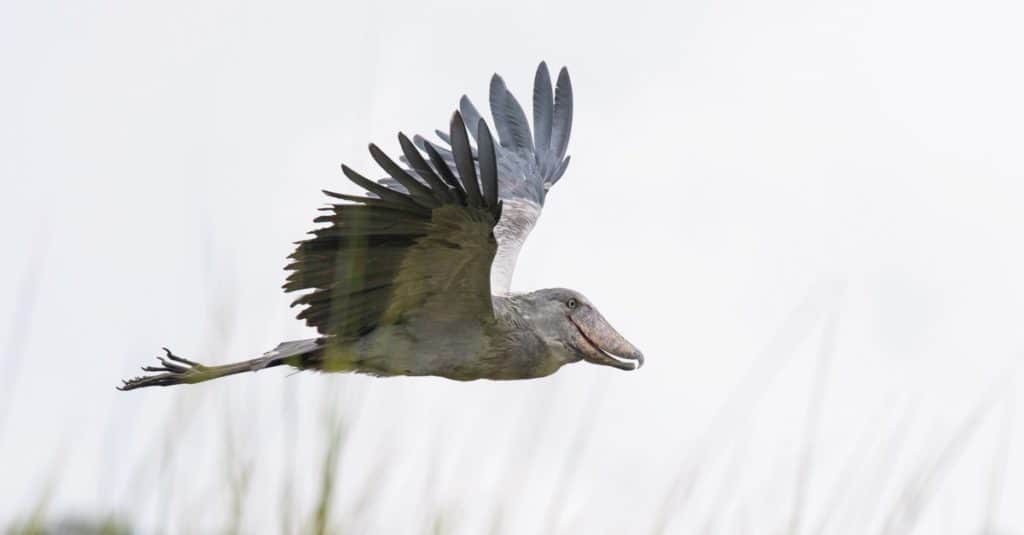
This shoebill is making a short flight above the grass of Uganda’s wetlands.
©Petr Simon/Shutterstock.com
As seen in this footage, the shoebill’s large, pointed beak also serves as a grooming tool. Like other birds, shoebills groom their feathers to remove parasites and to add waterproofing oil from a gland at the base of their tails. Between feeding and preening, shoebills are quite sedentary, spending about 85 percent of their time engaged in low-energy activities such as standing, sitting, walking slowly, and preening, according to a 2014 study of shoebills in the Bangweulu Wetlands of Zambia. Despite their large wingspan, they rarely fly more than short distances, typically making only brief hops within the wetland.
An individual shoebill has a relatively long lifespan, reportedly living as long as 30 to 40 years. However, according to recent estimates, only about 3,300 to 5,300 mature adult shoebills—those capable of reproduction—remain in the wild. The total population, including juveniles, is estimated to be between 5,000 and 8,000 shoebills. The wetlands they require have been increasingly drained for development, leaving shoebills reliant on smaller patches of marsh. Although shoebills have few natural predators, they are targeted by the illegal wildlife trade and are sometimes captured for sale to private collectors or unregulated facilities, with demand occasionally coming from zoos operating outside international regulations.