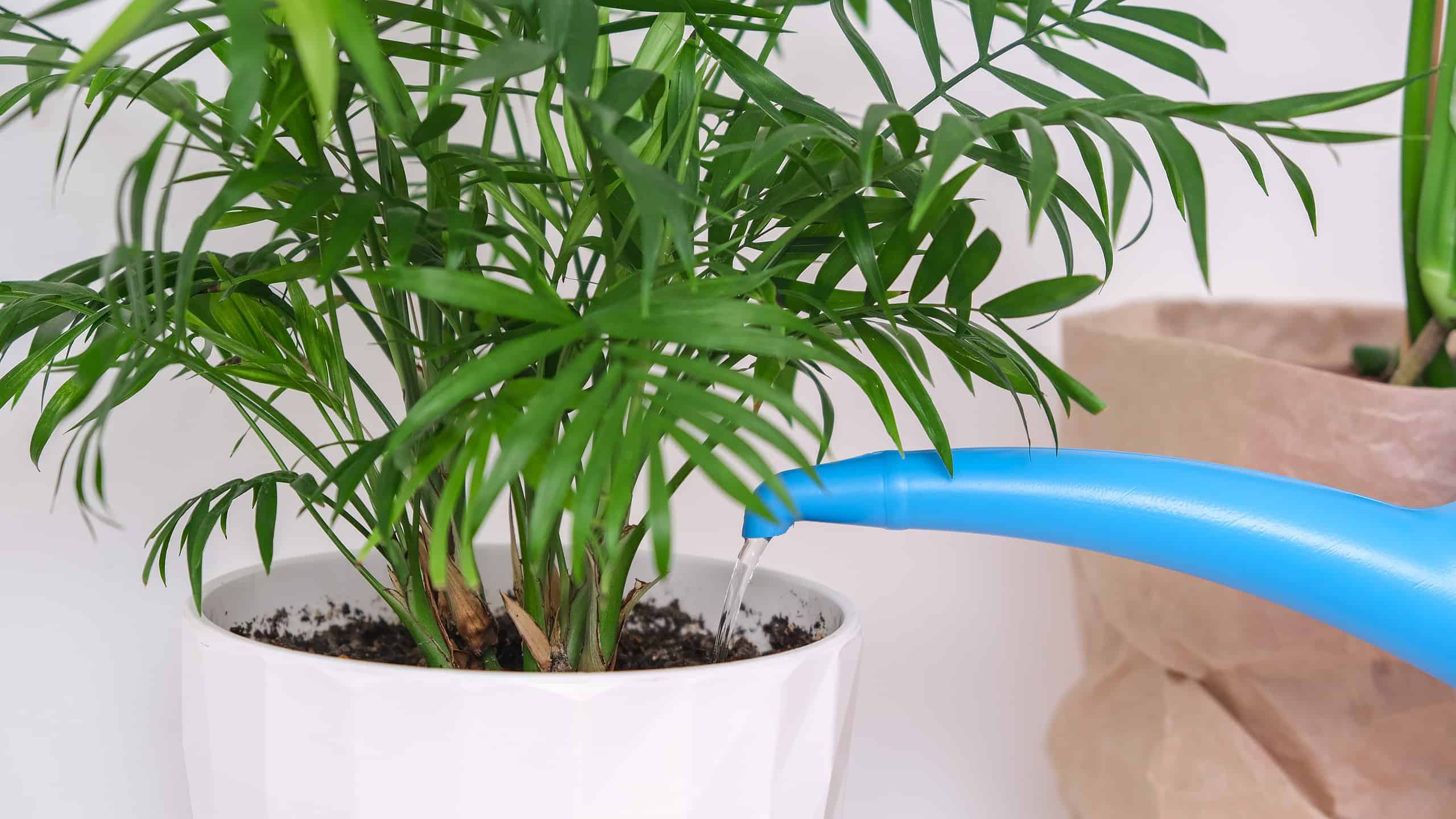

Did you know that you can grow palm trees indoors? You may be surprised to learn that many species do great in the range of temperatures and light levels that can be found in the average home. Caring for a potted palm is pretty straightforward.
In this guide, we’ll give you the rundown on how to make sure that your palm has all of the nutrients it needs, as well as how to go about potting up. We’ll also give you a short list of palm species that do great indoors in case you haven’t picked one out yet.
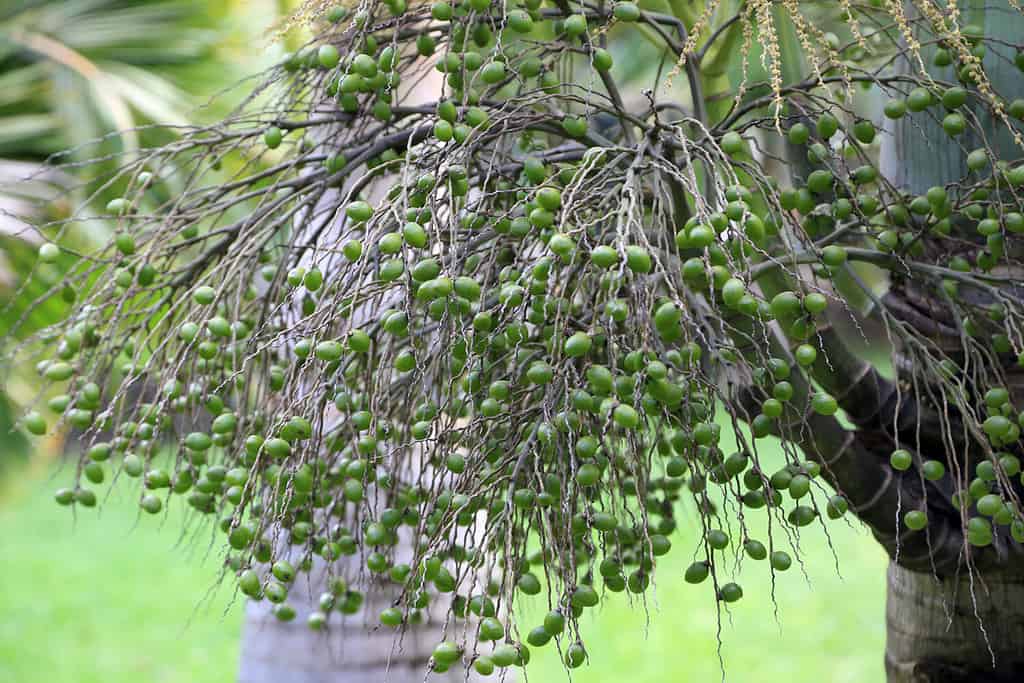
True palms are flower-bearing evergreens that belong to the family Aracaceae.
©Bildagentur Zoonar GmbH/Shutterstock.com
What Are Palms?
True palms are flower-bearing evergreens that belong to the family Aracaceae. Not all plants that are referred to as palms are palms, however. Some, like the banana palm, are rhizomatic herbs. Others still, like the sago palm, belong to an ancient order of plants called cycads. Because they resemble each other so closely, however, they have all been given the palm moniker.
While there are some differences between species of true palms and other plants of a similar namesake, those that can grow well indoors tend to have overlapping care requirements. Additionally, because many of these plants hail from the same tropical and subtropical regions of the world, they naturally thrive in the temperature range kept by the average household.
Because there are so many of these plants that can grow indoors, we’ll stick to just the true palms for the scope of this guide.
Potted Palms for Indoor Growing
If you’re looking for a species of true palm to grow indoors, the ones listed below are good candidates. They all grow well in containers, produce interesting foliage or trunks, and attain heights that are comfortable inside most homes.
- Christmas palm (Adonidia merrillii)
- Bottle Palm (Hygrophorbe lagenicaulis)
- Parlour palm (Chamaedorea elegans)
- Robellini palm (Phoenix roebelenii)
- Lady palms (Rhapis sp.)
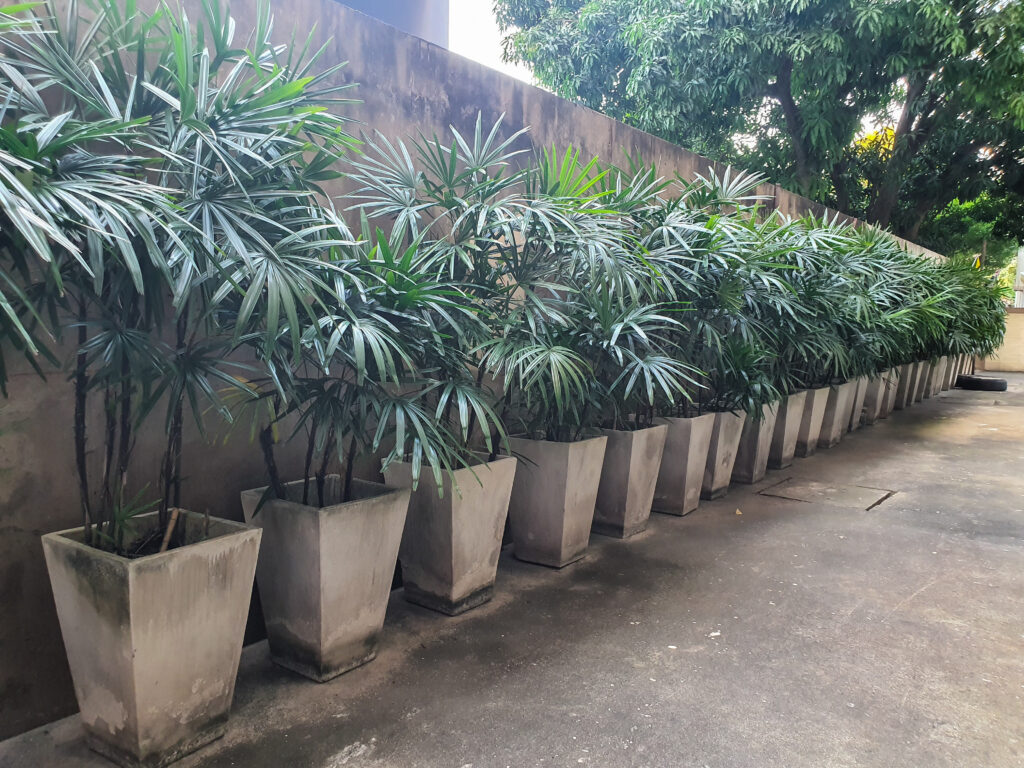
If you’re looking for a species of true palm to grow indoors, lady palms are one of the species to choose.
©Maminami/Shutterstock.com
Fertilization of Potted Palms
Outdoor palms tend to require different fertilizing than containerized indoor palms. Outdoors, in soils that can have widely varying histories and compositions, palms tend to want most for potassium, magnesium, and manganese. While palms growing in containers may also struggle for these nutrients if improperly fertilized, they oftentimes lack nitrogen.
Because most potting mixes are high in organic matter, they encourage the growth of decomposing microbes. These microbes use nitrogen in large amounts as they continuously break down the bark and mosses in the potting soil. Of course, the more nitrogen that these microbes use, the less of it is available for your palm. Therefore, you must supply your plant with plenty of nitrogen as well.
Nitrogen Demand
Because of the additional nitrogen demand, you can use a slow-release fertilizer that is designed for other tropical houseplants. These types of fertilizers are usually intended to encourage foliage growth and therefore contain enough nitrogen (N) to meet your palm’s needs. They will also contain enough phosphorus (P) and potassium (K) to prevent deficiencies.
While commercially available fertilizers will provide plenty of N, P, and K, they may be lacking in magnesium (Mg), another nutrient that is crucial for healthy palm growth. Without it, your plant cannot maintain healthy leaves. Therefore, you should take care to add a slow-release source of magnesium, such as dolomite, to your potting mix. Dolomite will provide your palm with not only magnesium but plenty of calcium (Ca) as well.
You should also be sure to give your palm access to micronutrients to ensure healthy long-term growth. Palms also require elements such as manganese (Mn), iron (Fe), and boron (B) in small amounts. Commercial micronutrient blends are available that will provide your palm with all of these.
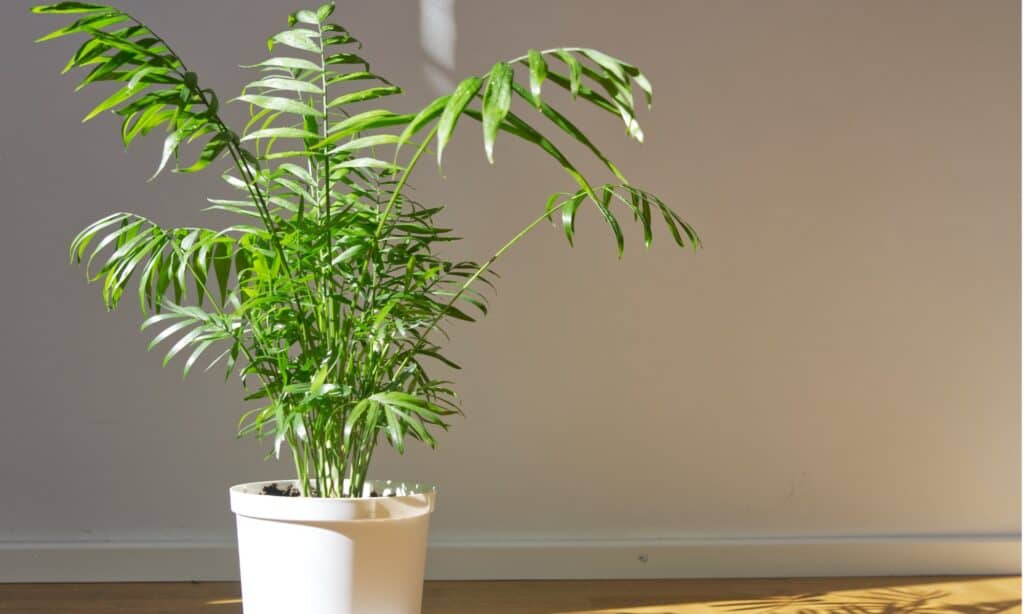
While commercially available fertilizers will provide plenty of N, P, and K, they may be lacking in magnesium (Mg), another nutrient that is crucial for healthy palm growth.
©iStock.com/Wheatfield
When to Repot Your Palm Tree
Because palms produce a tight, fibrous root structure, they do quite well when their roots are confined. Most palms require very infrequent repotting — usually every two or three years. In fact, due to the nature of their roots, it is best to leave them alone for as long as possible.
When your palm finally does need a larger container, you will need to be very careful during the move. Compared to tree roots that continually branch and strengthen over time, potted palm roots are extremely thin and never grow thicker than when they first emerged. They tend to be fragile and are rarely much bigger around than a ballpoint pen.
It is best to pot up your palm in the spring or summer when it is actively growing. When selecting your palm’s new home, you should choose a pot that is a few inches larger in circumference than its previous pot. As you are moving your palm into its new container, it is best to place the base of the trunk at or slightly below the surface of the soil.
Pot-binding is not an issue with palms. Wrapped and twisted roots will not affect the growth pattern of future roots and should not be trimmed or broken when repotting. These roots will age out and be replaced by new ones fairly quickly.
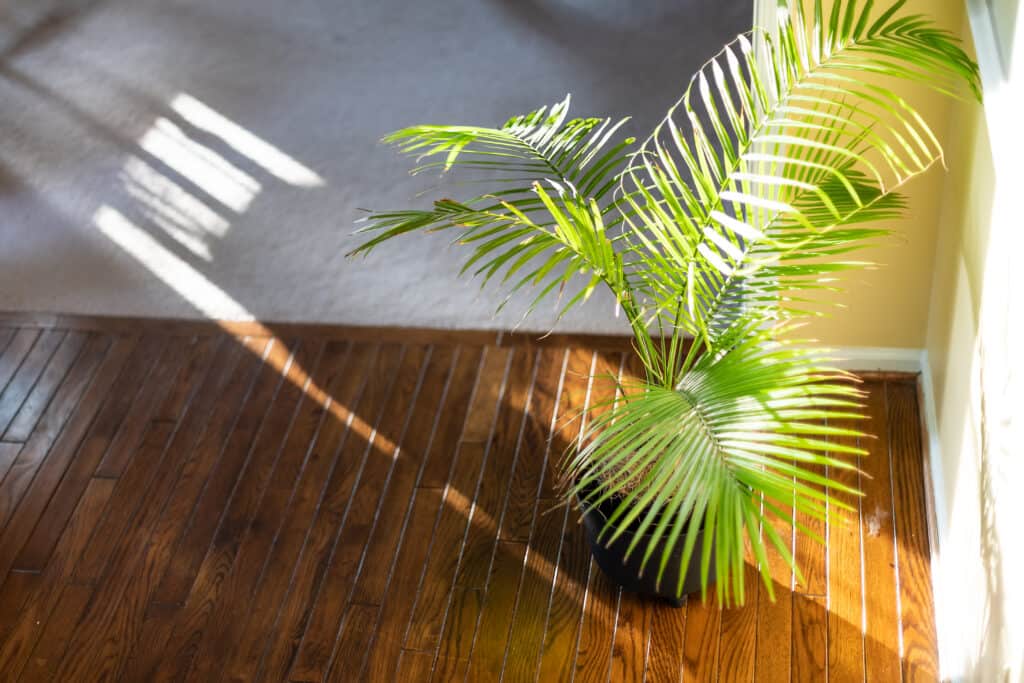
Pot-binding is not an issue with palms.
©iStock.com/ablokhin