If you live somewhere with warm winters, odds are you’ve seen a Christmas palm. They’re very popular ornamental plants that are showy, adaptable, and easy to care for. Due to their small stature, they shine in landscaping roles where other palm species would be too large. They also make for wonderful houseplants in areas that experience cold winters.
Whether you’d like to grow your own Christmas palm at home or just want to know more about them, the information in this guide will give you a great start. We’ll talk about how these palms grow and the conditions they need to thrive both indoors and outdoors. We’ll also discuss some common diseases and how to deal with them.
| Botanical Name | Adonidia merrillii |
| Common Name | Christmas palm, Manila palm |
| Sunlight | Full sun is ideal but can tolerate partial shade. |
| Water | Water regularly, but allow the top of the soil to dry first. Do not overwater. |
| Soil Conditions | Adaptable, but requires well-draining soil. Slightly acidic to neutral pH. |
| Hardiness | USDA zones 9b-11. Can survive freezing in very short bursts, but foliage damage will result. |
| Indoor or Outdoor? | Both. Slow-growing but requires a lot of sunlight. |
| Beginner Friendly? | Yes. Easy to grow, low-maintenance. |
What Is a Christmas Palm?

The Christmas palm is also known as the Manila palm.
©gustavomellossa/Shutterstock.com
A native of the Philippines and Malaysia, this palm species is cultivated in tropical and subtropical areas worldwide. Because of its smaller size and showy appearance, it’s popular in landscapes where space is limited. The Christmas palm accepts a variety of growing conditions and can be grown as a houseplant as well.
This palm is considered solitary, meaning each plant grows only a single trunk. However, it is a common practice to plant multiple palms in a single hole to emulate multi-trunked palms. While this adds visual interest, it can cause competition between plants, negatively affecting their health.
Young Christmas palms will quickly reach about 6 feet in height and then slow down for the rest of their lifespan. While mature plants can eventually reach heights of 20 to 25 feet, they can take many years to do so. Trunks of this species are slender and may develop an attractive, ringed texture that continues from ground level to the crown.
The canopy of the Christmas palm consists of beautiful, arching fronds that each grow to about 4 or 5 feet in length. Each frond is pinnate, or feather-like, and consists of many small, lance-shaped leaflets that emerge from a central rib. At maturity, the canopy will reach a width of about 8 feet.
Although the rest of the plant is beautiful, the primary attraction to this palm is its creamy white flowers and showy, bright red fruits. During the summer, clusters of small, white flowers appear along the base of the palm’s crown and eventually give way to green fruits. Later in the year, usually around December, these fruits begin to ripen and turn a bright, vibrant red at maturity.
How Do Christmas Palms Reproduce?
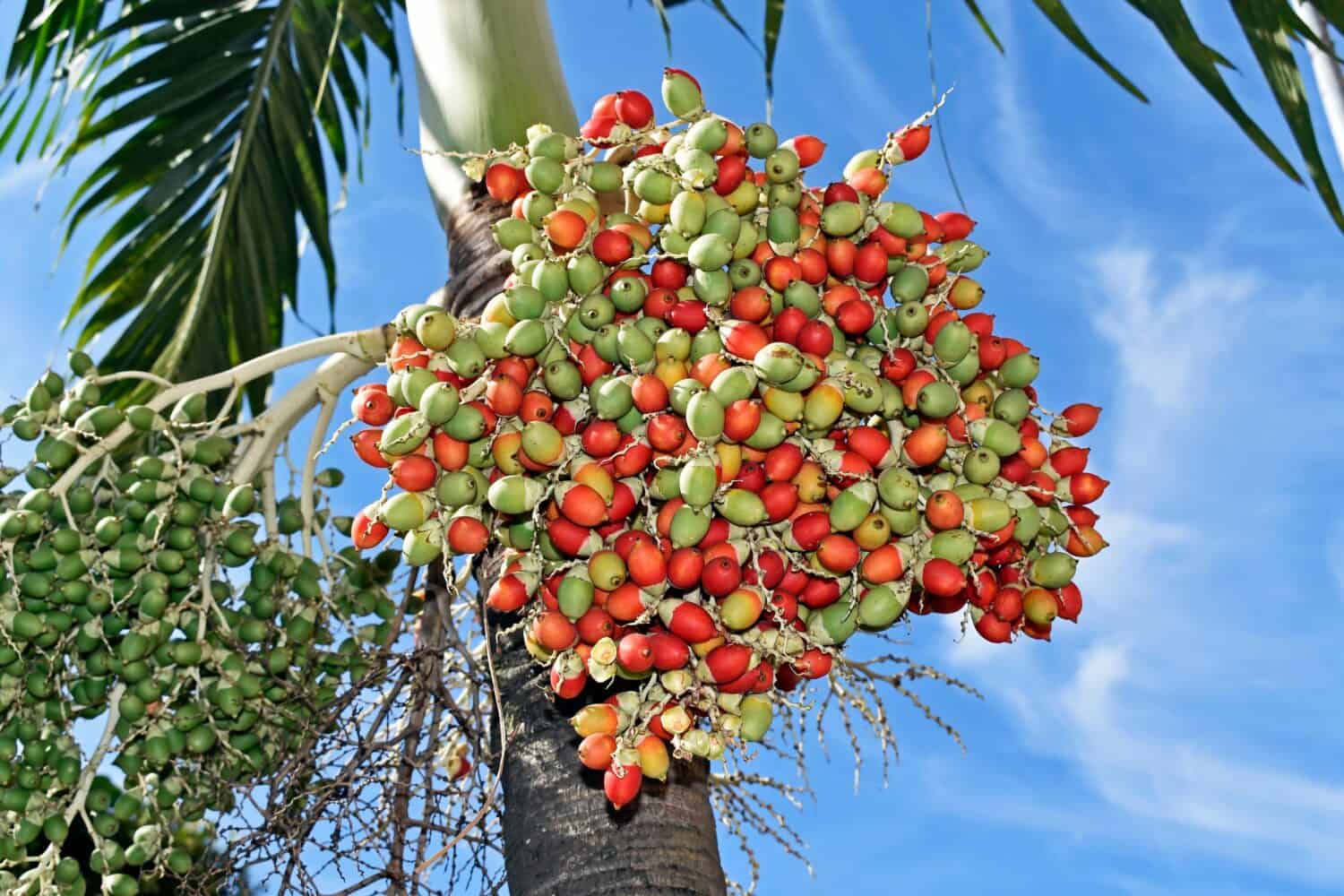
The Christmas palm gets its name from the fruits that bloom in the winter.
©Wagner Campelo/Shutterstock.com
Christmas palms are monoecious, meaning that individual members of the species are sexually independent and can self-fertilize. When mature, each of its fruits usually contains viable seeds. The seeds quickly and readily germinate, then are often spread outdoors by birds and other animals that use the fruits as a food source
If you’d like to grow additional Christmas palms at home, you can separate the seeds from the fleshy pulp of the fruits and plant them in containers of standard potting soil. Be sure to leave a little bit of each seed proud of the soil’s surface and keep the soil moist. Do not allow the soil to dry out. Within a couple of months, you should begin to see germination.
How to Grow a Christmas Palm
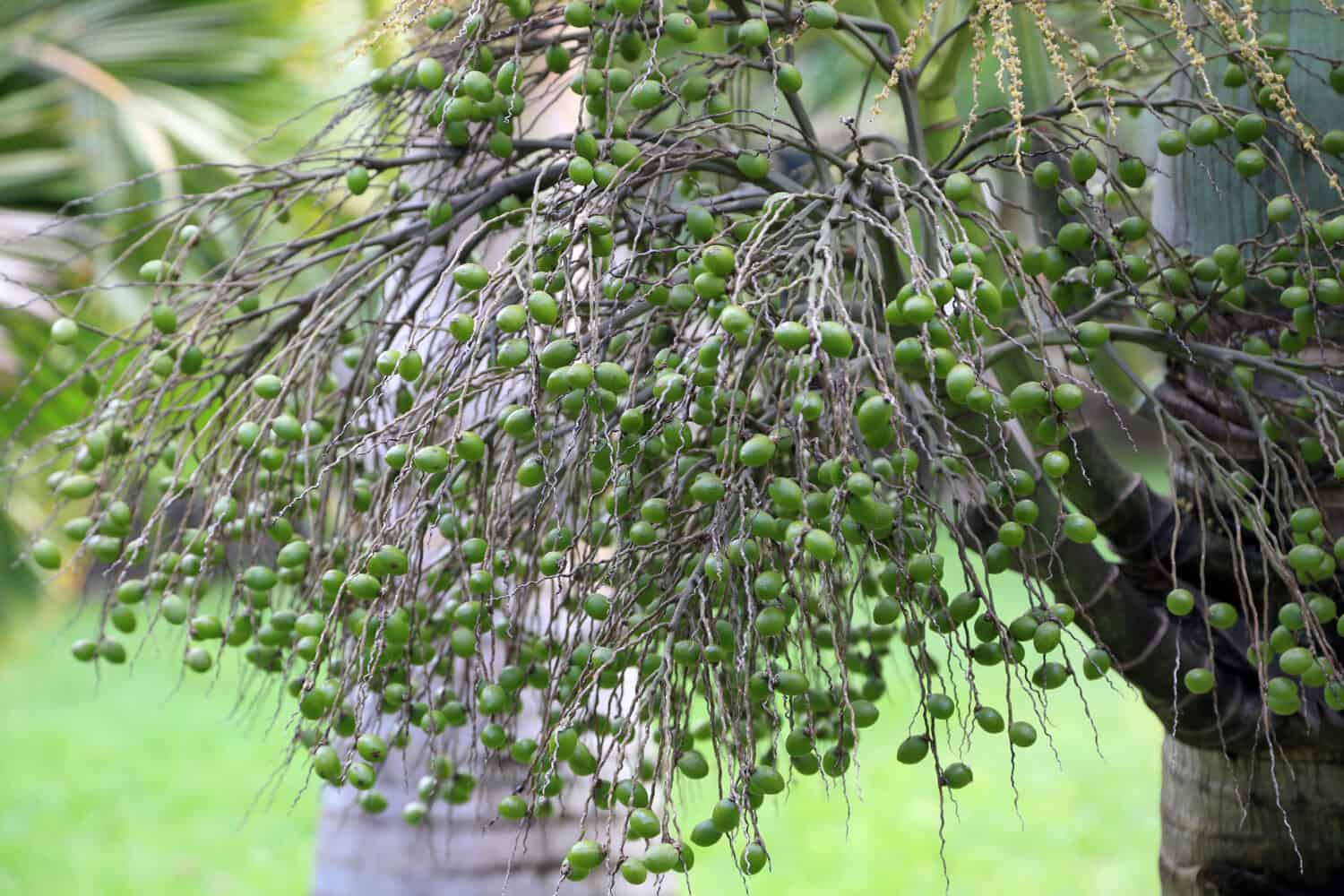
The Christmas palm needs fertilizer every four months but features relatively easy care and growing instructions.
©Bildagentur Zoonar GmbH/Shutterstock.com
The Christmas palm is flexible about its growing requirements and is very easy to care for. Whether you plan to grow your palm indoors in a container or outdoors in your home’s landscape, this popular, low-maintenance palm species will surely be a great fit for you.
Below, we’ll discuss the conditions your palm will need to thrive. Building a care routine around these guidelines will get you started and set you up for success.
Remember that this tropical species of palm can handle short bursts of freezing weather without dying and is best grown in areas that stay warm year-round. If your palm is grown outside in a container, you should bring it indoors in winter if cold weather is expected.
Sunlight
Christmas palms are pretty adaptable when it comes to sunlight conditions. They will do their best when receiving 6–8 hours of full sun daily. However, they also tolerate light shading and will grow just fine in areas with less sunlight. This makes them good candidates for indoor growing.
If you are growing your Christmas palm indoors, be sure to place its container in the brightest room of your house for the best results. Rotate the container a quarter-turn every time you water your plant to give all of its leaves frequent access to sunlight. This will help keep your palm growing evenly.
Water
Although these palms are fairly tolerant of drought conditions, they prefer to have access to plenty of water. However, Christmas palm roots are sensitive to moisture and do not tolerate overly wet soil. Therefore, it is important to avoid watering too frequently. You should allow your plant’s soil to dry out before watering again to ensure it does not become oversaturated.
Soil Conditions
Christmas palms are adaptable to a range of soil conditions. As long as the soil is well-draining, the exact ratio of clay, sand, and silt is not particularly important. Higher clay and silt ratios will slow drainage plus provide greater access to vital nutrients and minerals.
While it is crucial to prevent puddles of standing water from forming, it is also important that your soil does not dry out too quickly. By applying a couple of inches of mulch, you can help your soil retain moisture for longer periods. This keeps the soil cool and sheltered from the weather while still allowing oxygen to reach your plant’s roots. It also helps prevent erosion.
Additionally, mulching increases the amount of organic matter present in the topsoil. Organic matter improves soil health by increasing pore size, improving drainage, and boosting your soil’s ability to hold onto nutrients. It also gives safe refuge to aerobic soil microbes that are vital to your plant’s and its soil’s health.
Fertilization
Outdoors, fertilization of these palms is generally unnecessary as they are well-adapted to soils with low nutrient content. Because of this, they are also less susceptible to many nutrient deficiencies that other palm species suffer from. Boron deficiencies may occasionally occur, however. Managing this type of deficiency can be touchy, as the healthy range of boron in the soil is narrow and the threshold for toxicity is rather low. Usually, low-strength applications of boric acid are made at intervals of 5 or 6 months.
In containers with limited soil volume, you will eventually need to apply fertilizer. Once per year, you should apply slow-release fertilizer designed especially for palms.
Pruning Your Christmas Palm
Part of why Christmas palms are so popular is owed to their self-cleaning nature. While some palms, like Bismarck’s palm, may hold onto dead fronds for a long time, these trees will drop their fronds quickly and cleanly on their own.
If your palm isn’t dropping dead fronds quickly enough for your taste, you can still help it along. Do not, however, remove fronds that are still partially alive. Removing fronds that are still living prevents the palm from reabsorbing the vital nutrients contained in the frond. It also leaves open wounds that allow pathogens and insect pests to easily enter the tree’s living tissue.
Pests and Disease
Plants that are healthy and have all of their needs met are less likely to become sick. However, even with the best care, it is still possible that you and your plant will have to contend with pests or diseases at some point. Unfortunately, in the case of palms, many of the common illnesses and insects prove to be fatal. The following two diseases cause serious damage to your palms and should be watched out for closely.
Ganoderma Butt Rott (Ganoderma zonatum)
A soil-borne fungus of the genus Ganoderma causes this fungal infection. While it is closely related to the medicinal reishi mushroom, this fungus is anything but helpful. Over time, it digests the lignin in the lower portion of the palm’s trunk, causing weakness and instability. Because the fungus targets the plant’s lignin and not the cellulose, the trunk will still feel hard and sturdy from the outside. Other symptoms, like yellowing or dying leaves, are common ailments, making the disease impossible to diagnose.
Late in the disease progression, the fungus will likely produce a brown and white, bracket-shaped fruiting body called a conk from the base of the palm’s trunk. This is the only visual information that can be used to diagnose the disease while the palm is still living. Unfortunately, there is no cure. Once this conk has appeared to confirm the infection, the tree should be promptly removed. The sooner both the tree and the fruiting body are removed from the site, the less likely nearby palms are to contract the illness. Do not reuse parts of infected palms in the landscape, as this only spreads the fungus.
Lethal Yellowing Disease
Lethal yellowing is a palm-specific disease that is spread by an insect pest, specifically Haplaxius crudus. This plant hopper species has piercing mouthparts that it uses to feed on plants. When the insect pierces the plant’s tissue, it may transmit a phytoplasma that may ultimately cause the death of the affected palm.
Symptoms of the disease vary from species to species but progress in the same order over several months. First, the flowers of affected palms will become necrotic and prematurely drop their fruit. The fruit that falls will generally be brittle, discolored, and necrotic on one end. If the palm is not in flower during the progression of the disease, this symptom will not be present.
Next, the palm’s fronds will begin to discolor. In many palm species, the disease will cause fronds to turn a characteristic yellow before dying completely. However, Christmas palm fronds will turn from green to various shades of reddish-brown and gray.
The oldest leaves at the bottom of the crown are affected first, followed by the next youngest. Eventually, the disease will progress far enough through the crown to kill the apical meristem. This is the main growing point at the top of the crown and is responsible for all of the palm’s new growth. At this point, the entire crown will wither, and the palm will finally die.
Managing Lethal Yellowing
Unlike a Ganoderma infection, lethal yellowing can be prevented and even treated if it is caught in the early stages. If you know that lethal yellowing occurs in your area, you may opt to preventatively administer an antibiotic called OTC (oxytetracycline HCl). This same antibiotic is used to manage active infections, although it may be ineffective if the disease progresses significantly. If your palm has lost more than a quarter of its leaves to lethal yellowing, it will unlikely respond to treatment. In this case, the tree should be removed as soon as possible.