
Quick Take
- A plant that photosynthesizes still needs insects to survive, though not for the reason you'd expect. See how pollinators survive →
- The Venus flytrap's snap doesn't trigger for raindrops, and its solution to that problem is surprisingly elegant. Discover the trigger mechanism →
- Venus flytraps didn't evolve carnivory to be deadly. They did it out of desperation. Explore the nutrient-poor origins →
An organism that captures and digests insects has got to be an animal, right? Actually, nature is not as straightforward as that. There is a group of carnivorous plants that feed on animals, and the Venus flytrap is perhaps the most famous. We explain why this meat eater is actually a plant, why it eats insects, and how it catches them!
Plant or Animal?
The classification of life on Earth is a little more complex than plant vs animal. All life on our planet can trace its roots back to an entity called the Last Universal Common Ancestor. From this, three major lifeforms evolved, which are called Archaea, Bacteria, and Eukarya. The first two are tiny, single-celled organisms. Both animals and plants are Eukarya, which means they are made up of eukaryotic cells (which have DNA in a nucleus surrounded by a membrane).
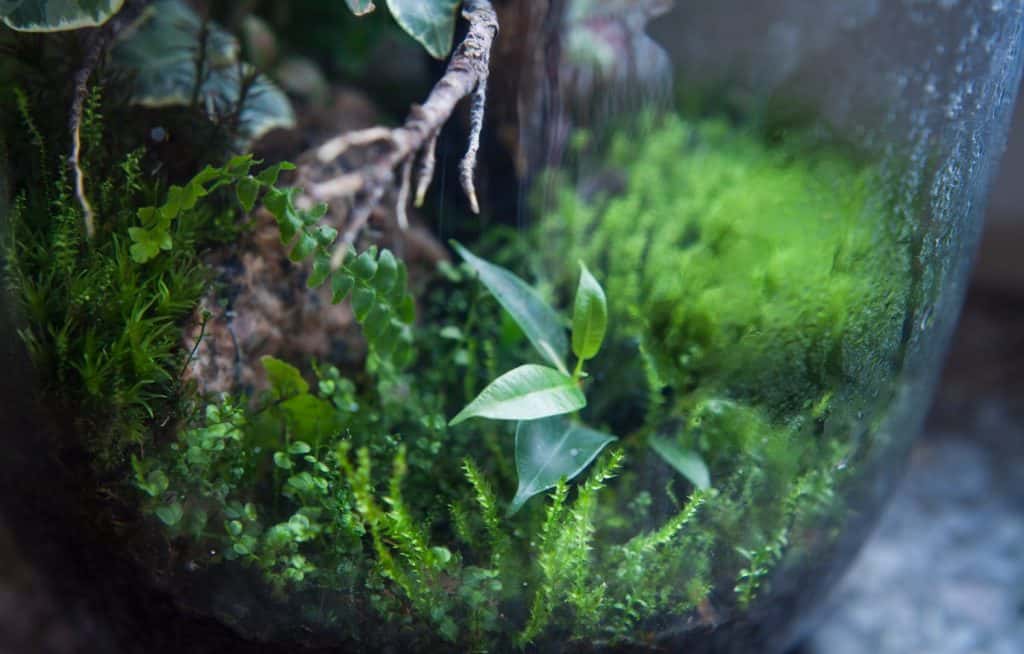
Plants can make their own energy.
©JoannaTkaczuk/Shutterstock.com
Animals are defined as multicellular, eukaryotic organisms that ingest organic matter for energy, breathe oxygen, possess specialized tissues, and are capable of movement for at least some part of their life. Also, their cells do not have walls.
Plants, on the other hand, are defined by their ability to make their own energy from water, minerals, and carbon dioxide, with the aid of pigments and the radiant energy of the sun. In many plants, this process is photosynthesis, but some parasitic plants obtain their energy from other plants or fungi.
Blurring the Lines
Some organisms make you think twice about whether they are a plant or an animal. Take sponges, for example. They are largely immobile, do not have nerve cells, and grow in branching structures just like a plant. However, they produce sperm cells, lack cell walls, and have a mobile larval stage, so they are classed as animals.
Then, there are carnivorous plants. They can make energy through photosynthesis but have evolved to supplement this energy source with live prey. To be considered carnivorous, a plant must capture and kill the prey, digest it, absorb its nutrients, and use those nutrients for growth and development. The Venus flytrap ticks all these boxes.
About Venus Fly Traps
Venus flytraps (Dionaea muscipula) only occur naturally within a 75-mile radius around Wilmington, North Carolina. However, they have been introduced to other US states, including Florida and New Jersey. They are also popular potted plants all over the world. These are small perennial herbaceous plants that can live for 20 years and possibly longer. They grow in distinct longleaf pine habitats. Importantly, these areas have nutrient-poor soil that is moist and acidic. They need an open understory (the part of the forest below the canopy), which is maintained by natural fires.
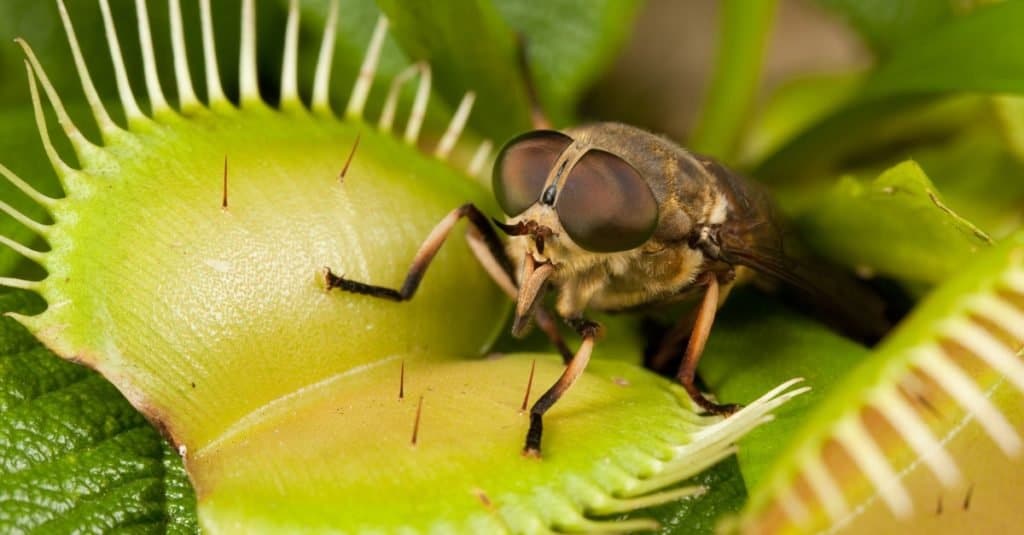
Insects trigger sensory hairs in the trap.
©Linas T/Shutterstock.com
As of 2020, the International Union for Conservation of Nature (IUCN) listed the Venus flytrap as Vulnerable. They face threats from habitat loss, especially fire suppression and the conversion of land to agriculture. When fires are suppressed, shrubs and trees encroach on their habitats. When they grow on roadsides, they are threatened by road maintenance, vegetation management, and road expansions. However, poaching is another significant threat. Sadly, Venus flytraps are being taken from the wild for sale in the horticulture trade.
How Do Venus Flytraps Catch Insects?
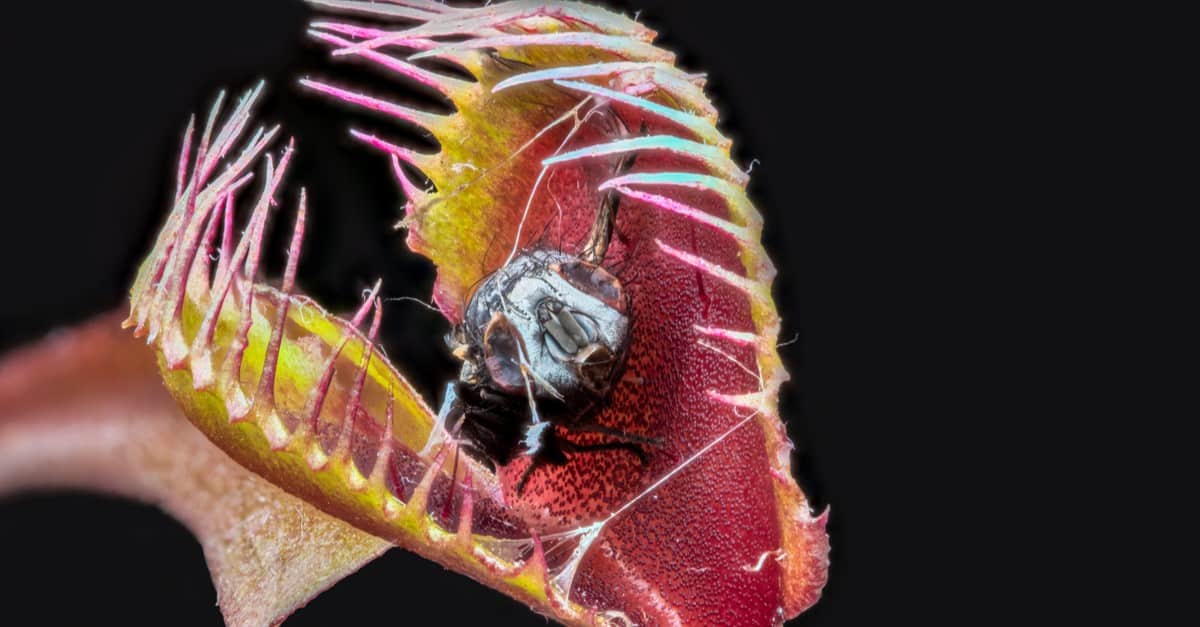
If you have ever watched a clip of a Venus flytrap consuming a fly, you’ll know that it looks remarkably like some jaws snapping closed around prey. In fact, these jaws are modified leaves (lobes). Starving Venus flytraps attract insects through the secretion of volatile compounds. There are six sensory hairs (trichomes) distributed on the two lobes of the trap. When the unsuspecting bug brushes a hair, it triggers an action potential, probably through opening ion channels. A second touch within 30 seconds triggers the closure.
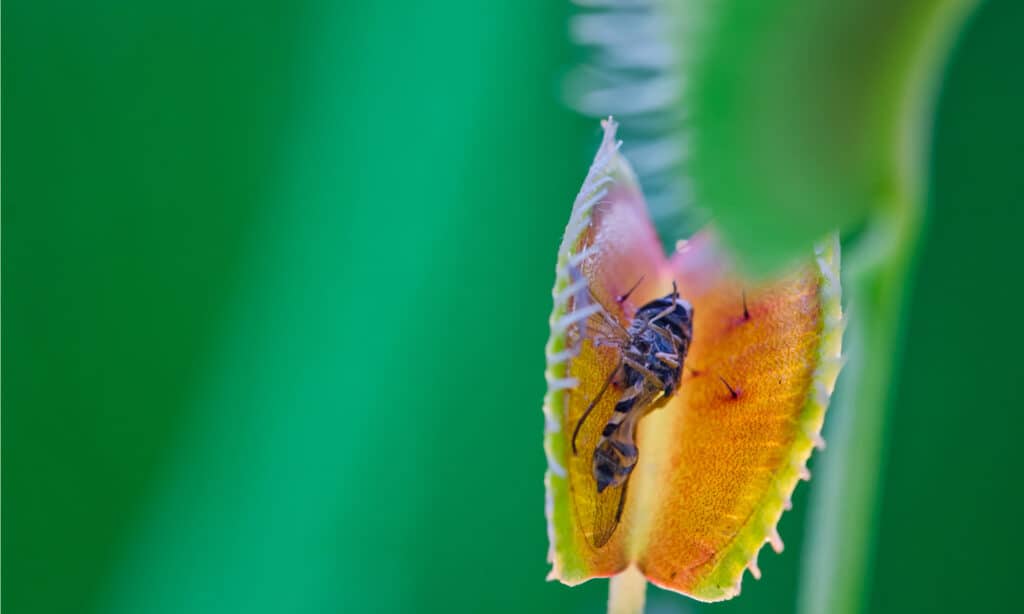
Venus flytraps digest insects with digestive acids and enzymes.
©Linda Blazic-Mirosevic/Shutterstock.com
Once the insect is secured, the plant releases digestive acids and enzymes that dissolve the insect. Then, the plant absorbs the nutrient-rich soup. This keeps the plant going for between 7 and 10 days. Then, the lobes open again, ready for another insect meal. That said, these plants can go months between meals if they need to. Each leaf catches between five and seven insects before it dies. The plant continually grows new traps from its underground stems.
So, why isn’t the trap triggered by raindrops and dust? The Venus flytrap has a clever adaptation to stop it wasting energy snapping its leaves shut on objects that have no nutritional value. Its trigger hairs must be struck twice within a 30-second timeframe before they will operate. However, recent research has shown that one stimulus is sometimes sufficient under certain circumstances and with a strong stimulus.
Why Are Venus Fly Traps Carnivorous?
We know that plants normally get their energy from photosynthesis. This is also true for Venus fly traps. They are able to get energy from the sun. However, most plants also take nutrients from the soil, including nitrogen, sulfur, magnesium, and calcium. In wet, nutrient-rich soil, plants can get all of the nutrients that they need. However, Venus fly traps grow in acidic, nutrient-poor bogs. This water-holding soil is particularly low in nutrients. Therefore, the plant has adapted to get the nutrition it needs from another source. Venus fly traps do not just capture and digest insects such as ants, beetles, and grasshoppers; they will also ‘eat’ spiders.
What About Pollinators?
Venus fly traps are flowering plants and rely on insects for pollination. This would be a problem if the plant ate the very insect it needed for pollination. Therefore, Venus flytrap flowers grow on tall stalks, keeping them well away from the snapping leaves. The flowers are white with green veins running from the base of the petals. By growing on tall stalks, the flowers keep pollinating insects safe from the snapping jaws below.