
Quick Take
- Only one animal on this list is actually a true rabbit, while the rest are something else entirely, and the distinction matters more than you'd think. Meet the true rabbit →
- One of these giants can hit 50 mph, though its speed is not even its most remarkable desert survival trick. See its desert survival tricks →
- One species uses its ears in a way that has nothing to do with hearing, while another evolved shorter ears for the exact opposite reason. Explore ear adaptations →
- One of these hares earned its name by mimicking a completely different animal while sprinting away from predators. Discover the pronghorn mimicry →
The U.S. is home to approximately 15 native species of wild lagomorphs, including various cottontail rabbits and true hares, which are commonly called jackrabbits. They vary drastically in size, from the tiny pygmy rabbit weighing under a pound to large hares that can weigh up to 10 pounds. Although they look similar, rabbits and hares belong to different genera within the family Leporidae and have distinct biological traits. Rabbits give birth in underground burrows to altricial young, which are blind, hairless, and helpless. Hares nest in shallow surface depressions called forms and give birth to precocial young, which are fully furred, have their eyes open, and are ready to run within hours. Rabbits have a more compact, egg-shaped body and primarily avoid predators by hiding in dense vegetation or underground burrows. Continue reading to discover five of the largest rabbits (and hares) hopping around the United States.
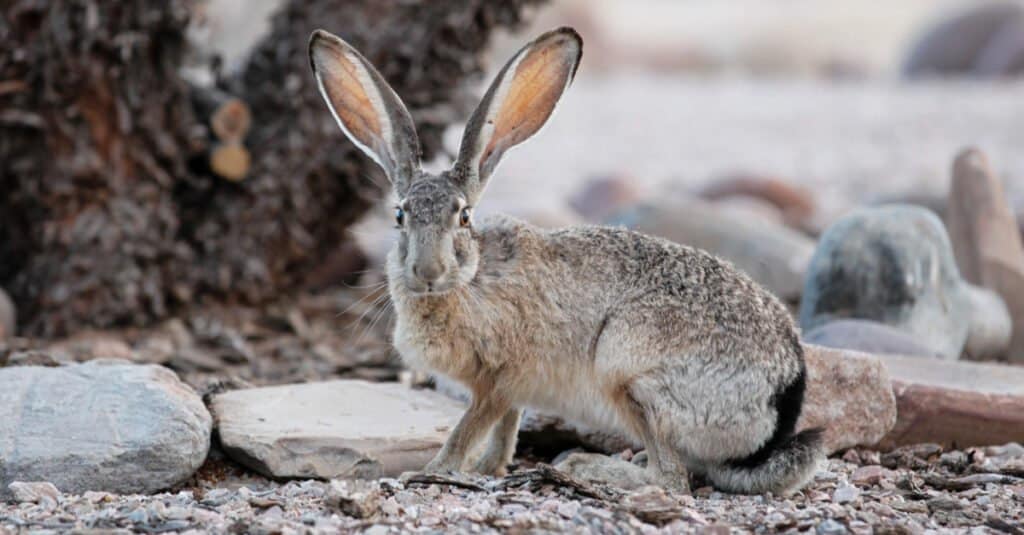
Jackrabbits have significantly longer, more slender legs and much larger ears than true rabbits.
©Ingrid Curry/Shutterstock.com
Snowshoe Hare: 3-5 Pounds
The snowshoe hare (Lepus americanus) is a medium-sized lagomorph native to North America, easily recognized by its large, well-furred hind feet that act like natural snowshoes. These hares are famous for their seasonal camouflage, which allows them to blend seamlessly into the snowy boreal forests and mountainous undergrowth where they live.

During the summer, snowshoe hares have a grizzled, rusty, or grayish-brown coat with a white belly and feet. In the winter, they molt into a stark white coat.
©Jim Cumming/Shutterstock.com
Their large, wide hind feet are densely covered in thick fur, which makes them buoyant, preventing them from sinking into deep, soft snow. Their ears, which measure 2.4 to 2.8 inches, are relatively short for a hare. However, their smaller ears help minimize body heat loss in freezing climates.
Their short tail is generally dark brown or grayish on top, and white underneath. Snowshoe hares are widely distributed across Canada and Alaska, reaching the northern shores of the Arctic Ocean. Their southern range extends down to New Mexico in the west and northern New England and the Great Lakes region in the east.
Swamp Rabbit: 3.5 – 6 Pounds
The swamp rabbit (Sylvilagus aquaticus), the only true rabbit on our list, is the largest member of the cottontail genus. As their name implies, these rabbits are intimately tied to water. They primarily inhabit swampy lowlands, river bottoms, floodplains, and bottomland hardwood forests.
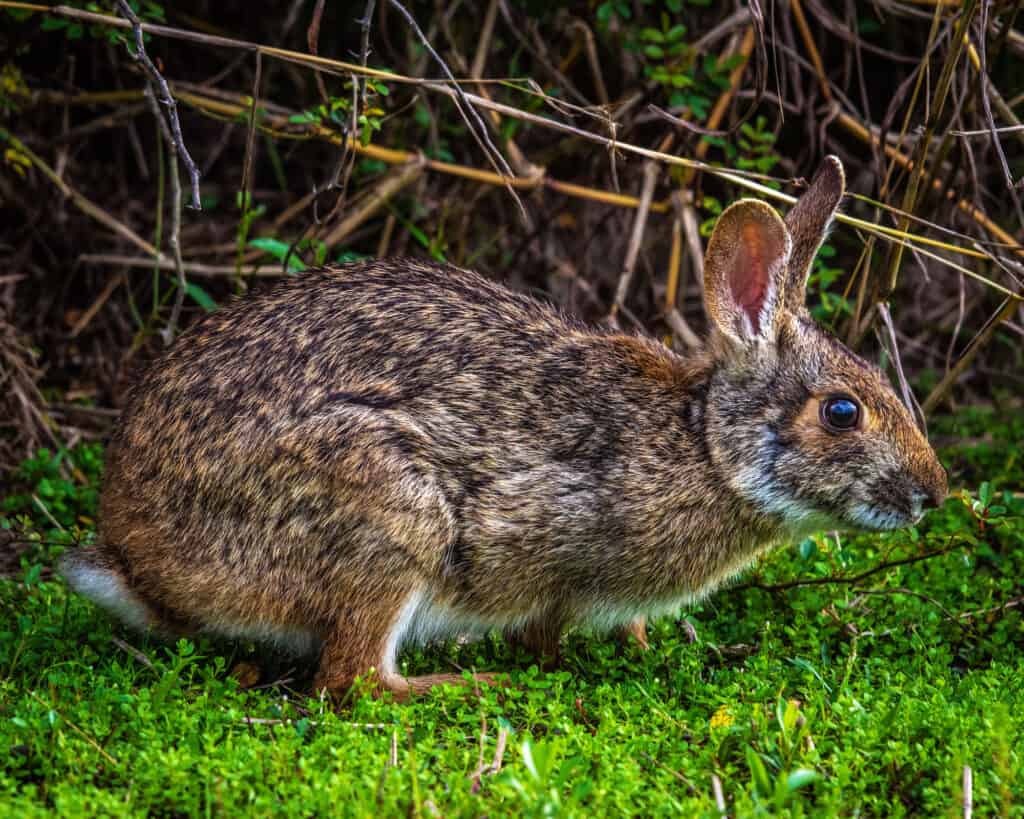
Swamp rabbits are the largest cottontail species.
©Lawrence Jefferson/Shutterstock.com
Swamp rabbits are distributed across the South-central and Southeastern United States. Their range extends from the Gulf Coast northward along the Mississippi River into Southern Illinois and Indiana, stretching as far west as Eastern Texas and Oklahoma and eastward to parts of Western South Carolina.
Black-tailed Jackrabbit: 3-7 Pounds
The black-tailed jackrabbit (Lepus californicus) is a large North American hare found in deserts, prairies, and scrublands of the American West. These hares have large, black-tipped ears and a black-tipped tail. They rely on exceptional speed, the ability to leap up to 20 feet, and a zigzag running pattern to evade predators.
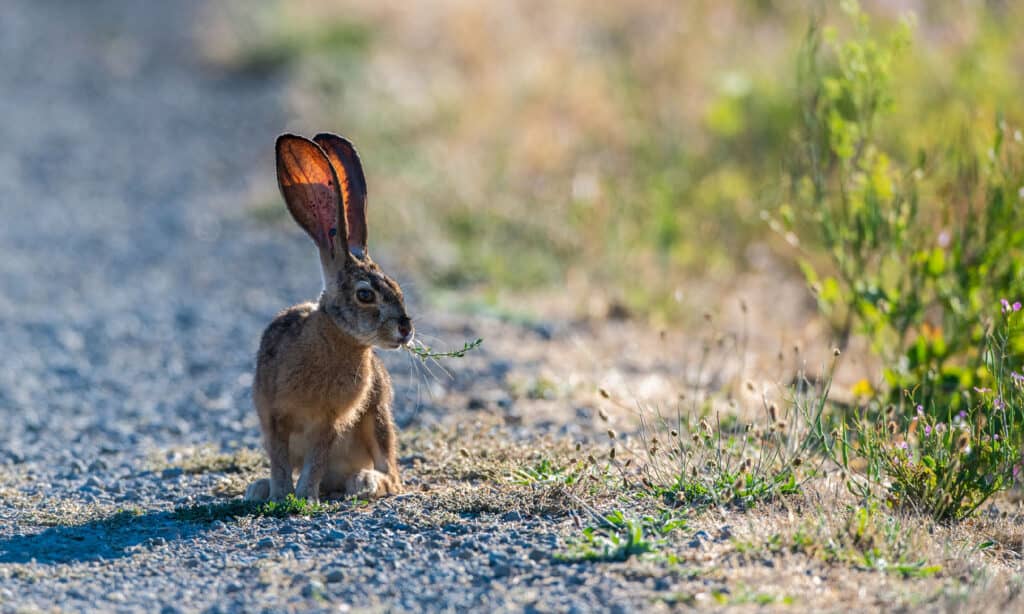
Black-tailed jackrabbits use their 5- to 7-inch, blood-vessel-filled ears as radiators to shed body heat.
©iStock.com/zhuclear
Black-tailed jackrabbits can run at speeds of up to 40 miles per hour (mph) in short bursts to escape predators, such as coyotes and bobcats. They are solitary, nocturnal herbivores that consume large quantities of grasses, shrubs, and cacti.
White-tailed Jackrabbit: 6-10 Pounds
The white-tailed jackrabbit (Lepus townsendii) s a large hare with powerful legs that allow it to reach speeds of up to 50 mph for short periods. It is typically found in wide-open habitats, such as shortgrass prairies, sagebrush plains, and high-altitude alpine meadows of the American West. Northern populations of white-tailed jackrabbits turn almost pure white in winter to help camouflage themselves in the snow.

White-tailed jackrabbits are considered the fastest jackrabbit species.
©ShayneKayePhoto/Shutterstock.com
The white-tailed jackrabbit’s 4- to 6-inch ears are slightly shorter and more proportional to their bodies than those of their desert-dwelling cousins, the black-tailed jackrabbits. Because they inhabit milder environments, white-tailed jackrabbits do not need such large ears for cooling.
Antelope Jackrabbit: 9-10 Pounds
The antelope jackrabbit (Lepus alleni) iis one of the largest hares in North America, widely known for its immense ears, athletic leaps, and striking color patterns. It is named for its pronghorn-like ability to sprint and display patches of white fur while running, making it a highly specialized desert survivor.
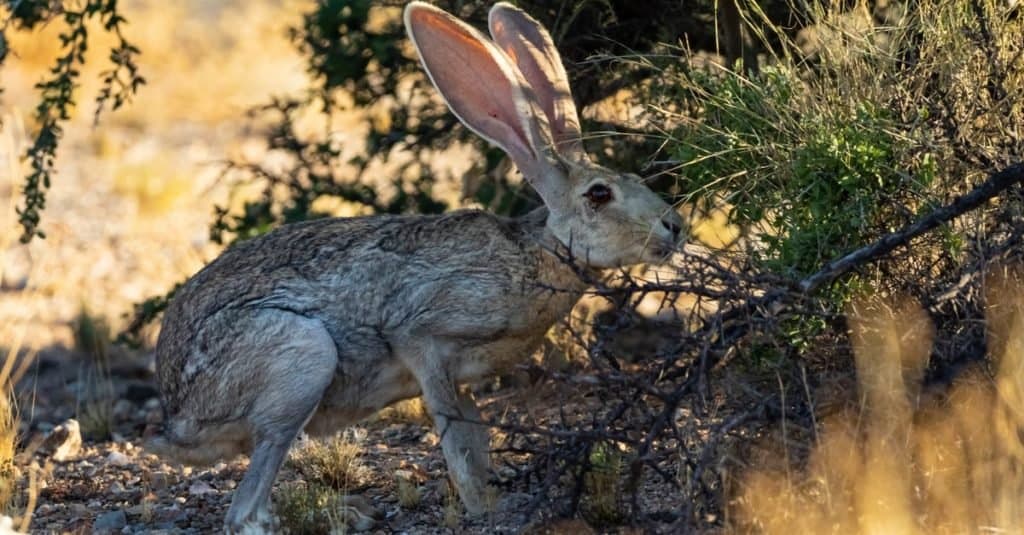
The ears of an adult antelope jackrabbit are typically 5.5 to 7 inches long.
©Vincent Pro Photo/Shutterstock.com
The antelope jackrabbit has a highly restricted distribution, found only in the Southwestern United States and Northwestern Mexico. In the United States, they are confined almost entirely to the Sonoran Desert regions of Southern and Central Arizona.