G
Species Profile

Giant Panda Bear

Ailuropoda melanoleuca

A bear built for bamboo.
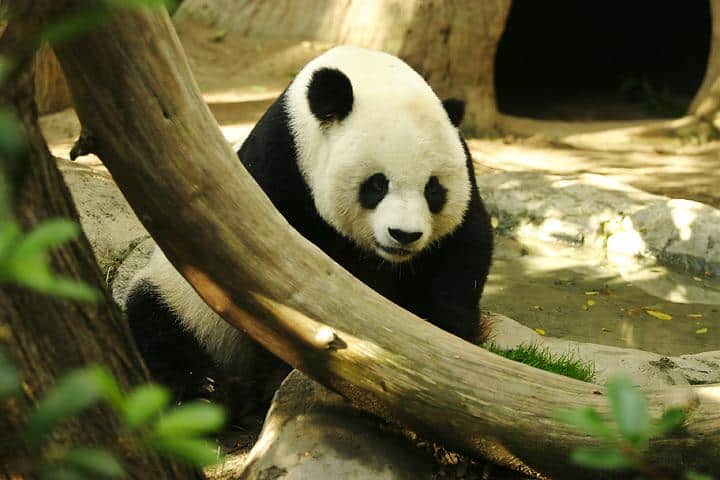
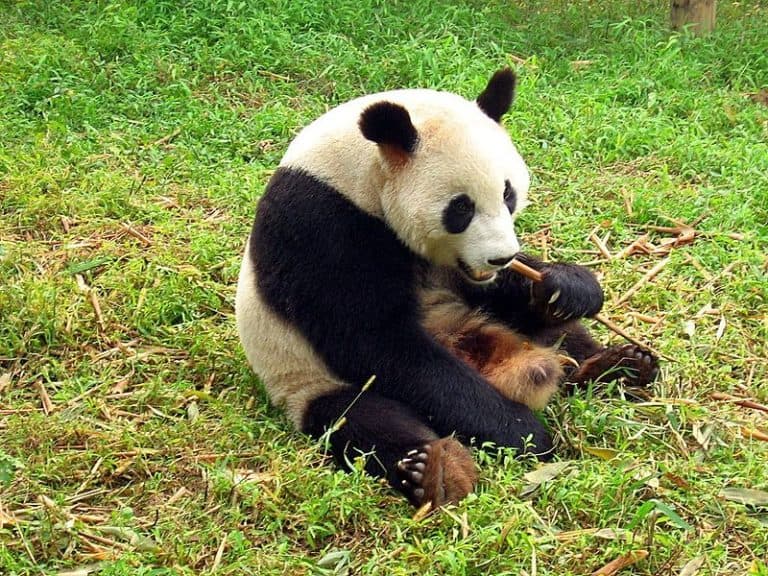
Aaron Logan / Creative Commons

Giant Panda Bear Distribution

Click a location to explore more animals from that region

Endemic Species
Loading map...

Found in 1 country

Size Comparison

Human 5'8"
Giant Panda Bear 2 ft 6 in

Giant Panda Bear stands at 43% of average human height.

At a Glance

Wild Species
Also Known As Panda, Panda bear, Bear cat, 熊猫 (xióngmāo), 大熊猫 (dà xióngmāo)
Diet Omnivore
Activity Cathemeral+
Lifespan 18 years
Weight 160 lbs
Status Vulnerable
Did You Know?

Despite a bamboo diet, it's taxonomically a true bear (Family Ursidae, Order Carnivora).

Scientific Classification

The giant panda is a large bear species endemic to China, famous for its black-and-white coat and highly specialized bamboo diet.

Kingdom
Animalia
Phylum
Chordata
Class
Mammalia
Order
Carnivora
Family
Ursidae
Genus
Ailuropoda
Species
Ailuropoda melanoleuca

Distinguishing Features

  • Bold black-and-white pelage with black eye patches
  • Powerful jaws and enlarged molars adapted for crushing bamboo
  • A modified wrist bone functioning as a ‘pseudo-thumb’ for grasping bamboo
  • Primarily herbivorous diet despite being in the order Carnivora

Physical Measurements

Males and females differ in size

Height
2 ft 6 in (1 ft 12 in – 2 ft 11 in)
2 ft 2 in (1 ft 12 in – 2 ft 6 in)
Weight
243 lbs (187 lbs – 353 lbs)
187 lbs (154 lbs – 220 lbs)
Tail Length
5 in (4 in – 6 in)
5 in (4 in – 6 in)
Top Speed
20 mph
Short bursts: 32 km/h

Appearance

Primary Colors
Secondary Colors
Skin Type Giant Panda (Ailuropoda melanoleuca) has thick, fur-covered skin with dense underfur and coarse guard hairs for cool, wet mountain forests; paw pads are mostly bare and rough for grip, feet mostly furred; family Ursidae.
Distinctive Features
  • Bear (Family: Ursidae) with robust, round-headed build; adult head-body length typically 1.2-1.9 m; tail ~10-15 cm (species-level measurements commonly reported in mammalogy references, e.g., Nowak).
  • Giant Panda (Ailuropoda melanoleuca) adult weight varies by sex and season: females about 70–100 kg, males about 100–115 kg or more, and some males reach about 160 kg.
  • Iconic facial appearance: large black periocular patches, black ears, blunt muzzle; eyes are relatively small for head size, contributing to the 'masked' look.
  • Powerful jaws and enlarged, flattened molars/premolars suited to crushing fibrous bamboo; despite bamboo-dominated diet, dentition and digestive anatomy remain fundamentally carnivoran/bear-like (short, simple gut typical of Ursidae/Carnivora).
  • Forepaws bear a functional 'pseudo-thumb' (enlarged radial sesamoid bone) used to grasp bamboo culms and leaves-key to bamboo specialization in this Ursidae species.
  • Large, stocky limbs with strong shoulder musculature for climbing and foraging; adults retain climbing ability though juveniles climb more frequently.
  • Behavioral appearance context: typically solitary; spends a large fraction of the day feeding (often reported ~10-16 h/day) and consumes large quantities of bamboo (commonly reported on the order of ~12-38 kg/day, varying with bamboo part/season).
  • Endemic range context affecting appearance/ecology: occurs in fragmented montane bamboo forests of central China (notably Sichuan, Shaanxi, and Gansu), typically at ~1,200-3,400 m elevation; cool, humid habitat aligns with dense insulating coat.
  • Giant Panda (Ailuropoda melanoleuca) is threatened by habitat fragmentation and past loss of bamboo forest. It is listed as Vulnerable on the IUCN Red List, a status about population and habitat.

Sexual Dimorphism

Sexual dimorphism is present mainly in overall size and skull/cheek robustness rather than coat pattern: adult males average larger and heavier than adult females (commonly reported ~10-20% heavier on average), with broader heads and stronger jaw musculature typical of ursids.

  • Larger body mass on average; exceptionally large individuals reported up to ~160 kg in males.
  • Broader skull and more prominent sagittal/zygomatic regions associated with stronger jaw musculature (more pronounced 'cheek' appearance).
  • Smaller average body mass; exceptionally large females reported up to ~125 kg in some datasets.
  • Overall head and forequarter musculature typically less bulky than males, while coat pattern remains similar.

Did You Know?

Despite a bamboo diet, it's taxonomically a true bear (Family Ursidae, Order Carnivora).

Adults typically measure 1.2-1.9 m in head-body length; tail ~10-15 cm.

Mass commonly ~70-125 kg in adults; large males can reach ~160 kg.

They may eat about 12-38 kg of bamboo per day and spend ~10-16 hours daily feeding.

Newborn cubs are tiny-about 90-130 g at birth-among the most extreme size gaps between mother and newborn in placental mammals.

Females have a very short annual fertile window (estrus about 2-3 days) in spring (roughly March-May).

Wild lifespan is often ~15-20 years; in human care many live 25-35+ years, with rare individuals reaching ~38 years.

Unique Adaptations

  • "Pseudo-thumb" (enlarged radial sesamoid bone): functions like an opposable thumb to grasp and strip bamboo efficiently.
  • Powerful jaw musculature and broad molars: specialized for crushing tough bamboo culms; skull and teeth are robust for high-force chewing.
  • High daily intake strategy: compensates for bamboo's low caloric density by eating large masses (often 12-38 kg/day) and feeding for many hours.
  • Digestive compromise of a carnivore: retains a simple bear-like gut yet relies on heavy consumption and selective feeding (shoots vs. leaves) rather than ruminant-style fermentation.
  • Camouflage patterning: black-and-white coloration provides disruptive concealment in snowy and shaded forest mosaics; dark eye patches may aid signaling in close-range communication.
  • Dense fur and compact body: suited to cool, humid montane forests typically around ~1,200-3,400 m elevation in central China.
  • Delayed implantation (embryonic diapause): gestation length varies widely (about ~95-160 days total), helping time births to favorable seasons.

Interesting Behaviors

  • Bamboo-focused foraging routine: long daily feeding bouts (often 10-16 hours/day) with frequent defecation due to low-nutrient, high-fiber food.
  • Solitary spacing system: adults mostly live alone, using scent marks (anogenital gland secretions and urine) and scratch marks to communicate identity and breeding status.
  • Seasonal elevational movement: individuals shift to different elevations as bamboo shoots and leaves become available at different times in mountain forests.
  • Vocal communication: bleats are common in social/breeding contexts; chirps, honks, and growls occur during interactions and conflicts.
  • Brief, seasonal mating: during spring breeding season, multiple males may compete and follow an estrous female; most social tolerance is tied to reproduction.
  • Maternal care is intensive: mothers keep cubs warm, nurse, and carry them frequently; twins can occur, but in the wild usually only one cub is successfully raised.
  • Play and climbing: juveniles climb and tumble extensively, building coordination and strength needed for navigating steep, forested terrain.

Cultural Significance

The giant panda (Ailuropoda melanoleuca) is China’s national symbol and a global conservation icon (WWF logo) used in panda diplomacy. Linked with peace, pandas show bears (Ursidae) can eat mostly bamboo. Reserves, corridors, and anti‑poaching help; IUCN: Vulnerable.

Myths & Legends

A Chinese tale says the Giant Panda (Ailuropoda melanoleuca)'s black patches came from grief: after a girl died protecting a cub, pandas wiped eyes and hugged with ash-stained paws, leaving dark ears and eye patches.

One old tale says giant pandas were once all white. After a mountain tragedy, they covered themselves with dark ash during a funeral, leaving the black marks as a sign of memory.

In mountain stories, the Giant Panda (Ailuropoda melanoleuca) is a calm, forest spirit that avoids fighting and brings harmony. That image later helped make pandas a modern symbol of peace.

In China, the giant panda (Ailuropoda melanoleuca) had an old name meaning 'bear-cat' because of its catlike face and behavior; that name made people see it as a mix of familiar animals in folk stories.

A modern cultural myth, "panda diplomacy" treats pandas as living ambassadors whose presence signals goodwill and better relations. Media and stories repeat this idea, as if pandas alone can calm human conflicts.

Conservation Status

VU Vulnerable

Facing a high risk of extinction in the wild.

Population Increasing

Protected Under

  • China: listed as a Class I National Key Protected Wild Animal (highest level of legal protection).
  • CITES: Appendix I (international commercial trade prohibited, with limited exceptions).
  • China: Large protected-area network including the Giant Panda National Park (formally established 2021) and numerous nature reserves/corridors aimed at maintaining and restoring habitat connectivity.
  • Population reference (widely cited): 1,864 wild individuals reported from China's Fourth National Giant Panda Survey (data released 2015; survey period ending 2014); IUCN status downlisted from Endangered to Vulnerable in 2016 with an increasing trend attributed to habitat protection and management.
  • Biology (species-specific, commonly cited ranges): adult head-body length ~1.2-1.9 m; mass commonly ~70-125 kg (large males can be heavier); wild longevity typically ~15-20 years, with documented captive longevity >30 years (record ~38 years).
  • HUBS (Ursidae conservation landscape): Bear species range from Least Concern (e.g., brown bear in many regions) to threatened categories (e.g., several Asian bears listed VU-CR in parts of their ranges). Common cross-cutting threats include habitat loss/fragmentation, hunting/poaching and illegal trade (bile/paws), human-wildlife conflict, and climate change (especially affecting Arctic/seasonal food systems). Notable at-risk ursids include polar bear (climate-linked declines) and sun/sloth/brown bear subpopulations in regions with heavy persecution and rapid land conversion (status varies by species/region per IUCN).

Life Cycle

Birth 1 cub
Lifespan 18 years

Lifespan

In the Wild
14–20 years
In Captivity
20–38 years

Reproduction

Mating System Polygynandry
Social Structure Solitary
Breeding Pattern Seasonal
Fertilization Internal Fertilization
Birth Type Internal_fertilization

Giant pandas are mostly solitary. They breed once a year in spring; females are in heat 1–3 days, and several males may mate (polygynandry) with no pair bonds. Fertilization is internal with delayed implantation (≈95–160 days). Mothers raise 1–2 cubs alone.

Behavior & Ecology

Social Solitary (no stable collective group name) Group: 1
Activity Cathemeral, Crepuscular
Diet Omnivore Bamboo shoots (young shoots; preferred over leaves/culms when available).

Temperament

Generally non-gregarious and avoidance-oriented toward conspecifics outside breeding; most social contact is indirect via scent marks (Schaller et al., 1985; Swaisgood et al., 2010).
Typically calm/low-aggression when undisturbed, but can show defensive aggression when threatened or when a female has a cub.
Giant Panda (Ailuropoda melanoleuca) spends time eating and resting because bamboo has little nutrition. They are active in short bouts day and night, peaking at dawn and dusk, and change with temperature or human disturbance.
Giant Panda lifespans: wild about 15–20 years; captive over 30 (up to ~38). Longer captive life allows repeat mating each season, but adults don't form stable groups.

Communication

Bleats Common close-range affiliative/sexual signal; used by estrous females and males) (Charlton et al., 2009
Chirps Often associated with female estrus and mate attraction) (Charlton et al., 2009
Barks Alarm/agitation
Growls/roars Aggression/threat
Cubs: squeals/squawks/whimpers to solicit maternal care Schaller et al., 1985
Chemical scent marking: anogenital gland secretions and urine deposited on trees/rocks; scent marks convey sex, reproductive state, and individual identity and structure spacing/encounter rates Schaller et al., 1985; Swaisgood et al., 2010
Visual/physical marking: scratching/clawing tree trunks and rubbing to leave combined visual and chemical signals Schaller et al., 1985
Postural/body signals during close encounters: head lowering, lunging, and avoidance/retreat behaviors; mother-cub tactile contact Nuzzling, carrying, positioning) is central to family-unit cohesion (Schaller et al., 1985

Habitat

Forest Coniferous Forest Deciduous Forest Mountain Alpine Meadow
Biomes:
Temperate Forest Alpine
Terrain:
Mountainous Hilly Valley Rocky
Elevation: 3937 ft – 11154 ft 10 in

Ecological Role

Specialized bamboo-dominant forager and ecosystem indicator/umbrella species in temperate montane bamboo forests of central China; contributes to understory/patch dynamics via intense, selective bamboo browsing and to nutrient cycling via high-volume fecal deposition.

Nutrient cycling and soil fertilization via large quantities of bamboo-rich feces Influences bamboo stand structure and regeneration through selective feeding on shoots/leaves/culms (can alter bamboo patch dynamics) Umbrella/flagship effect: conservation actions for panda habitat protect co-occurring montane forest biodiversity Indicator of intact, connected bamboo-forest ecosystems (presence/absence reflects habitat quality and fragmentation)

Diet Details

Main Prey:
Pikas Small rodents Bamboo rat Birds and eggs Insects Carrion
Other Foods:
Bamboo shoots Bamboo leaves Bamboo stems Arrow bamboo Umbrella bamboo Other bamboos Other vegetation and fruits +1

Human Interaction

Domestication Status

Wild

The giant panda is a wild bear species and has not been domesticated. There is no history of long-term selective breeding to produce human-managed traits like those seen in domestic animals. Human interaction has mainly involved protecting wild populations and managing a limited number of animals in captivity for conservation breeding, veterinary care, and scientific research.

Danger Level

Moderate
  • Bites/crush injuries: adults are powerful bears with large canines and strong jaw musculature; injuries can be severe, particularly to hands/arms, and have occurred to keepers during close handling.
  • Defensive attacks during surprise encounters in the wild (especially at close range) or when animals are cornered.
  • Higher risk around females with cubs or during high-arousal situations (restraint, medical procedures).
  • Zoonotic disease risk is generally low compared with many domestic species, but standard wildlife handling risks (bacterial contamination from bites/scratches, parasites) apply.

As a Pet

Not Suitable as Pet

Legality: Giant Panda (Ailuropoda melanoleuca) cannot be kept as a private pet. It is strictly protected in China and listed on CITES Appendix I; abroad pandas are only held by government or institution agreements, not private ownership.

Care Level: Expert Only

Purchase Cost:
Lifetime Cost: $5,000,000 - $50,000,000

Economic Value

Uses:
Conservation funding and ecosystem services (flagship species driving protected-area investment) Zoo-based revenue (attendance, memberships) and education International diplomacy/cultural value (state-level cooperative loans) Scientific research value (nutrition, reproduction, veterinary medicine, genetics) Ecotourism in and around reserves
Products:
  • institutional loan/cooperation agreements (typically conservation-linked, not commercial pet sales)
  • zoo admissions and on-site experiences tied to panda exhibits
  • merchandising and brand/licensing linked to panda imagery (institutional/NGO fundraising)
  • guided ecotourism services near panda reserves
  • research outputs and conservation program funding streams

Relationships

The giant panda is a species of bear that is found in the mountains of central and western China. One of the most popular and distinguishable animals in the world, the giant panda is also one of the rarest. Habitat loss threatens this gentle creature, although the Chinese government has done much to improve its outlook. The giant panda is unique among bears as they do not hibernate, they have very small babies at birth, and they survive on a diet that is almost entirely vegetarian.

Since the giant panda was first discovered by a French naturalist in 1869, it has become a global symbol for conservation with the World Wildlife Fund using it as its logo. The Chinese people also see the giant panda as a symbol of peace, and numerous efforts have been made to try to protect the remaining population in its native habitat.
Anatomy and Appearance

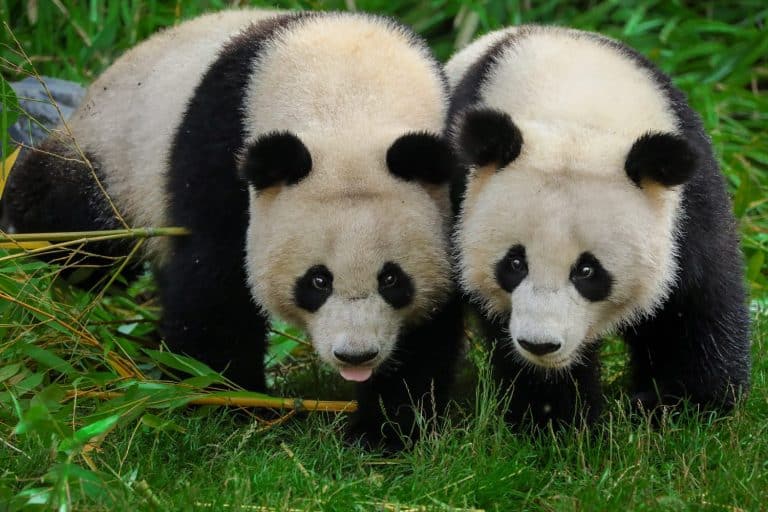
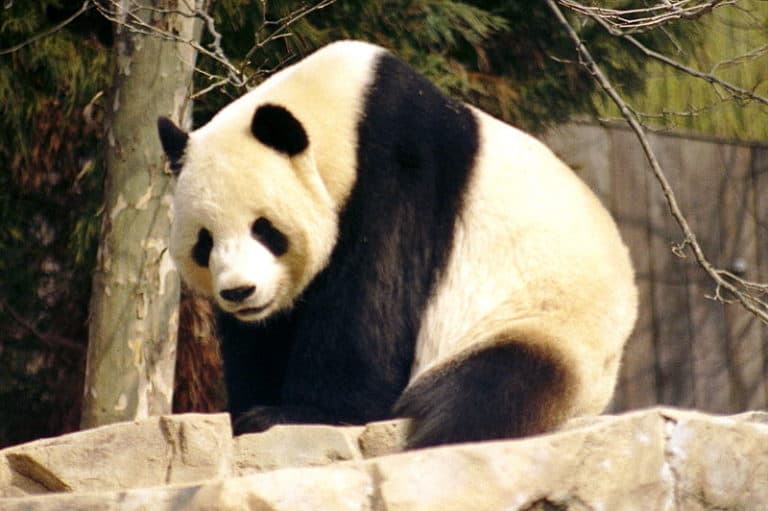
The giant panda is a medium- to large-sized bear that has a large head, short tail, and a long muzzle with a large nose, which gives them an excellent sense of smell. The thick fur of the giant panda is creamy-white in color with large patches of black on the limbs, shoulders, ears, and nose, and distinctive black patches around their small eyes. The giant panda primarily eats bamboo and so has a number of physical adaptations to help with its consumption including an extension of their wrist bone, which acts a bit like a thumb, allowing the giant panda to grip onto bamboo stems. They also have large jaws with strong jaw muscles that — along with their flat molars — allow the giant panda to crush bamboo stems and leaves in order to extract nutrients.
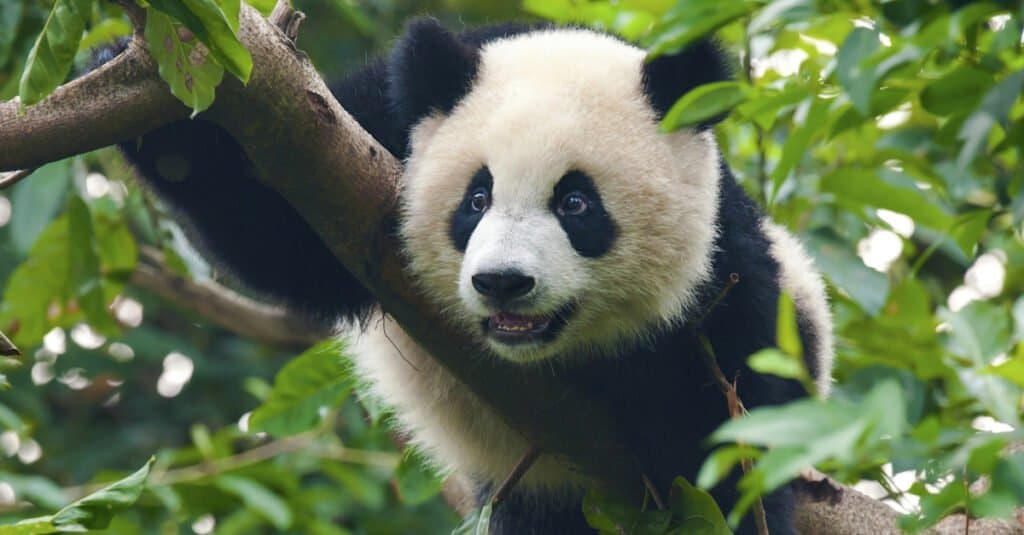
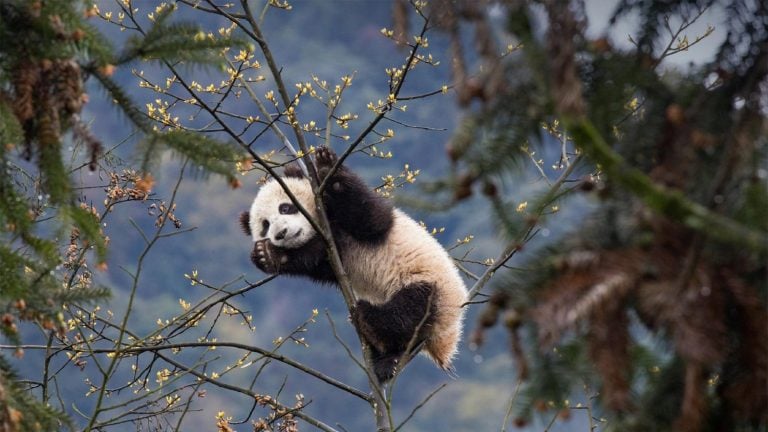
panda bear climbing on tree

The giant panda is a bear and a member of the family Ursidae.

Classification and Evolution

For many decades, there was a dispute over the giant panda’s lineage because it shares traits of both bears and raccoons. However, the giant panda has been proven to be a bear – a member of the family Ursidae. Referred to as living fossils, giant pandas are unique among all other bear species, having evolved without breeding with other types of bears.

Distribution and Habitat

Historically, the giant panda would have been found throughout the lowlands of the Yangtze River Basin but increased human activity in these areas has pushed the giant pandas high up into the mountains. Remote populations are still found in six different mountain ranges in central and western China, where they inhabit broadleaf and coniferous forests with a thick bamboo under-story at elevations between 5,000 and 13,000 feet. These high-altitude forests are cool, cloudy, and moist and are generally subjected to a high level of rainfall. It is thought that the unique coloration of the giant panda may help them to blend into these misty forests when they are foraging for food. It is, however, the loss of these habitats to deforestation that is the biggest threat to the giant panda today as they rely almost solely on bamboo to survive.
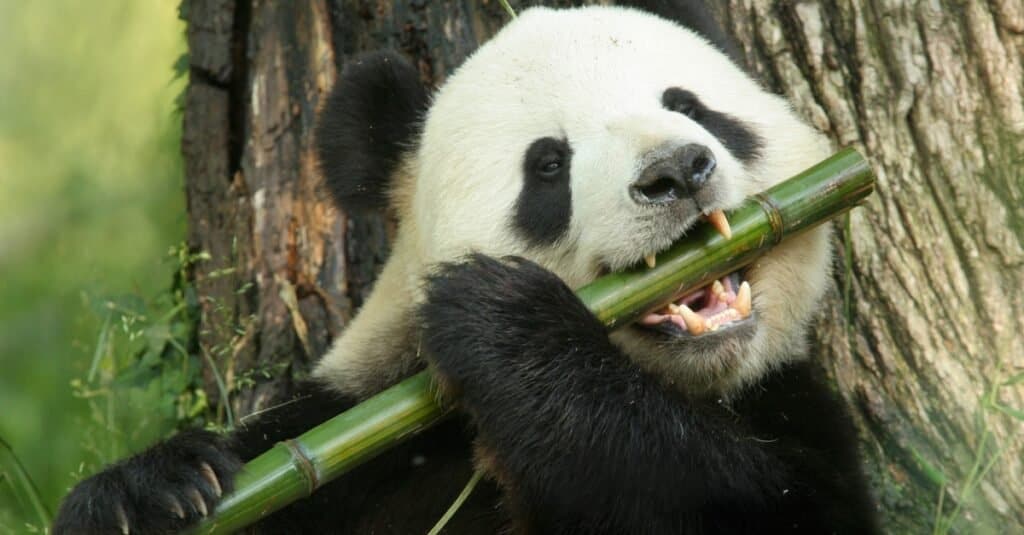
Animals with Opposable Thumbs-giant panda

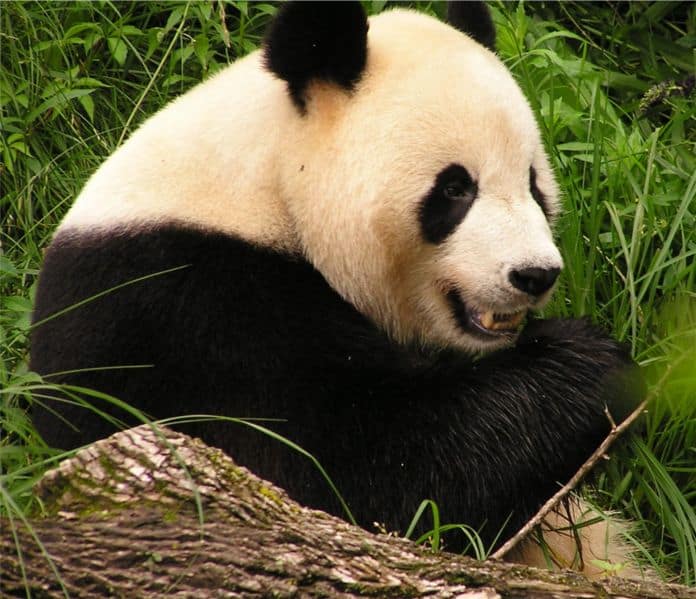
This panda munches on his favorite food: bamboo.

Behavior and Lifestyle

The giant panda is a solitary animal that marks its territory with secretions from scent glands and scratch marks on trees. Male giant pandas roam home ranges more than double the size of a female’s, with their territory overlapping those of several female giant pandas with which he holds breeding rights. As bamboo is not particularly nutritious, the giant panda must eat lots of bamboo every day and can consume up to 65 pounds of bamboo leaves, shoots, and stems, which is roughly 40% of its body weight. Giant pandas, therefore, dedicate between 12 and 15 hours a day to munching bamboo, which they do by sitting down and using their front paws to grip the plants. Even though the bear appears to spend its whole day either eating or sleeping, they are also known to be good at climbing trees and can even swim well when needed.
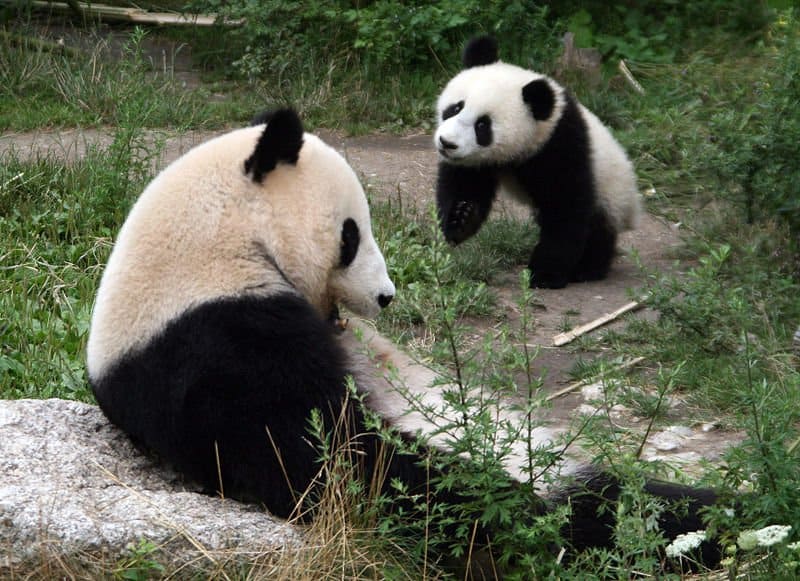
Panda bear cubs are weaned when they are around a year old but don’t leave their mother until they are 18 months old.

Reproduction and Life Cycles

Giant pandas breed between March and May when the female indicates her desire to mate by making a series of groans and bleats to attract a male. After a gestation period lasting around five months, the female giant panda gives birth to one or two cubs in the base of a hollow tree or cave. Panda bear cubs are very underdeveloped at birth, measuring as little as 5 inches and weighing only 3.5 ounces, they are made even more vulnerable by the fact that they are also blind and hairless at birth and don’t crawl until they are nearly three months old.

Female pandas care for one cub at a time even if they have twins. Cubs ride on their mother’s back until they can walk as fast as her, which is typically at around six months. Panda bear cubs are weaned when they are around a year old but don’t leave their mother until they are 18 months old. Some cubs may stay with their mother for a few years until she becomes pregnant again and they leave to establish a territory of their own.
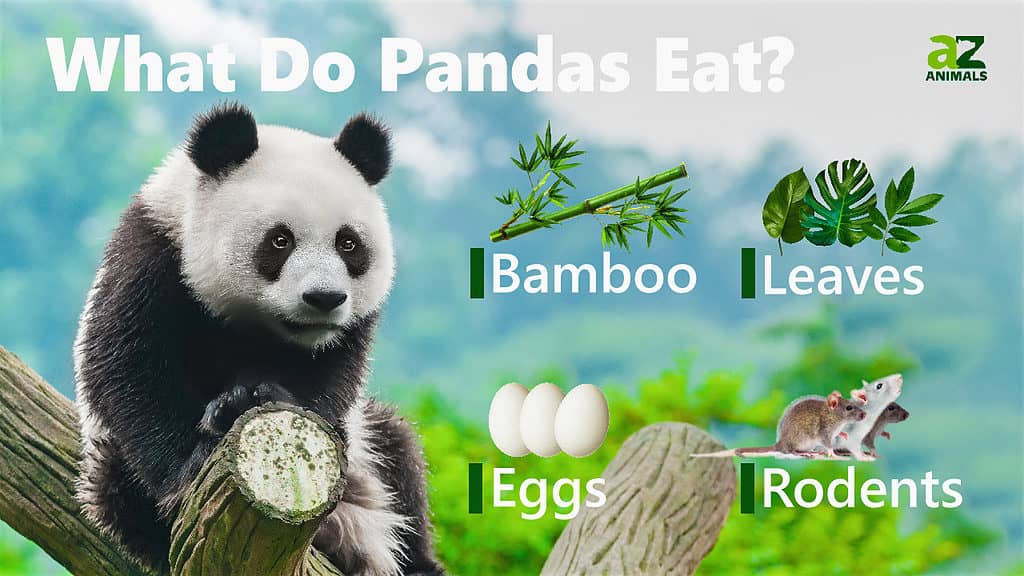
Pandas eat a lot of bamboo, but they do not exclusively eat bamboo. They are functionally omnivores.

Diet and Prey

Although taxonomically classified within the order Carnivora, giant pandas are functionally omnivores, with a diet consisting almost exclusively of bamboo. Known to consume more than 30 different species of the bamboo plant, giant pandas feed on different parts of the plant at different times of the year in order to get the most out of it. They use their strong jaws to crush the various plant parts into a more easily digestible paste. Spending more than half of their day eating, giant pandas also supplement their diet with other plants including grasses and fruits, as well as rodents and birds on occasion. Even though they can eat nearly half of their body weight in bamboo parts in just one day, the giant panda still needs to drink water and does so from mountain streams that are fed by melting ice and snow higher up the slopes.
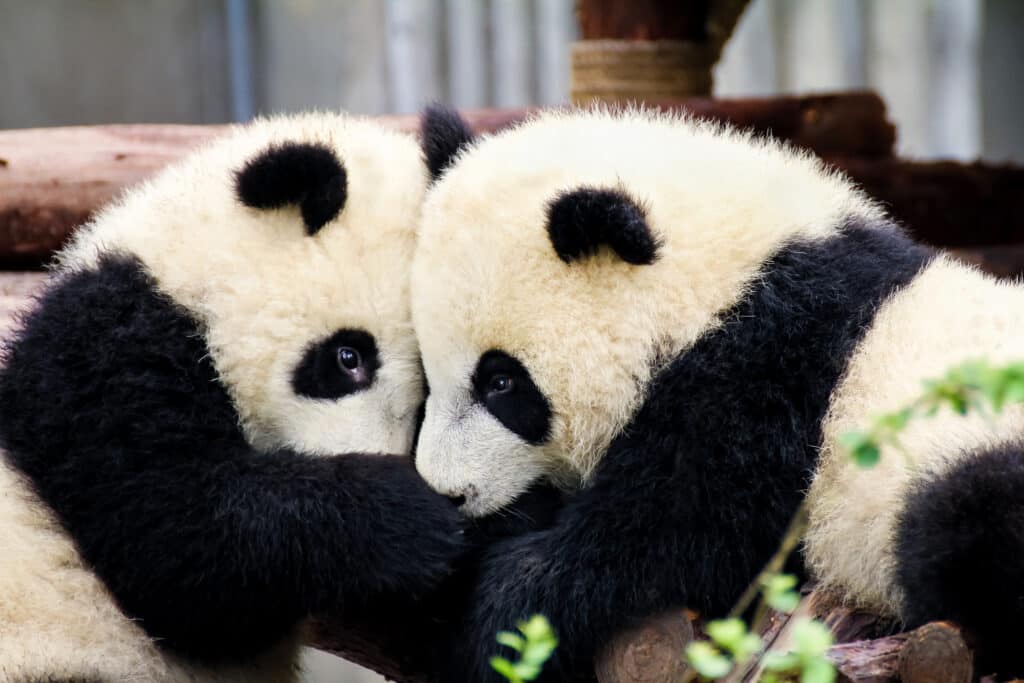
Two Giant Panda Bears Hug

Giant panda bear cubs are completely helpless until they are a year old. They are threatened by leopards and birds of prey.

Predators and Threats

Due to the large size and unique habitat of the giant panda, adults have no natural predators within their cool, bamboo-filled world. Cubs however are completely helpless until they are at least a year old. They are preyed upon by larger predators such as leopards and birds of prey. Humans however are the biggest threat to giant pandas in the Chinese mountains as they have hunted these remarkable animals for their unique fur, almost to extinction in some areas. Although harsh punishments for poaching have now slowed hunting down, giant pandas are under extreme threat from habitat loss in the form of deforestation for timber and land clearance for agriculture. They have therefore been forced into small, isolated pockets of their once vast natural range, and have been subjected to severe declines in their population numbers.
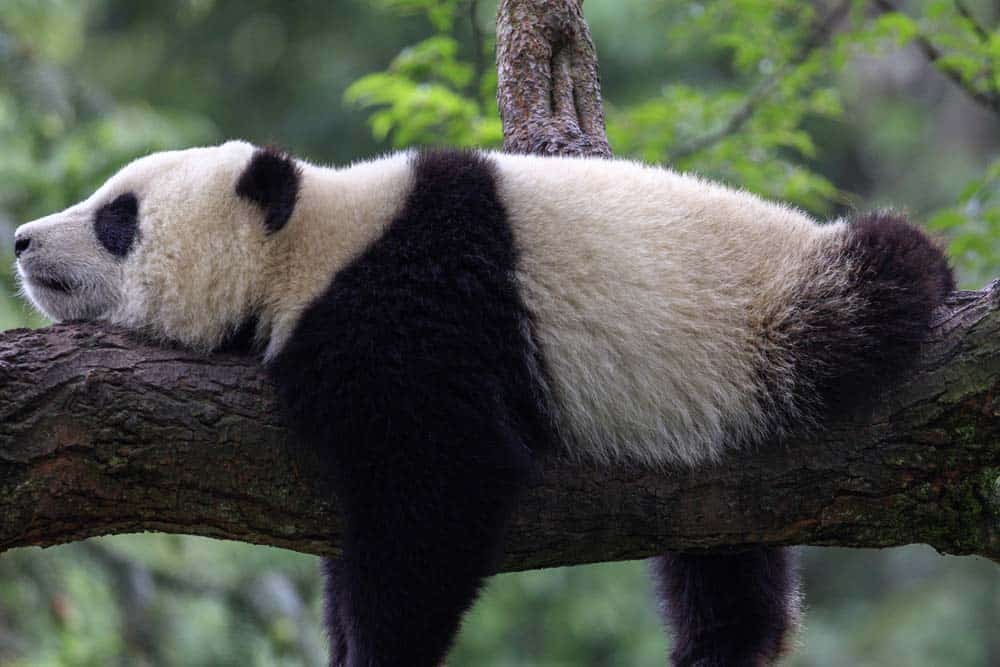
Giant pandas are sometimes known as bamboo bears.

Interesting Facts and Features

  • The giant panda has always fascinated people and therefore goes by a number of different names. Its scientific name means “cat-foot black and white,” and its Chinese name translates literally to “giant bear cat”, as the giant panda has slits for pupils in their eyes much like a cat.
  • They are also known as bamboo bears by locals due to the enormous amount of bamboo that they consume.
  • Giant panda cubs are so small at birth that they weigh about the same as an average mouse and at 3.5 ounces are roughly 0.001% of their mother’s weight.
  • Giant pandas communicate with one another using a series of calls, with 11 different giant panda noises having been identified.
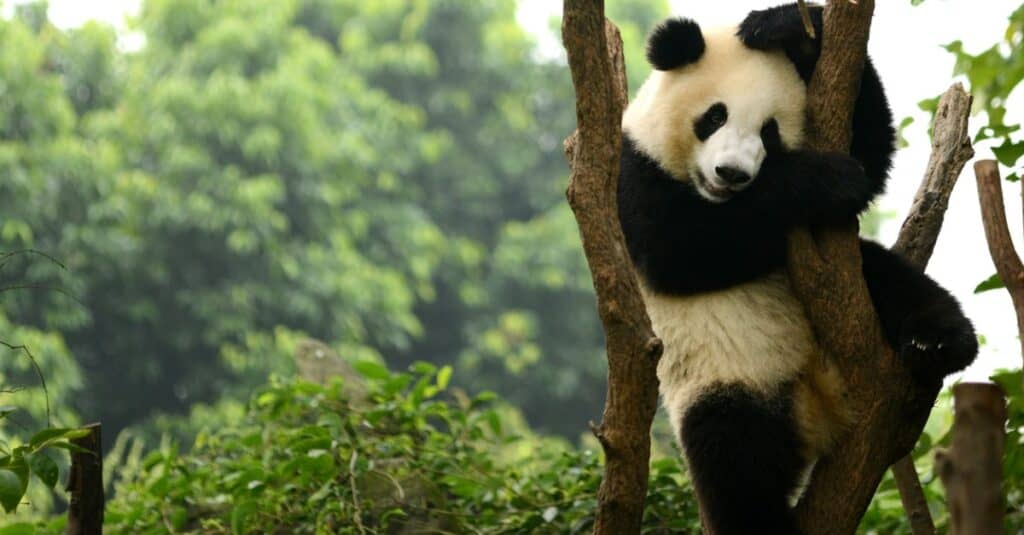
giant panda hanging in a tree

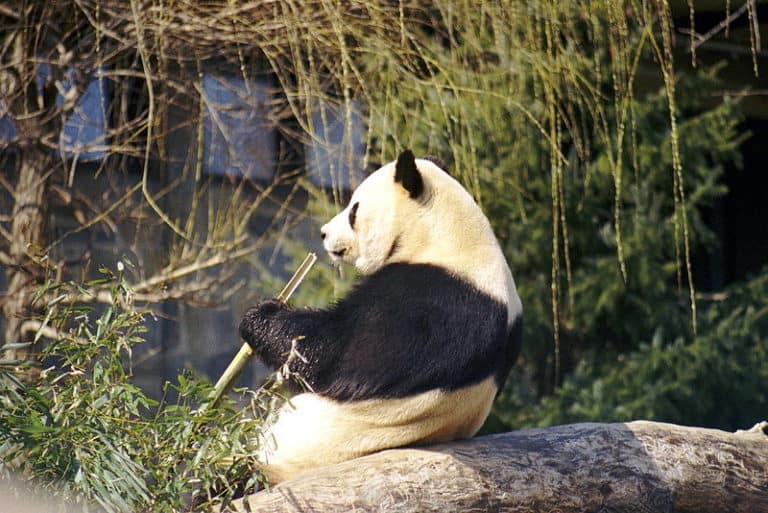
Bamboo is the main nutrient of a giant panda’s diet.

Conservation Status and Life Today

For decades the giant panda was listed by the IUCN as an animal species that was endangered in the wild. It was strongly believed that the giant panda was facing extinction in the wild in the near future if more was not done to protect it. The Chinese government has created 33 giant panda reserves, and more than 50% of its natural habitat is now protected by law. Extensive research has also gone into preventing the giant panda from becoming extinct, but it simply cannot survive without its unique bamboo forests. However, after 10 years of increasing population numbers to around 2,000 adult individuals, the giant panda has now been removed from the endangered species list and is instead classed as vulnerable by the IUCN mainly thanks to efforts by the Chinese government to not only protect their natural habitats but also by successful reproduction programs.

Download our Giant Panda Lesson Plan here.

View all 261 animals that start with G
How to say Giant Panda Bear in ...
Bulgarian
Голяма панда
English
Panda
Catalan
Panda gegant
Czech
Panda velká
Danish
Panda
German
Großer Panda
English
Giant Panda
Esperanto
Granda pando
Spanish
Ailuropoda melanoleuca
Estonian
Hiidpanda
Finnish
Isopanda
French
Panda géant
Hebrew
פנדה ענק
Croatian
Veliki panda
Hungarian
Óriáspanda
Indonesian
Panda
Italian
Ailuropoda melanoleuca
Japanese
ジャイアントパンダ
Latin
Panda maior
Malay
Panda Gergasi
Dutch
Reuzenpanda
English
Panda
Polish
Panda wielka
Portuguese
Panda-gigante
English
Ailuropoda melanoleuca
Slovenian
Orjaški panda
English
Panda
Swedish
Jättepanda
Turkish
Dev panda
Vietnamese
Gấu trúc lớn
Chinese
大熊猫

Sources

  1. David Burnie, Dorling Kindersley (2011) Animal, The Definitive Visual Guide To The World's Wildlife / Accessed November 24, 2008
  2. Tom Jackson, Lorenz Books (2007) The World Encyclopedia Of Animals / Accessed November 24, 2008
  3. David Burnie, Kingfisher (2011) The Kingfisher Animal Encyclopedia / Accessed November 24, 2008
  4. Richard Mackay, University of California Press (2009) The Atlas Of Endangered Species / Accessed November 24, 2008
  5. David Burnie, Dorling Kindersley (2008) Illustrated Encyclopedia Of Animals / Accessed November 24, 2008
  6. Dorling Kindersley (2006) Dorling Kindersley Encyclopedia Of Animals / Accessed November 24, 2008
  7. David W. Macdonald, Oxford University Press (2010) The Encyclopedia Of Mammals / Accessed November 24, 2008
  8. Giant Panda Facts / Accessed November 24, 2008
  9. Giant Panda Information / Accessed November 24, 2008
Lisha Pace

About the Author

Lisha Pace

After a career of working to provide opportunities for local communities to experience and create art, I am enjoying having time to write about two of my favorite things - nature and animals. Half of my life is spent outdoors, usually with my husband and sweet little fourteen year old dog. We love to take walks by the lake and take photos of the animals we meet including: otters, ospreys, Canadian geese, ducks and nesting bald eagles. I also enjoy reading, discovering books to add to my library, collecting and playing vinyl, and listening to my son's music.

Thank you for reading! Have some feedback for us?


Giant Panda Bear FAQs (Frequently Asked Questions)

Even though their diet consists almost entirely of bamboo, giant panda bears are considered carnivores.