Argentine Horned Frog
Ceratophrys Ornata
 Verified by: AZ Animals Staff
Natively found in South America!
Advertisement
Argentine Horned Frog Scientific Classification
- Kingdom
- Animalia
- Phylum
- Chordata
- Class
- Amphibia
- Order
- Anura
- Family
- Leptodactylidae
- Genus
- Ceratophrys
- Scientific Name
- Ceratophrys Ornata
Read our Complete Guide to Classification of Animals.
Argentine Horned Frog Conservation Status

Argentine Horned Frog Facts
- Main Prey
- Worms, Roaches, Insects
- Habitat
- Rainforest and tropical swamplands
- Predators
- Birds, Snakes, Bears
- Diet
- Carnivore
- Average Litter Size
- 1,500


View all of the Argentine Horned Frog images!



How to Add Us to Google News


Like humans, Argentine horned frogs can have eyes that are bigger than their stomachs.
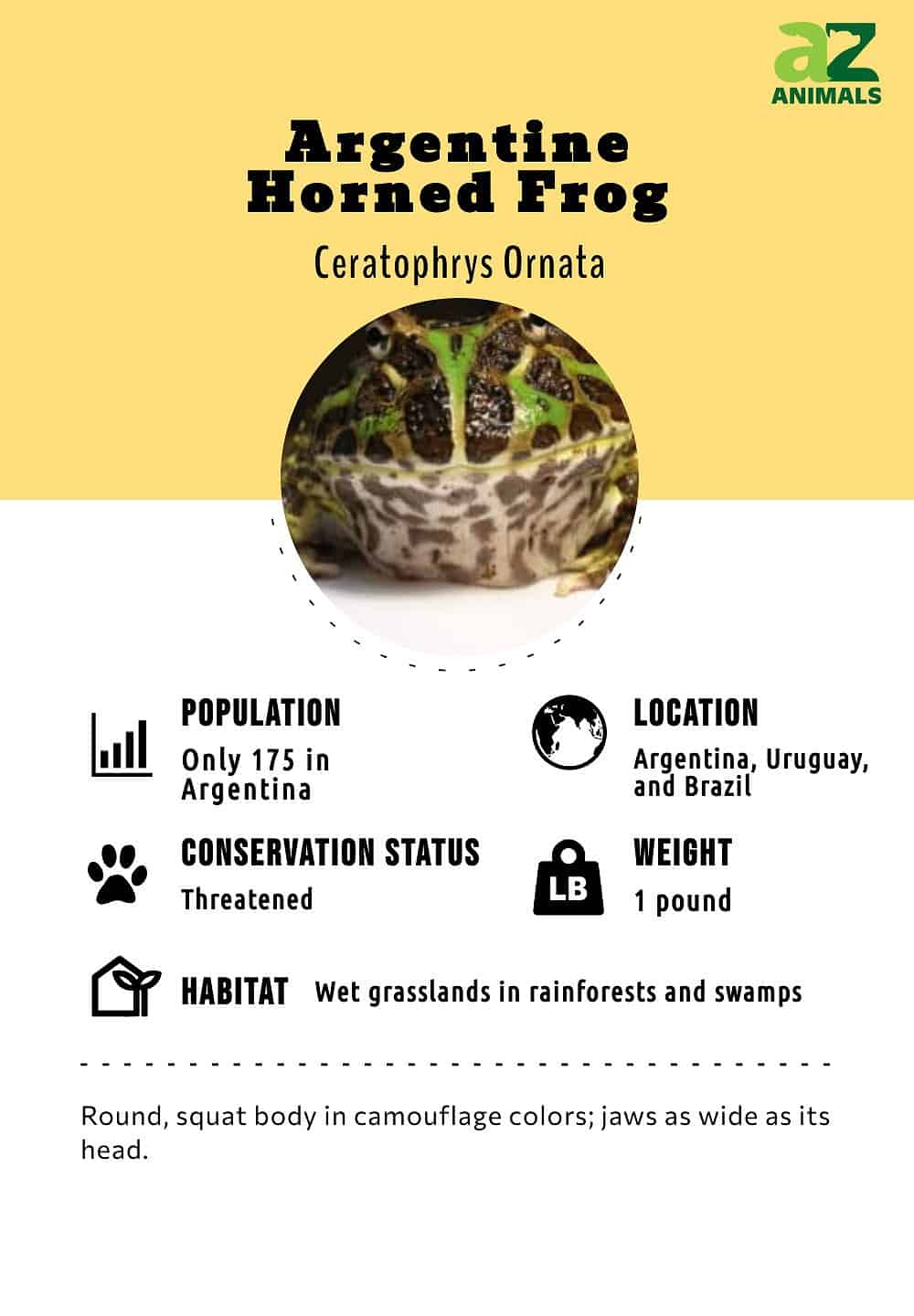
Argentine horned frogs come from South America. They are also called Pacman frogs after the game character with the wide, snapping mouth. Some people keep them as exotic pets, probably because they develop in various colors.
These frogs are patient predators, sitting still and waiting for prey to come into sight before leaping with their mouths wide open so as to take in their meal with one gulp. They will eat almost anything including mice, insects, and birds.
Note: The Argentine Horned Frog is not to be confused with what Americans know as the horned frog or the horny toad, which is actually a lizard. This animal has become famous as the mascot of Texas Christian University (TCU), known for its highly-ranked sports teams.
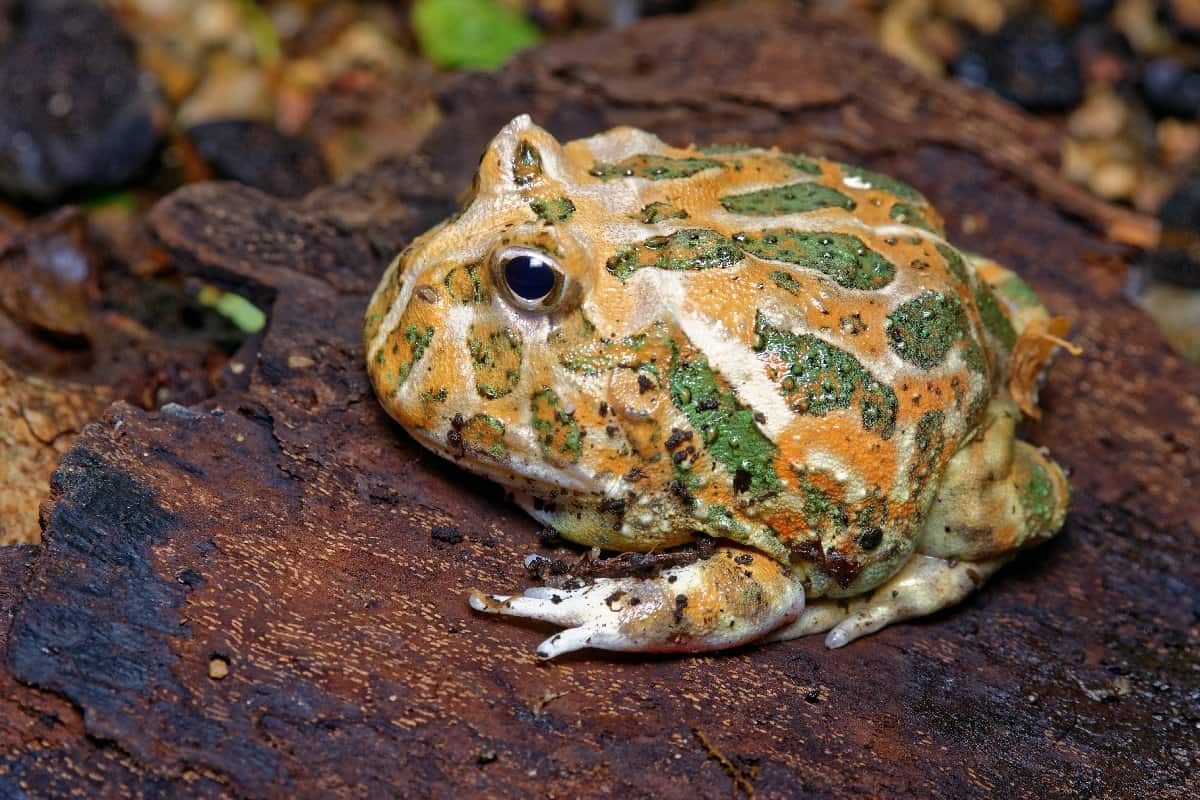
Argentine Horned Frogs, or Pacman frogs, are very low-maintenance pets, and their unique appearance has made them quite popular
©Valt Ahyppo/Shutterstock.com
5 Interesting Facts:
• Argentine horned frogs have been known to suffocate in their attempt to eat something larger than themselves.
• Female frogs are larger than males.
• This frog species is close to being on the endangered list.
• The Argentine horned frogs may be the most popular amphibian kept as an exotic pet.
• Aregentine horned frogs live for five to eight years in the wild and up to 16 in captivity.
Scientific Name
The “Argentine horned frog” is the common name for this amphibian, but its scientific name is Ceratophrys Ornata. People also call it the Argentine wide-mouthed frog and the ornate Pacman frog because of its expansive gapping mouth. The Cranwells horned frog and the Argentine horned frog are the two main species of this type of amphibian. It is in the Ceratophryidae family.
There are seven related species, all belonging to the genus Ceratophrys: C. cranwelli, C. cornuta, C. testudo, C. stolzmanni, C. joazeirensis, C. calcarata and C. aurita. The best known of these is Cranwell’s horned frog.
The horned frog’s name is based on its appearance. The amphibian has folds of skin over its eyes that look like horns. These horns may help the frog hide itself since they look like leaf tips that are resting on a forest floor.
There are many myths surrounding these frogs. For instance, in Argentina, they’ve been labeled “horse killers.” In fact, they’ve merely grasped onto the lips of horses that are grazing for food. Since the frogs are nonvenomous, it’s unlikely that one could kill a horse.
Appearance and Behavior
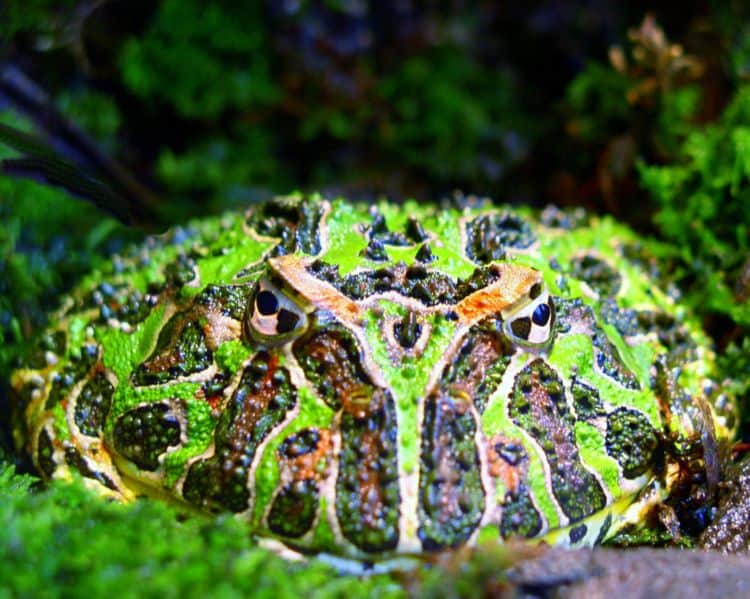
Argentine Horned Frogs have a camouflage combination of colors on the backs and limbs.
Argentine horned frogs are amphibians with round, squat bodies, and jaws that are as wide as the size of their heads. The animal has short legs, which is different from other types of frogs, so it’s not a good jumper. Male horned frogs can grow to be around 4.5 inches long, while females are bigger and measure around 6.5 inches long. They can weigh up to a pound.
The amphibians typically have yellow or white underbellies, and their limbs and back range in color combinations that include varying shades of greens, yellows, browns, and even reds. There are actually more than 40 paceman frog morphs displaying a wide range of colors and patterns!
When it comes to behavior, people may think that live horned frogs are deceased ones. If a frog’s environment becomes dry or if the amphibian loses its food source, then the animal will enclose itself within a resilient outer layer of skin for protection. The frog will remain completely still, giving those who encounter it the impression of being dead. Once the frog becomes rehydrated, it will shed the resilient outer skin layer and ingest it.
The horned frogs are aggressive, ambush predators. They are patient, and their coloring provides camouflage, so all the frogs have to do is hide and wait in some greenery until something tasty wanders by. When it does, the frog lunges and grabs its meal with its strong jaws and teeth, killing and swallowing its prey.
If the frog feels threatened, it will attack whatever is frightening it. The frog will attack even if the animal that’s threatening it is several times bigger than it is.
Habitat
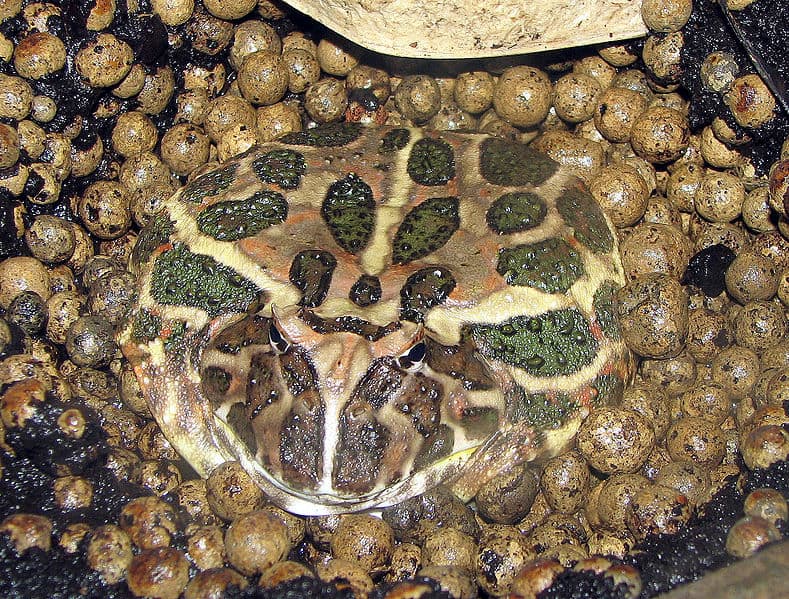
This amphibian is endemic to South America, specifically Argentian, Uruguay, and Brazil. The Argentine horned frog makes its home in debris-filled muddy forest floors that are humid and wet. In fact, it spends most of its time with two thirds of its body buried in damp soil. In the wild, the amphibians call wet tropical rainforests and swamp areas home.
If you intend to keep a pet horned frog, create a comfortable environment for it by including moist peat moss, clean damp soil, or grated pine bark mulch in its enclosure. Be sure to keep the frog’s enclosure damp but not overly wet. If it’s too wet, then it can cause bacteria to grow, distressing your pet and potentially causing illness. If you use soil or pine bark mulch, then it will dry out from the top down. When the top dries out entirely, moisten it. Try giving your horned frog a light mist using a spray bottle once a day either in the morning or at night. Be sure to keep your pet’s enclosure clean. Change the base material completely twice a month. This will decrease the possibility of bacteria growing. It will also reduce ammonia issues and the buildup of the animal’s fecal matter.
Include a small bowl of water in your frog’s enclosure. Make sure that the size of the bowl lets your frog get a drink and maybe splash around a bit without drowning. If your pet’s enclosure is on the dry side, then he or she will likely hang out in the water dish. Add a few plants around it to help your frog feel safe and secure.
When you have a pet horned frog, make sure that his or her enclosure stays around 82 degrees Fahrenheit during the daytime hours. At night, the temperature can decrease to about 78 degrees Fahrenheit. If you need to add heat to the container, use an under-tank heater instead of a bulb overhead. A bulb is likely to dry your frog’s skin too much.
Diet
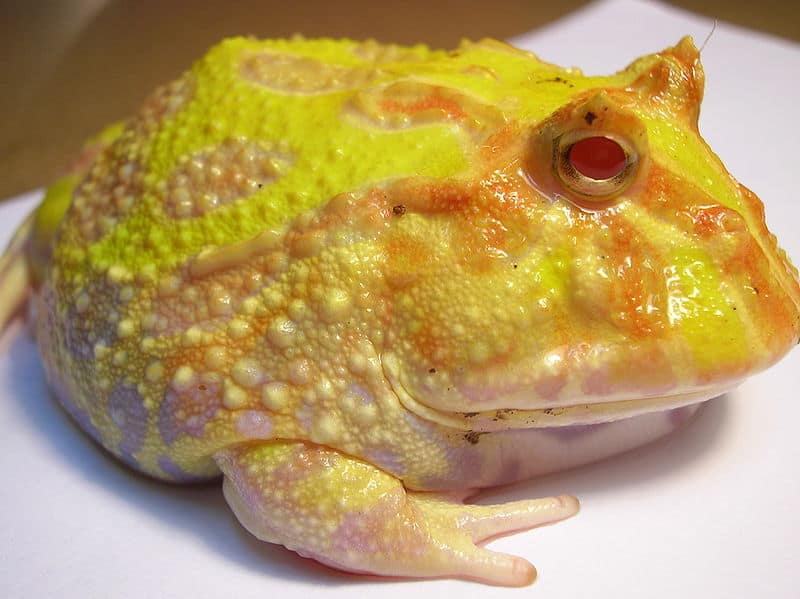
The Argentine Horned Frog
When the Argentine horned frog is living in the wild, it consumes mice, insects, amphibians, lizards, and even other frogs. It uses its wide mouth to catch and eat prey, even if it is almost the same size as it is.
Horned frogs that live in zoos or people’s homes dine on mice and crickets. You can give yours worms to eat also. If you decide to feed your frog mice, do so only occasionally because the amphibians are quite inactive. In fact, they may only jump to another spot after they’ve defecated in their previous one. This means that they can become overweight if fed a rich diet of fattening mice. You can feed a small horned frog daily. Once it reaches adulthood, feed him or her once every two or three days.
Predators and Threats
The horned frog is at risk from snakes, bears, and birds. This particular frog is hovering toward the endangered species list. It is near threatened status. The animal isn’t an immediate concern for environmental researchers, but they are watching it. Since the horned frog is amphibian, environmental changes and pollution may be harmful to it because of the animal’s delicate skin.
Today, many animals are facing survival challenges because they are losing their natural habitats. This includes horned frogs. Locals kill them because they inaccurately believe that they are venomous. People in the pet trade also collect them to sell.
When the frog species is kept in captivity, the animal may suffer from skin and eye infections caused by bacteria or fungi. If you’re keeping one as a pet, watch for pus, redness, or swelling on his or her skin. Respiratory infections are something else to watch out for. They happen less frequently in horned frogs than they do in other reptile and amphibian species, but they may still occur. If you notice that your pet is especially lethargic, wheezing, or drooling, then take him or her to an exotic pet veterinarian.
The horned frog may suffer from parasitic infections. If you’ve determined that the enclosure temperatures are in a comfortable range, and your frog doesn’t want to eat, then have him or her checked out for parasites. It’s also a good idea to give your vet an annual fecal sample to make sure that your frog friend is healthy. Most frog conditions are treatable if they’re caught in time.
Reproduction, Babies and Lifespan
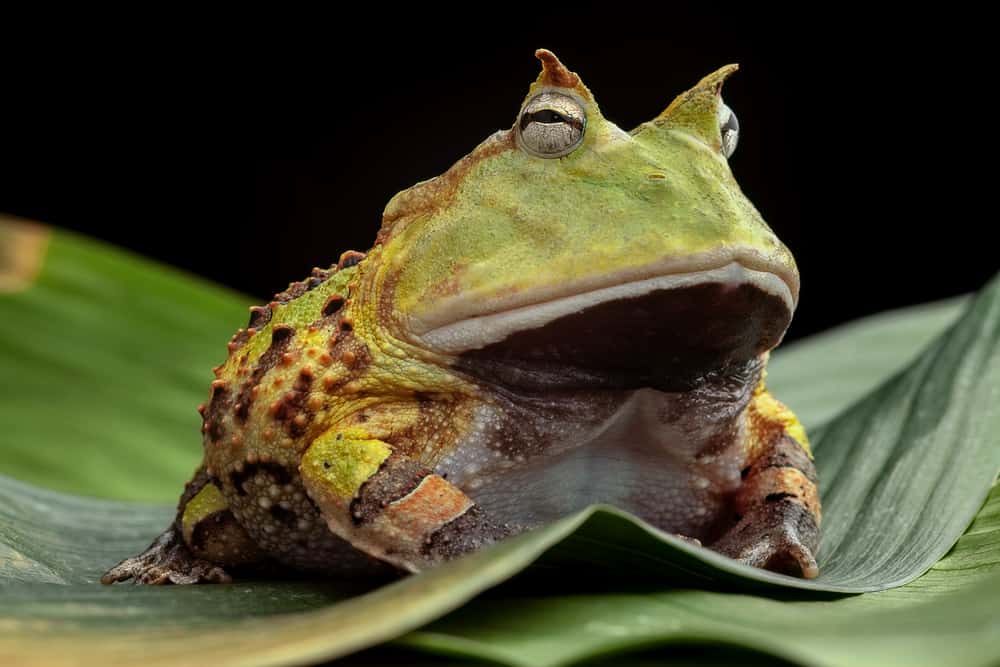
The Argentine horned frog will risk leaving its burrow and go out into the jungle to mate.
©Dirk Ercken/Shutterstock.com
The South American horned frog prefers to spend its time burrowed deep down in the mud or within leaf debris. Typically, the only time that the amphibian risks going out into the jungle is for reproduction purposes. When it feels the urge to reproduce, the horned frog will conceal itself under some moss or leaves with just its eyes and the top of its head sticking out. A mating frog is highly alert to any sound or movement happening around it. This is likely because it is more vulnerable when it is out of its isolated mud areas.
Once a pair of frogs mate, the female will search for a water source where she can lay her eggs. After finding one that’s suitable, she’ll lay around 2,000 eggs. Horned frog eggs hatch in about two weeks. When they first hatch, they are tadpoles. In the tadpole phase, the amphibians are completely carnivorous and will eat one another if the opportunity arises. Tadpoles grow super-fast, and in just one month, they’ll become tiny frogs. Horned frogs reach sexual maturity in 18 to 24 months.
The lifespan of this frog species is from 5 years to 8 years in the wild. When they are in captivity, the amphibians can live as long as 15 years.
Population
According to a study published in the Herpetological Conservation and Biology Journal, the horned frog is a species that is under threat of extinction. The study tracked the frog population from 2008 to 2017. For the study, the research team surveyed adult frogs when they were in their breeding areas. They checked these areas in spring and summer. This study reported that there were only 175 of the amphibians in Argentina during this time period. A number of researchers confirm that the horned frog population is decreasing.
How to Add Us to Google News
Argentine Horned Frog FAQs (Frequently Asked Questions)
Are Horned Frogs Carnivores, Herbivores or Omnivores?
Horned frogs are carnivores that aren’t particularly picky about what kind of animal that they eat. The amphibians will attack almost anything that crosses their path when they’re hungry including animals that are larger than themselves. Along with a large mouth, a horned frog has a super sticky tongue that holds onto its meal and retracts, pulling the animal into its mouth. Once there, the frog’s enormous jaws use immense force to clamp down, preventing the prey from escaping. Some researchers have compared the frog’s tongue to an adhesive that is pressure sensitive.
Are Horned Frogs Dangerous?
Horned frogs are not dangerous to people. The amphibians are only a danger to other smaller sized animals and each other.
Do Pacman Frogs Make Good Pets?
Pacman frogs are a common species available in the pet trade industry. The amphibians are easy to take care of, and they are unique and interesting pets to own. If you prefer owning animals that are low maintenance, then you might want to consider getting one. These creatures are not very active, so if you want an animal to play with, then a Pacman frog may not be for you. This type of frog is not one that’s meant to be handled.
The frog species doesn’t require a large container. In fact, a 10-gallon tank will work perfectly. If you get a Pacman frog, only get one since they are cannibals. Purchase a tank with a top to keep the container’s temperatures and humidity levels comfortable for your exotic pet. It’s unlikely that your frog will try to escape especially since he or she will be living in a cozy place with food that’s readily available.
When you select your Pacman frog, look for an animal that’s alert and active, one with blemish-free skin that has bright, clear eyes. Try to watch the one you want eat something before bringing it home. Pacman frogs will usually only turn down food when they are ill. Search for a reputable breeder. He or she should be able to give you a detailed health history on your pet. Captive-bred frogs are the better choice because they’ll be less likely to have parasites or another ailment. Also, buying from a breeder means that you’re not encouraging the removal of the animal from the wild.
What Kingdom do Horned Frogs belong to?
Horned Frogs belong to the Kingdom Animalia.
What phylum do Horned Frogs belong to?
Horned Frogs belong to the phylum Chordata.
What class do Horned Frogs belong to?
Horned Frogs belong to the class Amphibia.
What family do Horned Frogs belong to?
Horned Frogs belong to the family Leptodactylidae.
What order do Horned Frogs belong to?
Horned Frogs belong to the order Anura.
What genus do Horned Frogs belong to?
Horned Frogs belong to the genus Ceratophrys.
In what type of habitat do Horned Frogs live?
Horned Frogs live in rainforests and tropical swamplands.
What is the main prey for Horned Frogs?
Horned Frogs prey on worms, roaches, and insects.
What are some predators of Horned Frogs?
Predators of Horned Frogs include birds, snakes, and bears.
What is the average litter size for a Horned Frog?
The average litter size for a Horned Frog is 1,500.
What is an interesting fact about Horned Frogs?
Horned Frogs are natively found in South America!
What is the scientific name for the Horned Frog?
The scientific name for the Horned Frog is Ceratophrys Ornata.
What is the lifespan of a Horned Frog?
Horned Frogs can live for 5 to 8 years.
How fast is a Horned Frog?
A Horned Frog can travel at speeds of up to 5 miles per hour.
Thank you for reading! Have some feedback for us? Contact the AZ Animals editorial team.
Sources
- David Burnie, Dorling Kindersley (2011) Animal, The Definitive Visual Guide To The World's Wildlife
- Tom Jackson, Lorenz Books (2007) The World Encyclopedia Of Animals
- David Burnie, Kingfisher (2011) The Kingfisher Animal Encyclopedia
- Richard Mackay, University of California Press (2009) The Atlas Of Endangered Species
- David Burnie, Dorling Kindersley (2008) Illustrated Encyclopedia Of Animals
- Dorling Kindersley (2006) Dorling Kindersley Encyclopedia Of Animals