
A
Species Profile

Argentine Horned Frog

Ceratophrys ornata

Big mouth. Bigger ambush.
Sandstein / Creative Commons

Argentine Horned Frog Distribution

Click a location to explore more animals from that region

Loading map...

At a Glance

Wild Species
Also Known As Ornate Horned Frog, Pacman Frog, Ornate Pacman Frog, Argentine Horned Toad, rana cornuda
Diet Carnivore
Activity Nocturnal+
Lifespan 5 years
Weight 0.5 lbs
Did You Know?

Females are much larger: reported adult snout-vent length (SVL) commonly ~12-16 cm; males often ~8-11 cm (species-level sexual size dimorphism).

Scientific Classification

A stout, ambush-predator frog known for its very wide mouth and small horn-like projections above the eyes; native to parts of southeastern South America (notably Argentina and adjacent regions).

Kingdom
Animalia
Phylum
Chordata
Class
Amphibia
Order
Anura
Family
Ceratophryidae
Genus
Ceratophrys
Species
ornata

Distinguishing Features

  • Horn-like supraocular projections (‘horns’) above the eyes
  • Extremely large mouth and broad head; squat, heavy-bodied build
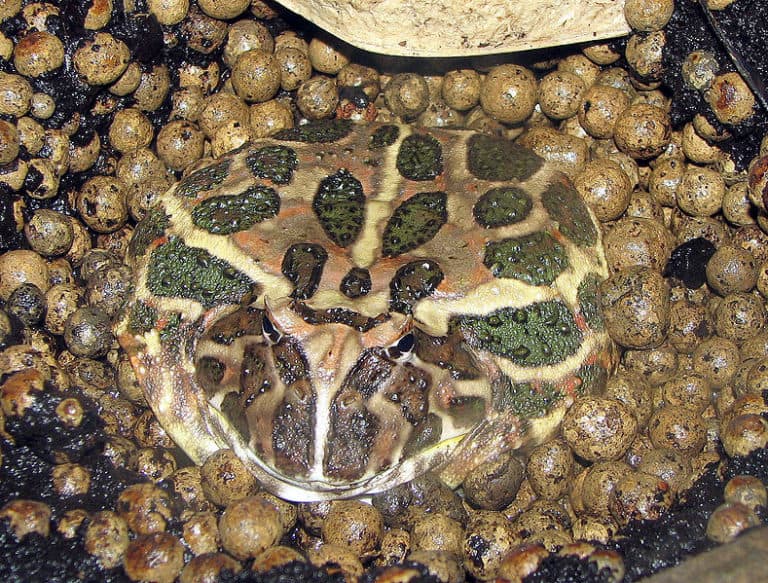
  • Camouflaged coloration/patterning suited to leaf litter/soil
  • Sit-and-wait predation; capable of taking relatively large prey for its size

Physical Measurements

Males and females differ in size

Length
5 in (2 in – 7 in)
Weight
0 lbs (0 lbs – 1 lbs)
1 lbs (1 lbs – 1 lbs)
Poisonous

Appearance

Primary Colors
Secondary Colors
Skin Type Thick, glandular amphibian skin with a granular-to-warty dorsum and low ridges/tubercles; often carries a thin mucus layer; adapted for terrestrial life and frequent partial burial.
Distinctive Features
  • Very large, extremely wide gape (sit-and-wait, 'ambush' predator that often attacks prey nearly as large as its head; documented to take large invertebrates and small vertebrates).
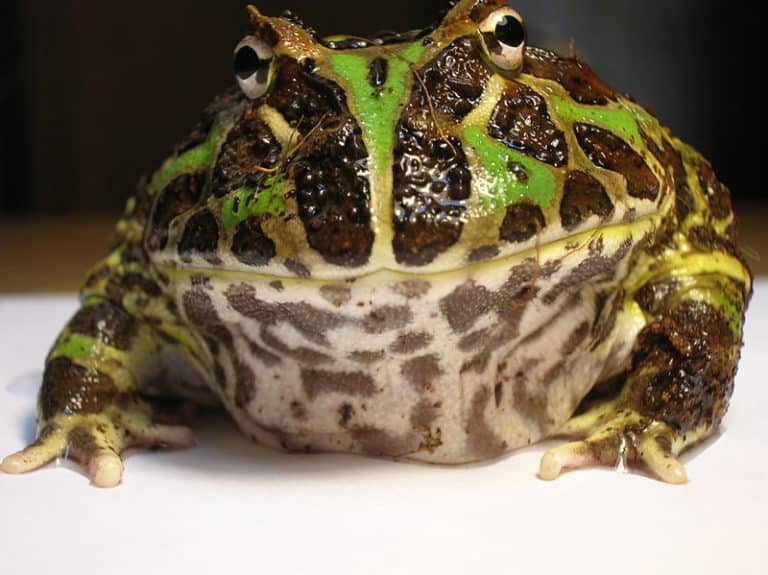
  • Short horn-like dermal projections above the eyes ('horned' appearance); in C. ornata these are present but generally not as long/pronounced as in C. cornuta (Amazonian horned frog), helping avoid common misidentification.
  • Stout, round-bodied build with a proportionally large head and short limbs; spends long periods motionless and partially buried with only eyes/nostrils exposed (classic terrestrial ambush posture).
  • Adult size (snout-vent length, SVL) is strongly sex-biased: reported adult males ~80-115 mm SVL and adult females ~100-165 mm SVL (e.g., Cei 1980; regional field guides and species accounts commonly report females substantially larger).
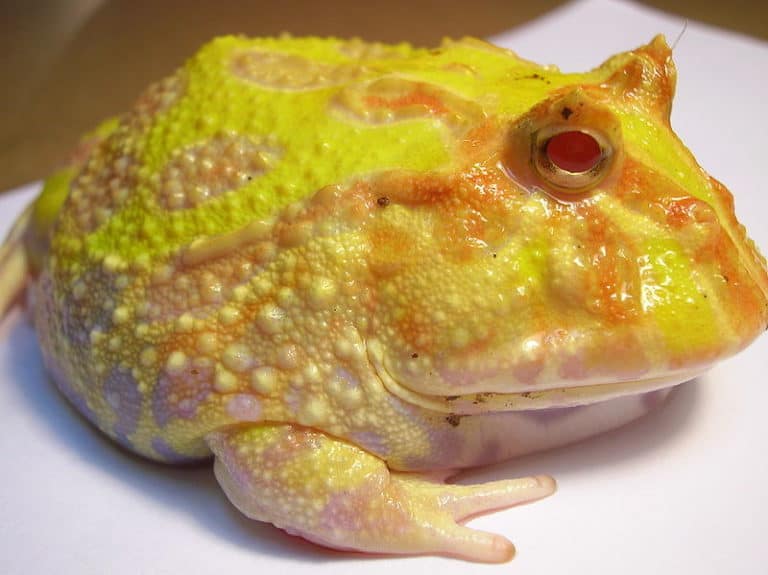
  • Argentine Horned Frog (Ceratophrys ornata) is native to southeast South America, mainly Argentina and nearby Uruguay, southern Brazil, and Paraguay. Its color and pattern help it hide in grasslands, savannas, and leaf litter.
  • Ceratophrys ornata often has a more ornate, high-contrast back pattern with strong red-orange patches and bold dark edges than C. cranwelli; it has shorter supraocular 'horns' than C. cornuta and lives outside the Amazon Basin.

Sexual Dimorphism

Sexual dimorphism is present, primarily in body size and breeding-related traits: females are typically larger and heavier-bodied; males are smaller and develop calling structures/nuptial features during the breeding season (reported in Ceratophrys species accounts; size ranges commonly summarized from regional taxonomic/field literature such as Cei 1980 and IUCN-linked references).

  • Generally smaller SVL than females (commonly ~80-115 mm SVL reported for adult males).
  • During breeding season, males develop a subgular vocal sac (for advertisement calls) and may show darker/roughened nuptial pads (keratinized breeding excrescences) on the thumbs/inner fingers typical of many anurans.
  • Generally larger SVL than males (commonly ~100-165 mm SVL reported for adult females) with a broader, more massive body profile associated with egg production.
  • Typically lacks the male's developed vocal sac and prominent seasonal nuptial pad development.

Did You Know?

Females are much larger: reported adult snout-vent length (SVL) commonly ~12-16 cm; males often ~8-11 cm (species-level sexual size dimorphism).

Its "horns" are not true horns-just pointed extensions above the eyes that help break up the head outline while it waits buried.

It commonly hunts by sitting motionless with only eyes and mouth exposed, then lunging with a rapid gape-and-grab strike.

It will take surprisingly large prey for its body size (including other frogs and small vertebrates) thanks to a very large gape and robust jaw muscles.

In the Pampas, it spends much of its life on land, often buried in loose soil or leaf litter-water is mainly needed for breeding.

The species is frequently confused in the pet trade with Chaco horned frogs (Ceratophrys cranwelli) and Surinam horned frogs (Ceratophrys cornuta); C. ornata is the "Argentine/ornate" Pampas species.

It has an unusually strong bite for a frog and may clamp down when handled, so it should be handled carefully.

Unique Adaptations

  • Extremely wide gape and robust skull/jaw musculature for subduing large, struggling prey relative to its body size.
  • Horn-like supraocular skin projections and mottled coloration that enhance camouflage in grassland/leaf-litter substrates.
  • Stocky body and strong hind limbs suited for short, powerful lunges rather than long-distance hopping.
  • Skin and posture that support a buried, moisture-conserving lifestyle in seasonally variable grassland climates.

Interesting Behaviors

  • Sit-and-wait predation: remains partially buried and motionless, striking suddenly when prey comes within range.
  • Burrowing/"plugging in": settles into substrate so only the head is visible; often chooses shaded, humid microhabitats.
  • Opportunistic diet: takes insects, other amphibians, reptiles, and small mammals/birds when available (classic wide-gape generalist).
  • Defensive biting: if handled or threatened, it may lunge and clamp down; it can also inflate its body to appear larger.
  • Explosive breeding after rains: adults are largely terrestrial, but move to shallow water to mate and lay eggs during favorable wet periods (typical anuran rain-triggered breeding pattern).

Cultural Significance

The Argentine Horned Frog (Ceratophrys ornata) is known in Argentina and nearby countries by a Spanish name and seen as a bold frog with a strong defensive bite. It’s popular in terrariums and as a pet, familiar to hobbyists and teachers.

Myths & Legends

In Argentina and Uruguay, rural tales say the Argentine Horned Frog (Ceratophrys ornata) won't let go of a bite until it thunders or until forced—stories used to warn children near ditches and farm ponds.

Folk belief in parts of the Pampas portrays the frog as "poisonous" or able to harm larger animals through its bite, elevating it in local imagination from ordinary frog to feared countryside creature.

No specific myths or legends about the Argentine horned frog are well documented in verifiable scientific references; scientific accounts instead emphasize that the species is fossorial and typically emerges and breeds after heavy rains.

Conservation Status

NT Near Threatened

Likely to qualify for a threatened category in the near future.

Population Decreasing

Protected Under

  • Argentina: general national wildlife framework (e.g., Law 22,421-Conservation of Wild Fauna) and associated provincial regulations restrict/permit capture, transport, and commercialization of native wildlife (implementation varies by jurisdiction).
  • Occurs in/near some protected areas within its range, but key pressures persist largely outside reserves in heavily modified Pampas landscapes; conservation effectiveness depends on protection/management of seasonal wetlands and surrounding terrestrial habitat (as emphasized in IUCN species documentation).

Life Cycle

Birth 1500 tadpoles
Lifespan 5 years

Lifespan

In the Wild
3–8 years
In Captivity
6–15 years

Reproduction

Mating System Promiscuity
Social Structure Aggregation Group
Breeding Pattern Transient
Fertilization Substrate Spawning
Birth Type Substrate_spawning

Argentine Horned Frog (Ceratophrys ornata) are solitary except during breeding at temporary ponds after heavy rains. Males call and they mate by external fertilization with brief amplexus; females lay jelly-like egg masses. No pair bonds and no care for eggs or young; females are larger.

Behavior & Ecology

Social Solitary Group: 1
Activity Nocturnal, Crepuscular
Diet Carnivore other anurans (frogs)
Seasonal Hibernates

Temperament

Highly sedentary ambush predator; remains buried or concealed with only head exposed for long periods (sit-and-wait strategy) (Cei, 1980).
Strongly defensive when approached or handled: may inflate body, gape widely, lunge, and bite; often characterized as aggressive compared with many sympatric anurans (Cei, 1980; Gallardo, 1974).
Opportunistic, very large prey spectrum relative to body size; cannibalism and predation on other frogs reported in Ceratophrys, consistent with the genus' trophic ecology (Cei, 1980).

Communication

Male advertisement call from water/pond margins during breeding season; described in regional literature as a low-pitched, loud call used to attract females and space males during chorusing/aggregations Cei, 1980; Gallardo, 1974
Release call Emitted when clasped incorrectly) and distress vocalizations may occur, as in many anurans; specific quantitative descriptions for C. ornata are less consistently reported than for some other taxa in the accessible regional summaries (Cei, 1980
Tactile communication during mating: axillary amplexus Male grasps female) to maintain pairing for oviposition (Cei, 1980
Postural/visual threat display at close range Body inflation, raised posture, mouth gaping) as a defensive signal that can deter predators/competitors (Cei, 1980; Gallardo, 1974

Habitat

Biomes:
Temperate Grassland Wetland Freshwater
Terrain:
Plains Riverine Muddy
Elevation: Up to 1640 ft 5 in

Ecological Role

Generalist ambush mesopredator in pampas/grassland and wetland-edge habitats; links aquatic-terrestrial food webs by consuming both terrestrial arthropods and small vertebrates (including other amphibians).

suppression of large-insect populations regulation of small-vertebrate (especially amphibian) abundance via predation energy transfer between aquatic breeding sites and surrounding terrestrial habitats serves as prey for higher predators (e.g., snakes, wading birds, carnivorous mammals), supporting trophic structure

Diet Details

Main Prey:
Large insects Frogs Small reptiles Small mammals Small birds Fish

Human Interaction

Domestication Status

Wild

Ceratophrys ornata has no domestication history (not bred for tame or farm traits). Human contact comes from habitat change in the Pampas and grassland-savanna mosaics of southeastern South America and from capture and captive breeding for the international pet trade. Other impacts include road deaths, persecution, agriculture conversion, zoo use, and disease spread (chytrid).

Danger Level

Low
  • Painful defensive bite: C. ornata is an aggressive ambush predator with strong jaws; bites can cause puncture wounds/bleeding, especially if fingers are mistaken for prey.
  • Zoonotic pathogen risk typical of amphibians (e.g., Salmonella) from handling or contaminated water/substrate; risk reduced with strict hygiene.
  • Biosecurity/ecological risk: moving animals between facilities or releasing pets can spread amphibian pathogens (e.g., chytrid fungi) to native populations.

As a Pet

Suitable as Pet

Legality: Argentine Horned Frog (Ceratophrys ornata) is often legal as a pet if captive-bred, but laws vary. Imports, sales, or wild collection may be restricted; check permits and that animals are legally captive-bred.

Care Level: Moderate

Purchase Cost: $30 - $150
Lifetime Cost: $600 - $2,000

Economic Value

Uses:
Pet trade (captive breeding and retail) Public education/display (zoos, aquaria, nature centers) Research/teaching (comparative physiology, feeding biomechanics, husbandry)
Products:
  • live captive-bred juveniles/adults for the pet market
  • display animals for institutions
  • husbandry-related goods/services indirectly (enclosures, feeders, veterinary care)

Relationships

Predators 5

Racer snakes Erythrolamprus spp.
Terrestrial and semi-aquatic snakes Xenodontinae
Herons and egrets
Herons and egrets Ardeidae
Caracaras and opportunistic raptors
Caracaras and opportunistic raptors Falconidae
Large predatory fish Siluriformes and Characiformes

Related Species 9

Chaco Horned Frog Ceratophrys cranwelli Shared Genus
Surinam Horned Frog Ceratophrys cornuta Shared Genus
Brazilian Horned Frog Ceratophrys aurita Shared Genus
Caatinga Horned Frog Ceratophrys joazeirensis Shared Genus
Ecuadorian Horned Frog Ceratophrys stolzmanni Shared Genus
Budgett's Frog Lepidobatrachus laevis Shared Family
Llano Frog Lepidobatrachus llanensis Shared Family
Paradoxical Frog Lepidobatrachus asper Shared Family
Chacoan Monkey Frog Chacophrys pierottii Shared Family

Ecological Equivalents 4

Animals that fill a similar ecological role in their ecosystem

Budgett's Frog Lepidobatrachus laevis Shares a South American, large-gaped, sit-and-wait predatory niche. Both consume relatively large prey (including vertebrates) and rely on explosive feeding. Both are associated with seasonal wetlands where rapid growth and opportunistic predation are advantageous.
Surinam Horned Frog Ceratophrys cornuta Ecologically similar ambush predator with an extremely wide mouth and a propensity to take vertebrate prey. Both use crypsis and remain motionless for long periods before launching rapid strikes.
Chaco Horned Frog Ceratophrys cranwelli Very similar habitat use and foraging mode—burrowing or partial burial and ambush predation—in seasonally wet South American landscapes; comparable prey spectrum, including large invertebrates and small vertebrates.
African Bullfrog
African Bullfrog Pyxicephalus adspersus Convergent ecology: a stout, ground-dwelling, sit-and-wait frog that can consume large prey (including other frogs and small vertebrates) and survives unfavorable seasons by burrowing and estivating.

Like humans, Argentine horned frogs can have eyes that are bigger than their stomachs.
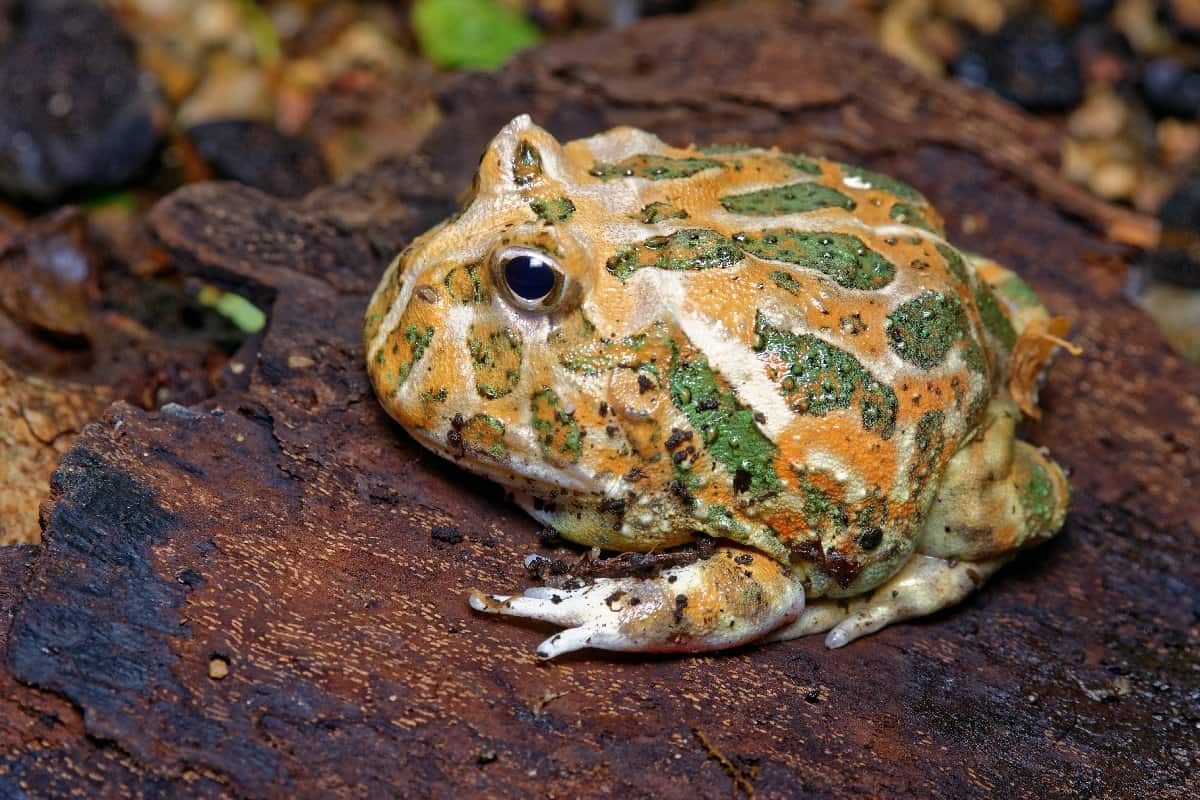
Argentine horned frogs come from South America. They are also called Pacman frogs after the game character with the wide, snapping mouth. Some people keep them as exotic pets, probably because they develop in various colors.

These frogs are patient predators, sitting still and waiting for prey to come into sight before leaping with their mouths wide open so as to take in their meal with one gulp. They will eat almost anything including mice, insects, and birds.

Note: The Argentine Horned Frog is not to be confused with what Americans know as the horned frog or the horny toad, which is actually a lizard. This animal has become famous as the mascot of Texas Christian University (TCU), known for its highly-ranked sports teams.
5 Interesting Facts:

• Argentine horned frogs have been known to suffocate in their attempt to eat something larger than themselves.
• Female frogs are larger than males.
• This frog species is close to being on the endangered list.
• The Argentine horned frogs may be the most popular amphibian kept as an exotic pet.
• Aregentine horned frogs live for five to eight years in the wild and up to 16 in captivity.
 

Scientific Name

The “Argentine horned frog” is the common name for this amphibian, but its scientific name is Ceratophrys Ornata. People also call it the Argentine wide-mouthed frog and the ornate Pacman frog because of its expansive gapping mouth. The Cranwells horned frog and the Argentine horned frog are the two main species of this type of amphibian. It is in the Ceratophryidae family.

There are seven related species, all belonging to the genus Ceratophrys: C. cranwelliC. cornutaC. testudoC. stolzmanniC. joazeirensisC. calcarata and C. aurita. The best known of these is Cranwell’s horned frog.

The horned frog’s name is based on its appearance. The amphibian has folds of skin over its eyes that look like horns. These horns may help the frog hide itself since they look like leaf tips that are resting on a forest floor.

There are many myths surrounding these frogs. For instance, in Argentina, they’ve been labeled “horse killers.” In fact, they’ve merely grasped onto the lips of horses that are grazing for food. Since the frogs are nonvenomous, it’s unlikely that one could kill a horse.
 

Appearance and Behavior
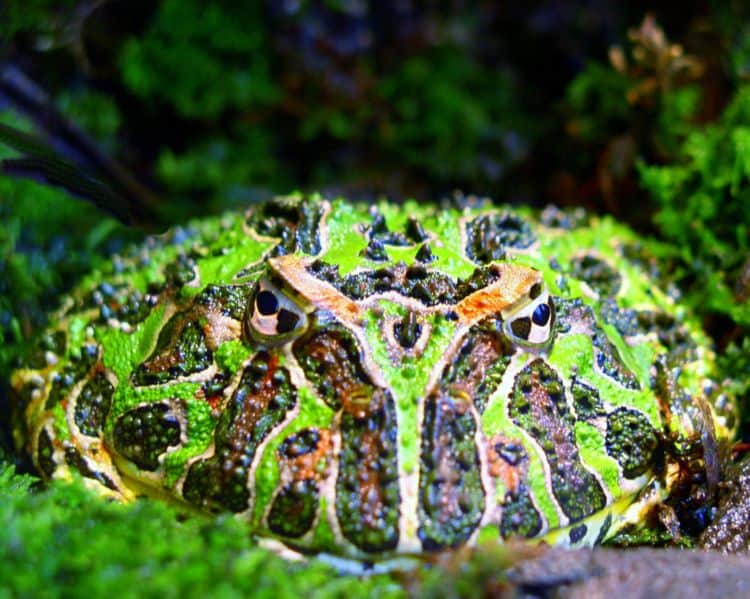
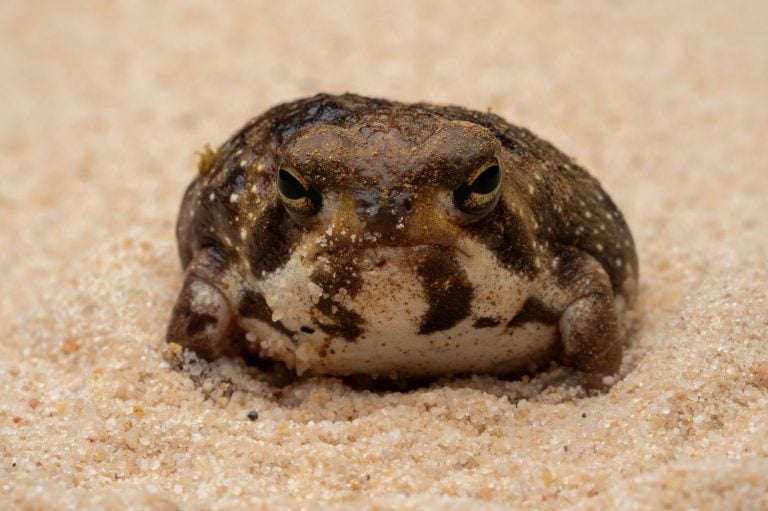
Argentine horned frogs are amphibians with round, squat bodies, and jaws that are as wide as the size of their heads. The animal has short legs, which is different from other types of frogs, so it’s not a good jumper. Male horned frogs can grow to be around 4.5 inches long, while females are bigger and measure around 6.5 inches long. They can weigh up to a pound.

The amphibians typically have yellow or white underbellies, and their limbs and back range in color combinations that include varying shades of greens, yellows, browns, and even reds. There are actually more than 40 paceman frog morphs displaying a wide range of colors and patterns!

When it comes to behavior, people may think that live horned frogs are deceased ones. If a frog’s environment becomes dry or if the amphibian loses its food source, then the animal will enclose itself within a resilient outer layer of skin for protection. The frog will remain completely still, giving those who encounter it the impression of being dead. Once the frog becomes rehydrated, it will shed the resilient outer skin layer and ingest it.

The horned frogs are aggressive, ambush predators. They are patient, and their coloring provides camouflage, so all the frogs have to do is hide and wait in some greenery until something tasty wanders by. When it does, the frog lunges and grabs its meal with its strong jaws and teeth, killing and swallowing its prey.

If the frog feels threatened, it will attack whatever is frightening it. The frog will attack even if the animal that’s threatening it is several times bigger than it is.

Habitat
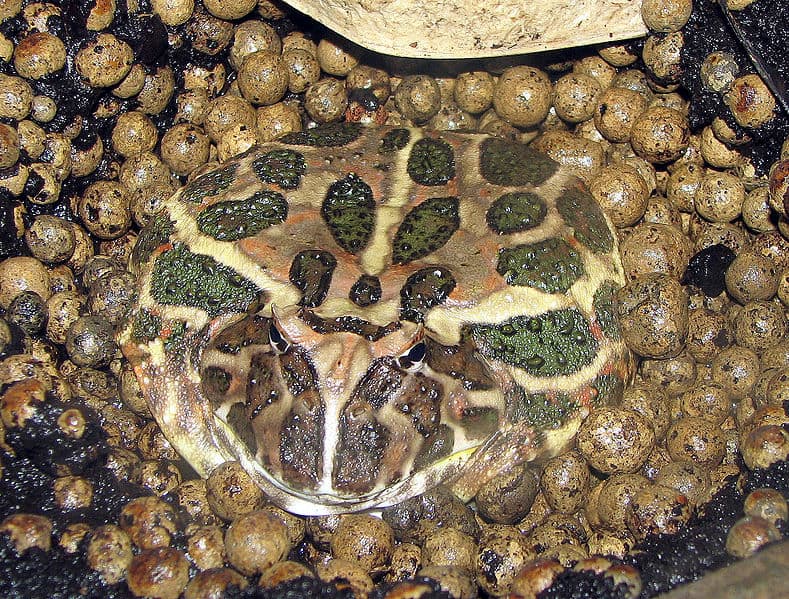
Horned Frog Sitting Still on Ground
Muddy forest flors are ideal spots for the Argentine horned frog because amphibians need a moist environment.

This amphibian is endemic to South America, specifically Argentian, Uruguay, and Brazil. The Argentine horned frog makes its home in debris-filled muddy forest floors that are humid and wet. In fact, it spends most of its time with two thirds of its body buried in damp soil. In the wild, the amphibians call wet tropical rainforests and swamp areas home.

If you intend to keep a pet horned frog, create a comfortable environment for it by including moist peat moss, clean damp soil, or grated pine bark mulch in its enclosure. Be sure to keep the frog’s enclosure damp but not overly wet. If it’s too wet, then it can cause bacteria to grow, distressing your pet and potentially causing illness. If you use soil or pine bark mulch, then it will dry out from the top down. When the top dries out entirely, moisten it. Try giving your horned frog a light mist using a spray bottle once a day either in the morning or at night. Be sure to keep your pet’s enclosure clean. Change the base material completely twice a month. This will decrease the possibility of bacteria growing. It will also reduce ammonia issues and the buildup of the animal’s fecal matter.

Include a small bowl of water in your frog’s enclosure. Make sure that the size of the bowl lets your frog get a drink and maybe splash around a bit without drowning. If your pet’s enclosure is on the dry side, then he or she will likely hang out in the water dish. Add a few plants around it to help your frog feel safe and secure.

When you have a pet horned frog, make sure that his or her enclosure stays around 82 degrees Fahrenheit during the daytime hours. At night, the temperature can decrease to about 78 degrees Fahrenheit. If you need to add heat to the container, use an under-tank heater instead of a bulb overhead. A bulb is likely to dry your frog’s skin too much.

Diet
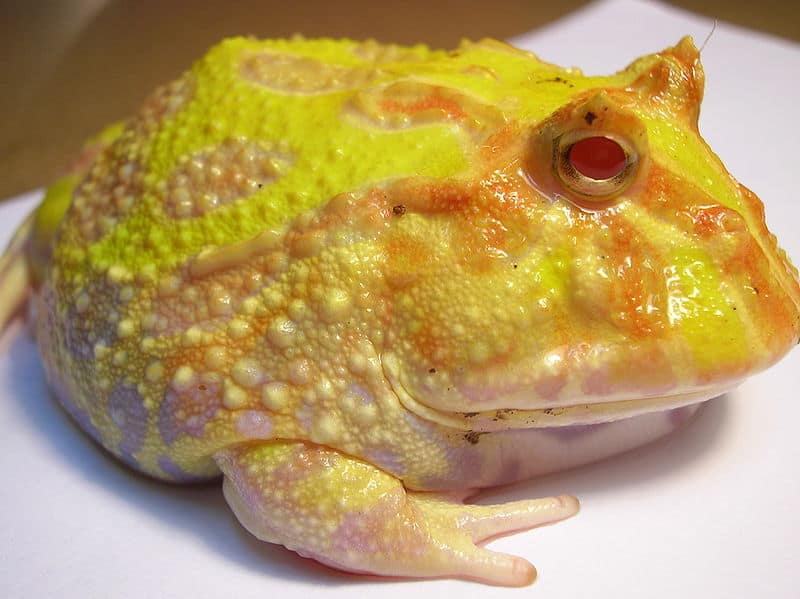
When the Argentine horned frog is living in the wild, it consumes mice, insects, amphibians, lizards, and even other frogs. It uses its wide mouth to catch and eat prey, even if it is almost the same size as it is.

Horned frogs that live in zoos or people’s homes dine on mice and crickets. You can give yours worms to eat also. If you decide to feed your frog mice, do so only occasionally because the amphibians are quite inactive. In fact, they may only jump to another spot after they’ve defecated in their previous one. This means that they can become overweight if fed a rich diet of fattening mice. You can feed a small horned frog daily. Once it reaches adulthood, feed him or her once every two or three days.

Predators and Threats

The horned frog is at risk from snakes, bears, and birds. This particular frog is hovering toward the endangered species list. It is near threatened status. The animal isn’t an immediate concern for environmental researchers, but they are watching it. Since the horned frog is amphibian, environmental changes and pollution may be harmful to it because of the animal’s delicate skin.

Today, many animals are facing survival challenges because they are losing their natural habitats. This includes horned frogs. Locals kill them because they inaccurately believe that they are venomous. People in the pet trade also collect them to sell.

When the frog species is kept in captivity, the animal may suffer from skin and eye infections caused by bacteria or fungi. If you’re keeping one as a pet, watch for pus, redness, or swelling on his or her skin. Respiratory infections are something else to watch out for. They happen less frequently in horned frogs than they do in other reptile and amphibian species, but they may still occur. If you notice that your pet is especially lethargic, wheezing, or drooling, then take him or her to an exotic pet veterinarian.

The horned frog may suffer from parasitic infections. If you’ve determined that the enclosure temperatures are in a comfortable range, and your frog doesn’t want to eat, then have him or her checked out for parasites. It’s also a good idea to give your vet an annual fecal sample to make sure that your frog friend is healthy. Most frog conditions are treatable if they’re caught in time.
 

Reproduction, Babies and Lifespan
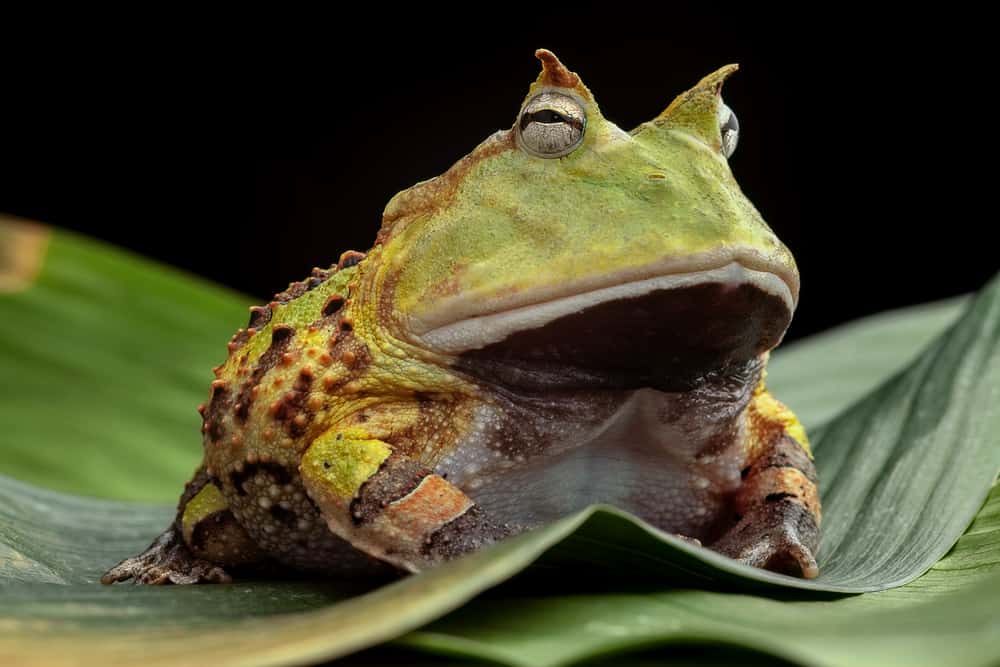
The South American horned frog prefers to spend its time burrowed deep down in the mud or within leaf debris. Typically, the only time that the amphibian risks going out into the jungle is for reproduction purposes. When it feels the urge to reproduce, the horned frog will conceal itself under some moss or leaves with just its eyes and the top of its head sticking out. A mating frog is highly alert to any sound or movement happening around it. This is likely because it is more vulnerable when it is out of its isolated mud areas.

Once a pair of frogs mate, the female will search for a water source where she can lay her eggs. After finding one that’s suitable, she’ll lay around 2,000 eggs. Horned frog eggs hatch in about two weeks. When they first hatch, they are tadpoles. In the tadpole phase, the amphibians are completely carnivorous and will eat one another if the opportunity arises. Tadpoles grow super-fast, and in just one month, they’ll become tiny frogs. Horned frogs reach sexual maturity in 18 to 24 months.

The lifespan of this frog species is from 5 years to 8 years in the wild. When they are in captivity, the amphibians can live as long as 15 years.

Population

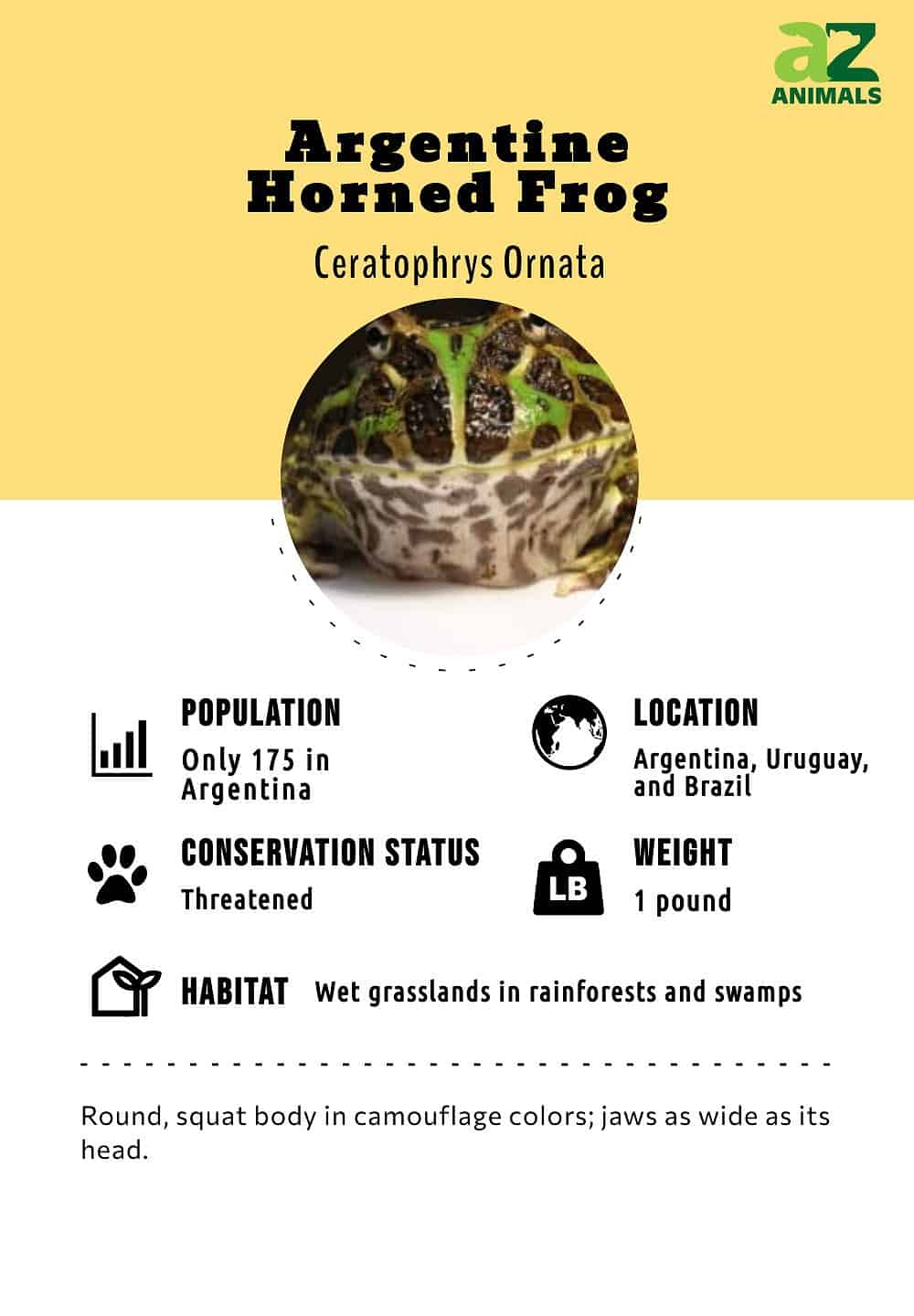
According to a study published in the Herpetological Conservation and Biology Journal, the horned frog is a species that is under threat of extinction. The study tracked the frog population from 2008 to 2017. For the study, the research team surveyed adult frogs when they were in their breeding areas. They checked these areas in spring and summer. This study reported that there were only 175 of the amphibians in Argentina during this time period. A number of researchers confirm that the horned frog population is decreasing.
 

View all 326 animals that start with A

Sources

  1. David Burnie, Dorling Kindersley (2011) Animal, The Definitive Visual Guide To The World's Wildlife / Accessed January 20, 2009
  2. Tom Jackson, Lorenz Books (2007) The World Encyclopedia Of Animals / Accessed January 20, 2009
  3. David Burnie, Kingfisher (2011) The Kingfisher Animal Encyclopedia / Accessed January 20, 2009
  4. Richard Mackay, University of California Press (2009) The Atlas Of Endangered Species / Accessed January 20, 2009
  5. David Burnie, Dorling Kindersley (2008) Illustrated Encyclopedia Of Animals / Accessed January 20, 2009
  6. Dorling Kindersley (2006) Dorling Kindersley Encyclopedia Of Animals / Accessed January 20, 2009
Thank you for reading! Have some feedback for us?


Argentine Horned Frog FAQs (Frequently Asked Questions)

Horned frogs are carnivores that aren’t particularly picky about what kind of animal that they eat. The amphibians will attack almost anything that crosses their path when they’re hungry including animals that are larger than themselves. Along with a large mouth, a horned frog has a super sticky tongue that holds onto its meal and retracts, pulling the animal into its mouth. Once there, the frog’s enormous jaws use immense force to clamp down, preventing the prey from escaping. Some researchers have compared the frog’s tongue to an adhesive that is pressure sensitive.