Polar Bear
Ursus maritimus
 Verified by: AZ Animals Staff
Could be extinct within the next 30 years!
Advertisement
Polar Bear Scientific Classification
- Kingdom
- Animalia
- Phylum
- Chordata
- Class
- Mammalia
- Order
- Carnivora
- Family
- Ursidae
- Genus
- Ursus
- Scientific Name
- Ursus maritimus
Read our Complete Guide to Classification of Animals.
Polar Bear Conservation Status
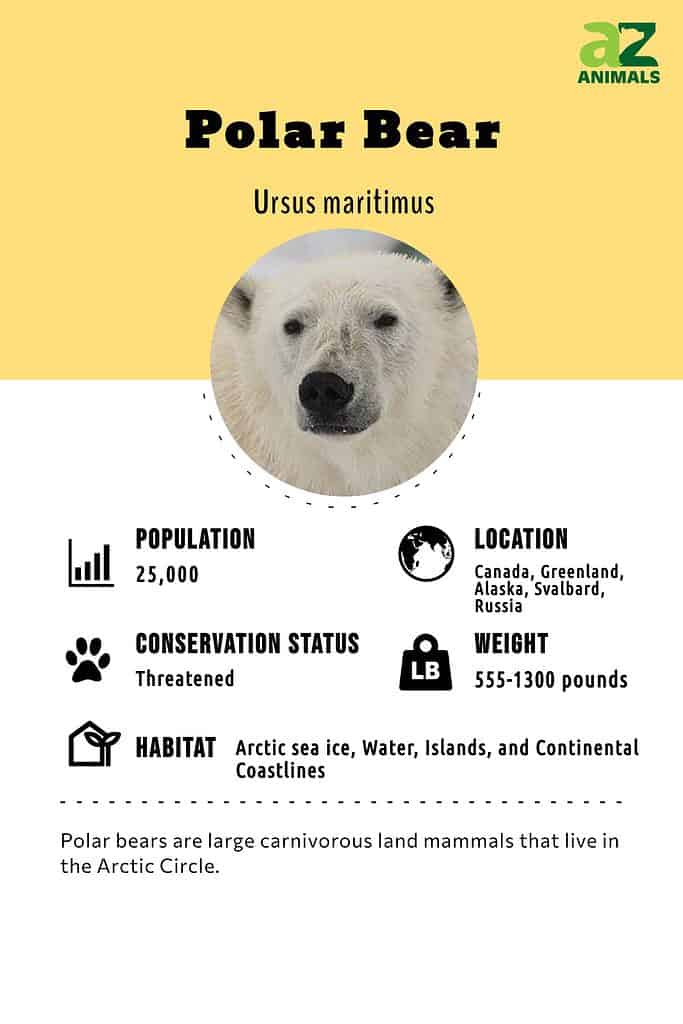
Polar Bear Facts
- Prey
- Seal, Walrus, Seabirds
- Name Of Young
- Cub
- Group Behavior
- Solitary
- Fun Fact
- Could be extinct within the next 30 years!
- Estimated Population Size
- 20,000 - 25,000
- Biggest Threat
- Global warming
- Most Distinctive Feature
- Clear not white fur and black skin
- Other Name(s)
- Nanuuq
- Gestation Period
- 6 - 9 months
- Habitat
- Coastal ice fields and floating ice
- Diet
- Carnivore
- Average Litter Size
- 2
- Lifestyle
- Diurnal
- Common Name
- Polar Bear
- Number Of Species
- 1
- Location
- Arctic Ocean
- Slogan
- Could be extinct within the next 30 years!
- Group
- Mammal
Polar Bear Physical Characteristics
- Color
- Yellow
- White
- Skin Type
- Fur
- Top Speed
- 25 mph
- Lifespan
- 20 - 30 years
- Weight
- 150kg - 600kg (330lbs - 1,322lbs)
- Length
- 2m - 2.5m (6.5ft - 8.3ft)
- Age of Sexual Maturity
- 3 - 5 years
- Age of Weaning
- 2 - 3 years

 © Lamberrto/Shutterstock.com
View all of the Polar Bear images!



How to Add Us to Google News


Classification and Scientific Name
Ursus maritimus (“maritime bear”) was first described in 1774 by Constantine John Phipps. Inuit people call it Nanook, and Norwegian names are isbjørn (‘ice bear’) or kvitbjørn (‘white bear’).
The polar bear was once believed to be its own separate species, but recent evidence has shown that it is actually a hybrid of the brown bear. The accepted scientific name for the polar bear is now Ursus maritimus.
The polar bear is a large species of bear that is found inhabiting the ice fields in the Arctic Ocean. It is the biggest species of bear in the world (with the exception of the Kodiak brown bears found in Alaska, which can reach similar sizes), with males often weighing in at around 1300 pounds. Thought to be closely related to the brown bear, the polar bear’s name actually means “sea bear” as they are known to not just spend a great deal of time close to the coast but are also strong and capable swimmers that have been spotted up to 100 miles from the closest ice or land. They are, however, being devastatingly affected by global warming as the ice that they rely so heavily on is disappearing fast and has led to the polar bear becoming a strong symbol of the effects of climate change. Polar bear populations have also fallen across the Arctic Ocean due to hunting, pollution, and drilling for oil and gas, leading to them being as listed as a threatened species.
Evolution
The Ursidae family has evolved over millions of years. The oldest known polar bear fossil is a 130,000 to 110,000-year-old jaw bone found on Prince Charles Foreland in 2004. This suggests that the polar bear diverged from a population of brown bears during the Pleistocene period when Siberia was covered by glaciers. It is believed that this isolation led to changes in the molar teeth of polar bears between 10,000 and 20,000 years ago, which further differentiated them from their brown bear ancestors.
DNA analysis suggests polar bears diverged from brown bears, Ursus arctos, ~150k years ago. Some clades of brown bear mtDNA are closer to polar than other brown bears. Irish bear’s (now extinct) mtDNA is particularly close. Nuclear genome comparison revealed distinct clades ~603k years ago, but a recent complete genome analysis revised this date to 400k years ago.
However, the two species have mated intermittently for all that time, most likely coming into contact with each other during warming periods, when polar bears were driven onto land, and brown bears migrated northward. Most brown bears have about 2 percent genetic material from polar bears, but one population, the ABC Islands bears, has between 5 percent and 10 percent polar bear genes, indicating more frequent and recent mating.
Polar bears can breed with brown bears to produce fertile hybrids, suggesting their genetic similarity persists despite morphological and behavioral differences. Thus, the two species remain classified as separate.
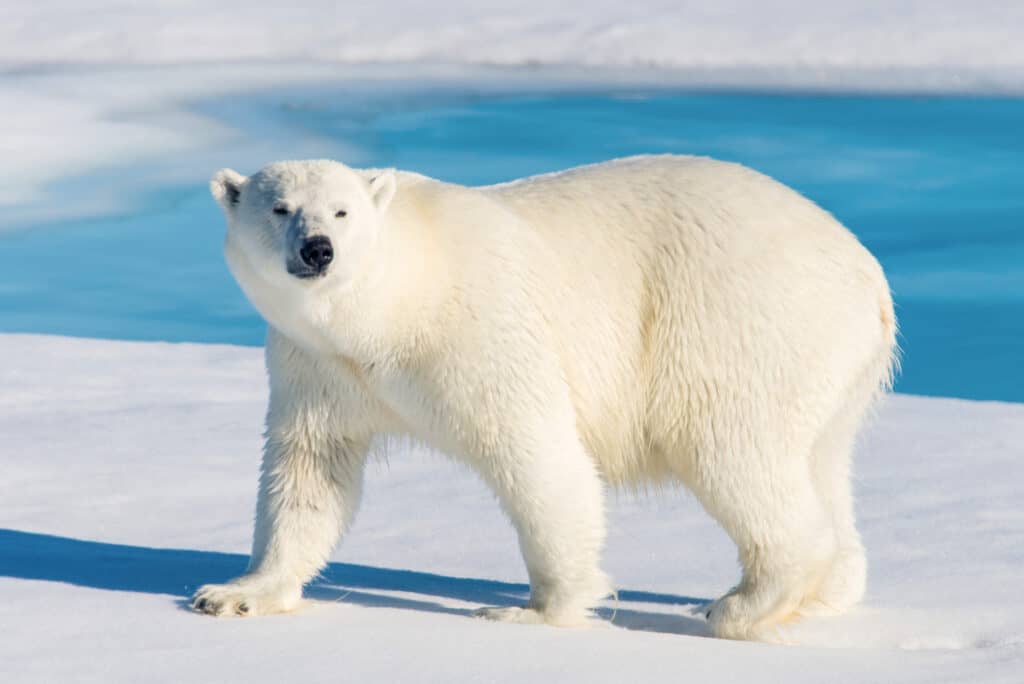
DNA analysis suggests polar bears diverged from brown bears, Ursus arctos, ~150k years ago.
©iStock.com/Alexey_Seafarer
Anatomy and Appearance
Adult polar bears are animals that typically measure more than six feet in length and weigh around half a ton. Females, though, are much lighter than their male counterparts, that are almost double their weight. Polar bears are one of the few large mammals found in such hostile conditions and have adapted well to their life on the ice. Their fur is thick and dense and is made up of a warm undercoat with longer guard hairs on top that are clear, hollow tubes that trap warmth from the sun and transmit it directly down to their black skin, which then absorbs the welcome heat. The polar bear is an animal with a strong and muscular body, broad front paws that help when paddling in the water, and fur on the bottom of its feet that not only helps to keep them warm but also gives the polar bear extra grip when moving about on the ice. They have very long necks in comparison to other bear species, which enables their head to remain above the water when swimming. They also have more elongated muzzles and smaller ears than their relatives.
The largest polar bear ever recorded weighed 2,209 pounds (1,002 kg)! It stood more than 11 feet tall on its high legs and was discovered in Alaska in 1960. While polar bears are the largest bear species, in documented altercations that pit polar bears vs. grizzly bears, it has normally been the grizzly that stands its ground while the polar bear flees.
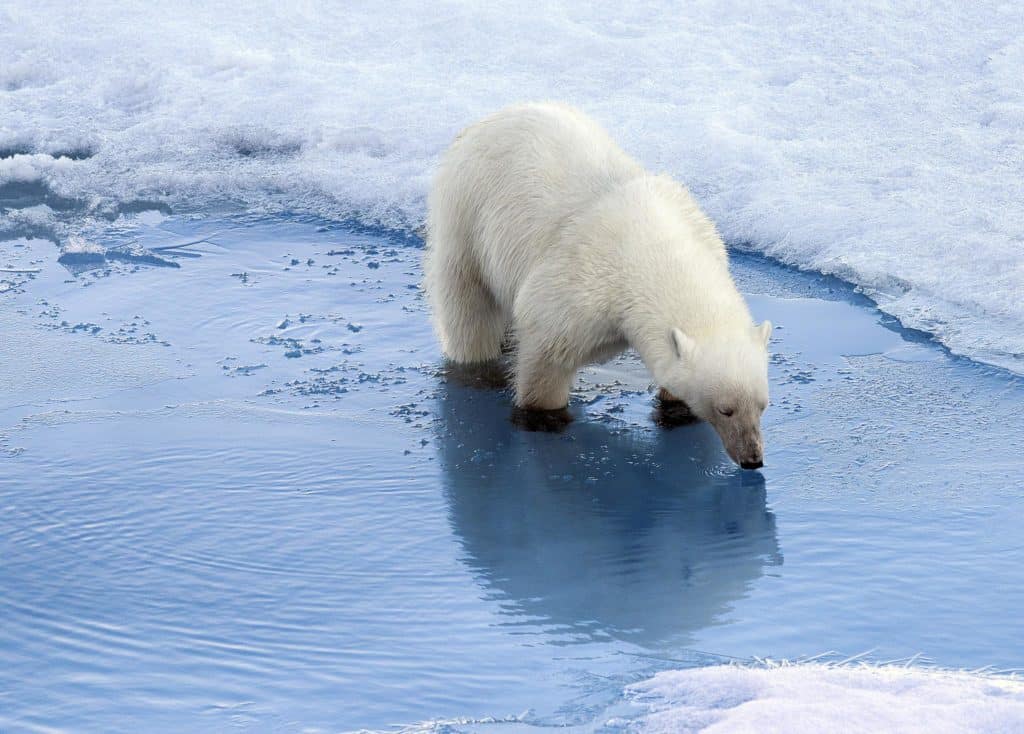
Polar bears are one of the few large mammals found in such hostile conditions and have adapted well to their life on the ice.
Distribution and Habitat
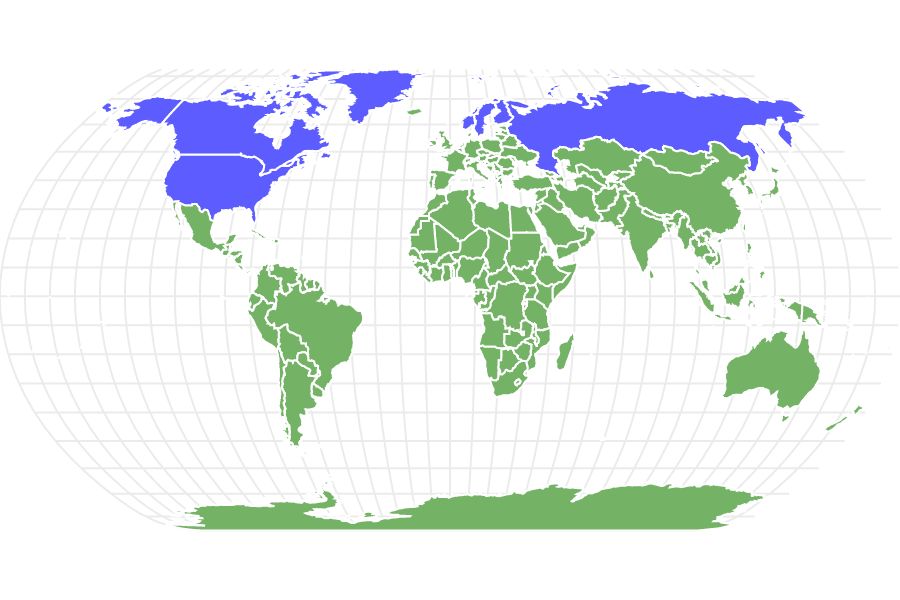
Polar bears are animals that are found on the icy coasts that surround the North Pole and as far south as Hudson Bay. Around 60% of polar bears can be found in northern Canada, with the remaining individuals distributed throughout Greenland, Alaska, Svalbard, and Russia, where they tend to be found relatively close to the ocean, roaming vast distances across the ice fields. Polar bear populations have fallen drastically throughout their natural range, with the biggest threat to this enormous carnivore being global warming. Although polar bears are accustomed to seasonal changes in the Arctic Circle, the summer ice melt is happening earlier and more ferociously year by year, meaning that polar bears have less time to hunt on the ice before it disappears. Their precarious habitats are also affected severely by human encroachment in the forms of hunting, growing settlements, and the release of chemical pollutants into the water.
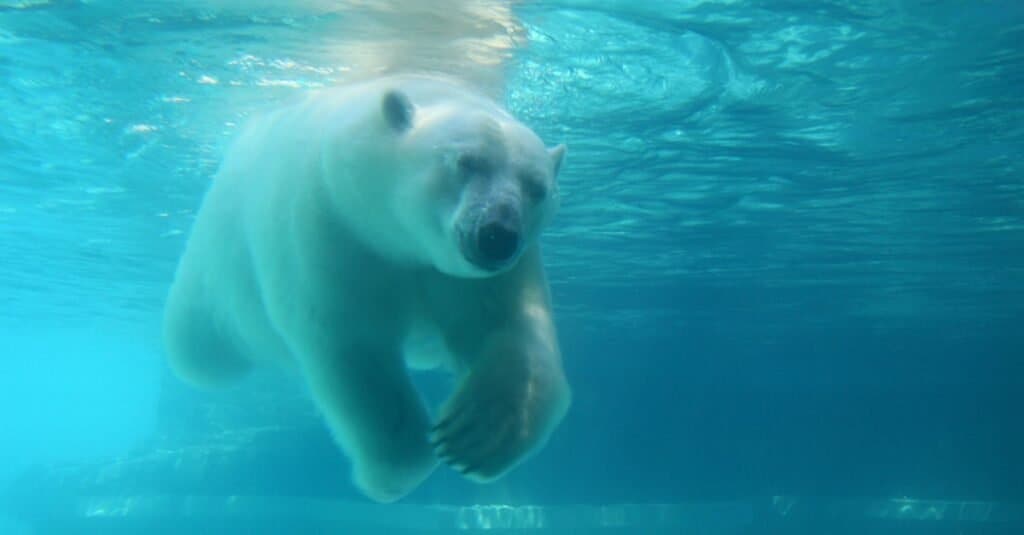
Polar bears can be found in Canada, Greenland, Alaska, Svalbard, and Russia.
©Vladimir Gjorgiev/Shutterstock.com
Behavior and Lifestyle
The polar bear is a solitary animal that can not only run at speeds of up to 25mph, but its strong ability to swim at 6mph makes it a true apex predator within its environment. These semi-aquatic mammals can hunt both on the ice and in the water and have been known to swim vast distances across the open ocean in search of food. Polar bears are able to dive under the water to catch their prey which they do by keeping their eyes open and holding their breath for up to two minutes. On land, they tend to hunt using two main techniques: they either stalk then chase their prey or sit waiting next to a breathing hole for up to many hours before ambushing the seal as it emerges. Eating seals is vital to the survival of the polar bear as they are able to provide it with a high-energy meal. During the short Arctic summer, however, polar bears are forced further north as the ice recedes when they have to feed on other animals further inland.
You can check out incredible facts about polar bears.
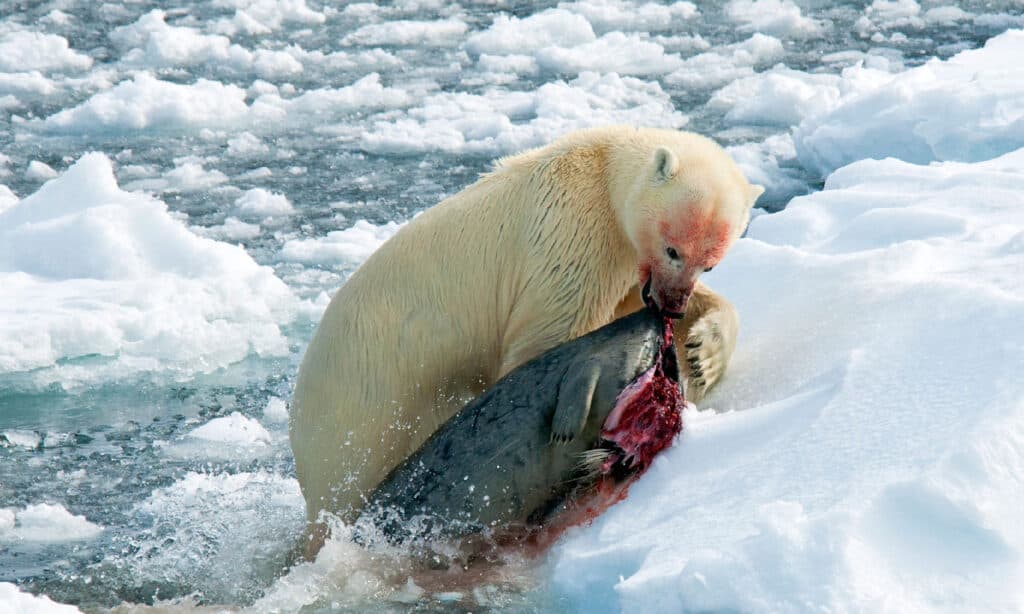
Eating seals is vital to the survival of the polar bear as they are able to provide it with a high-energy meal.
©iStock.com/AGAMI stock
Reproduction and Life Cycles
Polar bears tend to breed in the spring between April and May, with the gestation period then varying considerably (depending on the health of the female) due to a period of delayed implantation. Up to 9 months later, the female gives birth to between 1 and 4 cubs in a den that she has dug into the snow or ground. The cubs weigh just over one pound when they are newborns and are hairless, and cannot see. Females enter their dens towards the end of autumn and don’t emerge with their cubs until the harsh winter conditions have turned into spring. Although polar bear cubs begin eating solid food when they are around 5 months old, they are not weaned until they are between two and three. Cubs are known to commonly play-fight with other cubs, which involves wrestling and chasing, along with baring their teeth and even biting one another, but without causing harm. These games are critical for polar bear cubs to learn how to fight and therefore defend themselves successfully once they leave their mother and live on their own.
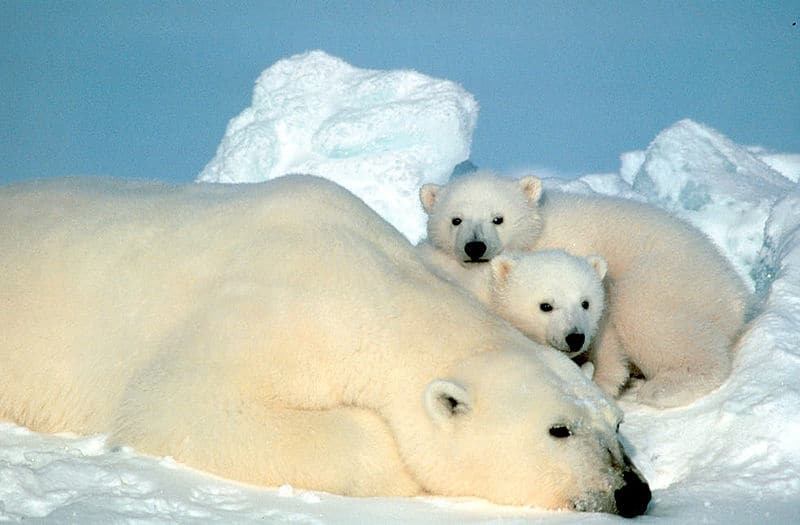
The polar bear has a relatively slow rate of reproduction which means that populations are not only shrinking rapidly, but they are not growing quickly enough to sustain themselves.
©Steve Amstrup, Public domain, via Wikimedia Commons – License
Diet and Prey
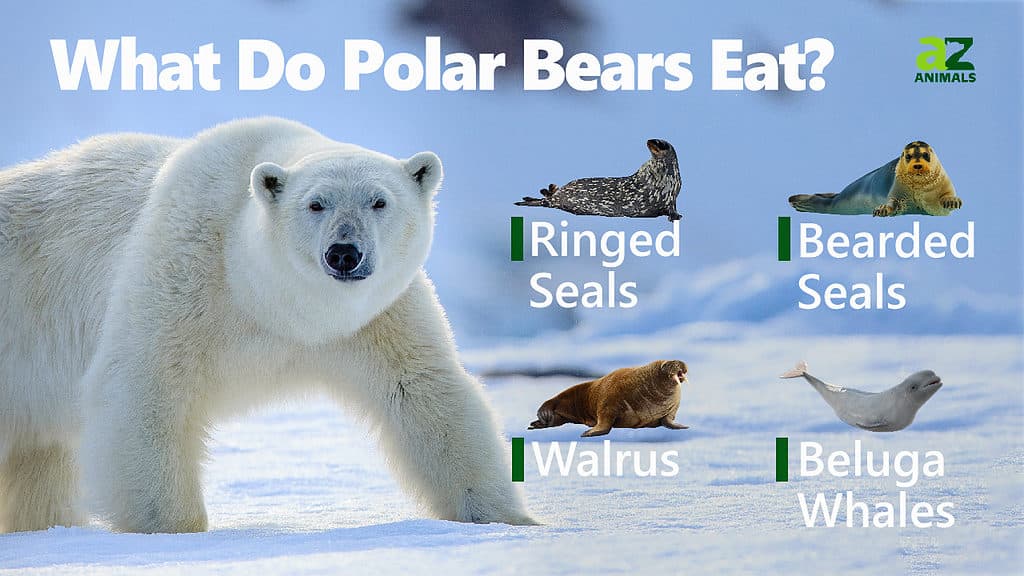
The polar bear is the largest carnivorous mammal on land and must hunt regularly to ensure that it is well-fed and maintains its insulating layer of fat to keep it warm. The skins and blubber of ringed seals make up the bulk of the polar bears’ diet as they often leave the remaining meat, which provides an important source of food for other animals, such as arctic foxes. Although seals are their primary source of food, polar bears also eat birds, berries, fish, and reindeer (particularly during the trickier summer months), along with the occasional walrus. The carcasses from large marine mammals, including seals, walruses, and even whales, also provide a regular food source for polar bears that are said to have such a good sense of smell that they are able to sniff them out from a considerable distance away. Polar bears are also known to break into underground seal dens to hunt the pups inside them.
Predators and Threats
Due to the fact that the polar bear is an enormous and ferocious predator, there are no animals that prey on them in their surrounding environment. They tend to have the most trouble with other polar bears, and females will protect their cubs fiercely from males that may be trying to harm them. Humans are by far the biggest threat to the dwindling polar bear population numbers as they have greedily hunted them from their arrival in the Arctic Ocean in the 1600s until the mid-1970s when international hunting bans fell into place. Along with the receding ice fields that are crucial to the survival of the polar bear caused by climate change, they are also heavily affected by drilling for oil and gas, increased shipping activity, and rising levels of industrial chemicals that pollute the water. The polar bear has a relatively slow rate of reproduction which means that populations are not only shrinking rapidly, but they are not growing quickly enough to sustain themselves. Some experts claim that the polar bear could be extinct from the wild in the next 30 years.
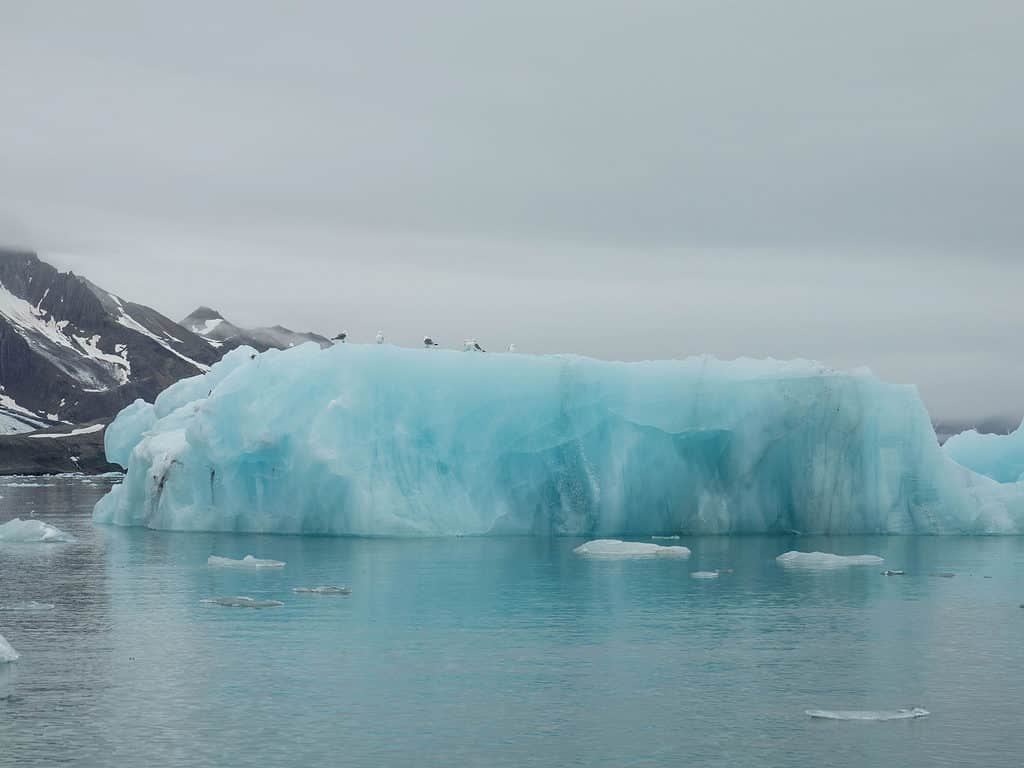
The polar bear could be extinct from the wild in the next 30 years if we do not stop climate change and global warming.
©iStock.com/Eisenlohr
Interesting Facts and Features
Before the harsh winter conditions have fully arrived, female polar bears dig themselves a den in the snow where they hibernate through these hostile months (and where they give birth to their cubs) and only emerge in the spring. These dens are known to be up to forty degrees warmer than the outside, but males seem to prefer to be active all year round. Polar bears have a layer of blubber under their skin which can be up to 4 inches thick and helps to keep them warm. They are, in fact, so well insulated that polar bears must move slowly for the majority of the time so that they don’t overheat. Polar bears shed their fur in the summer, meaning that they seem at their whitest at the beginning of autumn. By the spring, their coats appear to be more yellow in color, which is something thought to be partially due to the oils found in seal skins.
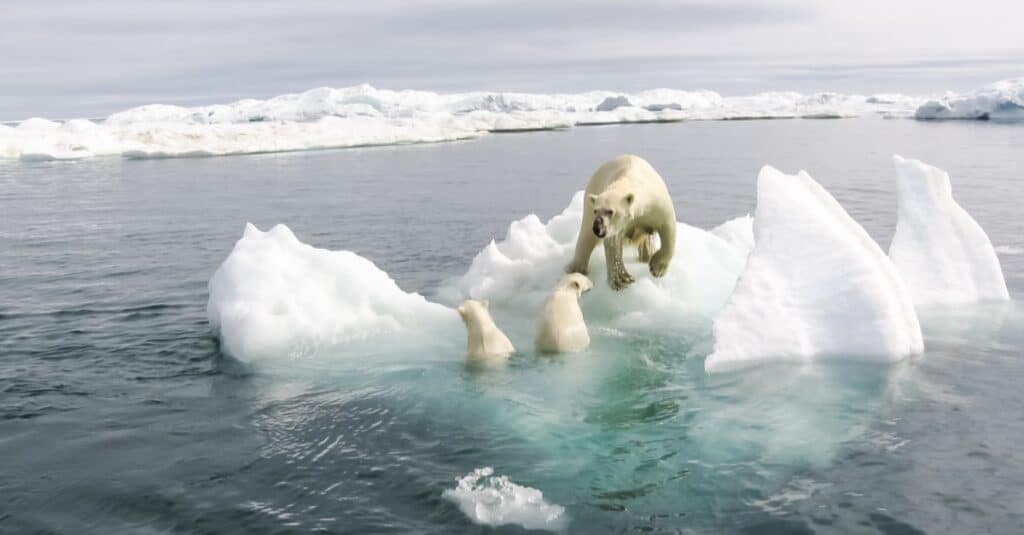
Polar bears have a layer of blubber under their skin which can be up to 4 inches thick and helps to keep them warm.
©iStock.com/avstraliavasin
Relationship with Humans
Before the 1600s, when the European, Russian and American hunters arrived in the heart of the Arctic Circle, only native people really knew anything about them. Polar bears were mercilessly hunted until 1973, when an international agreement put an end to such uncontrolled hunting. Even today, native people are still allowed to hunt the polar bear for traditional uses, but the biggest threat to polar bears is the rapidly melting ice shelf. Global warming caused by people is thought to be reducing so quickly, in fact, that some say that their southern limit of Hudson Bay will have no ice at all by 2080. Polar Bears are known to be aggressive towards humans, with reported attacks still occurring, including the most recent and famous incident in Svalbard, when a number of teenagers and their expedition leaders were attacked by a polar bear in their camp.
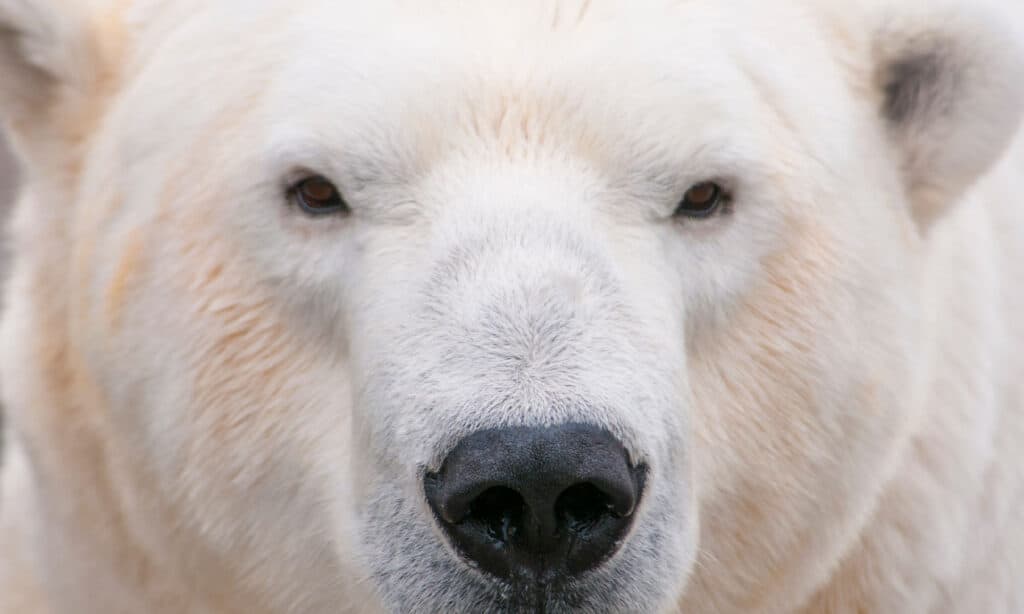
Polar bears were mercilessly hunted until 1973, when an international agreement put an end to such uncontrolled hunting.
©iStock.com/ElliotHurwitt
Conservation Status and Life Today
Today, the polar bear has been listed on the IUCN Red List as a species that is Vulnerable in its natural environment. Although international hunting bans have prevented such a high level of hunting, conservation efforts within the Arctic Circle prove to be hard, with the one thing that the polar bear actually needs to survive disappearing more every year. Increased levels of industrial activity in their natural environment also cause declines in the quality of their remaining habitats. There are estimated to be between 20,000 – 25,000 polar bears left roaming close to the North Pole, with the majority of these found in northern Canada.
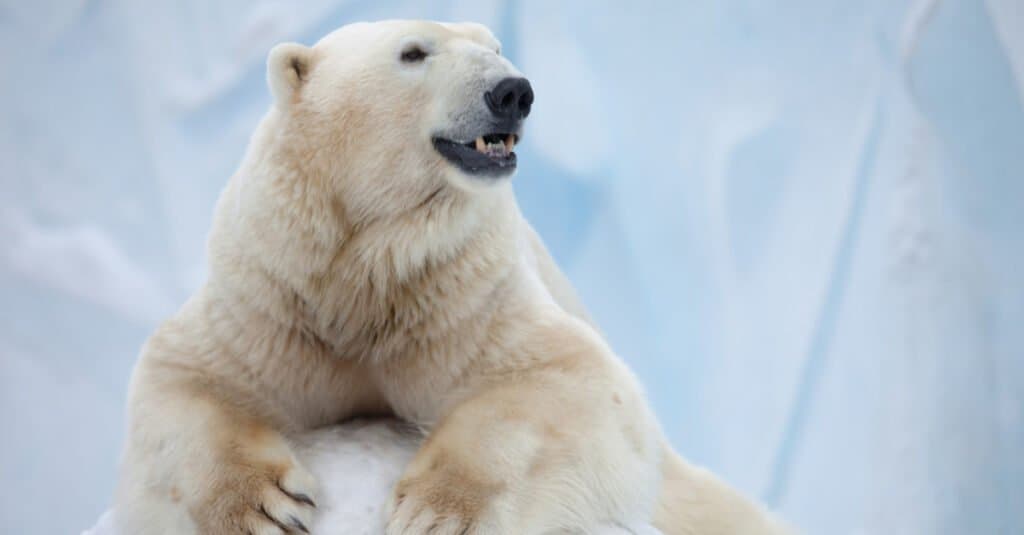
There are estimated to be between 20,000 – 25,000
polar bears left
in the wild.
©Zhiltsov Alexandr/Shutterstock.com
Types of Polar Bears
There are only one species of the polar bear. However, there are eight total species of bears. The eight species of bears that are currently extant on the planet today include the American black bear, the Asiatic black bear, the brown bear, the polar bear, the sloth bear, the sun bear, the spectacled bear, and the giant panda. These bears can be found in a wide variety of habitats throughout North America and Europe, as well as parts of South America and Asia. Bears are characterized by their bulky bodies with short legs, long snouts for sniffing out food sources or potential mates, and small rounded ears to better detect predators or nearby prey sources.
Additionally, they have thick fur coats, which help them keep warm in cold climates such as those inhabited by polar bears who live almost exclusively on sheets of ice year-round. All modern species also possess paws with five nonretractile claws, which come in handy when climbing trees or digging up roots while searching for food during hibernation season. Finally, all modern-day species have a distinctive short tail used primarily for balance while walking or running.
View all 192 animals that start with P How to Add Us to Google News

Polar Bear FAQs (Frequently Asked Questions)
Are Polar Bears herbivores, carnivores, or omnivores?
Polar Bears are Carnivores, meaning they eat other animals.
What Kingdom do Polar Bears belong to?
Polar Bears belong to the Kingdom Animalia.
What class do Polar Bears belong to?
Polar Bears belong to the class Mammalia.
What phylum to Polar Bears belong to?
Polar Bears belong to the phylum Chordata.
What family do Polar Bears belong to?
Polar Bears belong to the family Ursidae.
What order do Polar Bears belong to?
Polar Bears belong to the order Carnivora.
What type of covering do Polar Bears have?
Polar Bears are covered in Fur.
What genus do Polar Bears belong to?
Polar Bears belong to the genus Ursus.
Where do Polar Bears live?
Polar Bears live near the Arctic Ocean.
In what type of habitat do Polar Bears live?
Polar Bears live in coastal ice fields and floating ice.
How many babies do Polar Bears have?
The average number of babies a Polar Bear has is 2.
What is an interesting fact about Polar Bears?
Polar Bears could be extinct within the next 30 years!
What is the scientific name for the Polar Bear?
The scientific name for the Polar Bear is Ursus maritimus.
What is the lifespan of a Polar Bear?
Polar Bears can live for 20 to 30 years.
What is a baby Polar Bear called?
A baby Polar Bear is called a cub.
How many species of Polar Bear are there?
There is 1 species of Polar Bear.
What is the biggest threat to the Polar Bear?
The biggest threat to the Polar Bear is global warming.
What is another name for the Polar Bear?
The Polar Bear is also called the nanuuq.
How many Polar Bears are left in the world?
There are between 20,000 and 25,000 Polar Bears left in the world.
How fast is a Polar Bear?
A Polar Bear can travel at speeds of up to 25 miles per hour.
What's the difference between a polar bear and a Kodiak bear?
There are many differences between a polar bear and a Kodiak bear. Kodiak bears are larger than polar bears, while polar bears are found in more locations. Kodiak bears are also brown, while polar bears are white.
How long do polar bears live?
The average polar bear’s lifespan is 20 to 30 years. In captivity, some may live up to 40 depending on diet and health.
Who would win a fight between a polar bear and a hippo?
A hippo would win a fight against a polar bear. The hippo is larger, stronger, has better offensive powers and a defense that would allow it to last longer in a battle than a polar bear.
Sure, the polar bear could use its claws to cut the hippo to ribbons, but it would take some time and power to cut through all that flesh and fat. There’s no way that the hippo, one of the most powerful, aggressive animals in the world, sits there and takes that damage. Instead, the hippo needs one or two bites to incapacitate the polar bear.
Who would win in a fight between a polar bear and a walrus?
A polar bear would win a fight against a walrus on land, but a walrus would kill the polar bear in the water.
What are the differences between leopard seals and polar bears?
The differences between leopard seals and polar bears include size, appearance, behavior, and diet, among other factors.
How to say Polar Bear in ...
Thank you for reading! Have some feedback for us? Contact the AZ Animals editorial team.
Sources
- David Burnie, Dorling Kindersley (2011) Animal, The Definitive Visual Guide To The World's Wildlife
- Tom Jackson, Lorenz Books (2007) The World Encyclopedia Of Animals
- David Burnie, Kingfisher (2011) The Kingfisher Animal Encyclopedia
- Richard Mackay, University of California Press (2009) The Atlas Of Endangered Species
- David Burnie, Dorling Kindersley (2008) Illustrated Encyclopedia Of Animals
- Dorling Kindersley (2006) Dorling Kindersley Encyclopedia Of Animals
- David W. Macdonald, Oxford University Press (2010) The Encyclopedia Of Mammals
- Polar Bear Information, Available here: http://www.fws.gov/home/feature/2008/polarbear012308/polarbearspromo.html
- Polar Bear Facts, Available here: http://animals.nationalgeographic.com/animals/mammals/polar-bear/
- Polar Bear Threats, Available here: http://www.iucnredlist.org/apps/redlist/details/22823/0