


Quick Take
- Scientists still can't fully explain why these dolphins turn pink, and the leading theories are stranger than you'd expect. Explore the pink color theories →
- Male river dolphins have a bizarre courtship ritual that no other dolphin species uses, and this ritual involves live animals. See the courtship rituals →
- Their ears are almost useless, but they navigate and hunt with a precision that rivals any predator in the river. Discover their echolocation abilities →
- In South American mythology, these dolphins live a double life that has nothing to do with water. Uncover the mythology →
The Amazon River dolphin (also known as the pink dolphin and botos) is a freshwater animal and a species of toothed whale. Considered the biggest and smartest animal of the freshwater dolphin species, it lives in the Amazon, Orinoco, and Tocantins-Araguaia rivers located in Bolivia, Brazil, Colombia, Ecuador, Guyana, Peru, and Venezuela.
River dolphins are smaller than saltwater dolphins, and they have excellent hearing. Pink dolphins must live in warm, shallow water because they have very little blubber. River dolphins suffer in captivity, with few aquariums able to keep them alive.

Scientific Name and History
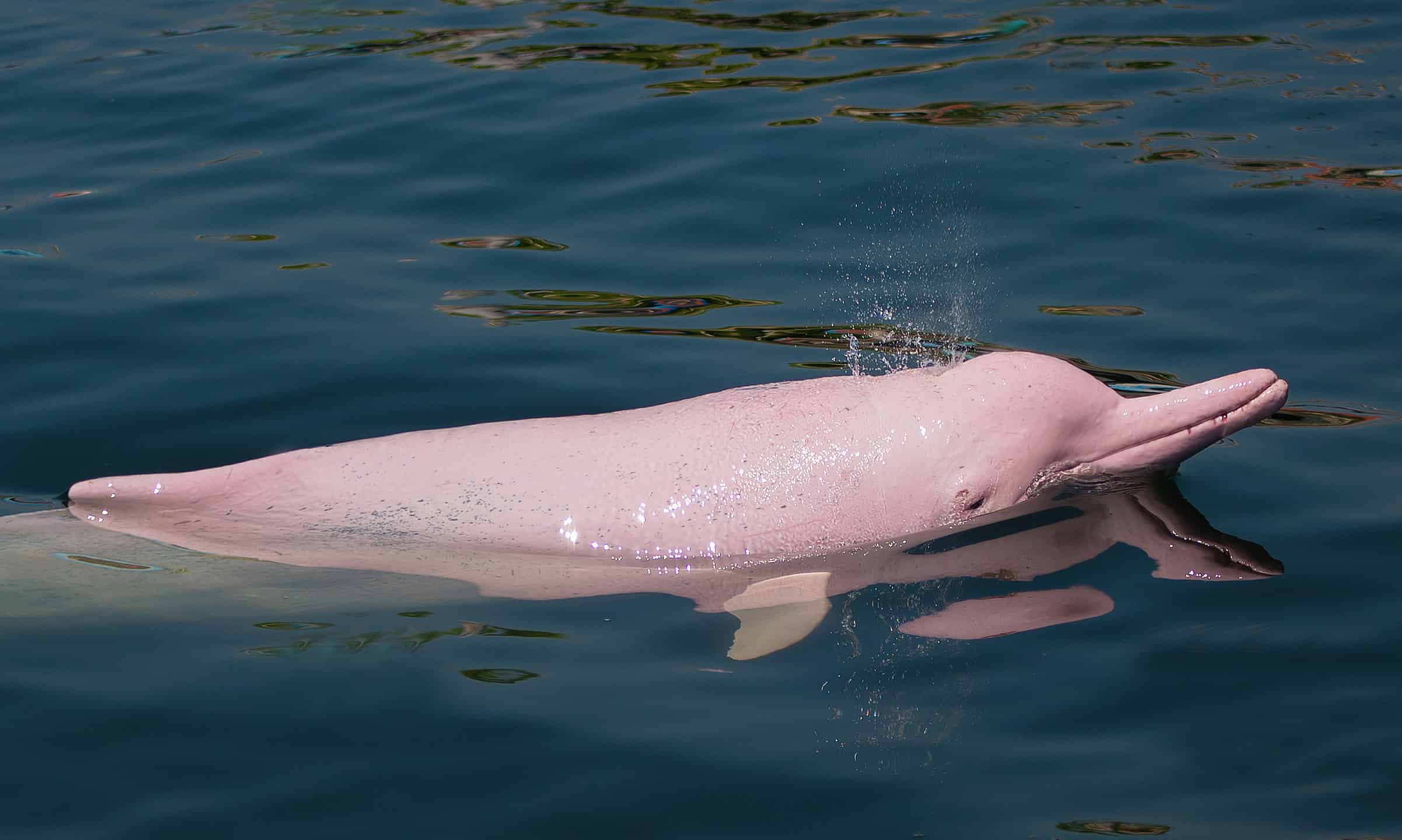
The Amazon River dolphin is also known as the pink dolphin due to its pink coloring.
©Anirut Krisanakul/Shutterstock.com
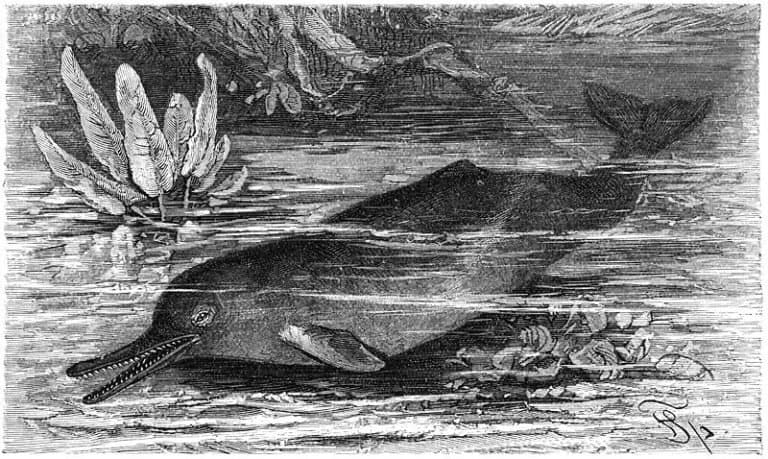
The Amazon River dolphin’s scientific name is Inia geoffrensis. Its common name comes from where it often makes its home and its skin color.
The name “boto” is used by natives. It is also a popular character in South American mythology, where pink dolphins have amazing musical skills, are seductive, and love parties. Some myths claim that they can shapeshift into human form and have magical abilities.
There are several recognized species of river dolphins, including the Amazon River dolphin (Inia geoffrensis), Araguaian boto (Inia araguaiaensis, proposed), Ganges River dolphin (Platanista gangetica), Indus River dolphin (Platanista minor), and tucuxi, though the exact number varies depending on the taxonomic framework used. The Yangtze River dolphin (Lipotes vexillifer) was declared extinct in 2006, though some sources describe it as possibly extinct.
It is unknown how or when the dolphin got into the Amazon basin, but it may have done so during the Miocene period, entering from either the Atlantic or the Pacific Ocean before the formation of the Andes.
Species
There is considerable debate within the scientific community as to whether the Amazon River dolphin is actually one, two, or potentially even three different species. In 2014, scientists in Brazil published research in the journal PLOS ONE, saying that the Araguaia River dolphins were a unique species. Also, there has been considerable debate as to whether river dolphins living in Bolivia are a unique species. As of 2020, the IUCN recognizes three subspecies: the Amazon River dolphin (I. g. geoffrensis), the Bolivian River dolphin (I. g. boliviensis), and the Orinoco River dolphin (I. g. humboldtiana).
Appearance and Behavior
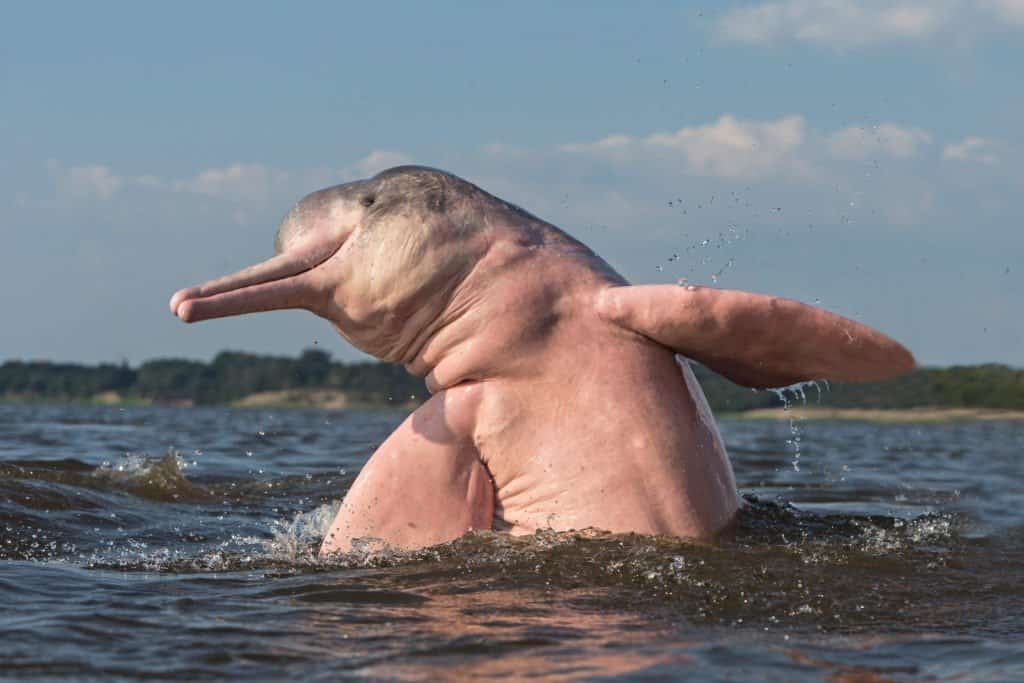
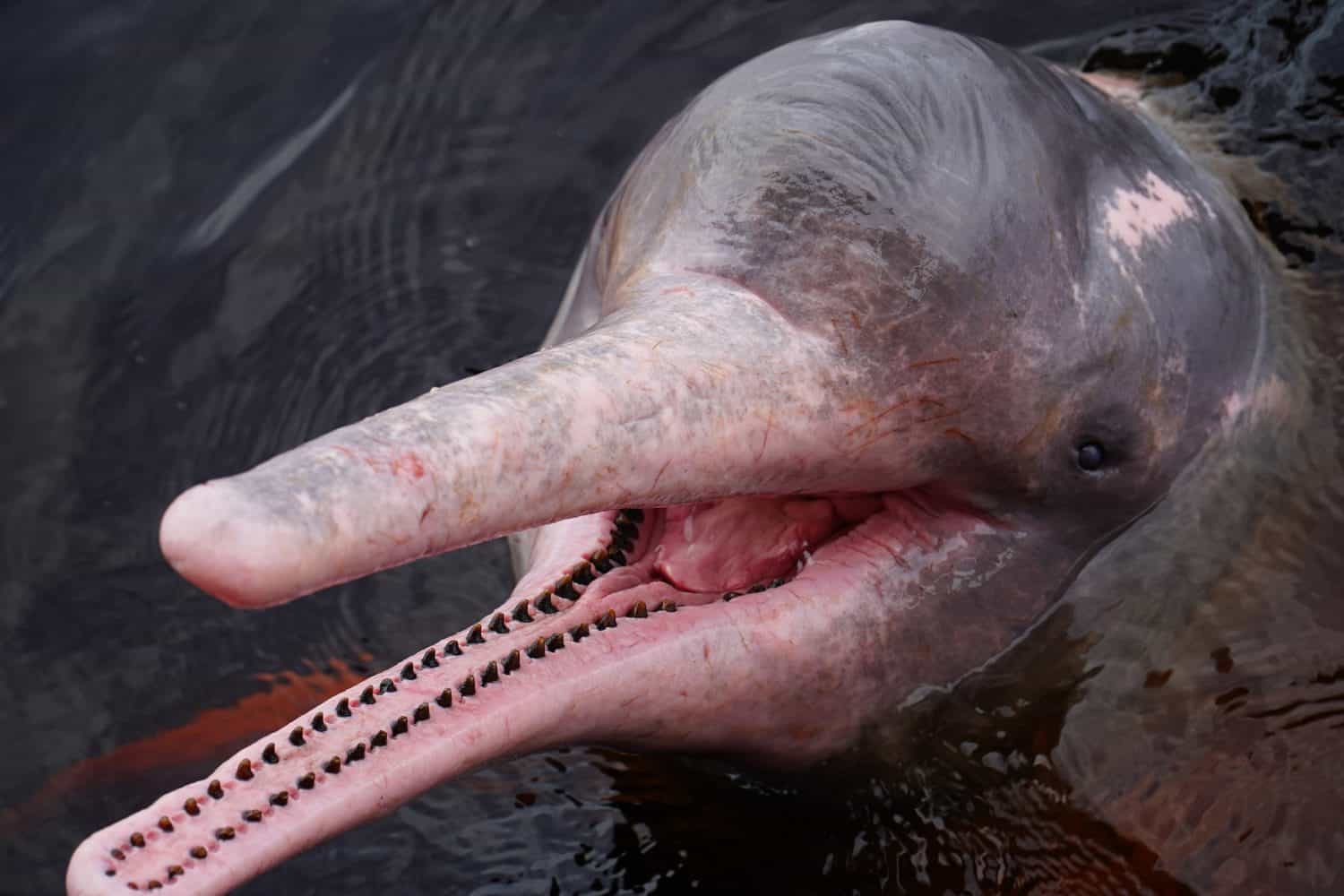
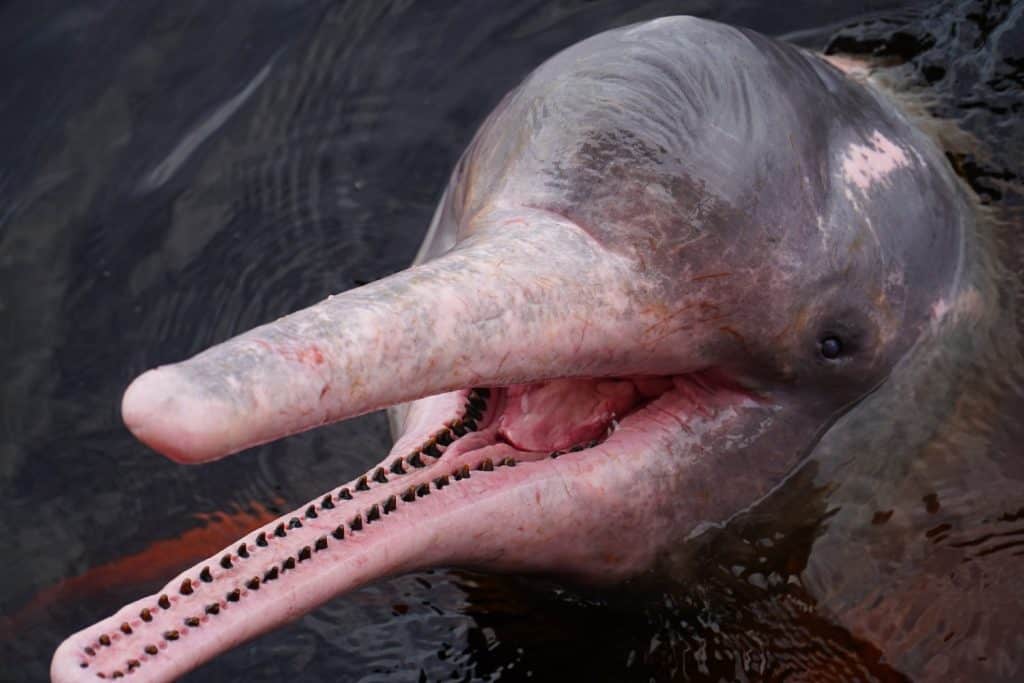
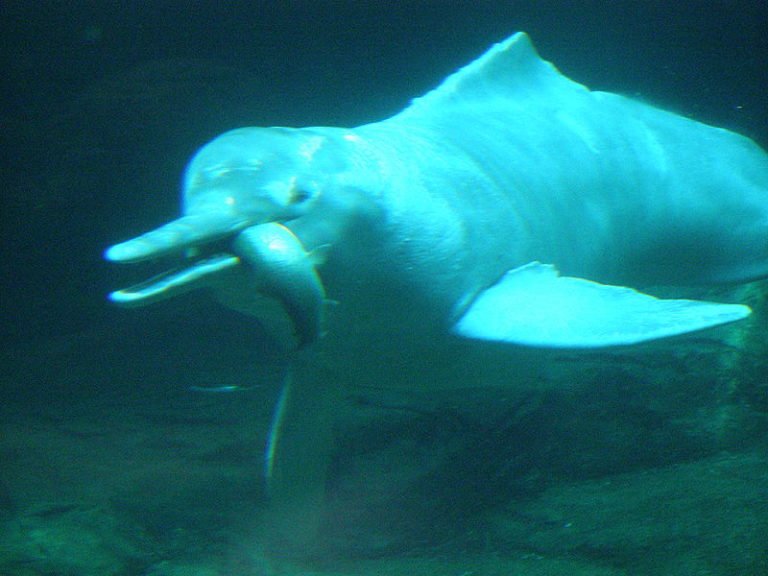
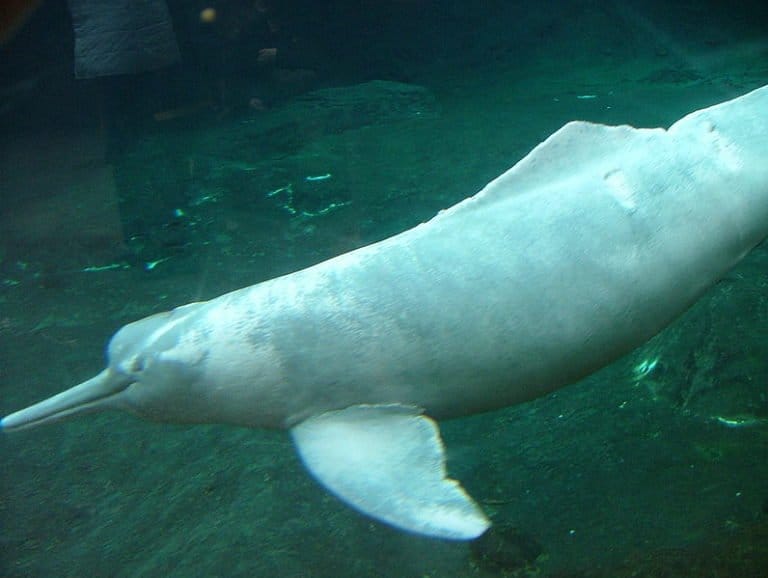
The pink river dolphin features a distinctive dolphin smile. They have rounded foreheads and long, slender beaks.
©COULANGES/Shutterstock.com
While other river dolphin species have dimorphism where females are larger than males, the opposite is true of Amazon River dolphins. Males can grow to be about 16% longer than females, weighing 55% more, and reaching in excess of 400 pounds (180 kg).
The animals have conical-shaped teeth that they use to catch small fish and other prey. The river dolphin has a long nose that can measure up to 23 inches long, and this is about four times longer than the nose of ocean dolphins. River dolphins have a two-chambered stomach, and they breathe by emitting air through a blowhole.
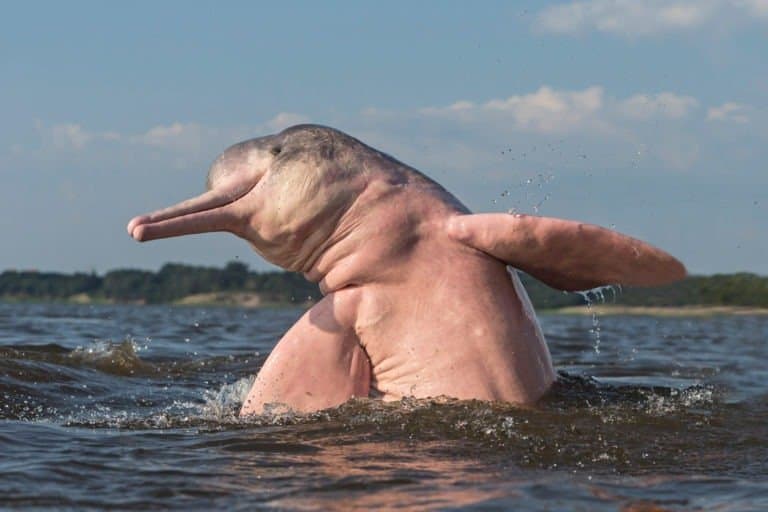
Pink dolphins swim with great precision. Because river dolphins are extremely flexible, they can maneuver around rocks, tree trunks, and other objects. They can also swim forward using one flipper while the other flipper paddles backward. This swimming method lets them make tight turns. River dolphins also like to swim upside down.
River dolphins have exceptionally large brains, and while dolphins are known for swimming in groups, river dolphins tend to spend more time alone or in small groups of two to four. You might see a bigger group of them in areas rich in food.
The Amazon River dolphin does not have a dorsal fin. Instead, it sports a modified hump. The animal navigates rivers and flooded areas using strong flippers and a tail fluke. Compared to oceanic dolphins, pink dolphins swim slowly. Their top speed is around 15 miles per hour. The reason for this is that their neck vertebrae are not fused. This gives them more flexibility, but it means that they cannot swim as fast. River dolphins can turn their heads without shifting their bodies.
River dolphins have unique ear adaptations that help them survive in their watery environment. They hear sound through their lower jaw, where fatty tissue conducts sound waves to the middle ear, bypassing the outer ear entirely. Their ears are also acoustically isolated from their skulls, with sinus pockets between them. The combination gives them enhanced directional hearing under the water. Dolphins use an organ called a melon to emit high-frequency clicks, producing biosonar that helps them orient themselves.
Dolphins rely on echolocation to the point that they can survive even if blinded. Echolocation lets them determine the size and shape of surrounding objects. in fact, river dolphins have small eyes and poor vision. Additionally, their eyes are on the sides of their heads, giving them two separate fields of view rather than the single forward-facing view humans have. Researchers believe that some types of pink dolphins are blind, while others just have extremely poor eyesight.
These dolphins, like their saltwater cousins, are friendly and curious about humans. This curiosity can be a problem, given their poor eyesight. Many are killed because they inadvertently come into contact with nets and fishing boats.
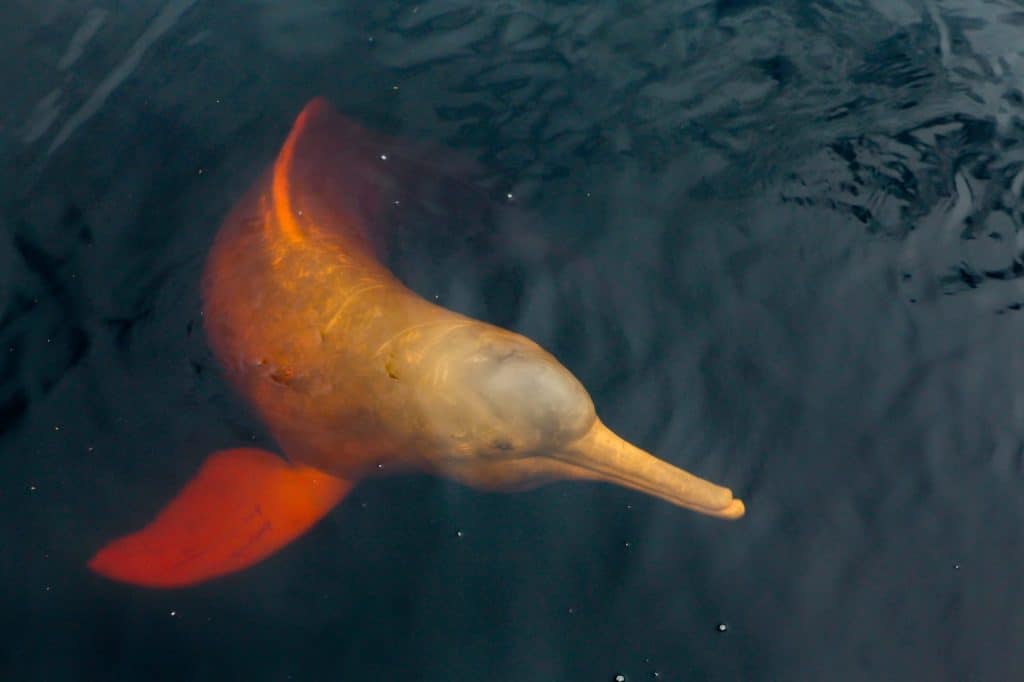
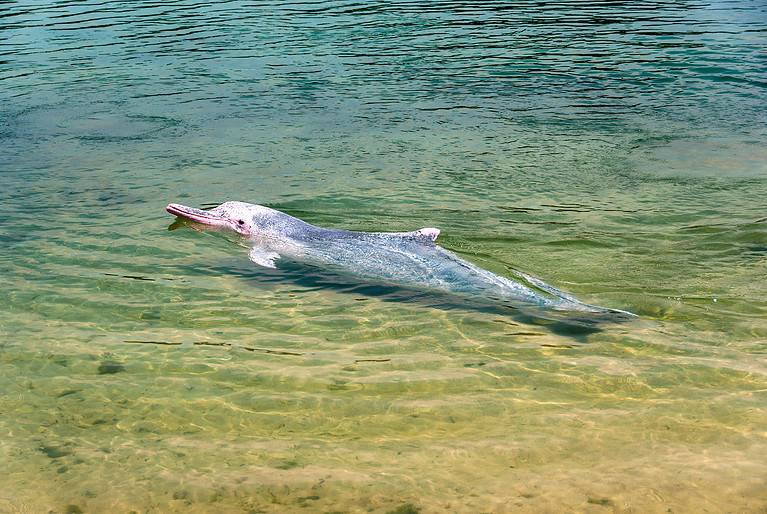
A rare pink dolphin “boto cor de rosa” swimming in the Negro River in the Brazilian Amazon.
©PARALAXIS/Shutterstock.com
Why Amazon River Dolphins Are Also Known as “Pink Dolphins”
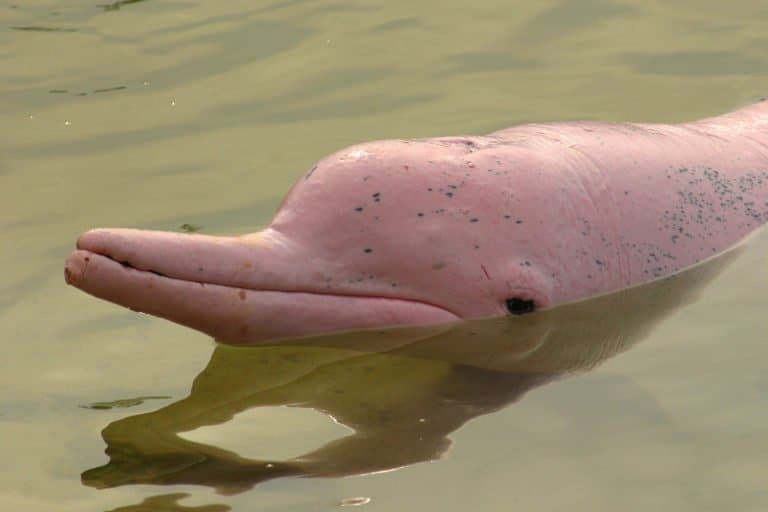
One of the defining features of Amazon River dolphins is that they often turn pink. Scientists are still researching the reason why, but a few theories stand out.
Amazon River dolphins often fight one another and leave significant amounts of scar tissue. It is hypothesized that this scar tissue turns pink, which is why older males tend to have the most distinctive pink coloration.
Amazon River dolphins live in rivers along the Amazon rainforest, which are often inundated with incredible amounts of rain. This high level of rainfall causes the muddy bottoms of rivers to turn a red/pink hue. Amazon River dolphins may have simply evolved to better blend in with their surroundings.
It is important to note that most Amazon River dolphins are born with gray tones, and males tend to become more pink as they age. In addition, this pink coloration typically covers parts of their body while areas of gray remain. It is hypothesized that males with more pink coloration are better able to attract mates.
Habitat
Amazon River dolphins live in freshwater areas, including lakes, enormous rivers, and small tributaries. As the Amazon is fed by large stretches of rainforest, it floods its banks every year for extended periods. During this period, Amazon River dolphins expand into the vast inland seas created in floodplains.
Pink dolphins can be found in Bolivia, Colombia, Ecuador, Brazil, Venezuela, and Peru. The Amazon River dolphin also lives in the Amazon and Orinoco rivers and in the Araguaia River.
Diet
Amazon River dolphins have teeth that are similar to the molar teeth that humans have. They are not picky about what they eat. The mammals will dine on turtles, shrimp, crabs, and more than 40 different species of fish, including piranhas.
Predators and Threats
Animals that prey on the river dolphin include large snakes, jaguars, and caimans. However, once dolphins have passed adolescence, they have few natural predators.
Human development and farming have had a major impact on the habitats of the river dolphin, disrupting the ecology of the waterways. Human fishing is also threatening the species. Overfishing is a problem because it decreases the food supply. The dolphins also get caught in the nets.
Pollution is another threat. Small gold mining operations cause mercury pollution, which enters dolphins’ bodies through the food chain. River dolphins eat a lot of catfish, which dwell on the bottom of waterways where mercury generally accumulates.
Amazon River dolphins are endangered. The Brazilian Institute of Environment and Renewable Natural Resources has taken steps to protect the dolphin species. They have made it illegal to kill the dolphins.
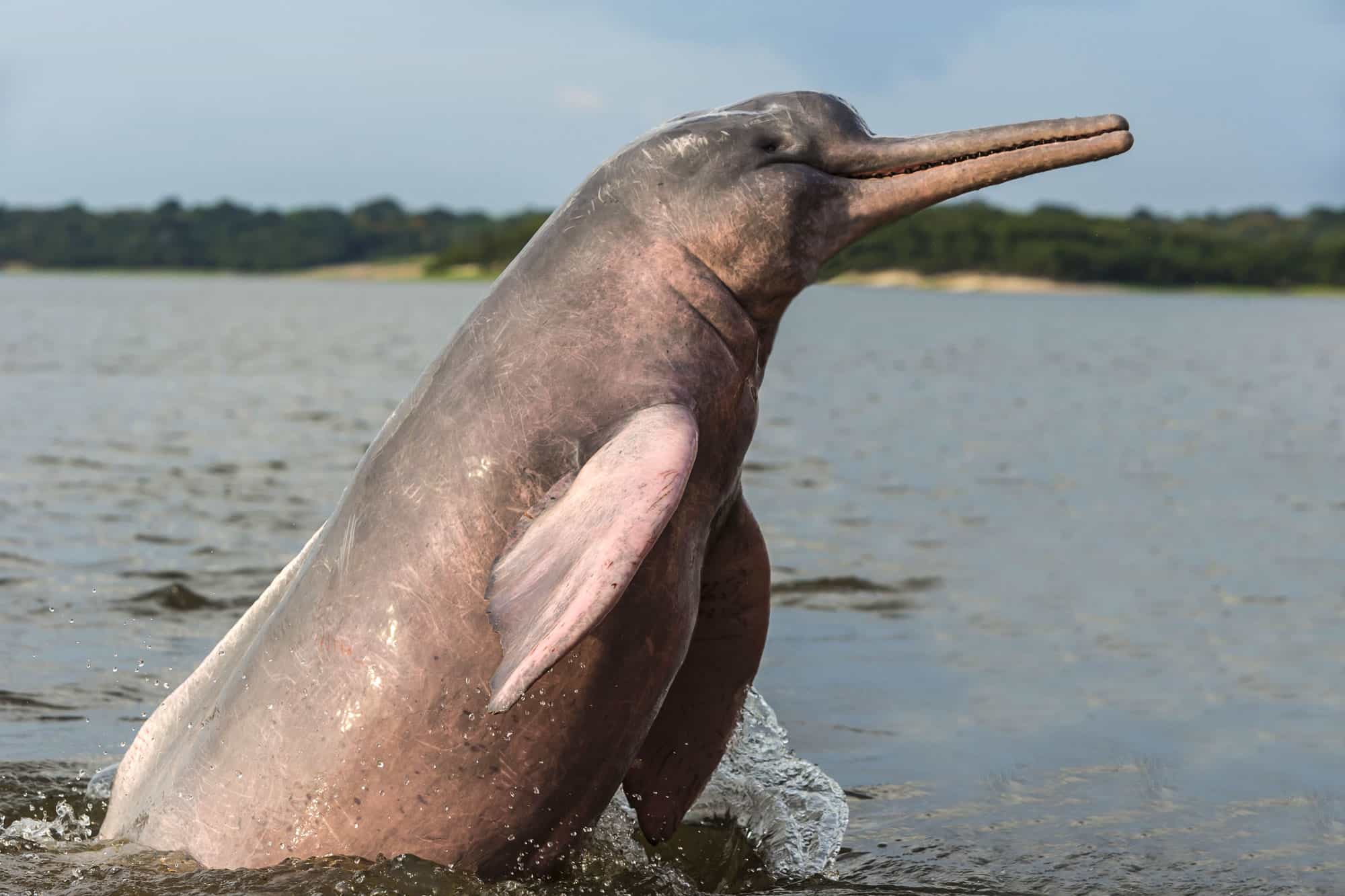
Pink dolphins swim in groups and are friendly and curious, interacting with humans frequently.
©iStock.com/Michel VIARD
Reproduction, Babies, and Lifespan
In South America, spring is the rainy season. During this time, vast acres of rainforest are flooded, turning into an enormous tree-covered sea. The water becomes deep enough for the river dolphins to swim amongst the trees. Mating season occurs when the water recedes, and the male and female dolphins are restricted to the river channels. The dolphin species is polygamous, meaning males mate with several females each year. However, females mate every two to three years.
Female river dolphins are more attracted to males that are a brighter shade of pink. To impress the females, male river dolphins smack the water with bunches of grass or branches in their mouths. Sometimes, they hold up a turtle to capture the attention of a female. When a female river dolphin becomes pregnant, she will carry the calf for 11 to 15 months. The animal species gives birth to just one calf. After a baby dolphin is born, it will nurse for over a year. Baby dolphins are often around 30 inches long, and they weigh around 22 pounds at birth. Adult female dolphins usually give birth to their calves from July to September. Once they are born, babies remain close to their mothers for protection.
Sexual maturity is based on the dolphin’s size. When a female reaches 5.5 feet in length, she becomes sexually mature. Males reach this stage once they are 7 feet long. In the wild, river dolphins live for an average of 12 to 18 years, but they can live for as long as 30 years.
Population
The Amazon River dolphin population is difficult to estimate because the dolphins live in remote, muddy waters and lack a distinctive dorsal fin, making them harder to spot. While their population is thought to be over 10,000, river dolphins are endangered.
Amazon River Dolphin (Pink Dolphin) Pictures
View all of our Amazon River Dolphin (Pink Dolphin) pictures in the gallery.

COULANGES/Shutterstock.com
Sources
- David Burnie, Dorling Kindersley (2011) Animal, The Definitive Visual Guide To The World's Wildlife / Accessed December 10, 2008
- Tom Jackson, Lorenz Books (2007) The World Encyclopedia Of Animals / Accessed December 10, 2008
- David Burnie, Kingfisher (2011) The Kingfisher Animal Encyclopedia / Accessed December 10, 2008
- Richard Mackay, University of California Press (2009) The Atlas Of Endangered Species / Accessed December 10, 2008
- David Burnie, Dorling Kindersley (2008) Illustrated Encyclopedia Of Animals / Accessed December 10, 2008
- Dorling Kindersley (2006) Dorling Kindersley Encyclopedia Of Animals / Accessed December 10, 2008
- David W. Macdonald, Oxford University Press (2010) The Encyclopedia Of Mammals / Accessed December 10, 2008