


S
Species Profile

Snapping Turtle

Chelydra serpentina

Big bite, bigger ecosystem role.
Willy Logan / Creative Commons

Snapping Turtle Distribution

Click a location to explore more animals from that region

Invasive Species
Loading map...

Found in 45 states/provinces

Snapping Turtle in the zoo

At a Glance

Wild Species
Also Known As Snapping turtle, Snapper, North American snapping turtle, Freshwater snapping turtle
Diet Omnivore
Activity Cathemeral+
Lifespan 30 years
Weight 34 lbs
Status Least Concern
Did You Know?

Size: adult carapace (upper shell) typically ~20-35 cm; large individuals reach ~47 cm (Ernst & Lovich, 2009).

Scientific Classification

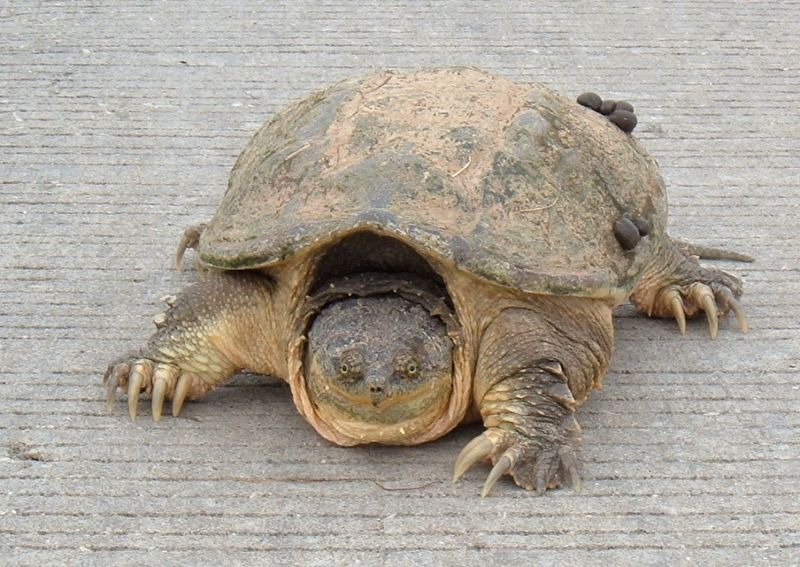
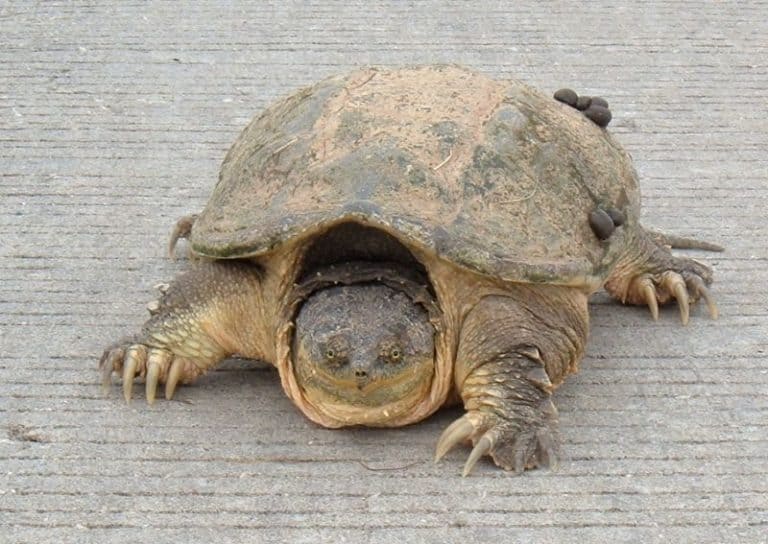
A large, freshwater turtle known for its powerful bite, long tail, and defensive behavior on land; primarily aquatic and widespread across much of North America.

Kingdom
Animalia
Phylum
Chordata
Class
Reptilia
Order
Testudines
Family
Chelydridae
Genus
Chelydra
Species
Chelydra serpentina

Distinguishing Features

  • Large head with strong hooked jaws
  • Long, thick tail often as long as the shell
  • Rough carapace (shell) without the pronounced ridges typical of alligator snapping turtles
  • Often defensive and quick to bite when handled on land; typically shy in water

Physical Measurements

Males and females differ in size

Length
1 ft 6 in (1 ft 2 in – 1 ft 12 in)
Weight
29 lbs (15 lbs – 77 lbs)
13 lbs (6 lbs – 31 lbs)
Tail Length
6 in (4 in – 7 in)
Top Speed
1 mph
swimming

Appearance

Primary Colors
Secondary Colors
Skin Type Thick, rough, pebbled skin with tubercles; keratinized scutes; long, saw-toothed tail with dorsal keels.
Distinctive Features
  • Adult straight carapace length commonly ~20-36 cm; large individuals may exceed ~45 cm (Ernst & Lovich, 2009).
  • Typical adult mass ~4.5-16 kg; exceptionally larger individuals reported (Ernst & Lovich, 2009).
  • Long muscular tail about carapace-length, with 3 prominent dorsal keels (field ID hallmark).
  • Carapace usually low-profile with weak keels; rear margin often serrated in juveniles, smoother with age.
  • Large head with strong hooked jaws; powerful bite; neck retracts only partly (cannot fully withdraw).
  • Primarily aquatic in ponds, lakes, marshes, rivers; often rests on bottom and ambushes or scavenges (Ernst & Lovich, 2009).
  • Defensive on land: may hiss, lunge, and strike when handled; in water typically avoids confrontation and flees (Ernst & Lovich, 2009; USGS species accounts).
  • Opportunistic omnivore and important scavenger/predator: fish, amphibians, invertebrates, carrion, and aquatic vegetation (Ernst & Lovich, 2009).
  • Identification vs alligator snapping turtle (Macrochelys temminckii): lacks 3 towering shell ridges and worm-like tongue lure; head generally narrower and shell less massively spiked (Ernst & Lovich, 2009).
  • Longevity: commonly >30 years; documented to reach several decades, with some reports >50 years (Ernst & Lovich, 2009; NatureServe reports).

Sexual Dimorphism

Males are generally larger, with longer, thicker tails and the cloacal opening positioned beyond the carapace edge. Females tend to be smaller with shorter tails and the vent nearer the shell margin (Ernst & Lovich, 2009).

  • Larger body size and more massive head/neck overall.
  • Tail longer and thicker at base; cloaca typically posterior to carapace edge.
  • Often higher foreclaw robustness used during mating grasping.
  • Smaller average size; body proportionally rounder when gravid.
  • Tail shorter and thinner; cloaca at or near carapace margin.
  • Often shows broader pelvic opening relative to size for egg-laying.

Did You Know?

Size: adult carapace (upper shell) typically ~20-35 cm; large individuals reach ~47 cm (Ernst & Lovich, 2009).

Mass: commonly 4.5-16 kg; large adults can exceed 30 kg (Ernst & Lovich, 2009).

Longevity: often 30+ years in the wild; individuals can surpass 50 years (Ernst & Lovich, 2009).

Reproduction: nests on land; typical clutch ~20-40 eggs, with reported extremes from single digits to >80 in some populations (Ernst & Lovich, 2009).

Diet: an opportunistic omnivore-takes fish, amphibians, crayfish/insects, carrion, and aquatic plants-helping recycle nutrients as a scavenger (Ernst & Lovich, 2009).

Cold-season strategy: can remain submerged for long periods during winter dormancy, using very low metabolism and aquatic gas exchange (reported broadly for Chelydra in herpetological syntheses, incl. Ernst & Lovich, 2009).

Unique Adaptations

  • Reduced plastron (undershell): a relatively small, cross-shaped plastron leaves much of the limbs exposed-improving mobility and strike reach compared with many heavily armored turtles (family-level trait expressed strongly in Chelydra).
  • Long neck and rapid strike: the neck folds into an S-curve, enabling a fast forward lunge; paired with strong jaw-closing muscles for a powerful bite.
  • Rugged, saw-toothed tail: long tail with dorsal tubercles helps stabilize swimming and is a key field mark (especially in juveniles and subadults).
  • Aquatic respiration support: can obtain some oxygen while submerged via gas exchange through moist linings (including cloacal/pharyngeal surfaces), aiding long submergence during cold-water dormancy (reported for snapping turtles in herpetological literature).
  • Camouflage and mud tolerance: algae-stained shells and a willingness to bury into soft substrate make it hard to detect in weedy, turbid wetlands.
  • Broad trophic role: dentition/jaw structure and generalized gut allow a true omnivorous diet-unusual flexibility that supports survival in disturbed habitats.

Interesting Behaviors

  • Aquatic vs. terrestrial temperament: in water it often slips away or stays still; on land it frequently hisses, lunges, and snaps when approached-especially while traveling to nest sites.
  • Ambush-and-sit feeding: may lie motionless on the bottom and strike rapidly at passing prey; also readily scavenges carrion.
  • Overland migrations: adults (especially gravid females) can travel surprisingly far between wetlands and nesting areas, crossing roads and uplands.
  • Nesting behavior: females dig flask-shaped nests in open, well-drained substrates (sand/gravel/soil), typically in late spring-early summer across much of the range; hatchlings emerge later in summer/fall or may overwinter in the nest depending on climate.
  • Basking is less showy than many turtles: it may bask at the surface or on logs briefly, but often relies more on remaining submerged than prolonged aerial basking.
  • Intraspecific interactions: juveniles are more vulnerable and secretive; large adults can dominate shallow feeding areas and may show aggressive encounters during crowding at food sources.

Cultural Significance

The common snapping turtle (Chelydra serpentina) is respected as a wetland scavenger but feared for defensive snaps on land. It appears in food traditions, conservation messages about wetlands and road crossings, and is taught apart from the alligator snapping turtle.

Myths & Legends

Turtle Island: In Haudenosaunee and other Northeastern stories, Sky Woman falls to a water world. Animals bring earth to a turtle's back, which grows into the land—often not species-specific.

In Anishinaabe clan tradition of the Great Lakes, the Common Snapping Turtle (Chelydra serpentina) stands for long life, persistence, and steady ties to water and land, shown by seasonal moves and long life in stories.

Early European-American tales called the Common Snapping Turtle (Chelydra serpentina) a fierce marsh guard; its name and nicknames grew from warnings told to children to avoid its jaws when it crossed land in summer.

Conservation Status

LC Least Concern

Widespread and abundant in the wild.

Population Stable

Protected Under

  • Canada: Species at Risk Act (SARA) - listed as Special Concern (Snapping Turtle, Chelydra serpentina)
  • Ontario (Canada): Endangered Species Act, 2007 - listed as Special Concern
  • Various U.S. states and Canadian provinces: regulated harvest seasons/bag limits or local protections for snapping turtles

Life Cycle

Birth 30 hatchlings
Lifespan 30 years

Lifespan

In the Wild
20–50 years
In Captivity
25–47 years

Reproduction

Mating System Promiscuity
Social Structure Solitary
Breeding Pattern Transient
Fertilization Internal Fertilization
Birth Type Internal_fertilization

Solitary adults meet briefly in spring; males attempt to mount and copulate with multiple females, and genetic studies show frequent multiple paternity. Females can store sperm ~2-3 years, lay about 20-40 eggs, and provide no parental care after nesting.

Behavior & Ecology

Social Bale Group: 1
Activity Cathemeral, Nocturnal
Diet Omnivore fish and carrion
Seasonal Hibernates

Temperament

Predominantly non-social; interactions mostly limited to mating, nesting areas, or shared refuges (Ernst & Lovich 2009).
Defensive and often aggressive when handled on land (lunging/biting); typically more tolerant underwater (Ernst & Lovich 2009; Harding 1997).
Intraspecific aggression can occur at high densities (e.g., in captivity or constrained habitats), including biting and dominance over food items (Ernst & Lovich 2009).
Seasonal variation: movements/activity often increase during warm months; overwintering may involve communal tolerance rather than cooperation (Ernst & Lovich 2009).
Life history linked to low sociality: delayed maturity commonly ~8-20 years; longevity commonly multiple decades (Ernst & Lovich 2009).

Communication

Hissing/forceful exhalation when threatened or handled Harding 1997; Ernst & Lovich 2009
Chemical cues for mate finding and reproductive condition Pheromonal/olfactory cues inferred for aquatic turtles; Ernst & Lovich 2009
Tactile signaling during courtship/copulation Mounting, contact, positioning) (Ernst & Lovich 2009
Visual postures and threat displays Head extension, gaping) primarily defensive, not social bonding (Harding 1997

Habitat

Biomes:
Freshwater Wetland Temperate Forest Temperate Grassland Boreal Forest (Taiga)
Terrain:
Riverine Valley Plains Coastal Muddy Sandy
Elevation: Up to 6561 ft 8 in

Ecological Role

Freshwater mesopredator and scavenger

helps regulate populations of aquatic invertebrates, fish, and amphibians (predation pressure focused on vulnerable individuals) scavenging removes carrion from waterways, potentially reducing localized organic loading and recycling nutrients links aquatic and riparian food webs by consuming both animal prey and plant material and moving nutrients across habitats

Diet Details

Main Prey:
Fish Amphibians Aquatic invertebrates Mollusks Aquatic insects and larvae Worms and leeches Small reptiles Waterfowl and other birds Small mammals Carrion +4
Other Foods:
Aquatic macrophytes Filamentous algae Fallen fruits and seeds Detrital plant matter

Human Interaction

Domestication Status

Wild

Chelydra serpentina is a wild freshwater turtle with no history of true domestication or breeding for tame traits; captive breeding happens but turtles still defend themselves. Humans harvest them for meat, control or move nuisance turtles, kill many on roads during nesting, protect them by laws in some places, and sell a few hatchlings as pets.

Danger Level

High
  • Severe bite and laceration risk when handled; powerful jaws and rapid strike on land (handling injuries are the typical context, not predatory attacks)
  • Measured bite-force values reported for this species (e.g., laboratory measurements in comparative turtle bite-force studies) indicate strong jaw-closing forces capable of significant tissue damage (e.g., Herrel et al., 2002, bite-force comparisons in turtles)
  • Zoonotic disease risk typical of reptiles, especially Salmonella spp. transmission via contact with the animal, water, filters, or contaminated surfaces (basis for U.S. federal restrictions on small turtle sales)
  • Injury risk during relocation from roads or yards: defensive striking, scratching, and stress-related thrashing; improper tail handling can injure the turtle and increase handler risk

As a Pet

Not Suitable as Pet

Legality: Rules vary. For Common Snapping Turtle (Chelydra serpentina), U.S. law since 1975 restricts interstate sale of turtles with shell under 10.16 cm due to salmonella. States/provinces often require permits or ban keeping them.

Care Level: Expert Only

Purchase Cost: $50 - $250
Lifetime Cost: $3,000 - $20,000

Economic Value

Uses:
Food (subsistence/commercial harvest) Wildlife management (regulated take; nuisance control/relocation) Pet trade (limited; often discouraged/restricted) Research/education (comparative physiology, ecology, toxicology/contaminant studies)
Products:
  • Meat (sold/consumed in some regions; harvest often regulated)
  • Live animals (limited trade, typically juveniles; legality varies)

Relationships

Related Species 5

Central American Snapping Turtle Chelydra rossignonii Shared Genus
South American Snapping Turtle Chelydra acutirostris Shared Genus
Alligator Snapping Turtle Macrochelys temminckii Shared Family
Apalachicola Alligator Snapping Turtle Macrochelys apalachicolae Shared Family
Suwannee Alligator Snapping Turtle Macrochelys suwanniensis Shared Family

Ecological Equivalents 4

Animals that fill a similar ecological role in their ecosystem

Alligator Snapping Turtle Macrochelys temminckii Closest similar turtle in North America: a highly aquatic, bottom-dwelling ambush predator and scavenger in freshwater. Like Chelydra serpentina, it uses sit-and-wait feeding and eats fish, invertebrates, amphibians, and carrion, but is more fish-oriented and larger.
Spiny Softshell Turtle Apalone spinifera Overlaps in rivers, lakes, and reservoirs and in aquatic foraging, acting as opportunistic aquatic predators of fish and invertebrates. Apalone spinifera is more streamlined and actively forages, but both eat benthic prey and carrion.
Slider Trachemys scripta Trachemys scripta shares freshwater shoreline, basking, and nesting sites with Chelydra serpentina. T. scripta becomes more herbivorous as an adult; C. serpentina remains omnivorous, consuming live prey and carrion and thereby shaping pond and lake communities.
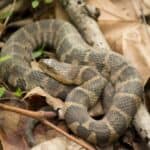
Northern Water Snake
Northern Water Snake Nerodia sipedon Although not a turtle, it behaves like one in many freshwater areas: a semi-aquatic hunter of fish and frogs in the littoral zone, where Chelydra serpentina also forages and eats dead animals.

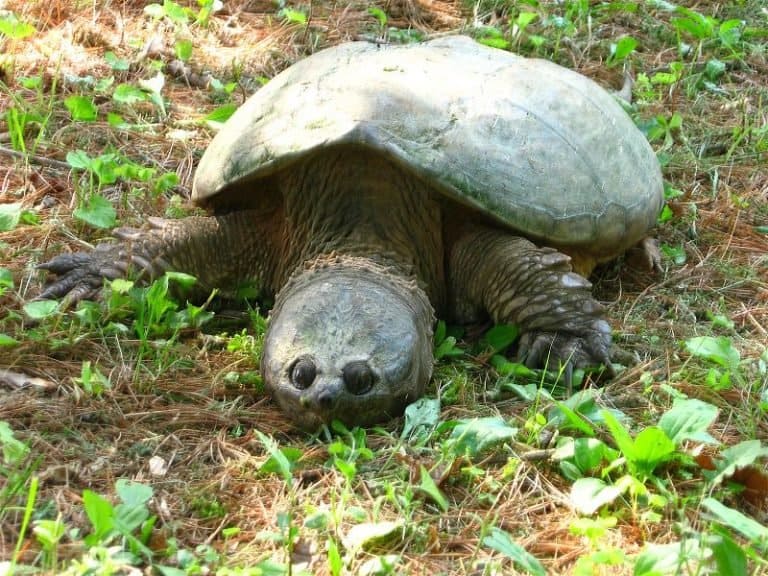
Unlike other turtles, a common snapping turtle is not able to fit its whole body into its shell.

Snapping turtles typically can live to be 30-45 years old in the wild, and alligator snapping turtles can live over a hundred years! Their living area spreads from southeastern Canada all the way down through the central and eastern parts of the United States and into the state of Florida. A snapping turtle’s shell can grow up to 20 inches in length. These turtles are omnivores, eating both animal and plant life. Adult turtles are aggressive and have very few predators.

5 Incredible Snapping Turtle Facts!

  • A snapping turtle in captivity can live up to 50 years.
  • These turtles are nocturnal so they hunt at night.
  • The mouth of a snapping turtle is shaped like the hooked beak of a bird.
  • These turtles live in lakes, ponds, canals, and rivers.
  • Snapping turtles are solitary (live alone) most of the time.
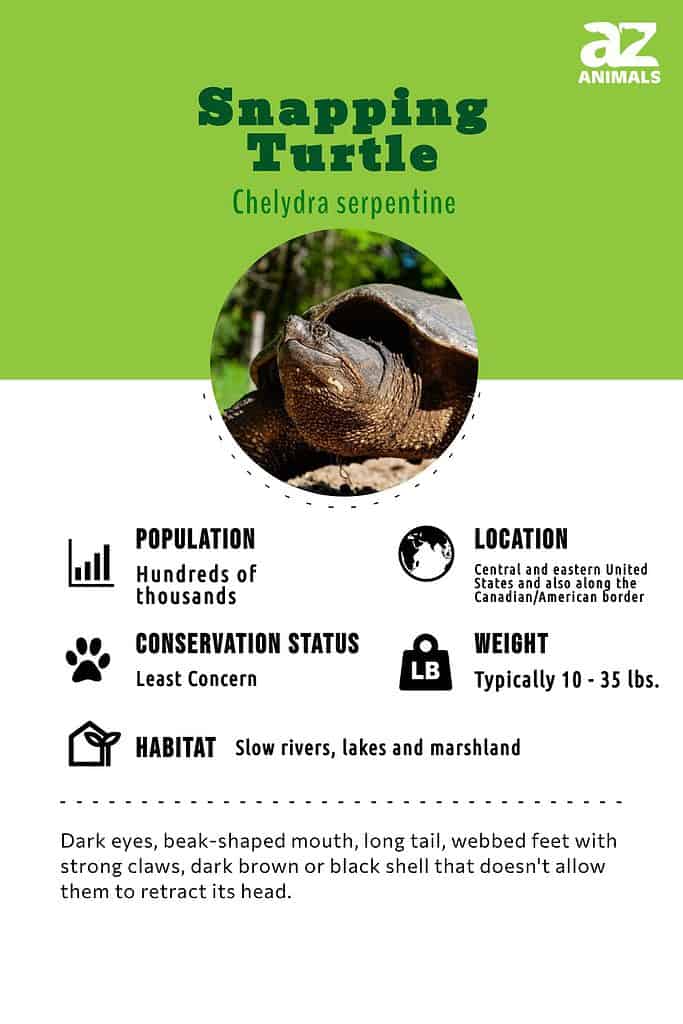
Scientific Name

A snapping turtle goes by other names including snapper and Tortuga Lagarto. In English, Tortuga Lagarto translates to lizard turtle. The scientific name for this turtle is Chelydra serpentine. While the first part of the name refers to its family, the Latin word ‘serpentine’ refers to its serpent, or snake-like, behavior. It can move its head and neck in a way that’s similar to a snake. It is in the class Reptilia.
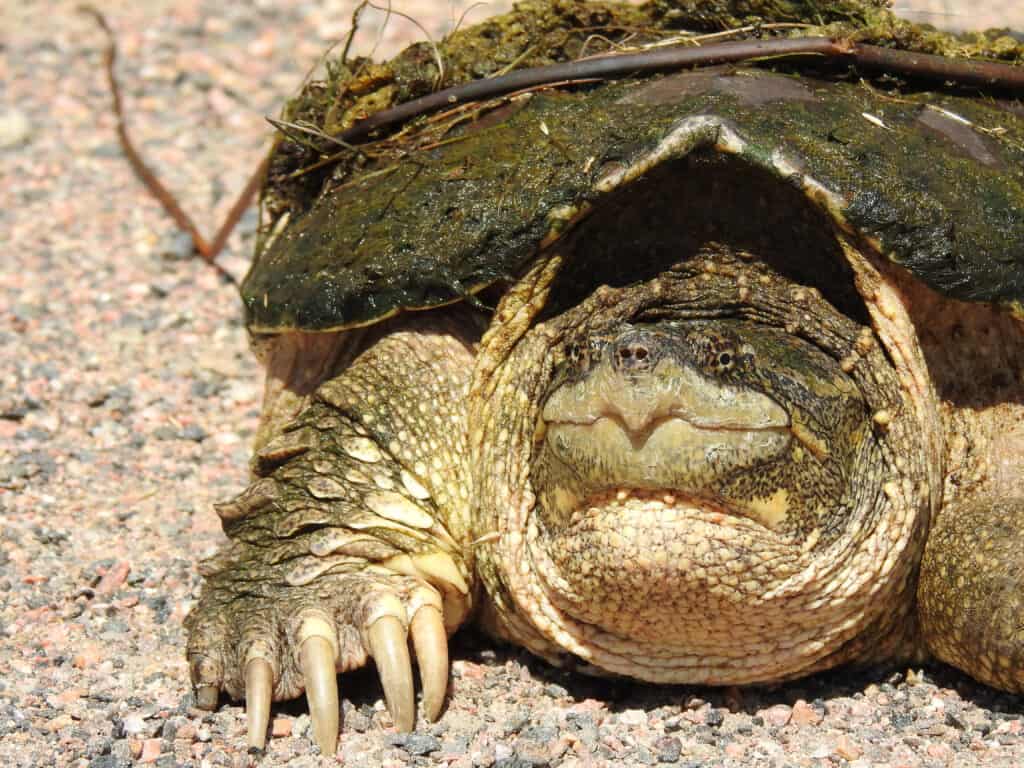
The Snapping Turtle’s scientific name is Chelydra serpentine, and the alligator snapping turtle’s is Macrochelys temminckii.

History and Evolution

The history of these members of the family Chelydridae goes back really far! Generally thought to have evolved 90 million years ago, these reptiles were walking around with dinosaurs making them one of the very oldest types of turtles! Even the way they look is prehistoric, especially the alligator snapping turtle!

Tens of millions of years ago, snappers ventured into Eurasia and remained up until a couple of million years ago. They died off and disappeared everywhere except for North America, where we see them today. This ancient species has seen a lot and endured a tremendous amount of change! It is thought that they are even the predecessor for four out of five turtle species that remain alive today.

Two Types of Snapping Turtles

There are two types of snapping turtles. One is the common snapping turtle while the other is the alligator snapping turtle. The alligator snapping turtle (Macrochelys temminckii) is also a member of the Chelydridae family.

  • Common Snapping TurtleChelydra serpentine is the scientific name for the common snapping turtle.
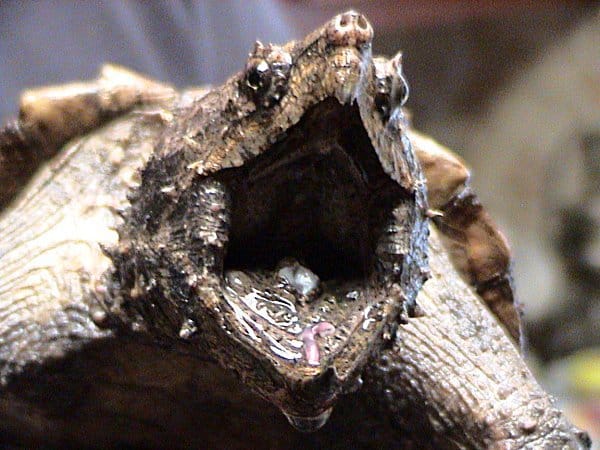
  • Alligator Snapping TurtleMacrochelys temminckii is the scientific name for this turtle. They differ from common snappers with heavily-ridged shells, beaked mouths, and their primary location being in freshwater leading to the Gulf of Mexico.
  • Suwannee Alligator Snapping Turtle – The Macrochelys suwanniensis is a divergent species from the alligator snapper and lives only in the Suwannee River Basin.
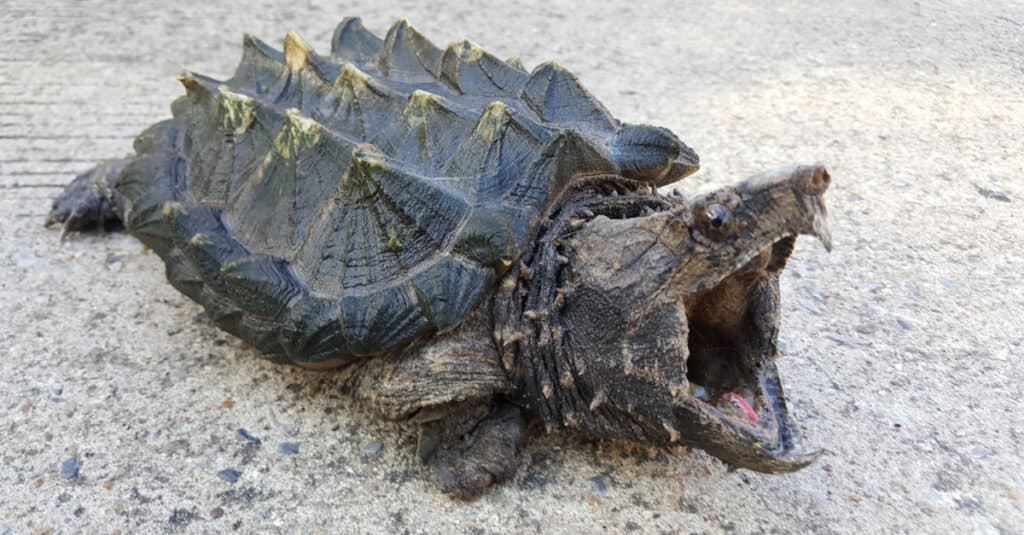
Alligator Snapping Turtle

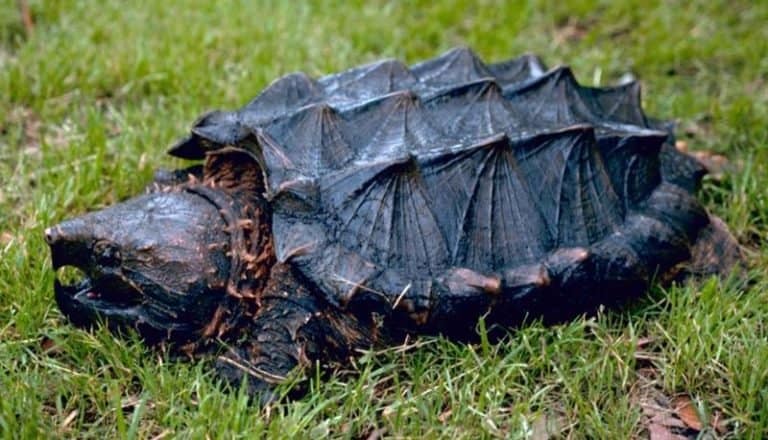
Alligator Snapping Turtles have ridged shells and beaked mouths.

Appearance and Behavior

These turtles have two dark eyes and a mouth shaped like a hooked beak, along with four legs and webbed feet. Each foot of these turtles features five strong claws. The skin of this turtle is covered in rough bumps called tubercles.

The shell or carapace, of a snapping turtle can be dark brown or black. Out of the two types of snapping turtles, the ridges on the shell of an alligator snapping turtle are more visible than those on the shell of a common snapping turtle. Though this turtle’s shell can measure as much as 20 inches in length, it’s usually between eight and 18 inches long. If you lined up eight golf tees end to end, they would equal close to the length of a snapping turtle’s shell. The tail of a snapping turtle has ridges on its surface and usually measures as long as its shell.

The average weight of an adult snapping turtle ranges from 10 to 35 pounds. Picture a medium-sized dog playing in your yard. A 35-pound snapping turtle weighs about as much as an adult Spaniel Alternatively, a 10-pound snapping turtle weighs about as much as the average-sized adult house cat. The largest snapping turtle on record is an alligator snapping turtle weighing 249 pounds. That’s as heavy as two and a half toilets!

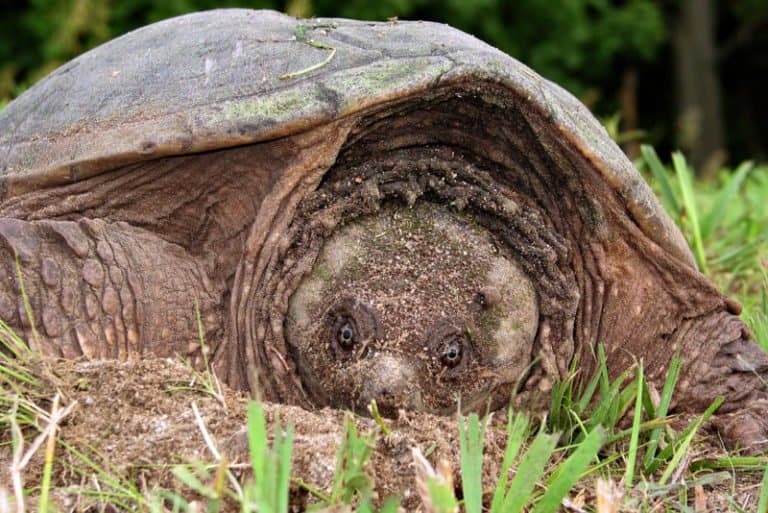
The underside of this turtle features a strong plate called a plastron. This plate is not large enough to allow a snapping turtle to retreat completely into its shell. So, disappearing into its shell (like other turtles) is not an option when a predator appears in front of this turtle.

Instead, if this turtle is in the water when a predator appears, it will swim away and hide near the bottom of a pond or river. But most of the time, this turtle acts in an aggressive way toward any predator especially when it’s moving around on land. They use their claws, sharp hooked beak, and powerful jaws to attack a predator.

Its neck and head have a large range of movement and it can move quickly against a threatening animal. This animal is definitely aggressive and is sometimes described as vicious when confronting predators.

Of course, being able to move its head and neck around easily can help this turtle to capture prey as well.

These turtles are solitary except during the mating season. The number of snapping turtles living near one another in a particular area depends on the amount of food available there.
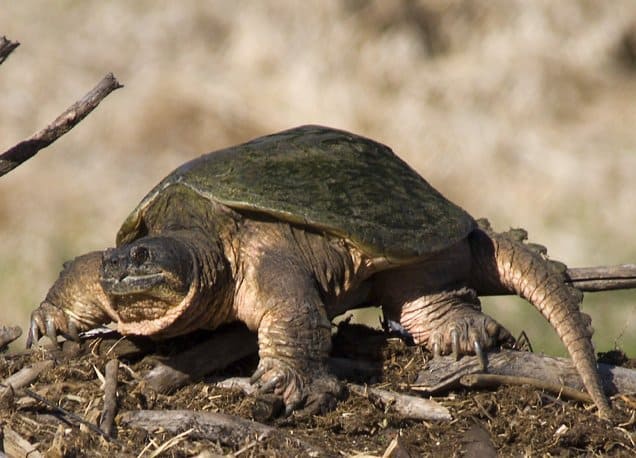
The tail of a snapping turtle has ridges on its surface and usually measures as long as its shell.

Habitat

These turtles can be found across a large part of North America. They live in areas of southeastern Canada down through the central and eastern parts of the United States. They live throughout the state of Florida as well.

Most snapping turtles live in a temperate climate – not too cold or too hot. However, some of these turtles do live in Canada where it gets very cold. These turtles actually hibernate for five or six months. They bury themselves in the mud until the warm weather months arrive once again.

These turtles live in streams, lakes, rivers, ponds, and other bodies of water. They spend most of their time in the water except during mating season.

These turtles have strong legs and webbed feet making them excellent swimmers. They may retreat to the muddy bottom of a pond or river when threatened. However, they are sometimes found sunning themselves on a fallen log in a pond or creek.
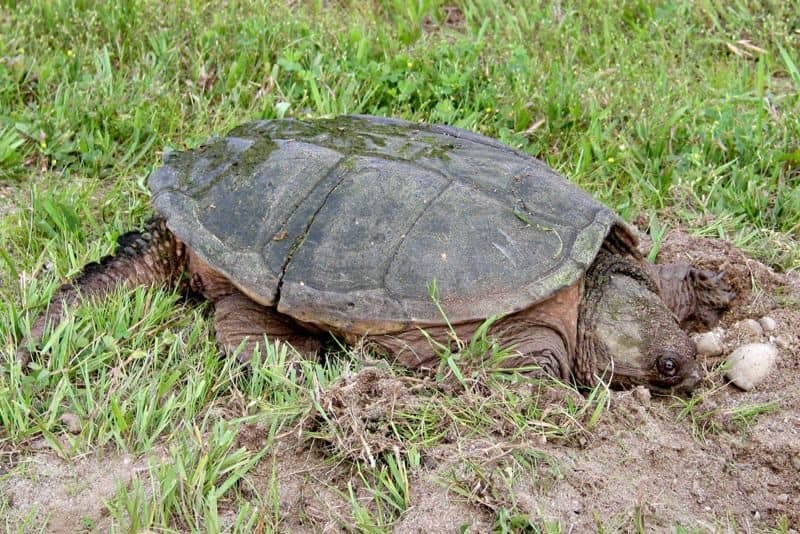
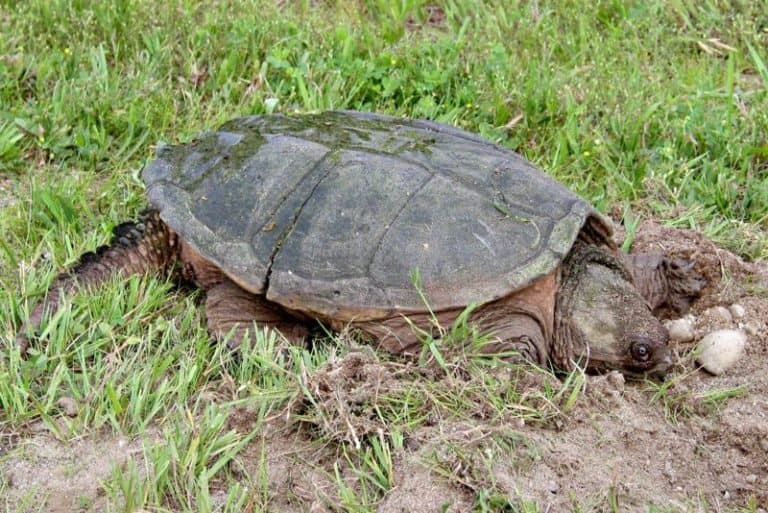
Snapping Turtle on grass

Snapping Turtles live in areas of southeastern Canada down through the central and eastern parts of the United States.

Diet

What do these turtles eat? Snapping turtles are omnivores, so they eat both animals and plants. Some of their prey include frogs, insects crayfish, dead rodents, fish, ducks, and vegetation growing in the water. Their powerful jaws allow these turtles to eat many types of animals and plants.

A common snapping turtle may sneak up on a duckling swimming in a lake and pull it under the water to eat it. Or it could dart after a frog in the water and capture it.

The alligator snapping turtle has a tongue it can wiggle like a worm. The turtle hides in the vegetation and wiggles its tongue. A fish approaches the hidden turtle thinking it’s found a worm, then the turtle grabs the fish and eats it. Snapping turtles can also feel vibrations in the water around them allowing them to detect prey. For a complete analysis of their diet, give our ‘What Do Snapping Turtles Eat?’ page a read!”
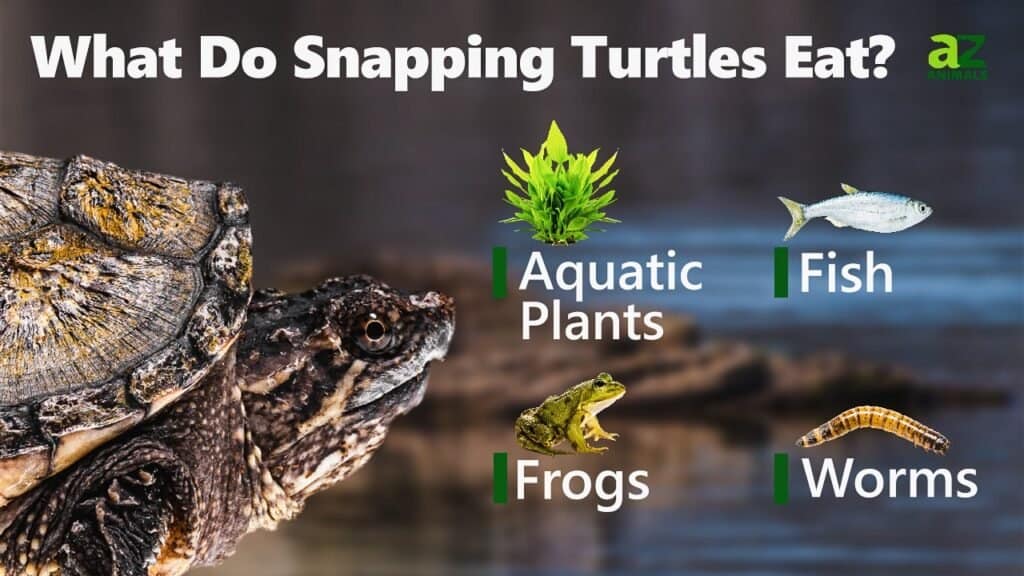
What Do Snapping Turtles Eat
Snapping turtles are herbivores that eat anything from aquatic plants to worms.

Predators and Threats

An adult turtle with its aggressive nature and powerful jaws doesn’t have many predators. Although, these turtles may be eaten by a larger turtle.

Humans are actually a threat to snapping turtles. Some humans capture these turtles to eat them or take young turtles to sell as pets.

Unlike adult turtles, turtle eggs and babies are vulnerable to many predators. Raccoons, skunks, foxes, largemouth bass, snakes, crows, and Great Blue herons all eat eggs and very young turtles.

The existence of these turtles is threatened by water pollution and they are suffering from the loss of habitat due to land clearing and construction. The official conservation status of these turtles, according to the International Union for the Conservation of Nature (IUCN), is threatened.
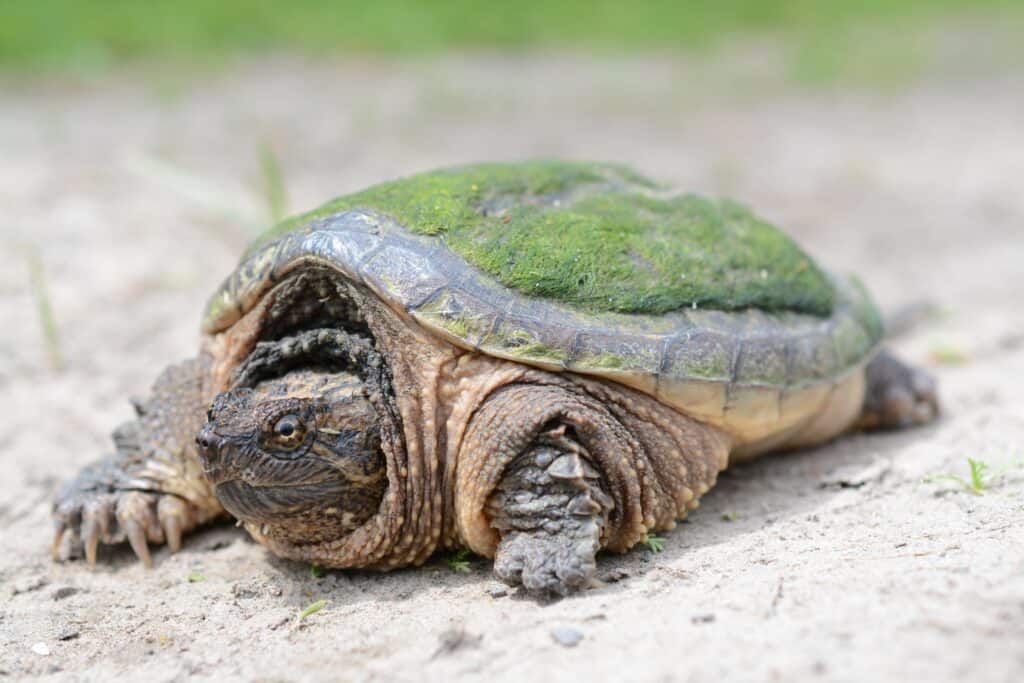
Snapping Turtles are threatened by water pollution and they are suffering from the loss of habitat due to land clearing and construction.

Reproduction, Babies, and Lifespan

The mating season for this turtle goes from April to November. A male turtle uses his sense of smell to find a female to mate with. They communicate with one another using leg movements.

A few weeks later, a pregnant female moves onto land and digs a hole on the sandy shore using her legs and claws. She lays her eggs in the hole. A female can lay a group, or clutch, of about 10 to 80 eggs. They hatch in about 80 to 90 days. These turtles lay a lot of eggs because many of the baby snapping turtles don’t make it to adulthood.

One of the reasons not many baby turtles survive is because the female does not stay with the nest of eggs. She goes back into the water almost immediately and the eggs are left alone. The eggs are buried in the sand which is their only protection against predators.

Oftentimes, there are a few eggs in the nest that doesn’t even hatch. Also, many turtle eggs are discovered by predators and eaten. A predator such as a fox or a raccoon can smell the presence of turtle eggs in the ground.

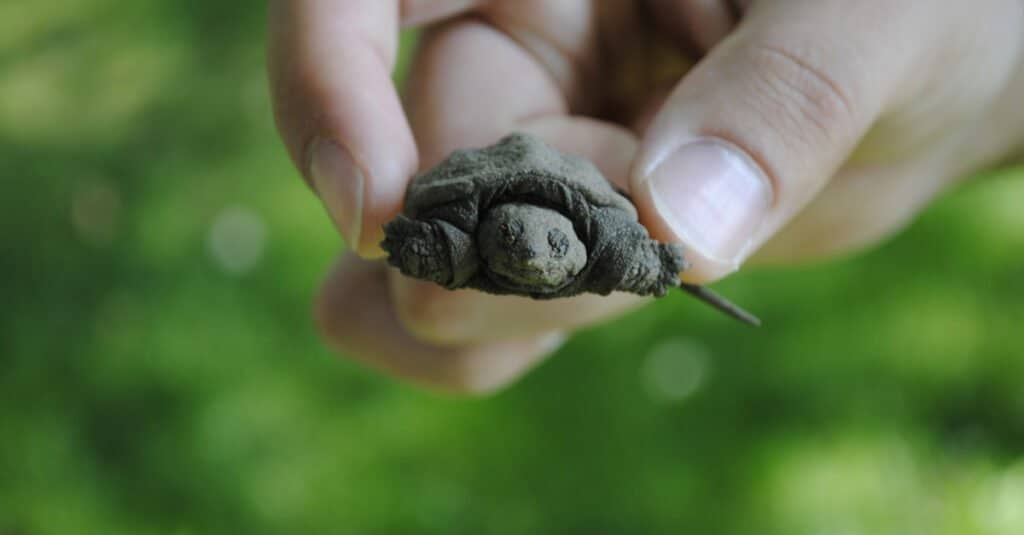
When the eggs hatch, the baby turtles (also known as hatchlings) crawl out. A hatchling is about the same size as a quarter. After coming out of their eggs, the hatchlings immediately crawl toward a nearby pond or river. They have soft shells when they hatch so they are still very vulnerable to predators as they move toward the water.

Once they enter the water, they are on their own to find food and shelter. Turtle hatchlings find small pieces of vegetation and insects to eat. But, as they grow, they are able to eat larger prey. Also, a young turtle’s shell gets harder as it grows older.

These turtles can live to be 30 years old in the wild and live to the age of 50 in captivity. A wild turtle may be eaten by a larger turtle, captured by a human, or even killed while trying to cross a road. In short, a wild turtle faces more threats than one living in the safety of a zoo or wildlife conservation park. The oldest alligator snapping turtle in captivity lived for 150 years!
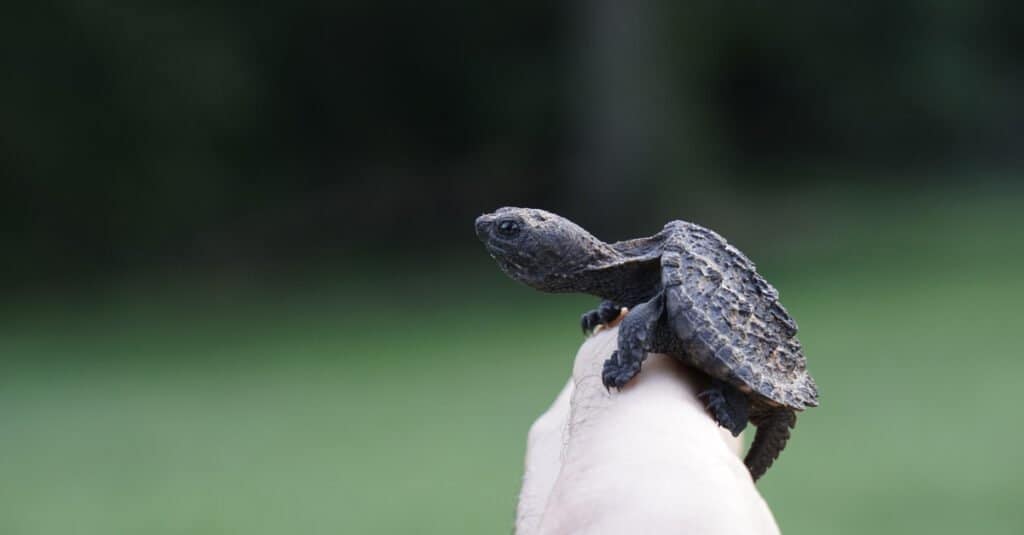
tiny baby snapping turtle

Turtle hatchlings find small pieces of vegetation and insects to eat, but, as they grow, they are able to eat larger prey.

Population

These turtles live in North America. They’re believed to number in the hundreds of thousands. This turtle’s population is decreasing, however. This turtle’s population is in danger as a result of habitat loss, water pollution, and poaching by humans.
tiny baby snapping turtle

Snapping Turtles are in danger as a result of habitat loss, water pollution, and poaching by humans.

View all 390 animals that start with S

Sources

  1. David Burnie, Dorling Kindersley (2011) Animal, The Definitive Visual Guide To The World's Wildlife / Accessed November 17, 2008
  2. Tom Jackson, Lorenz Books (2007) The World Encyclopedia Of Animals / Accessed November 17, 2008
  3. David Burnie, Kingfisher (2011) The Kingfisher Animal Encyclopedia / Accessed November 17, 2008
  4. Richard Mackay, University of California Press (2009) The Atlas Of Endangered Species / Accessed November 17, 2008
  5. David Burnie, Dorling Kindersley (2008) Illustrated Encyclopedia Of Animals / Accessed November 17, 2008
  6. Dorling Kindersley (2006) Dorling Kindersley Encyclopedia Of Animals / Accessed November 17, 2008
Heather Ross

About the Author

Heather Ross

Heather Ross is a secondary English teacher and mother of 2 humans, 2 tuxedo cats, and a golden doodle. In between taking the kids to soccer practice and grading papers, she enjoys reading and writing about all the animals!

Thank you for reading! Have some feedback for us?


Snapping Turtle FAQs (Frequently Asked Questions)

Snapping turtles eat both animals and plants. Their omnivorous diet includes frogs, fish, ducks, and vegetation they find in the water.