




This post may contain affiliate links to our partners. Purchasing through these helps us further the A-Z Animals mission to help us educate about the world’s species so we can all better care for them.
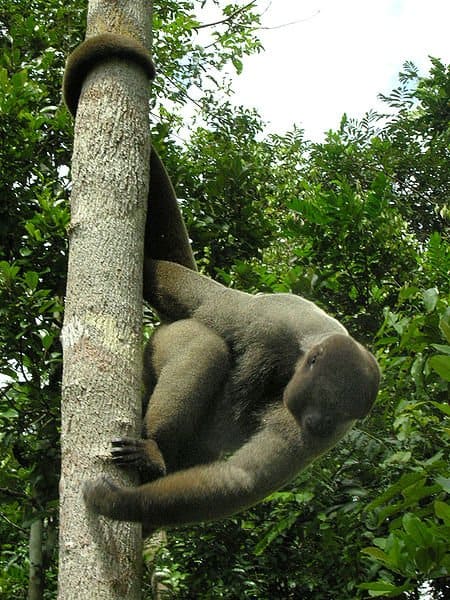
The woolly monkey excels above all at one thing: climbing. Even among arboreal primates, its climbing ability is remarkable.
With its long, ergonomic, and tactile tail, this animal performs incredible feats of movement through the trees of the Amazonian forests. It is also intelligent, inquisitive, playful, and diligent. But decades of habitat loss in the Amazon has greatly reduced and fragmented the natural habitat of the woolly monkey. It is now in perilous danger of ultimate extinction.
Incredible Woolly Monkey Facts!
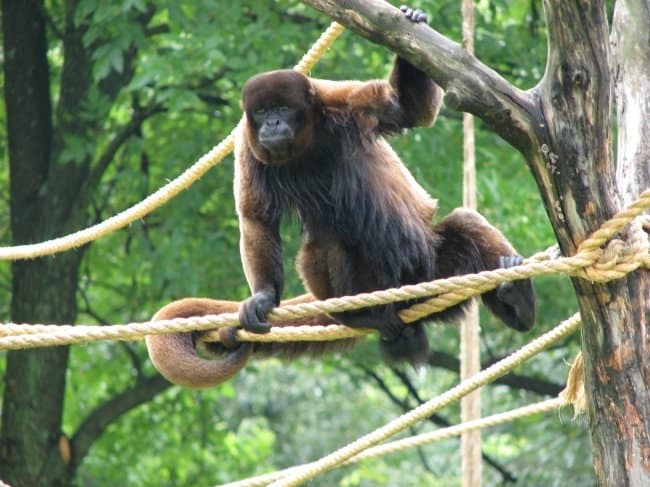
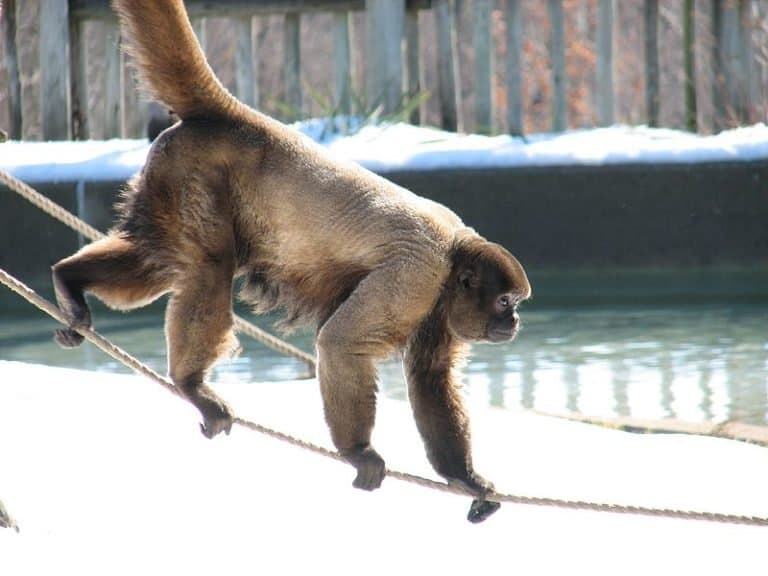
- The woolly monkey climbs around the forests on all four legs with the assistance of its prehensile tail. It is estimated to zip around at a maximum speed of 35 MPH. The monkey is also capable of very limited bipedal motion by propping up its body with the tail.
- The Portuguese name for this animal is barrigudo, which roughly translates to big belly. This is a reference to the big portly stomach that characterizes many species.
- Rough play is an important part of the bonding process between different members of the group.
Woolly Monkey Scientific Name
The woolly monkey actually includes four species within the genus Lagothrix (the name itself seems to be a Latin reference to the woolly hair). These four species are the brown or common woolly monkey, the gray woolly monkey, the Colombian woolly monkey, and the silvery woolly monkey. Each of these can then be divided again into various subspecies with distinct geographical ranges as well.
A fifth species, the Peruvian yellow tailed woolly monkey, which is named after the yellow stripe on the underside of the tail, is not part of the “true” woolly monkey genus. Instead, it is classified within a separate genus entirely. There is still some scientific debate about how to classify them, because it is not entirely clear whether some populations are distinct species or merely subspecies. That is why scientists have begun to use genetic analysis as a tool to understand the relationships between them.
Regardless of how they’re classified, all of these species are part of the family Atelidae, along with the closely related spider monkeys and the howler monkeys. They are some of the only primates in the world with a prehensile tail that functions as a kind of fifth limb. Most of them are found within a similar range of the Amazonian forests.
The woolly monkey is an example of a New World primate. As the names suggest, the New World primates live in the Americas, whereas the Old World primates live in Asia and Africa. The main differences between them are their size and skeletal structures. On an evolutionary scale, these two groups separated from each other some 40 million years ago.
Woolly Monkey Appearance and Behavior
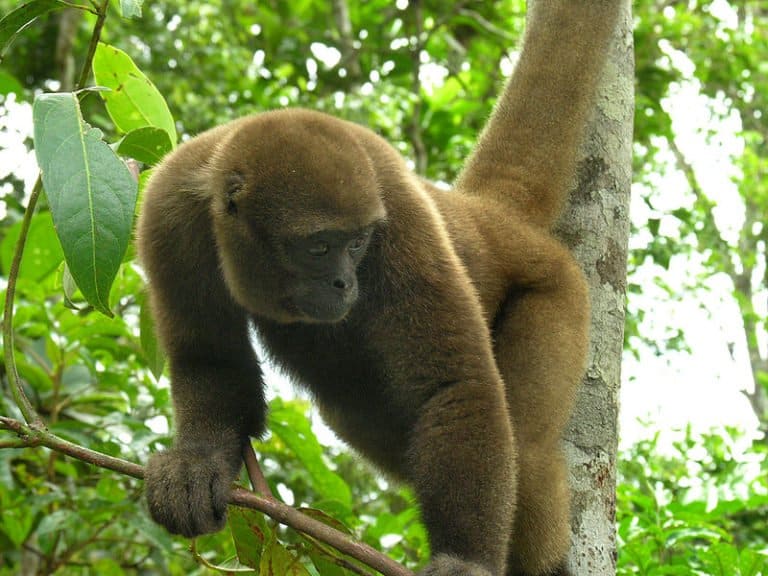
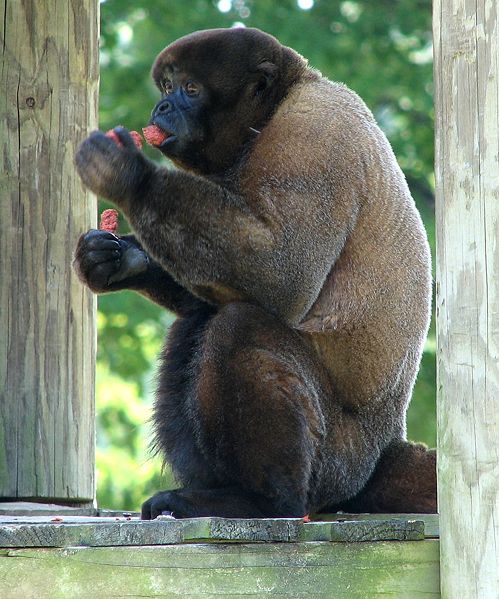
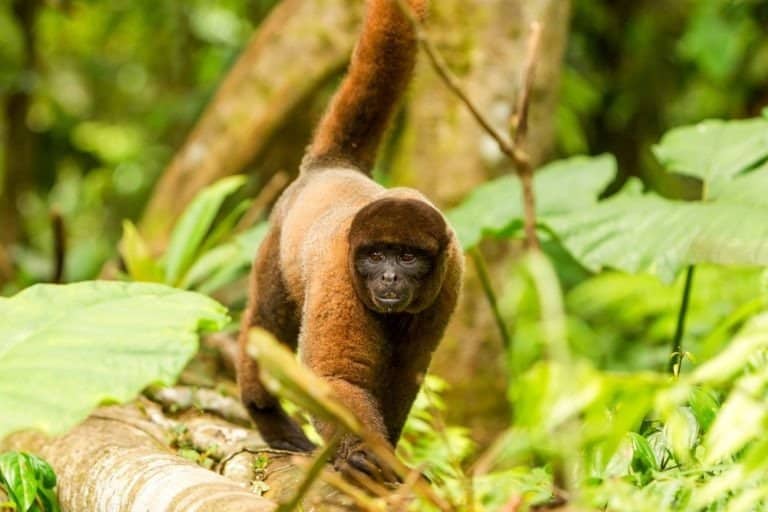
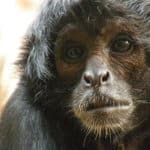
The woolly monkey is primarily named for its soft coat of wool-like fur. The exact coloration and appearance varies based on the species, but the most common colors are some mixture of black, white, gray, brown, or orange-red. The prehensile tail is perhaps the most prominent and important feature. With a soft pad on the end, it allows the monkey to grip objects and clamber around trees. This “fifth limb” is incredibly important to its survival, because the woolly monkey otherwise lacks a fully opposable thumb for gripping objects.
The woolly monkey measures about 16 to 24 inches in length from the head to the rump (and around double this with the tail included). It also weighs approximately 10 to 25 pounds, though the weight can vary with the changes of the seasons. While this may seem small (it’s about the size of some dog breeds), they are actually among the larger species of the New World monkeys in the Americas. Males are also larger than females on average.
These social animals primarily live in large troops of up to 50 individuals (though larger groups have also been observed). They are often clustered together with spider monkeys, capuchins, and other primate species in the trees. During the day, the troops branches out into smaller groups of two to five individuals each to forage for food, especially during times when food happens to be scarce. This is interspersed with periods of rest, which peak during the middle of the day. Sleep takes place mostly at night.
The troop has a complex social organization based on age and sex. It is led by a single dominant male who takes responsibility for group activities and defense. The rest of the hierarchy is enforced through dominance and aggression. Males tend to remain with the same group for much of their lives, whereas the females tend to disperse soon after achieving independence. Many species of monkey are actually the opposite, with females staying in the group for the remainder of their lives.
Play time and food sharing are the most effective means of establishing and strengthening bonds between individuals. Grooming is less important but also serves mostly the same function. These group relationships and activities are coordinated with visual, verbal, and even olfactory communication. The woolly monkey has three distinct vocalizations: an alarm call, a contact call, and a social interaction call (including both friendly and aggressive calls).
When they branch out into smaller groups, the monkeys will regularly emit contact calls to keep tabs on each other and convey information about potential threats. They are almost always close enough in proximity to aid each other when members are threatened by a predator. Monkeys may also make aggressive moves other members of the group. This is usually accompanied by lunges, chases, threat displays, and aggressive contact. Other forms of communication include branch shaking, teeth chattering, and rapid head movements.

Brown Woolly Monkey (Lagothrix lagotricha) Taruma River, Brazil
©Evgenia Kononova – Public Domain
Woolly Monkey Habitat
The woolly monkey is found almost exclusively in the South American Amazonian regions, including the countries of Brazil, Ecuador, Colombia, Bolivia, and Peru. Each species has its own unique geographical range, but most tend to inhabit lowland rainforests, river forests, and cloud forests (mountainous forested regions with lower cloud cover). They spend the vast majority of time resting in and traversing trees approximately 20 to 40 feet above the ground, beyond the reach of some predators.
Woolly Monkey Diet
The diet of the woolly monkey consists almost entirely of fruits and leaves. The type of fruits it consumes tends to change throughout the year based on the season and the availability. If it cannot find enough ripe fruit, then the monkey will start to consume unripe fruit instead. Fortunately, there is almost always enough fruit in the Amazon all year round to supply it with plenty to eat. The fruit-based diet is sometimes supplemented with seeds and insects. In fact, the woolly monkey helps the local ecosystem by inadvertently dispersing undigested seeds throughout the environment.
Woolly Monkey Predators and Threats
The woolly monkey is sometimes preyed upon by eagles, jaguars, and pumas. Its physical size, social organization, and arboreal lifestyle are usually good enough defenses to provide protection against hungry predators. For this reason, predators tend to target juvenile monkeys, especially ones abandoned or left alone.
As the Amazon is cleared for logging and agriculture, human activity has threatened every single species of the woolly monkey with extinction by robbing them of their natural homes. Other threats include poaching for the exotic pet trade and illegal hunting for meat and medicine. This animal is also susceptible to all manner of diseases, including the woolly monkey hepatitis B virus. As in humans, this can cause severe liver damage and death.
Woolly Monkey Reproduction, Babies, and Lifespan
The woolly monkey is a promiscuous animal that shares sexual partners with other members of the same group. As it does not have a set breeding season, the group members can mate with each other all year round. Females will actively solicit males and show reproductive availability with several provocative displays, including a head shake and a grin directed toward a potential partner. This is sometimes accompanied with teeth chatter and clicks. Female on female aggression is not uncommon within the group. In fact, some females may harass a copulating pair.
Once impregnated, the mother carries the young for about seven or eight months. Due to the stress of birth and the investment requirement of raising the young, she produces only one child at a time, while twins are relatively rare. The child is born with the eyes open and with a lighter color of fur than the adults. When the child is growing, it clings to the mother’s stomach and later the back for protection. She is mostly responsible for raising and feeding the child alone, especially during its first year of life
By the six-month mark, the child is ready to start walking completely independent of its mother. However, the juvenile still relies on her care and direction as it learns group dynamics, communication, and foraging strategies. It may take about four years to reach full sexual maturity. If it survives, then the woolly monkey can live up to 24 to 30 years in the wild. Without the pressure of disease, hunting, and predation, it can live even longer in captivity.
Woolly Monkey Population
According to the IUCN Red List, which tracks the conservation status of many species, almost every species of woolly monkey is endangered or threatened in some capacity. The brown or common woolly monkey, which resides in a large swath of territory between the Amazon Basin and the Andes Mountains, is currently classified as vulnerable to extinction. In fact, almost every species of woolly monkey appears to be in population decline across the board.
Conservationists are trying to prevent the extinction of the woolly monkey by preserving what remains of the Amazonian habitat. Some organizations are committed to keeping alive backup populations of the woolly monkey in case wild populations go extinct. They are also focused on reintroducing captives back into their native habitats. But the longer development times and low birth rates make it difficult to fully rehabilitate numbers.
Woolly Monkeys in the Zoo
Although they used to be more common, the woolly monkey cannot be found currently in any zoo across the United States or Canada. Outside of North America, the woolly monkey is a prime exhibit at the Basel Zoo in Switzerland and the Paris Zoological Park.
Woolly Monkey Pictures
View all of our Woolly Monkey pictures in the gallery.

Evgenia Kononova - Public Domain
Sources
- David Burnie, Dorling Kindersley (2011) Animal, The Definitive Visual Guide To The World's Wildlife / Accessed October 21, 2009
- Tom Jackson, Lorenz Books (2007) The World Encyclopedia Of Animals / Accessed October 21, 2009
- David Burnie, Kingfisher (2011) The Kingfisher Animal Encyclopedia / Accessed October 21, 2009
- Richard Mackay, University of California Press (2009) The Atlas Of Endangered Species / Accessed October 21, 2009
- David Burnie, Dorling Kindersley (2008) Illustrated Encyclopedia Of Animals / Accessed October 21, 2009
- Dorling Kindersley (2006) Dorling Kindersley Encyclopedia Of Animals / Accessed October 21, 2009
- David W. Macdonald, Oxford University Press (2010) The Encyclopedia Of Mammals / Accessed October 21, 2009
- Britannica / Accessed November 4, 2020
- Wisconsin National Primate Research Center / Accessed November 4, 2020