
Quick Take
- Howler monkeys have a terrifying roar, yet their actual personality is the opposite of what you'd expect. Their surprising gentle side →
- Their tail does something no other body part can do, and that ability changes how they survive in the treetops. How their tail works →
- Howler monkeys spend 80% of their lives doing one thing, and this habit has earned them a strange title among all primates. Their lazy primate record →
- One howler monkey subspecies behaves so differently from the rest that it has transformed how people keep them, though most captive howlers still meet a grim fate. Captivity and its consequences →
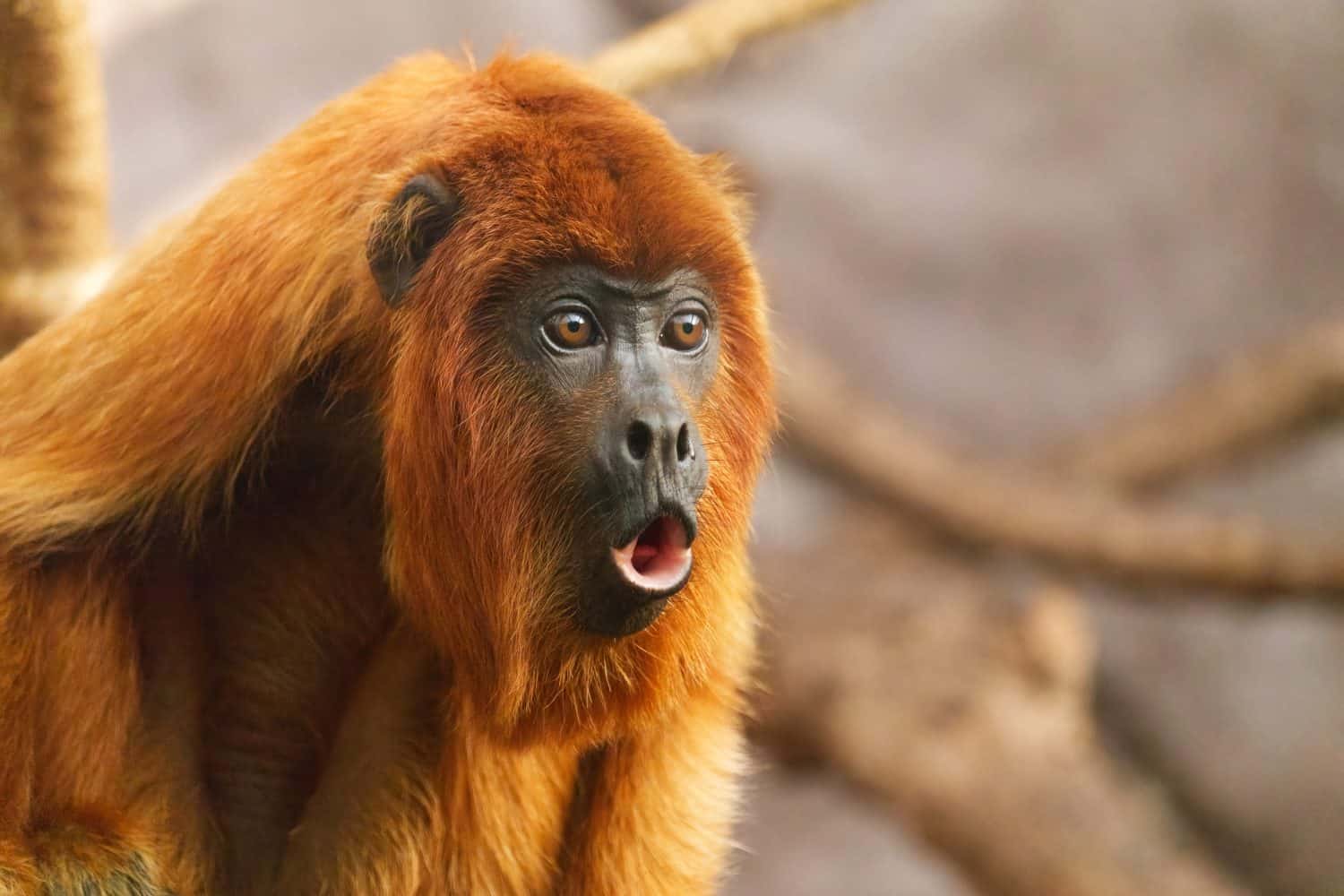
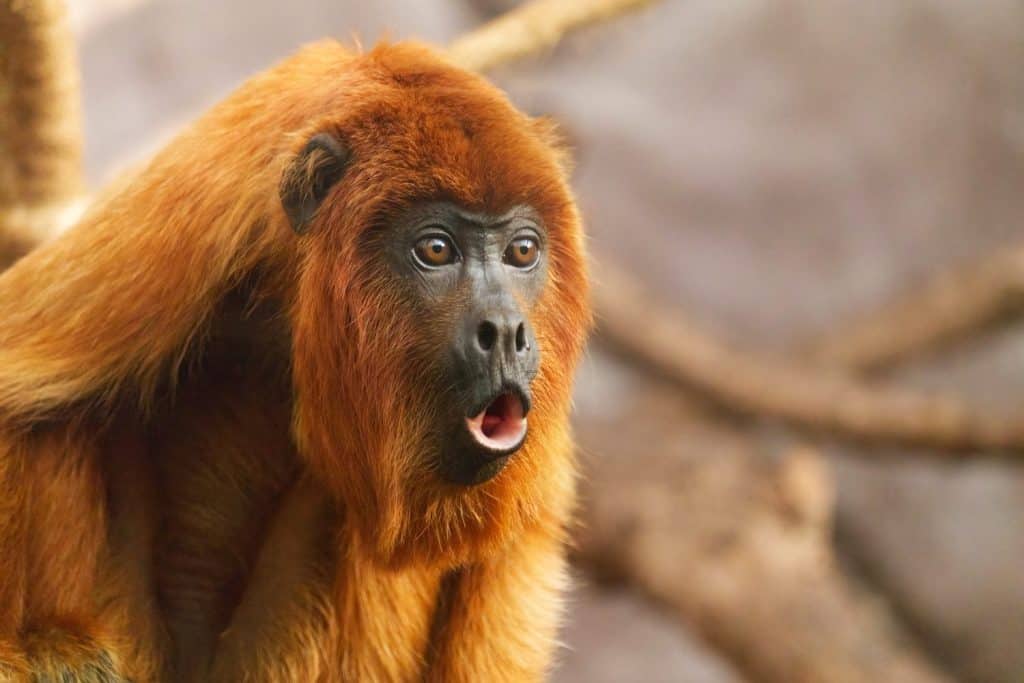
The howler monkey is a New World primate known for its thunderous roaring cry. This howl can be heard for up to three miles. Living in Central and South America, these monkeys reach lengths of 22 to 36 inches. Their tails are another 23 to 36 inches. The species as a whole is not endangered at this time. But they live under constant threat of habitat loss and human poaching.

3 Incredible Howler Monkey Facts
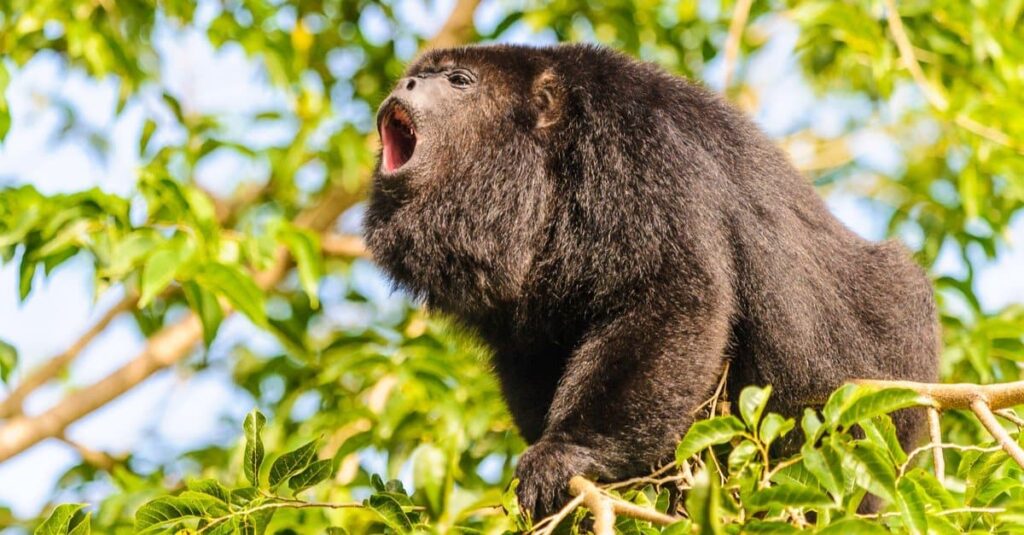
Howler Monkeys are the loudest animal in the New World, and their sound can travel for up to three miles through thick forest.
©Anton_Ivanov/Shutterstock.com
- Howler monkeys have trichromatic vision, just like people.
- Howler monkey tails are roughly the same length as their bodies.
- A howler monkey’s bark sounds frightening, but they rarely fight.
Evolution and Origins
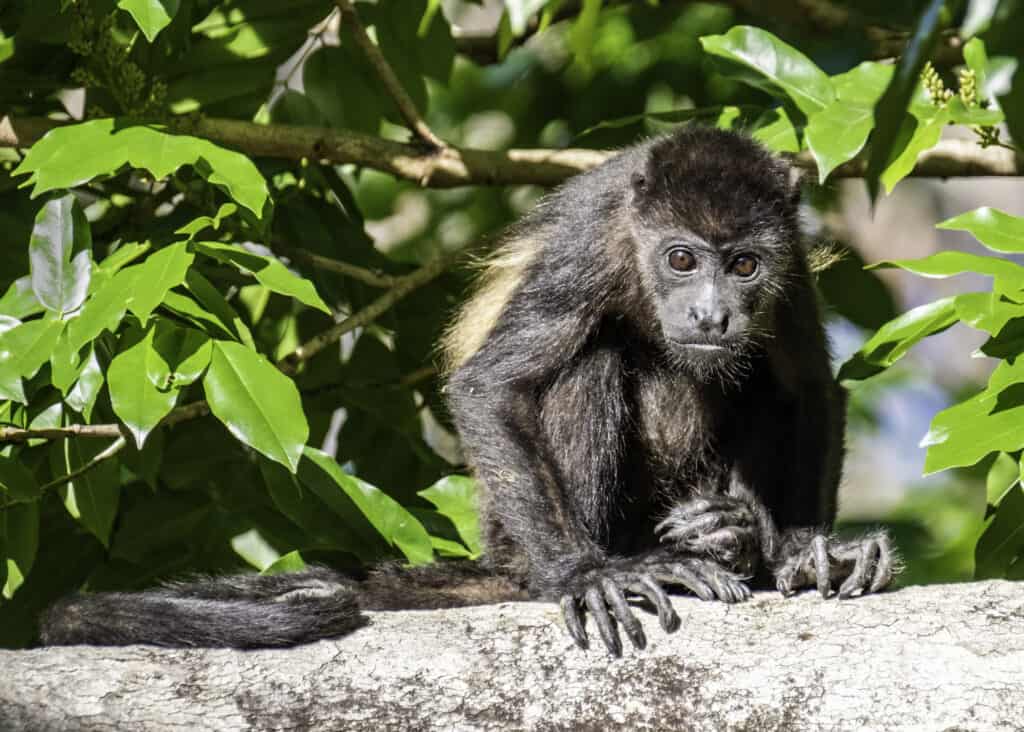
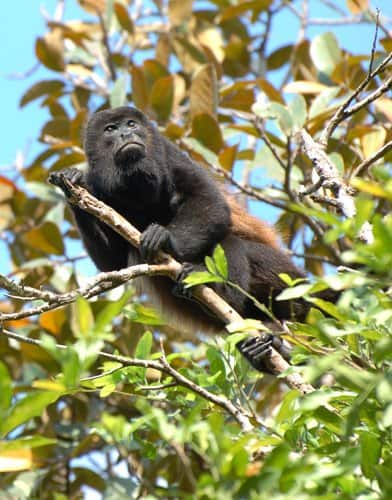
A young howler monkey in Guanacaste, Costa Rica, sits crouching pensively on a large branch with his long fingers and toes gripping the tree.
©iStock.com/John Fader
Mantled and black howler monkeys, the focus of the study, separated around 3 million years ago and lived apart until recently, possibly within the last 10,000 years, when they reconnected in a hybrid zone in southeast Mexico with a diameter of about 12 miles.
Southern Brazil, Paraguay, eastern Bolivia, and northern Argentina are all home to black howler monkeys. They reside in broadleaf and primarily arid deciduous woods. The low, guttural sound made by howler monkeys is one of the loudest noises produced by any land mammal.
During the Oligocene Period, prosimians gave rise to monkeys. New World monkeys diverged from African catarrhines, which later gave rise to apes during the Miocene epoch.
Classification and Scientific Name
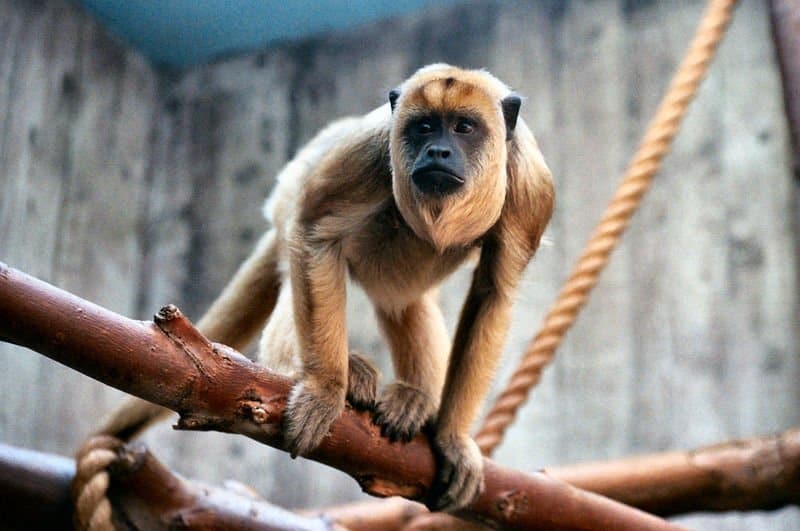
The howler monkey is classified in the genus Alouatta.
©Lea Maimone / Creative Commons – Original
Howler monkeys are part of the Atelidae family. There are 14 to 15 species of howler monkeys within the genus Alouatta, though the exact number remains a subject of ongoing taxonomic debate. Other Atelidae cousins are spider, woolly, and woolly spider monkeys. All of the monkeys in this family live in South and Central America.
Well-known species include the following:
- Mantled Howler (Alouatta palliata): Found across Central America and parts of South America; recognized by long guard hairs on its flanks.
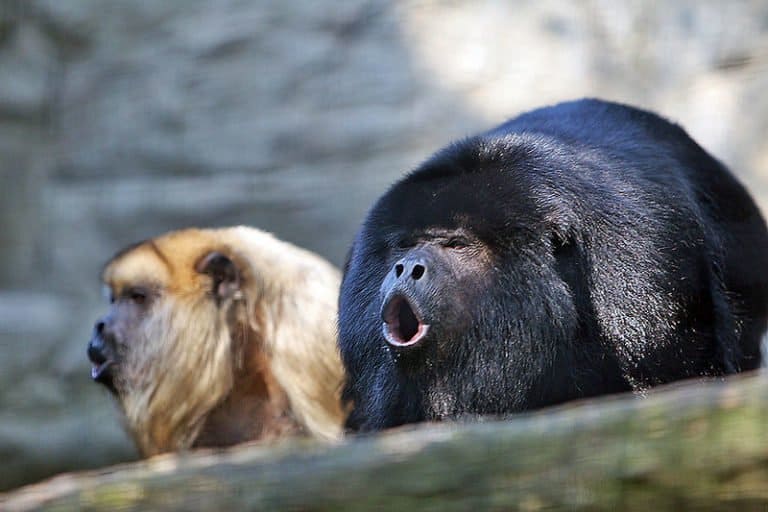
- Black Howler (Alouatta caraya): Native to South America; exhibits strong sexual dimorphism where males are black, and females are yellowish-brown.
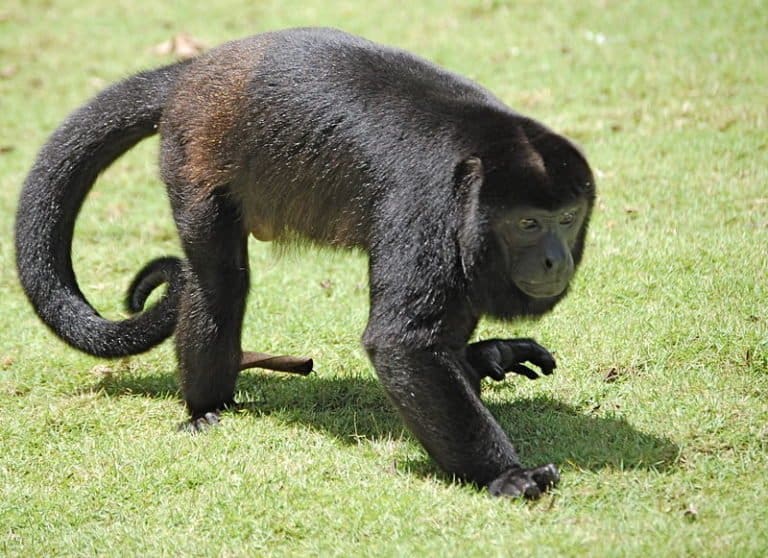
- Guatemalan / Yucatán Black Howler (Alouatta pigra): Found in Mexico, Belize, and Guatemala; known for its robust black coat and endangered status.
- Venezuelan Red Howler (Alouatta seniculus): A widespread northern South American species with a reddish coat.
- Guianan Red Howler (Alouatta macconnelli): Native to the Guianas and northern Brazil.
- Brown Howler (Alouatta guariba): Found in the Atlantic Forest of Brazil and Argentina.
- Red-Handed Howler (Alouatta belzebul): Native to eastern and southern Amazonian Brazil.
- Spix’s Red-Handed Howler (Alouatta discolor): Found in central Brazil.
- Bolivian Red Howler (Alouatta sara): Located in Bolivia and parts of neighboring South America.
- Amazon Black Howler (Alouatta nigerrima): Inhabits the southern Amazon basin in Brazil.
- Coiba Island Howler (Alouatta coibensis): Limited to Coiba Island and parts of Panama.
- Maranhão / Ululating Howler (Alouatta ululata): A critically endangered species native to northeastern Brazil.
Appearance & Behavior
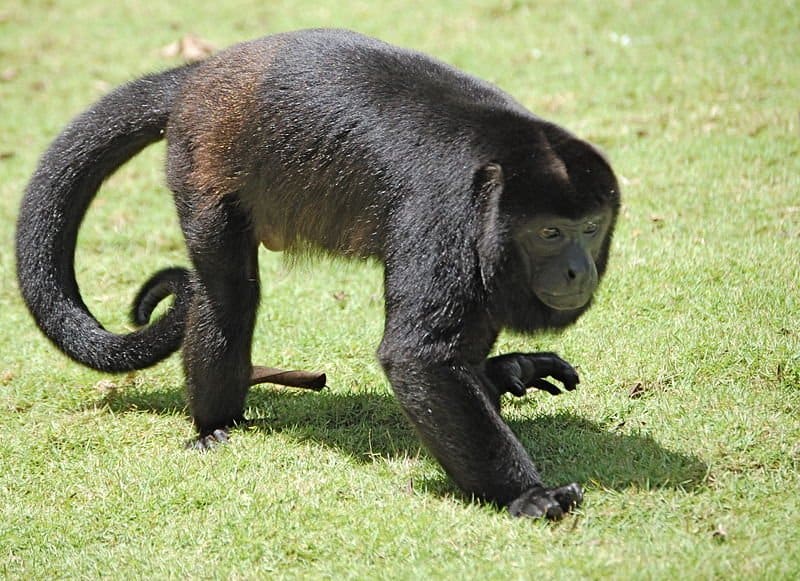
Howler monkeys are bigger than all other monkeys of the New World. Howlers have wide nostrils that open on the sides. They do not have pads on their rumps, as other New World monkeys do.
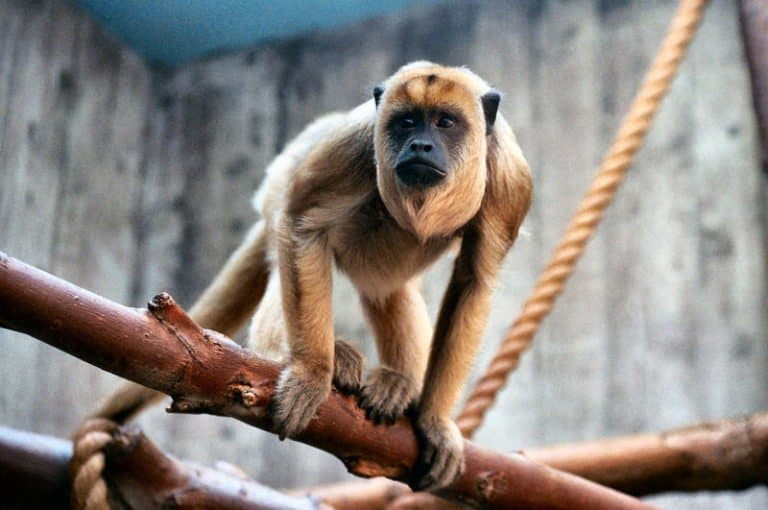
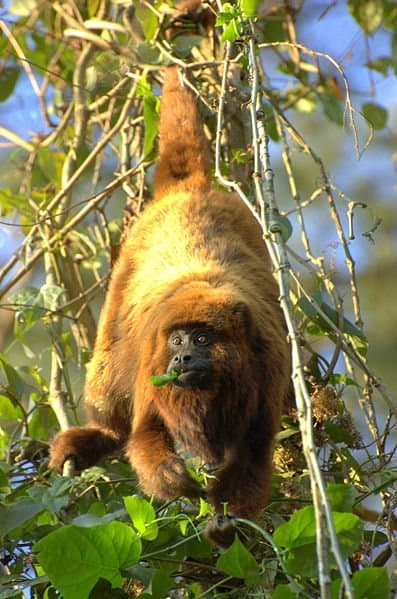
One of their most important features is their tail. They use this tail like a fifth arm. Their tail grips branches, helps them swing through trees, and holds food. Howler monkeys also have long, thick hair with beards. The hair on their scalp and face is brown, black, or red. Red is their most common color, as part of the red howler species.
Howler monkeys spend most of their lives in trees. There, they swing from branch to branch and eat their preferred diet of leaves.
Howler monkey groups usually include up to 15 adult males and females. Scientists call their group a “troop.” One alpha male takes control of the troupe. When young males and females reach maturity, the group forces them out on their own. The lone monkey then wanders the jungle, sometimes venturing near humans or spider monkeys, until it finds another troupe willing to take it in.
Howler monkey howls are frightening, especially to people or animals hearing them for the first time. But these monkeys are actually harmless. They are peaceful leaf-eaters howling just to talk to each other. To keep predators away, such as humans getting too close to their troop, they pee from overhead. Unless you want to get wet, you should never stand under howler monkeys in the trees.
As noted above, howler monkey troops have a dominant male. But they also have a dominant female. The male is the boss of the whole group. The female helps him keep everyone in order. Rarely do members of the troupe fight among themselves, even though most have grumpy dispositions. They stick close together and watch out for each other. Sometimes a short spat can cause injuries, such as when a male and female fight with each other. Troupes usually have one male for every four females.
Because howler monkeys spend 80 percent of their time resting, they are considered the laziest monkeys in the world. These mammals do not act aggressively around people, but they do not live well in captivity. Most captive howler monkeys stop eating because they miss their group. This makes it difficult to keep them alive. The black howler monkey is an exception, as it is a gentle species that adapts more readily to captivity.
Howling
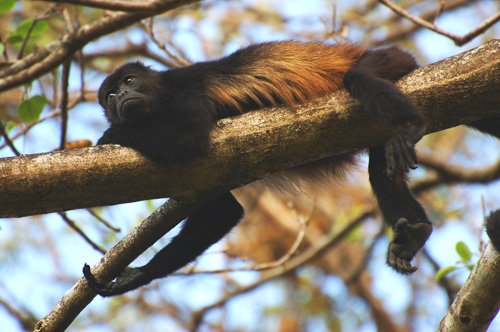
Not many other land creatures are as noisy as howler monkeys, which produce a deep, low sound.
©leofleck / Creative Commons – Original
Howler monkeys make a deep, low sound louder than almost all other land animals. The sound travels three miles, with the male being louder than the female. They produce their howling sound using a highly modified larynx and an enlarged cup-shaped hyoid bone containing an air sac, which amplifies the sound.
Howling is a critical part of their social behavior. Troupe males call every morning and at nightfall. They also call during the day to “talk” to other members of the troupe. Calls can tell other troupe members to space out more in the trees. Other calls tell the group to come closer together. Still, others announce a nearby intruder or warn another group member to stay away from their mate.
Habitat
Howlers live mostly in tropical Mexico, Central America, and South America. They dwell in cloud forests, rainforests, and tropical dry forests.
Howler monkeys play a significant role in the rainforest ecosystem. When more howlers live in a forest, more birds follow. Trees produce more leaves and fruit in response to howler monkey feeding, which attracts more insects, which in turn support more birds. With more leaves and fruit for each tree, more insects follow. The bounty of insects can feed more birds.
Diet
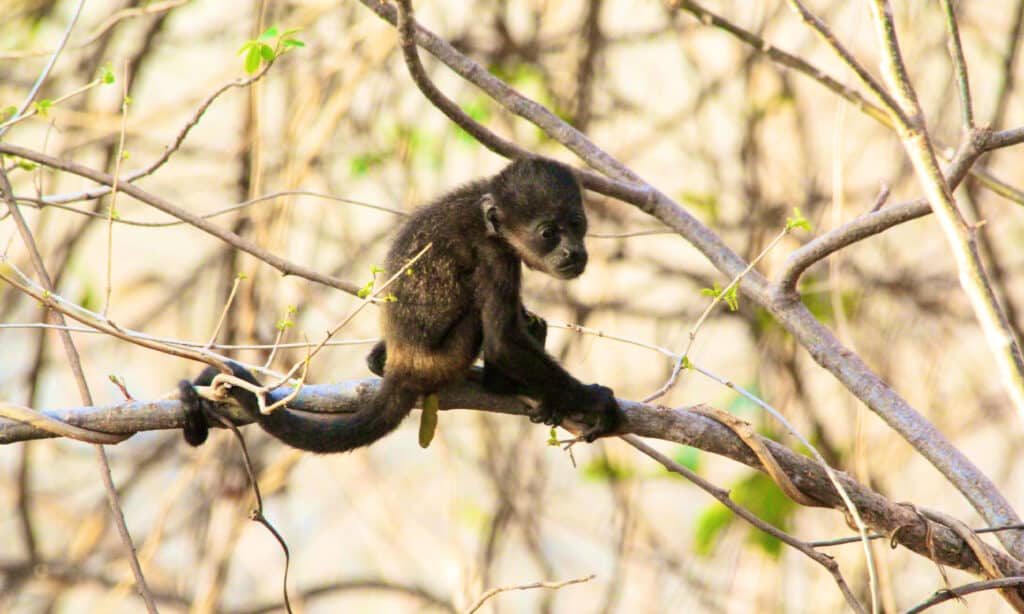
Only howler monkeys have been identified as folivores in the New World.
©iStock.com/PharmShot
Howler monkeys are the most folivorous New World primates. This means they eat mostly leaves. They do not eat just any leaf, however. They pick only the best leaves from each tree. The best leaves are those with the most protein and other nutrients.
Howler monkeys love fruit. But spider monkeys eat the fruit much faster. The spider monkeys steal most of the fruit away before howler monkeys can get to them. Besides occasional fruit, howler monkeys also steal eggs from chicken coops when they live close to humans.
Sometimes howlers eat plants containing toxins, which can sicken or even kill the entire troop.
Predators & Threats
The main threat to howler monkeys is humans. People destroy the forests where the monkeys live. They knock down trees to create farms or sell the wood from the howler monkeys’ habitat. Many people in Central and South America also love to eat the howlers’ meat. The howler monkeys do not put up a big fight around humans, so they make easy prey. People also capture many howlers from their troops for zoos or to keep as household pets. Many howlers in captivity die.
One of the most dangerous threats to howler monkeys is electric wiring. Across much of Costa Rica, howlers die on live wires along roads. The monkeys try to use the wires to reach other trees. They also die on transformers that do not have covers.
Reproduction, Babies, and Lifespan
Howler Monkey Reproduction
Female howlers have their first babies before age four. Pregnancy lasts six months. Females typically give birth to one baby at a time. Like humans, howlers have babies at any time of year.
Babies
Since mothers only have one baby at a time, they take great care of their young. These babies grow very fast. Mothers take care of them for the first year, giving them all of the food, love, and learning they need to survive on their own.
At about one year old, young howlers must leave their troupe. They get kicked out of the group to find a new one. During this period, the young howlers explore the forest, looking for another troupe to take them in. Many try to join humans as their new troupe. Others try to bond with spider monkeys. But soon, all young howler monkeys must find their own kind to accept them.
Lifespan
Living in small groups high in the trees, most howler monkeys survive for 10 to 25 years.
Population
Scientists consider howler monkeys not threatened as a species. But humans keep destroying their habitat, so this can quickly change. Overall, about 100,000 howlers of all species remain in the wild.
The Colombian red howler has the largest population among all 15 types of howlers. Maranhao red-handed howler monkeys of Brazil are very endangered, as they have been listed as such since 1996. They have been hunted and suffered the loss of habitat, which takes a toll on their population.
Ecologists counted only about 2,500 Maranhao red-handed howlers in 2008. Since 2003, ecologists have listed Yucatan black howlers of Guatemala, Mexico, and Belize as endangered, too.
Howler Monkey Pictures
View all of our Howler Monkey pictures in the gallery.

Sources
- David Burnie, Dorling Kindersley (2011) Animal, The Definitive Visual Guide To The World's Wildlife / Accessed December 13, 2008
- Tom Jackson, Lorenz Books (2007) The World Encyclopedia Of Animals / Accessed December 13, 2008
- David Burnie, Kingfisher (2011) The Kingfisher Animal Encyclopedia / Accessed December 13, 2008
- Richard Mackay, University of California Press (2009) The Atlas Of Endangered Species / Accessed December 13, 2008
- David Burnie, Dorling Kindersley (2008) Illustrated Encyclopedia Of Animals / Accessed December 13, 2008
- Dorling Kindersley (2006) Dorling Kindersley Encyclopedia Of Animals / Accessed December 13, 2008
- David W. Macdonald, Oxford University Press (2010) The Encyclopedia Of Mammals / Accessed December 13, 2008