
Quick Take
- Baboons are among the largest Old World monkeys, with five species across Africa and the Arabian Peninsula.
- Baboons have 32 teeth, including large canines used for display and defense.
- They are omnivores, eating plants and small mammals like rodents and young antelopes.
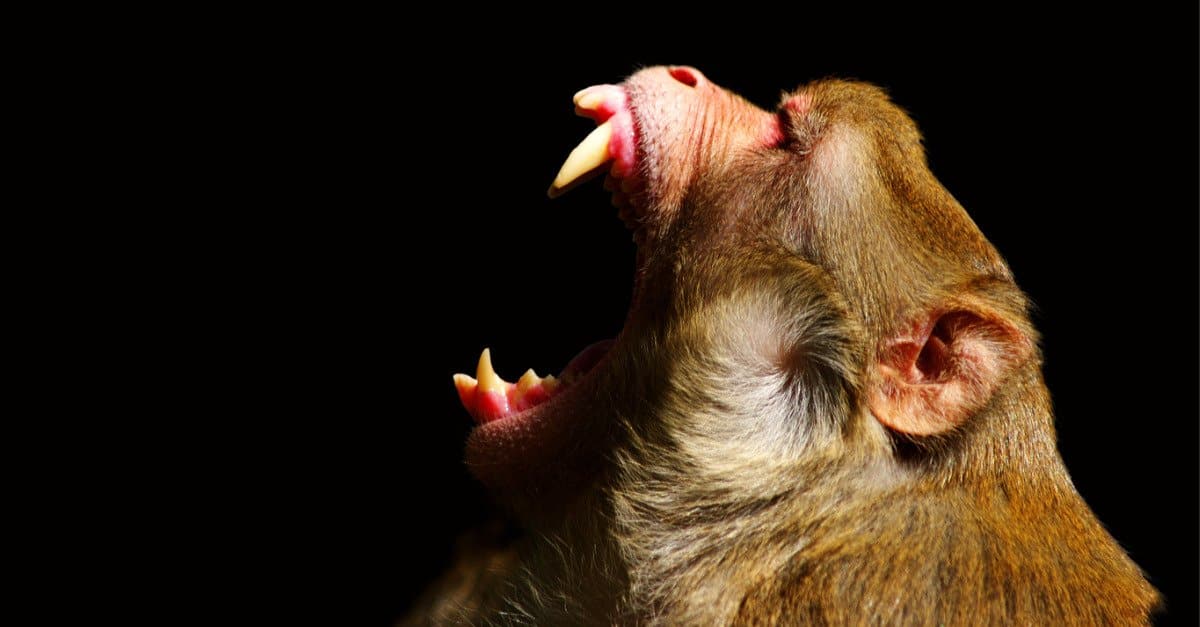
When we think of animals with long, sharp teeth, baboons do not typically come to mind. However, some baboons have teeth that are as long as a mountain lion’s. Baboons also use their teeth for more than just eating. They use their teeth to intimidate rivals, scare away predators, and fight for mating rights or territory. A male’s canine teeth can even reveal his dominance rank. Keep reading to learn everything you need to know about baboon teeth.
About Baboons
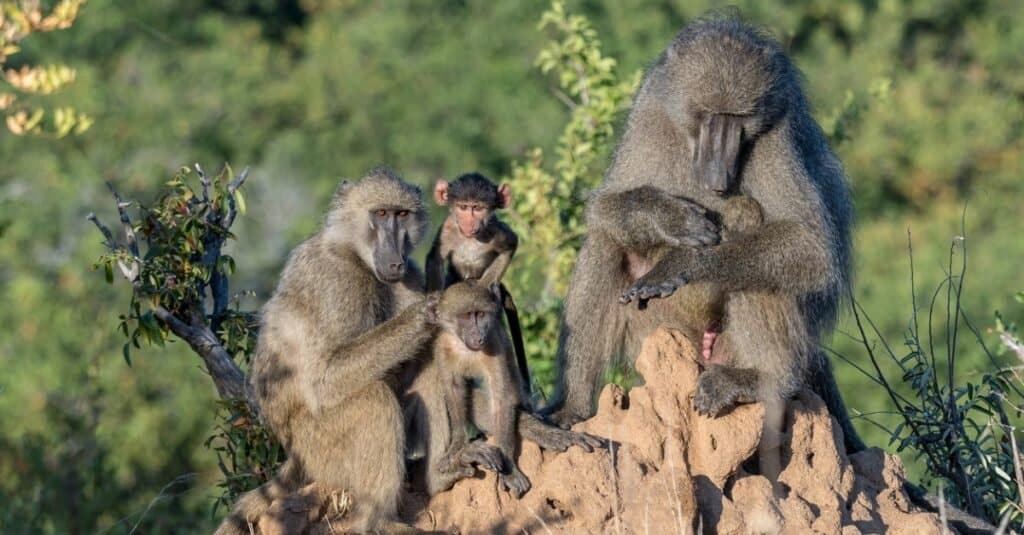
Baboons are Old World monkeys native to Africa and the Arabian Peninsula.
©Grobler du Preez/Shutterstock.com
The baboon (genus Papio) is an Old World monkey, with five species native to sub-Saharan Africa and the Arabian Peninsula. The chacma baboon, the Guinea baboon, the yellow baboon, and the olive baboon live in the savannas and woodlands of Africa. Hamadryas baboons are found in the hills and rocky cliffs of semi-desert areas in the Arabian Peninsula and northeastern Africa.
Baboons are among the biggest primates, with some males of the largest species, the chacma baboon, reaching around 3.75 feet in head-to-body length and weighing up to 88 pounds. Male baboons can be up to twice as large as females. They form large groups called troops that range from fewer than 10 to hundreds of individuals. Baboons have a complex social hierarchy, with female rank determined by the mother’s rank. Dominance among males is primarily based on size and fighting ability, which requires long, sharp teeth.
Baboon Teeth
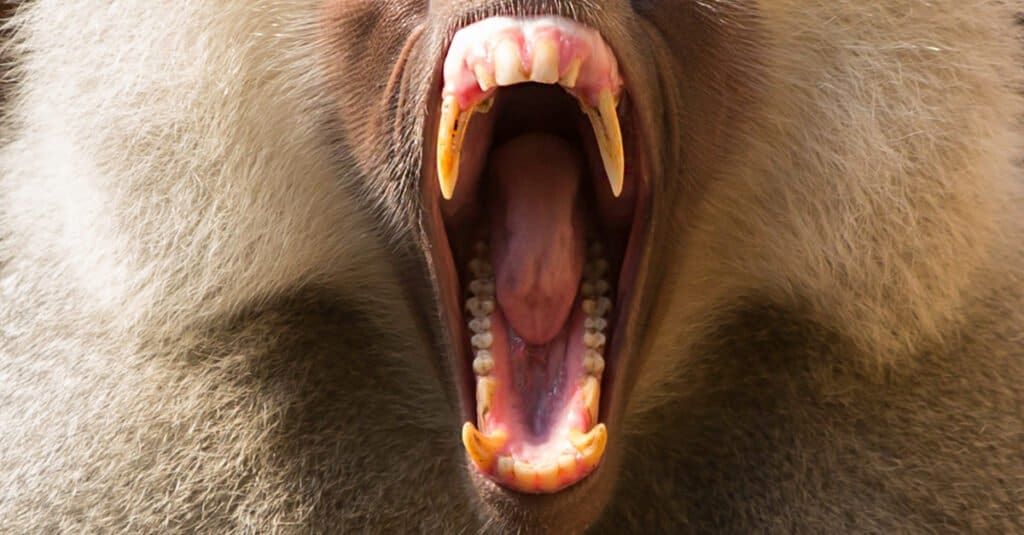
Like humans, baboons have 32 teeth.
©iStock.com/sneil375
Most Old World monkeys and apes, including baboons, have 32 teeth like humans do. Baboons have heterodont teeth, meaning they have different types of specialized teeth, including incisors, canines, premolars, and molars. The typical dental formula of a baboon is: incisors 2/2, canines 1/1, premolars 2/2, and molars 3/3.
They use their large, sharp incisors to slice and bite their food, as well as strip bark off trees. The incisors are also used for display and defense. Like other mammals, baboons use their premolars and molars to crush and grind food.
Primates typically exhibit sexual dimorphism in canine teeth, with males having larger upper canine teeth than females. Males’ canine teeth can measure up to 2 inches long. Baboons sharpen their canines by a process called honing. They hone their canines against their lower third premolars, which create facets that sharpen the tips and edges of the canine teeth. The premolars have extremely thick enamel, while the canines have thin enamel that wears down more easily. Honing can occur while the baboons are chewing, grinding their teeth due to aggression or tension, and during dominance displays.
Baboon Teeth and Social Dominance Rank
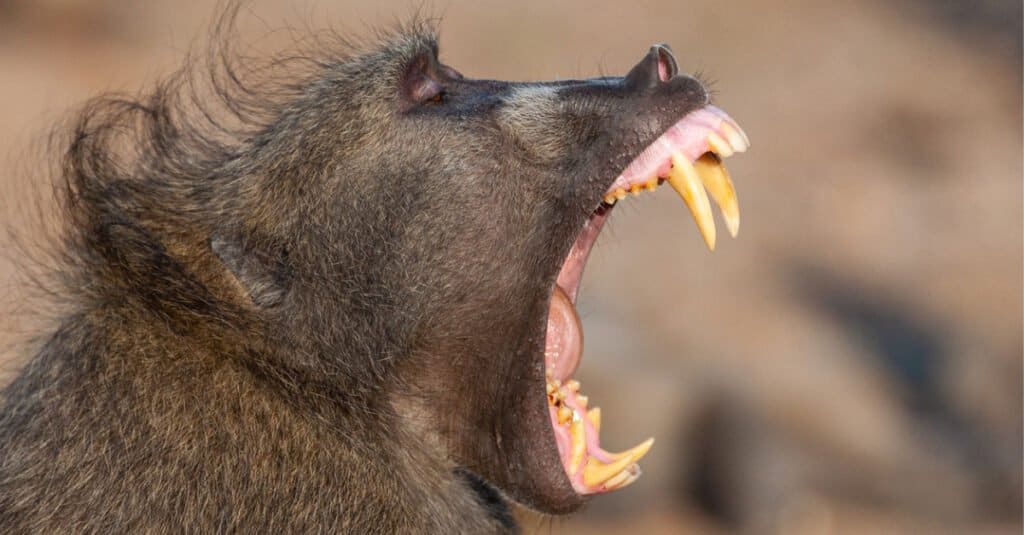
Higher-ranking males tend to have longer canine teeth.
©iStock.com/RudiHulshof
Males show their canine teeth in dominance displays to intimidate both rivals and predators. These displays can include staring, lip-curling, and yawning that exposes their long, sharp teeth. Sometimes these displays allow baboons to avoid physical conflict, but other times they can escalate into fights, during which their teeth are used as weapons.
Researchers have found that longer canines in baboons may contribute to dominance rank. Studies have shown that males of higher dominance ranks tend to have longer canines for their ages than males of lower ranks. Their social rank, and consequently their reproductive success, may partially depend on fighting ability, which is facilitated by canine size.
What Do Baboons Eat?
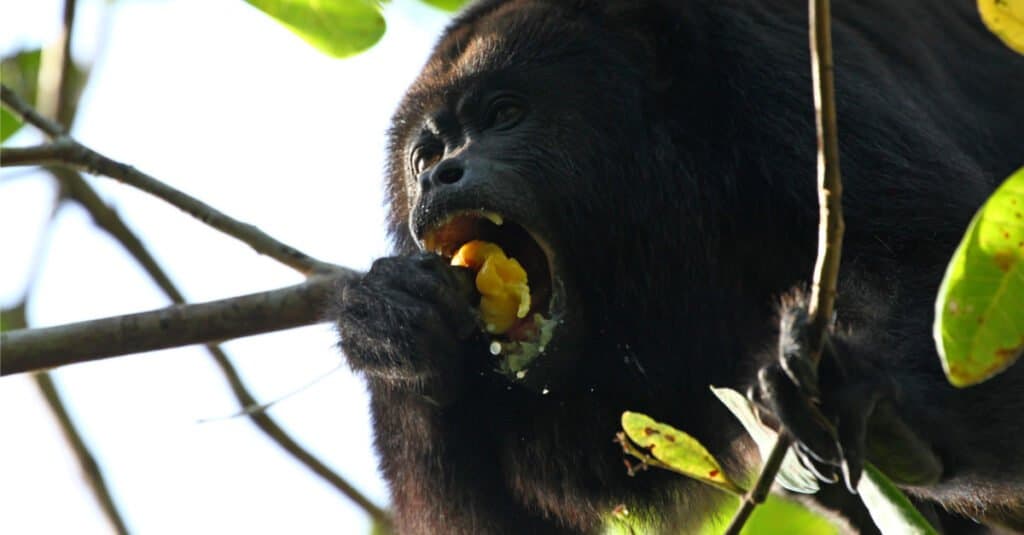
As omnivores, baboons eat both plant and animal matter.
©iStock.com/andyjkramer
Although baboons are omnivores, eating both plant and animal matter, up to 90% of the baboon’s diet is plant matter. However, there is some variation by region and species. A baboon’s diet primarily consists of seeds, fruit, grasses, flowers, nuts, roots, bark, and other types of vegetation that they grind between their premolars and molars.
Unlike other mammals with long, sharp canine teeth, baboons seldom use their canine teeth to grip and tear prey. Baboons are rarely carnivorous, but they are opportunistic, so they may supplement their diet with insects such as locusts, small mammals like hares and rodents, birds and bird eggs, and sometimes even small dik-dik antelope.