
Famous for the single, spiraled tusk jutting from its head, the narwhal (Monodon monoceros) is often called the “unicorn of the sea.” While this unique feature has long been a source of mystery, scientific investigations are revealing that the narwhal’s tusk is far more extraordinary than initially believed.
A recent study with drone footage captured surprising behavior from narwhals in the Canadian High Arctic. Researchers initially thought the small group was hunting Arctic char, but soon the evidence suggested the narwhals may actually have been playing with the fish.
Narwhal Tusks

Narwhals spend their whole lives in the frigid waters of the Arctic.
©Dotted Yeti/Shutterstock.com
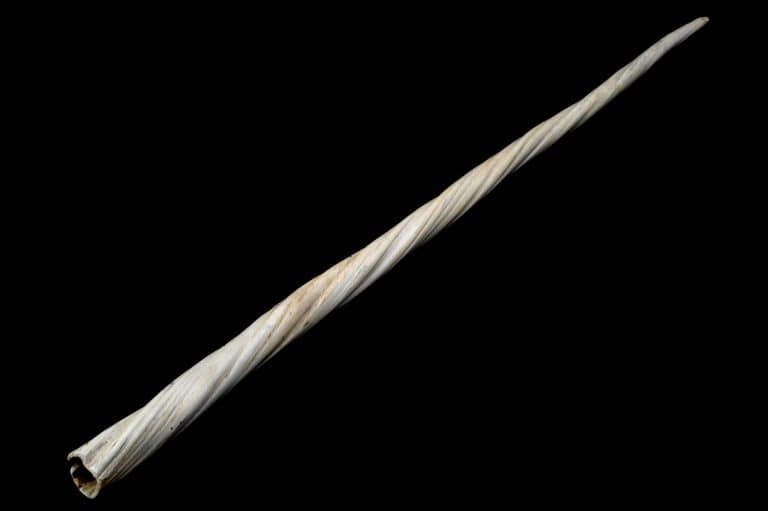
The narwhal’s distinctive “unicorn horn” isn’t a horn at all; it’s an overgrown canine tooth that grows straight through the whale’s upper lip. This spiraled tooth, which grows counterclockwise, can reach lengths of up to 15 feet. The scientific name, Monodon monoceros, is an apt description, as it literally means “one tooth, one horn.” What’s even more unusual is the tooth’s flexibility, allowing it to bend about 1 foot in any direction without breaking.
Despite the name, the narwhal technically has two teeth. The left canine becomes the long, visible tusk, while the smaller right canine remains inside the mouth, serving as a backup. If a tusk is lost, the narwhal cannot grow a new one. Most females do not have a visible tusk, though around 15 percent grow a small one.
Beyond its unusual appearance, the narwhal’s tusk has a fascinating “inside-out” internal structure. Unlike other mammal teeth, the sensitive, softer material (dentin) is on the exterior, while the harder, denser material is on the inside. The tusk’s outer layer contains up to 10 million nerve-filled channels (tubules) that connect the narwhal’s nervous system directly to the environment, allowing it to sense tiny changes in pressure, temperature, and salinity in the water.
What Is the Purpose of a Narwhal’s Tusk?

Narwhals can weigh up to 4,200 pounds.
©Obs70/Shutterstock.com
Scientists have debated the exact purpose of the narwhal’s tusk for decades. Early theories suggested it was a spear for hunting fish or breaking through ice. Later, biologists thought it may be a weapon for male combat or an ornamental display to attract females.
Some of these theories still have merit, though the tusk’s primary purpose remains uncertain. Male narwhals frequently engage in “tusking,” crossing and rubbing their tusks together. Researchers suggest this behavior may be a way for males to establish dominance or simply clean their teeth.
Unique Sensory Abilities

Narwhals change color as they age.
©JenDeVos/ via Getty Images
Another prominent theory suggests the tusk acts as a built-in environmental sensor. Since the tooth’s nerve endings are exposed on the exterior, it can detect subtle shifts in salinity (the saltiness of the water). As sea ice freezes or melts, the ocean’s salinity shifts, so this unique ability might function as an early warning system to help narwhals anticipate dangerous conditions and avoid being trapped in rapidly freezing water.
Researchers also speculate that the tusk’s sensory role could explain its evolution, possibly by helping males detect hormonal cues in the water to locate females during breeding season. Recent drone footage reveals that the tusk is used in hunting — not for stabbing, but to deliver a quick, firm tap to stun prey. This foraging technique demonstrates a clear functional use for the tusk, yet it sharply contrasts with the gentle nudging observed in the 2025 drone footage.
Do Narwhals Play?

Narwhals communicate with one another using squeals and clicks.
©iStock.com/dottedhippo
The most recent 2025 study captured footage of narwhals gently nudging and carefully flipping over an Arctic char with their tusks. Although researchers initially thought the whales were stunning the fish to eat it, the narwhals never actually ate the char. Their surprisingly gentle movements did not fit any known feeding pattern. This behavior also occurred in the summer, a time when Arctic char isn’t typically part of the narwhal’s diet.
Instead, the narwhal’s unusual behavior resembled the purposeful, yet tentative prodding seen in playful contexts among other intelligent marine mammals like otters and dolphins. This new evidence strongly suggests the narwhals were playing with the Arctic char, demonstrating curiosity rather than aggression. This is the first documented evidence of play behavior in narwhals — a key indicator of cognitive complexity and emotional depth, traits not often associated with Arctic wildlife.
Ultimately, the narwhal tusk may not be a magical unicorn horn, but it is every bit as remarkable. This specialized tooth can sense the ocean, possibly predict environmental changes, and may even allow the whales to play.
Unlocking the Narwhal’s Secrets with Technology

Narwhals typically travel in pods with anywhere from 10 to 100 other whales.
©Catmando/Shutterstock.com
This latest discovery was only possible using drones. Narwhals are notoriously elusive, spending winters beneath thick ice in areas inaccessible to humans. Drones allow scientists to observe the whales quietly from above without disturbing their natural behavior or endangering the researchers.
This unobtrusive research is revealing previously unknown aspects of narwhals, including their curiosity, intelligence, and perhaps even a sense of playfulness. As technology improves, researchers hope to combine drone footage with underwater acoustics and tracking sensors to further explore how narwhals use their tusks for sensing and communication.