
Quick Take
- One green beetle has killed an estimated 100 million trees, and it may already be spreading near you. See the tree killer →
- Not all green beetles are pests. One species actually protects your garden in a surprising way. Meet the garden protector →
- One beetle on this list eats a plant toxic to humans and uses that toxicity as its own defense, but the question is how it does so. Discover the toxic defense →
- A beetle from Central America quietly invaded Florida in the early 2000s, and experts still don't know how much damage it can cause. Explore the Florida invader →
Beetles are insects from the order Coleoptera. Over 350,000 species of beetles have been identified and described throughout the world, with many still waiting to be discovered. With more species than any other animal group, approximately one in every four animals described by science is a beetle. Beetles vary significantly in size and appearance, including their shape, color, and size. Although black and brown are the most common colors among beetles, green is one of the most widespread bright colors in the beetle world. Continue reading to learn about 10 of them.
Glorious Scarab Beetle
The glorious scarab beetle (Chrysina gloriosa) is a medium-sized body with interesting coloration. This beetle grows between 0.75 inches and 1.2 inches long, and it appears in many different colors. These insects come in a variety of colors, including green.
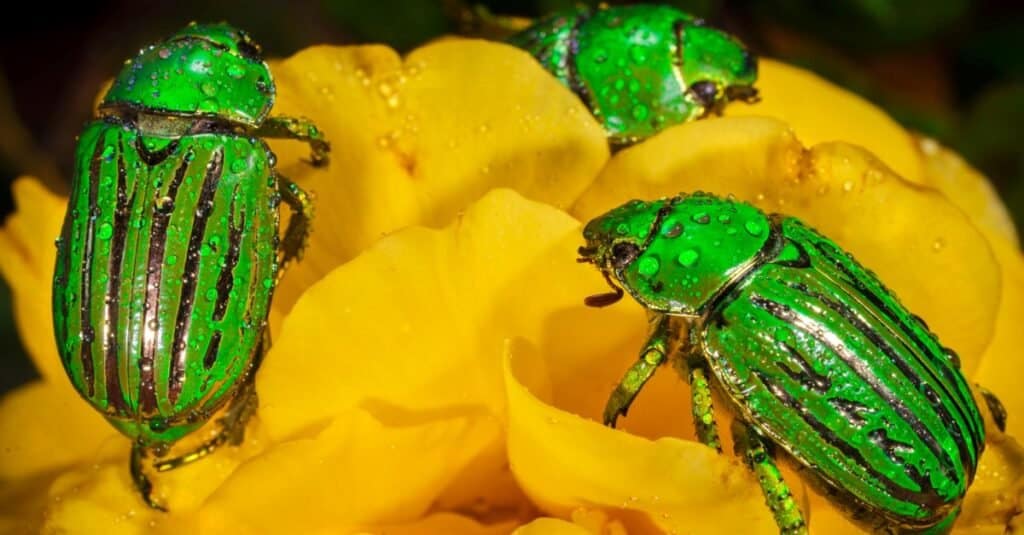
A group of the metallic glorious scarab beetles on a lush yellow flower covered with dew.
©GypsyPictureShow/Shutterstock.com
In North America, glorious scarab beetles are found in Mexico and the U.S. states of Texas, New Mexico, and Arizona. The glorious scarab beetle is certainly one of the most beautiful types of green beetles in the U.S.
Pale Green Weevil
The pale green weevil (Polydrusus impressifrons) is a small beetle native to Europe that has been introduced to parts of northeastern North America and the Pacific Northwest. However, they’ve also been spotted in Oregon in the U.S. as well. These beetles are only about a quarter of an inch long.
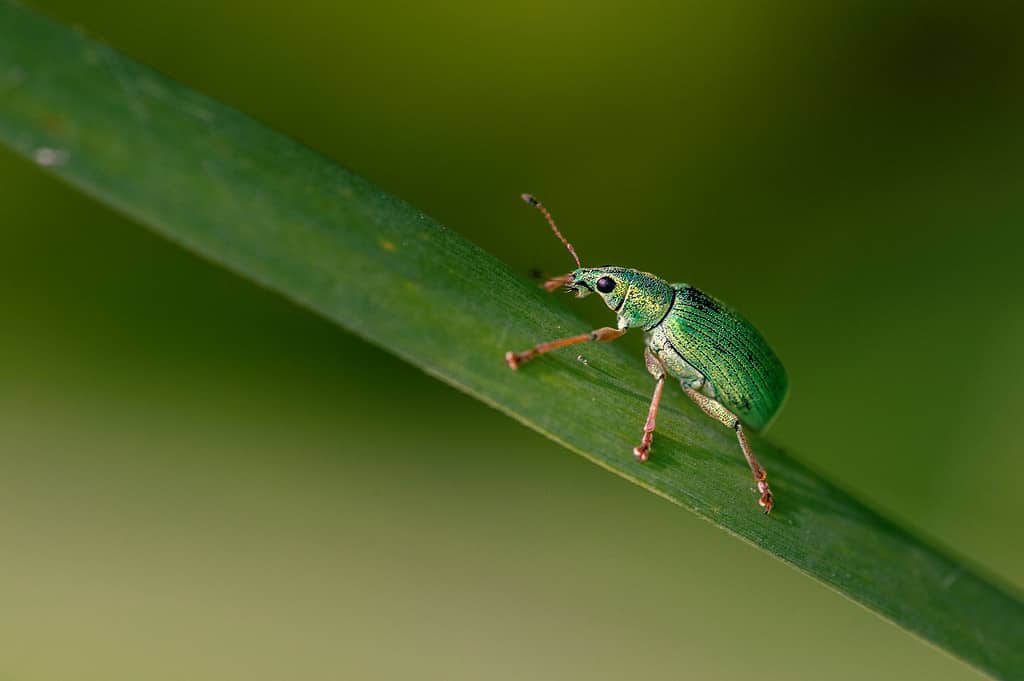
Pale green weevils are considered pests because they eat the leaves of fruit trees.
©iStock.com/Wirestock
The top of the pale green weevil’s body, including its top wings, is bright green. Their thoraxes and legs are often brown. These beetles are considered pests since they eat the leaves of many fruit-bearing trees, although they’re not as harmful as some other types of leaf-eating beetles.
Japanese Beetle
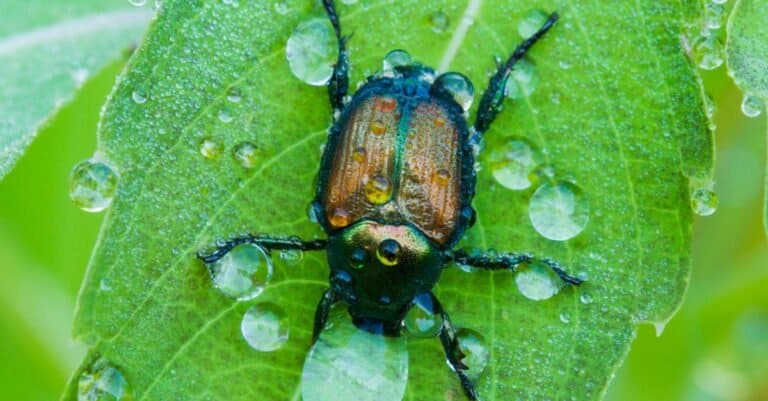
The Japanese beetle (Popillia japonica) is native to Asia, but is now found in North America and Europe, where it is considered an invasive pest. These insects have brown outer wings, green thoraxes, heads, and parts of their legs. Their legs and abdomens feature hair, but their elytra, thoraxes, and heads are shiny.
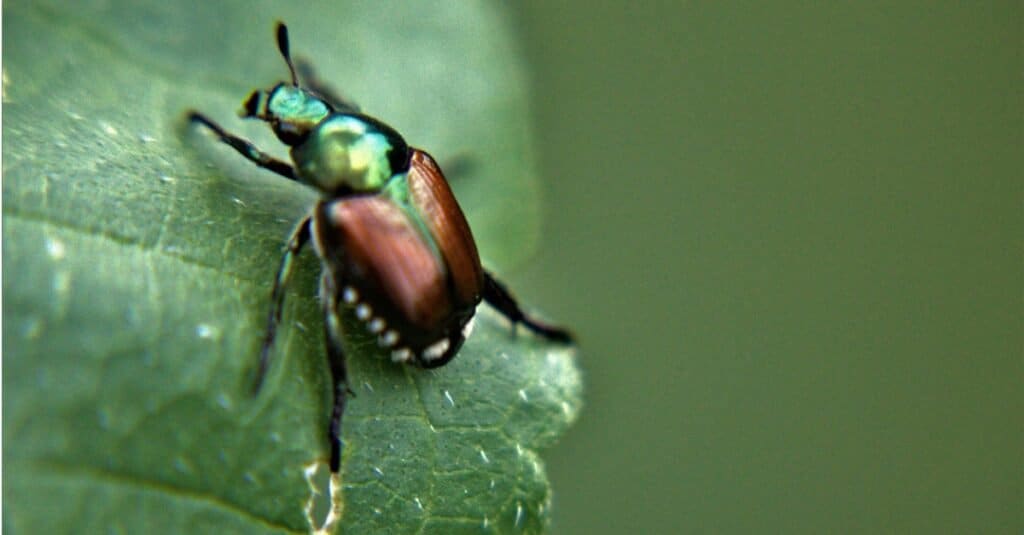
Originally from Japan, the Japanese beetle was spotted in the United States in 1916.
©iStock.com/Justin Tahai
While beautiful, these beetles are devastating pests that can cause significant damage to plants. They are particularly harmful to roses, soybeans, cherries, and other plants.
Figeater Beetle
The figeater beetle, (Cotinis mutabilis) is also called the green fruit beetle or simply the fig beetle. They’re members of the scarab family and grow to approximately 3/4 to 1-1/3 inches long. Their elytra, thoraxes, and heads are all iridescent green, and their underside often features a coppery color.
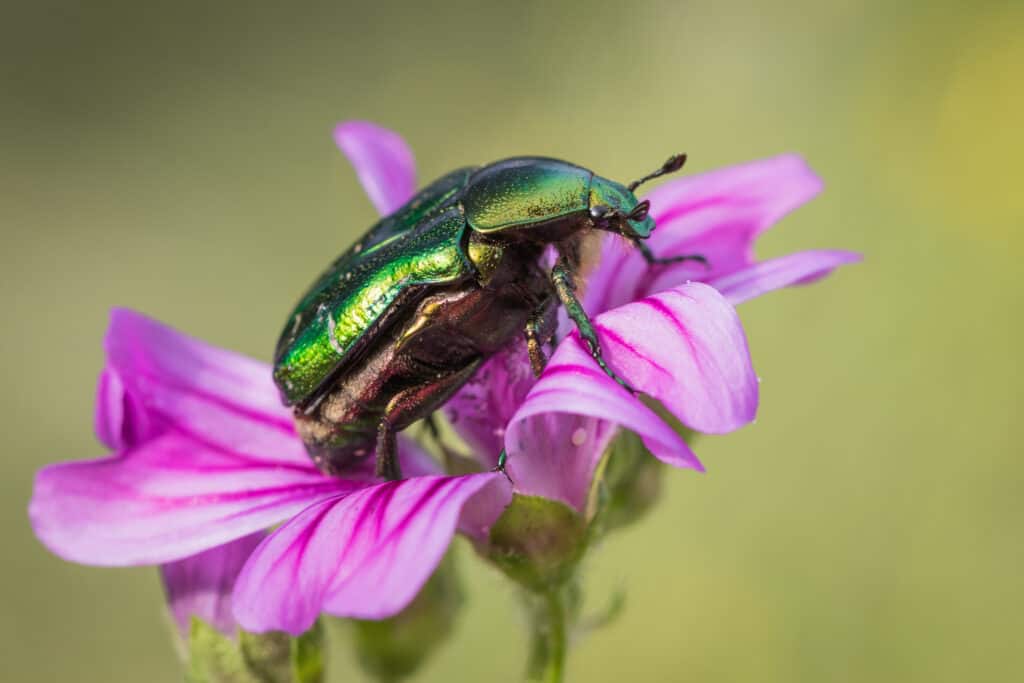
The figeater beetle is a type of scarab beetle native to North America.
©Virginie Merckaert/Shutterstock.com
These beetles are native to the Southwestern United States, often found in places where they can eat a variety of plants. These pests eat figs along with other ripe fruits like grapes and berries.
Emerald Ash Borer
The emerald ash borer (Agrilus planipennis) is a very destructive beetle. Originating in Asia, these beetles were first identified in the U.S. in 2002, but they may have arrived in the early 1990s. Their name is often shortened to EAB.
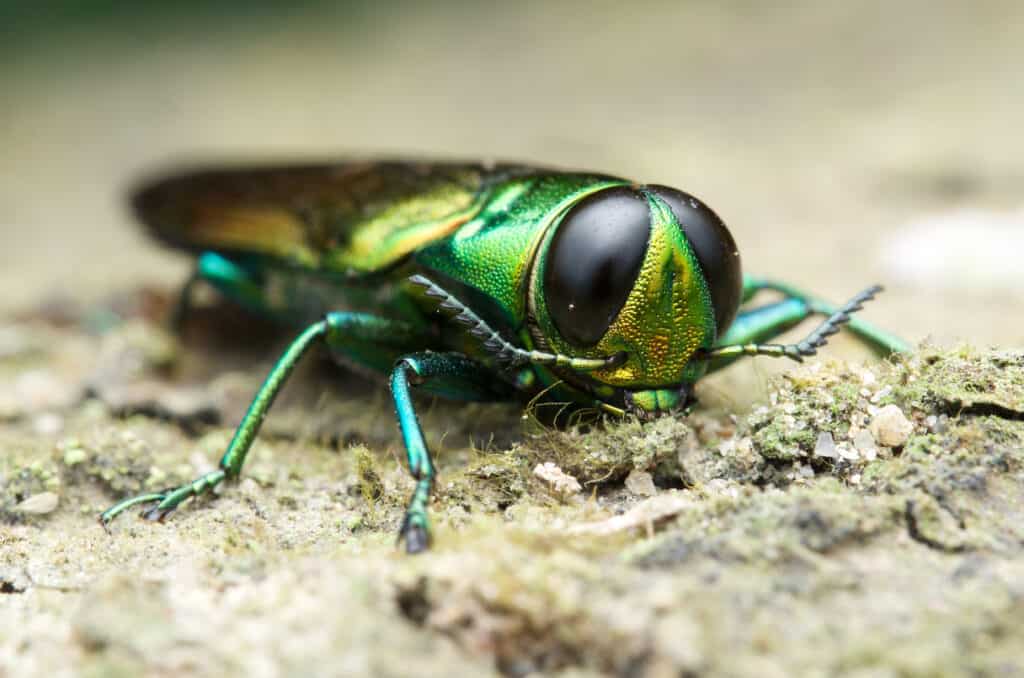
The emerald ash borer is an incredibly destructive beetle species.
©Herman Wong HM/Shutterstock.com
These beetles are small, measuring approximately 1/3 to 3/4 inch in total length. As the species name suggests, these beetles are emerald green and shimmery when looked at from above. They have a brown-green coloration on their abdomens.
EABs are certainly the most harmful types of green beetles because they bore into the wood of ash trees as larvae. They consume the tree’s inner tissue, causing great damage. Also, woodpeckers will often strip the bark of the trees that they’ve infested. An estimated 100 million trees have fallen victim to EAB attacks, and many more will die as the insect spreads.
Green June Beetle
The green June beetle (Cotinis nitida) has a distinct look. They have metallic, emerald-colored elytra with a golden-brown border along the wings and thorax. These shiny insects grow to about 0.87–1.02 inches long. They’re found throughout Canada and the United States, including just about every state east of Texas.
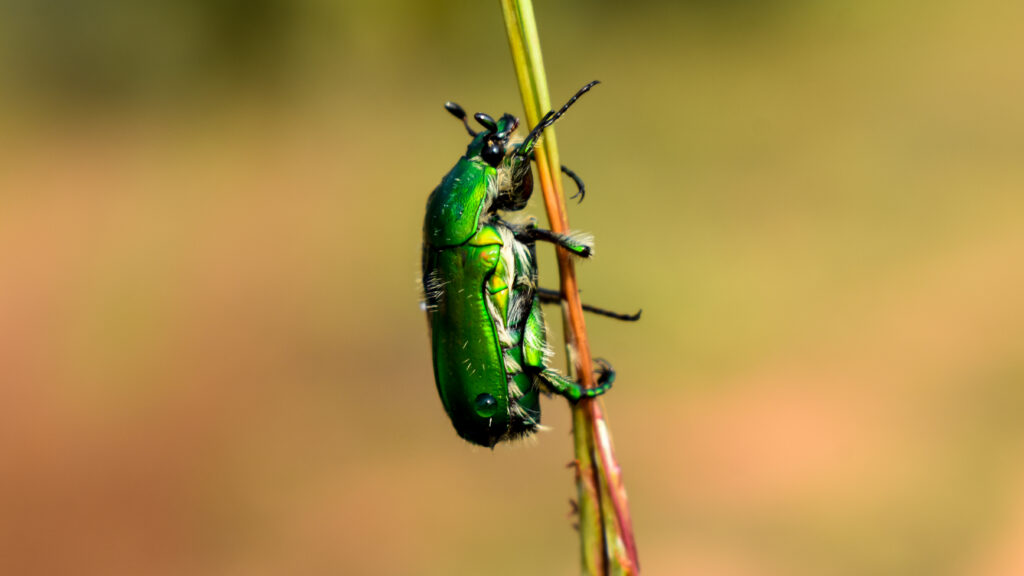
Green June beetle on a twig.
©Sudhakar Bisen/Shutterstock.com
As their name implies, they appear in the late spring and early summer.
Dogbane Leaf Beetle
The dogbane leaf beetle (Chrysochus auratus) is another metallic green beetle. This beetle has iridescent green elytra, thorax, head, and legs. Its elytra can contain other colors like red or copper too. The dogbane leaf beetle doesn’t grow very large, only about 0.3 to 0.5 inches long.
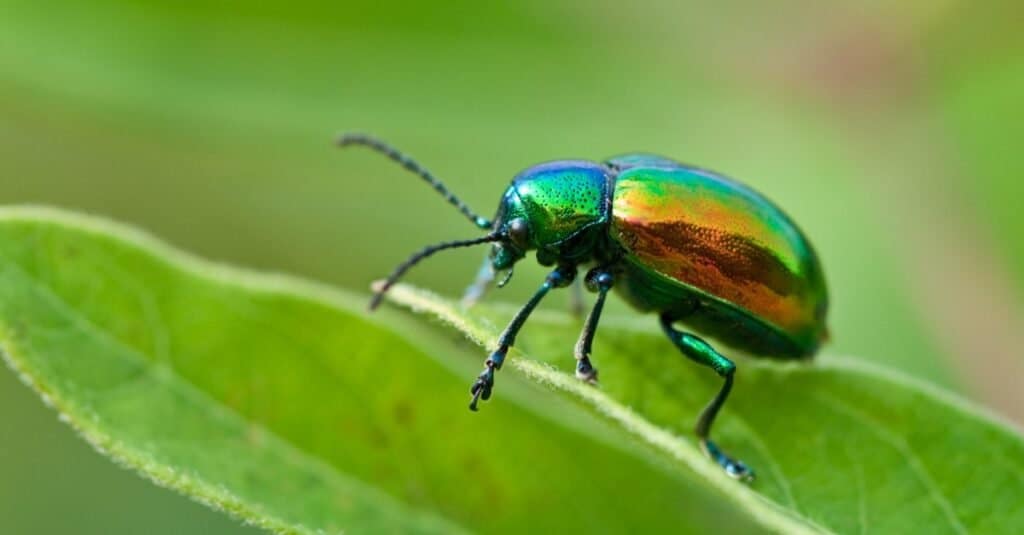
Dogbane beetles feed on toxic dogbane leaves – bright iridescence on the beetles warns predators against attack.
©Gerry Bishop/Shutterstock.com
Dogbane beetles eat the plant dogbane, one of many members of the Apocynum genus that are dangerous to humans and many other animals.
Six-Spotted Tiger Beetle
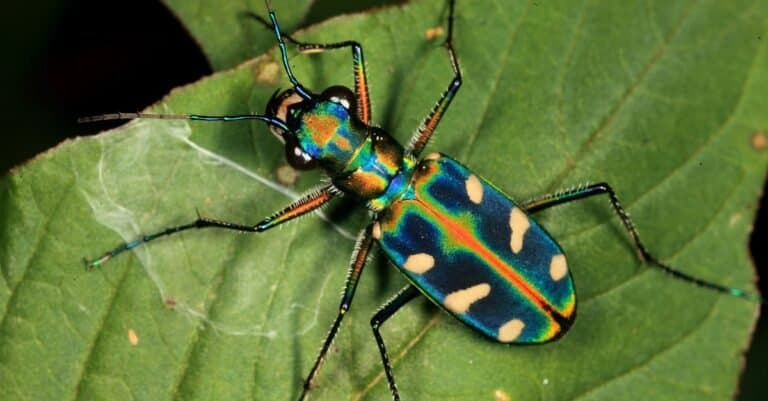
The six-spotted tiger beetle (Cicindela sexguttata) is known for its long legs and antennae as well as its relatively large eyes. These beetles are emerald green on their elytra, thoraxes, heads, and portions of their legs. They also have three white spots on each of their wings in most cases.
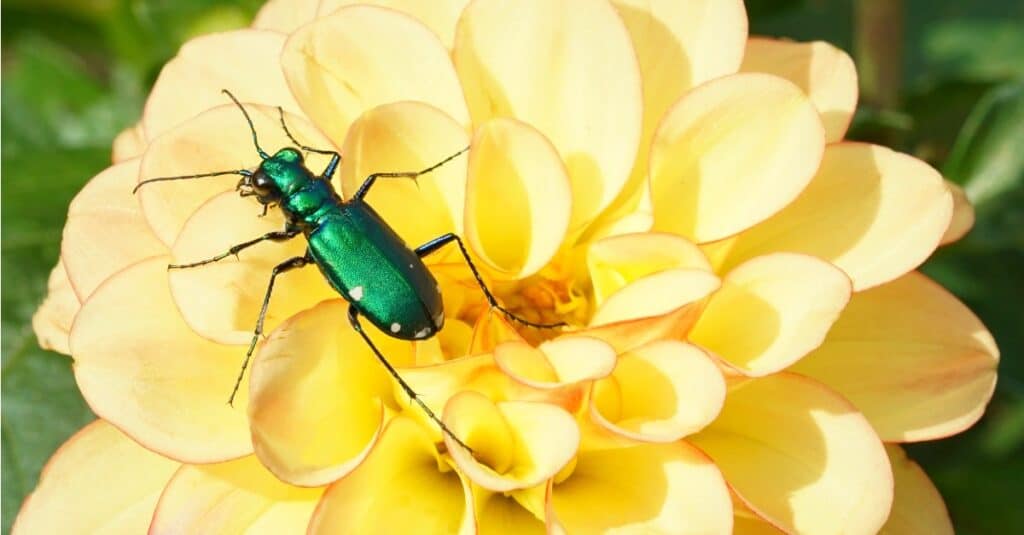
The unique colors of the tiger beetle are created by pigments in the exoskeleton and then refracted by its unique surface.
©iStock.com/Christiane Godin
These beetles have white hairs protruding from the upper part of their legs as well. Although green is a very common color in this species, it can also be blue or purple.
Fiery Searcher Caterpillar Hunter
The fiery searcher caterpillar hunter (Calosoma scrutator) is between 1 and 1.4 inches long, and it can be found throughout most of Eastern North America.
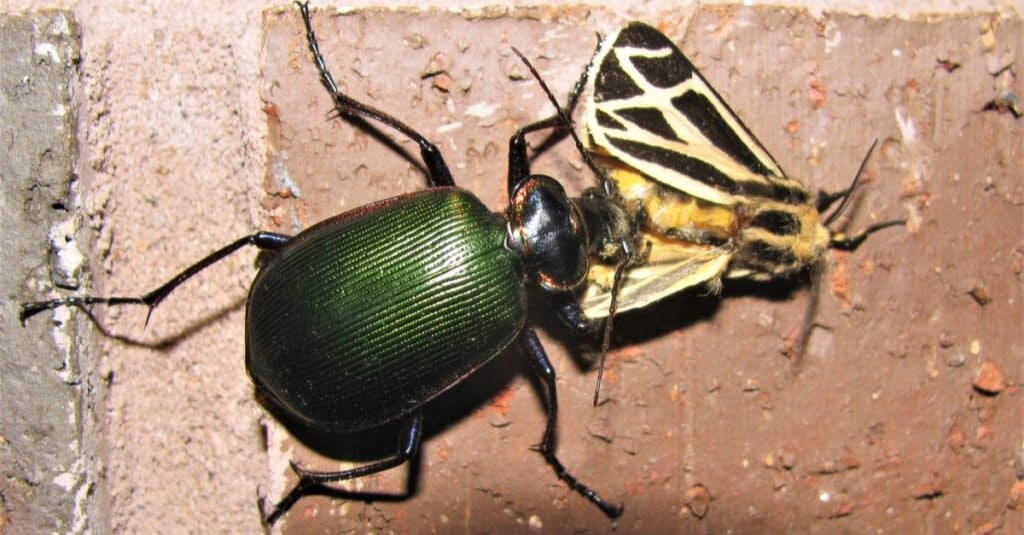
A fiery searcher eating a tiger moth at a porch light.
©Kevin Jarrell/Shutterstock.com
Fiery searcher caterpillar hunters have green elytra and thoraxes with a range of colors and a gold border. As their name suggests, fiery searcher caterpillar hunters specialize in hunting down and eating caterpillars. This makes them beneficial to have around your home and garden.
Jewel Weevil
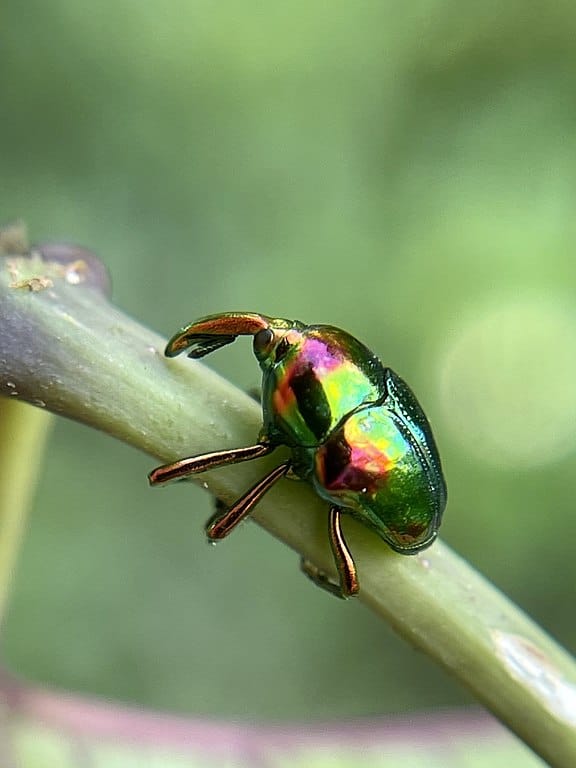
The tiny jewel weevil is less than a quarter inch in length.
©Sandra H Statner / CC BY 4.0, Wikimedia Commons – Original / License
The jewel weevil (Eurhinus magnificus) is a gorgeous beetle that originated in Central America and made its way to Florida in the early 2000s. Many other creatures are also called jewel weevils or jewel beetles.
These beetles are very small, measuring less than a quarter of an inch in length. However, they are shiny, metallic-looking insects with green and many other colors on their bodies. They’re garden pests that eat vining plants, but the extent of their potential for destruction is not currently known.