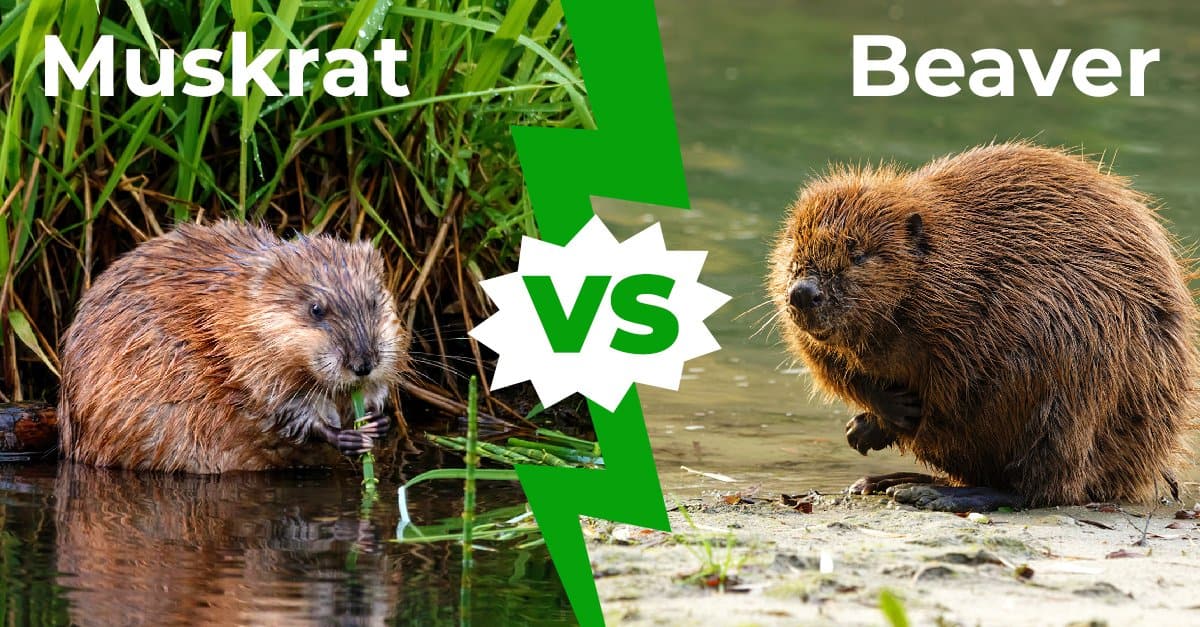

Beavers and muskrats look strikingly similar and are easily confused due to their stout, furry brown bodies and love of water. Yet, just how alike are they? How are they different? Although they are both rodents, there is a vast difference in their size. They also have different habitats, ecological roles, and social behavior. Keep reading to discover the key differences between a muskrat vs. a beaver.
Comparing Muskrats vs. Beavers
Although muskrats and beavers are both rodents, they belong to different families. There is just one species of muskrat, Ondatra zibethicus, and it is part of the Cricetidae family. This family also includes hamsters, some species of rats and mice, and voles. Beavers are the only members of the Castoridae family. It includes both American beavers, Castor canadensis, which are native to North America, and Eurasian beavers, Castor fiber, found primarily in Europe with scattered populations in Asia.
The chart below details the main differences between a muskrat vs. a beaver.
| Category | Muskrat | Beaver |
|---|---|---|
| Size | 1.5 to 4 pounds; 16-25 inches long | 35 to 65 pounds; 36-48 inches long |
| Physical Characteristics | Soft, dense, brownish-gray hair with oily guard hairs; partially webbed feet | Thick, dense, reddish-brown to black fur with long, glossy guard hairs; fully webbed feet |
| Tail | Long and thin; half of its body length | Wide, flat, and scaly; paddle-shaped |
| Habitat | Marshes, swamps, and wetlands in North America; small lodges built from vegetation | Ponds, streams, lakes, and rivers in North America, Europe, and Asia, depending on species; large, elaborate lodges built from logs and sticks |
| Ecological Roles | Do not build dams; eat aquatic vegetation to improve water quality and diversity | Build dams to create habitats and resources for a variety of animals |
| Diet | Omnivore | Herbivore |
| Social Behavior | More solitary, territorial, may live in loose colonies | Highly social, live in long-term family units |
Differences in Appearance
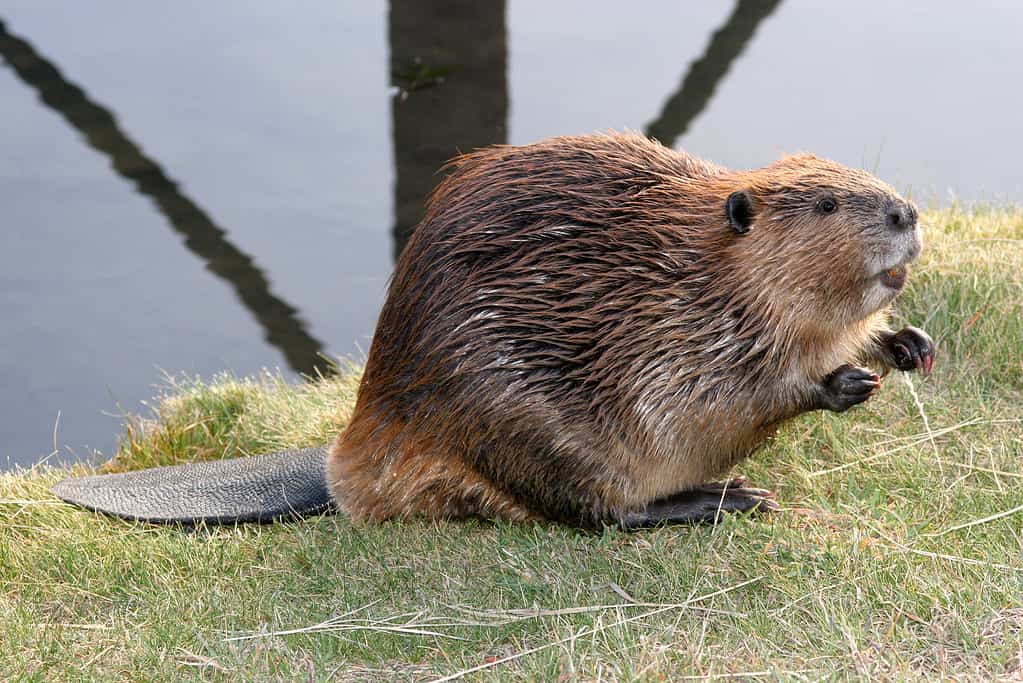
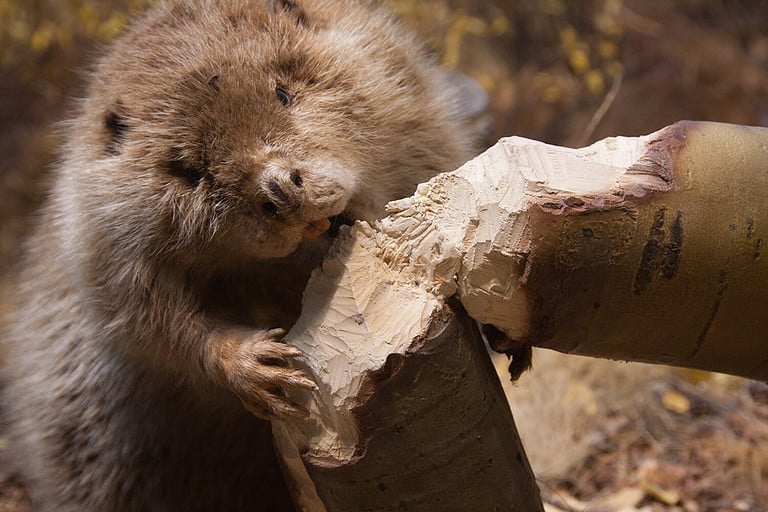
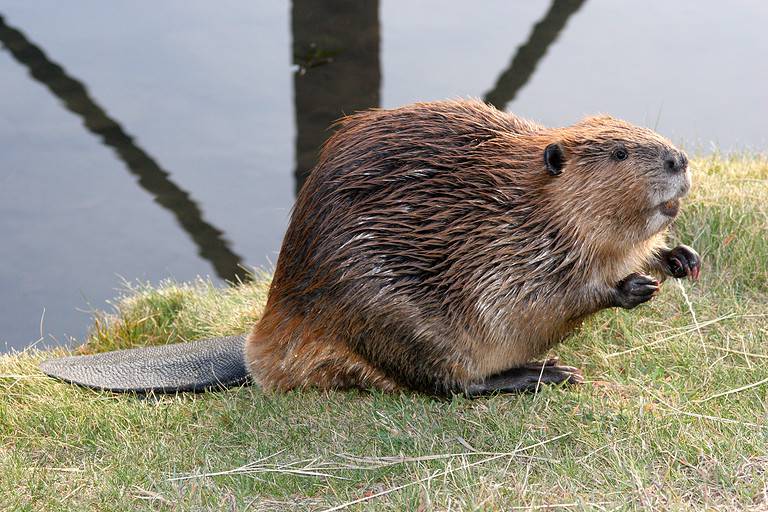
The largest beavers can weigh over 15 times more than a muskrat.
©iStock.com/webmink
The most noticeable difference between muskrats and beavers is their respective sizes. There are also differences in their physical characteristics and tail shapes that make it easy to tell these animals apart. Take a closer look at these differences below.
Size
Beavers are much larger and heavier than muskrats. Beavers typically weigh from 35-65 pounds, but the largest beaver on record weighed 110 pounds. They usually grow to 3–4 feet in length and stand about 1–1.5 feet tall.
Muskrats generally weigh only 1.5–4 pounds. Including their tails, they can reach about 2 feet in length and stand about 5–7 inches tall.
Physical Characteristics for Swimming
Muskrats have a soft, dense, brownish-grey coat with oily guard hairs over their undercoats to help repel water. Beavers also have thick, dense fur, but the color and the texture are somewhat different. Beavers have reddish-brown to black fur with long, glossy guard hairs over a soft, dense undercoat. The undercoat provides insulation, while the outer coat helps keep them dry.
Both beavers and muskrats are excellent swimmers and are often spotted in the water. However, there is a big difference in how they appear while swimming. When a muskrat swims, its head, back, and tail can be seen on the surface of the water. However, when a beaver swims, the only part of it that is visible is its head. Beavers have large, webbed hind feet, but muskrats’ feet are only partially webbed.
Tail Shape
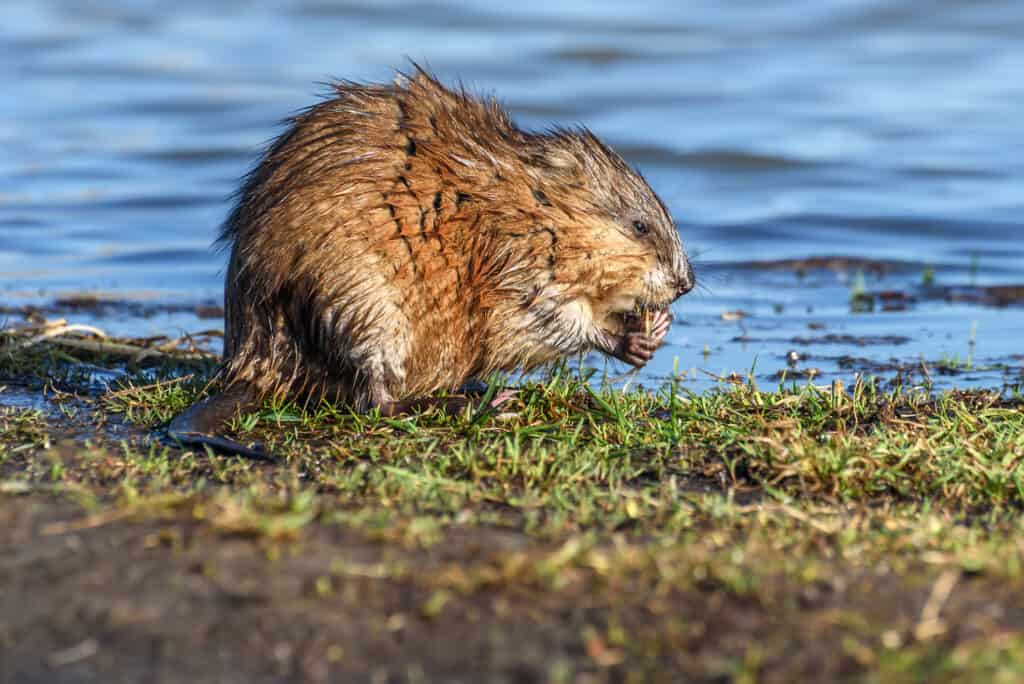
Muskrats have long, thin tails more like other rodents.
©iStock.com/Iri_sha
Another easy way to differentiate between a muskrat and a beaver is by looking at their tails. Beavers have an extremely wide, flat tail that is shaped like a paddle and covered in scales. Their tails can reach about 10-13 inches long and 6-8 inches wide. They often use their tails as rudders when swimming. Beavers also slap their tails on the water to warn others of danger. They can even store fat in their tails as an energy reserve for the winter.
In contrast, muskrats have a very long and skinny tail, more like that of a rat. Their tails are covered in scaly skin, but unlike a rat’s, they are not rounded. Instead, muskrat tails are vertically flattened — opposite to the beaver’s horizontally flattened tail — and measure 7-12 inches long. Muskrats also use their tails to aid in steering while in the water, as well as balance while on land.
Differences in Behavior
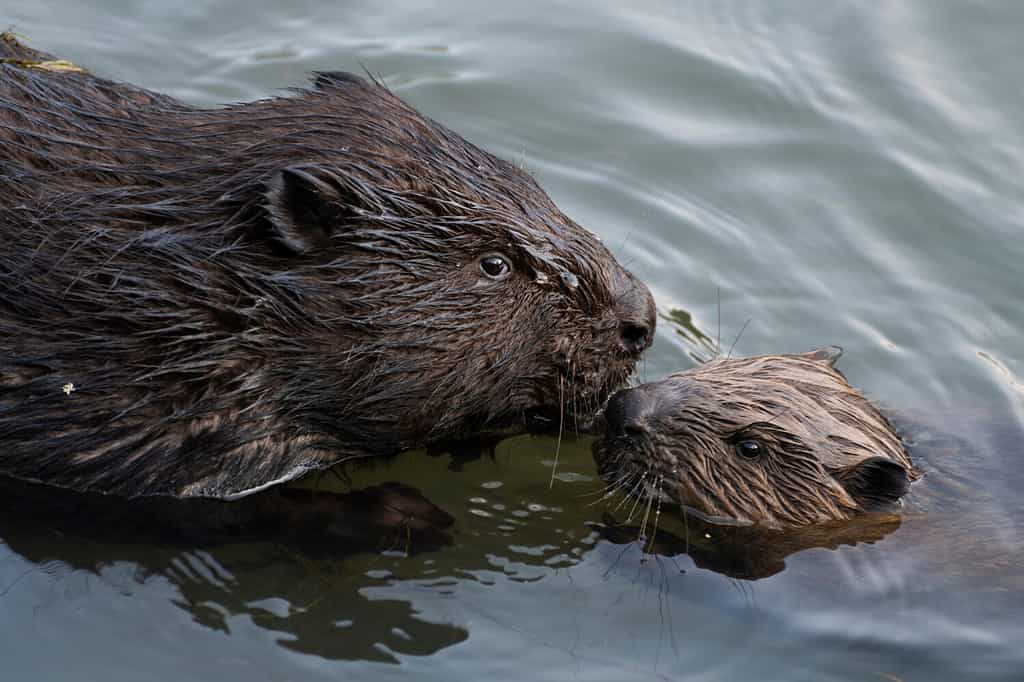
Beavers are more social than muskrats.
©Oksana Golubeva/Shutterstock.com
Physical differences are not the only way to tell these rodents apart. Muskrats and beavers can also be distinguished by their preferred habitats, their roles in the ecosystem, their social behavior, and their diets. Learn more about these differences in the following paragraphs.
Preferred Habitats
Muskrats and beavers both live near water, but their habitats are slightly different. Muskrats prefer still or slow-moving water found in marshes, swamps, and wetlands. They dig burrows near the water that can reach up to 45 feet long and may be used for generations. Muskrats also build lodges out of mud and vegetation, such as cattails. Their lodges may be 4–6 feet in diameter and reach 2–3 feet tall.
Beavers also prefer slow-moving freshwater ponds, streams, lakes, and rivers. However, they build elaborate lodges of logs and sticks, using mud to hold them together. The domes of their lodges can reach 6.5 feet tall and 40 feet wide. Beavers may also burrow into the banks of rivers and streams.
Roles in the Ecosystem
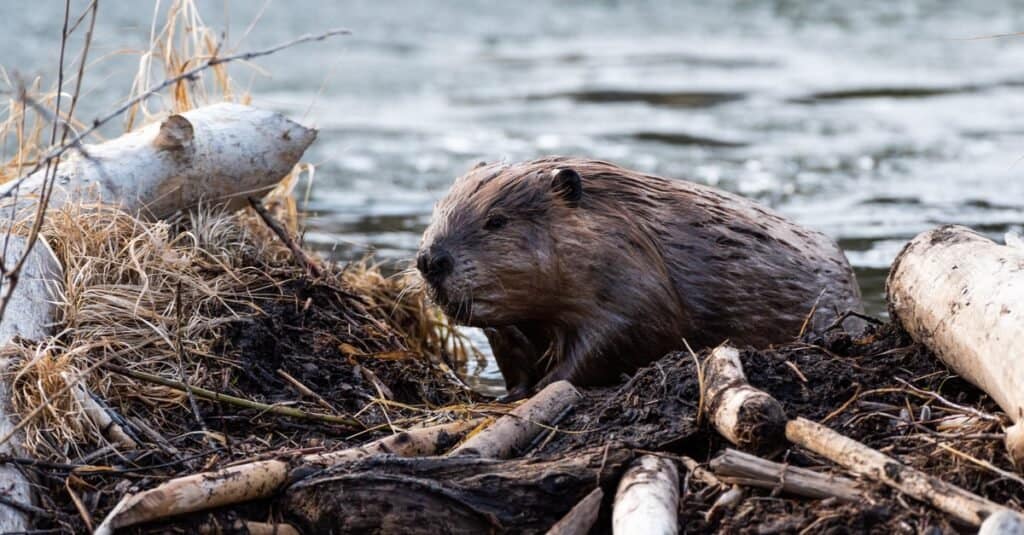
Beaver dams can help reduce erosion.
©Dan-Pepper/Shutterstock.com
Although both of these semi-aquatic rodents build lodges, muskrats do not build dams like beavers do. Beavers build dams to block off rivers and streams and create deep, standing water that won’t completely freeze at the bottom during the winter. The ponds are where they build their lodges. These ponds also reduce erosion and provide habitats and resources for other animals in the ecosystem.
Muskrats also play a role in the ecosystem. Consuming vegetation helps improve the water quality and control invasive plant species, restoring habitat diversity.
Diet
Muskrats are omnivores and eat aquatic plants such as cattails, water lilies, rushes, and pondweed. They also eat small fish, frogs, snails, clams, and mussels.
Beavers are strict herbivores. They eat only aquatic plants, bark, leaves, and twigs. Beavers feed on the cambium layer of woody plants. Some of their favorite building materials are also their favorite foods: aspen, alder, poplar, cherry, birch, willow, and maple trees.
Social Behavior
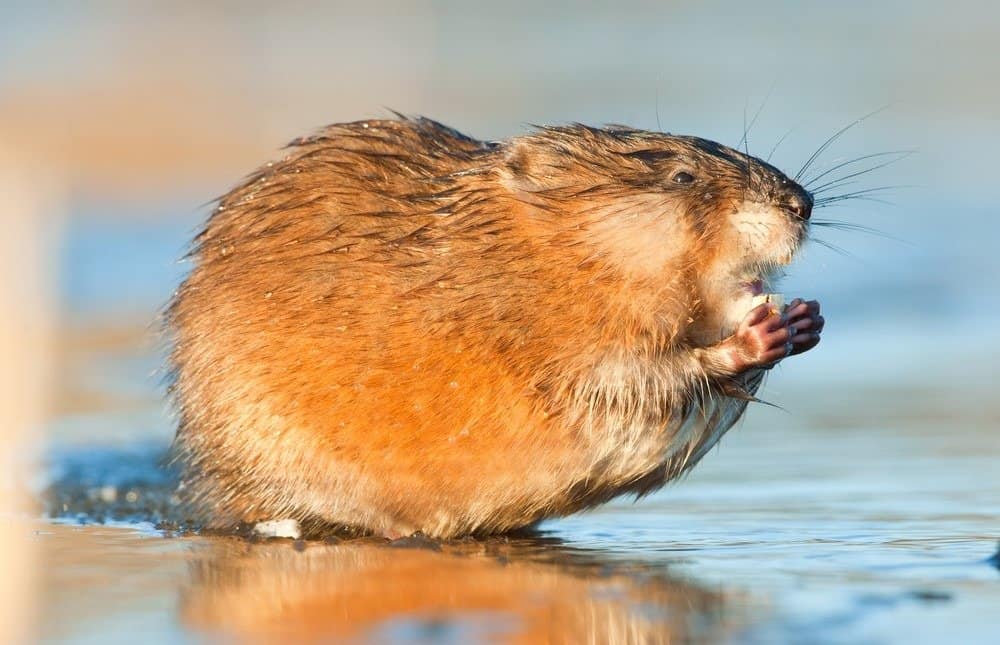
Muskrats are solitary outside of the breeding season.
©Sergey Uryadnikov/Shutterstock.com
Muskrats are more solitary unless it is the breeding season. Then, breeding pairs become territorial and often exhibit hostile behavior. Monogamous couples may briefly live with their offspring. They may also live in loose colonies and form hierarchies if there is a high population density. Muskrats may share a den during the winter to conserve heat. Young muskrats are forced from the den after weaning at about six weeks of age.
Beavers are highly social and have clear hierarchies. They live in family groups consisting of a monogamous breeding pair, their youngest offspring, and yearlings. They can be territorial, but they are not as aggressive as muskrats. Beaver young stay with their families for about two years before leaving to establish their own territories.