

T
Species Profile

Tiger Beetle

Cicindelidae

Sprint hunters of sunlit ground
iStock.com/Rachel Miller

Tiger Beetle Distribution

Click a location to explore more animals from that region

Loading map...
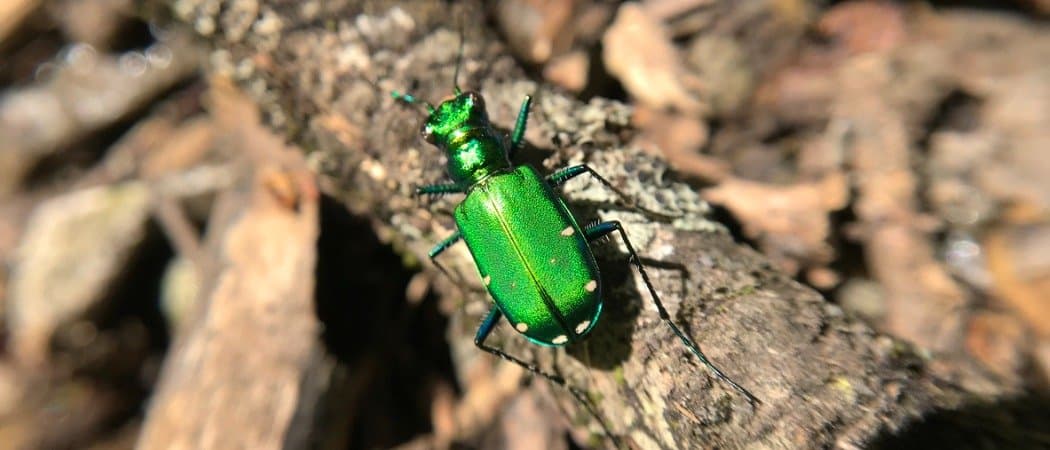
tiger beetle climbing on wood

At a Glance

Family Overview This page covers the Tiger Beetle family as a group. Stats below are general traits shared across the family.
Activity Diurnal+
Lifespan 2 years
Weight 0.005 lbs
Status Not Evaluated
Did You Know?

Across the group, adults range roughly 0.4-6 cm long, from tiny sand runners to huge African species with oversized jaws.

Scientific Classification

Family Overview "Tiger Beetle" is not a single species but represents an entire family containing multiple species.

Tiger beetles are fast-running, visually oriented predatory beetles known for powerful jaws and rapid pursuit of prey. Both adults and larvae are carnivorous; larvae often hunt from vertical burrows. They occur worldwide, especially in open, sunny habitats with bare ground.

Kingdom
Animalia
Phylum
Arthropoda
Class
Insecta
Order
Coleoptera
Family
Cicindelidae

Distinguishing Features

  • Large forward-facing eyes
  • Long legs for rapid running
  • Sickle-like mandibles
  • Often metallic or patterned elytra
  • Larvae ambush from burrows

Physical Measurements

Males and females differ in size

Length
1 in (0 in – 2 in)
Weight
0 lbs (0 lbs – 0 lbs)
Top Speed
6 mph
running

Appearance

Primary Colors
Secondary Colors
Skin Type Hard elytra
Distinctive Features
  • Adult body length ~0.3-6 cm across tiger beetles.
  • Large bulging compound eyes; strongly visual, day-active hunters.
  • Long cursorial legs and narrow waist-like pronotum for sprinting.
  • Prominent sickle-like mandibles; powerful bite for subduing prey.
  • Elytra often metallic with pale spots or broken transverse bands.
  • Head typically wider than pronotum; neck-like constriction behind eyes.
  • Larvae are pale, stout, with dorsal hooks on abdominal hump.
  • Larvae ambush from vertical burrows with flat, camouflaged heads.
  • Color and markings vary strongly with habitat substrate and latitude.
  • Taxonomy varies: treated as Cicindelidae or Cicindelinae within Carabidae.

Sexual Dimorphism

Dimorphism is usually subtle across Cicindelidae, commonly involving foreleg tarsi and sometimes mandible proportions. Males often show expanded adhesive pads for grasping females; females may be slightly larger-bodied in some species.

  • Fore tarsi often expanded with adhesive pads for mating grip.
  • In some taxa, relatively more robust or longer mandibles.
  • Often slightly broader abdomen for egg production.
  • Body size can be marginally larger in some species.

Did You Know?

Across the group, adults range roughly 0.4-6 cm long, from tiny sand runners to huge African species with oversized jaws.

Life cycles vary widely: many take 1-4+ years from egg to adult, while adults may live weeks to months.

Some tiger beetles clock among the fastest insects for their size, sprinting so quickly they briefly "overshoot" visual tracking.

Both adults and larvae are carnivores; larvae typically wait in vertical burrows and ambush prey at the surface.

Habitats are highly specialized across species: beaches, dunes, salt flats, riverbanks, clay pans, forest paths, and deserts.

Taxonomy varies by source: often treated as their own family, but sometimes as a subfamily within the ground beetle family.

Unique Adaptations

  • Large, forward-facing compound eyes and rapid visual processing support high-speed pursuit and precise prey strikes.
  • Powerful, sickle-shaped mandibles slice and pin prey; in some species, enlarged jaws are also used in contests.
  • Larval abdominal hooks act like grapples, anchoring the larva in its burrow when struggling with large prey.
  • Long legs and specialized tarsal grip help maintain traction on loose sand, mudflats, or hard-packed clay.
  • Coloration ranges from matte cryptic browns to metallic greens and blues, matching different soils and aiding camouflage or signaling.

Interesting Behaviors

  • Adults commonly hunt by sight in open sun, chasing down small arthropods; some species switch to dusk or night activity.
  • Many species "patrol" and defend small hunting areas, repeatedly running the same routes across bare ground and stopping to scan.
  • Larvae ambush from burrow mouths, striking passing prey and dragging it down to feed in safety.
  • Thermoregulation is constant: beetles bask, seek shade, climb debris, or change body angle to avoid overheating.
  • Dispersal varies greatly: some fly readily between patches, while flightless lineages remain isolated and strongly localized.

Cultural Significance

Tiger beetles are celebrated by naturalists as "jewel" predators and are widely used as bioindicators of habitat quality, guiding conservation of beaches, dunes, and riverbanks.

Myths & Legends

Children's folklore says 'doodlebug' tiger beetle larvae seize a grass blade dangled into their burrow and can be gently pulled out.

English natural history popularized "tiger beetle" as a vivid nickname, comparing their speed and fierce jaws to a hunting tiger.

In Victorian-era insect collecting, brightly metallic tiger beetles were prized cabinet specimens, emblematic of the era's fascination with exotic, beautiful insects.

You might be looking for:

Green tiger beetle

22%

Cicindela campestris

Widespread Palearctic species; metallic green adults on sandy heaths and paths; a classic “tiger beetle” often referenced in Europe.

Six-spotted tiger beetle

20%

Cicindela sexguttata

Common eastern North American woodland-edge species; bright metallic green with pale spots; frequently cited in North American field guides.

Northeastern beach tiger beetle

12%

Cicindela dorsalis dorsalis

Coastal dune/beach specialist in northeastern North America; conservation concern due to habitat loss and disturbance.

Australian tiger beetles

10%

Pseudotetracha spp.

Prominent Australian lineage; often nocturnal and fast-running; commonly encountered in regional guides under “tiger beetles.”

Salt flat tiger beetles

8%

Eunota spp.

North American group associated with saline flats and alkali habitats; includes several localized and threatened taxa.

Life Cycle

Birth 50 larvas
Lifespan 2 years

Lifespan

In the Wild
1–4 years
In Captivity
1–3 years

Reproduction

Mating System Polygynandry
Social Structure Solitary
Breeding Season Spring through late summer; year-round in tropics
Breeding Pattern Transient
Fertilization Internal Fertilization
Birth Type Internal_fertilization

Across tiger beetles, adults typically mate opportunistically after visual pursuit and contact; males often attempt repeated copulations and may guard females briefly. Both sexes can mate with multiple partners, and females lay eggs singly with no parental care.

Behavior & Ecology

Social Aggregation Group: 2
Activity Diurnal, Crepuscular, Matutinal, Vespertine, Nocturnal
Diet Insectivore ants
Seasonal Hibernates

Temperament

Wary
Territorial
Aggressive
Bold

Communication

stridulation
wing buzzing
visual tracking
pursuit displays
pheromone cues
contact chemoreception
tactile contact
substrate vibrations

Habitat

Biomes:
Tropical Rainforest Tropical Dry Forest Savanna Desert Hot Desert Cold Mediterranean Temperate Grassland Temperate Forest Temperate Rainforest Boreal Forest (Taiga) Tundra Alpine Freshwater Marine Wetland +9
Terrain:
Plains Valley Plateau Hilly Mountainous Coastal Island Riverine Rocky Sandy Muddy Volcanic Karst +7
Elevation: Up to 14763 ft 9 in

Ecological Role

Active predatory mesopredators regulating arthropod communities in open, sunny habitats

arthropod population control food web support bioindicator of habitat quality

Diet Details

Main Prey:
Other Foods:
Small insects Arthropods

Human Interaction

Domestication Status

Wild

Tiger beetles (Cicindelidae) have no domestication history. Across their worldwide range they've been interacted with mainly through collecting, natural history study, and conservation, rather than being bred for food, labor, or companionship.

Danger Level

Low
  • Painful pinch if handled
  • Allergic reaction to bites
  • Startle/eye irritation from flying into face

As a Pet

Not Suitable as Pet

Legality: Usually legal; wildlife collecting permits may apply.

Care Level: Expert Only

Purchase Cost: Up to $150
Lifetime Cost: $50 - $600

Economic Value

Uses:
Research Education Tourism Conservation
Products:
  • specimens
  • media

Relationships

Predators 7

Shorebirds and plovers Charadriiformes
Flycatchers and other insectivorous birds Muscicapidae
Lizard
Lizard
Frogs and toads
Frogs and toads Anura
Spider
Spider Araneae
Robber flies
Robber flies Asilidae
Hunting wasps

Related Species 8

Cicindela Cicindela Shared Family
Calomera Calomera Shared Family
Eunota Eunota Shared Family
Pseudotetracha Pseudotetracha Shared Family
Tetracha Tetracha Shared Family
Manticora Manticora Shared Genus
Amblycheila Amblycheila Shared Genus
ground beetles Carabidae Shared Family

Ecological Equivalents 5

Animals that fill a similar ecological role in their ecosystem

Ground beetles Carabidae Fast, ground-hunting predatory beetles that occupy similar open terrestrial habitats.
Antlions Myrmeleontidae Larvae are sit-and-wait predators in sandy soils that use ambush tactics.
Robber flies
Robber flies Asilidae Visually oriented aerial predators that chase prey in sunny, open areas.
Wolf spiders Lycosidae Fast-running, visual hunters on bare ground that often share the same microhabitats.
Shorebirds Charadriiformes Actively hunt small arthropods on beaches and flats where tiger beetles occur.

Types of Tiger Beetle

10

Explore 10 recognized types of tiger beetle

Green tiger beetle Cicindela campestris
Six-spotted tiger beetle Cicindela sexguttata
Dune tiger beetle Calomera littoralis
White-cloaked tiger beetle Eunota togata
Mendacious tiger beetle Pseudotetracha mendacia
Virginia big-headed tiger beetle Tetracha virginica
California night-stalking tiger beetle Omus californicus
Giant tiger beetle Amblycheila cylindriformis
Northeastern beach tiger beetle Cicindela dorsalis
Sandy tiger beetle Cicindela hybrida

“The oldest fossilized tiger beetles date back some 125 million years in a region that’s now called Inner Mongolia.”

The tiger beetle is a diverse group of insects that spend most of their lives underground as larvae, waiting in ambush for prey. Upon reaching adulthood, they come up above ground to hunt and mate. The adult’s metallic iridescent shells are very conspicuous and sometimes even beautiful to see. Since they’re very sensitive to habitat destruction, their presence is usually a sign of undisturbed ecosystems.

3 Incredible Tiger Beetle Facts!

  • The popular Nintendo videogame series “Animal Crossing” allows you to catch a tiger beetle, among many other insects.
  • The female tiger beetle mates continuously throughout the season and deposits her eggs into the ground. Once it hatches, the larva creates a burrow at the site where the eggs are laid. Through a long process of molting and growing, it can take one to four years for the larva to reach adulthood. The timing of maturity can vary. Some will wait out the winter and then mate in the spring. Others mate in the summer and then make the larvae wait out the winter. The adults only live a few months before perishing at the end of their lifespan.
  • These insects have powerful mandibles. Their bite can definitely pierce the skin and draw blood.

Tiger Beetle Species, Types, and Scientific Name

The tiger beetle is classified as a subfamily of insects. This is a taxonomical level below the family (in this case, the ground beetles) but above the genus. The scientific name for this subfamily provides a very fitting description. Cicindelinae appears to come from a Latin word meaning shining or glowing, in reference to the metallic shell.

There are some 2,600 recorded species spread out across dozens of different genera. Many of them are so elusive that they haven’t been well studied or documented at all. The IUCN Red List classifies most species as data deficient. Among those that warrant classification, several species, like the Columbia River Tiger Beetle and Puritan Tiger Beetle, are endangered animals.

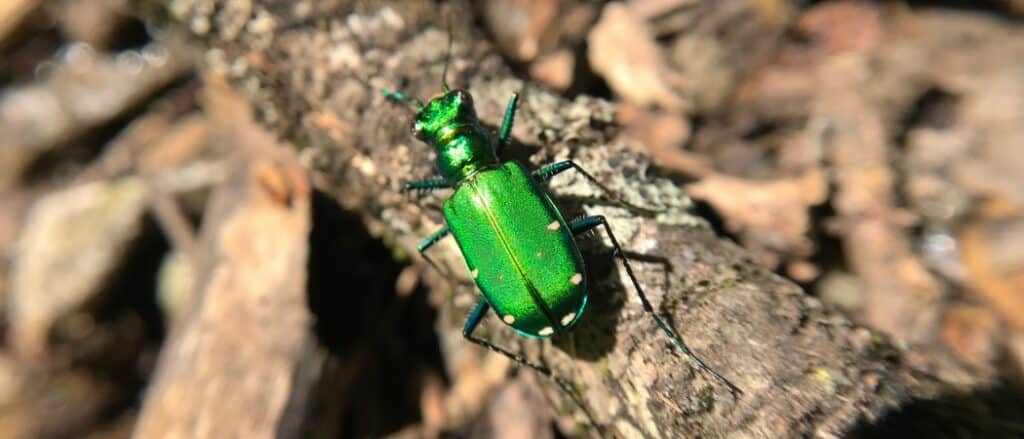
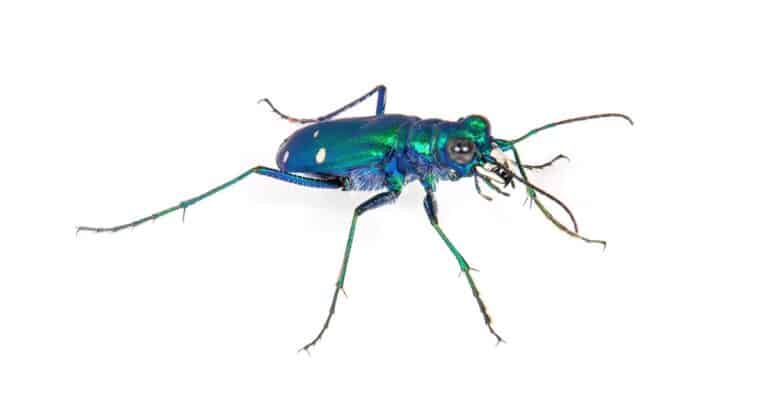
Fortunately, many other species are actually in excellent health. The six spotted tiger beetle is among the most well-known species. Native to the eastern part of North America, this species has a shiny blue-green shell and a pattern of six spotted markings.

Appearance: How to Identify the Tiger Beetle

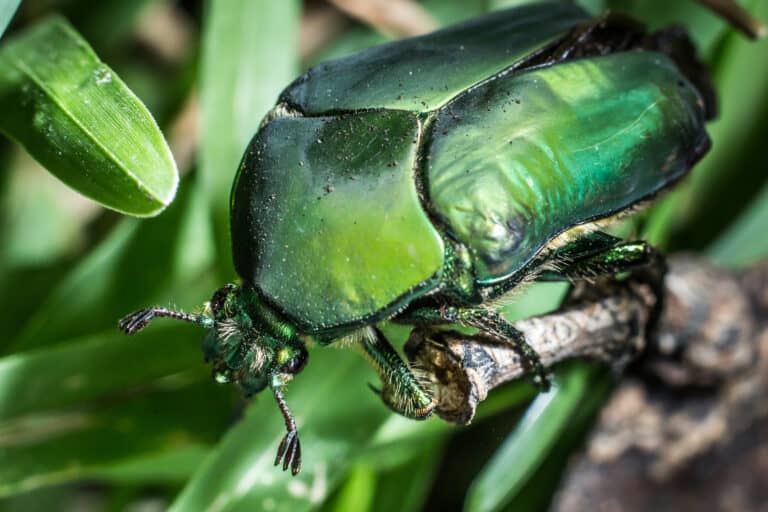
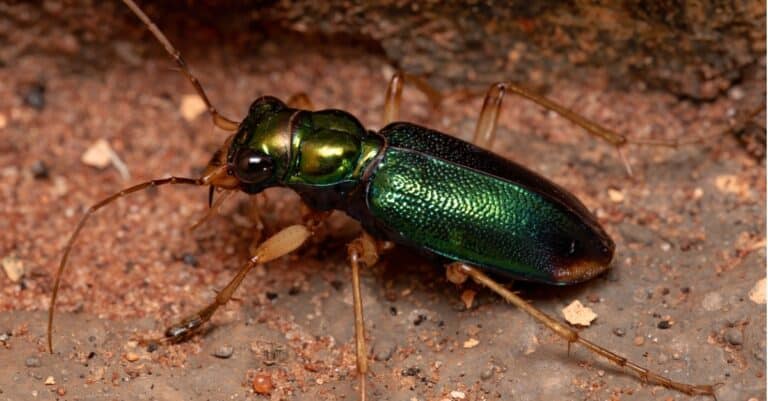
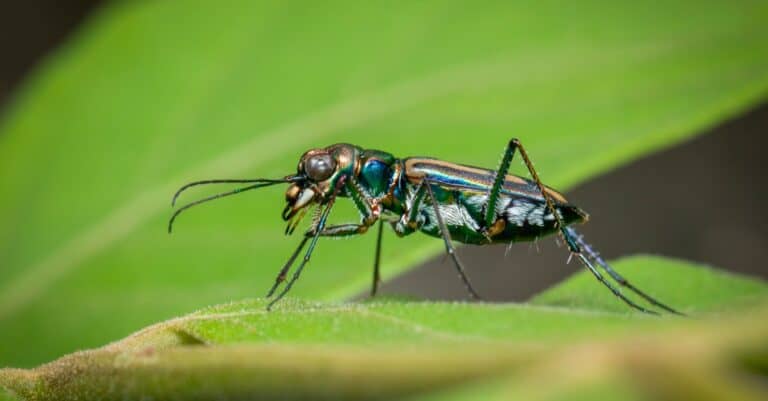
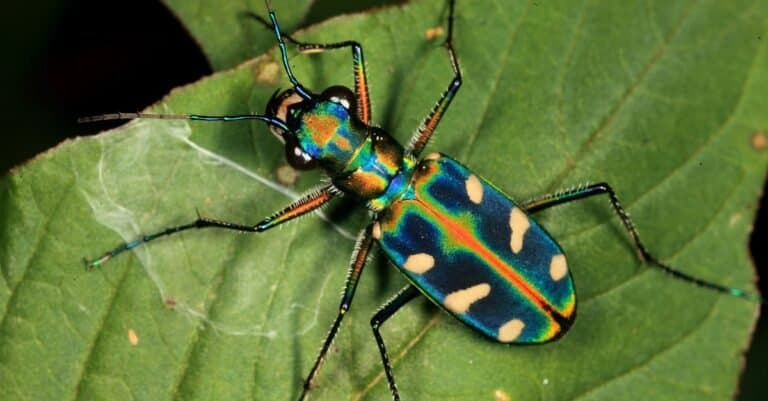
The adult tiger beetle is a segmented insect, measuring no more than an inch long, with long, slender legs, curved mandibles, and big, bulging eyes, which provide a good sense of vision. Identification can be a little difficult because they look so much like other beetles. One easy method of identification is to look at the shell. The rounded head and thorax, plus the elongated abdomen, are covered in metallic blue, green, red, or orange. These unique colors are created by pigments in the exoskeleton and then refracted by the exoskeleton’s unique surface. The wing covers on the abdomen also sometimes have marks or spots on them.

Some tiger beetles are specially adapted to match the color of their environments. The larvae, by contrast, have a standard grub-like appearance with large heads and humped backs. It normally measures just as long, if not longer, than the adult.
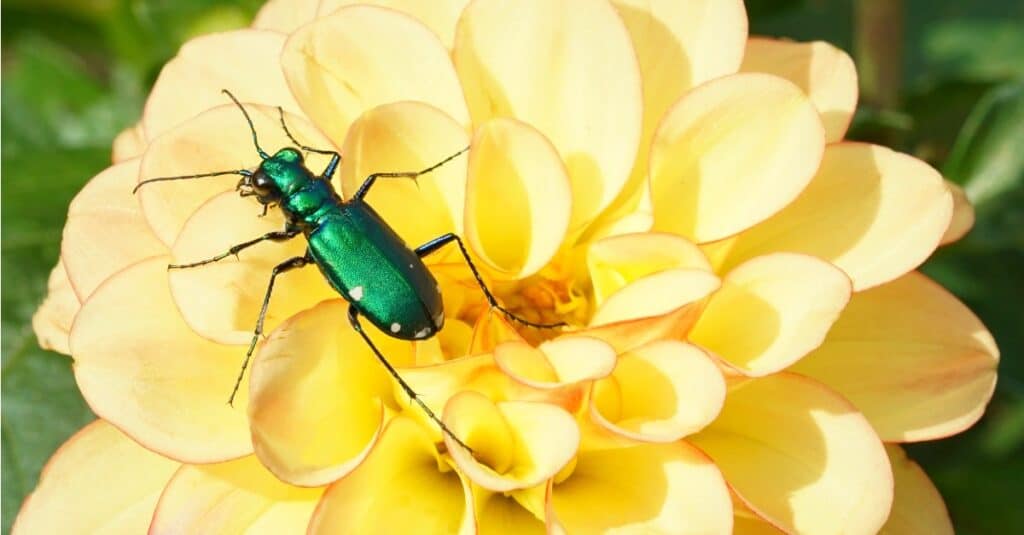
The unique colors of the tiger beetle are created by pigments in the exoskeleton and then refracted by its unique surface.

Habitat: Where to Find the Tiger Beetle

The tiger beetle lives all over the world in temperate and tropical climates, but the greatest concentration appears to occur in Southeast Asia. The larva lives in a vertical burrow, about two feet deep, and waits at the top for prey. They require fairly loose soil and sand in which to dig. Because of environmental disturbances and habitat loss, some species are becoming endangered.

Diet: What Do Tiger Beetles Eat?

The tiger beetle is a pure carnivore. It eats nothing but animal food.

What eats the tiger beetle?

The tiger beetle is consumed by larger predators such as birds, lizards, frogs, and some mammals. They can be vulnerable to parasitoid wasps and other insects as well.

What does the tiger beetle eat?

The larva will eat spiders and other insects as food. From the safety of its burrow, the larva will leap out at the prey and capture it with the mandibles. Hooks on the abdomen dig into the dirt and prevent the larva from being dragged out of its burrow. The adults hunt in a more traditional manner. They can usually hunt down live prey with their fast sprinting or flying speeds. Sometimes they will stop in mid-sprint to reorient their view. This is believed to occur because the visual information can’t be processed as quickly as they run. Their powerful bite force enables them to capture and consume their food fairly easily.

Prevention: How to Get Rid of Tiger Beetle

These insects are not considered to be a pest. While they do cause disturbances in the soil, they are normally a net benefit to the environment, because they consume other insects that are considered to be pests. If these insects are a problem in your yard, however, then you could conceivably use a chemical treatment to get rid of them. Many different insecticides will work.

View all 608 animals that start with T

Sources

  1. Britannica / Accessed October 13, 2021
  2. Missouri Department of Conservation / Accessed October 13, 2021
A-Z Animals Staff

About the Author

A-Z Animals Staff

AZ Animals is a growing team of animals experts, researchers, farmers, conservationists, writers, editors, and -- of course -- pet owners who have come together to help you better understand the animal kingdom and how we interact.
Connect:

Thank you for reading! Have some feedback for us?


Tiger Beetle FAQs (Frequently Asked Questions)

The tiger beetle is a subfamily (the taxonomical level immediately below the family) of ground beetles. The larvae spend their entire lives hiding in burrows until reaching maturity. The adults, whose Identification comes easily from the metallic iridescent shell, are usually half an inch to an inch in size. Many species are poorly studied and some are endangered.