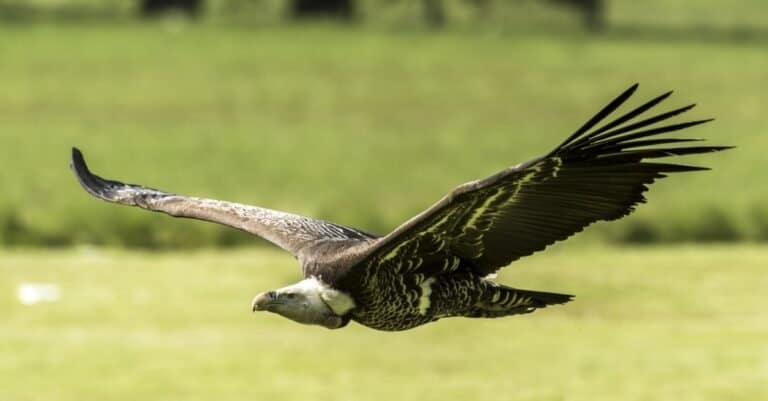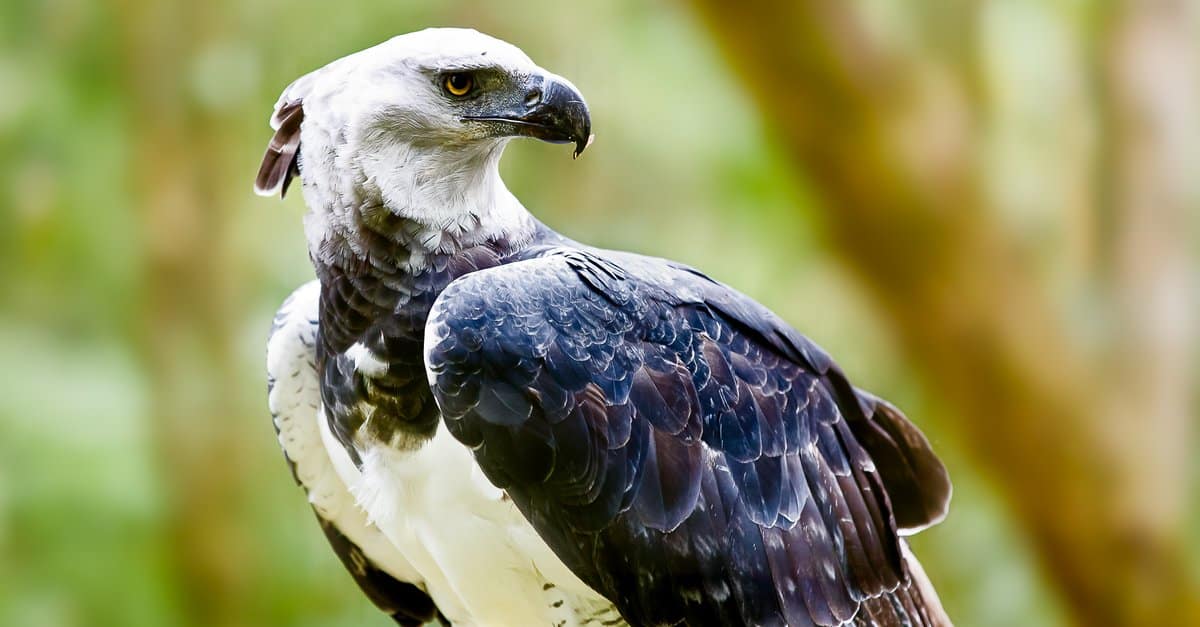

Let’s face it, some animals have cooler names than others. For example, how could the blobfish ever hope to compete with the hellbender or the goblin shark? Typically, animals get their names from a combination of variables, including their location, appearance, diet, or original discoverer. However, few animals have as fanciful and imaginative names as birds. While some, such as the dodo, could hardly be considered cool, others have truly epic names, as you’ll see on our list of 10 birds with the coolest names.
#10: Emperor Bird-of-Paradise
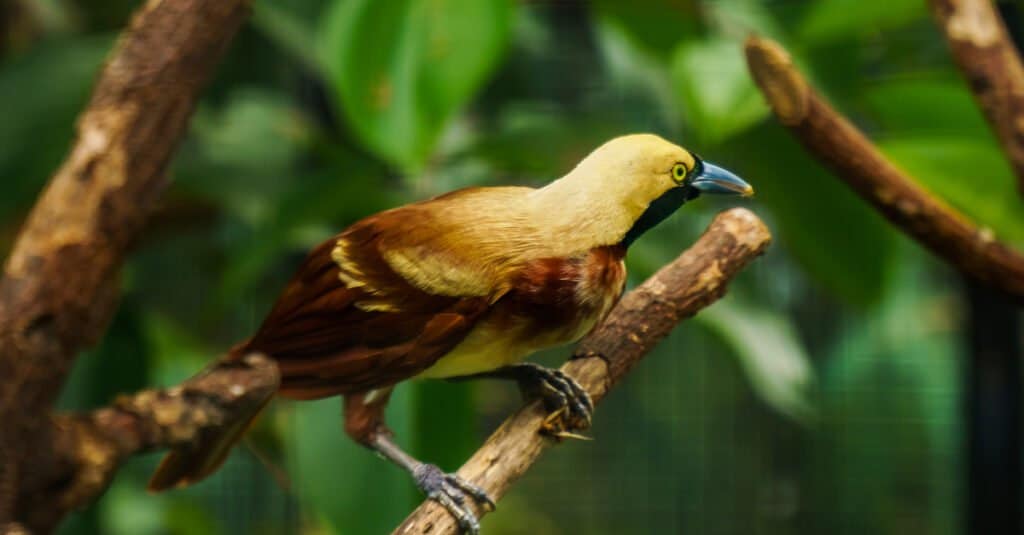
The emperor bird-of-paradise is a near-threatened species from Papua New Guinea.
©Ismail Rajo/Shutterstock.com
No list of birds with the coolest names would be complete without mentioning this bird. Also known as the emperor of Germany’s bird-of-paradise, the emperor bird-of-paradise (Paradisaea guilielmi) belongs to the family Paradisaeidae. The ornithologist Carl Hunstein named it to honor Wilhelm II of Germany, the last German Emperor and King of Prussia. Emperor birds-of-paradise live only in Papua New Guinea, where they range throughout forests in hilly regions.
On average, these birds measure about 12.9 inches long and weigh up to 9.3 ounces. They have a hooked, blue-gray bill. Males feature bright plumage including dark green faces and throats, white flank plumes, and brown tails, wings, and underparts. Their diet mostly consists of fruits such as figs, as well as a wide variety of arthropods. Due to overhunting and habitat loss, the IUCN currently lists the emperor bird-of-paradise as a Near Threatened species.
#9: Fiery-Throated Metaltail
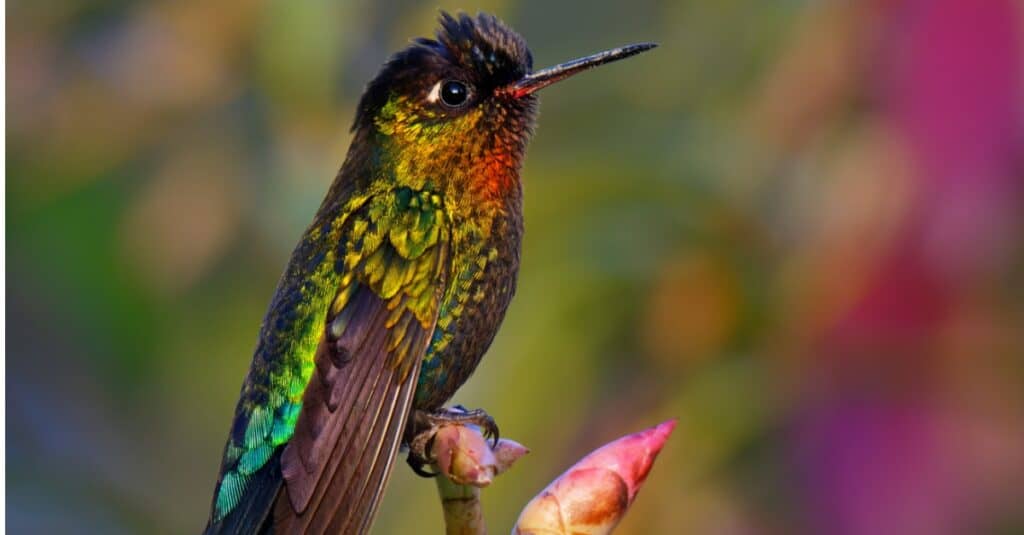
The fiery-throated metaltail lives only on the slopes of the Andes Mountains in Peru.
©Martin Pelanek/Shutterstock.com
Also known as the fire-throated metaltail, the fiery-throated metaltail (Metallura eupogon) is a member of the hummingbird family Trochilidae. It gets its name from its unique plumage, which appears metallic blue-green on the back, head, and tail, and dark red on the throat and the edges of the wings. These small birds only reach about 4.3 inches long and weigh around 0.18 ounces.
You can find these unique birds only in Peru, where they primarily inhabit humid, high-elevation forests along the slopes of the Andes mountains. Like other hummingbirds, its diet includes nectar, which it relies on to fuel its fast metabolism. In addition, they eat small insects, including beetles, mosquitoes, and spiders. While confined to a small range, they are an abundant species in their native habitat. As a result, the IUCN currently lists the fiery-throated metaltail as a species of Least Concern.
#8: Harpy Eagle
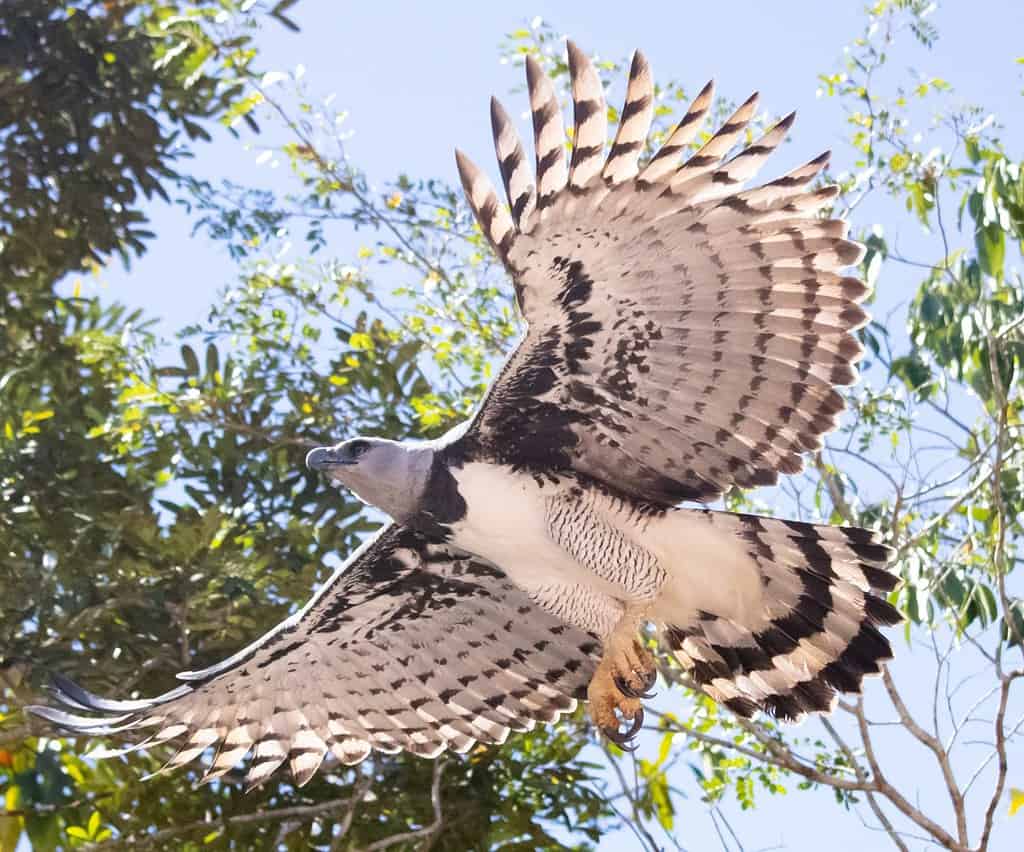
Harpy eagles are the largest eagles in the Americas.
©Alves-Silva K. R/Shutterstock.com
The next entry on our list of birds with the coolest names is also one of the deadliest. The harpy eagle (Harpia harpyja), or American harpy eagle, is a large raptor in the family Accipitridae. Its name comes from the Ancient Greek legend of the harpies, depicted as having the body of a bird and the head of a woman. Harpy eagles range throughout the tropical rainforests of Central and South America.
Harpy eagles are some of the largest raptors in the world, with females reaching up to 41 inches long and weighing up to 20 pounds. Their upper plumage is slate-black, while their underparts look white, and their heads are light gray. They have a wingspan of up to 6.5 feet. Their diet includes small mammals such as monkeys and sloths, as well as domestic livestock and smaller birds. Due to habitat loss, the IUCN lists the harpy eagle as a Vulnerable species.
#7: Vampire Ground Finch
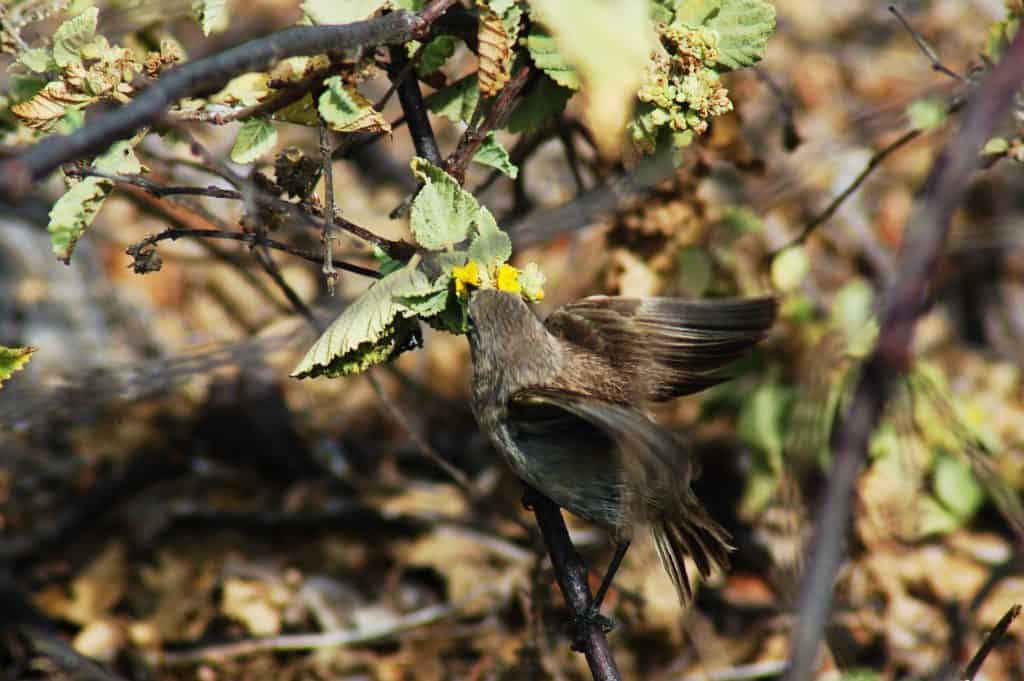
The vampire ground finch is native to the Galapagos Islands.
Despite its name, the vampire ground finch (Geospiza septentrionalis) actually belongs to the tanager family Thraupidae. You can find this curious little bird only in the Galapagos Islands, specifically the islands of Darwin and Wolf. These birds only reach 4.7 inches long and weigh a maximum of 0.71 ounces. The IUCN lists the vampire ground finch as a Vulnerable species.
The “vampire” part of the bird’s name is derived from its unusual diet. The vampire ground finch occasionally drinks the blood of other birds, particularly blue-footed and Nazca boobies, by pecking them until the skin breaks. Although the vampire ground finch’s diet is mostly seeds and insects, food can be scarce on their island habitat, so they evolved this behavior to supplement their diet. The males have almost completely black plumage, which only adds to their menacing description.
#6: Greater Flameback
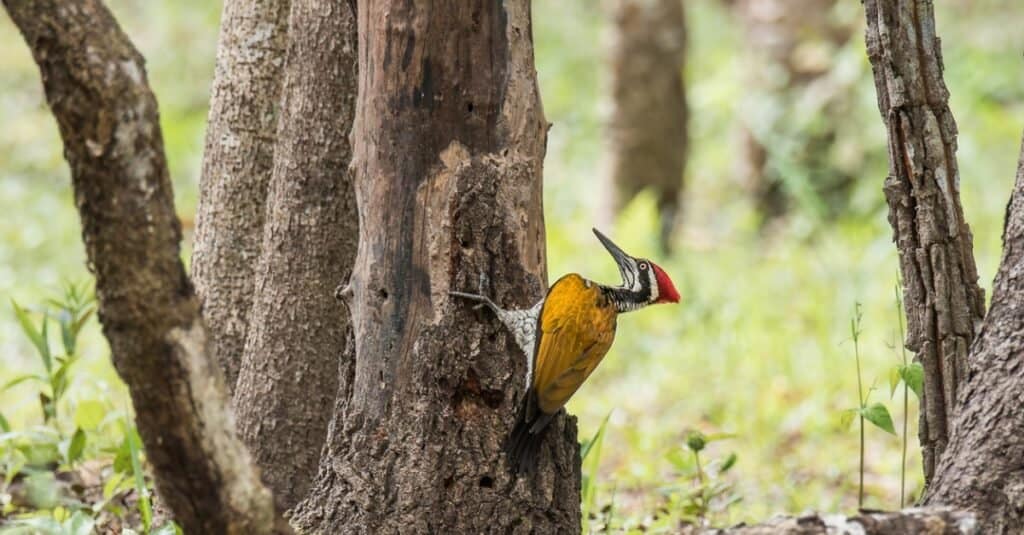
The greater flameback has bright, reddish-gold feathers on its back and a fiery red crest.
©iStock.com/Wichyanan Limparungpatthanakij
Also known as the greater goldenback, the greater flameback (Chrysocolaptes guttacristatus) is a large species of woodpecker in the family Picidae. These flashy woodpeckers live in tropical and subtropical forests throughout South and Southeast Asia. Like other woodpeckers, they use their bills to drill holes in trees to find food. Their diet mostly consists of insects and arthropods, although they also drink nectar from flowers.
These are large woodpeckers, measuring around 12.9 inches long and weighing up to 8.2 ounces. As its name implies, the greater flameback has a reddish-gold back and wings. The males always feature a large red crest. They have a mottled black-and-white neck and a black mask on their white faces. Due to its abundance in its natural range, the IUCN lists it as a species of Least Concern.
#5: Invisible Rail
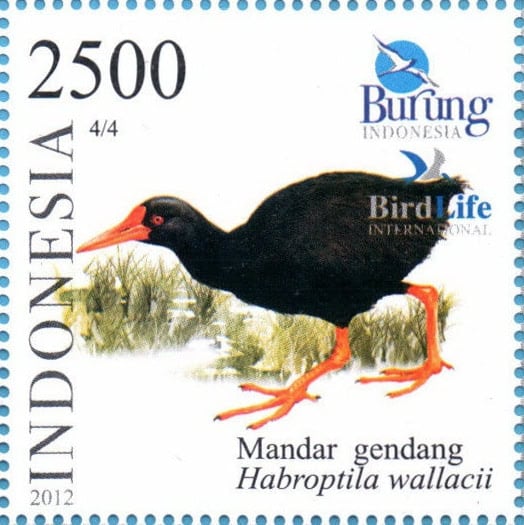
The invisible rail is a flightless bird with a red bill and red legs.
©Government of the Republic of Indonesia / Public Domain – Original / License
Among birds with the coolest names, invisible rail (Habroptila wallacii) sounds like it could also be the name of a superhero. Also known as the drummer rail, which is also a cool name, the invisible rail belongs to the rail family Rallidae. These flightless ground birds live only in swamps on the Indonesian island of Halmahera in Northern Maluku. A shy species, few confirmed sightings exist, which explains the “invisible” part of their name. They also go by the name drummer rail due to their unique call and wingbeats, which sound like the beating of a drum.
From what little we know, invisible rails measure around 13 to 16 inches long. They have predominantly slate-gray plumage with red bills and red legs. According to limited records about these secretive birds, their diet mostly includes the shoots of sago plants and insects. Due to habitat loss and its limited range, the IUCN lists the invisible rail as a Vulnerable species.
#4: Razorbill
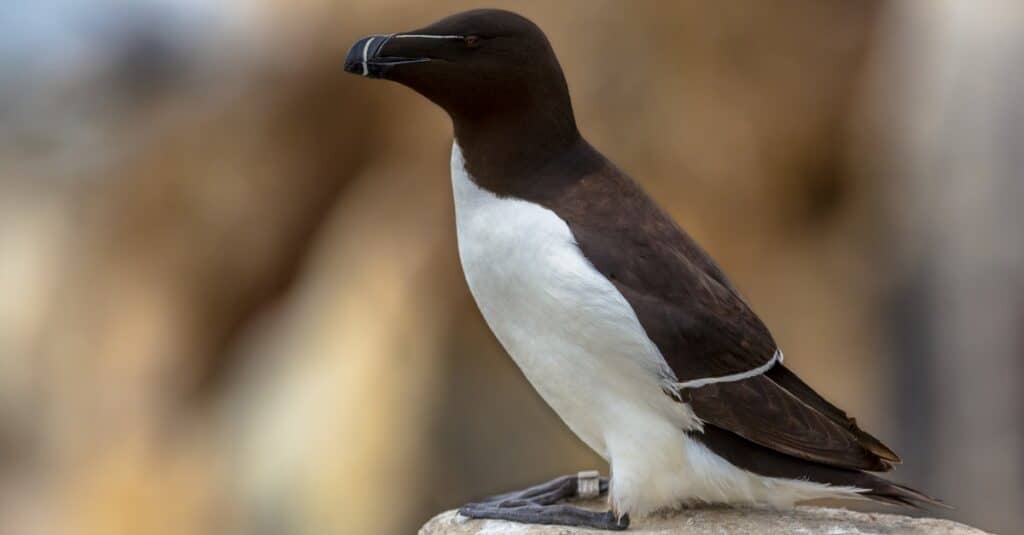
The razorbill gets its name from its thick, hatchet-like black bill.
©iStock.com/CreativeNature_nl
The razorbill, or lesser auk (Alca torda), is another bird with one of the coolest names. A member of the auk family, Alcidae, the razorbill is an agile seabird that lives in the subarctic regions of the Atlantic Ocean. Its name comes from its thick, hatchet-like black bill, which has vertical grooves and a white line near the curved tip.
Most razorbills measure up to 16.9 inches long and weigh between 1 to 2 pounds. Their backs and faces appear black, and their bellies are white, so they are sometimes mistaken for penguins. They spend most of their time foraging for fish and crustaceans at sea and only return to land to breed. Razorbills continue to face threats due to the destruction of their breeding sites. As a result, the IUCN lists them as a species of Least Concern.
#3: King Vulture
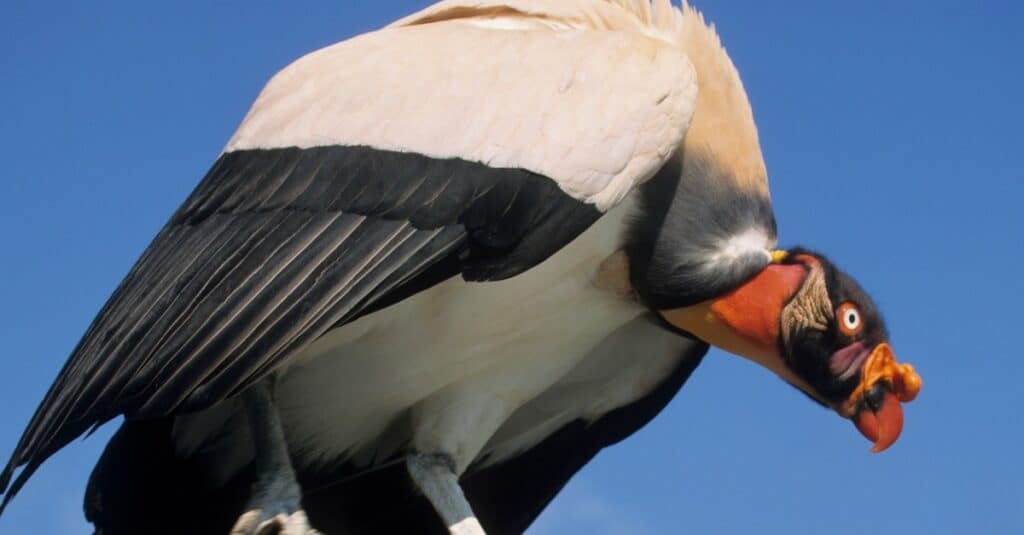
The king vulture is the most dominant vulture in its range, and other scavengers will move aside to let it feed first.
©iStock.com/Michel VIARD
Of the birds with the coolest names, this bird sounds like the one most likely to be a video game villain. The king vulture (Sarcoramphus papa) is part of the New World vulture and condor family, Cathartidae. They primarily inhabit lowland forests throughout Central and South America. Their plumage is white, with black feathers along the edges of their wings. They have a collar of gray and black feathers around their necks. Their most striking feature is their head, which is featherless and has skin in shades of red, orange, yellow, and purple. They also have a yellow-orange wattle above their nostrils.
King vultures measure about 2.5 feet tall and weigh up to 8 pounds. They are one of the largest vultures in the New World, second only to condors. King vultures predominantly eat carrion and will chase away other scavengers from a carcass, which is believed to be the origin of their name. They also featured prominently in Mayan legends, in which the king vulture delivers messages between people and the gods. King vultures have a wide distribution in their native range, so they are currently a species of Least Concern.
#2: Piratic Flycatcher
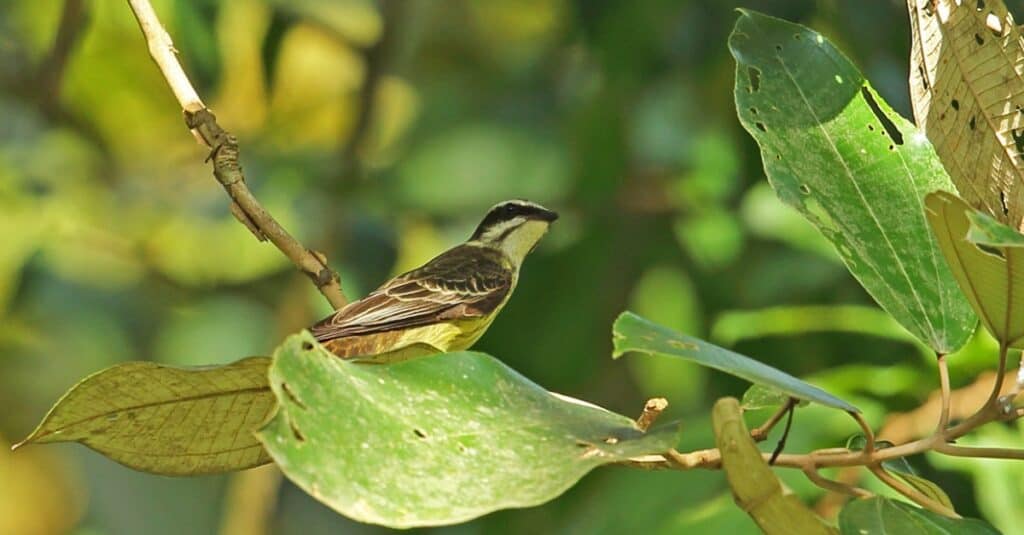
The piratic flycatcher will chase other birds from their nests and then move in.
©iStock.com/neil bowman
The piratic flycatcher (Legatus leucophaius) is a member of the tyrant flycatcher family, Tyrannidae. Depending on the time of year, some populations breed in Central America, but most live year-round in South America. Their preferred habitats include open forests and savannas with plenty of available fruits, which make up the major part of their diet. They measure 5.9 inches long and weigh around 0.9 ounces. These birds have brown backs, yellow crowns, and white underparts with brown streaks.
Among birds with the coolest names, the piratic flycatcher exhibits one of the most devious behaviors. These birds don’t build their own nests. Instead, they harass other birds until they vacate their nests. With the builder of the nest out of the way, the piratic flycatcher then moves in, and the female lays her own eggs. In this sense, the piratic flycatcher acts like a true pirate, using force to steal from other birds.
#1: Moustached Flowerpiercer
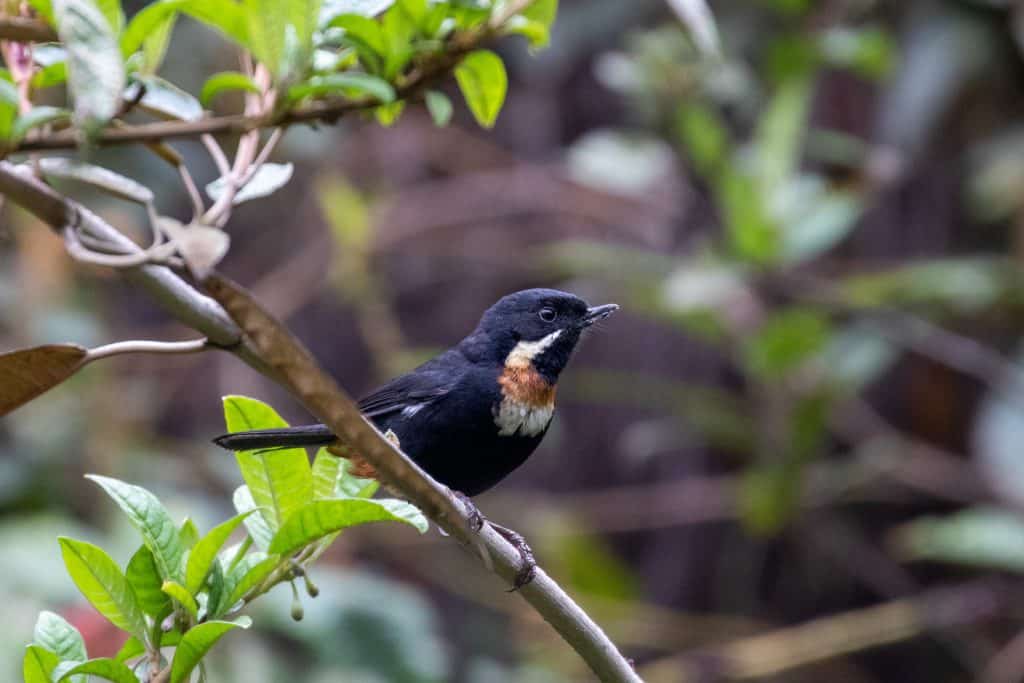
The moustached flowerpiercer uses its long bill to pierce the base of flowers to reach the nectar inside.
The last entry in our list of birds with the coolest names is also one of the cutest. The moustached flowerpiercer (Diglossa mystacalis) is a tiny flowerpiercer in the tanager family, Thraupidae. This adorable bird can be found only in Peru and Bolivia, where it lives in tropical forests and grasslands. They can grow to 5.7 inches in length and weigh up to 0.68 ounces.
Like other flowerpiercers, it uses its long bill to pierce the base of flowers to get to the nectar inside. As for the rest of its name, the moustached flowerpiercer is named for its distinctive plumage. While the majority of its plumage appears black, it has a thick white mustache on its face. Despite its limited range, the IUCN lists the moustached flowerpiercer as a species of Least Concern.