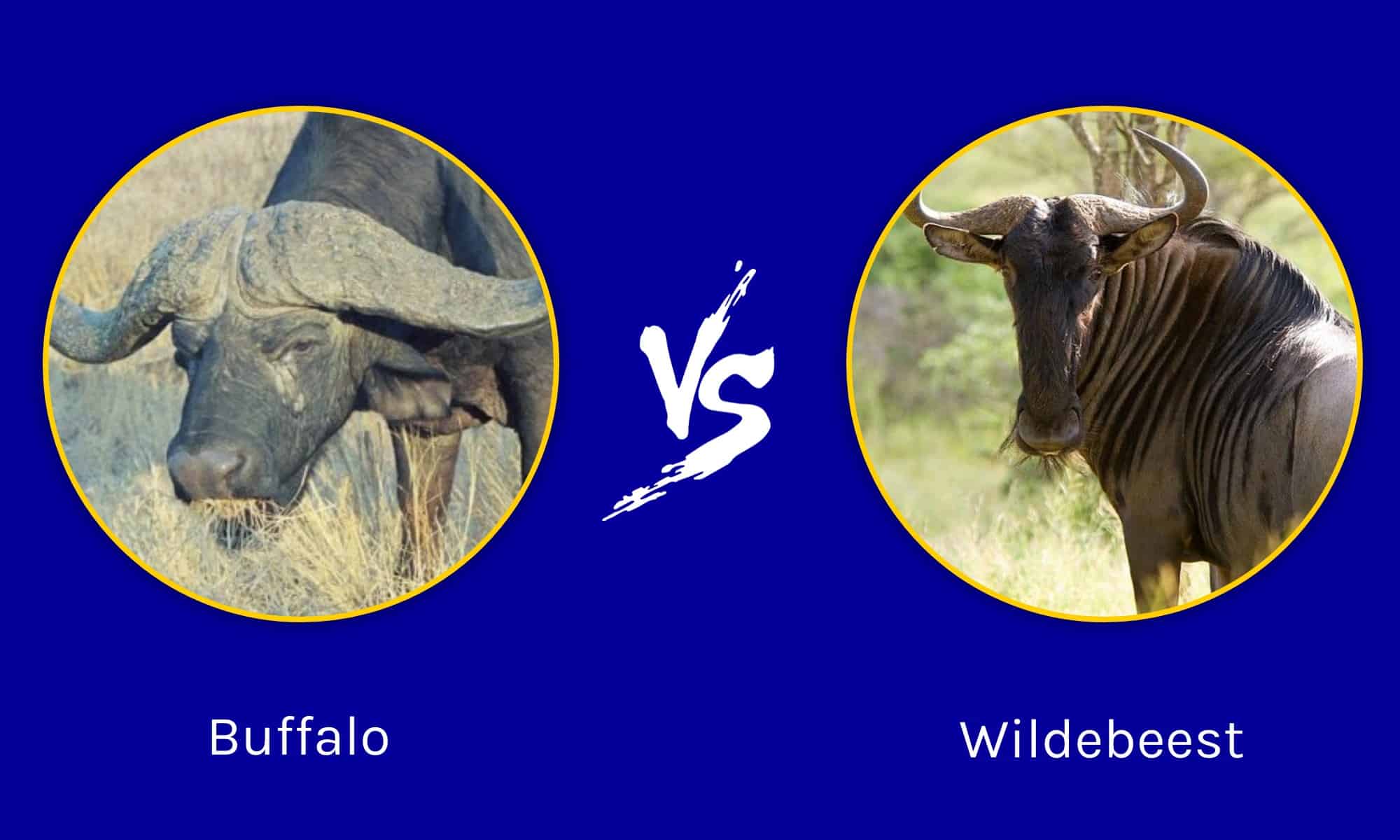

The blue wildebeest (Connochaetes taurinus) and Cape buffalo (Syncerus caffer caffer) belong to the taxonomic family Bovidae, which includes cattle, goats, and sheep. This family is characterized by cloven-hoofed, ruminant mammals with horns. Large African land mammals, such as blue wildebeests and Cape buffalo, also belong to the same subfamily, Bovinae, although they are distinct species within different genera. Beyond these taxonomic classifications, blue wildebeests and Cape buffalo differ in five key ways: size, appearance, diet, distribution, and behavior. Continue reading to discover more about what sets these two animals apart.
Size
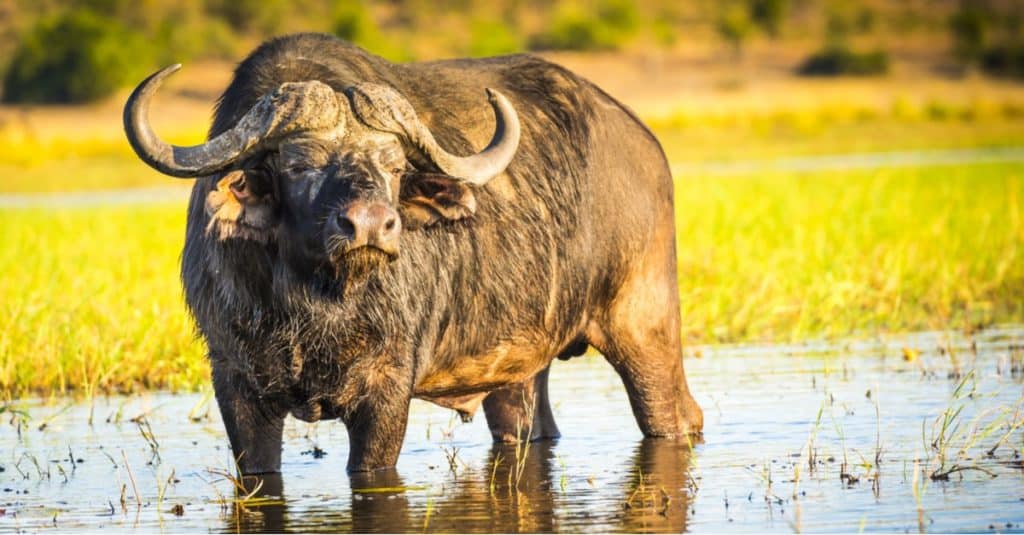
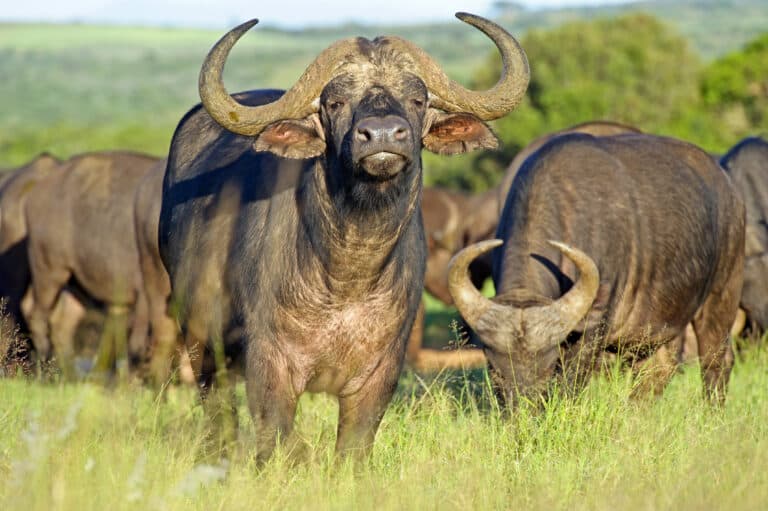
Cape buffalo can weigh nearly 2,000 pounds.
©THP Creative/Shutterstock.com
The Cape buffalo is a very large creature, making the wildebeest seem small in comparison; however, both are powerful and capable of defending themselves against much larger predators.
Male Cape buffalo are significantly heavier than females. An average male Cape buffalo stands 3.3 to 5.6 feet tall at the shoulder, is 7 to 11 feet long, and weighs between 935 and 2,000 pounds. The average female Cape buffalo has a similar height and length, but is approximately 25% lighter, with a top weight of 1,500 pounds.
Male blue wildebeests are also heavier than females. An average male blue wildebeest is about 5.5 to 8 feet long, stands 3.8 to 4.8 feet tall at the shoulder, and weighs 350 to 650 pounds. The average female weighs between 310 and 570 pounds, a difference of about 12%.
Physical Characteristics
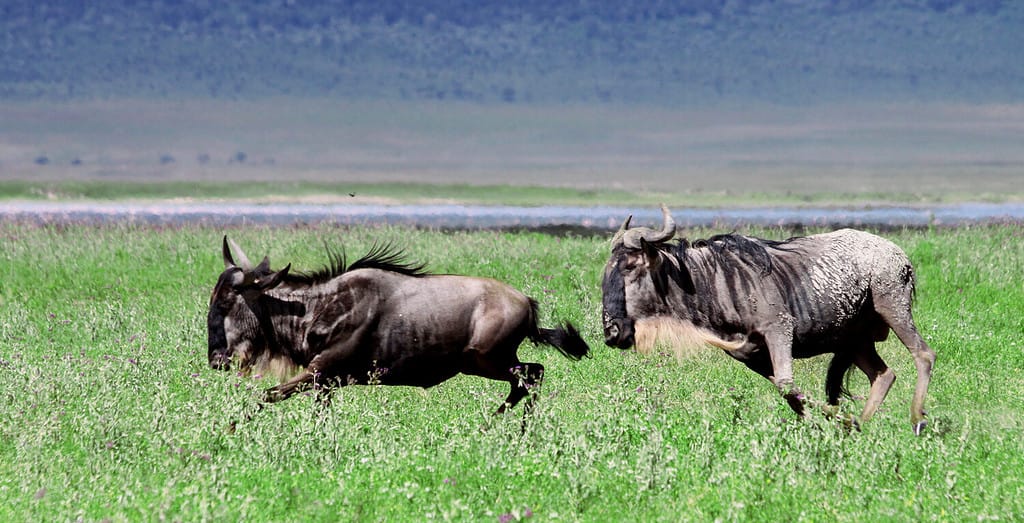
Blue wildebeests can run up to 50 miles per hour in short bursts to evade predators.
©Greens and Blues/Shutterstock.com
Though they can be confused for one another, the physical characteristics of the Cape buffalo and blue wildebeest are significantly different.
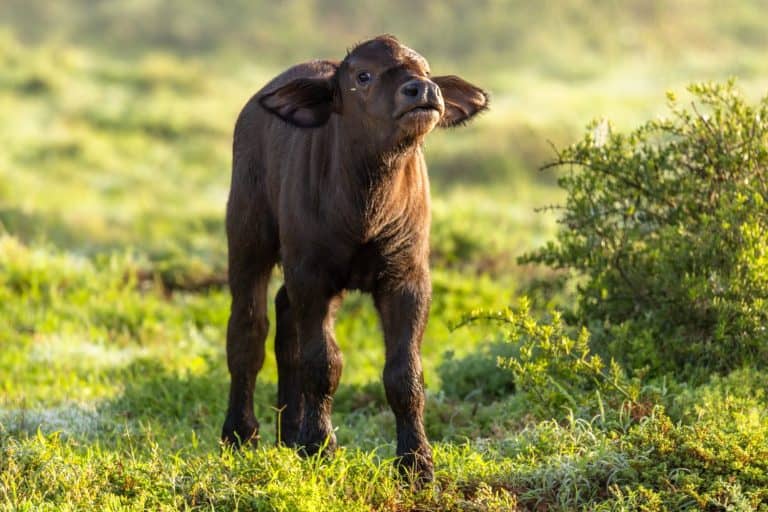
The Cape buffalo has a dark, shaggy coat ranging from dark brown to black. They are muscularly built with short legs, a large head with wide-set eyes, a short neck, and drooping fringed ears. Cape buffalo have a short, stocky tail with a tuft of long hair at the end. The Cape buffalo’s most distinctive feature, however, is its large, curved horns, which fuse at the base in mature males to form a bony shield called a boss. Female Cape buffalo also have horns, but they are generally smaller and more slender than the horns of males, and do not form a bony shield.
The blue wildebeest has a grayish-blue coat with dark vertical stripes on its body, a dark mane, and a long, black tail. Both sexes possess curved horns that extend sideways before curving up, and a thick beard hangs from their chin and necks. They also have scent glands in their feet, which are larger in males and help with communication and navigation during their migrations.
Diet
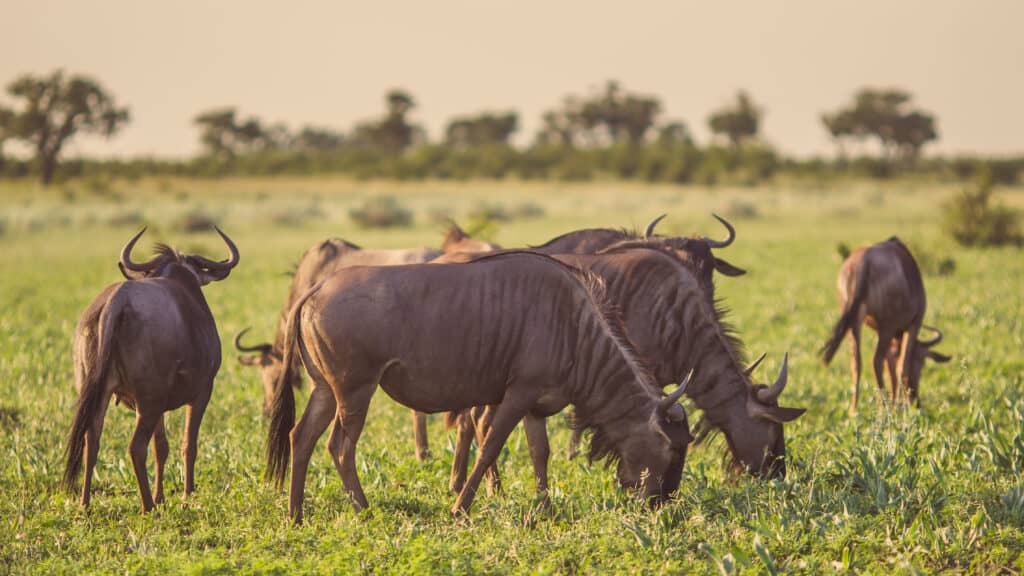
Common Blue Wildebeest or Brindled Gnu herd grazing at sunset in the Mooiplaas river bed in the bushveld savanna of Kruger National Park in South Africa.
©iStock.com/CreativeNature_nl
Cape buffalo and blue wildebeest have similar diets, as both are herbivores that primarily eat grasses and are considered pure grazers. They both consume grasses, sedges, and other plants, but their specific preferences can vary based on availability and the season.
Cape buffalo will eat tough, fibrous grasses that blue wildebeests tend to avoid. Due to their large size, Cape buffalo must consume a large amount (10 to 40 pounds) of grass daily, which requires them to drink plenty of water.
While both animals are primarily grass-eaters and their diets are quite similar, suggesting potential competition for food resources, they can coexist due to the vastness of their habitats.
Behavior
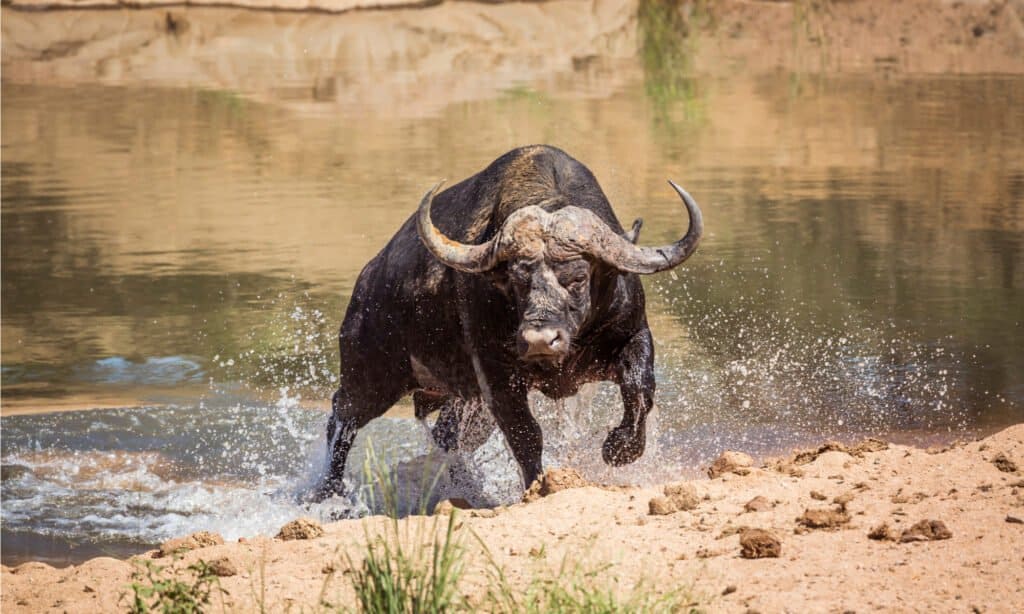
Cape buffalo can run up to 40 miles per hour and jump up to 6 feet vertically.
©PACO COMO/Shutterstock.com
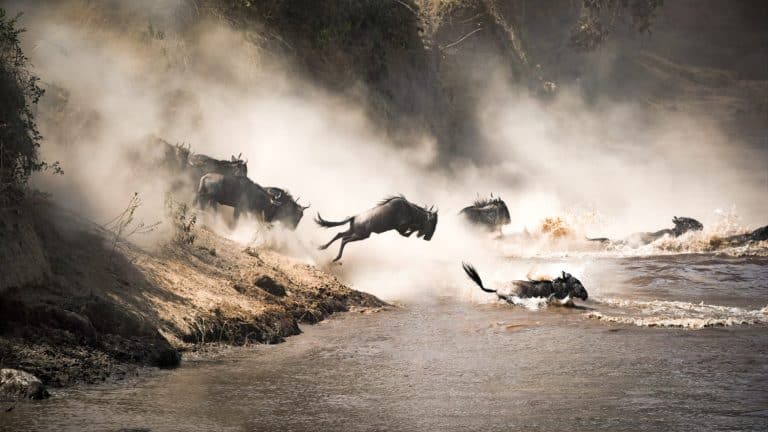
Wildebeests are migratory creatures that follow the pattern of rainfall to find nutritious grazing land across East Africa, moving from the Serengeti in Tanzania to the Masai Mara in Kenya and back again. This movement leads them to new grazing areas, ensuring they don’t deplete one region’s resources and can continue to feed their massive herds. The rains provide the water they need to survive during the journey, especially during the dry season when their usual water sources dwindle. Wildebeest migration is an emergent behavior, where thousands of individual animals create an ordered, large-scale journey without a single leader dictating the path.
Cape buffalo also migrate in search of water and fresh grazing during dry seasons. Cape buffalo herds make migration decisions through a democratic process in which dominant females align their heads in the direction they prefer, and the majority’s choice determines the course of the migration.
Distribution
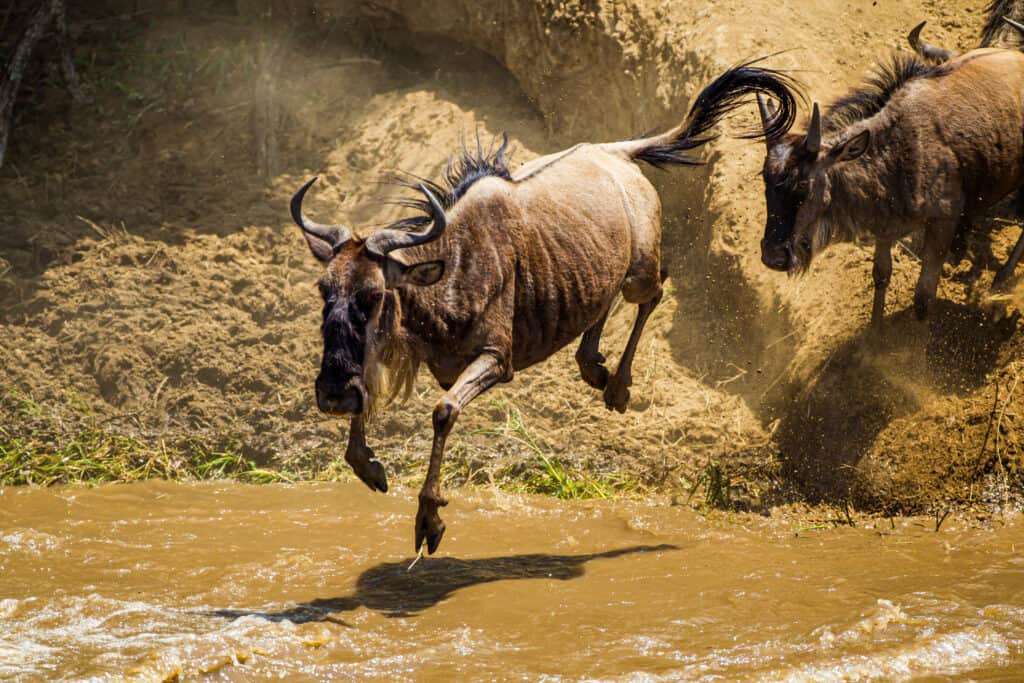
Blue Wildebeest crossing the Mara River during the annual migration in Kenya.
©iStock.com/Wayne Marinovich
Cape buffalo are distributed across sub-Saharan Africa, from Southern Ethiopia and South Sudan down into South Africa. They inhabit savannas, grasslands, and woodlands near water sources. The IUCN Red List classifies the Cape buffalo as Least Concern, with a global population estimated at over 560,000 individuals as of 2022.
Blue wildebeests are found in Eastern and Southern Africa, from Kenya to Namibia and as far south as the Orange River. The Orange River in South Africa marks the southern limit of their range, while the western limit is bounded by Lake Victoria and Mount Kenya. Their populations are abundant, and they are considered a species of Least Concern by the IUCN.