
Quick Take
- A saltwater crocodile outweighs a Komodo dragon by a staggering margin, yet the dragon carries one hidden weapon that could still decide the outcome. See the size gap →
- The croc's bite force is unlike anything else scientifically measured on Earth, yet that is not even its most lethal asset in a fight. Explore the bite force →
- These two apex predators already cross paths in the wild, and what actually happens when they do is not what most people expect. See what actually happens →
- On land versus water, the calculus of this fight flips entirely, and the terrain may matter more than size, speed, or weaponry combined. Compare terrain advantages →
Komodo dragons (Varanus komodoensis) are the largest, heaviest lizards on the planet. They only live on a few islands in southeastern Indonesia. The saltwater crocodile (Crocodylus porosus) is the largest reptile and crocodilian in the world. It, too, lives in Indonesia. However, it can also be found from the coastal regions of India, throughout Southeast Asia, and across the northern coast of Australia. Both of these reptiles are dangerous apex predators in their respective ecosystems, but which animal would come out on top in a fight? Read on to find out.
How Do Komodo Dragons and Saltwater Crocodiles Compare?
To accurately determine which reptile would come out on top, we must first compare the relevant characteristics of animals whose ranges overlap. These characteristics include size, speed, claws, teeth, and bite force, senses, predatory abilities, and defenses. Take an in-depth look at each of the animals’ attributes in the following sections.
Size
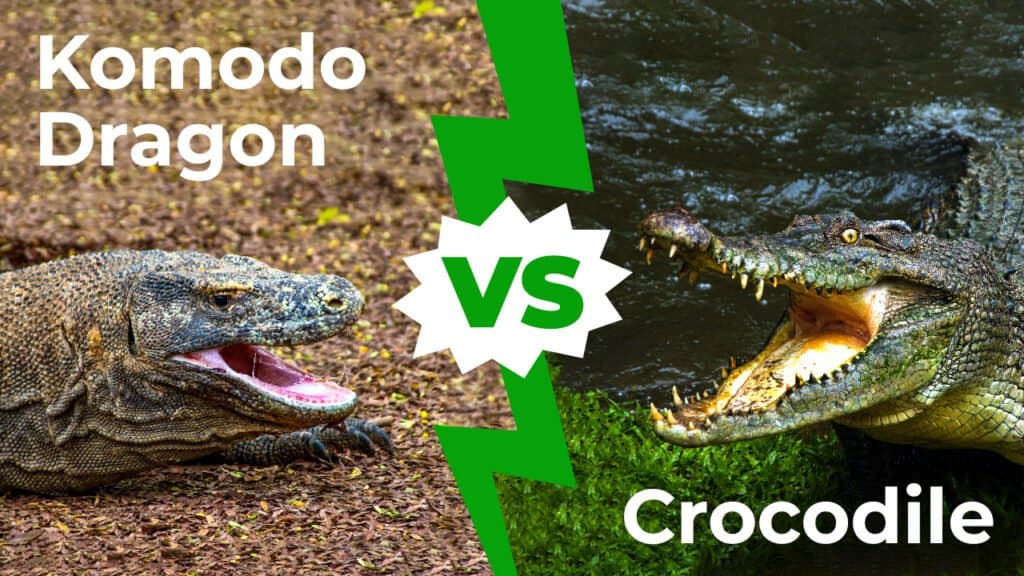
As mentioned above, the Komodo dragon is the largest lizard on Earth. They can weigh up to 300 pounds and measure 10 feet in length. The largest Komodo dragon ever recorded was 10.3 feet in length and weighed 365 pounds. However, in the wild, the average size is around 154 pounds and between 8 and 10 feet in length.
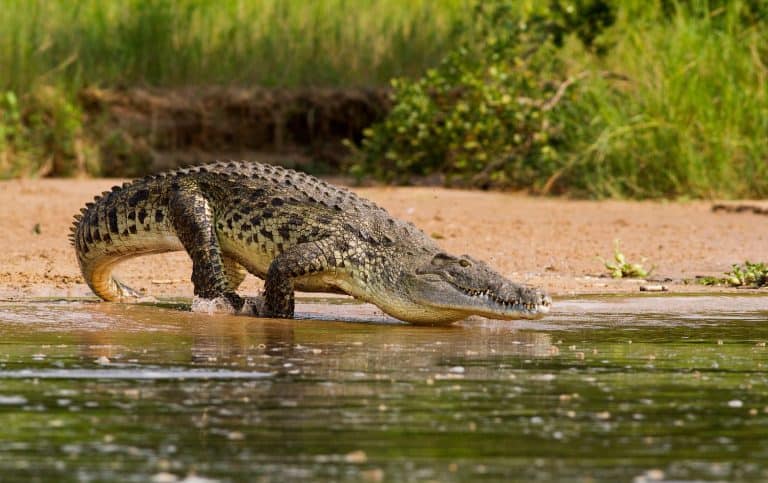
Komodo dragons may be the largest lizards, but saltwater crocodiles are the largest reptiles in the world. In Indonesia, saltwater crocs measure between 15 and 18 feet long, but some large individuals may reach about 20 feet. They weigh upwards of 2,000 pounds. The largest saltwater crocodile on record was caught in the Philippines. It measured approximately 20.3 feet in length and weighed around 2,370 pounds. So, when it comes to size, the average saltwater crocodile is roughly twice the length and about 13 times the weight of the average Komodo dragon.
Speed on Land and in Water
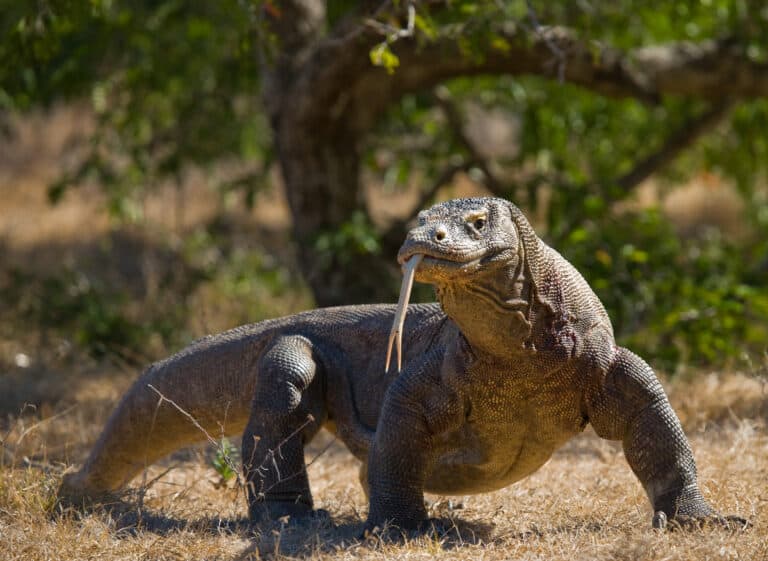
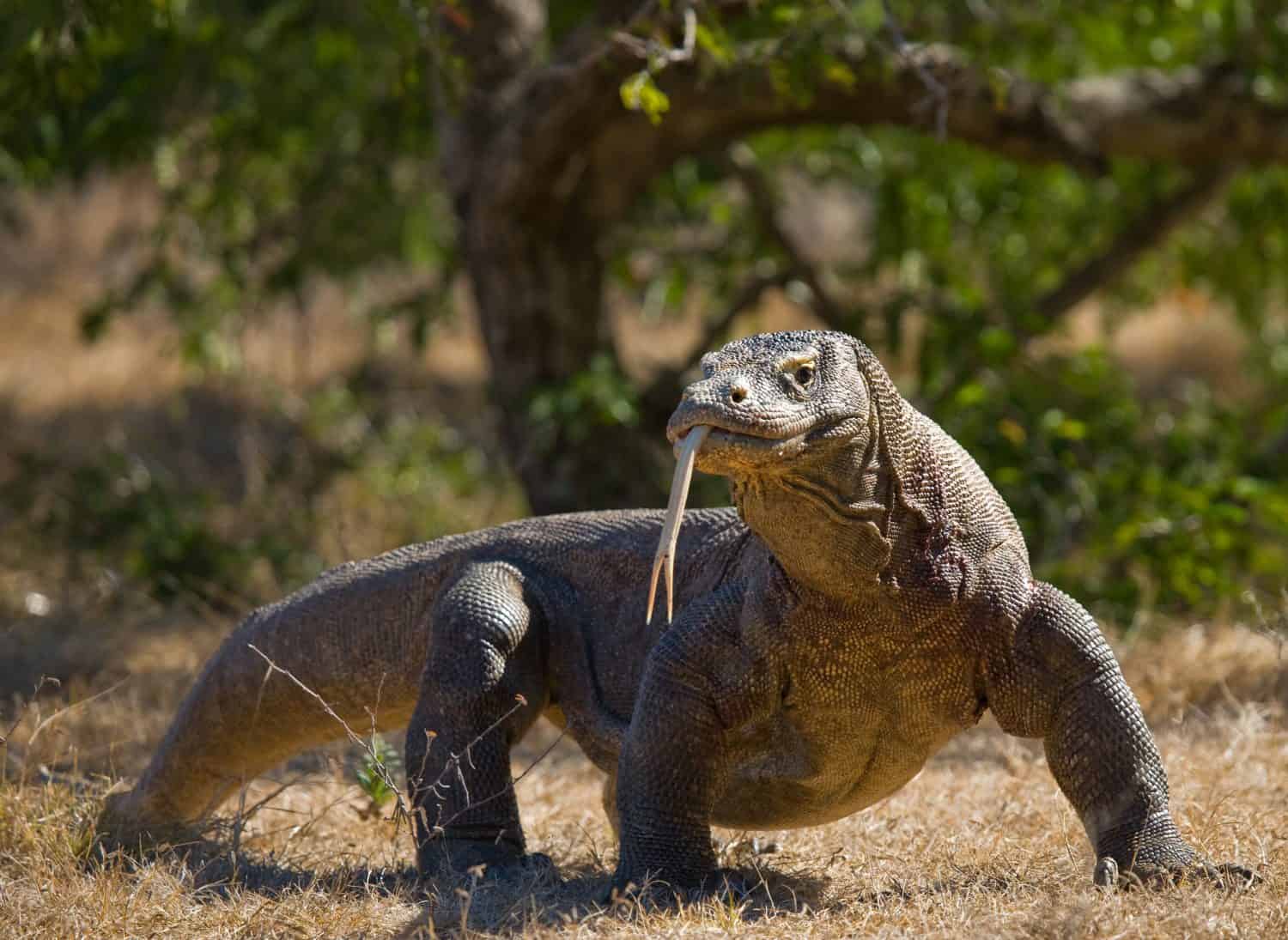
Komodo dragons may be found on the land and in the water. On land, Komodo dragons typically use a swaying walking gait. Their body, head, and tail swing from side to side. Since their legs are on the sides of their bodies instead of underneath, bending helps them increase speed. They stick out their forked tongues to taste a larger sample of the air. They can walk at around 3 mph. However, they can run short distances with their tails lifted off the ground at speeds of up to 13 mph. Monitor lizards like Komodos are also excellent swimmers, using their tails to propel them with their limbs held close to their bodies. Some sources in the region suggest they can swim at speeds of 3 to 5 mph. Komodo dragons can hold their breath for long periods, and Varanid lizards have a more intricate heart structure and complex blood chemistry, which provides greater stamina.
Saltwater crocodiles are more at home in the water, but they often emerge from the water to bask on riverbanks and beaches to regulate their body temperature. Crocodiles are fast over short distances. Unlike alligators, crocodiles can gallop like horses and dogs. They raise their bodies off the ground, and their front and hind legs work in pairs, taking turns landing. This allows them to increase their speed. Although they can only run in very short bursts, crocodiles can reach speeds of up to 11 mph. While a Komodo dragon may have a slight advantage on land, crocodiles are very fast swimmers, reaching speeds of 15 to 18 mph for short distances.
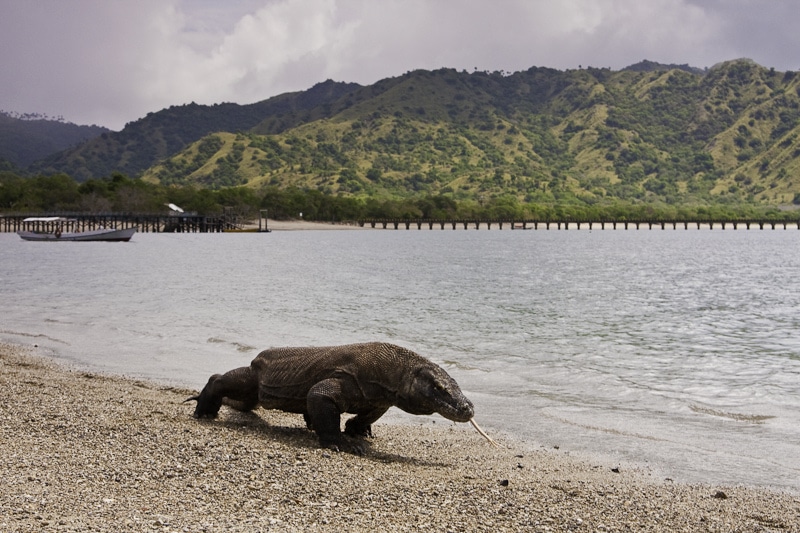
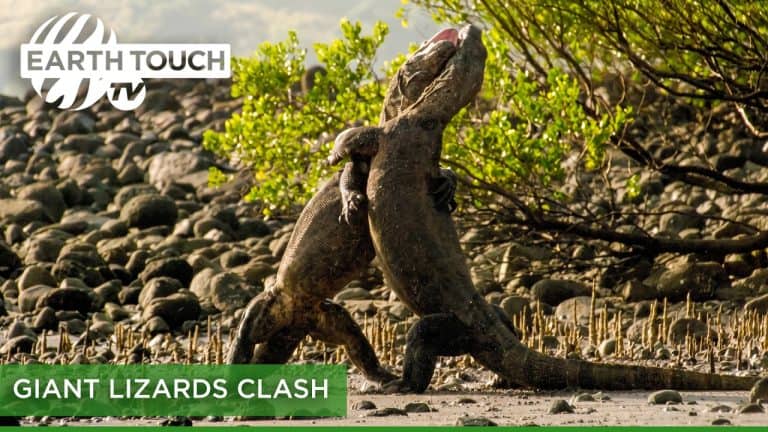
Komodo dragons spend more time on land, but they are also excellent swimmers.
©Adhi Rachdian from Indonesia, CC BY 2.0 – Original / License
Claws, Teeth, and Bite Force
On each foot, the Komodo dragon has long, sharp, recurved claws that measure around 2 inches long. It has 60 razor-sharp, serrated teeth that measure up to 1 inch long. These teeth are used for ripping and tearing flesh, as well as biting and pulling away to create large wounds in their prey. Teeth are replaced throughout the dragon’s lifetime. Their bite force is relatively weak at only a maximum of 600 PSI, but the deadly venom they release from glands in their lower jaw more than makes up for the lack of power.
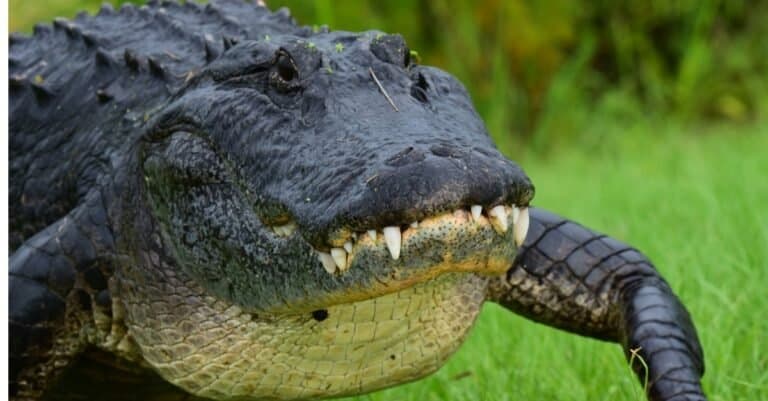
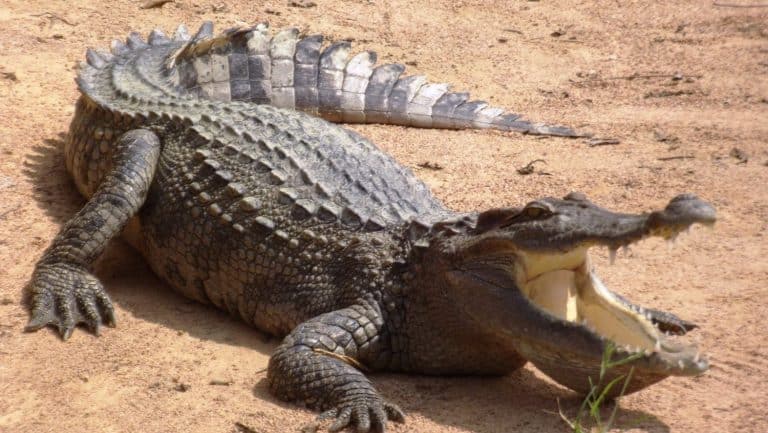
Saltwater crocodiles have thick, powerful claws on the first three digits of their front feet, but their four hind toes do not have claws. They have 66 blunt, cone-shaped teeth, with 18 on either side of their upper jaws and 15 on either side of their lower jaws. These 4-inch-long teeth are primarily used for grasping and holding prey. Their teeth are continuously replaced throughout their lives. Saltwater crocs have a bite force of 3,700 PSI, which is the highest of all scientifically measured animals on the planet.
Senses
Komodo dragons have a powerful sense of smell that can detect prey and carrion from up to 6.8 miles away. They have keen eyesight and can view objects from as far as 985 feet, but their eyes are better at detecting movement. Their eyes also have cones, so they may be able to see colors, but they have poor vision in low light conditions. Their hearing range is only around 400–2,000 Hz, which is narrower than a human’s, so they may not be able to hear sounds at the extreme ends of the spectrum.
Saltwater crocs also have a powerful sense of smell, detecting prey and carrion from up to 4 miles away. They have excellent night vision, with the reflective tapetum lucidum layer that aids in amplifying light. While they can see blurry images underwater, overall, their vision is not as precise as a human’s. However, they have one area of high visual clarity along the horizon, allowing them to see well with just their eyes above the water. Crocodiles also have excellent hearing across a wide range of frequencies from 100-6000 Hz.
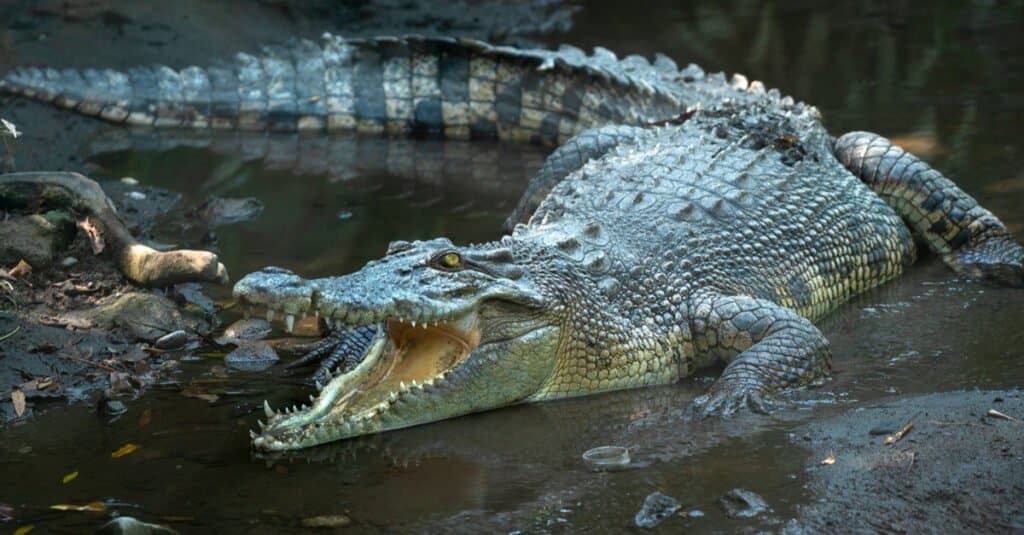
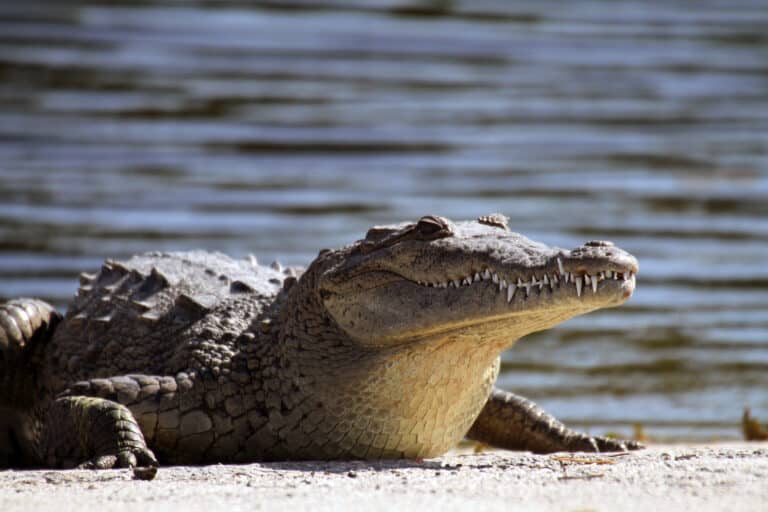
The saltwater crocodile has keen senses to locate and ambush prey.
©Pius Rino Pungkiawan/Shutterstock.com
Physical Defenses
Beneath their tough scales, Komodo dragons have small bones embedded in their skin called osteoderms, which have been likened to chain-mail. They have four distinct shapes of osteoderms protecting nearly their entire bodies, particularly their heads, while other lizards have only patches of one to two shapes. Komodos develop these plates as mature dragons, likely adding layers as they age. Komodo dragons also rely on their venom, which contains toxic enzymes and proteins, including anticoagulants. This causes blood loss and a drop in blood pressure that leads to shock and death. Their saliva also has over 50 types of bacteria, several of which are known to cause sepsis.
Fully grown saltwater crocodiles require few defenses. Due to their massive size and acute senses, their only natural predators are humans. Like Komodo dragons, they also have osteoderms under their tough, scaly skin. Some crocodiles have even been said to deflect or stop small-scale bullets such as .22 caliber from penetrating. These crocodiles also use their death roll, which involves quickly rotating their bodies in the water. While it is believed to have begun as a combat technique, it is now typically used to subdue and kill prey, tearing off chunks of large prey that are too large to swallow whole.
Could a Komodo Dragon Survive a Battle With a Saltwater Croc?
Komodo dragons and saltwater crocodiles occupy different habitats, so conflicts are not as common as one might think. Komodo dragons primarily live on land, and saltwater crocodiles primarily live in the water. However, they would be considered competitors, as they have similar prey. Each species also attempts to prey on the juveniles and eggs of the other species. Komodo dragon females have been observed to bite crocodiles on the lower jaw while defending their nests. Komodo dragons have also been seen raiding crocodile nests.
Saltwater crocs have a huge size and power advantage, especially in the water, and a Komodo dragon is unlikely to survive an encounter with an adult crocodile. However, if the dragon is able to land a lucky bite or two, the crocodile might not live long enough to regret its last meal. On land, Komodo dragons are faster and have more stamina and agility, so they can escape a confrontation. Both animals have keen senses, so an ambush is also unlikely. Unless it is defending its territory, a Komodo dragon will generally avoid adult saltwater crocodiles.