
Quick Take
- These fights look like pure chaos, but reptile scientists have watched the exact same sequence play out over and over. The structure behind it is nothing like what you'd expect from the world's largest lizard. See the ritual structure →
- A Komodo's most dangerous weapon is almost never used during these fights, which is surprising given what it reveals about how their bodies are actually built for combat. Discover the hidden venom →
- Before two males ever make contact, one of them may already know whether he's going to lose. His tongue is how he figures it out. How the tongue reads rivals →
- The fact that Komodo dragons are endangered actually makes their wrestling matches more important rather than less important, and the math behind why is surprisingly elegant. Why endangerment changes everything →
On a few small islands in Indonesia, the world’s largest living lizard puts on one of the most physical strength displays in the reptile world. Video footage from Earth Touch TV captures the footage of two male Komodo dragons sprinting along a beach, facing each other head-to-head, and then standing up on their back legs to wrestle in a chest-to-chest hug.
The Rules of Dragon Wrestling
Standing on two legs while wrestling is the signature move of male Komodo combat. During mating season, which can span from as early as May through October, with peak activity typically in July and August, adult males compete for the chance to mate with females, and their fights almost always follow the exact same script. The rivals walk up to each other, size each other up, and then stand tall on their back legs. They balance using their heavy, muscular tails and lock their front legs around each other’s shoulders. Their main goal is to throw the other guy to the ground. Researcher Walter Auffenberg documented this ritual in detail back in 1981, describing it as a structured wrestling match rather than an all-out fight to the death.
Body size usually determines the winner. Male Komodos can grow over 10 feet long and weigh up to 330 pounds, and the largest, oldest males usually get the first pick of mates. Smaller males normally back off once they lose their footing or get pinned. Serious injuries are actually pretty rare, despite how violent the wrestling looks. Both the San Diego Zoo Wildlife Alliance and international conservation experts describe these matches as formal rituals rather than deadly fights. The losing male simply signals defeat by lying flat on the ground or running away.
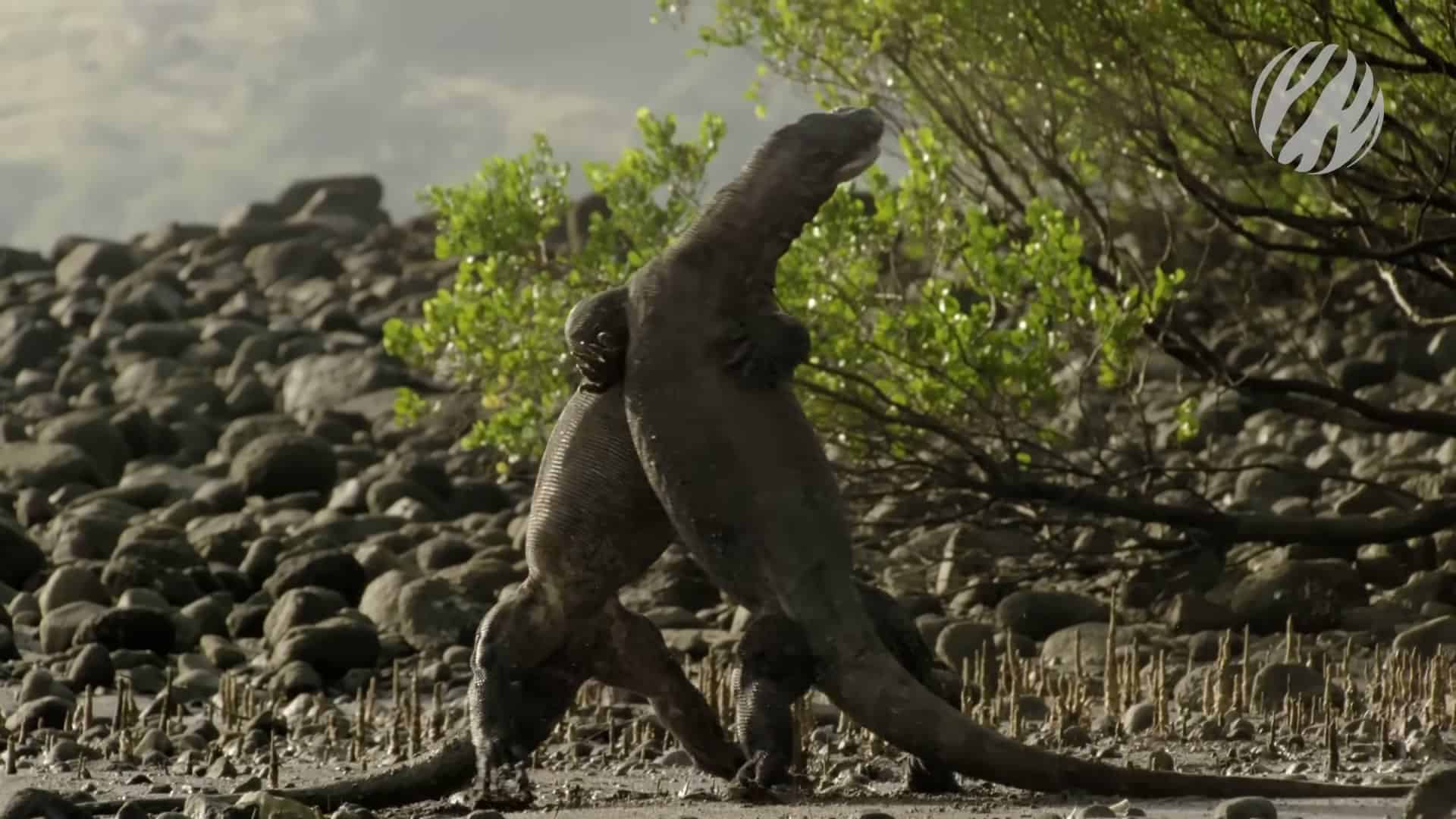
Note how they use their tails to balance while they embrace in their wrestling behavior.
©Earth Touch TV via YouTube — used under fair use – Original / License
Built-In Armor and Hidden Venom
Several special physical features allow Komodos to wrestle like this. First, they have built-in armor. Komodos have unusually thick, tough skin filled with tiny bones called osteoderms, which act like a natural suit of chain mail. Next, a 2019 study using high-resolution X-ray computed tomography (CT) scans showed that adult Komodos build up an elaborate mesh of these tiny bone deposits across their head, likely protecting them during fights with other adults. Finally, the age difference plays an important role. Young Komodos don’t have this skin armor, which suggests these bones developed specifically to protect adults from fighting each other.
Komodos rely heavily on their sense of smell, picking up scent particles from the air with their tongues and carrying them to a specialized scent organ in the roof of their mouth. This is how they sniff out dead animals from miles away. During mating season, it’s also how they track down females and scout out rival males. Chemical scent clues probably help a male decide whether to pick a fight or back down before things even get physical.
Biting can happen during these scuffles, and a Komodo bite is nothing to mess with. Scientists led by Bryan Fry discovered that Komodos have venom glands in their lower jaw. This venom releases chemical compounds that prevent blood clotting and cause shock, disproving the old belief that dirty bacteria in their mouths were the only thing making their bites deadly to prey. However, during male-on-male fights, serious biting is fairly uncommon. The upright wrestling format seems designed to test raw strength and endurance while keeping both lizards safe from those dangerous jaws.
High Stakes on Small Islands
Living space plays a big role here. Komodo dragons live on a small number of Indonesian islands, including Komodo, Rinca, Gili Motang, and nearby islets, covering a total area of just around 400 square miles. Because their territory is so limited, adult males run into each other often. Wildlife experts currently list the species as Endangered, with fewer than 1,400 adult dragons left in the wild. Formal wrestling matches are a smart, efficient solution for a crowded island: they settle who gets to mate without accidentally killing off the limited population.
People often think these fights are just wild, random violence, but they actually follow a very predictable pattern. The approach, the stand on two legs, the wrestling, and the surrender signals follow a set routine that reptile scientists have watched over and over in the wild. Winners get mating rights and sometimes first dibs on large meals. Losers walk away mostly unharmed and get another chance next season, which is great news for a species whose entire global population could easily fit inside a single sports stadium.