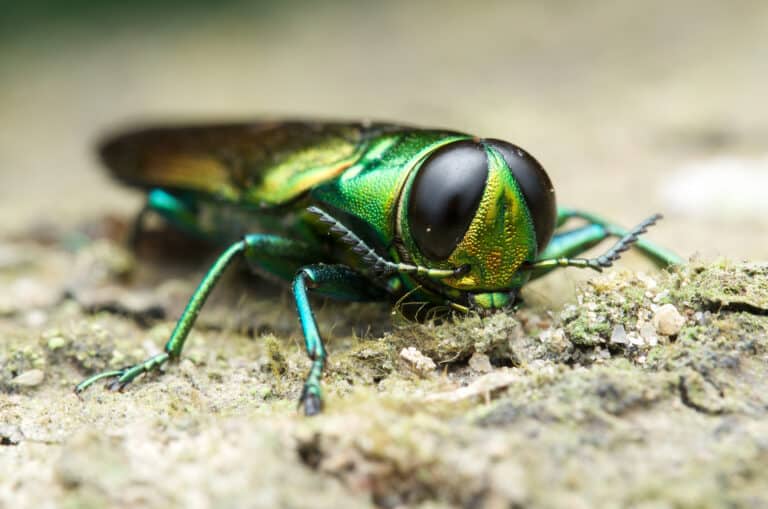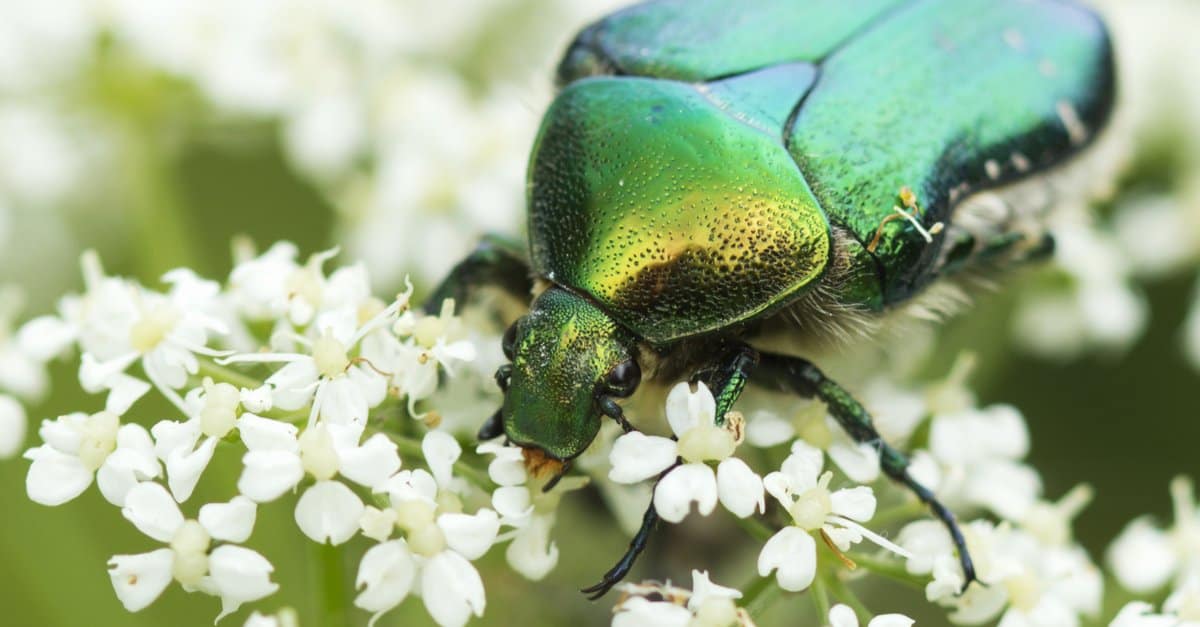

Phyllophaga is a large genus of over 900 species of scarab beetles, commonly known as May beetles. The genus Cotinis is a group of scarab beetles, also known as flower chafers, which includes the green June beetle (C. nitida). These insects, native to the Americas, are attracted to lights and fly clumsily. These pests may appear to be on the attack with their clumsy attempts to navigate, but they are harmless to humans. However, despite these similarities, there are key differences between the May beetle and the June bug. Continue reading to discover how these insects are different.
Appearance

Adult May beetles can grow up to 1.25 inches long.
Adult May beetles range in size from 0.375- 1.25 inches. Female May beetles are generally heavier-bodied than males. This is a common pattern in many beetle species, known as female-biased sexual size dimorphism, where the larger size in females is linked to egg production. Green June bugs are slightly smaller, with adults typically measuring 0.6–0.9 inches long. Male and female green June bugs are almost identical in size
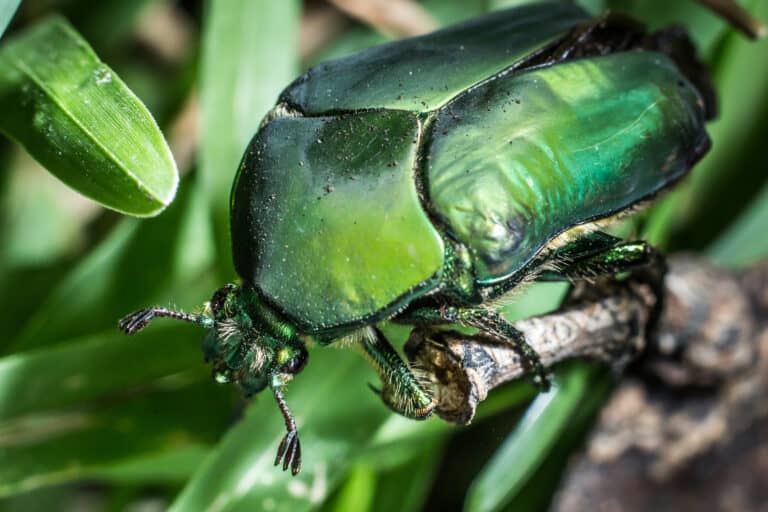
May beetles are characterized by their stout, oval body, reddish-brown to black color, and clubbed antennae. The green June bug has a metallic green body that has gold or brownish highlights on the wing margins and sometimes on the head. The undersides and legs are typically metallic green.
Both May beetles and June bugs have hairy undersides. The stiff bristles or setae on the abdomen function as sensory organs called mechanoreceptors, which detect touch and air currents.
Flight Patterns
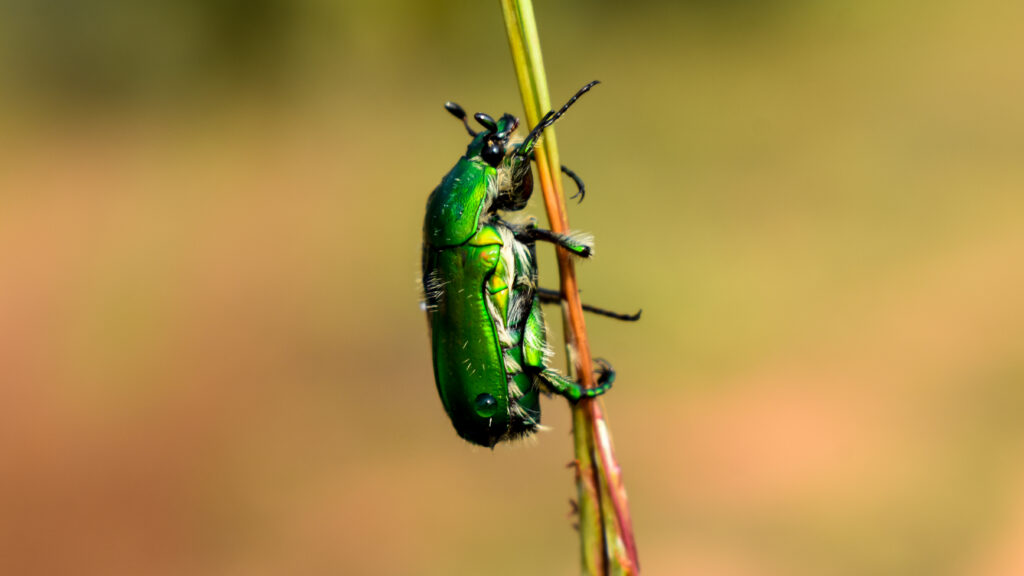
June bug on a twig.
©Sudhakar Bisen/Shutterstock.com
The most notable difference in the wings of these two beetles is in their flight style. May beetles lift or spread their hard forewings (elytra) up and out to expose and use their membranous hind wings for flight. This results in a clumsy or lumbering flight pattern. Their heavy bodies and relatively slow wing beats (45 per second) make them poor fliers that often bump into objects like screens and walls. They can also be seen struggling to right themselves if they land on their backs.
Green June bugs are also clumsy fliers with a flight path that often appears uncoordinated or out of control. Their wings beat relatively slowly, and their flight is accompanied by a loud, bumblebee-like buzz. Green June bugs typically fly low to the ground, often just a few inches above the turf. While some sources describe them as strong, fast fliers in terms of speed, they universally agree that the beetles struggle with navigation and frequently crash, leading to the perception of clumsiness. They may also land on their backs and struggle to right themselves after a crash or exertion.
Activity
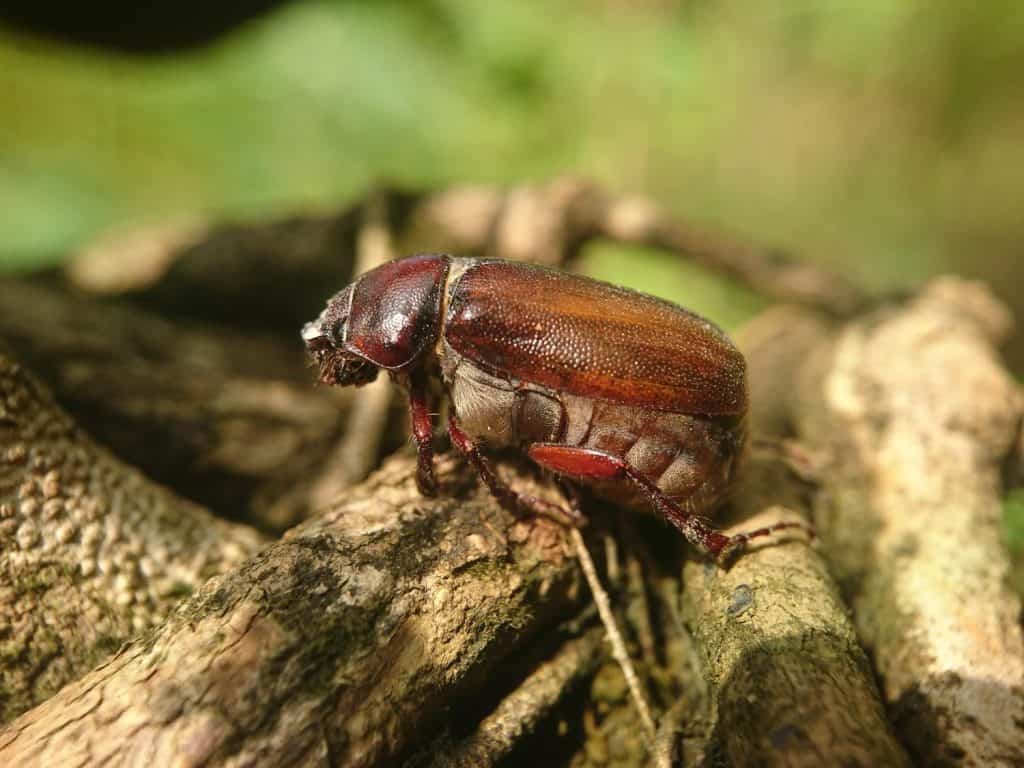
May beetles are strictly nocturnal.
©ayoe's/Shutterstock.com
May beetles are nocturnal, meaning they are most active at night, especially during late spring and early summer. During the day, they hide in the soil but emerge after sunset to feed on leaves, mate, and fly. They are commonly seen buzzing around and colliding with porch lights and windows.
The green June bug is diurnal, meaning it is primarily active during the daytime. Its activity patterns are distinct from many other June bugs, which are typically nocturnal. Adult green June beetles are most active during daylight hours, especially in the morning when males can be seen swarming low over grassy areas in search of mates. They spend their days feeding on ripe and rotting fruits (like peaches, berries, and grapes), as well as on pollen, plant leaves, and sap. They are effective, though clumsy, pollinators during the day. At night, adults typically rest on plants, in thatch, or in compost piles.
Larvae
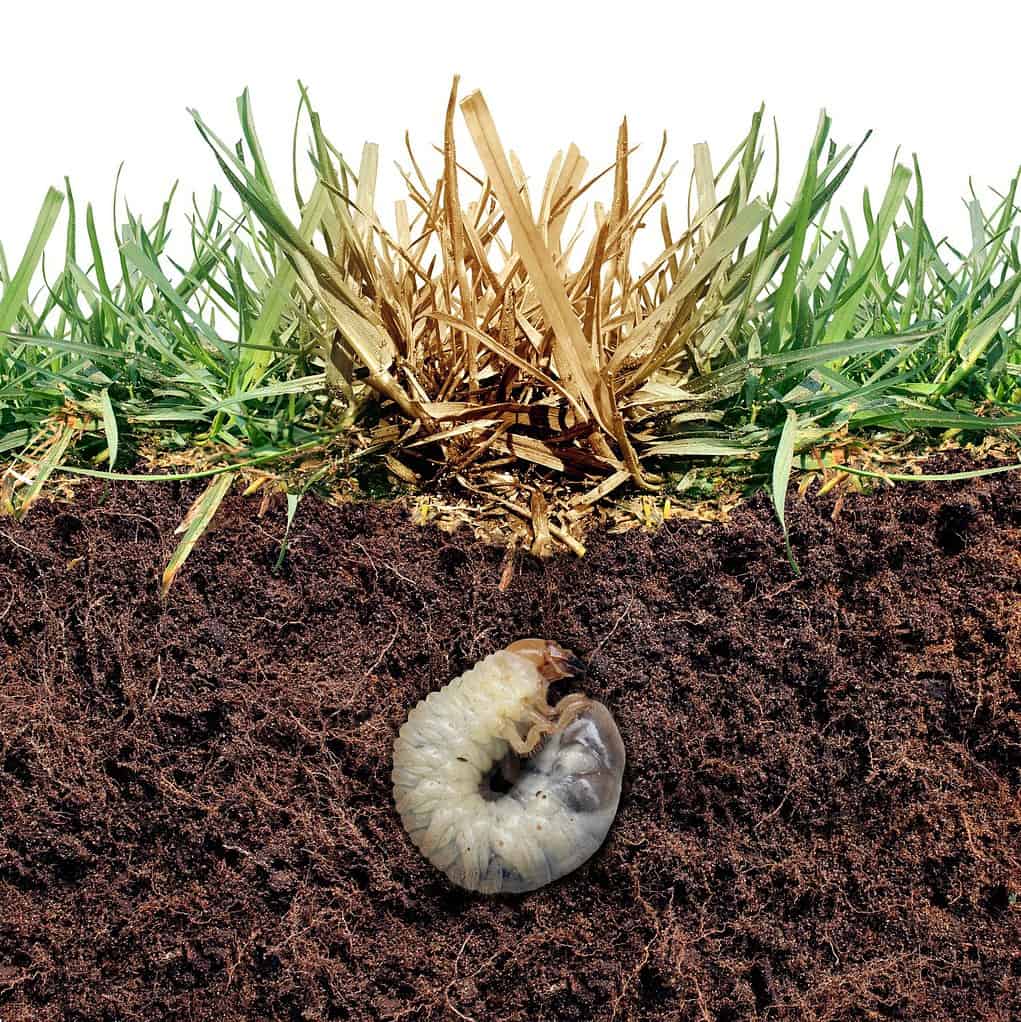
The larvae of the May beetle and the June bug look similar but are quite different.
©Lightspring/Shutterstock.com
The larval forms of May beetles and green June bugs are both referred to as white grubs, but they can be distinguished by their movement, posture, and primary food sources.
May beetle larvae move using their legs and body segments, typically remaining in a characteristic comma-like or C-shaped position when disturbed. They do not crawl on their backs. May beetle larvae are agricultural pests that primarily feed on the roots of grasses, cereals, vegetables, and ornamental plants, causing significant damage to lawns and crops. They live in the soil near the roots of their host plants, moving deeper into the soil to overwinter.
Green June bug larvae are up to 2 inches long, cream-colored or yellowish-white grubs with a brownish-black head and three pairs of short legs. Their behavior of crawling on their backs with their legs in the air, using stiff bristles on their abdomen to move rapidly across surfaces, is a unique characteristic of green June bug larvae. While they may exhibit a C-shape at rest, they are more elongate and less consistently curled than Phyllophaga larvae. Green June bug larvae primarily feed on rich organic matter, humus, and mold in the soil, rather than living plant roots, though they can cause damage to roots when populations are high or preferred food is scarce. They often come to the surface at night to feed.