
Quick Take
- Our understanding of pterosaur wings depends on scientific reconstructions built around incomplete fossil evidence See the core problem →
- Despite spanning creatures the size of sparrows to the size of giraffes, pterosaur wing reconstructions share a surprising problem. Explore the surprising finding →
- Pterosaurs aren't dinosaurs, and a few anatomical hints can help you tell them apart. Discover pterosaur anatomy →
- One part of the pterosaur body almost never survives fossilization, but that's what matters most for understanding flight. See what rarely fossilizes →
As an early 1990s baby, I grew up on The Land Before Time. I would faithfully watch as the movie’s young dinosaurs, including Littlefoot the apatosaurus and Ducky the hadrosaur, made their trek in search of the Great Valley. And yes, I saw all the sequels. Although I loved every character, I was the biggest fan of Petrie, a lovable and anxious pterodactyl who the others referred to as a “flyer.” At first, Petrie is terrified of flying. But by The Land Before Time XII, he’s fully overcome his fears. Pterosaurs like Petrie were evolutionarily adapted for flight. For decades, scientists have come to understand that pterosaurs’ lightweight frames and air sacs helped position them to rule the skies in their time. However, it wasn’t until more recently that scientists started questioning the range of pterosaur wings.
Pterosaur wings were made of tissue, muscle, and membrane. However, those aren’t preserved in the fossil record like bones are. As a result, our knowledge of pterosaur wings hinges on how those wings are reconstructed by scientists, researchers, and illustrators. But, as a research team from the University of Bristol asked, how accurate are those reconstructions? Their study, published in Paleobiology in June 2026, explores why these reconstructions may not account for the full range of pterosaur wing shapes and unpacks exactly why that’s important for us to know.
What Were Pterosaurs?
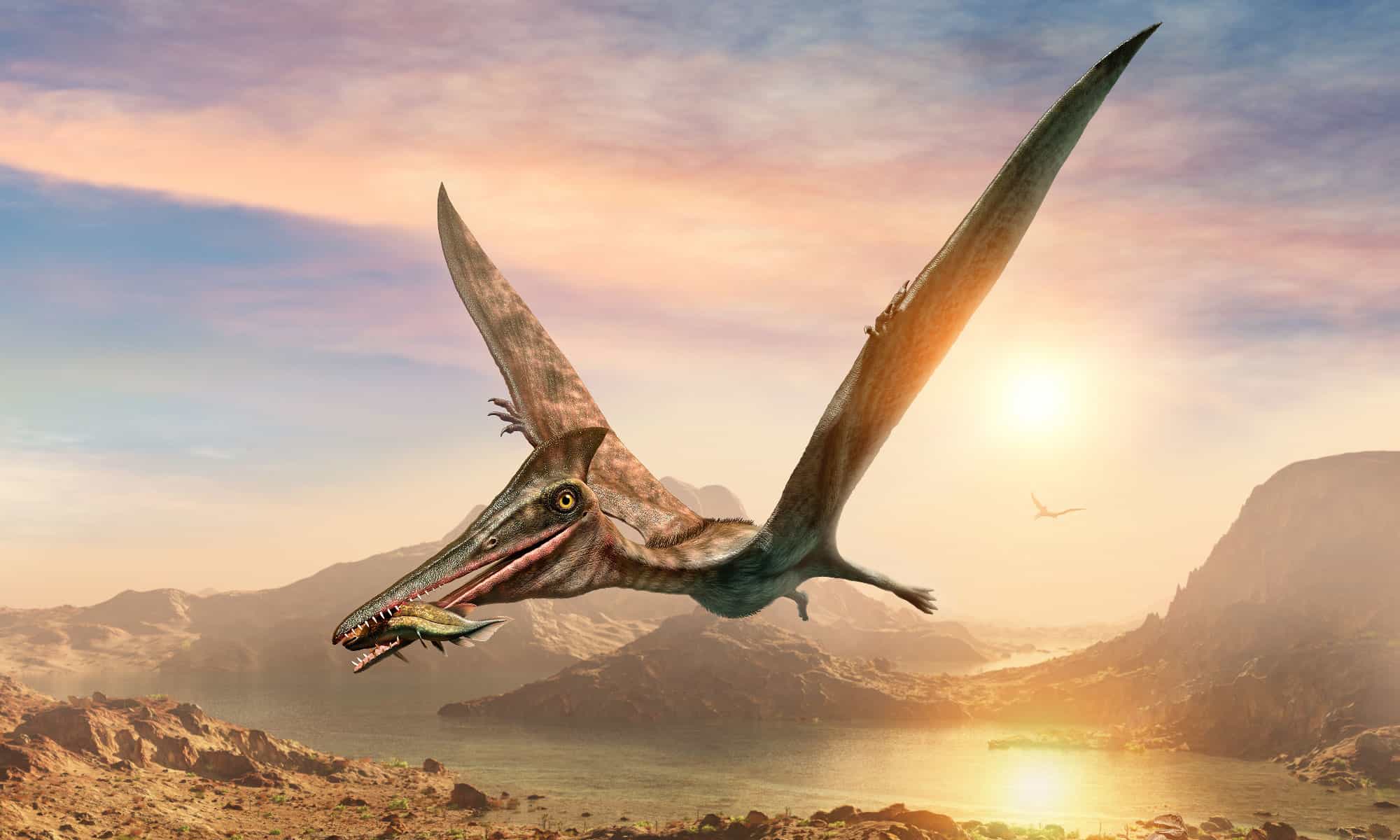
Pterosaurs were a broad group of ancient flying reptiles and are known as the first vertebrates with powered flight. Well-known pterosaurs include Pterodactylus, Nemicolopterus, and Quetzalcoatlus. Quetzalcoatlus was one of the largest, if not the largest, flying animals of all time. Fossil records suggest it was about as tall as giraffes today, with a wingspan of around 33 to 36 feet.
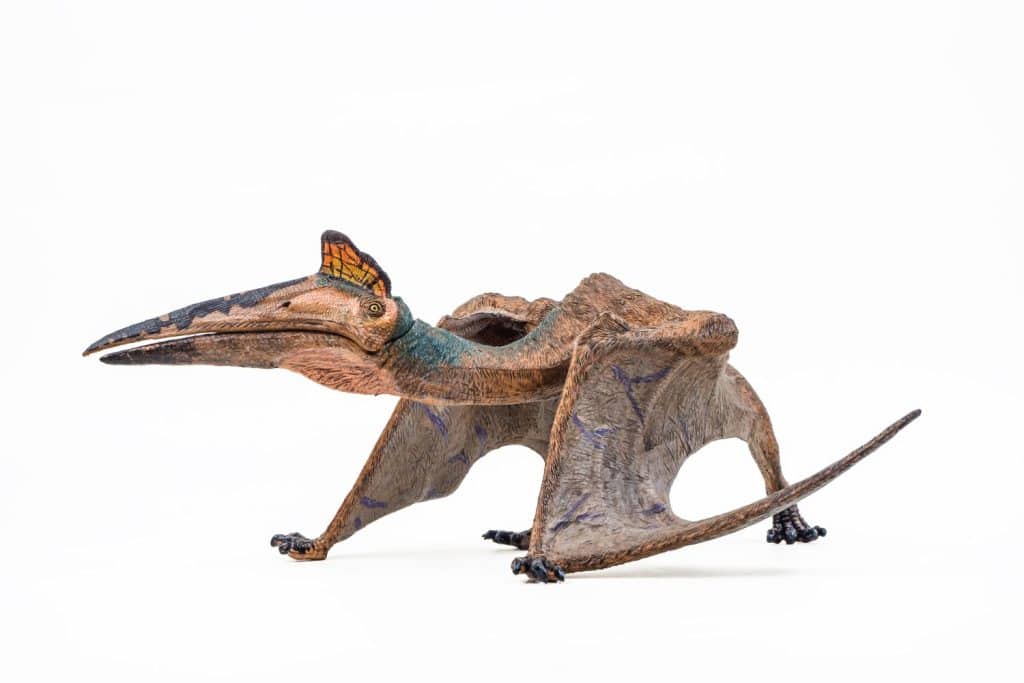
Some scientific models put Quetzalcoatlus’ flying speed at up to 80 miles per hour.
©kamomeen/Shutterstock.com
You might be surprised to learn that pterosaurs are not actually dinosaurs. The two groups do share similarities. For example, both dinosaurs and pterosaurs lived during the Mesozoic era. Both groups are also considered part of the Archosauria clade, meaning they’re both archosaurs.
However, pterosaurs and dinosaurs split from a common ancestor and their lineages evolved separately. They also had physical differences. Pterosaurs had closed, depressed hip sockets, while dinosaurs had open, perforated hip sockets. These led to their gaits (or the way they walked) being distinct. The Natural History Museum of Utah also explains that CT scans of both pterosaur and dinosaur skulls have shown that each has a unique ear canal shape. Finally, pterosaurs had hollow, thin bones. Although some dinosaurs also had hollow bones, their bones were usually thicker and sturdier.
Before the study, researchers already understood several important aspects of pterosaur wings. To start, their wings are membranous. In other words, the wings consist of a supple, flexible membrane stretched over the body and attached to a long fourth finger. You can think of them similarly to bat wings. However, pterosaur wings were only attached to the fourth finger, with the other fingers for walking, whereas bat wings are attached to and supported by all fingers.
Researchers also had an understanding of the diversity of wing sizes. Anurognathids, Nemicolopteruses, and other smaller pterosaurs had, as you might expect, smaller wings. Nemicolopterus, for example, had a wingspan of about 10 inches. These were dwarfed by the wingspans of larger pterosaurs, which could stretch up to 36 feet.
How the Pterosaur Wing Study Began
Although we know the relative wingspan of many pterosaurs, researchers questioned whether reconstructions accurately capture the true range of wing shapes and designs. We’d expect a wide variety of wing shapes as diverse as pterosaurs themselves. As the study authors explain, “These wing shapes are subject to multiple conflicting scientific opinions and the artistic styles of the researchers and illustrators reconstructing them.”
To investigate their question, the research team collected 79 wing reconstruction images from eight pterosaur genera, as well as two broader families: rhamphorhynchids and ornithocheirids. The team selected a range of species, including Nyctosaurus, to ensure they were evaluating a wide variety of sizes and geological time periods.
Next, they used a theoretical morphospace to map out wing diversity. A theoretical morphospace essentially models all the possibilities that a biological shape can take. Using this tool, the scientists could see how many potential variations of pterosaur wings existed, even if those variations never actually emerged.
The Diversity of Pterosaur Wings
Ultimately, the research team wasn’t looking to understand whether existing reconstructions are “incorrect.” Instead, they focused on whether wing shapes represent the diversity of pterosaurs. After all, as we’ve discussed, some pterosaurs were as small as today’s sparrows, while others were enormous. It would make sense for their wing shapes to reflect their different needs.
But this wasn’t what researchers found. Instead, after comparing morphospace designs to existing reconstructions, the scientists found that reconstructions tend to be very similar.
That doesn’t mean pterosaurs all had the same wings, though. The research team stresses that reconstructions often struggle to account for the actual membrane. If the membrane stretched farther than some reconstructions suggest, or had different shapes or edges, the wings would undoubtedly look different. Unfortunately, it’s fairly impossible to know what the membranes looked like.
Because soft tissues rarely fossilize, our understanding of pterosaur wing diversity remains incomplete. But there’s always the future! The great thing about scientific advances is that, looking forward, we may develop technologies that give us deeper insight into fossil reconstruction or what these past creatures looked like. Until then, however, we have to recognize that as much as fossils can tell us about the past, there is still plenty we don’t know.