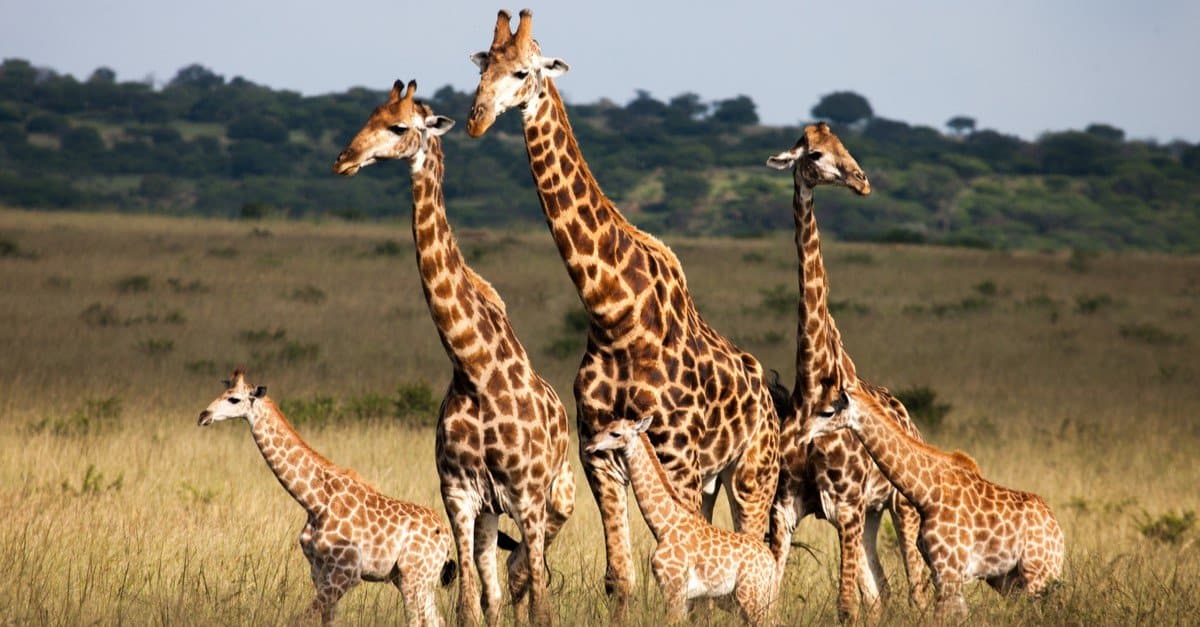

Giraffes are some of the most unique animals in the world, famous for their incredible height with their long legs and long necks. However, it’s not just the adults that are tall, as even baby giraffes are pretty big. With that in mind, it’s time to dive into the fascinating world of giraffe gestation. Have you ever wondered how long they are pregnant for? Read on to find out!
Giraffes: The Facts
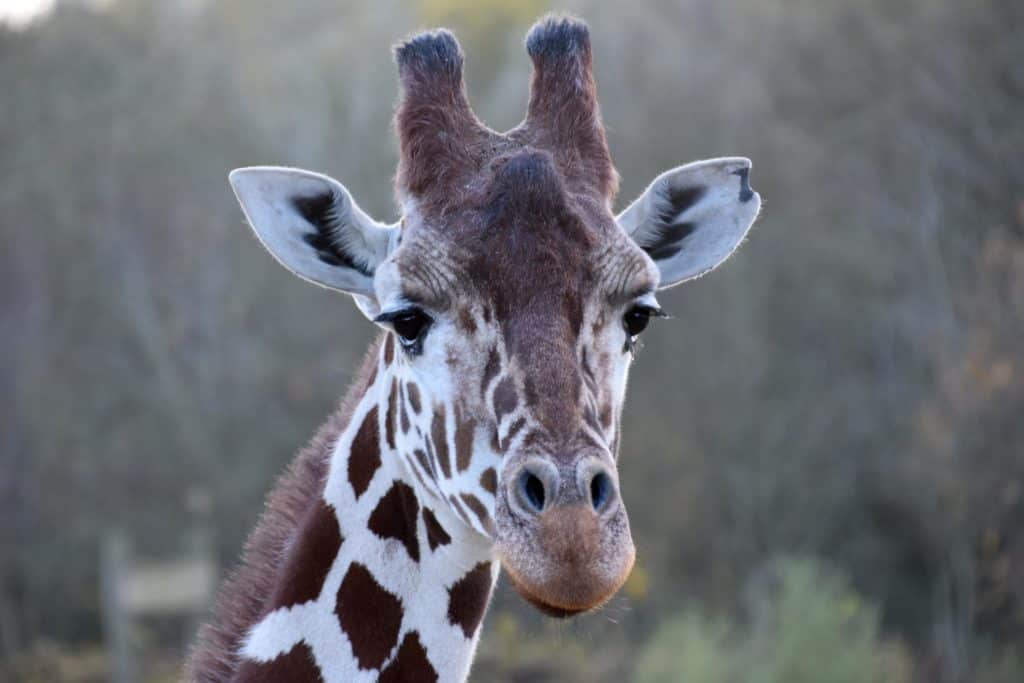
Giraffes are so tall so that they can reach food that no other animal on the savannah can access.
©Millie Bond – Copyright A-Z Animals
Giraffes are huge herbivores that are found only in sub-Saharan Africa, where they inhabit grasslands and savannahs. Estimations of their population size differ but it’s believed that there are between 90,000 and 150,000 giraffes left in the wild, with an estimated decrease of 30% since the 1980s.
Appearance
Easily the most distinguishing feature of the giraffe is its long neck. In fact, looking at giraffes, most of their body appears to be composed of legs and a long neck. They also have long tails with a fringe of long, black hair on the tip. A narrow, upright mane travels from the middle of their shoulders to between their ears, which are large and mobile. Another noticeable feature of a giraffe is the pair of ossicones between the ears. Ossicones are bony growths on the skull, covered by skin and hair, that resemble horns. Finally, the giraffe’s entire body is covered in intricate, irregularly shaped, brown spots broken up by white borders.
Size
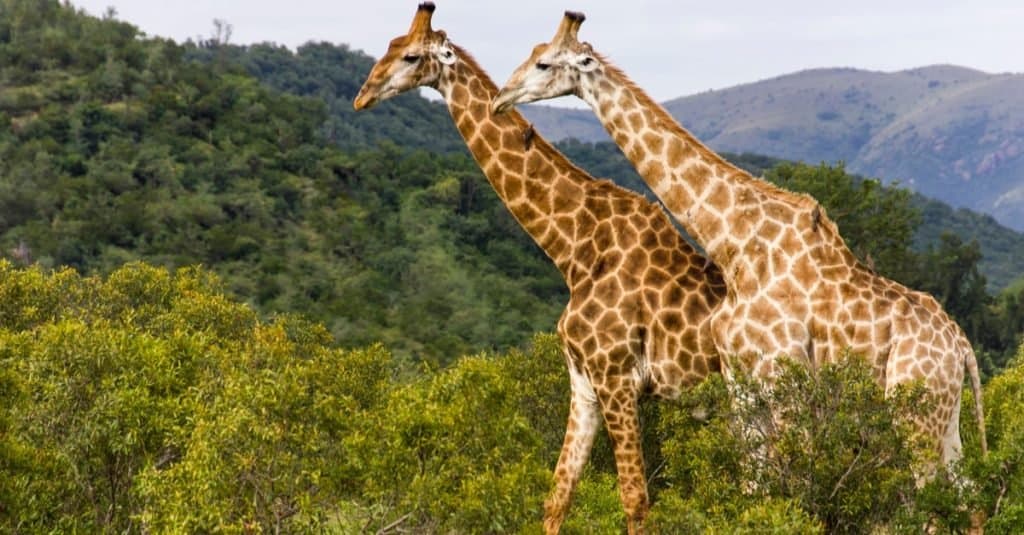
Adult giraffes range in height from 14 to 19 feet.
©NelisNienaber/Shutterstock.com
Adult giraffes range in height from 14 to 19 feet, depending on their age, sex, and subspecies. Females are smaller than males. Males may weigh up to 2,500 pounds or more, while females rarely top 2,000 pounds. Giraffes are big all over; even their tails can grow up to 40 inches long. Also, their necks can be up to eight feet long in adults. Giraffes use their incredible height and long necks to reach leaves high in the trees. Since they’re the tallest animals out there, giraffes face little competition for food.
Distribution and Habitat
Giraffes occupy a wide distribution of disparate ranges. That is to say that, while giraffes occur in multiple parts of Africa, populations are often separated from one another. There are subspecies of giraffes living in Chad, South Africa, Niger, and Somalia, among other countries. They occupy savannahs and light woodlands, where they forage for food and keep an eye out for predators.
Behavior

Female giraffes tend to stick together, while males more often go out on their own.
©Ketan shah/Shutterstock.com
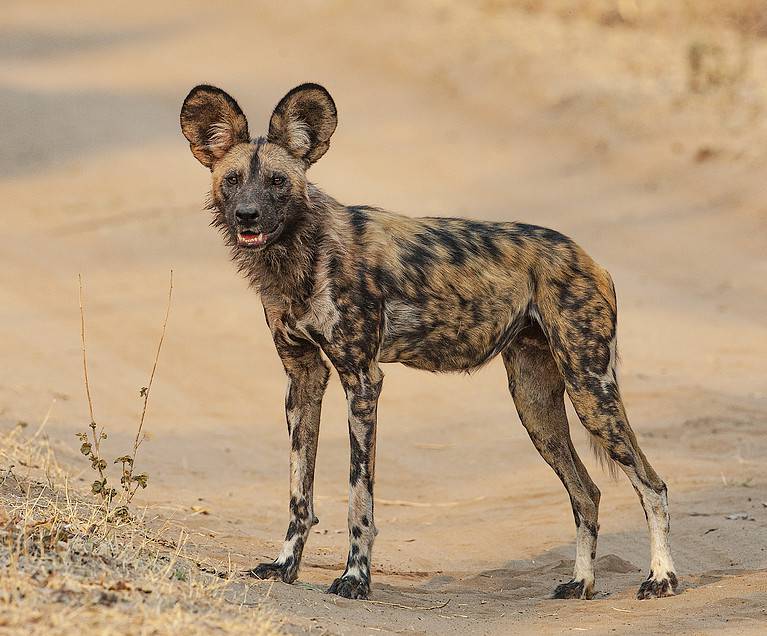
For the most part, giraffes are gentle creatures. However, if faced with danger, or, in the case of males, competition for a mate, they can use their necks, heads, and legs as formidable weapons. Normally, giraffes live for around 26 years in the wild. However, young giraffes are often preyed on by lions, wild dogs, hyenas, leopards, cheetahs, and even crocodiles. When attacked by low-to-ground predators, giraffes use their long legs and sharp hooves to kick.
Giraffe Gestation
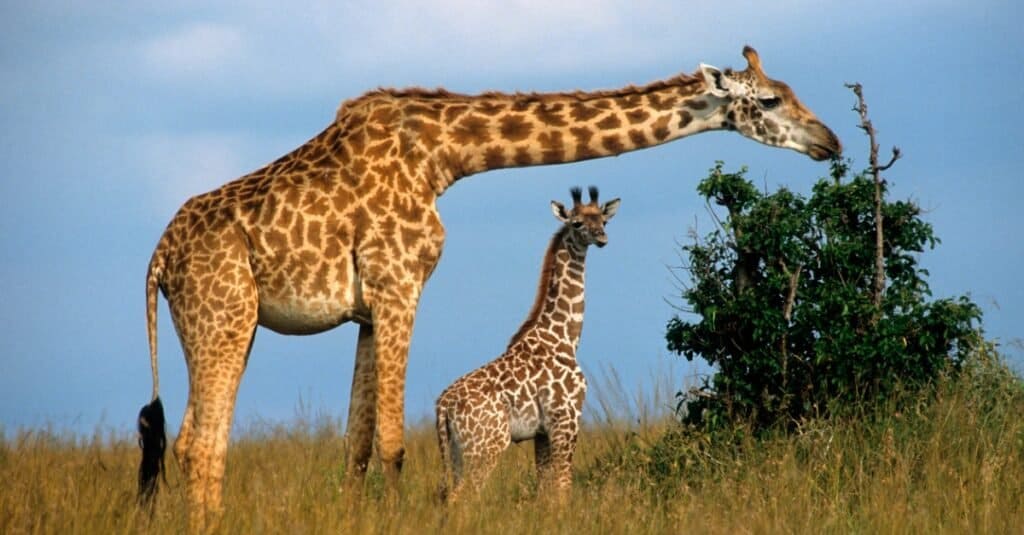
Giraffes almost always have a single calf at a time.
©iStock.com/Michel VIARD
A giraffe’s gestation lasts anywhere from 400 to 460 days, or from 13 to 15 months. Giraffes do not form monogamous pairs. Rather, dominant males fight each other for mating rights, with winners getting ready access to females. Female giraffes can get pregnant at any time of the year and there is no fixed breeding cycle. Once their calves are born, mother giraffes tend to stick together in ‘nursery’ herds.
Giraffes almost always have a single calf at a time. However, twins are not unheard of. Giraffes don’t reach sexual maturity until four or five years old for females and three or four years old for males. Male giraffes take no part in the raising or protecting of babies.
Giraffes give birth every one to two years, and baby giraffes are dependent on their mothers for the first 6 to 8 months of life. After that, they’re weaned off milk and begin eating solid food. By the time they’re 12 to 14 months old, they’re fully independent.
Why Do Giraffes Give Birth While Standing?
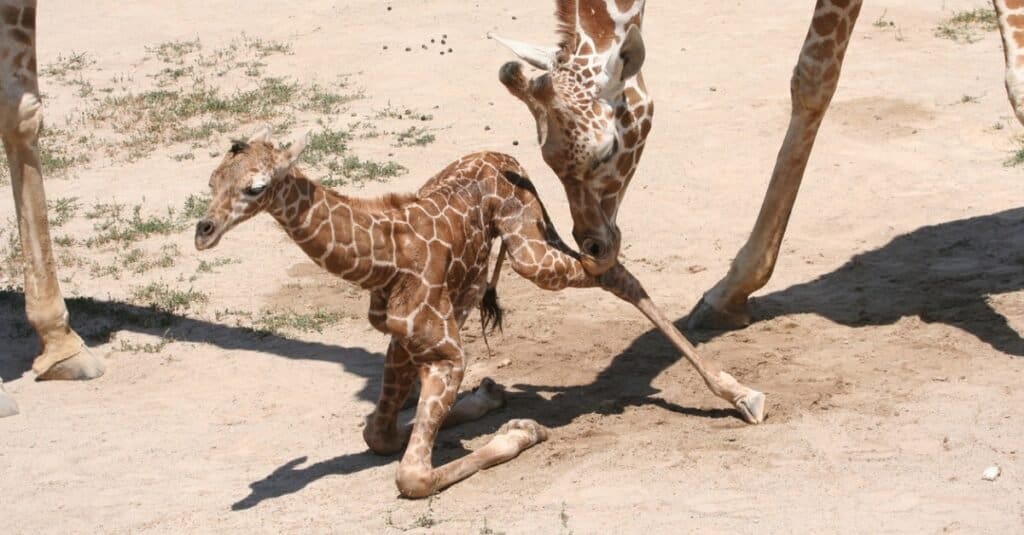
Female giraffes give birth standing up because of predators.
©iStock.com/Janugio
Female giraffes give birth standing up because if they were to lie down, they would be like sitting ducks for any nearby predator, as it’s difficult for them to get up quickly with their long legs and long necks. Therefore, baby giraffes first experience the world through a plummet to the Earth.
Female giraffes are very tall, and their wombs sit about eight feet from the ground. So, giraffes fall about eight feet down at birth. However, within a few hours of this birth, they’re up and fully capable of walking on their own.