
Quick Take
- The plasma that gave this calf a fighting chance had been sitting in a freezer at another zoo for years, where it waited for a moment exactly like this. Explore the plasma rescue →
- Weeks before the procedure, the team was already preparing for the worst, and that early decision is the only reason the calf survived delivery at all. See the early preparations →
- Keeping this calf alive meant grieving her mother at the same time, and the way the keepers navigated both reveals something raw about life behind zoo walls. Read about grief and care →
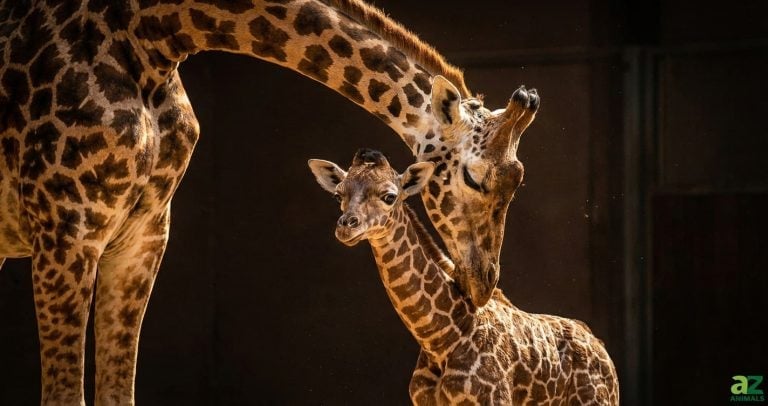
When a newborn reticulated giraffe calf arrived at Tanganyika Wildlife Park in Goddard, Kansas, by emergency cesarean section, the team caring for her knew they were entering almost uncharted territory.
The calf was delivered after her mother Virtue’s condition became irreversible and her organs were shutting down.
The calf was premature, critically fragile, and born without many of the natural advantages a giraffe calf would normally have. She had not passed through the birth canal. She had not made the six-foot drop that typically helps stimulate a giraffe calf’s first breath. She had not nursed from her mother or received the maternal antibodies that normally come through first milk.
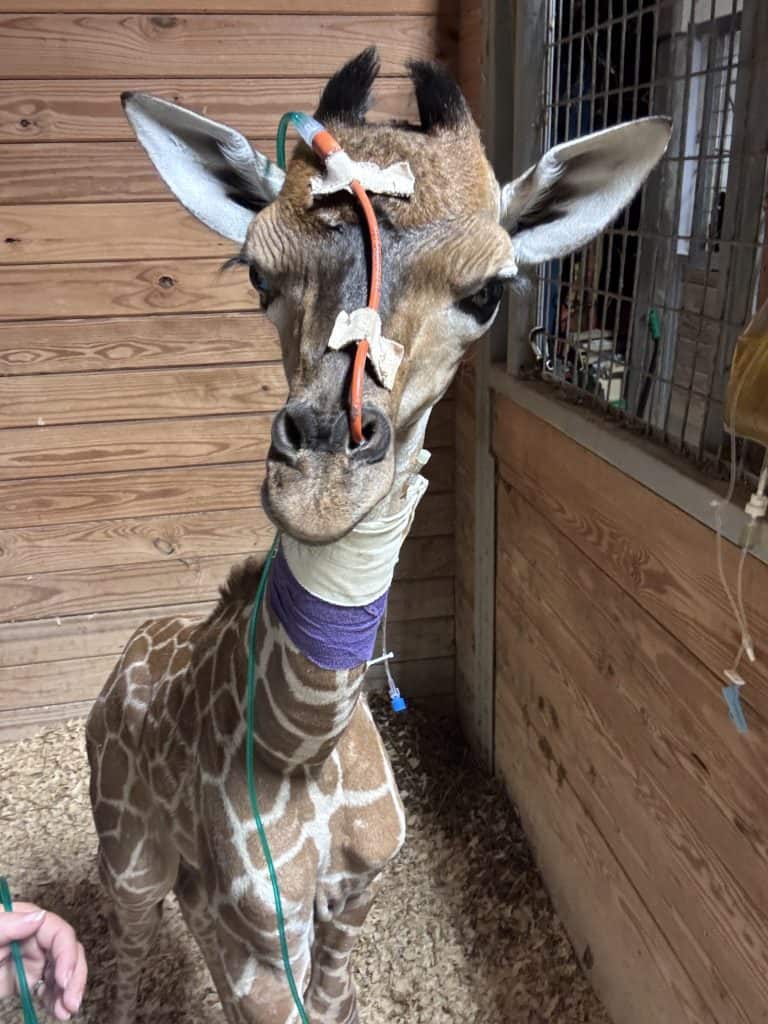
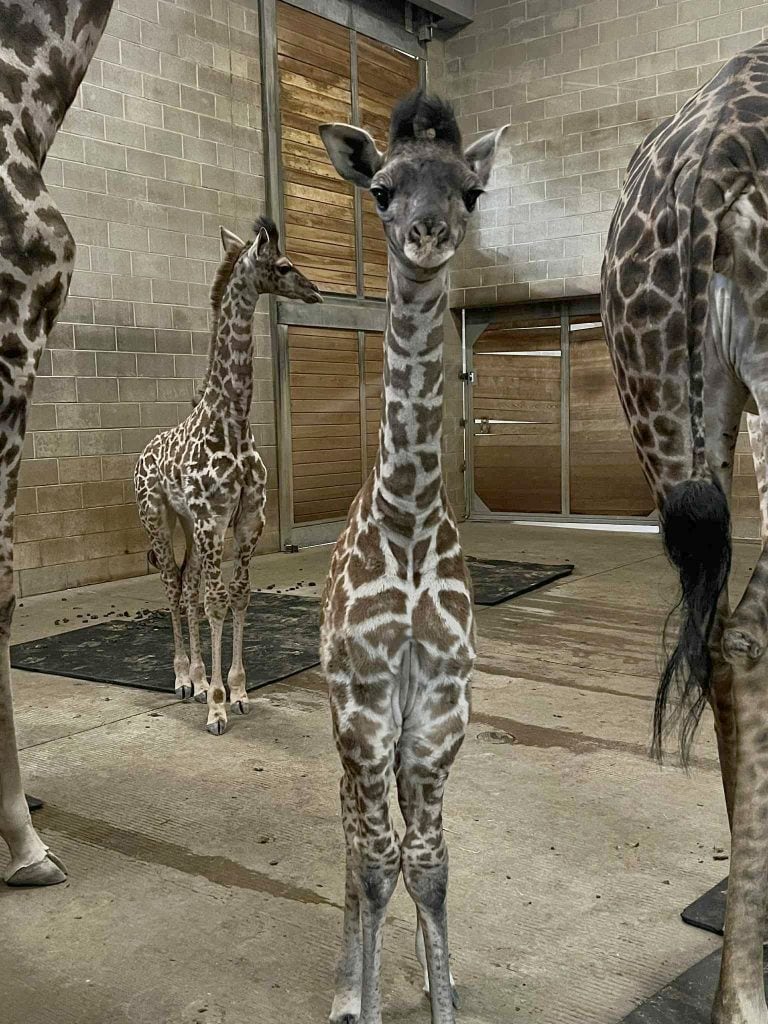
The calf at Tanganyika Wildlife Park is standing on her own.
©LynnLee Schmidt, Integrator at Tanganyika – Original / License
Inside the Race to Save a Newborn Giraffe Calf
And yet, from the moment she was delivered, the team began fighting for her life. “In a situation like this, the preparation and planning actually started weeks before the procedure,” says LynnLee Schmidt, Integrator at Tanganyika Wildlife Park. “We were coordinating with veterinarians around the country, reading case studies and scientific papers about the few giraffe C-sections that have occurred, sharing Virtue’s blood work, and asking whether anyone thought there was a chance of getting her through the last few weeks of pregnancy.”
Virtue, an adult reticulated giraffe in the late stages of pregnancy, had been receiving veterinary care for weeks as her appetite declined and her health continued to deteriorate. Because sedation carries significant risks for giraffes, Tanganyika’s staff depended on training established well before the crisis: each giraffe in the herd is taught to willingly enter a custom chute for medical care. That preparation enabled veterinarians to assess Virtue, collect blood samples, administer fluids and medication, and check on the calf without adding unnecessary stress.
The hope at first was to stabilize Virtue and buy more time.
“The day before the procedure, we prepared for every possible outcome,” Schmidt says. “Our original plan was a standing sedation with aggressive IV fluids, blood work, antibiotics, steroids, pain relief, and an appetite stimulant, hoping we could stabilize Virtue long enough for her to continue the pregnancy. But when we reviewed her blood work during the sedation, it was clear her body was already beginning to shut down.”
At that point, the team pivoted to the emergency plan. “Because of that, we shifted to a plan we had already prepared for: an emergency terminal C-section,” Schmidt says. “Meaning that we would complete the procedure and then euthanize Mom in hopes of saving the calf.”
A necropsy later revealed severe underlying disease in Virtue, including advanced heart and kidney disease and a uterine cyst. Full pathology is still pending, but the park has said the outcome was unavoidable.
For the calf, however, the work was only beginning.
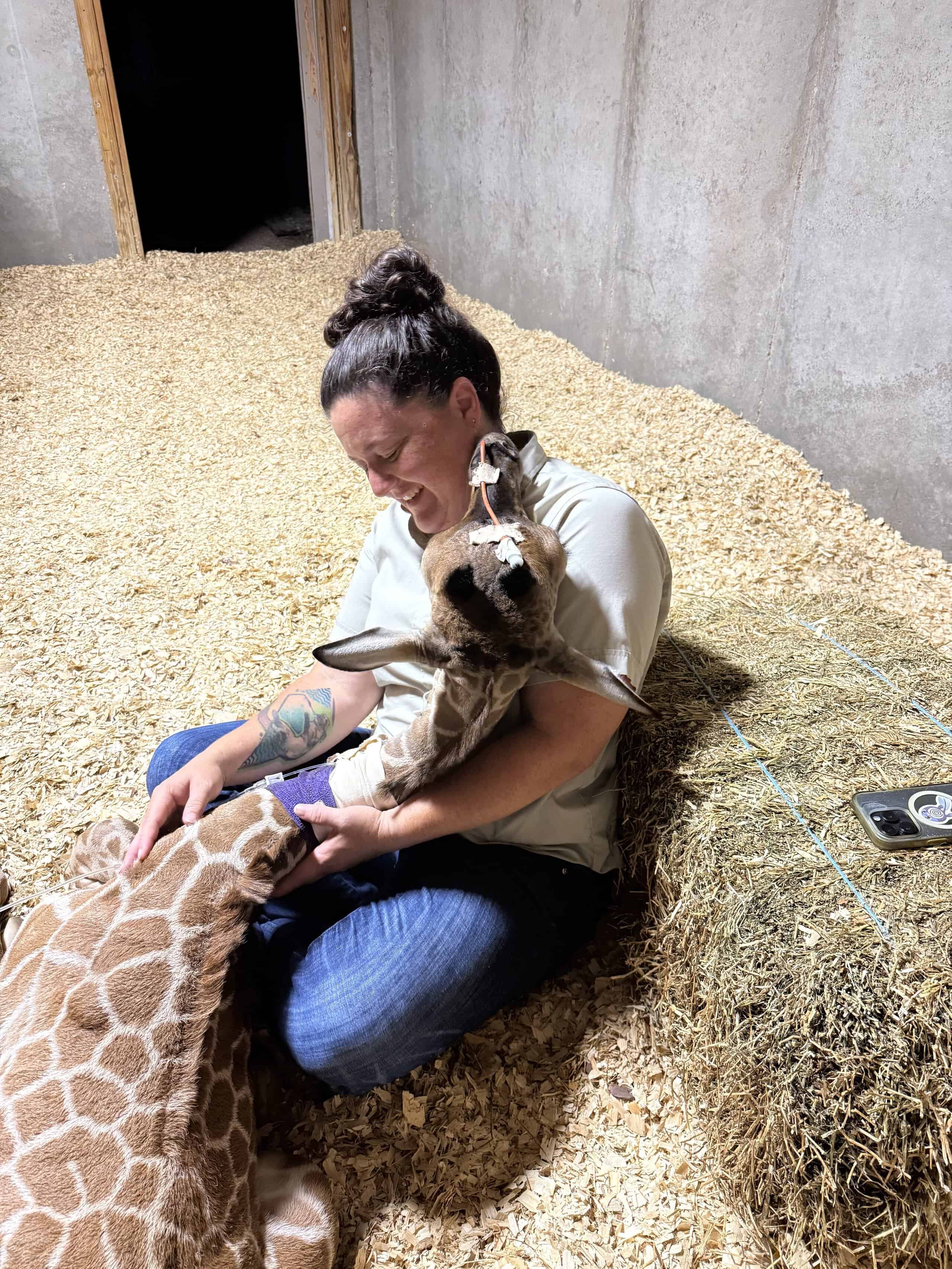
LynnLee Schmidt with the calf during one of her physical milestones.
©LynnLee Schmidt, Integrator at Tanganyika Wildlife Park – Original / License
How Keepers Fought for a Premature Giraffe’s Survival
“The procedure started around 6:30 in the morning and lasted about four-and-a-half to five hours before the calf was delivered and breathing,” Schmidt says. “From there, it became a true divide-and-conquer effort.”
That effort involved teams moving in all directions at once. Some stayed with the calf to provide oxygen, IV fluids, blood draws, tube feedings, and lung X-rays. Others coordinated with veterinarians across the country, secured specialized supplies, and retrieved plasma needed to help replace the antibodies the calf could not get from Virtue.
“By the time she was stable and breathing on oxygen, we were already 15 to 20 hours into the day,” Schmidt says. “Then we started organizing overnight shifts so someone could stay with her around the clock.”
The calf’s first challenges were profound. Because she was born prematurely and by surgery, her lungs were not fully ready for life outside the womb. “Our biggest hurdle early on was lung development,” Schmidt says. “It became clear that her lungs weren’t fully developed, so we started steroids to help with that and provided supplemental oxygen through a modified Foley feeding tube placed through her nose and reaching just above the trachea. We gradually reduced her oxygen support as her lungs improved.”
The Intensive Care Effort Saving a Baby Giraffe
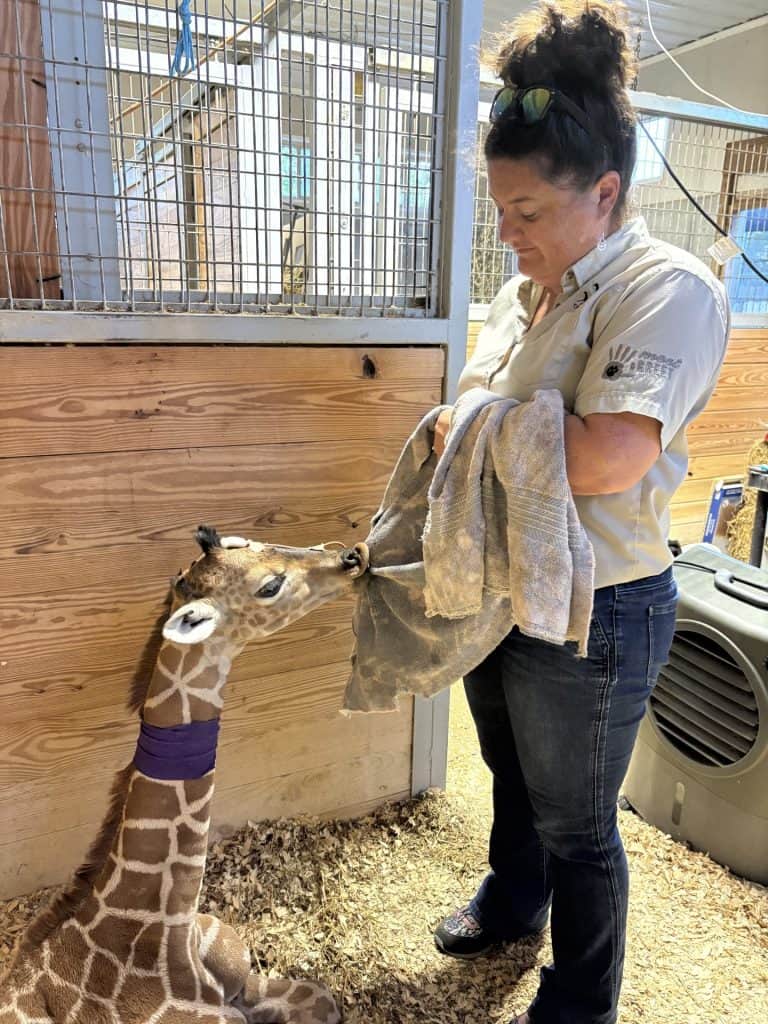
Even basic newborn milestones came slowly. A healthy giraffe calf typically stands within minutes and nurses within the first hour. This calf could do neither. “She couldn’t even get herself into a sternal position or hold her head up,” Schmidt says. “We were waiting for her to sit upright, hold her head up, stand, and eventually walk on her own. It took about a week before we checked all of those boxes.”
The lack of maternal colostrum created another major medical concern: a failure of passive immunity. To help compensate, the team gave her bovine replacement colostrum and giraffe plasma from Dickerson Park Zoo, which had been banked for years in case a moment like this ever came.
But supporting a 100-pound giraffe calf is not just medically complicated. It is physically exhausting. “Helping her stand and lie down has probably been the most physically demanding part,” Schmidt says. “She still weighs just over 100 pounds, and she has more confidence than coordination.”
Because the calf’s umbilicus tore during delivery and had to be surgically repaired, handlers could not put pressure on her abdomen while helping her move. The team studied videos of healthy giraffe calves and improvised supportive equipment to protect her body while teaching her how to rise, balance, and walk.
“We developed a stirrup to help support her chest while she learned to stand and walk,” Schmidt says. There were also constant risks to manage. If a giraffe calf’s legs splay outward, serious ligament damage can occur. IV lines, oxygen tubing, medications, temperature checks, bloodwork, feedings, wound care, and monitoring all had to happen around a calf who wanted to move before her body was fully ready.
“Beyond the physical challenges, the around-the-clock care is exhausting,” Schmidt adds. “It interrupts your sleep, and you’re always worried that something could change. You’re constantly watching, evaluating, and hoping she continues moving in the right direction.”
What It Took to Give This Giraffe Calf a Chance
That intensity unfolded alongside grief. The team was not only trying to save a newborn; they were also coping with the loss of Virtue. “I think that’s different for every keeper,” Schmidt explained. “Some people took time to say goodbye before the procedure because they knew what was possible. Others stepped away afterward to spend a few quiet moments with Virtue. Some people cry in their cars. Some cry when they get home. And honestly, some of us probably haven’t fully dealt with it yet because our focus shifted immediately to keeping the calf alive.”
What has helped, she said, is the calf’s progress. “I do think it helps that the calf is doing so well,” Schmidt says. “It doesn’t erase the loss of Virtue, but it helps you feel that the incredibly difficult decision was worth making.”
For Schmidt, one of the biggest lessons of the case is how much zoo medicine depends on collaboration rather than any one institution’s expertise. “I think one of the biggest things this case shows is just how collaborative the zoo community really is,” Schmidt says.
Even Tanganyika, with one of the country’s largest giraffe herds and more than 90 giraffe calves born over the years, had never faced anything like this. Plasma was mobilized from another zoo. Veterinarians reviewed bloodwork in real time. Specialists across institutions offered guidance as the calf’s needs changed hour by hour.
“More than anything, I hope people come away with a greater appreciation for the people caring for these animals,” Schmidt says. “Zoo keepers are often underpaid, underappreciated, and overworked, and they still show up every day willing to make incredible personal sacrifices for the animals in their care.”
For now, the calf remains in critical care, still making her own history one milestone at a time. And for the people surrounding her, that fight has become both a medical effort and a testament to what devotion looks like behind the scenes.
You can keep up with progress this precious giraffe is making on the Park’s Instagram account here, and you can donate to the costs involved in providing the care here.