Quick Take
- This frog is neon orange, and yet scientists spent seven years failing to find it. The reason they finally did has nothing to do with its color. How the frog was found →
- Frogs are built to jump, yet this one can't stick a single landing, and the biological cause is stranger than you'd expect. The biology behind its clumsiness →
- It's one of the most toxic creatures for its size on Earth, yet its deadliest defense is not something it actively does but rather something hidden within its skin.
- Dozens of species in this frog's family were hiding in a region scientists had studied for decades, and most of them turned up only recently. A hotspot of hidden species →
Imagine a bright orange frog so small it can sit on your fingernail — and yet so elusive that it stayed hidden from scientists for years despite its vibrant coloring. Researchers finally uncovered this tiny amphibian deep in the leaf litter of Brazil’s Atlantic rainforest. Known as the pumpkin toadlet (Brachycephalus lulai), this new species lives nowhere else on Earth.
Its discovery highlights how much global biodiversity remains hidden. Out of the 42 recognized species in the Brachycephalus genus, 35 have been discovered just since 2000. This suggests that even in regions scientists have studied for decades, new species are still waiting to be found.
A Bright Orange Frog Hidden Among the Leaves
Researchers found this tiny orange frog in the cloud forests of southern Brazil’s Serra do Quiriri mountain range. They named the species after Brazilian President Luiz Inácio Lula da Silva, honoring his leadership and drawing attention to the importance of Atlantic rainforest conservation.
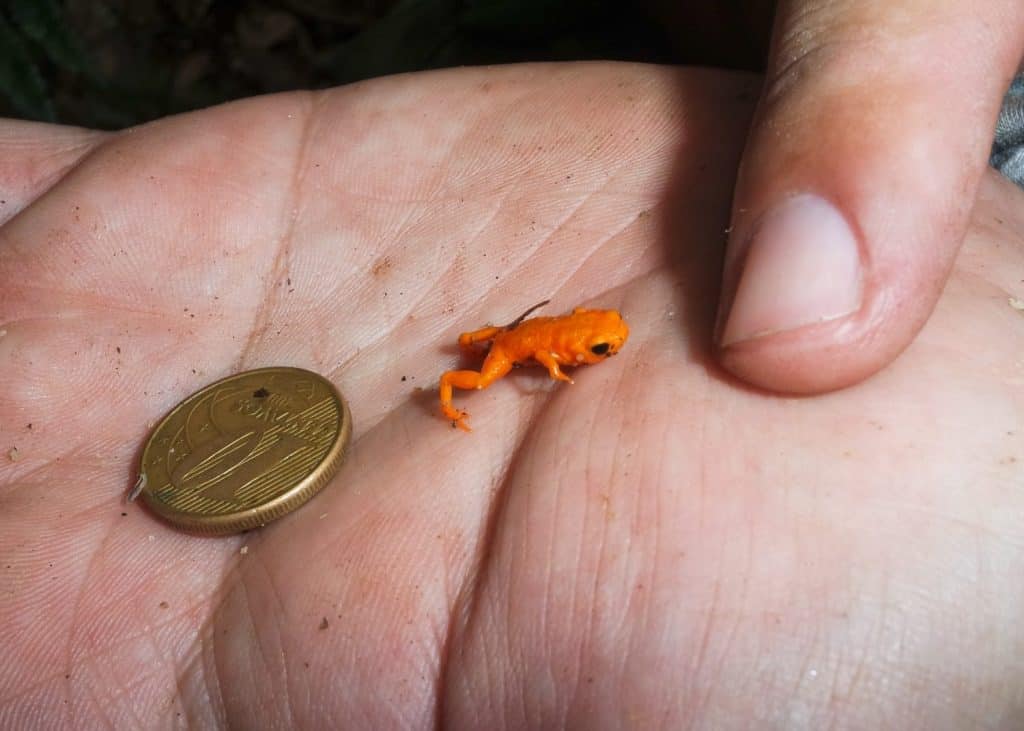
Pumpkin toadlets are members of the Brachycephalus genus, which are also referred to as saddleback toads.
©Gomes' Nature Records/Shutterstock.com
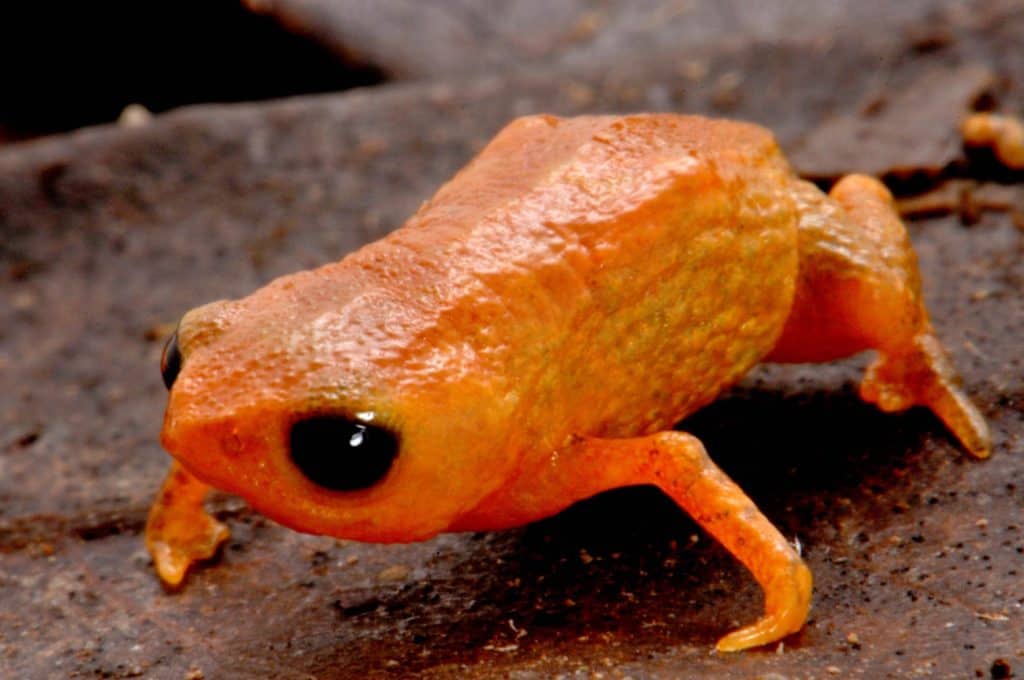
The pumpkin toadlet is extremely small, with adults measuring just over 0.39 inches (1 centimeter) long. Males range from 0.35 to 0.44 inches (8.9 to 11.3 millimeters). Females are slightly larger at 0.46 to 0.53 inches (11.7 to 13.4 millimeters).
Despite its tiny size, the pumpkin toadlet has a very distinct appearance. Its body is brilliantly orange and toad-like, accented with small, irregular green and brown spots. Its bright coloring makes it stand out against the damp leaves of the forest floor in its habitat.
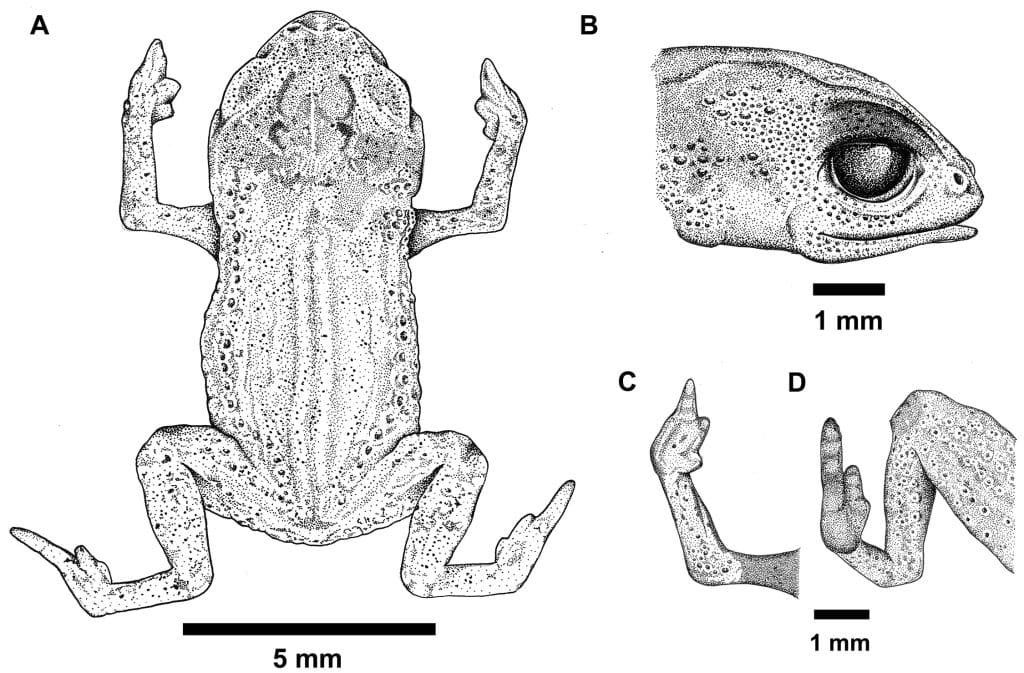
While it looks similar to other members of its genus, scientists identified a few distinct physical traits that set it apart from its relatives. Unlike species in the Brachycephalus ephippium group, this frog lacks bony plates fused to its skin or skull. It also possesses a specific feature known as a linea masculina.
The discovery of this new pumpkin toadlet species is partially due to how they have evolved. Many of these frogs live only on a single mountaintop or a few neighboring peaks, isolated from other populations by valleys and different habitats. Over thousands of years, these isolated groups gradually evolve and turn into distinct species. Now, researchers are exploring Brazil’s mountain cloud forests with better genetic tools and detailed anatomical studies. They are finding that what looked like a single, widespread species is actually several unique frog species, each restricted to its own tiny range.
A Frog That Can’t Stick the Landing
Most frogs use powerful hind legs to easily launch away from predators or toward prey. The pumpkin toadlet, however, is a surprisingly awkward jumper. When these tiny amphibians leap, they tumble through the air, spinning and cartwheeling before crashing down onto their backs or bellies. They are also poor walkers, moving with a stiff, stomping gait rather than taking smooth steps.
Researchers found that the problem comes from the frog’s inability to adjust its body while airborne. Unlike most frogs, which position themselves for a safe landing mid-jump, these tiny amphibians freeze in their initial launch position.
When air flows over the tiny, microscopic hairs in the ear canal, it sends a message to the brain, allowing the frog to know how to position its body when jumping.
©Luiz F. Ribeiro in M. Bornschein et al. / CC BY 4.0 / Wikimedia Commons – Original / License
The issue actually stems from their incredibly small ears. As part of the “oVert” project, researchers used CT scans to examine the inner ears of 147 frog species. They discovered that Brachycephalus toads have the smallest semicircular canals ever recorded in adult vertebrates. These fluid-filled structures normally help animals balance by sending signals to the brain about body position and movement. However, because the pumpkin toadlet’s canals are so small, the fluid cannot flow effectively, which keeps the frog from tracking its position in mid-air.
Fortunately for the pumpkin toadlet, agility and jumping aren’t as important as they are for many other frogs. Rather than making long leaps across open ground, these tiny amphibians spend most of their time moving slowly through damp leaf litter, looking for food and shelter under fallen leaves.
In addition, these frogs have developed other survival strategies. Many species in this genus produce tetrodotoxin — the same powerful poison found in pufferfish — through their skin to deter predators. They also have thickened, protective bone structures in their skulls and backs.
A Cloud Forest Specialist
Brachycephalus lulai lives in the damp leaf litter on the southeastern slopes of the Serra do Quiriri mountains in northeastern Santa Catarina, Brazil. It is found in isolated patches of mountain cloud forest at elevations above 2,460 feet.
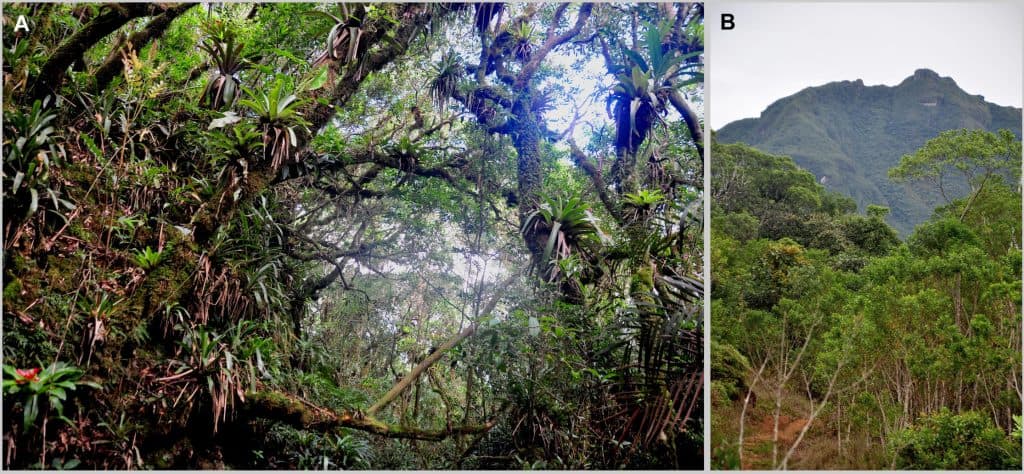
A cloud forest is a tropical or subtropical forest that is almost permanently shrouded in clouds due to its altitude.
©Luiz F. Ribeiro in M. Bornschein et al. / CC BY 4.0 / Wikimedia Commons – Original / License
This isolated mountain habitat helps explain the evolutionary path of this tiny frog. According to the “microrefugia” theory of evolution, climate changes during the Quaternary period caused forests to shift across the landscape. As wetter conditions returned, forests expanded upward, leaving isolated patches of cloud forest surrounded by high grasslands. These isolated environments separated frog populations from one another, allowing them to evolve independently into distinct species. Genetic research shows that Brachycephalus lulai is most closely related to Brachycephalus auroguttatus and Brachycephalus quiririensis, which also live in the Serra do Quiriri mountains.
How Scientists Finally Found the Pumpkin Toadlet
Despite its bright orange coloring, finding such a tiny frog was no easy task. Researchers spent seven years cataloging Brachycephalus populations in the region before finally identifying Brachycephalus lulai.
Interestingly, researchers did not find the frog because of its vibrant hue, but primarily by tracking its call. Scientists tracked down males by listening for their faint mating calls within the dense leaf litter. These calls consist of groups, each containing two notes, with each note having one to four pulses. Females are much quieter and were found mostly by chance.
The newest pumpkin toadlet species measures only half an inch long.
©Verônica R. Apolônio in M. Bornschein et al. / CC BY 4.0 / Wikimedia Commons – Original / License
During their field expeditions, researchers collected 32 frogs and recorded 13 mating calls. To confirm they had discovered a new species, they compared the frogs’ physical traits, calls, and DNA with other known species. Scientists also used high-resolution CT scans to examine the frogs’ skeletons and conducted genetic sequencing to map their place on the evolutionary tree. Through this process, they identified 18 physical and behavioral traits that separate Brachycephalus lulai from its closest relatives, placing it within the Brachycephalus pernix species group.
A Tiny Frog Facing Big Conservation Challenges
Because Brachycephalus lulai lives in a well-preserved, remote environment, researchers believe it faces no immediate risk of extinction. The study’s authors suggest that the frog would qualify as a species of “Least Concern” under the IUCN Red List, though it is not yet officially listed.
However, the species is not entirely safe. The broader Serra do Quiriri landscape faces growing threats from cattle grazing, grassland burning, mining, deforestation, tourism, invasive pine trees, and climate change. Nearby mountain habitats are already home to highly threatened frogs found nowhere else, including Brachycephalus quiririensis, Brachycephalus auroguttatus, and Melanophryniscus biancae.
To protect the pumpkin toadlet and other vulnerable amphibians, researchers propose creating a federal conservation unit in Santa Catarina called the Refúgio de Vida Silvestre (RVS) Serra do Quiriri. This would protect the cloud forest ecosystem without requiring the government to buy private land.
![Location of specimens examined of species from Brachycephalus pernix group, in southeastern and southern Brazil. (A) All specimens. (B) Detail of the distribution of B. lulai. Abbreviations: SP = São Paulo; PR = Paraná; SC = Santa Catarina. Urban areas are displayed in gray, open vegetation areas in light green, and dense vegetation in dark green. Basemaps: OpenStreetMap, under Open Database License (ODbL), available at [1]](https://a-z-animals.com/media/2025/12/Brachycephalus_pernix_species_group_distributions-1024x723.jpg)
Species in the Brachycephalus pernix group are mainly located in southeastern and southern Brazil.
©M. Bornschein et al. / CC BY 4.0 / Wikimedia Commons – Original / License
Protecting these tiny frogs will require ongoing research and monitoring. However, this is a significant challenge due to the remoteness of their habitat. Scientists face limited funding and must trek into remote mountain areas, often manually clearing miles of dense forest trails just to reach these ecosystems.
Ultimately, the discovery of the pumpkin toadlet reminds us that even the smallest creatures can teach us enormous lessons about evolution, biodiversity, and the vital need to protect the world’s remaining wild places.