
When animals die in the sea, their dead bodies sink to the seafloor. These lifeless bodies don’t break down right away because the rate of decomposition is much slower in water. You might expect to see the remains of dead organisms weeks after they sink to the bottom, but this is not typically the case. Just as vultures feed on land animals when they die, there are sea scavengers as well. They feed on dead organisms at a relatively fast rate, leaving little or nothing behind. The Gulf of Mexico has bottom-dwelling scavengers like this that live on the seafloor and feed on dead animals. Keep reading to find out exactly what is feasting on dead animals in the Gulf of Mexico.
Deep Sea Scavengers
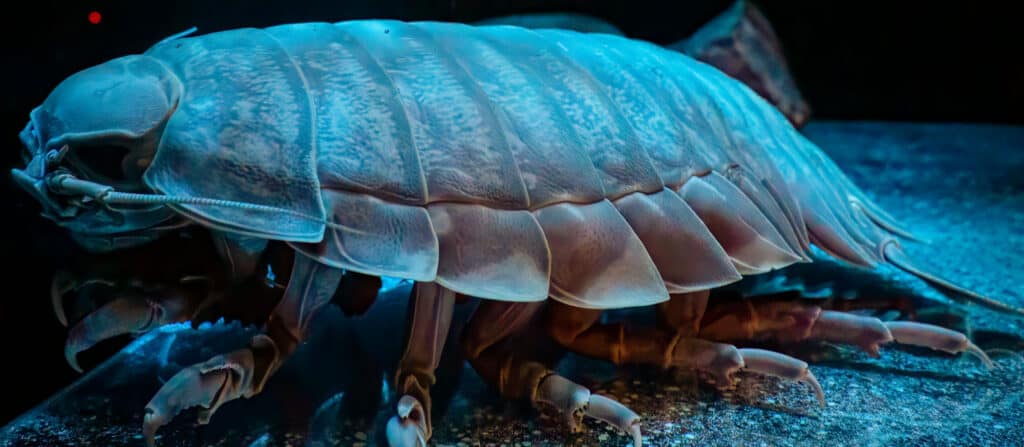
Bathynomus giganteus is the largest known isopod species.
©iStock.com/Darren Lynch
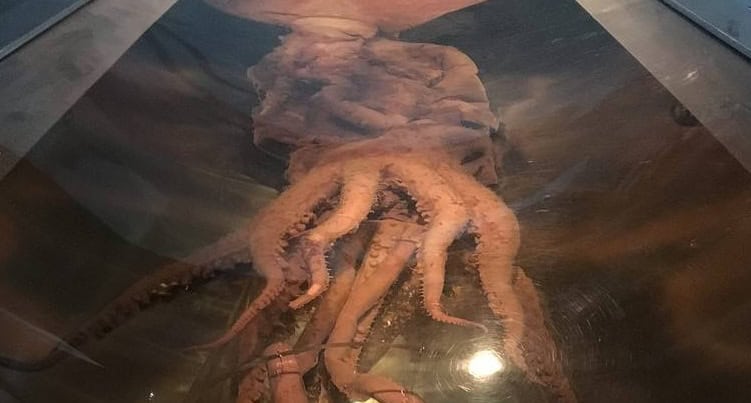
One of the most significant scavengers that exist on the deep seafloor of the Gulf is the giant isopod. These organisms can live at depths of up to 7,000 feet. It is a sizable arthropod related to decapods like shrimp and crabs. It is also a close relative of Armadillidium, which is a genus of terrestrial crustaceans commonly known as pillbugs.
The giant isopod belongs to the order Isopoda, a diverse group of crustaceans that includes woodlice and other related organisms. Any of the 20 large isopod species in the Bathynomus genus can be referred to as a giant isopod.
Bathynomus giganteus is the largest of all giant isopod species. It is native not only to the Gulf of Mexico, but also to parts of the Atlantic and Pacific Oceans, where it scavenges the deep waters for food. Due to its carnivorous nature, it is also capable of attacking fish caught in commercial trawler nets.
What Does a Giant Isopod Look Like?

Giant isopods are covered in a multi-segmented hard shell called an exoskeleton.
©Peter Gudella/Shutterstock.com
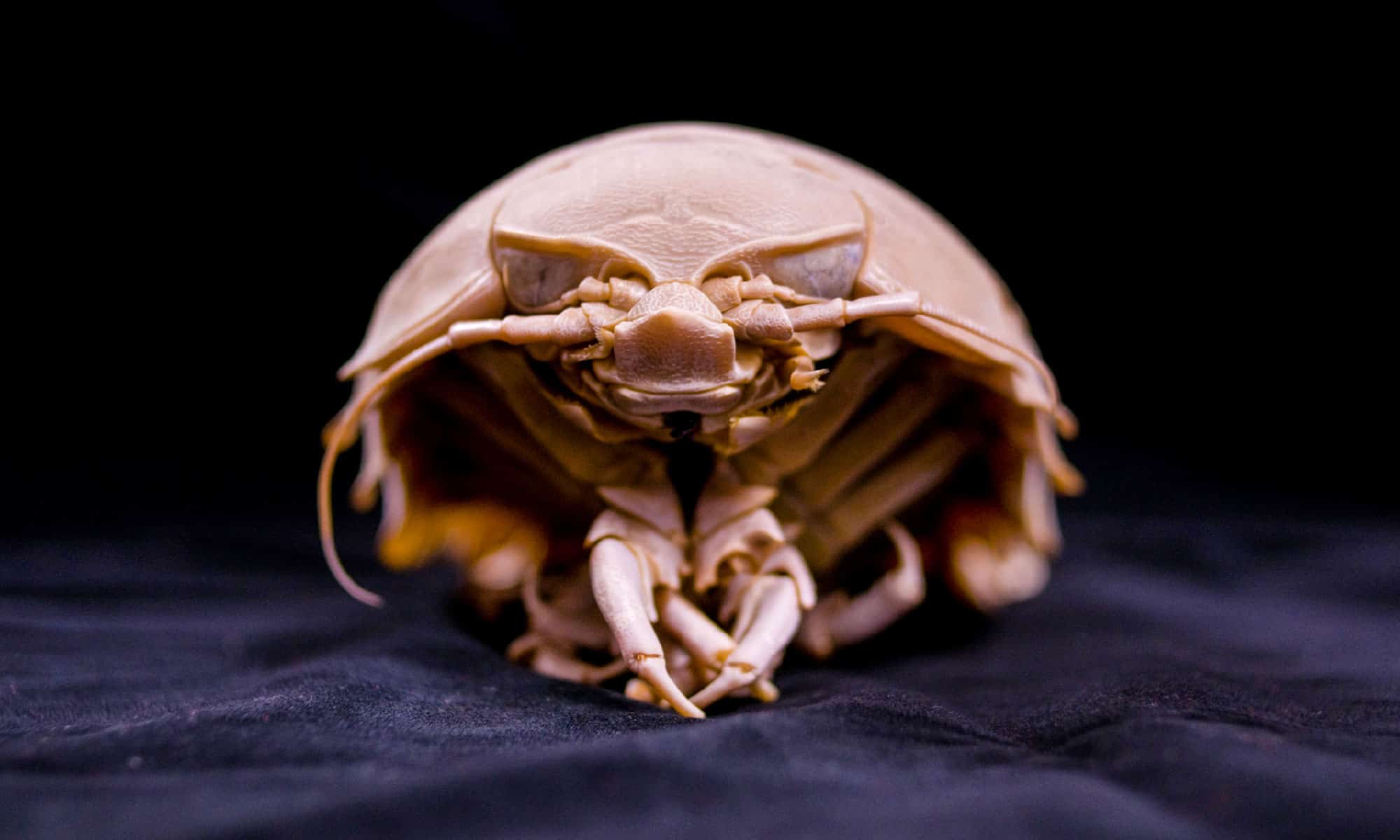
The giant isopod looks like a big woodlouse. The sizes of many species within the Bathynomus genus range from 3.1 to 19.7 inches. For Bathynomus giganteus, the size range is typically between 7.5 and 14.2 inches. The largest individual Bathynomus giganteus ever found was about 20 inches long, although there have been unconfirmed sightings of a 30-inch-long isopod. Giant isopods are mostly pinkish, pale lilac, or brown in color.
The entire outer part of the body is covered in a multi-segmented hard shell called an exoskeleton, which offers protection and flexibility. Like a typical arthropod, its body is divided into the head (cephalon), thorax (pereon), and abdomen (pleon). The organism has two pairs of antennae, one pair longer than the other. Isopods use their antennae and compound eyes to navigate and forage in their environment.
Giant isopods have seven pairs of legs that they use for movement on the seafloor. The first set of appendages is adapted to actively direct food into the organism’s mouth. The abdomen is divided into five segments, each with a pair of pleopods (swimmerets). The segment plates of male isopods have a pointed, arched shape, while those of females are rectangular. The pleopods, along with the fan-like tail, allow the isopod to swim. The pleopods also work with flat, gill-like structures known as rami to aid the isopod’s respiration.
The Giant Isopod Diet
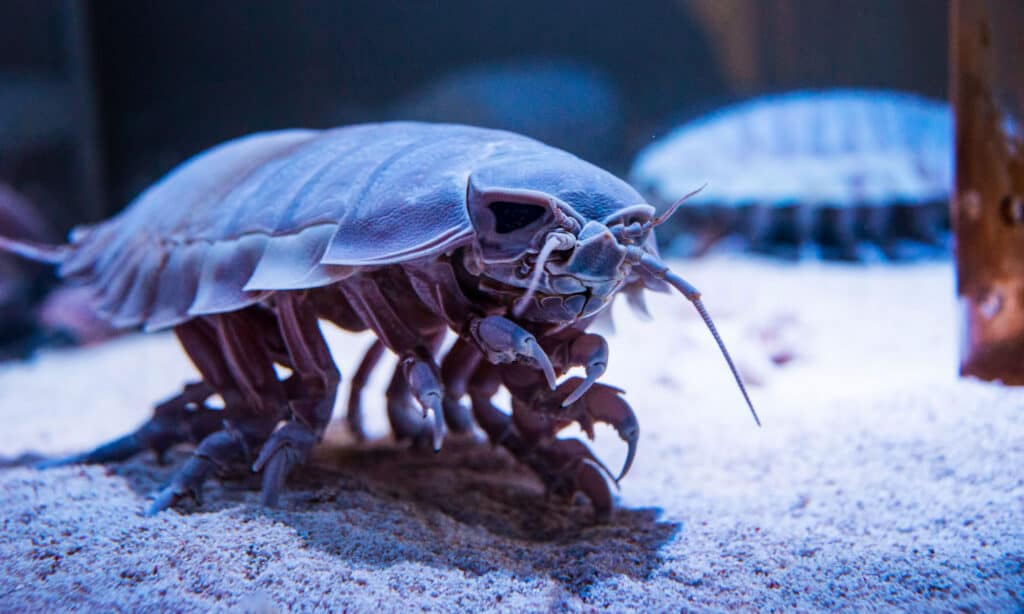
Giant isopods can survive for years without food.
©kikujungboy CC/Shutterstock.com
Giant isopods are bottom-dwelling carrion feeders and often have limited access to food resources on the seafloor. As a result, they may go long periods without finding a meal — sometimes as long as four years. These large arthropods have a slow metabolic rate and can survive in a state of semi-hibernation to conserve the energy needed for moving and feeding.
Because of their deep-sea habitat, these bottom dwellers must wait for food to come to them. Giant isopods depend on food particles that fall from shallower waters, known as “marine snow,” which often appears as white flakes by the time it reaches the seafloor. This “snow” may consist of crab flesh, marine worms, and other animal debris. Occasionally, giant isopods may be fortunate enough to find large food sources, such as dead whales or other large animals.
In an experiment to understand how deep sea creatures utilize carbon food sources, scientists dropped three dead alligators in the Gulf of Mexico. In the 2019 experiment, the scientists recorded how the giant isopods that live at the bottom of the Gulf of Mexico feed. The video showed how the deep-sea scavengers consumed a carcass within a relatively short period. The creatures used their powerful mandibles to tear at the tough flesh of the alligators, feeding rapidly until they could barely move.