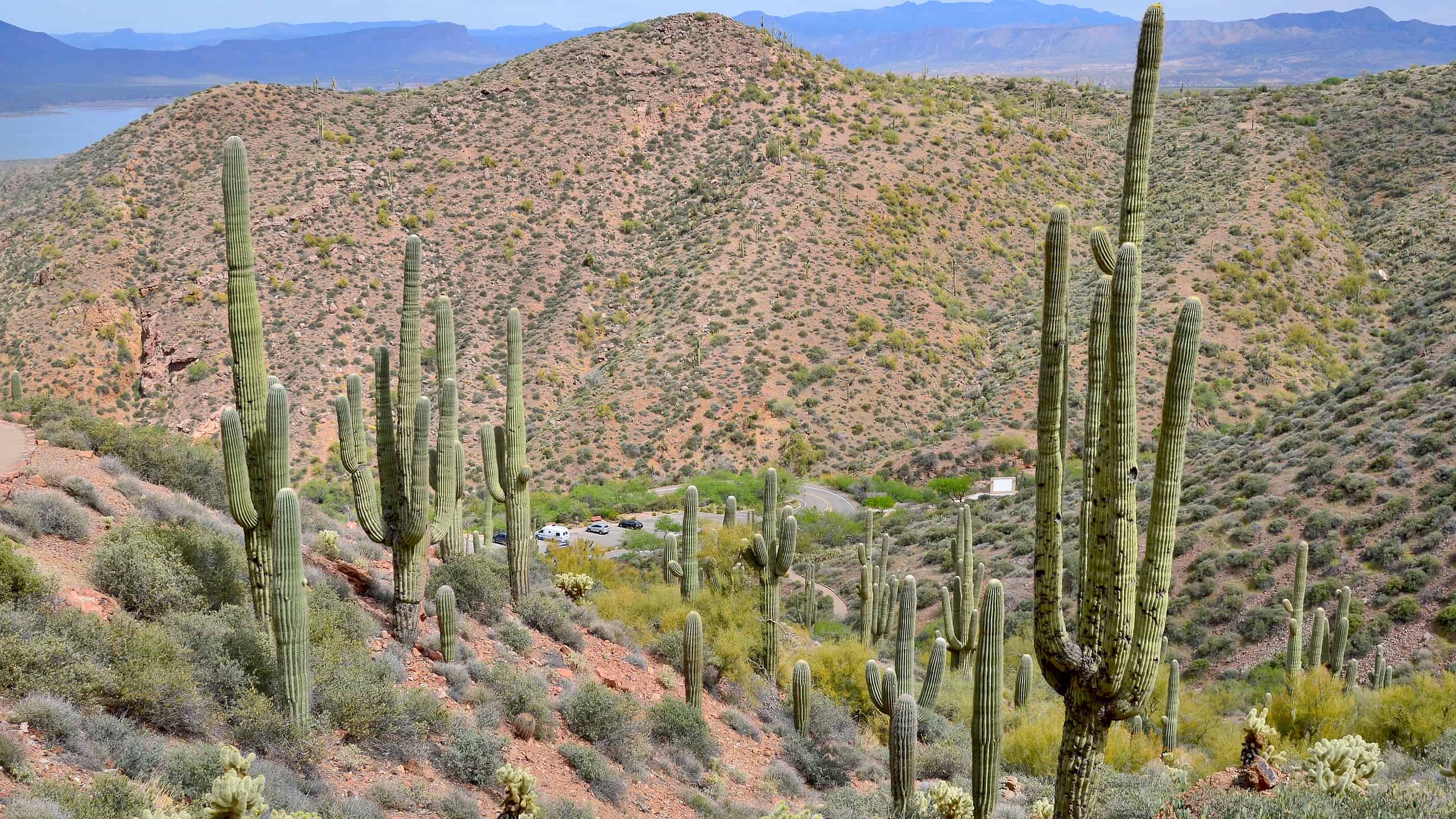

Saguaro Park in southeastern Arizona, near Tucson, offers a landscape unlike anything you’ll see elsewhere. The park hosts about a million visitors per year (in 2024, 946,000 people visited). Comprising more than 91,000 acres of land (143.3 square miles, the size of about 73,000 football fields), the park offers about 200 miles of trails for hiking, biking, and/or horseback riding. Trails range from flat to steep and mountainous, accommodating different levels of accessibility and challenge. For example, the paved Cactus Garden Trail winds a half mile through cactus gardens featuring interpretative signs and benches, while the Wasson Peak trail climbs 2,040 feet, offering staggering views of the mountain ranges.
The park is open year-round, with pedestrian and biker access 24 hours a day. You can pay a fee to drive through during certain daylight hours when the park is open to vehicles. Many prefer to visit the Sonoran Desert from about October through April, when daytime temperatures don’t exceed 60-70° F and rain is light. Summers (May through September) are hot, with temperatures often climbing above 100° F, punctuated by intense thunderstorms that cause flooding in low-lying areas. Still, the total rainfall for this desert park is less than 12 inches per year.
Saguaro Cacti
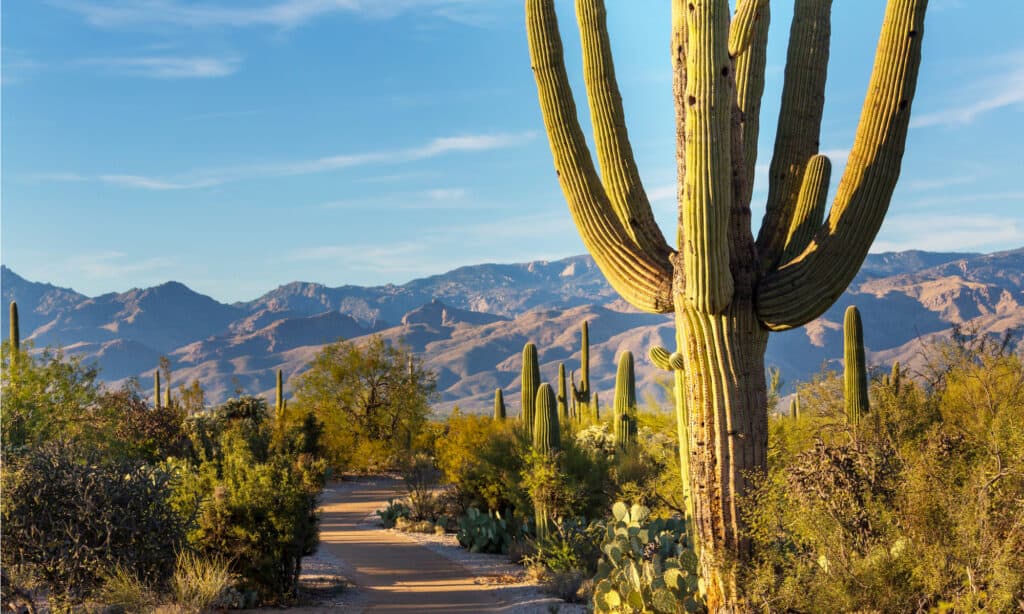
Tree-like saguaro cacti can be seen in the lower elevation parts of the park.
©high fliers/Shutterstock.com
Saguaro Park is part of the Sonoran Desert, which is the only desert in the world that experiences two rainy seasons per year. The park is named for its unusual “saguaro” cacti (pronounced “suh-wah-roh”). Endemic to the Sonoran Desert, the cacti grow over 45 feet tall and may live as long as 200 years. The tallest saguaro cactus ever recorded in the park reached 78 feet, though it fell over in 1986. You can see tall cacti on the Loma Verde loop in the East District. These giant cacti have become a symbol of the Old West, but they are just one of more than 25 cactus species in Saguaro National Park. Other common species include cholla, barrel, and prickly pear cacti.
Biodiversity of Saguaro National Park
The park’s two distinct districts encompass a diverse set of ecosystems. The Tucson Mountain District (TMD) on its western side contains a mix of drought-tolerant desert scrub, grasslands, oak woodlands, and conifer forests. It’s located in the Tucson Mountains, at relatively low elevations, from 2,130 to 4,687 feet. The Rincon Mountain District (RMD) on its eastern side, with mixed conifer forests, is at a higher elevation (from 2,580 to 8,664 at the peak of Mica Mountain). It sits at the interface of the Sonoran and Chihuahuan Deserts, forming part of a chain of mountaintops that run from southeastern Arizona into northwestern Mexico. The distinct temperature and humidity regimes support unique ecological communities.
In a visit to Saguaro National Park, you have the potential to see a huge variety of animals, with about 550 animal species known. More than 325 vertebrates—mammals, birds, reptiles, and amphibians—call the park home. The Sonoran Desert has the highest biodiversity of any desert in North America. Just birds alone tally about 200 individual species. Its exceptional biodiversity is attributed to the range of habitats it contains. In tandem with plant communities, the animal life in Saguaro National Park varies with elevation. In the desert scrub, you’ll find drought-tolerant animals like tiger salamanders, desert tortoises, road runners, and collared peccaries. At higher, cooler elevations are black bears, mountain chickadees, and mountain lions.
Birds on the Ground
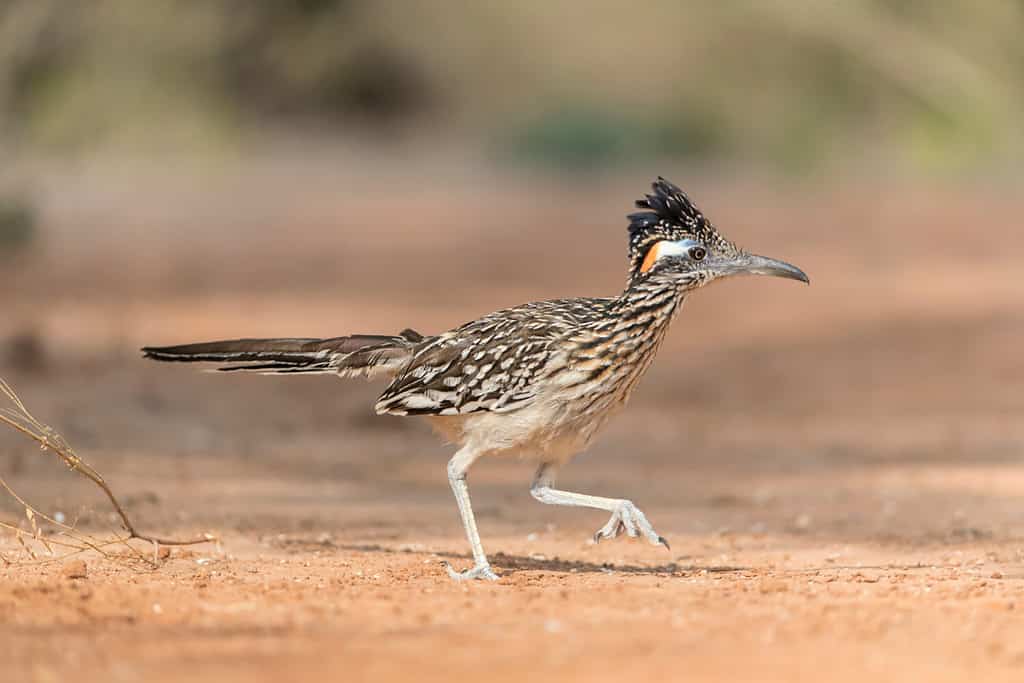
Greater roadrunners (Geococcyx californianus) zoom around Saguaro National Park.
©Dennis W Donohue/Shutterstock.com
Greater roadrunners are known from the old Looney Tunes cartoons; in real life, they share some of the characteristics of the cartoon birds but lack others. Roadrunners can fly but will typically run a long way at speeds of up to 18 miles per hour before choosing to take flight. Their long tails and brown streaked bodies with creamy undersides do not resemble the Looney Tunes character, other than some hints of blue around their eyes. Roadrunners prey on insects, reptiles (even snakes), and small mammals, but will supplement with seeds and berries. Listen for their soft cooing sounds and beak clattering (no BEEP BEEPS).
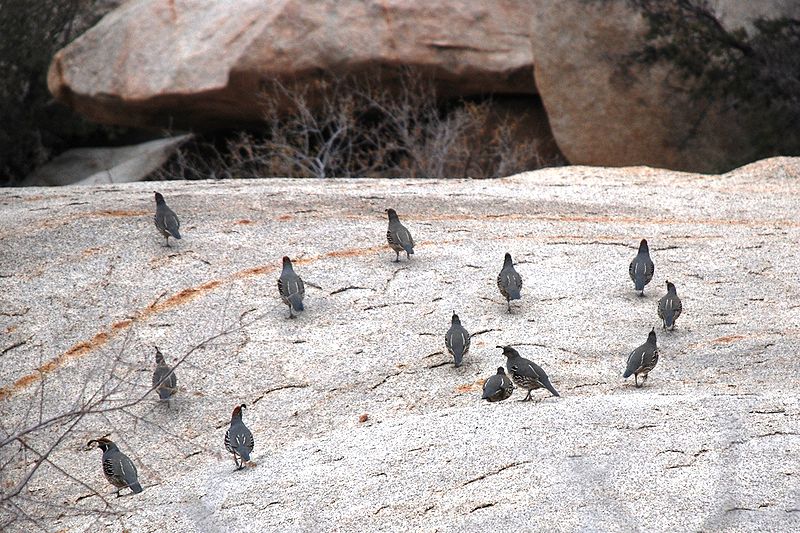
Look for groups of Gambel’s quail (Callipepla gambelii) at dawn or dusk when it’s cooler.
©Jarek Tuszynski / Creative Commons – Original
Other birds you’ll see on the ground are Gambel’s quail, which hang out in groups (“coveys”). They tend to take shelter in the shade at midday but look for them poking around in the morning and early evening. They feed mostly on seeds and leaves, supplementing with occasional insects and fruits. Like other quails, these chubby, small birds have a fancy head plume—a black, comma-shaped feather sticking out of their foreheads. Because they freeze when predators approach, relying on camouflage in shrubby vegetation, you may need to hold still for a while to spot them.
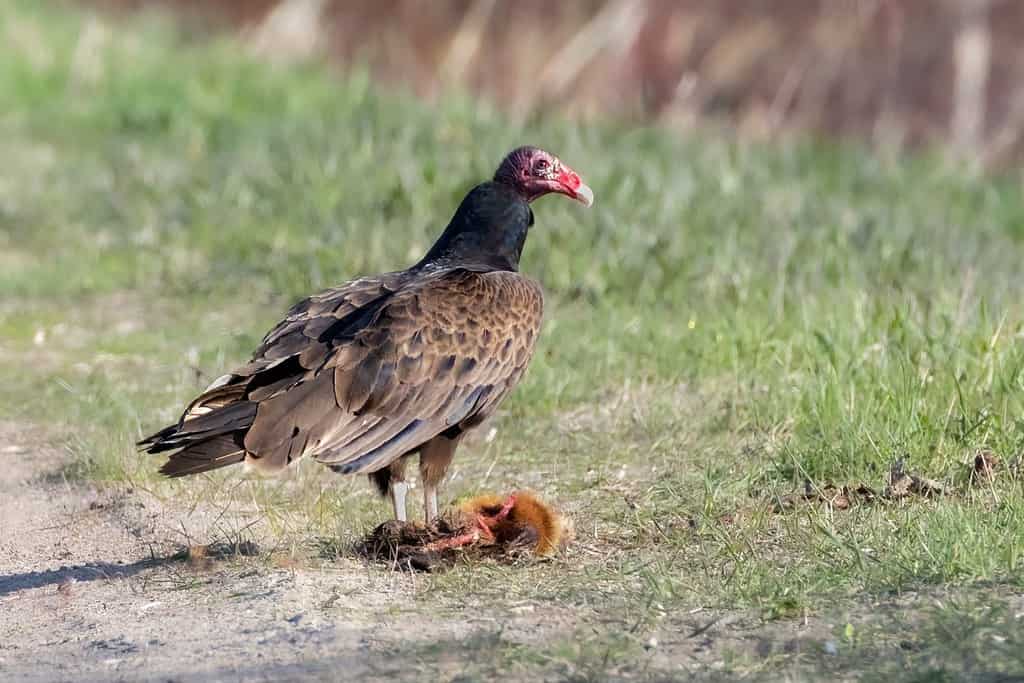
Turkey vultures (Cathartes aura) come to the ground to scavenge dead animals in any part of the park.
©Jean Landry/Shutterstock.com
Known as the “sanitary engineers” of ecosystems, turkey vultures scavenge on dead or dying animals. Although they prefer live animals as a food source, their excellent sense of smell leads them to rotting carcasses. Look for turkey vultures circling overhead, their wings in a shallow V shape, or feeding on roadkill. Their large black bodies with featherless red heads (for plunging into animal flesh) are unmistakable. To survive desert heat, they’ll urinate on their own legs, stimulating evaporative cooling. When threatened, vultures regurgitate stinky vomit to deter predators and reduce their weight for a quick escape.
Birds on the Cacti
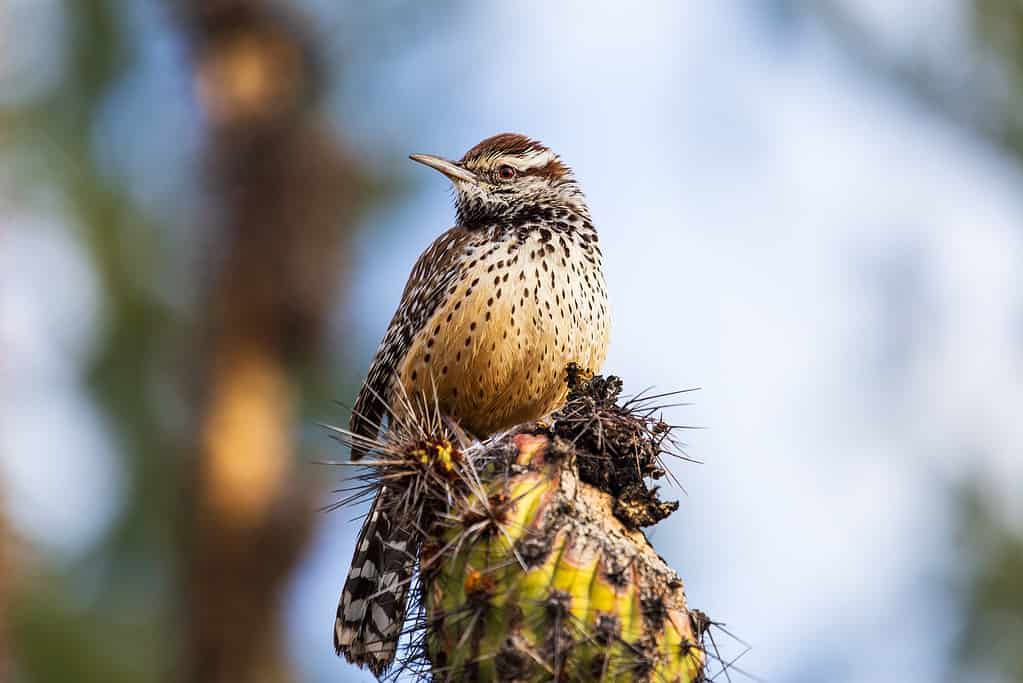
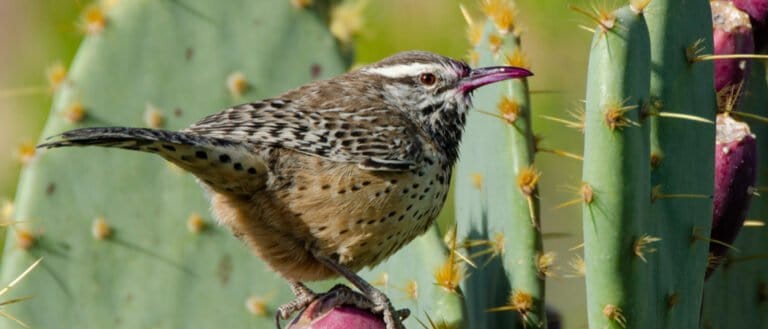
This long-tailed cactus wren (Campylorhynchus brunneicapillus) seems unphased by the cactus spines.
©mdesigner125/iStock via Getty Images
Watch for birds perching on cacti, such as along the five-mile Cactus Forest Loop Trail on the east side of the park. You may see long-tailed cactus wrens, which stand on top of cacti to get a view of the ground below, where they hunt for grasshoppers, beetles, ants, and plant foods. Their nests are made of straw stuffed among the cactus arms.

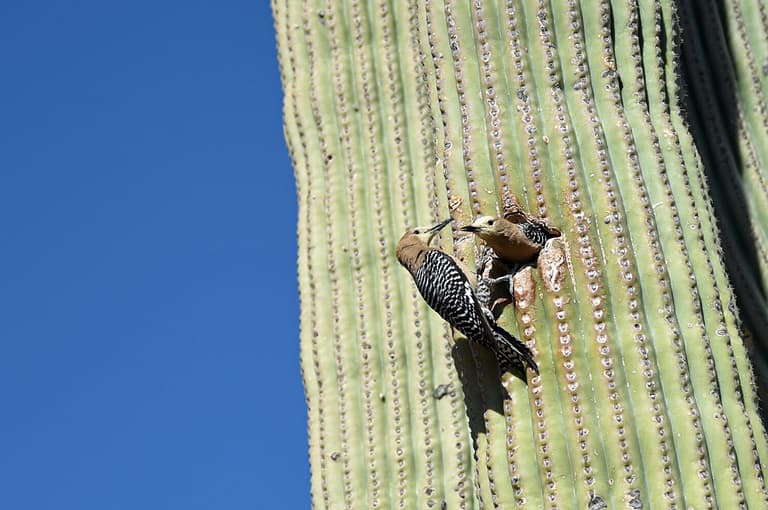
Gilded flickers (Colaptes chrysoides) may peek out of their saguaro cactus cavities.
©G. Parekh/Shutterstock.com
Gila woodpeckers (Melanerpes uropygialis) excavate their nest holes right into live saguaro cacti. You’ll see their zebra-striped backs as they forage on insects and cactus fruits on the branches of the saguaro. Look for a woodpecker with yellow under its wings and a cinnamon-colored crown. Gilded flickers, like the one pictured above, also dig cactus nest cavities. Unlike Gila woodpeckers, gilded flickers tend to forage on the ground, extracting ants with their long tongues.
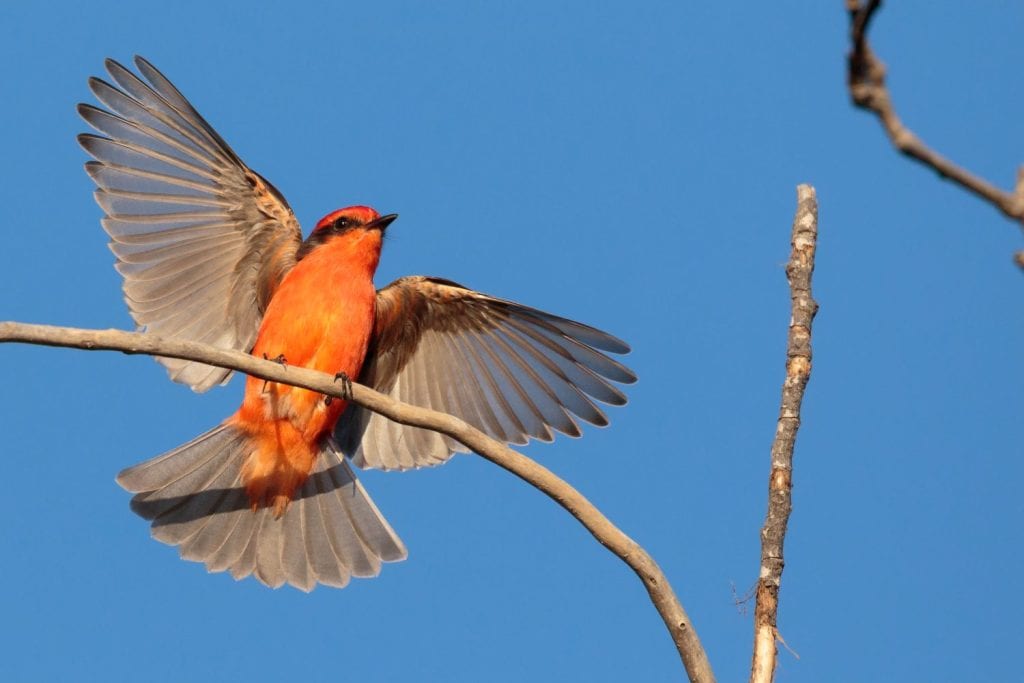
Saguaro National Park is one of the few places you can see these vermilion flycatchers (Pyrocephalus rubinus).
©Ryan S Rubino/Shutterstock.com
Once a woodpecker finishes using its nest, the empty cavity becomes fair game for a variety of other birds looking for nesting sites, such as flycatchers, cactus wrens, house finches, and owls. In the summer, you have a good chance of encountering a brown-crested flycatcher (Myiarchus tyrannulus), which often nests in a hole made by woodpeckers. The flycatchers stuff their nesting holes with feathers, fur, and even reptile skins. Their coloration is a dull brownish gray with a lemon-yellow belly. Listen for their sharply trilled “whit-will-do” calls. At least six other species of flycatchers call the Sonoran Desert home.
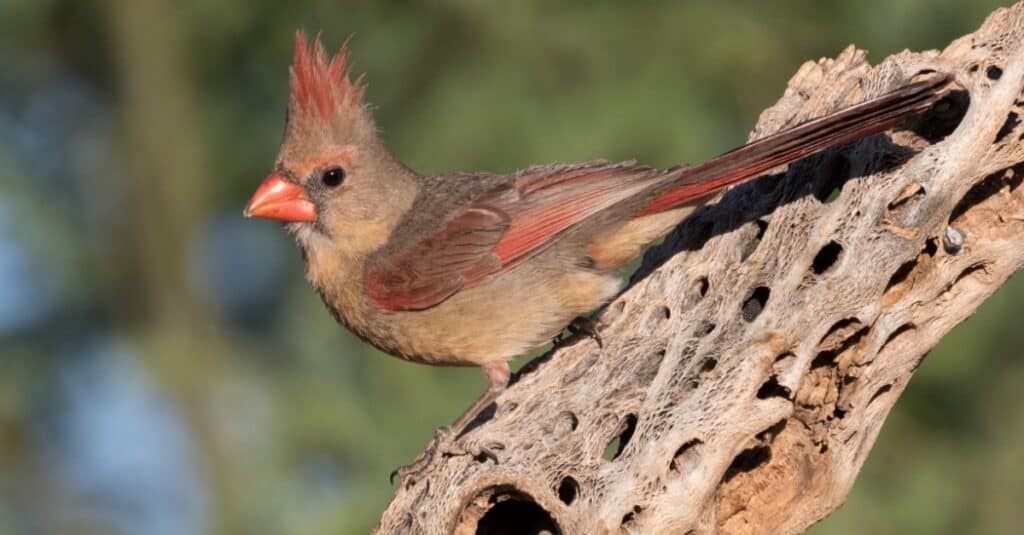
The desert cardinal is mostly gray with red markings, while the northern cardinal is mostly red with dark markings.
©iStock.com/Dee Carpenter Photography
If you see a cardinal-like bird perching on a cactus, you’re likely looking at a pyrrhuloxia (Cardinalis sinuatus). These desert-hardy relatives of American cardinals also sport red feathers on their bodies and head crests. But their distinct short, yellow beaks are used for eating desert insects. In the winter, they forage in huge flocks of up to 1000 birds.
Birds at Higher Elevation
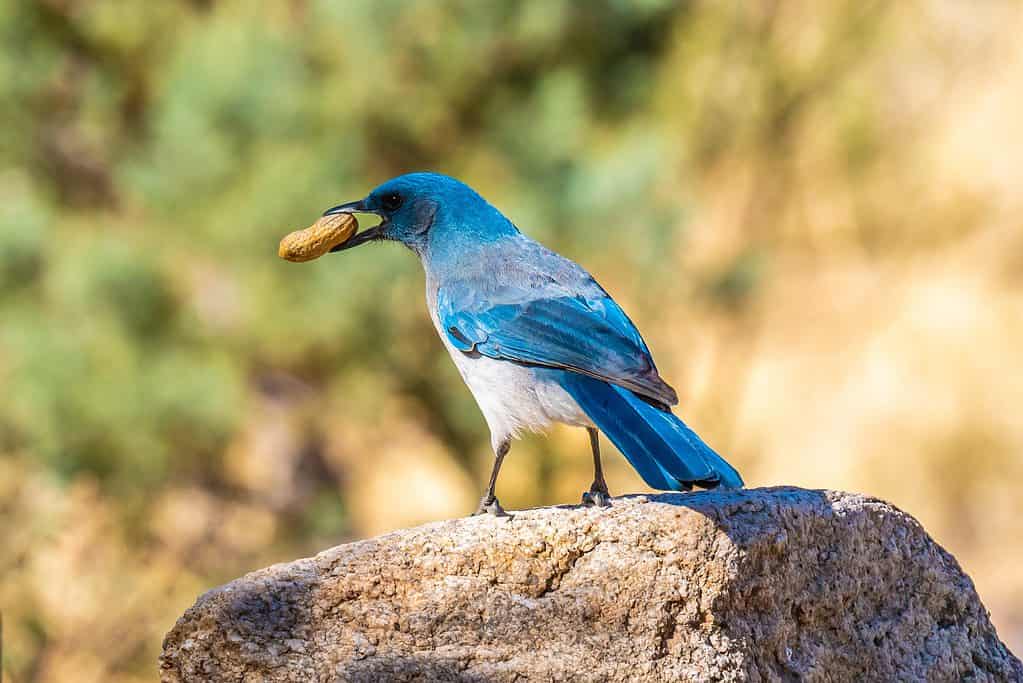
This Mexican jay (Aphelocoma wollweberi) has discovered a treat left by a park visitor.
©Cheri Alguire/Shutterstock.com
In the higher-elevation east side of the park, you may see other species of birds that depend on plants growing in somewhat cooler conditions. Mexican jays (Aphelocoma wollweberi) forage for pine nuts, acorns, and insects in the pine-oak woodlands. They have blue coloration like blue jays, but are bigger-bodied and lack the head crest. Listen for their nasal, high-pitched “weenk” sounds as they hang out in groups as large as 25 birds.
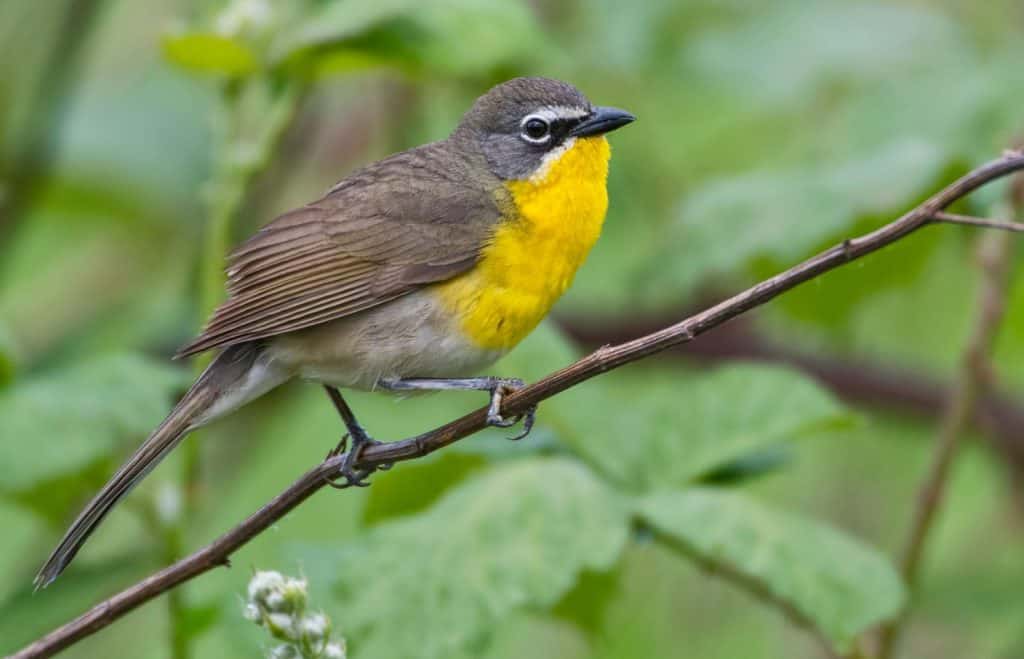
Yellow-breasted chats (Icteria virens) live in shrubbier, higher elevation parts of the park.
©punkbirdr/Shutterstock.com
In the higher elevation parts of Saguaro National Park, you’ll also encounter a variety of songbirds, such as wood warblers and sparrows, that stay hidden in the bush and tree foliage. Listen for their chirps and tweets. For example, among the eight or so species of sparrow in the park, you may hear the bubbly cheeping of rufous-crowned sparrows (Aimophila carpalis) in brushy areas with thicker vegetation, where they forage on the ground beneath shrubs. Among the six Sonoran Desert species of wood warblers, watch for the large yellow-breasted chat with its bright yellow throat. They tend to hide in thickets, but if you visit the park during spring, the males sing an impressive repertoire of loud songs, including whistles, cackles, and gurgles.
Birds in the Sky
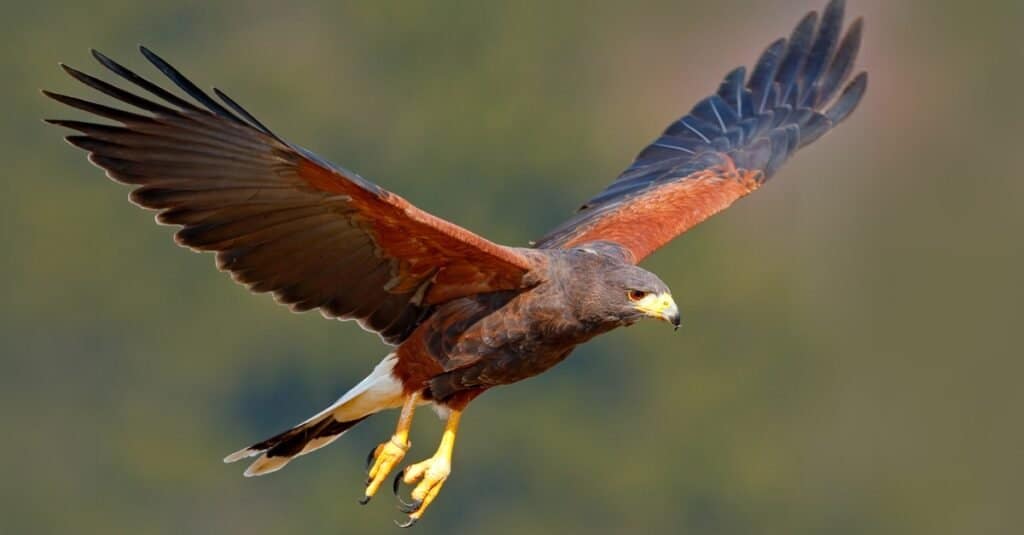
Harris hawks (Parabuteo unicinctus)
©Ondrej Prosicky/Shutterstock.com
If you see a group of hawks soaring over the saguaro forests, you’ve likely spotted Harris’s hawks. They hunt in groups, sometimes working cooperatively to flush prey out into the open. Look for their dark bodies with reddish hues, yellow beaks and feet, and white rump. Harris’s hawks range southward from Arizona and Texas into South America.
You may also see red-tailed hawks soaring overhead. They live year-round in the Sonoran Desert and are common compared to other species, such as gray hawks, ferruginous hawks, and Harris’s hawks. Red-tailed hawks cruise over open areas looking for small mammal prey, such as rats and rabbits. Look for their reddish tail feathers, which are spread out in a triangular shape during flight. And listen for their hoarse kee-eeee-arr calls.
Gray hawks (Buteo plagiatus) also inhabit the park, although you’d be lucky to spot one. Just 15 years ago, the U.S. population of gray hawks was estimated at fewer than 100 nesting pairs. While their numbers have increased somewhat due to conservation efforts, the population in southern Arizona remains small and vulnerable. This population is migratory, spending the winter in Mexico or South America. Gray hawks go after small desert prey, mostly lizards. Listen for their three-note whistling call.
Lizards in Saguaro National Park

You can tell this desert spiny lizard (Sceloporus magister) is male by the display colors on its chin.
©Wirestock Creators/Shutterstock.com
In Saguaro National Park, there are 50 known species of reptiles. Two species of spiny lizard (including the one pictured above) can be seen on the ground or on rocks, where males make colorful displays as they compete for females during courtship. If you see a lizard doing pushups, it’s likely a male desert spiny lizard or Clark’s spiny lizard (Sceloporus clarkii) showing his prowess. Females lack the vivid blue and green colors, but their heads do become orange-hued during breeding season.
Another common lizard inhabiting the park is the larger desert iguana (Dipsosaurus dorsalis), which prefers sandy areas where it can feed on the flowers of creosote bushes, even during the hottest parts of the day.
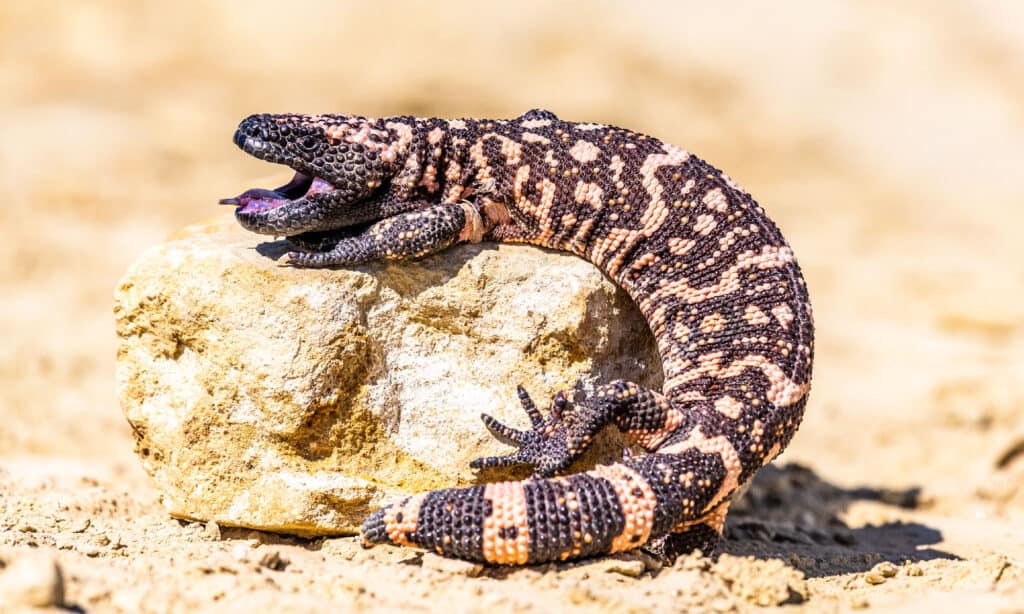
This gila monster (Heloderma suspectum) looks threatening but, if you don’t bother it, it won’t hurt you.
©Vaclav Sebek/Shutterstock.com
Saguaro National Park also boasts the only venomous lizard in the world, the bulky-bodied Gila monster. It has grooved teeth for secreting venom, which flows from glands in the lower jaw. Gila monsters are hard to spot because they mostly hunker down in burrows, emerging now and then to hunt small mammals, birds, and reptiles. Their fat-storage tails allow them to go long periods without eating. Look for a Gila monster, with its distinctive bead-like scales (osteoderms) and patterned skin.
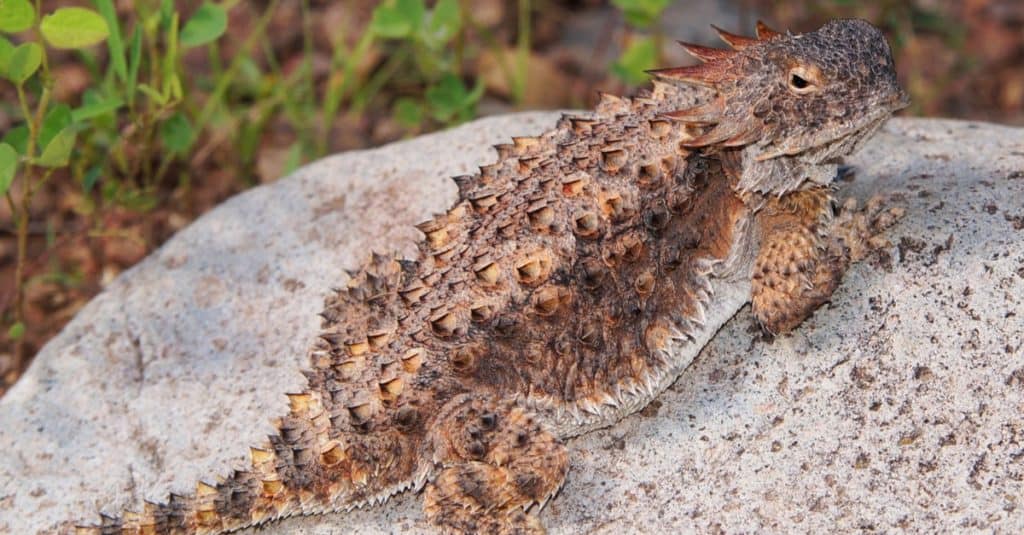
This regal horned lizard (Phyrnosoma solare) may be searching for its favorite prey—ants.
©Matt Jeppson/Shutterstock.com
Another odd reptile you might see if you’re lucky is the regal horned lizard. There are 17 known “horned lizard” species (genus Phyrnosoma), but the one in Saguaro National Park is the biggest. So named for spines ringing their faces, horned lizards have several unusual traits, including an ability to squirt blood out of an eyelid pore when attacked by a predator. In a remarkable act of camouflage, they shimmy under the sand, flattening and burying themselves. And they specialize in ants, eating huge quantities, including stinging ants.
Snakes in Saguaro National Park
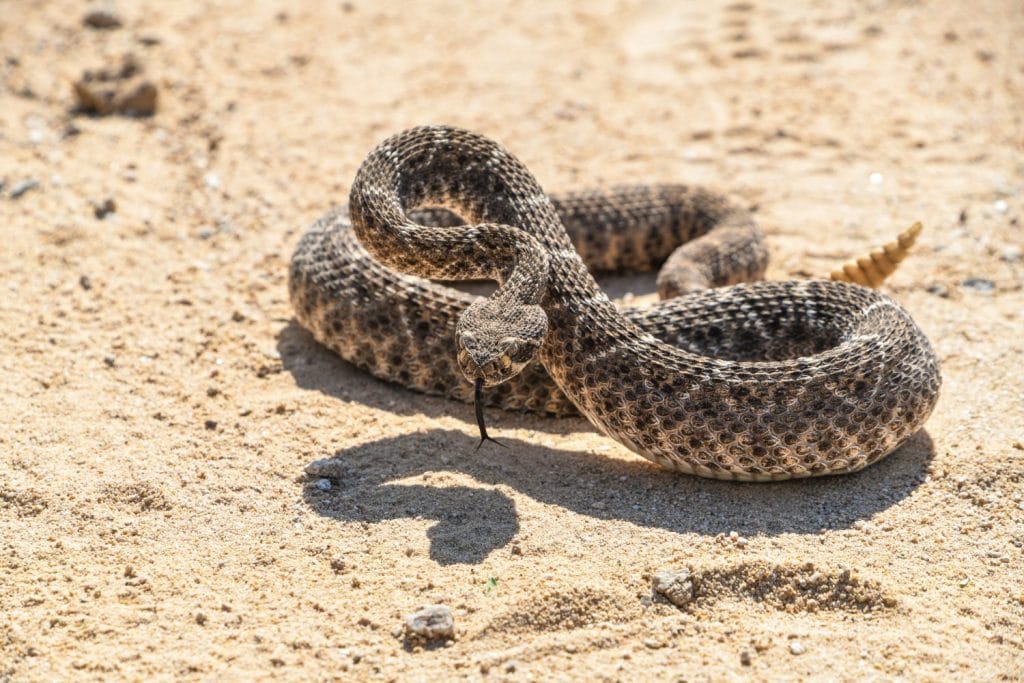
This western diamondback rattler (Crotalus atrox) is telling you to back off with its rattle and strike pose.
©Clint H/Shutterstock.com
The park is particularly rich in snakes, some of which are venomous, so watch your step and listen for rattling. Of the six species of rattlesnakes that call the park home, the western diamondback rattler is the most common. It’s the biggest rattlesnake in the U.S., with distinct diamond-shaped markings along its back. Growing up to more than 7 feet long, it feeds on rabbits and other moderate-sized prey. Keep your distance.
Other venomous rattlesnakes to watch out for in the dry, lowland areas are the sidewinder (Crotalus cerastes) and the Mojave rattlesnake (Crotalus scutulatus).
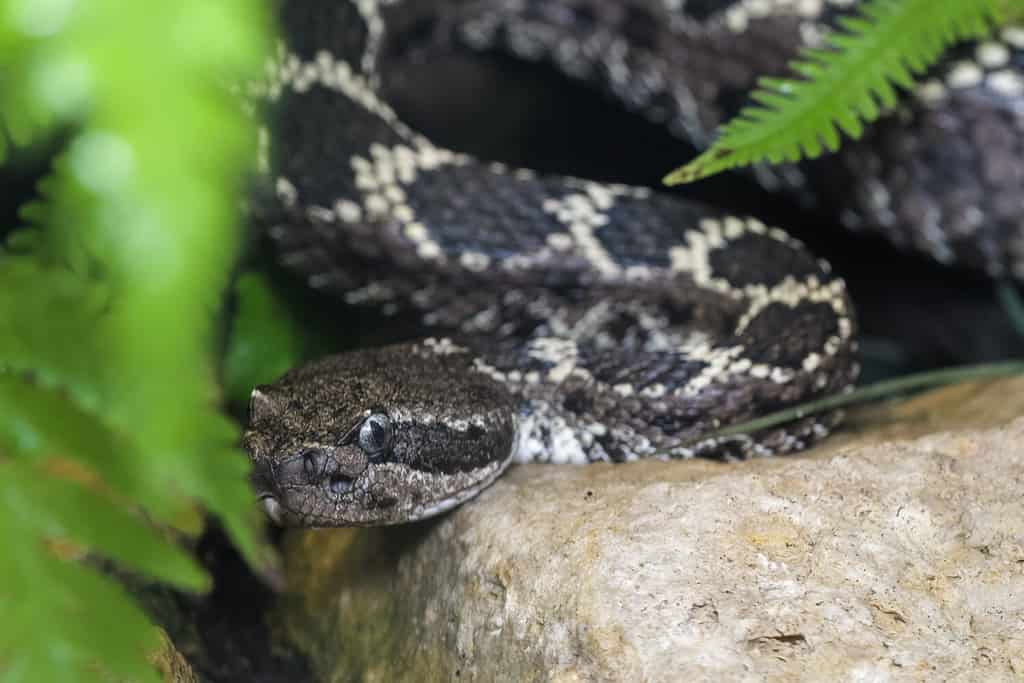
Arizona black rattlesnakes (Crotalus cerus) are found at higher elevations above 4,500 feet.
©Thorsten Spoerlein/Shutterstock.com
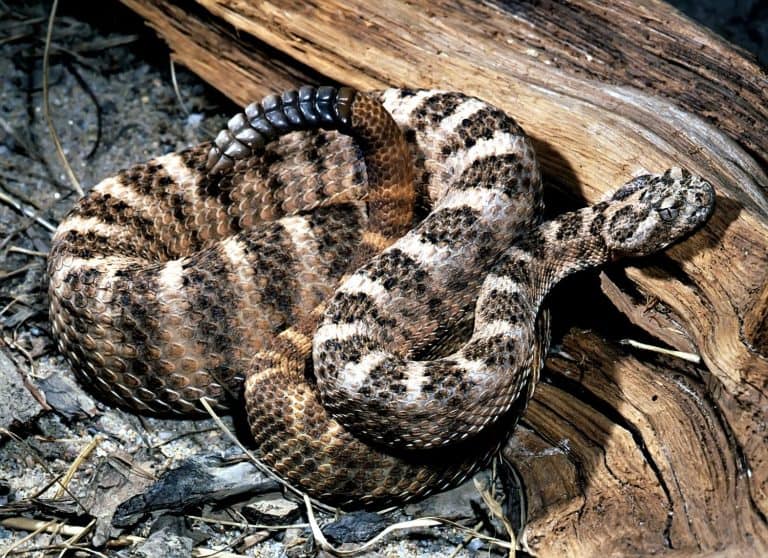
Some rattlesnakes favor the rockier upland habitats, such as the Arizona black rattlesnake above, which grows to several feet long. Some individuals are a uniform dark color with none of the patterning typical of rattlesnakes. The tiger rattlesnake (Crotalus tigris), which is endemic to the Sonoran Desert, also tends to be found in the foothills on the west side of the park. It has a relatively small head and a big, noisy rattle, but it is nocturnal when it gets really hot during the summer. And the black-tailed rattlesnake (Crotalus molossus) typically hides out in rocky pine-oak or conifer forests. They’ll hang out in bushes or trees a few feet off the ground, so keep your eyes peeled.
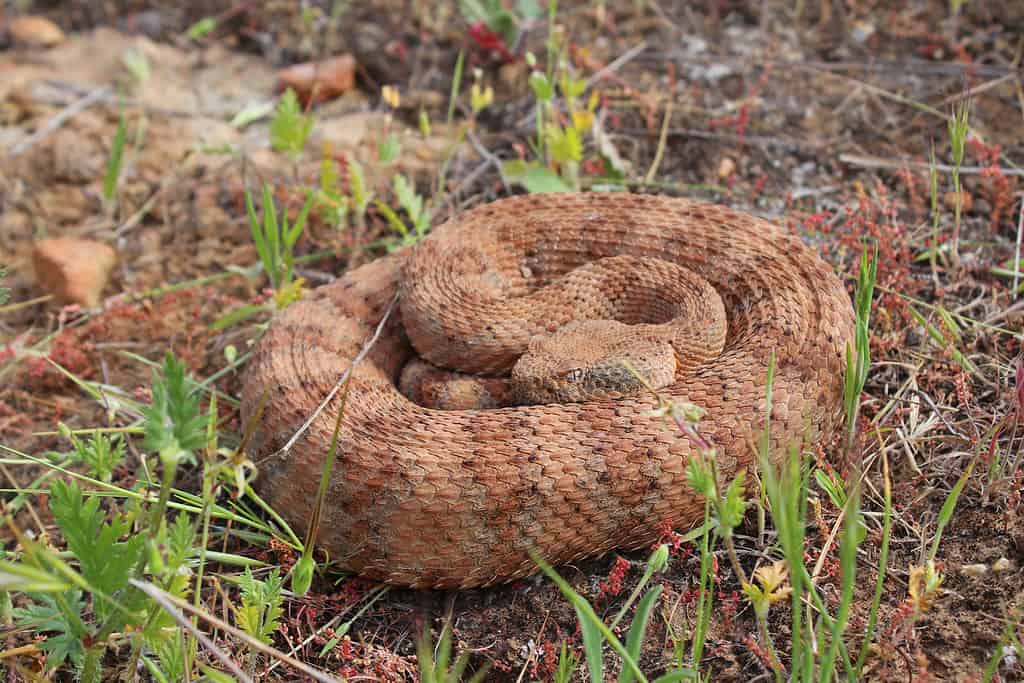
These speckled rattlesnakes (Crotalus mitchellii) are flexible in their habitat use.
©Creeping Things/Shutterstock.com
The speckled rattlesnake has the capacity to be active around the clock and live at various elevations in the park up to about 5000 feet. It’s a big one, growing up to more than four feet, allowing it to feed on rats. If you encounter a snake with rusty or pinkish hues, it may be a speckled rattlesnake. This species tends to hold still when approached, so watch your step.
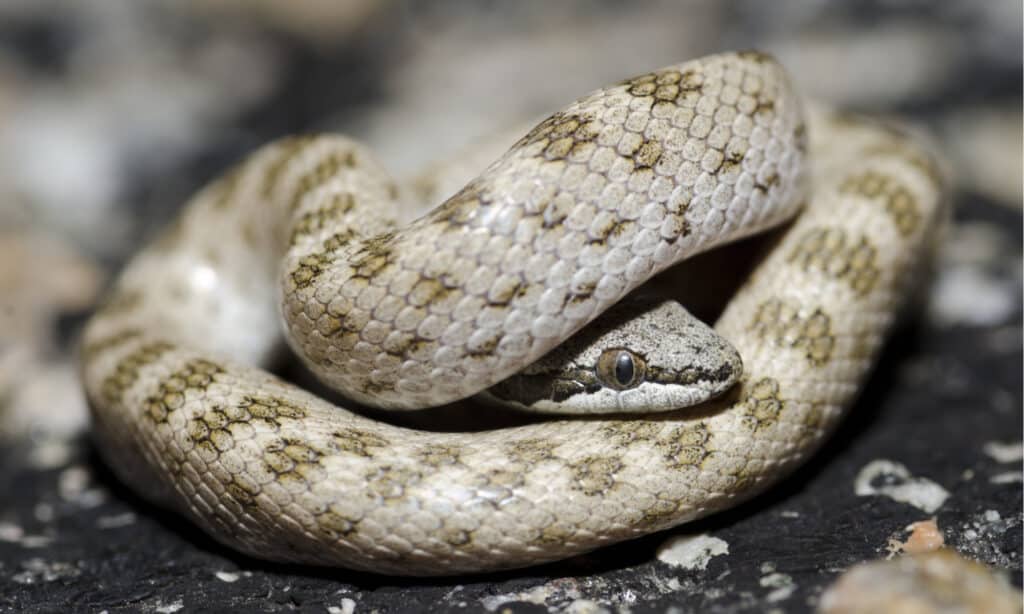
Desert nightsnakes (Hypsiglena chlorophaea) only grow to a couple of feet long and are strictly nocturnal/
©Jason Mintzer/Shutterstock.com
A variety of other snakes inhabit Saguaro National Park, including two additional venomous species. The desert nightsnake shown above carries venom, but it’s a mild variety that’s not a threat to people. Western lyre snakes (Trimorphodon biscutatus)—with distinctive V-shaped lyre markings on their heads—are also mildly venomous but not a threat to humans; they’re mostly interested in lizard prey. Still, their aggressive behavior when approached causes people to mistake them for rattlesnakes.
The Sonoran coral snake (Micruroides euryxanthus), on the other hand, is dangerously venomous. It only grows to two feet long, but it can deliver neurotoxic venom through its fangs, which it uses to subdue and prey on other snakes. If you see a striped black-cream-red-cream-black snake, stay clear. If it’s a striped black-red-black-cream pattern, it’s a Sonoran mountain kingsnake (Lampropeltis pyromelana), which looks an awful lot like the coral snake but is not venomous.
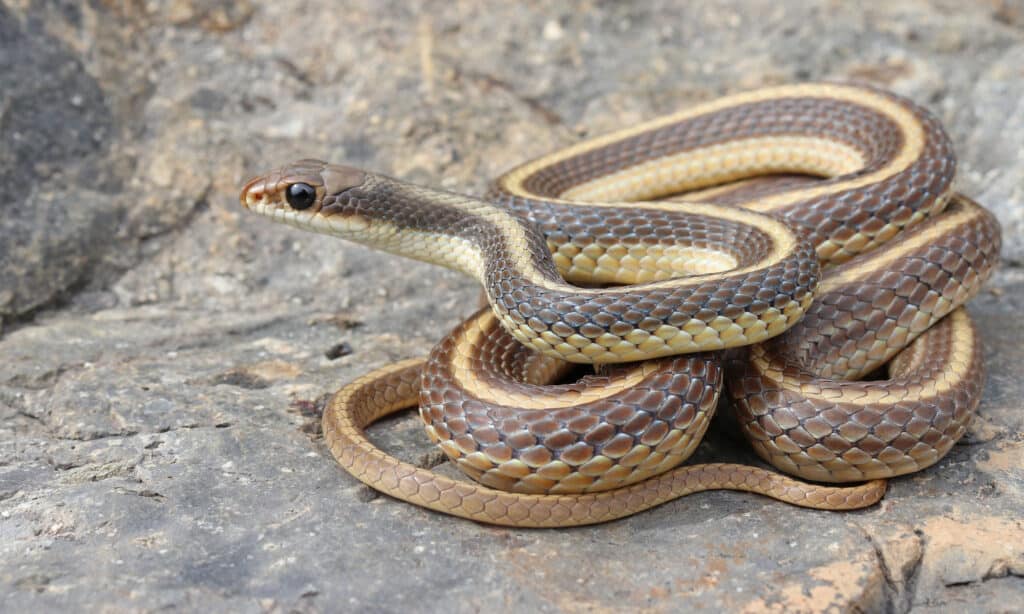
The western patch-nosed snake (Salvadora hexalepis) has a distinctive scale on the end of its nose.
©Creeping Things/Shutterstock.com
Most of the snakes in Saguaro National Park are not venomous. The western patch-nosed snake pictured above uses its reinforced nose to burrow into sandy soils, using its good sense of smell to root to find lizards, mammals, or reptile eggs. Saddled leaf-nosed snakes (Phyllorhynchus browni) are also burrowers with a protective nose scale. Long-nosed snakes (Rhinocheilus lecontei) lack the reinforced nose but have a recessed lower jaw that keeps sand from entering their mouths as they burrow.
In shrubby vegetation in the park, you might see jet-black coachwhip snakes (Masticophis flagellum) and Sonoran whipsnakes (M. bilineatus), which are slender and fast. They slither around looking for small prey that they can swallow whole.
In wetter areas, such as desert streams, you may see black-necked gartersnakes (Thamnophis crytopsis). They spend time on land, but also swim to catch frogs, fish, and tadpoles. In dry river bottoms, you could encounter western groundsnakes (Sonora semiannulata) or variable sandsnakes (Chilomeniscus stramineus), although both these species are nocturnal.
Turtles in Saguaro National Park
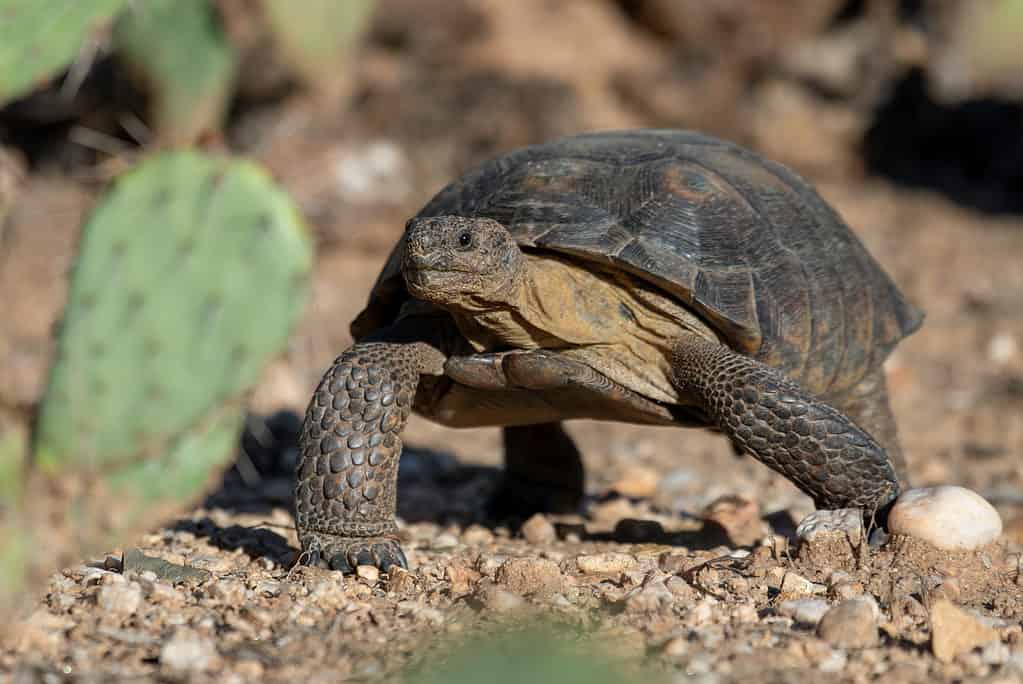
Sonoran desert tortoises (Gopherus marafkai) live in the most arid parts of the park.
©Sean R. Stubben/Shutterstock.com
The most iconic turtle in Saguaro National Park is the desert tortoise. Although hardy and resilient in their arid habitats, these tortoises excavate a system of underground burrows to shelter from extreme temperatures. Since they rarely encounter water to drink, they gain hydration from desert plants, such as prickly pear cacti, which retain water in their pad-like leaves. When conditions are favorable, Sonoran desert tortoises roam around grazing on cacti, grasses, and herbaceous plants. They tend to remain in the same areas for years during their long (50-100 year) lifespans. You’re more likely to see one in the early morning or late afternoon when they emerge from their burrows to feed.
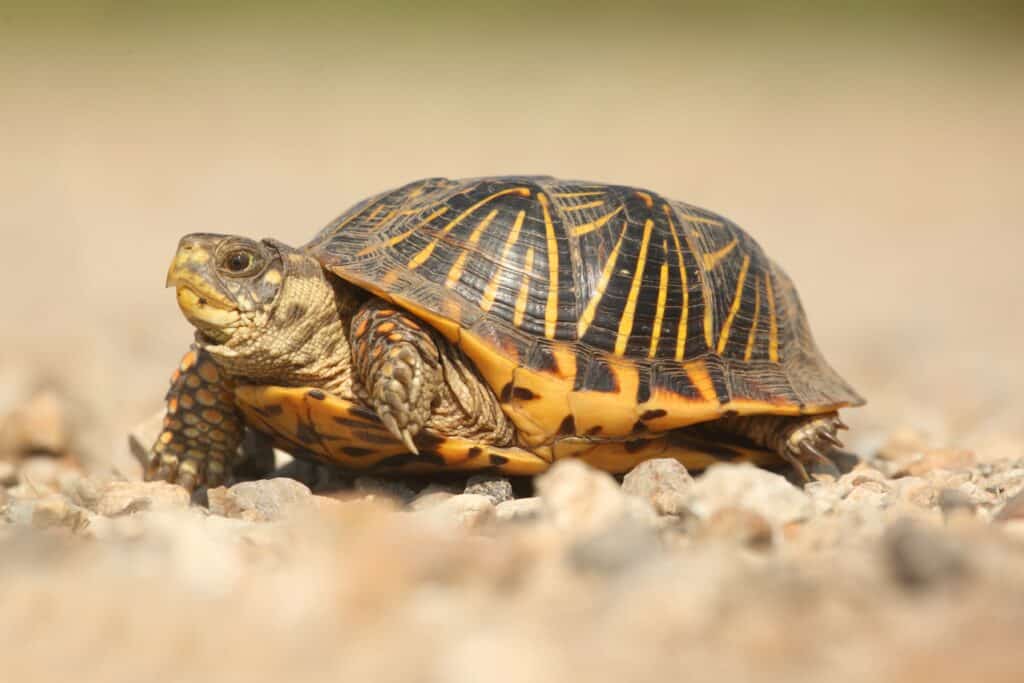
Ornate box turtles (Terrapene ornata ornata) are a subspecies of the western box turtle.
©Steve Byland/Shutterstock.com
In the park’s grasslands not far from streams, you might get lucky and see ornate box turtles. Although they look like tortoises, they are more closely related to pond turtles and require access to water. Growing to a maximum length of 5.5 inches, ornate box turtles have red spots on their front legs and radiating yellow lines on their top shells. They make shallow burrows to take refuge from extreme temperatures, but come out to forage on fruits, berries, leaves, and insects during more temperate times of day.
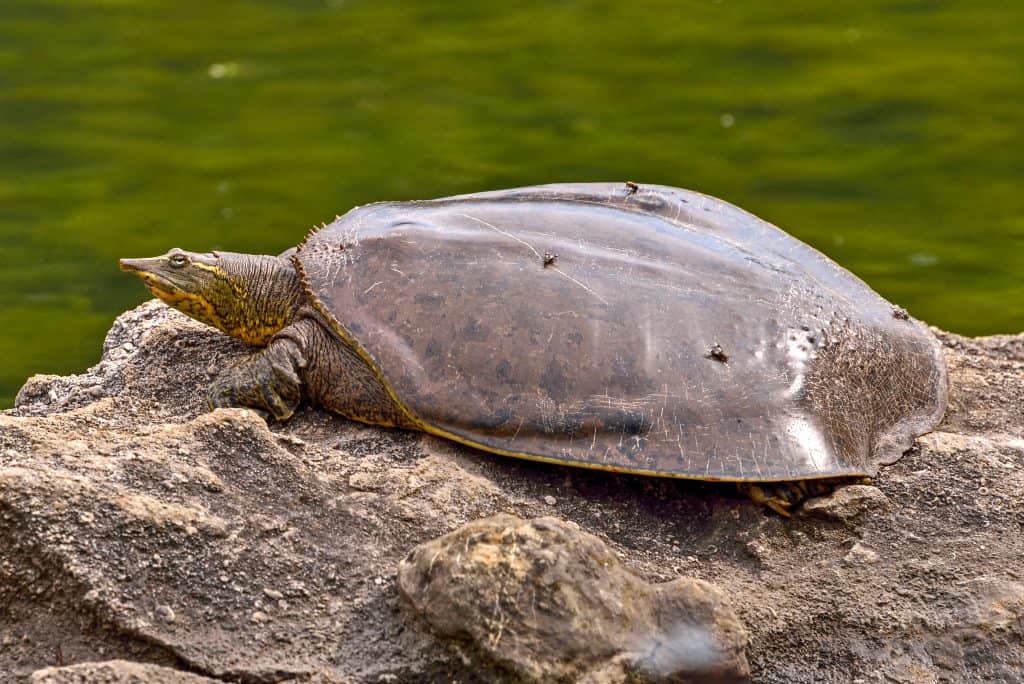
This spiny softshell turtle (Apalone spinifera) is sunbathing on a rock.
©damann/Shutterstock.com
Other species of turtles that are more fully aquatic inhabit the park’s waterways. If you see an especially flat round turtle with a funny-looking nose, it may be a spiny softshell. Its nose serves as a snorkel that it can poke out of the water to get air while the rest of its body remains submerged. Like all softshell turtles, its top shell is covered with a layer of skin, concealing the typical patterning underneath. Spiny softshells spend most of their time underwater eating crayfish, worms, frogs, and snails.
What you’re most likely to see in the park’s waterbodies are the common pond sliders (Trachemys scripta) with red marks on both sides of their head. Their natural range is in the eastern U. S. but, because of their popularity in the pet trade, red-eared sliders have been introduced to Arizona and even to other continents.
Although they inhabit the park and grow to about six inches long, you’re unlikely to see a Sonoran mud turtle (Kinosternon sonoriense), since they spend most of their time in the mud bottoms of streams and ponds. Their shell is brown with little patterning, giving them excellent camouflage in desert waterways. Like all turtles, Sonoran mud turtles nest on land, leaving waterways to lay eggs in oak or pine forests.
Amphibians in Saguaro National Park
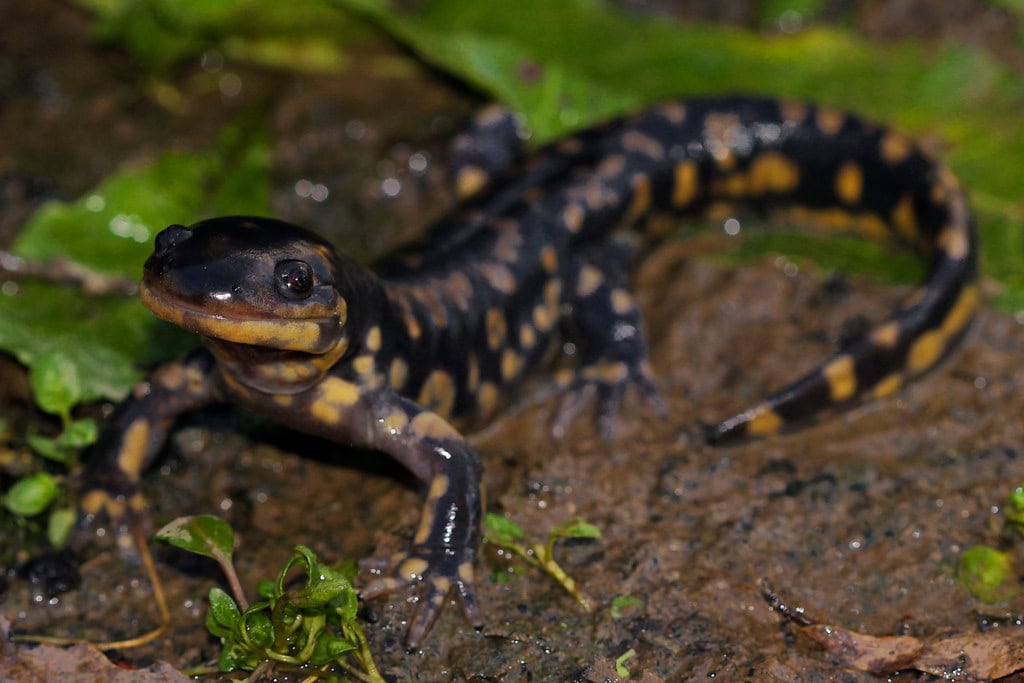
Tiger salamanders (Ambystoma tigrinum), the largest North American salamanders, can reach nearly 8 inches long.
©"Eastern Tiger Salamander (Ambystoma tigrinum)" by 2ndPeter is licensed under BY 2.0. – Original / License
Because it’s such an arid environment, and amphibians require water for breeding, only eight frog species and one species of salamander are known to inhabit Saguaro National Park. You won’t see a tiger salamander unless you are in the park after an exceptional rain. They spend most of the year underground in burrows made by other animals, such as desert tortoises, and only surface when surface water pools from rainfall are available.
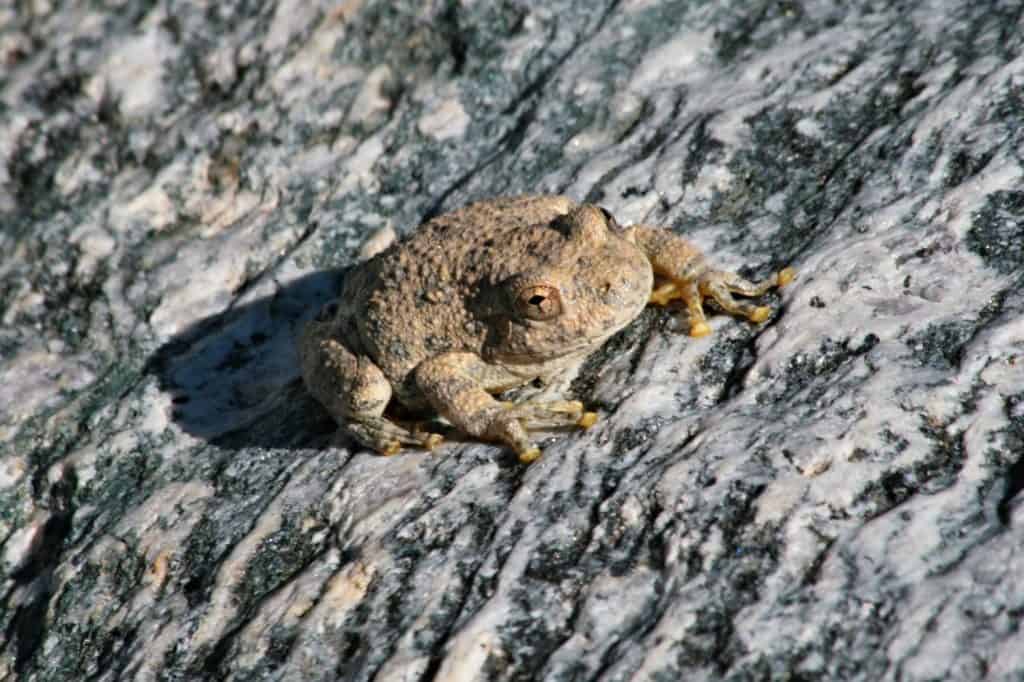
Canyon treefrogs (Hyla arenicolor) are found near streams and ponds with year-round water.
©Flying Mouse/Shutterstock.com
The amphibian you’re most likely to see is the canyon treefrog. They have a golden hue in the sunlight when they emerge from streams to bask, clinging to the surface with their sticky foot pads. Despite their “treefrog” common name, they prefer to sit on rocks and boulders adjacent to standing water, from where they snag insects and spiders to eat. Their tadpoles feed on algae in the water. Look for large masses of eggs floating on the water, and listen for the males’ loud call on spring or summer evenings.
The park is also home to lowland leopard frogs (Rana yavapaiensis), which are found in the park’s canyons that contain water. Look for a spotted frog peeking out along pond edges. Lowland leopard frogs and other native species are threatened by introduced American bullfrogs and nonnative fishes that eat their eggs and tadpoles. Leopard frogs in the park have also been impacted by a fatal fungal disease, so make sure not to handle them.
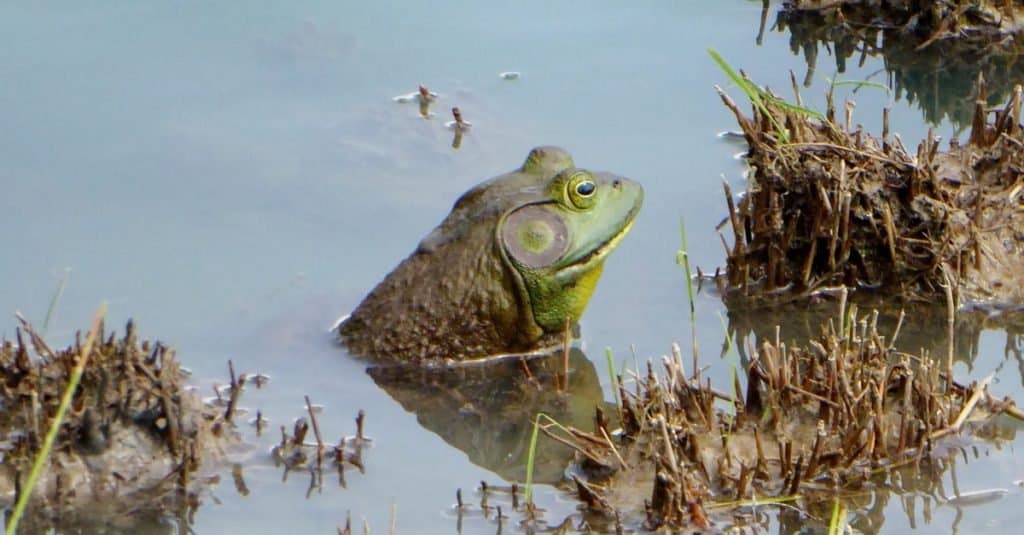
Bullfrogs will eat just about any prey they can fit in their mouths.
©LizzyB33/Shutterstock.com
Amphibians, in general, are considered sensitive indicators of ecosystem health. The decline of amphibians in Saguaro National Park is of concern. Bullfrogs are considered the biggest threat, dubbed “the Great White Shark of the Southwest” for their voracious feeding on native species. Efforts to eradicate them have been successful in reducing their numbers in Saguaro National Park, but you may still come across them; note the distinctive, large, circular eardrum.
Mammals in Saguaro National Park
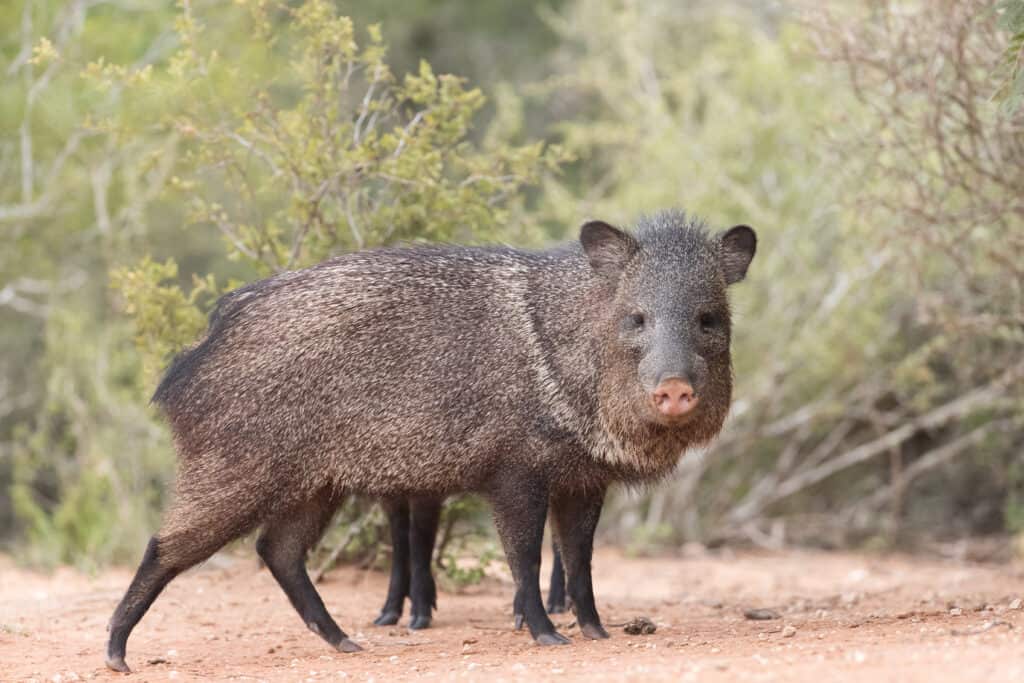
Javelinas (Pecari tajacu) migrated into the park from Central America about 250 years ago and are common today.
©Dennis W Donohue/Shutterstock.com
About 70 species of mammals are known to inhabit the park, from small packrats to large carnivores. Many of the mammals are only active at night, making it unlikely that you’ll see them. But, during the day, watch for the javelinas. They are not native, but have become “naturalized” in the park. They look like wild boars but are in a distinct family of mammals. Javelinas roam around in herds of about a dozen, feeding on prickly pear cacti and grasses, while rooting through the ground with their snouts and hooves for tubers. Sniff the air to get a whiff of the musky scent they emit during social interactions.
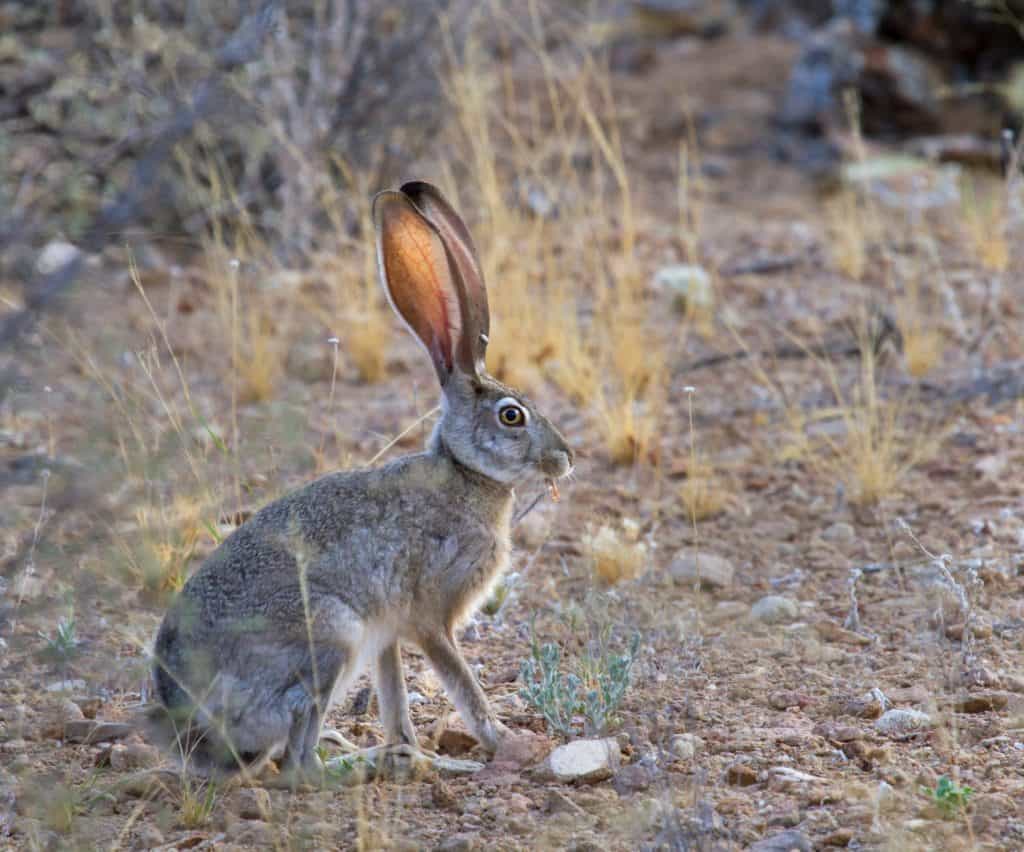
Black-tailed jackrabbits (Lepus californicus) graze on the sparse grasses in the park.
©Natalia Kuzmina/Shutterstock.com
If you see small, pellet-like poop, it may be from a black-tailed jackrabbit. Keep an eye out for these iconic desert rabbits sticking their long ears straight up to radiate heat and stay cool. At night, they can turn their ears downward to reduce blood flow and maintain their body heat. Compared to the cotton-tailed rabbits common to the northeastern U.S., these jackrabbits are bigger, leaner, and faster. Like all rabbits, they are herbivores, subsisting entirely on grasses, clover, alfalfa, and herbaceous plants. In the desert, they chew on cacti to stay hydrated. Antelope jackrabbits (Lepus alleni) are also known from the park, but are far less common.
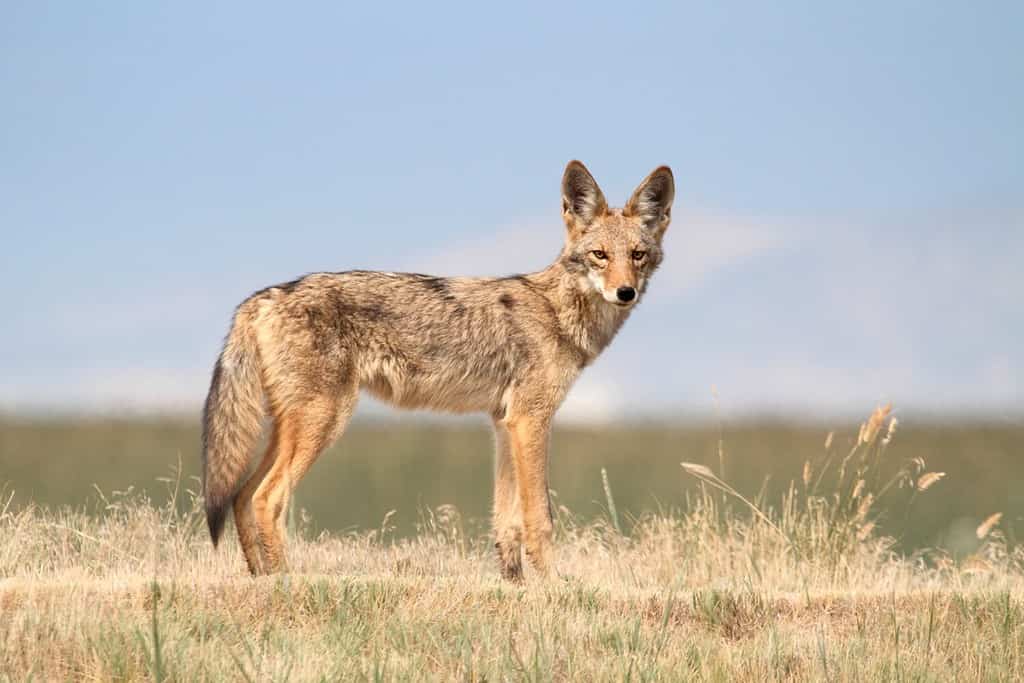
Coyotes (Canis latrans) may forage on cactus fruits and flowers, as well as small animals, during the day.
©Steve Byland/Shutterstock.com
Despite their nocturnal hunting habits, coyotes are frequently seen in the park. They become active before dark, often singing a get-ready-to-hunt song. Their nickname of “song dogs” reflects their complex set of vocalizations, including howls that echo over the landscape. If you don’t see a coyote, you might at least spot evidence of its presence: scat (poop) on trails and roads. Their scat is a twisted tubular shape with points at each end and a rough texture from bits of fur, hair, and berries. In the park, coyotes mostly inhabit the brushy grasslands and foothills. These adaptable species are found in various habitats throughout North America.

Bobcats (Lynx rufus), at 2-4 feet long, are smaller than mountain lions and have ear tufts.
©Len Blumin, CC BY 2.0, via Wikimedia Commons – Original / License
Cat predators live in Saguaro National Park, but are highly secretive. Both bobcats and mountain lions (Puma concolor) hunt at night. While bobcats tend to look around the park edges for rabbits, quail, and other small prey, mountain lions can take down larger prey like deer and javelinas. Mountain lions have a bite strong enough to crush an adult desert tortoise shell. Growing up to 6 feet long, they’re considered the most powerful predator in the park. Data on these cats has been obtained from nighttime camera traps.
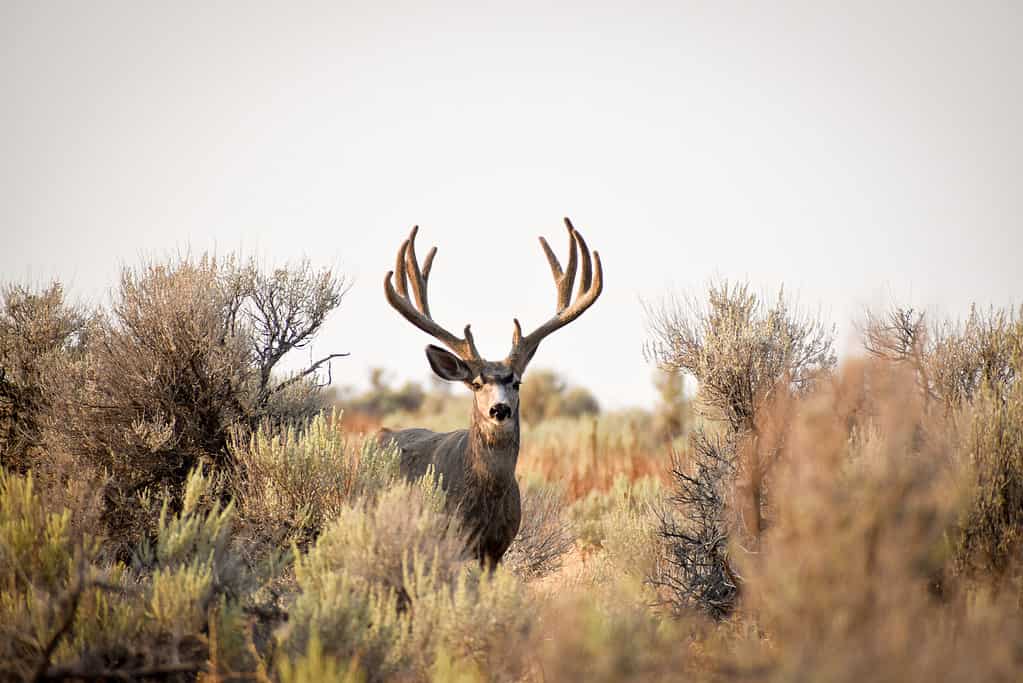
This mule deer (Odocoileus hemionus) has velvety antlers, showing that it’s in a growth phase.
©Chad J Stokes/iStock via Getty Images
Two species of deer live in Saguaro National Park: mule deer (shown above), which are exclusive to the West, and whitetail deer (Odocoileus virginianus), which range throughout the U.S. Mule deer are recognizable by their large ears. They spend winters in the park eating cactus fruits and other desert plants. In summer, they move up into woodlands, where there are plenty of grasses and shrubs to graze on. The smaller whitetail deer are confined to forested areas where they eat acorns, as well as the leaves of aspens and other trees.
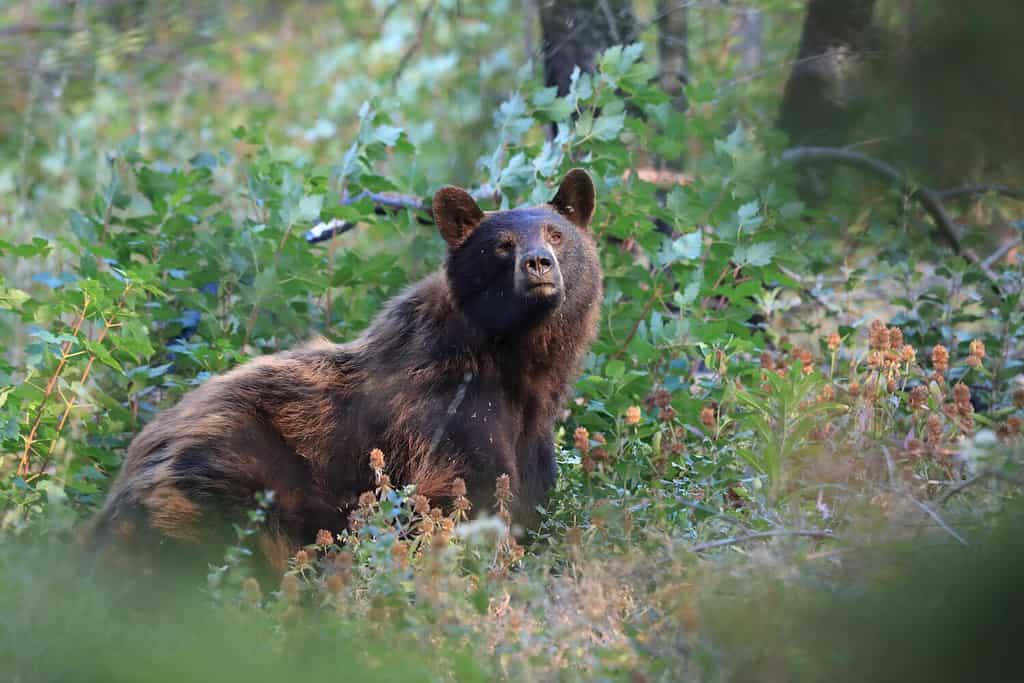
This black bear (Ursus americanus) will likely leave you alone if you just get out of its way.
©Greens and Blues/Shutterstock.com
At higher elevations in the park, you find black bears. They are concentrated in the Rincons at Mica Mountain, Heartbreak Ridge, Happy Valley Saddle, and Rincon Peak. Black bears favor forested areas, although they may venture downslope during dry periods when food is scarce to feed on desert plants, such as prickly pears. Despite their fearsome size, black bears are omnivores, feeding on small foods like berries, lizards, and dandelions. Their sharp claws allow them to dig up tasty roots, and analysis of their scat (poop) reveals that black bears eat saguaro seeds.
A variety of small mammals occupy the park, including badgers, ringtails, coatis, raccoons, chipmunks, and multiple species of squirrels and skunks. These small mammals are an important component of the food web, supporting the larger, more elusive predators like coyotes and cats.
Nighttime in Saguaro National Park
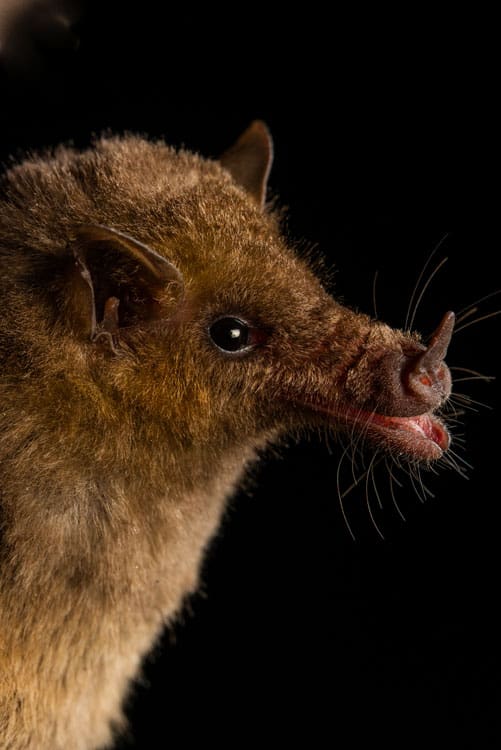
The Mexican long-tongued bat (Leptonycteris curasoae) has a triangle patch of skin on its nose thought to play a role in its echolocation.
©svaldvard/Shutterstock.com
If you decide to venture into the park at dusk, make sure to catch the gorgeous sunset. For the best views on the East side, try the Tanque Verde Ridge Trail or, if you’re driving, the Javelina Rocks pullout. On the West side, a parking lot at the top of the Gates Pass overlook provides a spectacular view of the sun setting over the desert. Look for flowers that bloom on summer nights in May and June, including saguaro cactus flowers.
Where there are saguaro blooms, there are bats. Both saguaro cacti and organ pipe cacti are pollinated by the lesser long-nosed bat, a migratory species that uses its long tongue to drink nectar as it flits from flower to flower. The pale flowers of saguaro, as well as cardon cactus and organpipe cactus, attract these bats. Another nectar-feeding bat species in the family of leaf-nosed bats (Phyllostomidae) is known from the park: the lesser long-nosed bat (Leptonycteris curasoae).
As many as 16 known insect-eating bats also inhabit Saguaro National Park. The most common is the big brown bat (Eptesicus fuscus). You might see these large bats flying into the open at dusk to start their foraging. Big brown bats typically roost in man-made structures but will sometimes sit in the saguaro cavities made by woodpeckers. The smallest U.S. bat—the western pipistrelle (Pipstrellus hesperus), which weighs only three grams—also lives in the park. Watch the desert floor on warm, winter evenings to see these tiny bats foraging for insects.
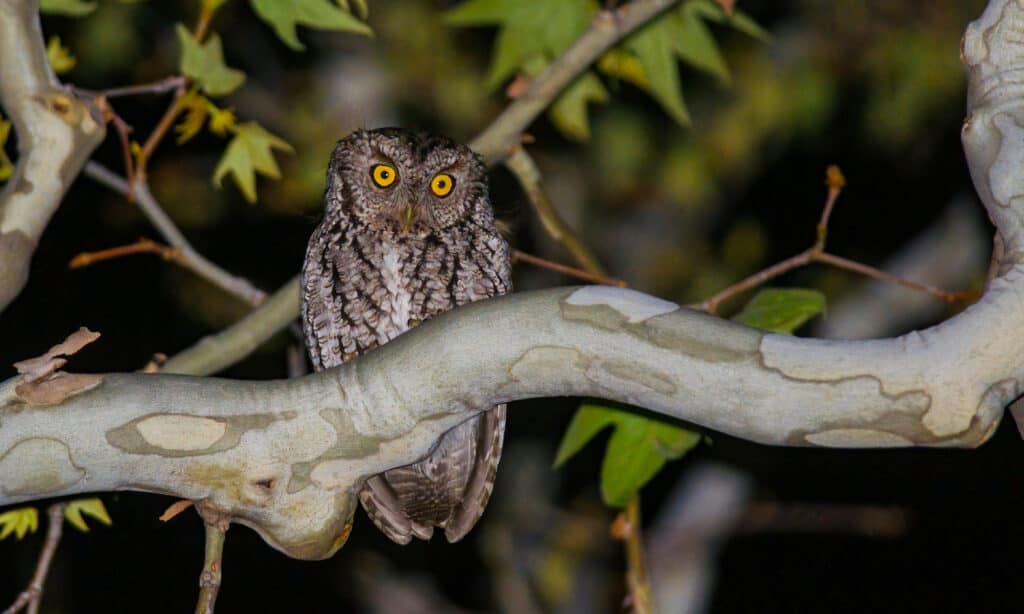
Whiskered screech owls (Megascops trichopsis) are endemic, found only in Saguaro National Park.
©Amanda Guercio/Shutterstock.com
The nights in Saguaro National Park also come alive with owls. Small whiskered screech owls make “toot-toot-toot” sounds from the higher elevation woodlands. The world’s smallest known owl, the elf owl (Micrathene whitneyi), has a call that sounds more like a puppy and could be mistaken for a coyote’s yip. Great horned owls, because of their larger body size, are more likely to be seen. One of the most common owls in the U.S., the great horned owl (Bubo virginianus) takes over abandoned hawk nests in the park. You might get lucky and see one resting in the daytime on a saguaro cactus. Known as the “Silent Hunter of the Sonoran Desert,” a great horned owl will take to the sky at sunset on powerful wings adapted for silent, hunting flight.
The Future of Saguaro National Park

Saguaro National Park hosts unique, fragile ecosystems.
As our climate continues to change, certain species may no longer be able to survive in the park. The National Audubon Society lists birds that might be extirpated by climate-induced habitat changes as: American robins, bushtits, chipping sparrows, hermit thrushes, lesser yellowlegs, northern house wrens, tree swallows, and warbling vireos. Other birds, such as Harris’s hawk and Mexican spotted owls, are also vulnerable to extirpation from other ramifications of climate change, such as more frequent droughts and fires.
Already, due to human activities during the past century, Saguaro National Park has lost some of its iconic inhabitants, including Mexican gray wolves, grizzly bears, jaguars, bighorn sheep, and porcupines. The intensive urbanization around the park introduces invasive grasses that don’t belong, among them red brome and buffelgrass. These new grasses are highly flammable, thus linked to the spread of damaging wildfires in the lower elevation parts of the park. Some of the higher elevation ecosystems, such as conifer forests, are fire-adapted, but the lower elevation ecosystems are not. According to a USGS study, the habitats of animals like lowland leopard frogs may get buried under sediment from intense fires.
If you fall in love with the park and live in the Tucson area, the National Park Service offers various ways to help maintain its biodiversity: see HERE. Regardless, cherish your visit to this unique, beautiful place.