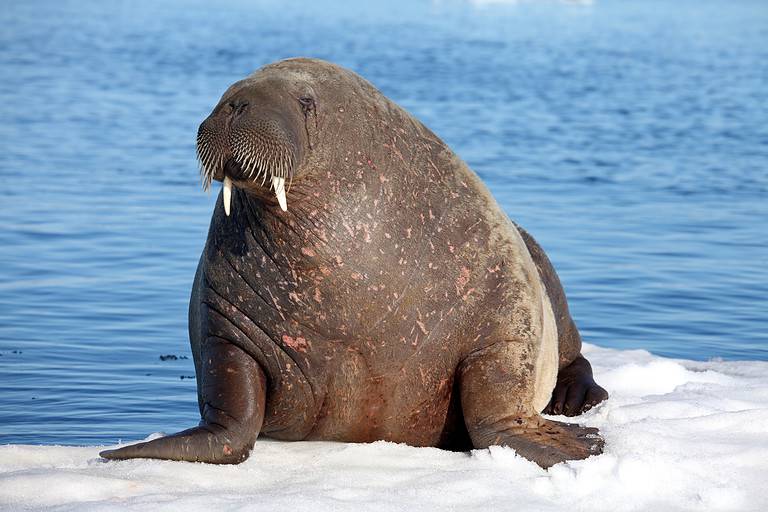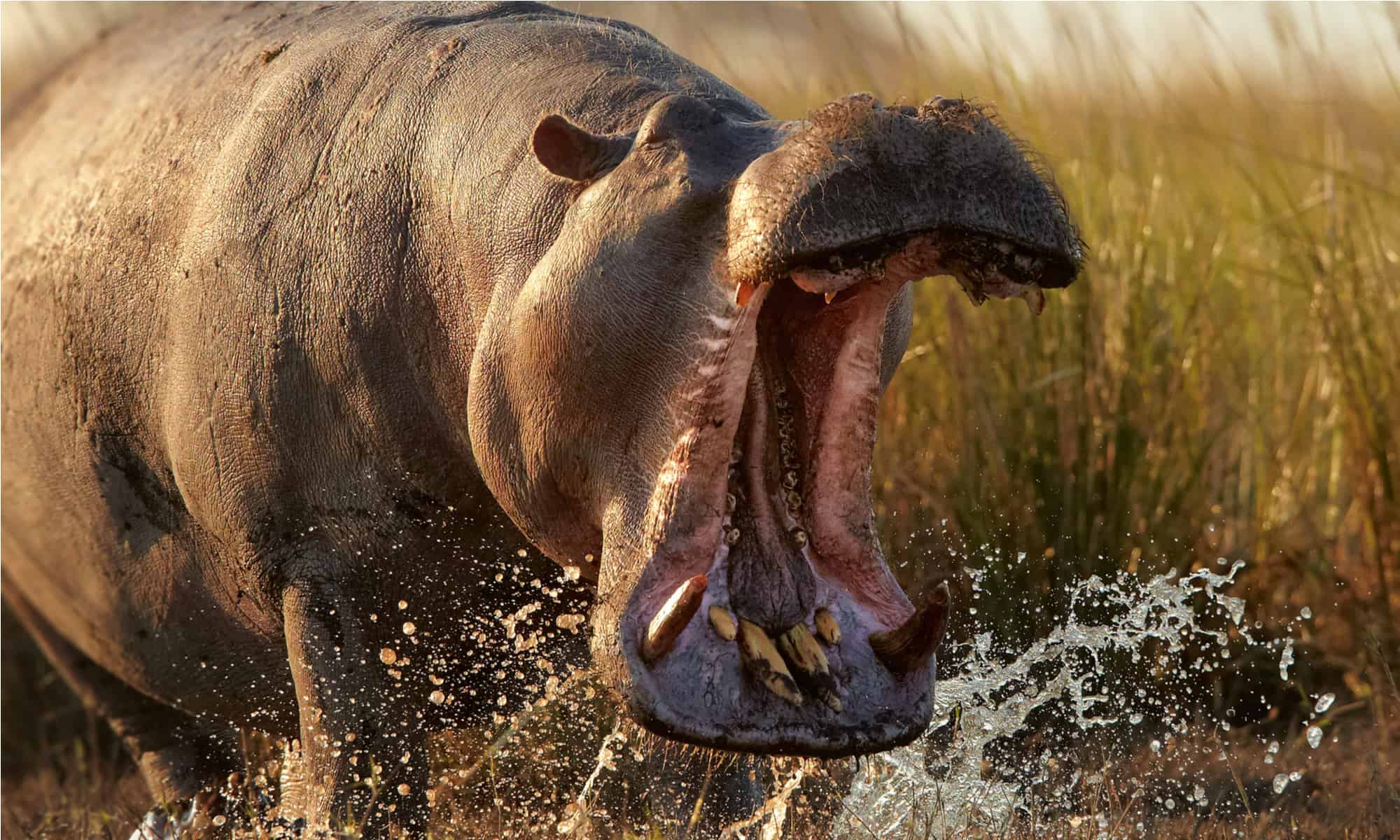

An animal’s teeth are shaped by its diet. For example, carnivores use sharp canine teeth to catch prey and tear meat, while herbivores have many molars to chew and crush tough plant material. Only mammals have incisors, canines, premolars, and molars arranged in a specific pattern. In mammals with tusks, these teeth grow almost continuously. However, have you ever wondered which animals have the biggest teeth overall? Keep reading to find out the top five animals with the biggest teeth and why they have them.
#5. Hippopotamus
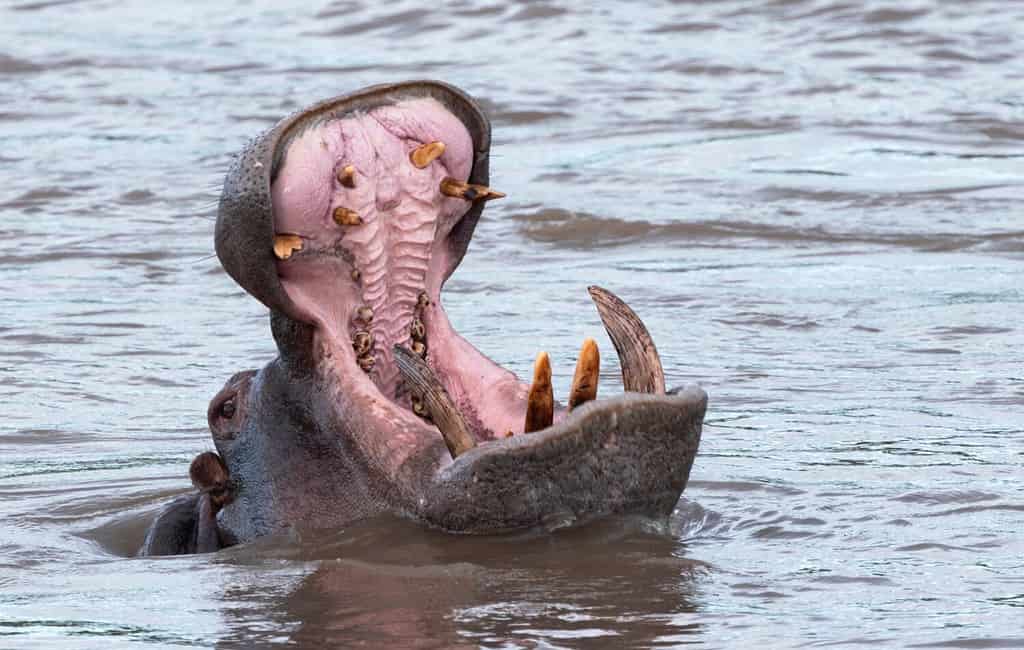
Hippos are enormous semi-aquatic animals typically found in shallow lakes, mangrove swamps, and rivers.
©Nick Greaves/Shutterstock.com
Sub-Saharan Africa is home to hippopotamuses, which are the third-largest living land mammals after elephants and white rhinoceroses. These enormous, semi-aquatic animals inhabit shallow lakes, mangrove swamps, and rivers. Hippos typically measure 10.8-16.5 feet in length. Wild males generally weigh between 3,408-4,552 pounds, while females weigh 3,053-4,080 pounds. However, some individuals can be even larger, depending on the region.
Hippos are distinguishable by their conspicuously massive mouths and teeth. Males use their razor-sharp canine tusks, which may reach 20 inches in length, for combat and defense. Females have much smaller canines, which are about half the size of a male’s. Hippos’ incredible jaw strength allows them to expand their mouths up to 150 degrees and they have a bite force of 1,800 pounds per square inch. They have 2-3 pairs of incisors, which can reach nearly 16 inches in length and are primarily used for fighting and display. Their canines and incisors grow continuously throughout their lives.
Hippos use their molars for eating. They grind and chew their food thoroughly before swallowing, which helps them extract nutrients from tough plant material. Grasses, reeds, and small shoots make up most of their herbivorous diet. Despite their sedentary lifestyle, hippos eat 1% to 1.5% of their body weight each night.
#4. Walrus
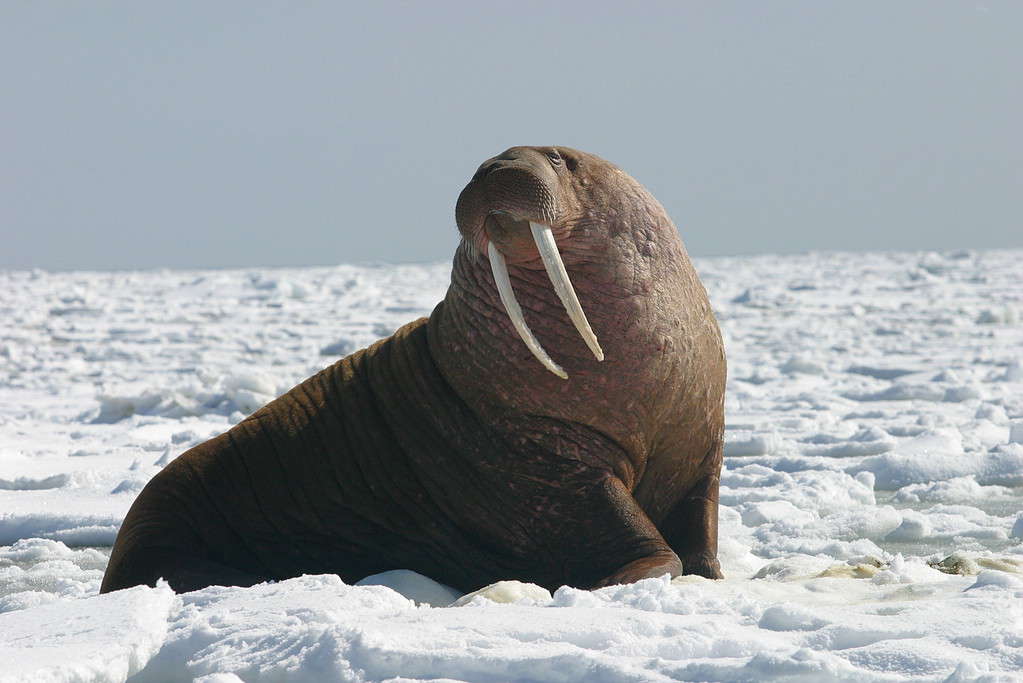
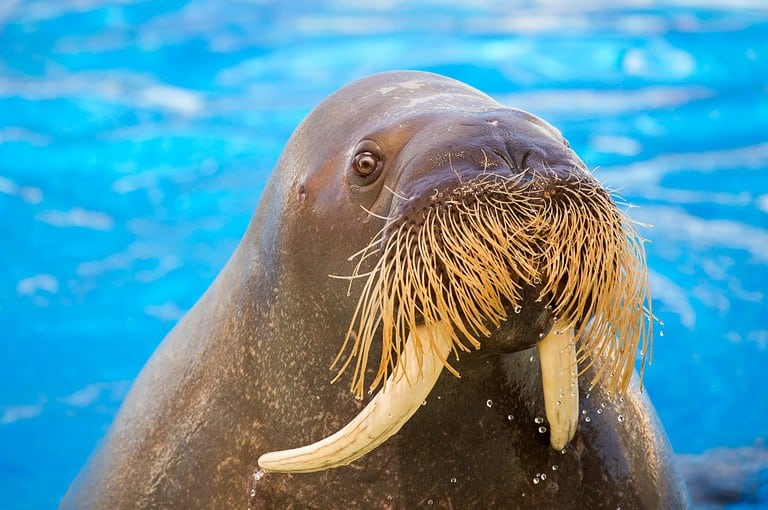
Walruses can use their tusks to help them climb out of the water.
©Joel Garlich-Miller, U.S. Fish and Wildlife Service, Public domain – Original / License
A walrus is an enormous marine mammal that lives in the cold waters of the Arctic and sub-Arctic regions. They can be found on sea ice, as well as beaches and rocky islands. Walruses grow from 7-12 feet in length. Males can weigh up to 4,400 pounds, while females may weigh over 2,200 pounds.
Walruses have a total of 18 teeth, including two prominent tusks. Walrus tusks are elongated, modified canine teeth that can reach up to 3 feet long in males. Females also have tusks, but male tusk length is 18%-22% longer. Males also have tusks that are over 40% thicker than those of females. Walrus tusks continue to grow throughout their lives.
Walruses do not use their tusks for feeding. Males use their tusks for dominance displays and to fight for position on the ice floes. During dominance displays, males raise their tusks in the air, and those with smaller tusks usually back down. Walruses also use their tusks for climbing, pulling themselves out of the water, digging holes in the ice, and moving ice floes so they have room to enter and exit the water.
#3. African Elephant
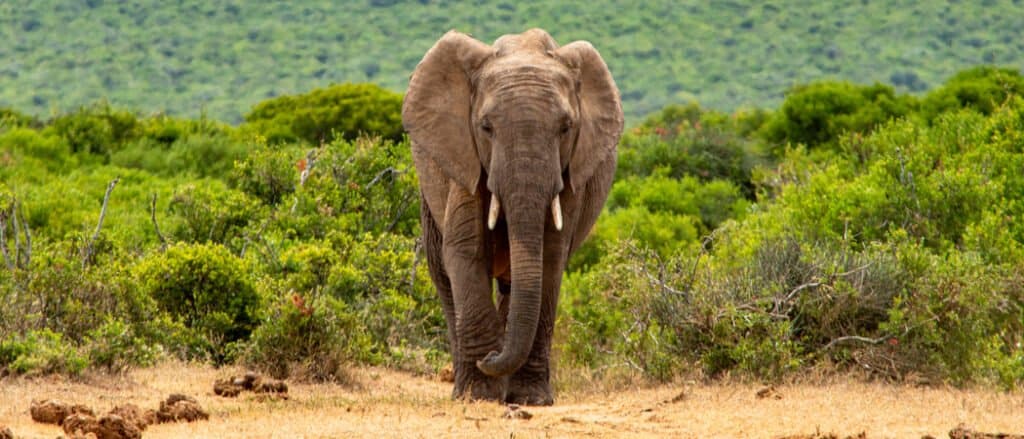
Adult African elephants can grow tusks 6-8 feet long.
©Carfield Photography/Shutterstock.com
African elephants need no introduction — they are the biggest living land mammals in the world. African elephants live in the savannas of sub-Saharan Africa and the rainforests of Central and West Africa. They can also be found as far north as the Sahel Desert in Mali. The two species of African elephants include the savanna elephant and the forest elephant. They can grow to about 7-13 feet tall at the shoulder. Females can weigh up to 7,700 pounds, while males can reach 13,448 pounds.
Adult African elephants possess lophodont dentition, which means they have a set of six moving, growing molars. Throughout an elephant’s life, their teeth deteriorate and are replaced about 4 to 6 times. As they get older, they’re unable to replace the molars needed to process food and may starve.Tusks in both sexes of African elephants are elongated upper incisor teeth. Calves are born with small, temporary tusks that are replaced by permanent tusks after a few months
African forest elephants have straighter, downward-pointing tusks, while the bush elephants have tusks that bend outward. Tusks are mostly used for feeding-related activities, including digging for roots, lifting objects, and removing tree bark. However, they are also useful for protection against predatory attacks and fights during the mating season. Tusks can range in length from around 6-8 feet and continue growing throughout an elephant’s life. Their tusks can weigh between 55-100 pounds.
#2. Narwhal

A male narwhal’s “horn” is actually a protruding tooth!
©iStock.com/dottedhippo
This list isn’t complete without the unicorn of the sea. The iconic narwhal is a light-colored toothed whale that inhabits the deep Arctic waters of Canada, Greenland, Norway, and Russia. It is regarded as the northernmost cetacean, often found between 70° and 80°N latitude, though they migrate on a seasonal basis. Narwhals can range from 13-18 feet in length and 1,760-3,530 pounds, with females being smaller.
Narwhals do not have traditional teeth. They have two teeth in their upper jaw, and when males reach 2-3 years of age, the left tooth grows through the front of their heads. In females, the teeth typically remain embedded in the jaw. A narwhal’s tusk can grow to nearly 9 feet long. Their tusk is also the only spiral tooth in nature, growing in a counterclockwise spiral.
The tusk is primarily used by males to assert dominance. It is also used as a visual cue to attract females. However, researchers believe that it may be used to detect changes in the environment or to help hunt prey.
#1. Sperm Whale
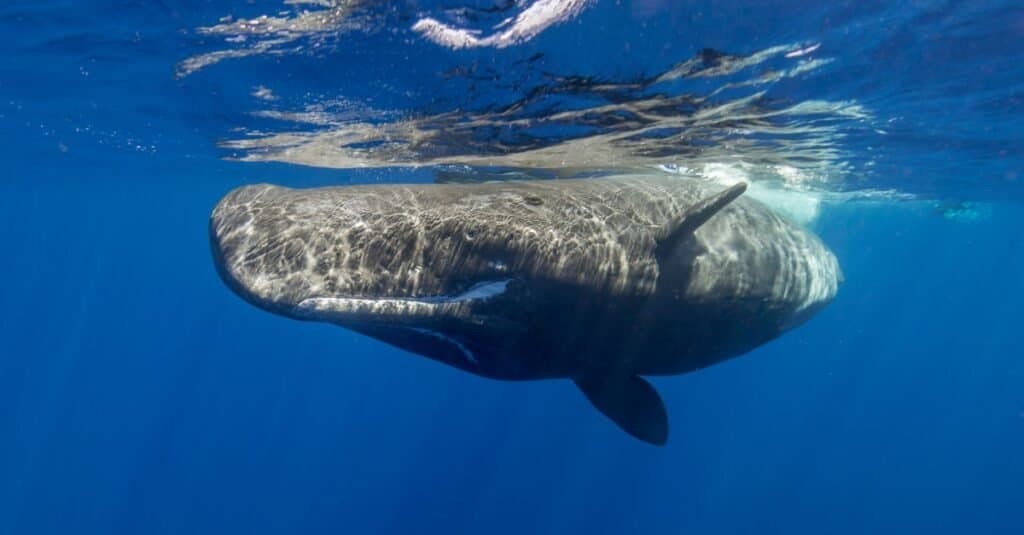
The huge, conical teeth of the sperm whale capture their favorite prey, which includes squid, sharks, and fish.
©wildestanimal/Shutterstock.com
The sperm whale is the largest of the toothed whales. It has the largest brain of any animal on Earth and also has one of the widest ranges of any marine mammal. It dwells in deep oceans everywhere, from the Arctic to the Antarctic. Male sperm whales can reach up to 52 feet in length and weigh as much as 40 tons. Females are much smaller, reaching only 40 feet and 15 tons.
They have enormous, block-shaped heads that can be between one-quarter and one-third of their body length. A sperm whale has 20-26 teeth on either side of its lower jaw. They usually have no teeth on their upper jaws, as those teeth rarely erupt. Their teeth can grow up to 8 inches in length and weigh over 2 pounds each.
Their huge, conical teeth are not designed to chew, but to capture and hold their favorite prey, which includes squid, sharks, and fish. They can dive to depths of 2,000 feet or more and stay underwater for up to 45 minutes, increasing their chances of finding prey that lives in the deeper ocean.