
Quick Take
- The northern cardinal was chosen as the official Kentucky state bird in 1926.
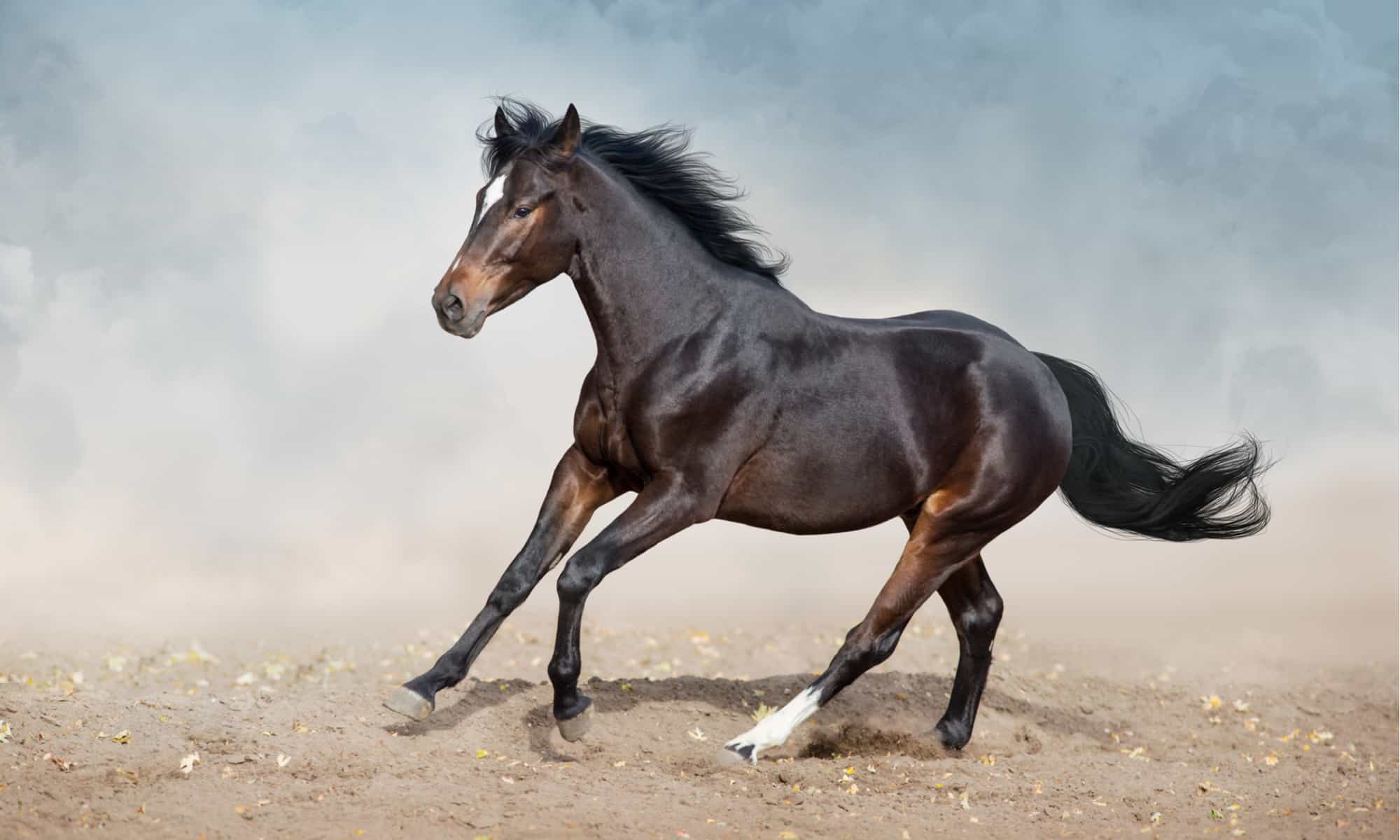
- It is no surprise that the “horse capital of the world” chose a thoroughbred horse as one of the official Kentucky state animals.
- The Viceroy butterfly mimics the appearance of the Monarch, which protects both butterflies.
- Honey bees are the official state insect due to their important role in agriculture.
Kentucky is part of the southeastern region of the U.S. The official animals of the Bluegrass State include horses, insects, and even fish. Each animal in this diverse group of species offers a glimpse into the state’s history and natural wonders. So, take a closer look at Kentucky’s six official state animals, and learn more about what makes them unique and why they were chosen to represent Kentucky.
What Is an Official State Animal?
Every state has official symbols that represent its history, culture, and natural heritage — the various elements of biodiversity found within the state. State symbols can highlight the need for conservation efforts and call attention to at-risk wildlife. An official state animal is native or common to the area and has ecological or economic significance.
The selection of a state animal generally begins with a proposal or suggestion from schools, residents, or special interest groups. Then a bill is drafted, reviewed, and voted on by the state legislature. Once the bill is passed by the legislature, the animal is officially adopted as a state animal. Here are the six animals officially adopted as symbols of the state of Kentucky.
Bird: Northern Cardinal (Cardinalis cardinalis)
The northern cardinal has the distinction of being the state bird of seven states, including Kentucky. The northern cardinal was chosen as the official Kentucky state bird in 1926, and it was re-codified in 1942. It is believed to have been chosen for its colorful plumage, cheerful songs, and its constant presence in Kentucky.
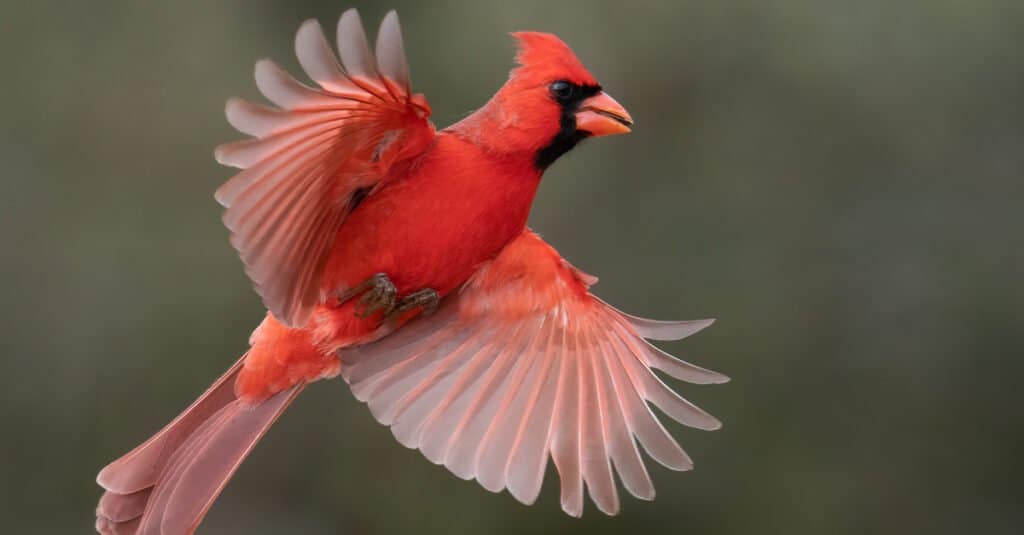
The northern cardinal is the official state bird of Kentucky, as well as six other states.
©Rob Palmer Photography/Shutterstock.com
Northern cardinals are recognized by their beautiful, fiery red coloring, the tufted crest of feathers on top of their heads, and their elongated tails. These birds are 8-9 inches in length with wingspans of 9-12 inches. They have cone-shaped orange beaks and dark colored legs. Male cardinals have bright red plumage and black faces, while females are a pale, brownish-gray overall, with reddish shades on their wings, tails, and crests.
Cardinals are non-migratory and can be heard singing all year long. They are territorial songbirds, and the male northern cardinal defends his territory from the tops of trees and other high perches. Cardinals may even fight their own reflections in windows and on the surfaces of water. These beautiful birds can be found in Kentucky’s diverse range of habitats, including forest clearings, gardens, overgrown fields, riverside thickets, and even city parks, as long as dense shrubbery is available for nesting.
Fish: Kentucky Spotted Bass (Micropterus punctulatus)
Although the fish was, and still is, prevalent statewide, the spotted bass was not recognized as a distinct species of bass until 1923. It was originally described based on a specimen caught at the Falls of the Ohio near Louisville, Kentucky in 1891. In 1956, the Kentucky legislature passed Senate Resolution 70, designating “the Kentucky bass” the official state fish. Once thought to only inhabit Kentucky, fishermen throughout the fish’s geographical range in the south-central U.S. still sometimes refer to the fish as the Kentucky bass.
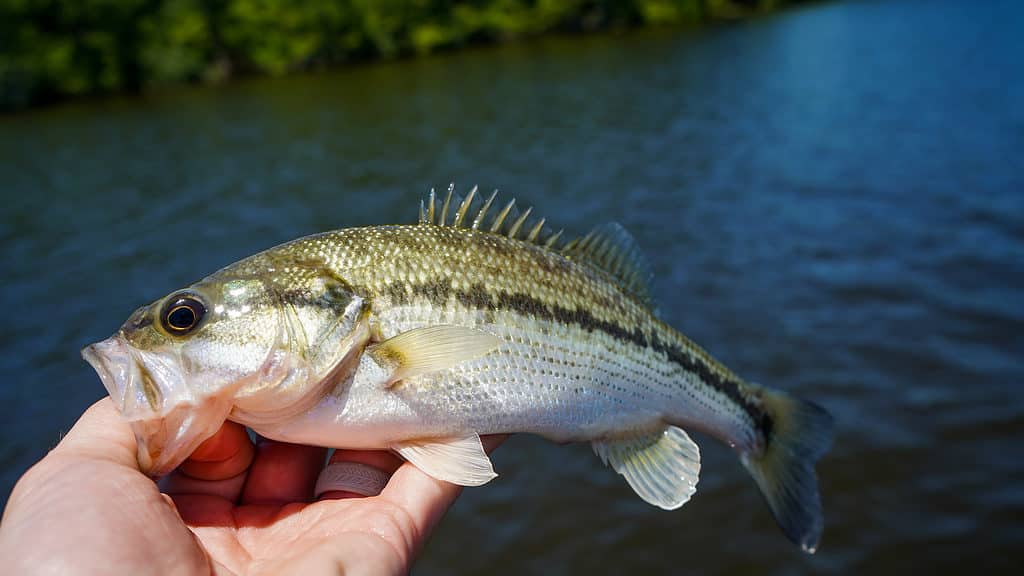
The Kentucky state fish, the spotted bass, is also known as the Kentucky bass.
©Maclane Parker/Shutterstock.com
Although Kentucky spotted bass and largemouth bass appear similar, several unique features differentiate the two. Kentucky spotted bass can be identified by the horizontal rows of small black spots under the lateral lines on either side. Adult Kentucky spotted bass also have a shallow notch between their dorsal fins, and a circular patch of teeth on their tongue. Largemouth bass lack spots and teeth on their tongue, and although they have a notch between their dorsal fins, it is deep, not shallow.
In Kentucky, adult spotted bass commonly measure between 10 to 15 inches in length and weigh 1-3 pounds, but they can reach lengths of 24 inches and weights of up to 8 pounds. They are similar in taste and texture to the largemouth bass or crappie, being mild white fish with a firm texture. These fish favor streams and rivers, but can also be found in reservoirs and lakes. They are common across the state, except in the far western part of the state in the Mississippi Coastal Plain.
Wild Game Animal: Eastern Grey Squirrel (Sciurus carolinensis)
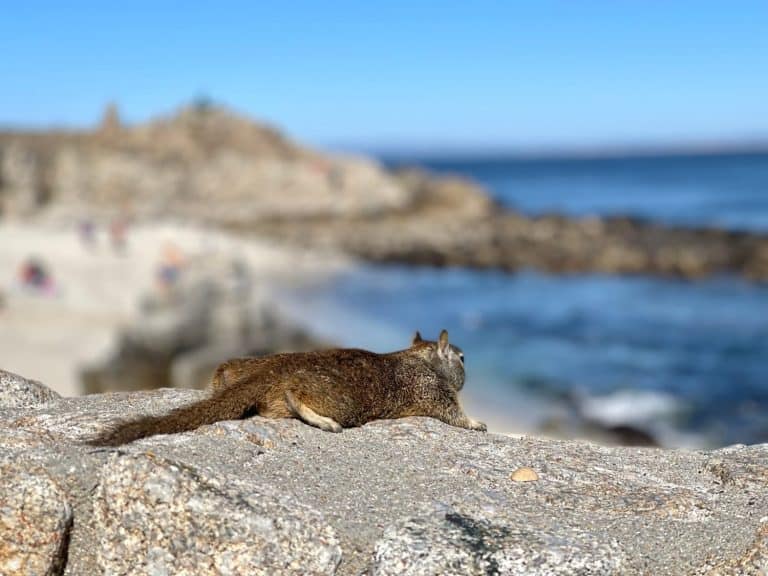
Kentucky’s official wild game animal is the eastern grey squirrel. It was chosen to highlight the historical significance of small game hunting to the region. Early frontier settlers, especially in the Appalachians, relied on eastern grey squirrels for food when larger game was scarce. It is still legal to hunt grey squirrels in Kentucky during their two yearly hunting seasons. The eastern grey squirrel was officially declared the state’s wild game animal as of June 13, 1968 by the Kentucky General Assembly.
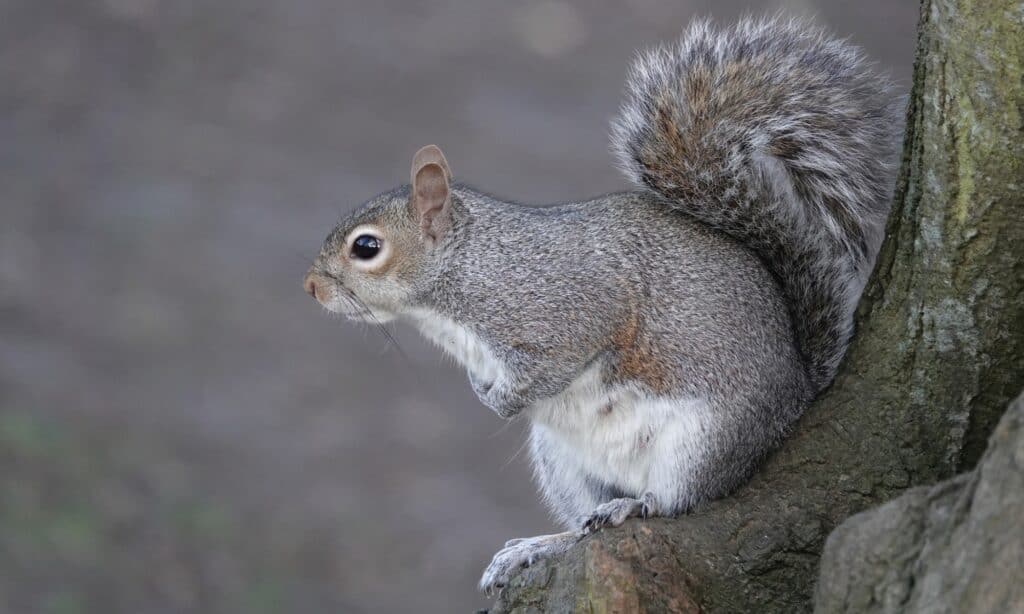
The eastern grey squirrel is the official wild game animal of Kentucky.
©iStock.com/Nigel Harris
Eastern grey squirrels have ticked, or grizzled, fur with a mix of brown, black, and white fur that looks grey from a distance. These squirrels have pale bellies and long, flattened, bushy tails. They have moderately-sized ears lacking tufts and cream-colored rings around their dark eyes. These squirrels weigh up to 1.5 pounds and typically reach lengths of 16-20 inches.
These squirrels inhabit urban and suburban environments, such as parks and backyards, as well as mixed hardwood forests with large trees that produce hard mast. This means that the trees produce nuts. Grey squirrels in Kentucky favor hickory, beech, white oak, pecan, and black walnut. They often use tree cavities or abandoned woodpecker holes as dens. They do not hibernate during the winter, spending most of their time foraging for nuts they buried previously.
Butterfly: Viceroy Butterfly (Limenitis archippus)
The viceroy butterfly is a common sight across Kentucky in all of its life stages. Since it overwinters as larvae, the viceroy can remain in the state year-round rather than migrating. Kentucky state legislature recognized the significance of the viceroy butterfly and designated it as the official state butterfly as of July 13, 1990.
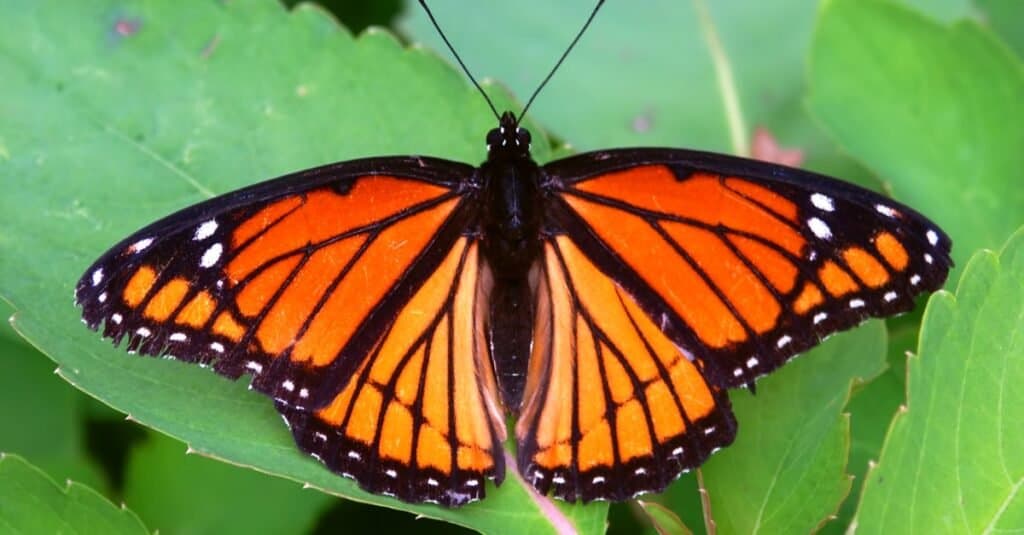
Kentucky’s official butterfly is the viceroy, which appears similar to a monarch.
©Jason Patrick Ross/Shutterstock.com
Kentucky’s official butterfly is has vivid, dark orange wings, black veins, and a row of white spots along the edges. Although its pattern resembles the monarch butterfly, the viceroy can be distinguished by the black, horizontal stripe running across the bottom of its hind wings. The viceroy is also smaller than a monarch, with a wingspan that ranges from 2.6 to 3.2 inches, versus the monarch’s 3.5 to 5-inch wingspan. One thing they do have in common with the monarch is they are both foul-tasting, and sometimes toxic, to predators. Müllerian mimicry occurs when two (or more) unpalatable or toxic species develop similar coloration, which offers protection for both.
As noted above, unlike monarchs, viceroy butterflies do not undertake seasonal migrations. This is because they spend the winter in diapause, which is a type of hibernation. Caterpillar larvae roll up in leaves that are attached with silk to their host trees, which include poplar, willow, and cottonwood. Viceroys are generally found in wet, open areas, such as marshes, swamps, the banks of lakes and rivers, and flooded fields and meadows.
Horse: Thoroughbred (Equus caballus)
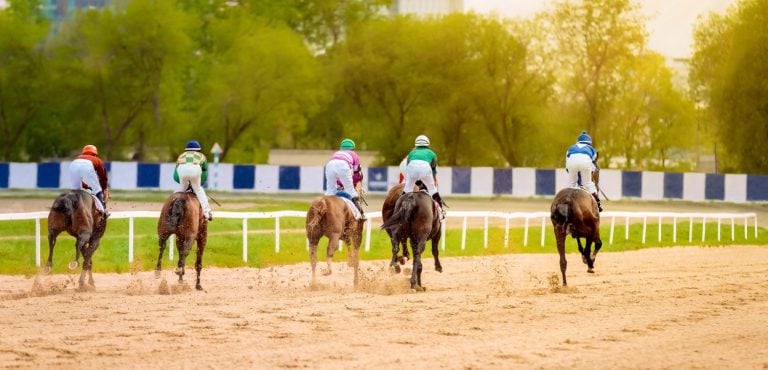
Effective July 15, 1996, the state of Kentucky officially declared the thoroughbred as its state horse. Known as “the horse capital of the world,” Kentucky, particularly the area around Lexington, has been a center for horse racing and breeding since the 1800s. The horse industry, which includes training and veterinary services as well, is an integral part of Kentucky’s history and economy. The famous Kentucky Derby also exclusively features thoroughbred horses.
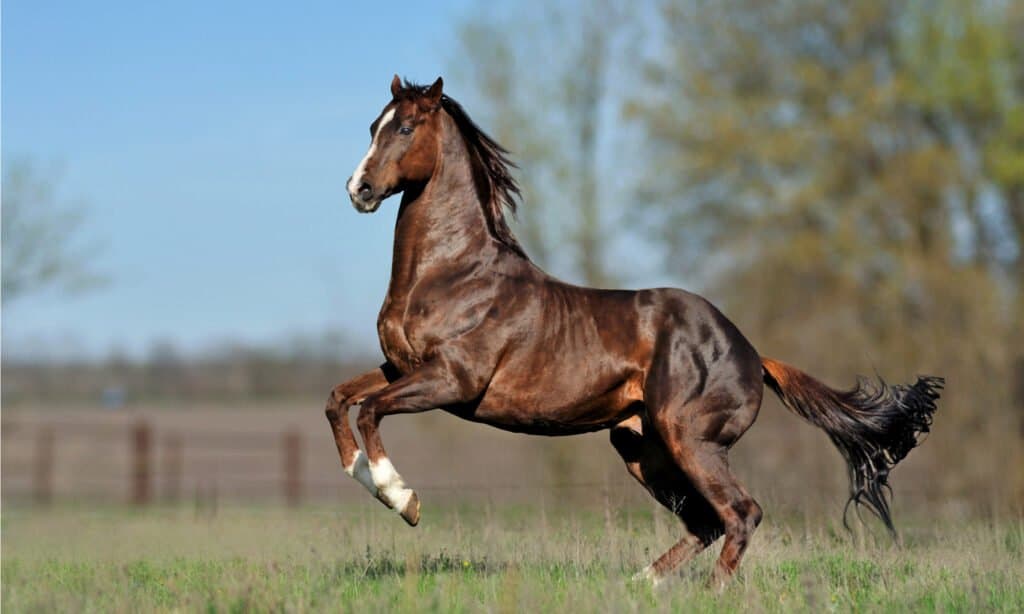
The Kentucky state horse is the thoroughbred, the only horse breed that participates in the Kentucky Derby.
©Anaite/Shutterstock.com
Although the term thoroughbred is often used to describe any purebred horse, a thoroughbred is a specific breed. These horses have deep chests, long necks, and relatively short backs. Selective breeding has resulted in leaner bodies, straight profiles, long legs, and powerful hindquarters, which allow these horses to achieve higher speeds. They generally reach heights of 15-17 hands (60-68 inches) and weigh around 1,000-1,200 pounds when fully mature. Thoroughbreds are typically shades of chestnut, black, grey, or brown.
When it comes to behavior, thoroughbreds are lively and spirited. These horses have a strong work ethic and are highly intelligent. Despite being primarily bred for racing, thoroughbreds are versatile horses, making them suitable for other disciplines, such as show jumping, dressage, hunting, and polo. Thoroughbred horses can be found on farms throughout the state. However, the Bluegrass Region in north-central Kentucky is world-famous for its horse farms. The high phosphorus and calcium in the soil are credited with helping horses in this region build stronger bones than horses from other regions.
Insect: Honey Bee (Apis mellifera)
The honey bee has been designated as the official state insect in 17 states, including Kentucky. In 2010, the honey bee was declared Kentucky’s official state insect due to its essential role in agriculture. The honey bee’s importance to agriculture goes beyond pollination. Bee products such as beeswax, royal jelly, and bee bread are used in various industries, such as cosmetics, pharmaceuticals, and food production. Honey is also a popular sweetener and has been used in human diets for centuries.
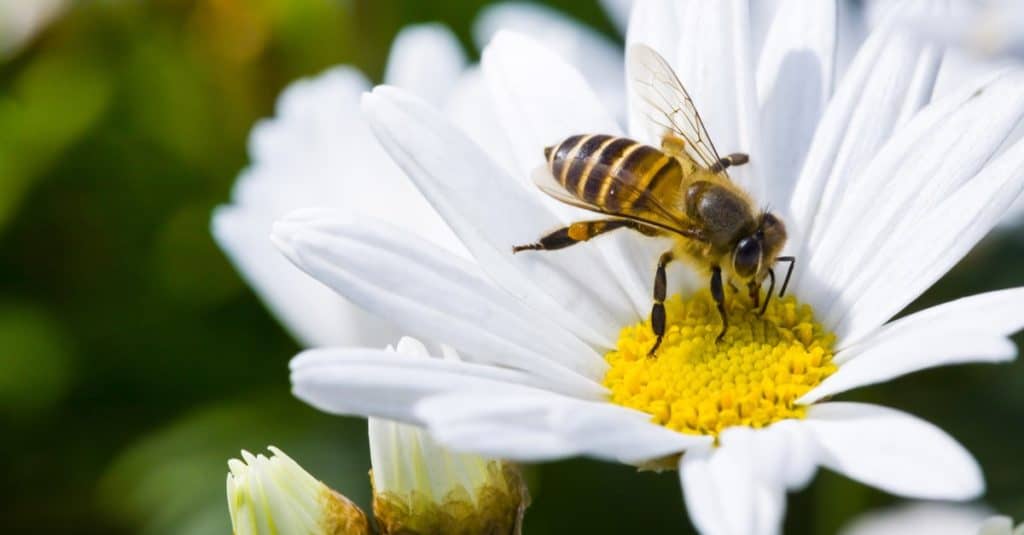
Due to its important role in agriculture, the honey bee is the official Kentucky state insect.
©Jack Hong/Shutterstock.com
Honey bees have oval-shaped bodies and reach about 0.5-0.6 inches long with a wingspan of 0.7-0.8 inches. They are generally shades of brown, yellow, and black with banding on the abdomen. Honey bees have dense, fuzzy hair on the upper surface of the prothorax, which is the first segment of the thorax. They have two large, compound eyes in the front and three smaller eyes called ocelli on top. The ocelli primarily aid in maintaining orientation and stabilizing flight. Adult bees also have stingers, but they can only sting once, as this is fatal for the bee.
Like most bee species, honey bees are social insects living in large colonies that can number in the thousands. Within a honey bee colony are three types of adult bees: infertile female workers, male drones that mate with the queen, and the queen, which lays eggs. Each type of bee plays a crucial role in the colony’s health and productivity. In the wild, honey bee hives can be found in wooded areas, typically inside hollow trees or other natural crevices.