Quick Take
- The man who invented scientific naming tried to correct one of his own mistakes, but the rules stopped him. See the Linnaeus principle →
- One common name confidently refers to three entirely different animals, which can be quite confusing. See naming confusion →
- DNA testing quietly reclassified an herb sitting in millions of kitchens right now, and as a result, its scientific name had to change. Discover the rosemary reclassification →
Every known animal has both a common name and a scientific name. While common names are used in everyday situations, scientific names are mainly used in research environments and formal classification. Think of it as the difference between a nickname and a legal name. Humans, for example, are scientifically known as Homo sapiens. What many people call a monarch butterfly is known in the scientific community as Danaus plexippus. Oftentimes, common names vary based on location, while scientific names reflect a standard form of identification. Let’s detail how common and scientific names work and how to distinguish between them.
Common Names Are Often Misleading

The large eyelike wing patterns in owl butterflies work as a defensive mechanism against predators.
©StockMediaSeller/Shutterstock.com
A common name is a non-scientific or colloquial name used by the general public to describe a species. Common names can vary by region, but they frequently fail to reflect the true biology of organisms. Names like starfish or killer whale are misleading. The origin of colloquial names can be affected by region, appearance, and behavior. Some common names are highly unique to a specific area.
One classic example of a common name that changes according to location is the land-dwelling isopod formally known as Armadillidium vulgare. In the United States, regional variations include pill bug or roly poly, names that refer to the isopod’s volvation, or the ability to roll into a protective ball. In Europe and the UK, these same critters are called woodlouse. In some specific parts of the U.S. and Canada, they are commonly known as potato bugs.
While common names shift regionally, scientific names can change with time. As we learn more about each species, scientific names are often altered to reflect changes in perception. Between 1970 and 2013, Clements’ Checklist of Birds changed about 9% of all bird species names. However, once a scientific name is changed, it still holds up across borders.
The Power of the “Everyday” Name

Penguins jump into the air prior to diving to swim faster.
©Faraz Kalmati/Shutterstock.com
Scientific names, though they provide specificity, can be intimidating. Recognize Acinonyx jubatus? How about cheetah? Cheetah is much easier to say, remember, and teach. Common names encourage nature to be accessible to the general public. As a conservation example, generating traction for a Save the Bee movement is much easier than for a Save the Apis mellifera, Bombus impatiens, and Megachile rotundata movement.
In addition, many common names include identifiers like the blue jay or giant sequoia. These names reference features that are obvious at first glance rather than subtle bone structures or internal biology. Common names also reflect cultural or historical significance that would be lost if we relied on scientific names only.
Scientific Names Provide Universality
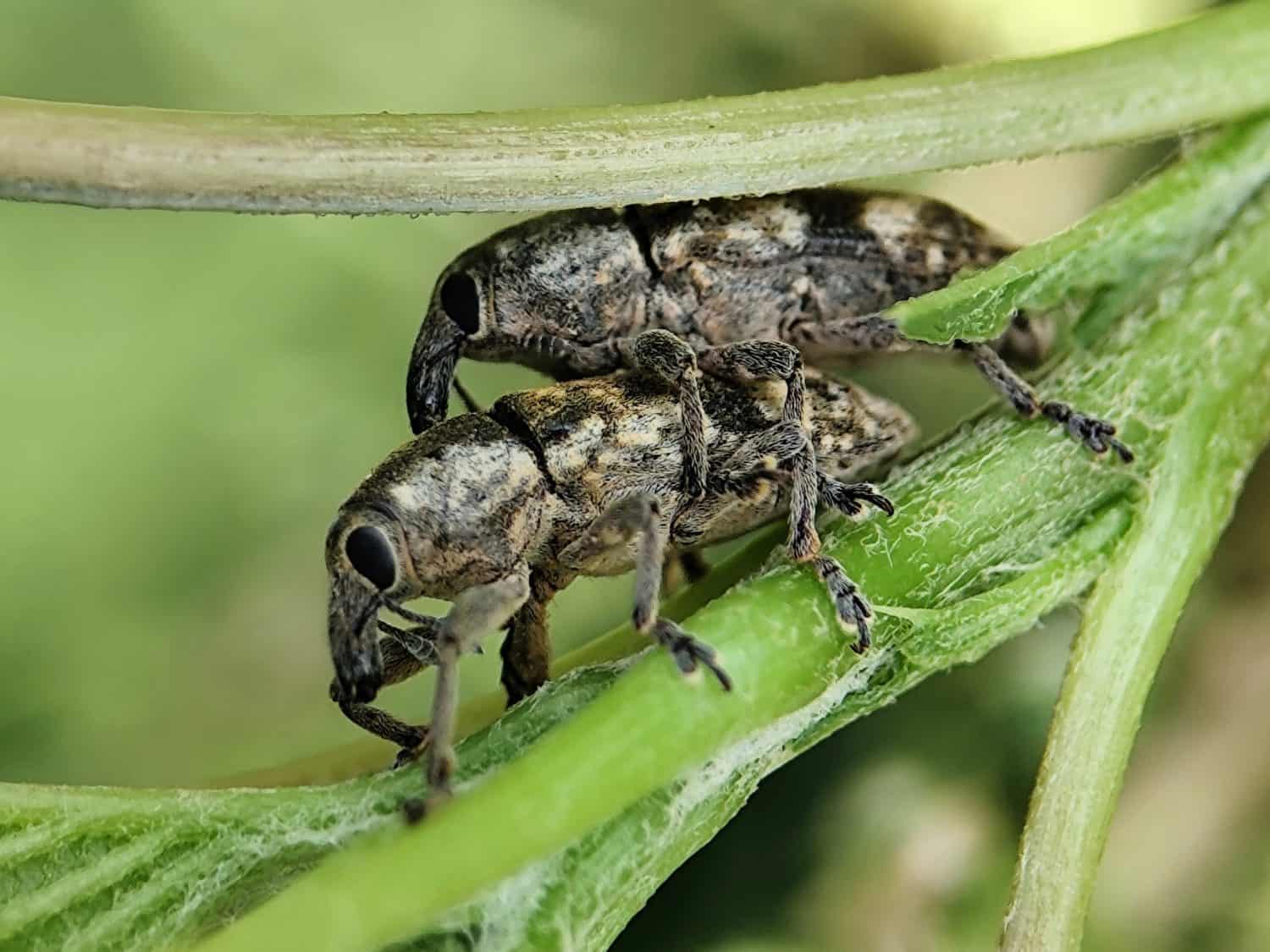
Weevils, or Cuculionidae spp., use their rostrum (snout) to access a wide variety of plant tissues.
©Vicky Wiedira/Shutterstock.com
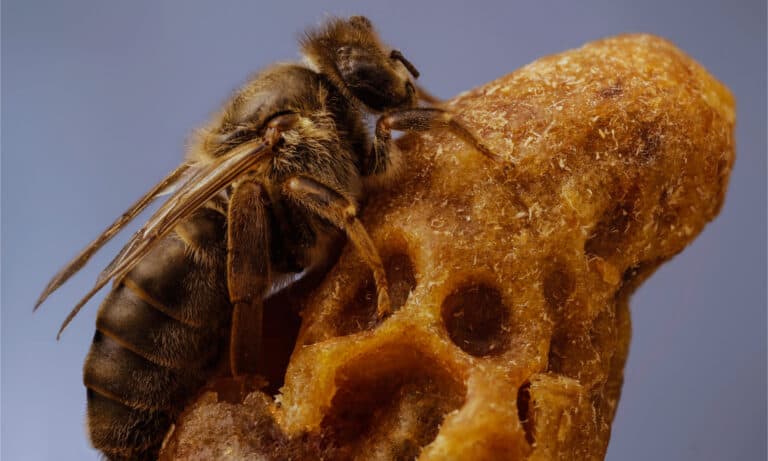
Scientific names work by utilizing the binomial system to uniquely identify a species. Carl Linnaeus introduced this two-part system to provide structure for naming new species. The first part, genus, characterizes species that share a common ancestor or group. Let’s use honeybees as an example. European honeybees (Apis mellifera) are from the genus Apis, which is Latin for “bee”. Apis comprises roughly 9 recognized species including dwarf bees (Apis florea) and giant bees (Apis dorsata).
Honeybees are unique in their ability to produce and store honey in perennial nests made of wax. Unlike other bees that may use mud, leaves or tunnels, these species utilize specialized wax glands on their abdomen. Mellifera stands for “honey-bearing” or “honey-carrying”. Apis mellifera was first established by Carl Linnaeus himself in 1758. Linnaeus combined two Latin words, melli (honey) and ferre (to bear or carry). After Linnaeus realized that honeybees carry nectar and not honey, the scientific community attempted a name change. Linnaeus replaced mellifera (honey-carrying) with mellifica (honey-making). Unfortunately, under the Principle of Priority, a species must use the oldest available scientific name that has been applied to it. Therefore, honeybees are scientifically known as Apis mellifera to this day.
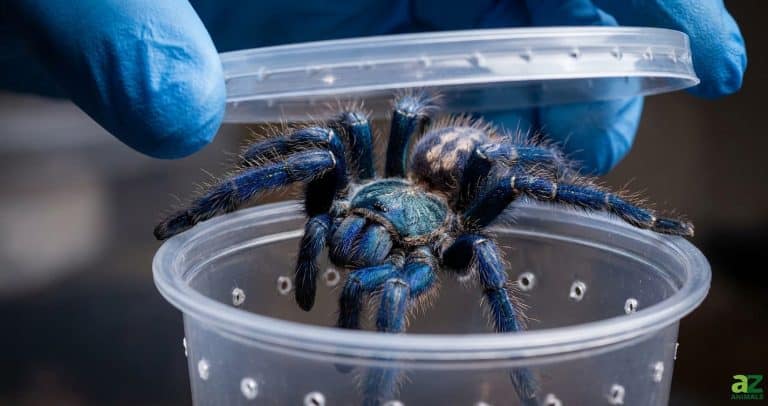
A formal naming system encourages specificity and reduces confusion. For an example, the common name daddy longlegs generally fails because it refers to multiple different animals. Depending on who you ask, the daddy longlegs is a cellar spider, a harvestman, or a flying crane fly. Using a scientific name reduces confusion by applying a standardized system that clearly identifies each species.
Key Figures in Identification
Rules like the Principle of Priority help keep the classification system stable. However, the path to this level of organization was gradual. The structure behind naming species has developed over thousands of years as our understanding of the natural world has deepened. Aristotle is often credited with one of the earliest classification systems, grouping organisms based on observable characteristics. Later, Carl Linnaeus introduced the formal two-name binomial system still used today. Building on this, Charles Darwin shifted the focus toward evolutionary relationships, emphasizing that classification should reflect the shared ancestry of living organisms.
What Makes a Scientific Name Change?

Rosemary is a mediterranean herb from the mint family.
©Maren Winter/Shutterstock.com
DNA sequencing allows scientists to decode the genetic blueprints of species. Prior to DNA analysis, scientists had to rely on physical characteristics to predict lineage. Rosemary’s scientific name was Rosmarinus officinalis. However, DNA testing revealed the herb to be a type of sage. Because of this, rosemary was placed into the genus Salvia and renamed Salvia rosmarinus.
One of the most interesting cases of renaming lies with the red panda, whose classification was an ongoing debate. With a ringed tail, face of a raccoon, and dietary habits of a giant panda, the animal seemed to defy classification. Modern DNA sequencing revealed that the red panda is neither bear nor raccoon. Red pandas are their own separate family, Ailuridae, of which they are the only currently living member. Further analysis showed that the Himalayan and Chinese populations of red panda are genetically distinct from one another, placing them in two separate categories under the genus Ailurus.
Occasionally, DNA evidence reveals one particular species to be two distinct species. Such a discovery directly impacts legal protections and funding for those animals. In the case of the African elephant, this distinction led to a tailored approach to both species which occupy different niches.
A Living Record Beyond the Name
The case of the red panda or African elephant exemplifies exactly why taxonomic flexibility is so important. By changing scientific names as we learn more about the Earth’s species, we reflect a more updated and accurate understanding of the natural world. As science evolves, common and scientific naming systems continue to act as vital records of discovery, helping us understand how life on Earth is connected.