
Have you ever noticed the flashy, vividly colored rear ends of some monkeys? You might see monkeys with blue butts and even monkeys with red butts. Bright buttocks in primates are typically linked to sexual signaling and skin vascularization. But how many and which monkeys have brightly colored bottoms? These traits are mainly in Old World monkeys (Africa and Asia). New World monkeys (the Americas) generally do not have colored rear ends. But which kind of monkeys have red butts, and which ones have blue butts? How do you tell them apart? Let’s look at some of the most familiar types of red-butt and blue-butt monkeys.
This post was updated on September 25, 2025 to clarify the reason behind male coloration, vervet color placement, species in which red privates are only displayed in females, and the reason behind female enhanced coloration while in heat.
Blue-Butt Monkeys
We like blue butts, and we cannot lie! There are several species of monkeys that have blue rear ends. Let’s look at three of the most common blue-butt monkeys!
Mandrill
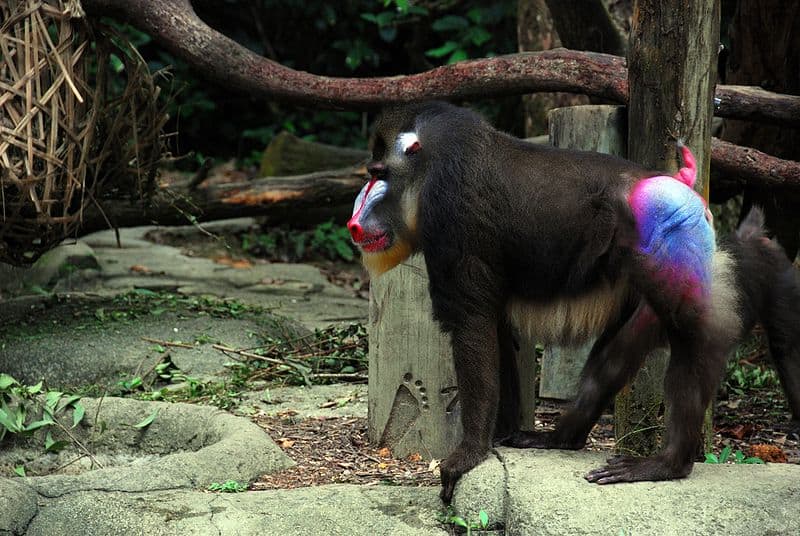
Mandrills are monkeys with blue butts.
©Robert Young / Creative Commons – Original
Mandrills are large primates closely related to the baboon. These animals inhabit the tropical forests of Africa and are monkeys with blue butts. Additionally, the mandrill is the largest non-ape primate. It is arguably the most colorful, with a trademark bright red and blue face and a very bright and colorful butt. These are secondary sexual characteristics, present in both sexes, though coloration is much more vibrant in males. Scientists believe that they use this feature to attract mates and indicate dominance.
The blue part of a mandrill’s butt is skin, not fur. The blue hue is structural coloration caused by how light scatters in skin collagen. As a result, the skin looks like a mosaic of blue, purple, and pink tiles when viewed up close. Underneath the skin, there are blood vessels that help to regulate the monkey’s body temperature.
Lesula
©Roger de la Harpe/Shutterstock.com
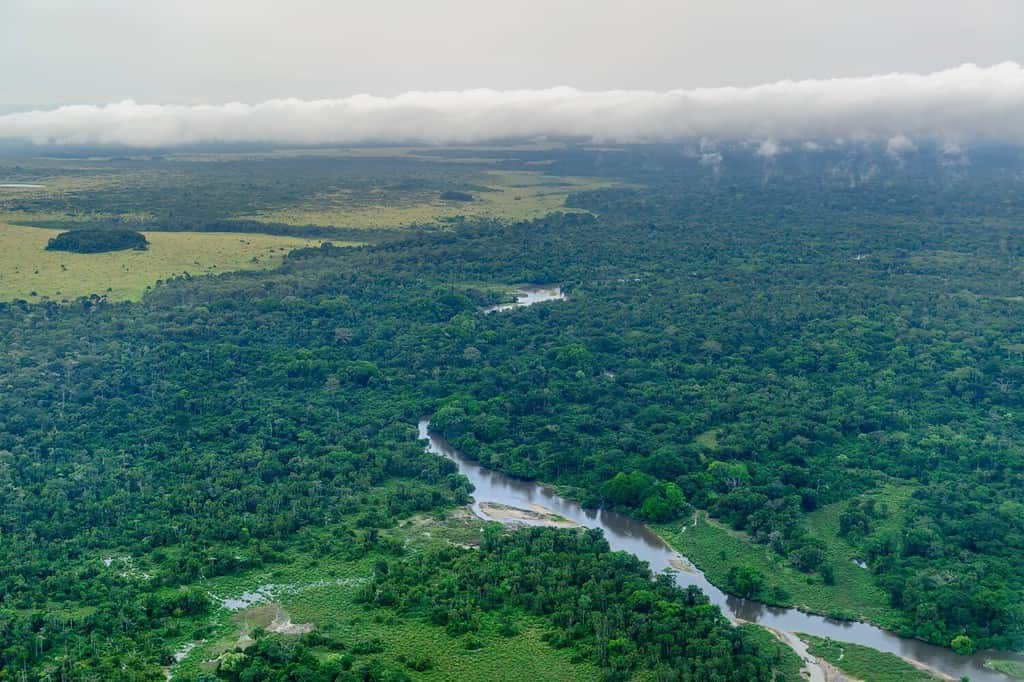
Lesula is an Old World monkey species living in the Congo‘s Lomami Basin. This monkey has startlingly characteristic human-like eyes, alongside a vibrant aquamarine buttocks and testicles. Though the international scientific community was unaware of its existence until relatively recently, the local population has been aware of its presence for some time. The lesula is the second new African monkey species that scientists have discovered since 1984. They found this new species in 2007 and confirmed this discovery in a 2012 publication. Researchers remain intrigued by this species’ eyes that strongly resemble its human cousins.
Vervet Monkey
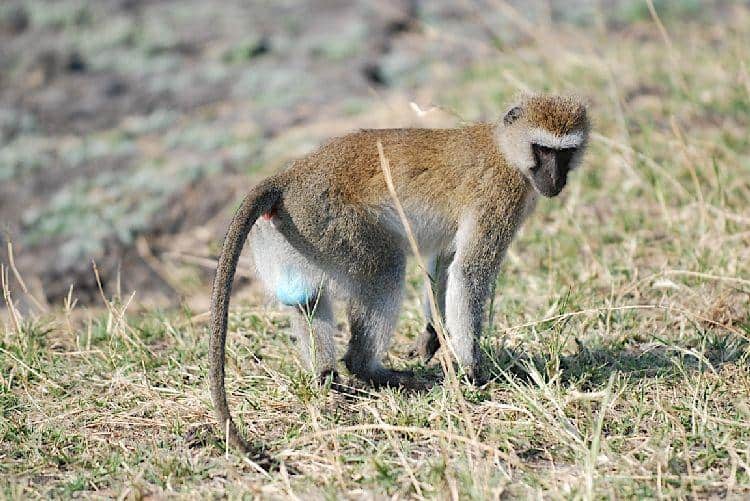
A Vervet Monkey in Katavi National Park, Tanzania.
This monkey doesn’t exactly have a blue bottom, but it does have another private part that’s blue. Males of this species have a blue scrotum. Their colorful nether regions turn pale blue, turquoise, or white in adulthood. Primatologists also believe this feature helps to attract females.
Vervet monkeys are an Old World monkey species native to Africa. Another name for this species is the green monkey due to the greenish-colored fur on its back. This monkey species inhabits woodlands, savannahs, and forests.
Red-Butt Monkeys
Like many monkeys with blue butts, monkeys with red butts extends across sexes. However, the extreme red swelling is especially prominent in females during estrus. Also, monkeys with red butts are relatively common like monkeys with blue butts. But, again, the reason seems closely tied to mating. Females use their red butts to signal males when they’re in heat and ready to mate. Let’s check out some red-butt monkeys.
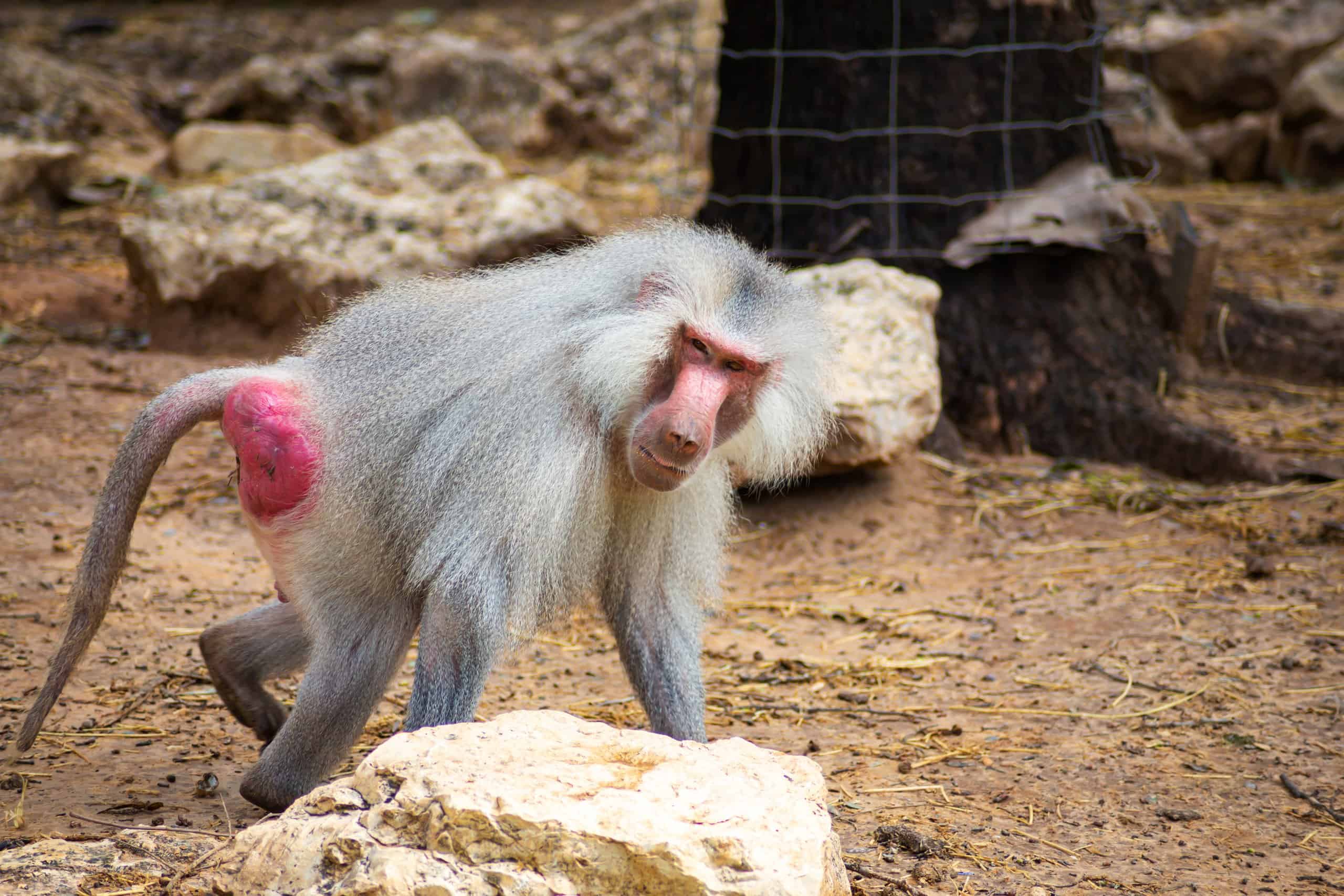
Baboons
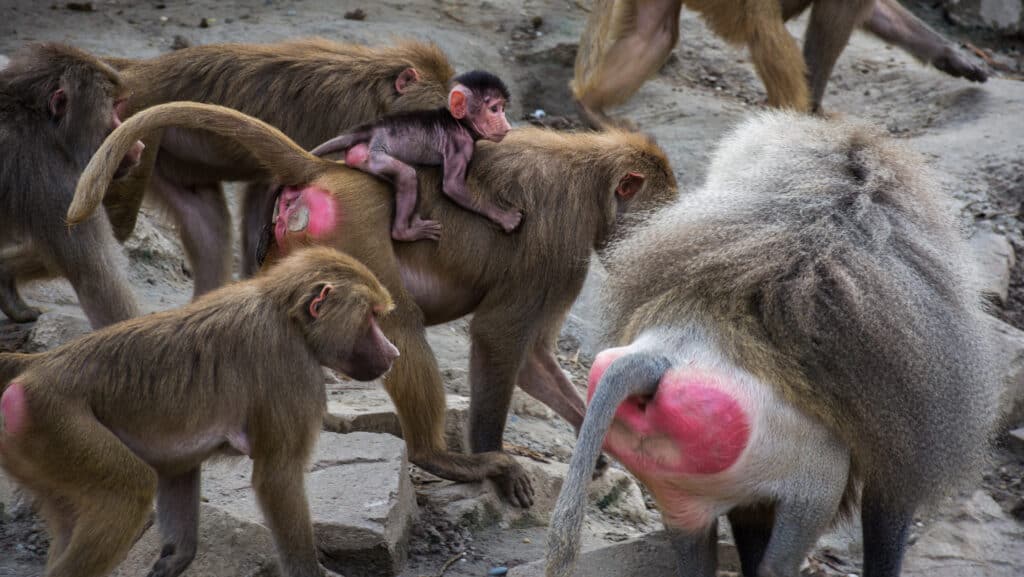
Male baboons have red butts that primatologists believe reflect sexual maturity/dominance.
©Nik Bruining/Shutterstock.com
Baboons are one of the most popular species of monkeys. They are easily recognizable by their long, dog-like snouts and thick fur. But one of the most distinguishing baboon features is their bright red bottoms. So why do baboons have red backsides? The swelling and color are signals of fertility in females, while the signature color reflects sexual maturity and dominance in males.
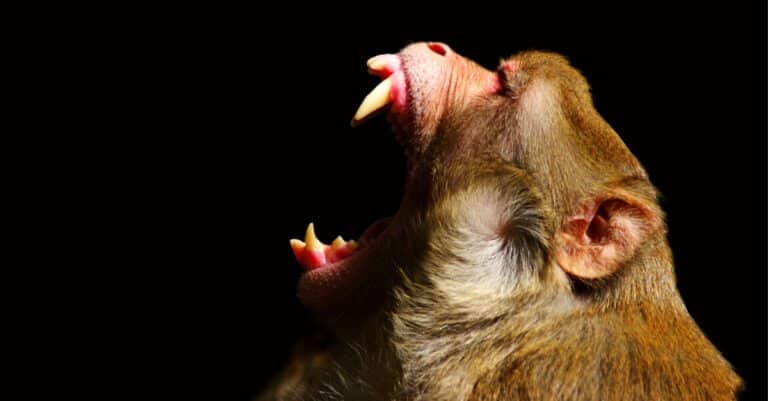
Rhesus Macaques
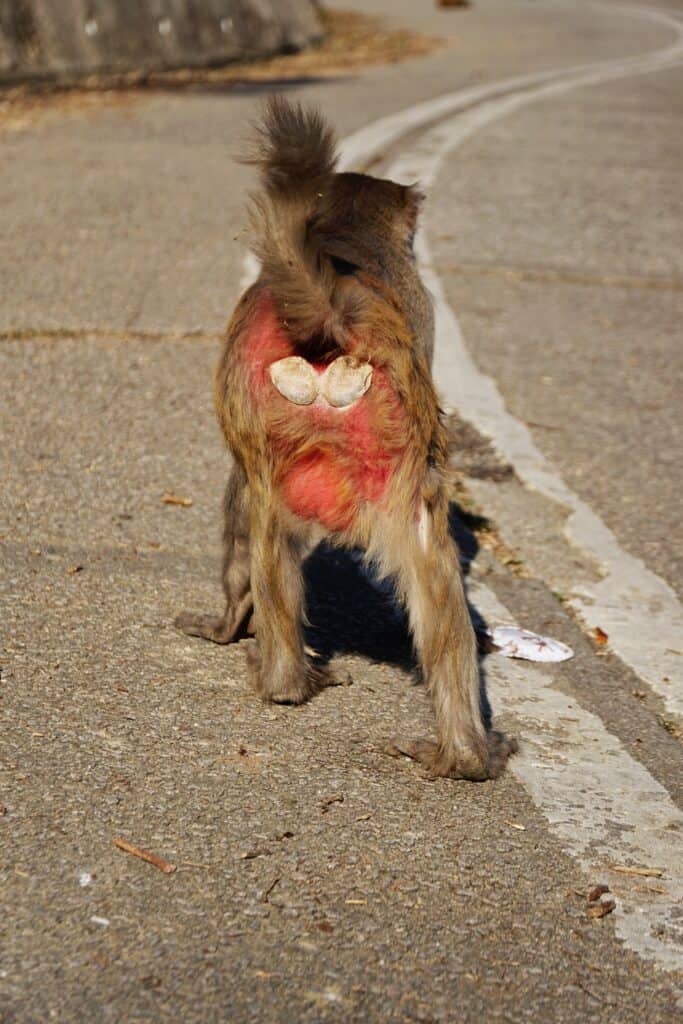
Female Rhesus Macaques with the reddest butts are most likely to attract mates.
©iStock.com/Yoyochow23
The Rhesus Macaque is a species of Old World monkey native to Asia. These monkeys have distinctive reddish-brown fur and long tails, are social and live in groups of up to 30 individuals. While males do not feature red bottoms, females show genital swelling and reddening during estrus. Females reach sexual maturity at around three years, while males reach maturity at approximately four years. Rhesus macaques typically mate during the summer months. After a gestation period of 155 days, the female will give birth to a single infant. Females’ vivid red bottoms during their most fertile time are essential to mate choice. Studies show that females with redder bottoms are more likely to acquire a mate.
Celebes Crested Macaque
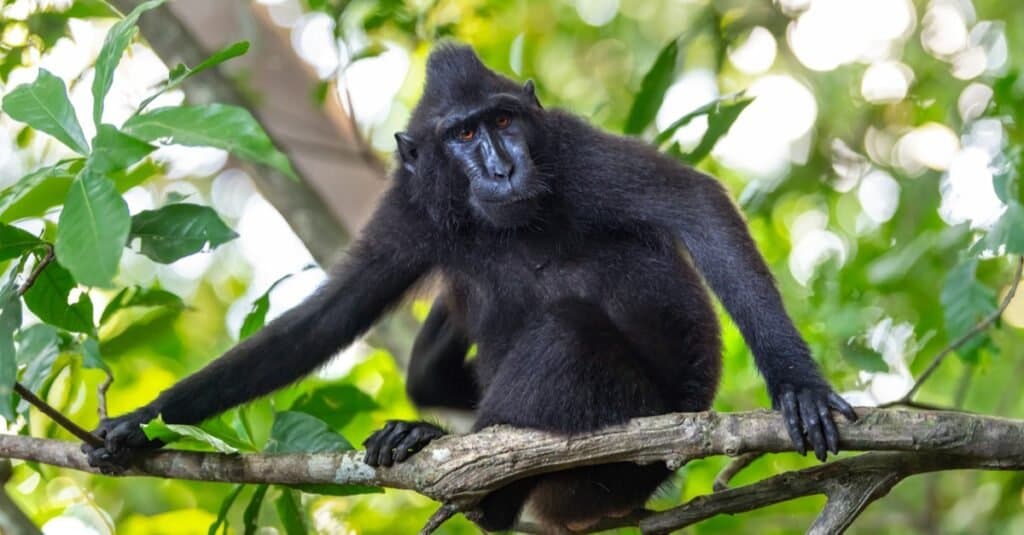
©Sergey Uryadnikov/Shutterstock.com
The Celebes crested macaque is a species of monkey that is found primarily in Indonesia. These monkeys are relatively large and have very short tails. Like Rhesus Macaques, it is only the female that displays a red bottom, and only during estrus. During the mating season, the backsides of female Celebes crested macaques swell enormously. However, when not in heat, female Celebes crested macaques’ butts lose their red coloration.