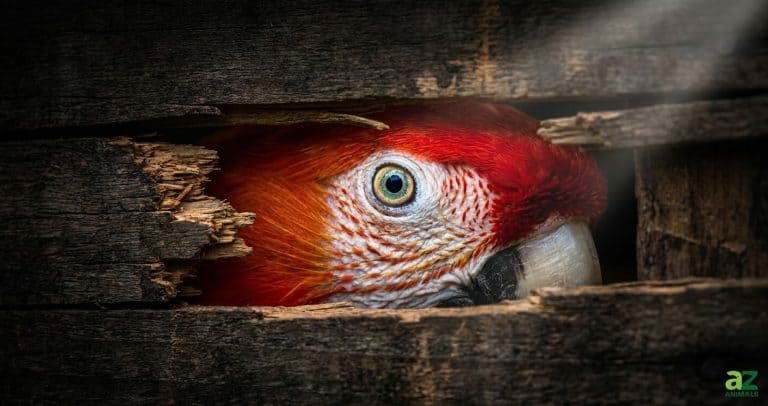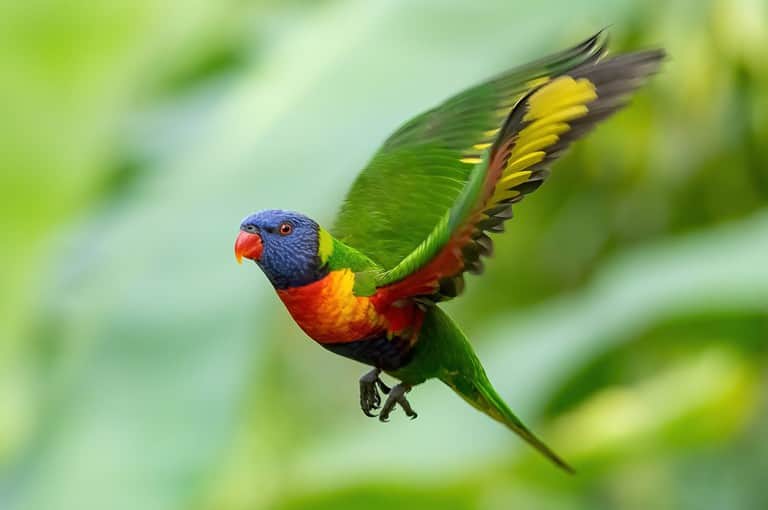

With their bright colors, intelligence, and remarkable ability to mimic human speech, parrots are among the most popular birds. There are more than 400 species worldwide, broken up into three superfamilies: “true parrots” (Psittacoidea), cockatoos (Cacatuoidea), and New Zealand parrots (Strigopoidea). They can be found throughout tropical and subtropical climates, primarily in the Southern Hemisphere. Their lifespan is one of the longest of any bird species, with some parrot species living longer than 60 years.
From the tiny pygmy parrots of Papua New Guinea to the giant macaws of South America, parrots come in all sizes. However, which species of parrot is the largest? To answer this question, we consider both their length and weight, with weight as the final determining factor. In this list, we rank 10 of the largest parrots on Earth.
#10: Yellow-Tailed Black Cockatoo
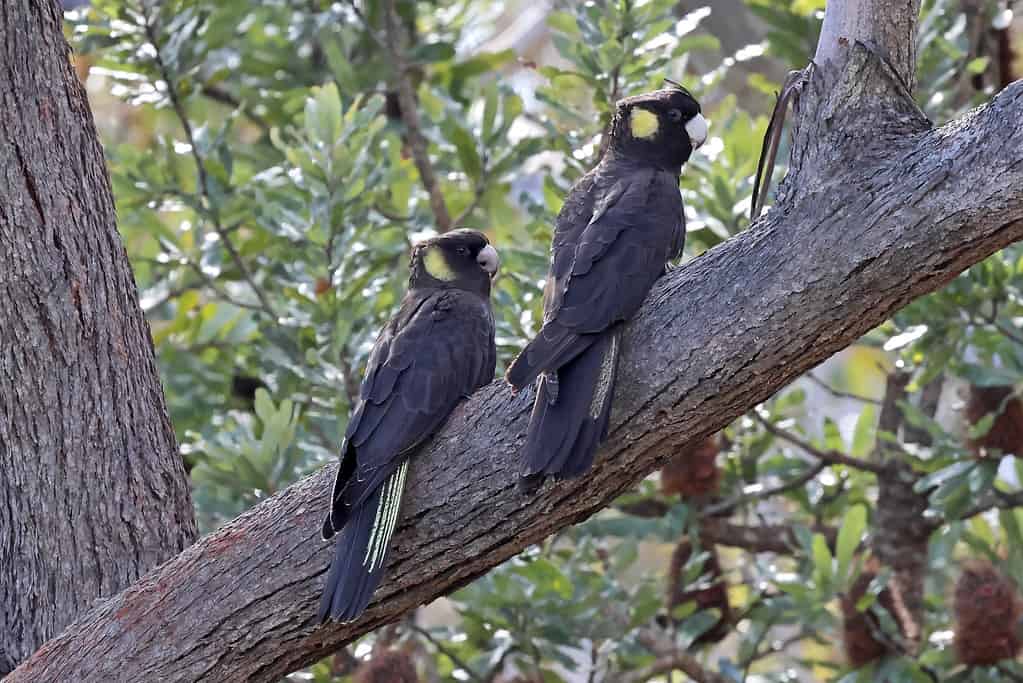
The yellow-tailed black cockatoo can be distinguished by its bright yellow cheeks.
©Ken Griffiths/iStock via Getty Images
Originally known as the funereal cockatoo, the yellow-tailed black cockatoo (Zanda funerea) can measure between 22-26 inches long and weigh up to 1.9 pounds. Its plumage is primarily brownish-black with pale yellow bands in the tail feathers, neck, nape, and wings. They also have bright yellow cheeks. You can hear their loud, varied calls from long distances, which helps distinguish them from other species of black cockatoos.
Yellow-tailed black cockatoos are located throughout southeastern Australia, including Tasmania, the Bass Strait Islands, and Kangaroo Island. They tend to live in temperate forests but will also take up residence in pine plantations and urban areas where food is plentiful. Their diet includes seeds, nectar, insect larvae, and pine cones. Although the IUCN lists the yellow-tailed black cockatoo as a species of Least Concern, their numbers continue to decrease due to habitat loss.
#9: Scarlet Macaw
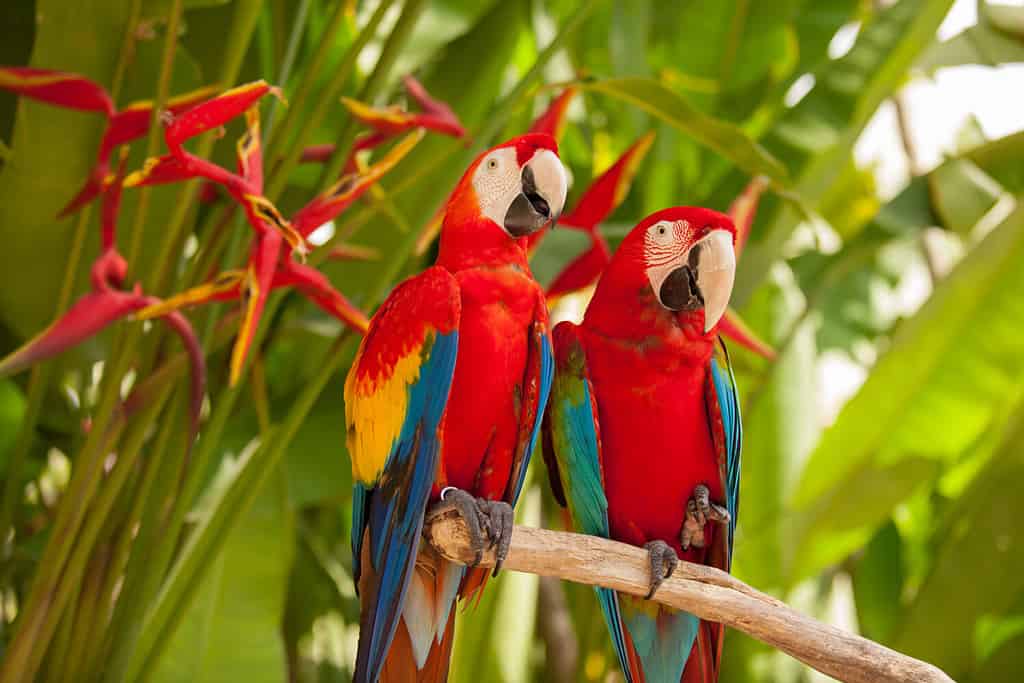
The scarlet macaw is the national bird of Honduras.
©Katia Titova/Shutterstock.com
The scarlet macaw (Ara macao) is a large species of macaw from Central and South America. They can reach up to 32 inches in length and weigh nearly 2.2 pounds at their heaviest. Their name comes from their striking red, blue, and yellow plumage. This distinguishes them from other macaw species and makes them one of the most popular exotic birds in aviculture. Honduras recognizes the scarlet macaw as its national bird.
Scarlet macaws are distributed from southeastern Mexico to the Peruvian Amazon, Ecuador, Colombia, Bolivia, Venezuela, and Brazil. They make loud, throaty squawks that carry for miles in every direction. Although commonly sighted alone or in pairs, they will occasionally travel in flocks. Their diet consists of fruits, seeds, nuts, flowers, and nectar. Although their population is in decline across several regions, the IUCN lists the scarlet macaw as a species of Least Concern due to its wide range and relatively large overall population.
#8: Blue-Throated Macaw
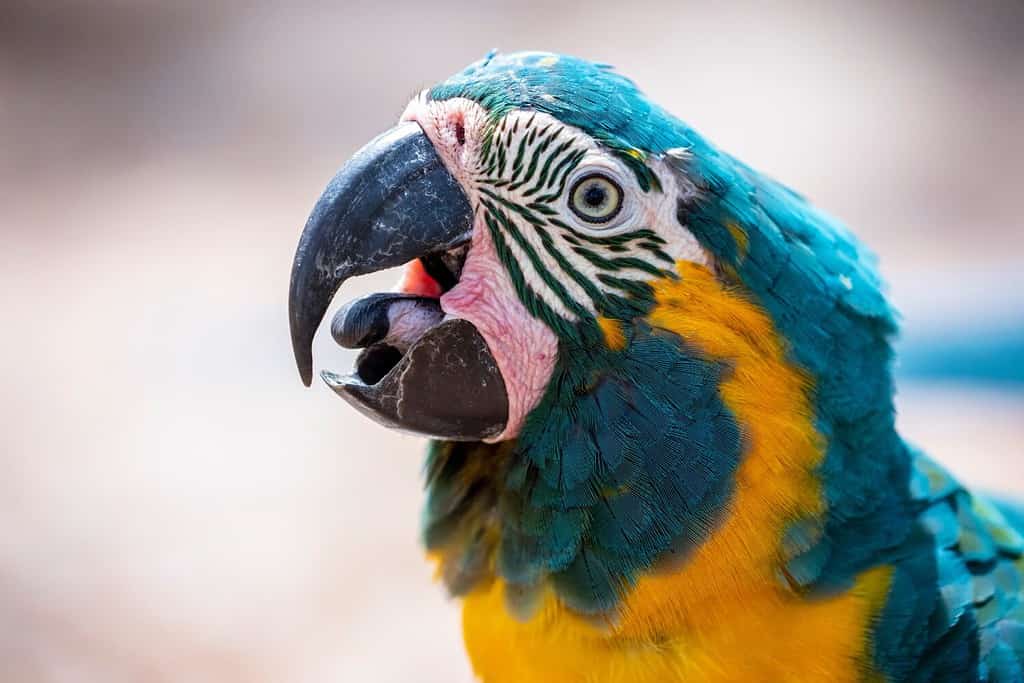
Blue-throated macaws are one of the rarest parrot species.
©Danny Ye/Shutterstock.com
The blue-throated macaw (Ara glaucogularis) is also known as Wagler’s macaw after the German herpetologist Johann Georg Wagler, who first described the bird to European readers. They can grow 33 inches long and weigh between 2-2.5 pounds. Their upper plumage appears turquoise-blue, while their bellies generally appear bright yellow. In addition, they sport a blue patch along their necks, which is where they get their name “blue beard” in Spanish.
Blue-throated macaws live only in the Llano de Moxos region of Bolivia. Unlike most parrot species, they do not live in forests, instead choosing to nest in islands of palm trees. While most blue-throated macaws live in monogamous pairs, they occasionally occur in groups of 7-9 individuals. They subsist primarily on palm tree fruit, although they will also eat seeds and nuts if no fruit is available. Blue-throated macaws are one of the rarest parrot species, as only around 400 still exist in the wild. The IUCN lists them as a Critically Endangered species.
#7: Military Macaw
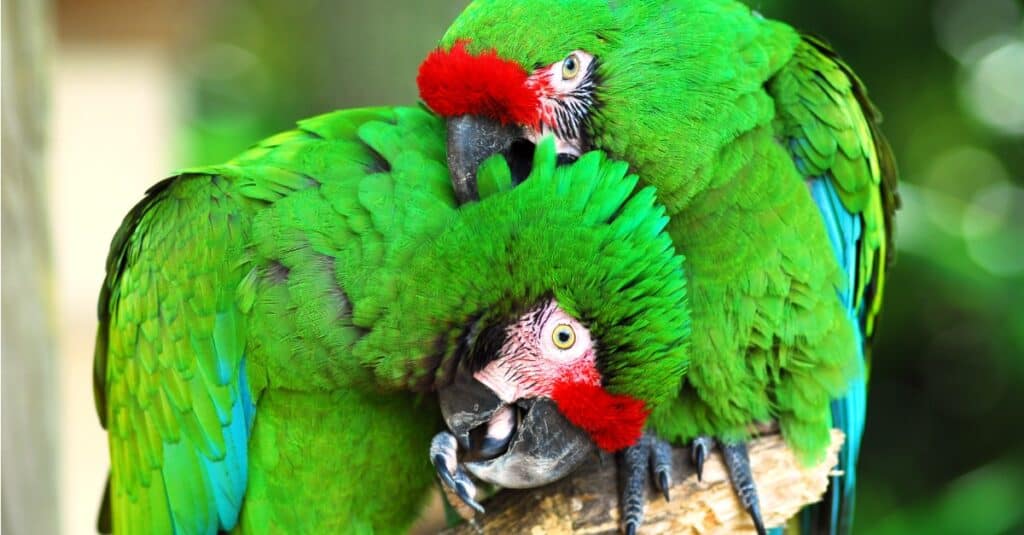
Military macaws are now listed as Vulnerable due to decreasing numbers.
©iStock.com/Musat
The military macaw (Ara militaris) is a large parrot native to Mexico and parts of South America. They generally measure between 27.5 and 33.5 inches long and weigh around 2.5 pounds. Their name comes from their predominantly green plumage, which resembles a military uniform. Although they appear similar to great green macaws, they are not quite as large, and their bills are black instead of white.
Military macaws inhabit deciduous and semi-deciduous forests in limited regions of Bolivia, Peru, Ecuador, Colombia, Venezuela, southern Mexico, and Argentina. Their diet consists primarily of seeds, but they will also feed on fruits and leaves. In addition, they will visit clay deposits known as “macaw licks” to detoxify the poisons in the seeds and vegetables they eat. Estimates suggest there are between 2,000 and 10,000 military macaws in the wild, although many live as pets. Due to their decreasing number, the IUCN lists them as a Vulnerable species.
#6: Palm Cockatoo
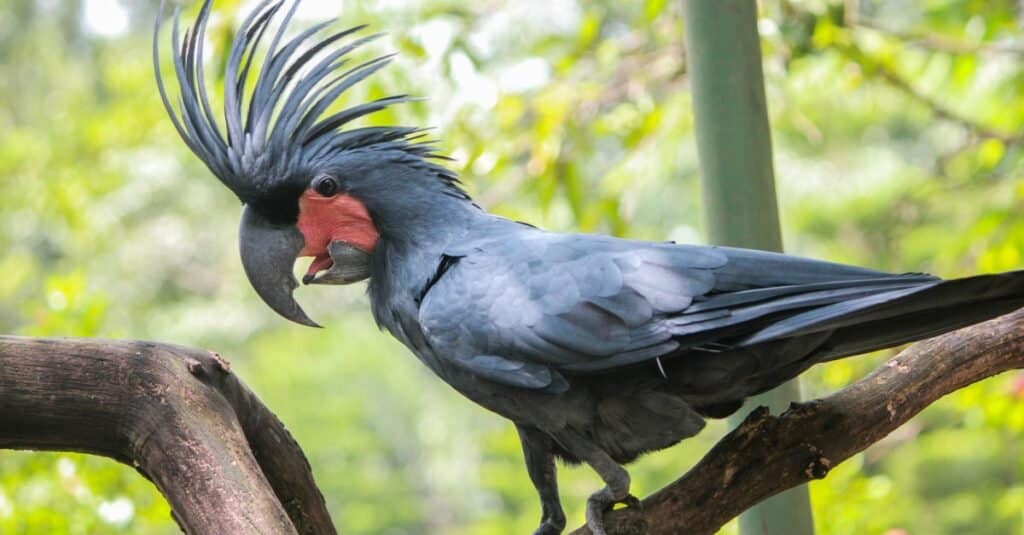
Palm cockatoos have a distinctive appearance with their huge bills and elaborate crests.
©BangKod001/Shutterstock.com
Also known as the Goliath cockatoo or great cockatoo, the palm cockatoo (Probosciger aterrimus) is the largest parrot in Australia and the largest cockatoo in the world. While not quite as long as some cockatoo or macaw species, palm cockatoos weigh more than their longer cousins. They measure between 22-24 inches long and weigh up to 2.6 pounds. Their grey-black plumage is broken only by prominent red patches located under their eyes. They also possess huge bills, which are surpassed only by the bill of the hyacinth macaw.
Palm cockatoos occur in northeastern Australia, New Guinea, Sorong, West Papua, and Indonesia. Their diet consists of nuts from the kanari tree and fruit from the andanus palm, which is where they get their name. They participate in unique territorial displays, where a male will break off a large branch and bite off pieces until it is the right size. Then they will use it to drum against a tree. This makes them one of the few species of bird known to make tools. Although listed as Near Threatened by the IUCN, populations of palm cockatoos face threats from habitat destruction and hunting.
#5: Great Green Macaw
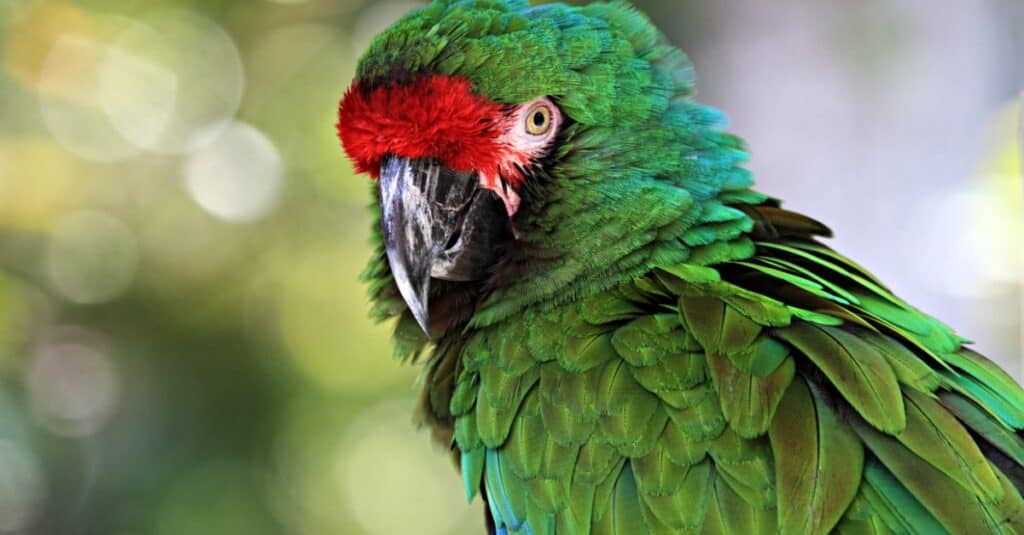
One population of great green macaws lives and breeds in Costa Rica.
©iStock.com/Eva2k0
Also known as Buffon’s macaw or the great military macaw, the great green macaw (Ara ambiguous) is a large parrot native to Central and South America. They typically measure between 33.5 and 35.5 inches long and weigh up to 2.9 pounds. While they appear similar to the military macaw, their plumage is a lighter green color, and their beaks are white instead of black.
Great green macaws range from Honduras to Panama, Colombia, and western Ecuador. In addition, there is a population that lives and breeds in Costa Rica. They prefer to live in tropical forests or evergreen forests, depending on the region. Their diet includes a wide variety of foods such as seeds, nuts, fruits, flowers, bulbs, roots, and tree bark. The total population of great green macaws that live in the wild is estimated at about 500-1,000 mature individuals. Due to its limited population and threats of habitat destruction and the pet trade, the IUCN lists the great green macaw as a Critically Endangered species.
#4: Blue-and-Yellow Macaw
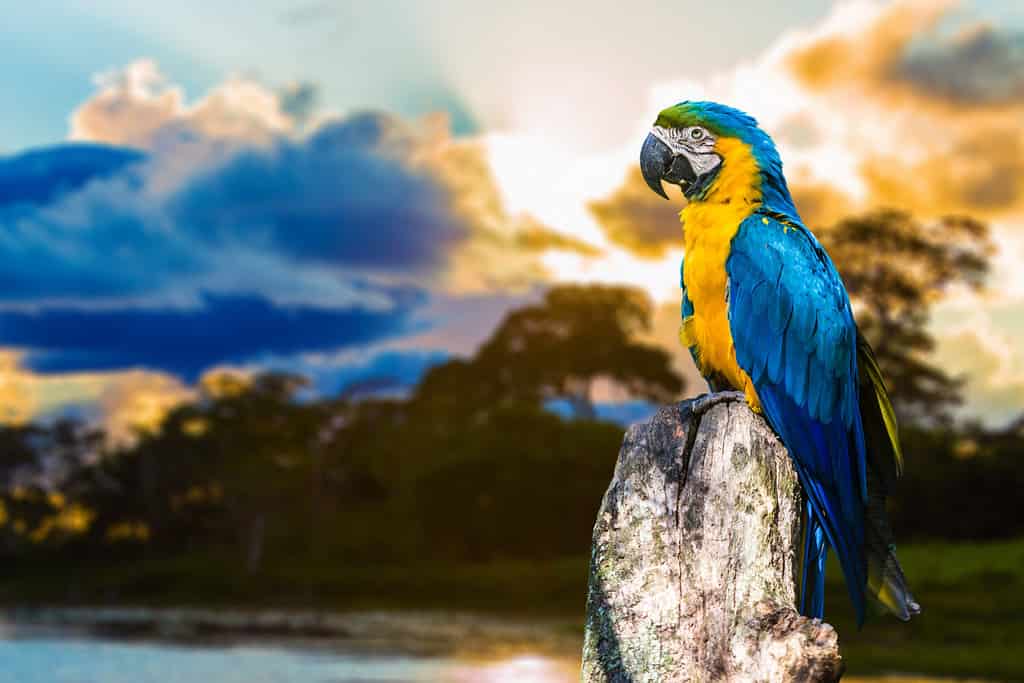
Blue-and-yellow macaws may live up to 70 years in captivity.
©ESB Professional/Shutterstock.com
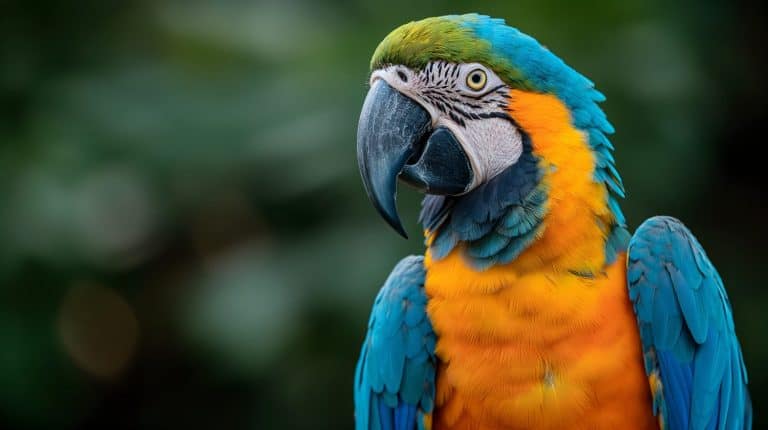
The blue-and-yellow macaw (Ara ararauna) is also known as the blue-and-gold macaw. While they measure slightly smaller than great green macaws at 30-34 inches long, they may weigh slightly more, reaching up to 3 pounds maximum. Their radiant plumage is bright blue on top, while their bellies appear light orange. They possess a powerful beak which they use to break up nutshells, as well as climb and hang from trees.
Blue-and-yellow macaws occur throughout Colombia, Venezuela, Brazil, Ecuador, Peru, and Paraguay. In the wild, they tend to live in forests, woodlands, and tropical savannas. They may live as long as 70 years in captivity and possess remarkable mimicry abilities that allow them to “talk.” These factors, along with their brilliant colors, make them popular pets. They are one of the more common parrot species, with an estimated wild population above 10,000 individuals. Although their numbers are decreasing, the IUCN currently lists them as a species of Least Concern.
#3: Red-and-Green Macaw
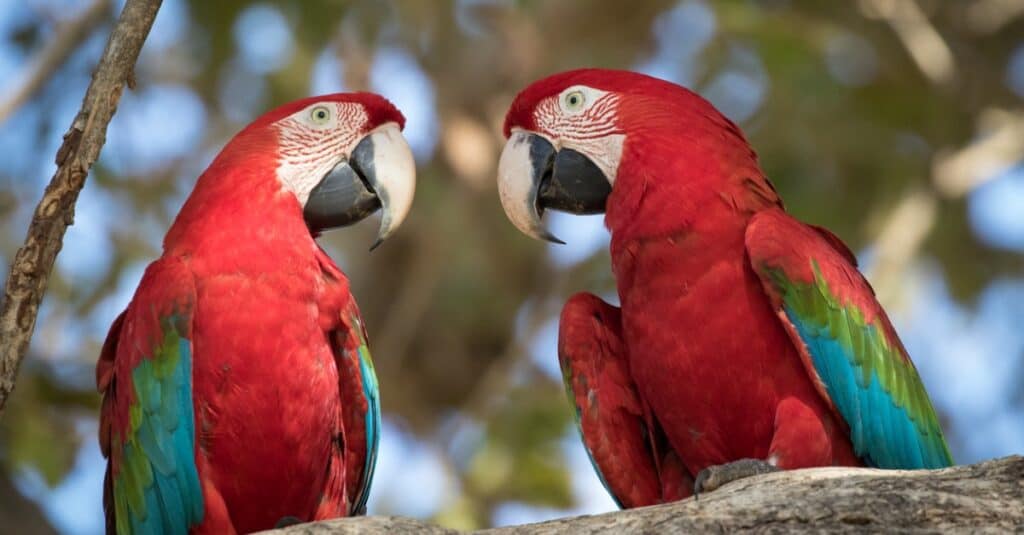
The red-and-green macaw mates for life.
©iStock.com/Pedro Ferreira do Amaral
The red-and-green macaw (Ara chloropterus), or green-winged macaw, is the largest macaw species in the genus Ara. They range from 35 to 37 inches in length and can weigh anywhere from 2.3 to 3.7 pounds. Their plumage is primarily red, but their wings also include shades of green and blue, which is where they get their name. They are one of the most recognizable macaw species, thanks to their striking appearance and wide distribution.
Red-and-green macaws are found throughout Brazil, Colombia, Bolivia, Ecuador, Peru, and Paraguay. They tend to nest in forests and woodlands, where they mate for life. The number of red-and-green macaws in the wild is in decline due to hunting, habitat loss, and illegal capture for the pet trade. However, at this time, the IUCN lists the red-and-green macaw as a species of Least Concern.
#2: Hyacinth Macaw
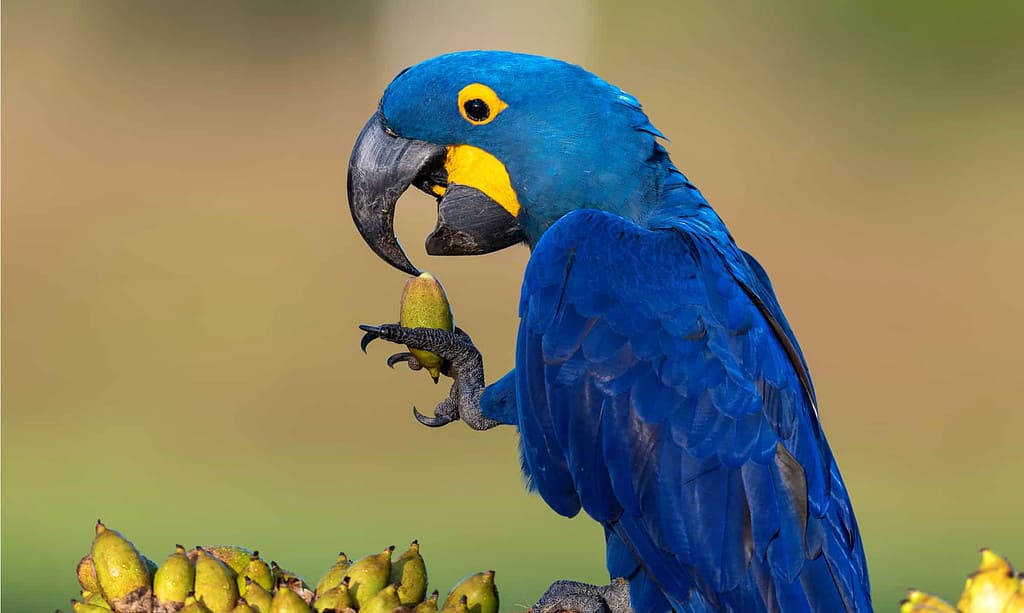
Hyacinth macaws have been observed using tools to open nuts.
©Reto Buehler/Shutterstock.com
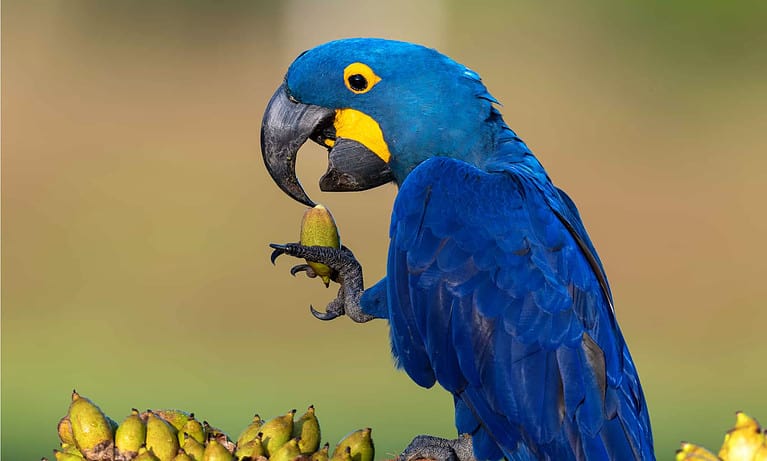
The hyacinth macaw (Anodorhynchus hyacinthinus) is the largest macaw in the world and the largest flying parrot species. They measure up to 39 inches long and weigh anywhere from 2.3 to 3.7 pounds. While similar in appearance to Lear’s macaw, hyacinth macaws are much larger. Their feathers are bright blue, with the only exceptions being a splash of yellow around their eyes and just underneath the beak.
Hyacinth macaws live in Brazil, eastern Bolivia, and northeastern Paraguay. They prefer to reside in palm swamps and woodlands and tend to avoid dense, humid forests. Their diet includes Brazil nuts, native palms, and fruits. There is some evidence that they use tools to help them break open harder nuts. Due to the pet trade and habitat loss, the IUCN lists the hyacinth macaw as a Vulnerable species.
#1: Kākāpō
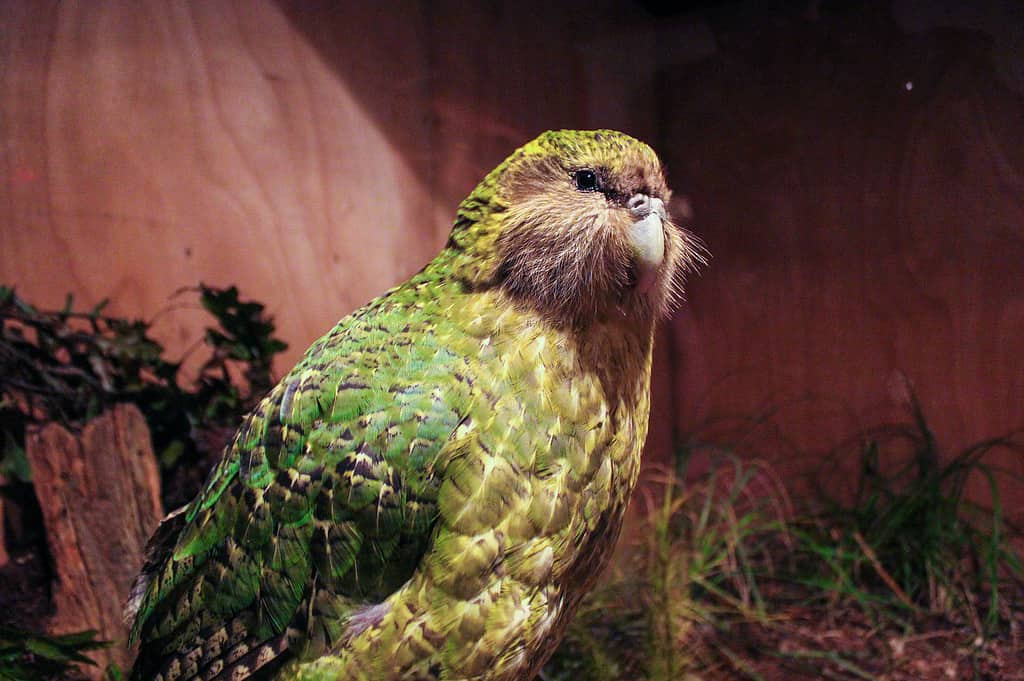
The kākāpō is unable to fly due to its large size.
©Imogen Warren/Shutterstock.com
The kākāpō, also known as the owl parrot, is the largest parrot in the world. In the Maori language, their name translates to “night parrot,” a name they earned because kākāpōs are nocturnal. The kākāpō (Strigos habroptilus) is part of the Strigopinae subfamily of parrots endemic to New Zealand. Although they only measure between 23 to 25 inches long, they are the heaviest parrot in the world. Individuals typically weigh between 3.3 and 9 pounds, making them the most massive parrot species by far.
Due to their size, kākāpōs are unable to fly and spend their entire lives on the ground. They are covered in mottled yellowish-green feathers, which allows them to blend in well with vegetation on the forest floor. Their diet consists of leaves, seeds, fruits, and nuts.
After the British colonized New Zealand and introduced predators such as stoats, ferrets, and weasels to the islands, the native kākāpō population almost wholly disappeared. Today, there are around 240 kākāpōs living on the predator-free islands of Codfish/Whenua Hou, Little Barrier/Hauturu, and Anchor, with each individual named and tagged. Due to the reduction in their numbers, the IUCN lists the kākāpō as a Critically Endangered species.