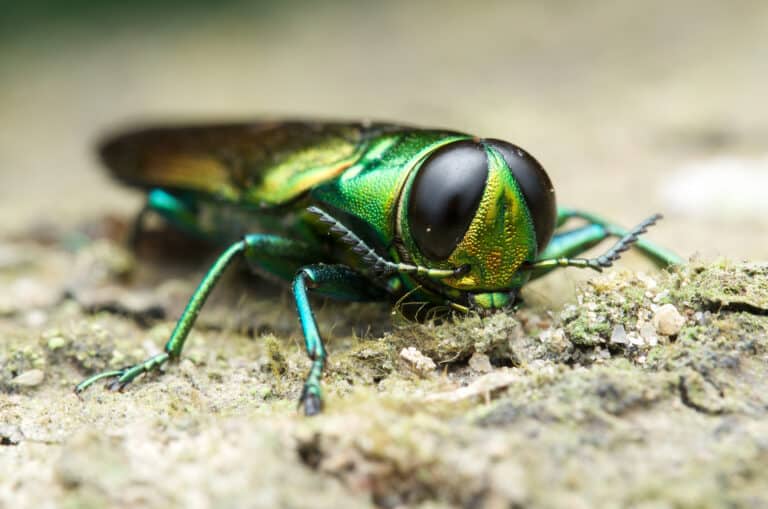

If you spend any time in the woods, you will begin to see that a vast number of trees are dying out. We have already lost the American chestnut and the elm tree. Currently, the emerald ash borer is killing off ash trees, and there is a fungus or parasite that kills mature beech trees. Hemlock is also being threatened by a parasite.
Our forests are in grave danger, and the spotted lanternfly is yet another invader contributing to the damage to our trees.
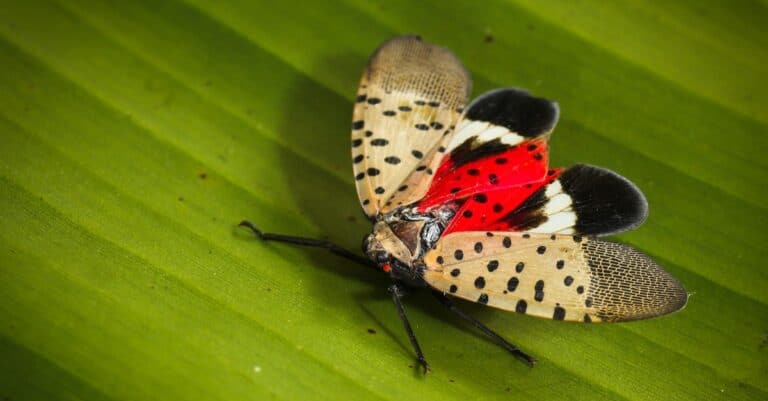
You may have seen these strange-looking insects in the eastern United States. Have you heard the call to destroy spotted lanternflies on sight? Have you wondered why this innocent-looking bug has such a bad reputation? Find the answers to these questions, and learn how to build the best type of spotted lanternfly trap.
Why Trap a Spotted Lanternfly?
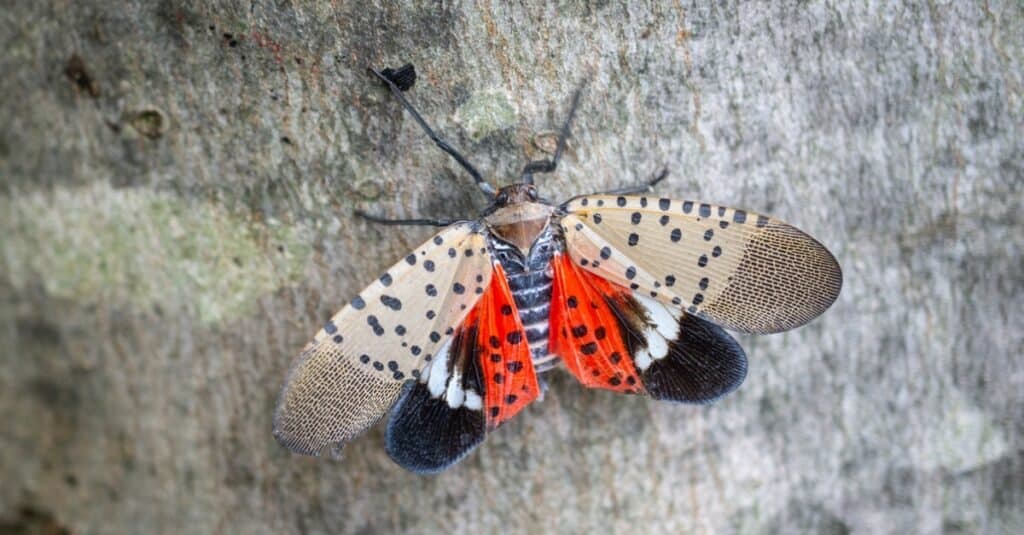
The spotted lanternfly has made headlines due to the significant damage it causes to crops.
©iStock.com/arlutz73
Spotted lanternflies can damage certain plants. This is especially problematic when trees or grapevines are cultivated for commercial use. In fact, it eats or lays eggs on nearly 200 North American plant species, including pine, apple, plum, cherry, and peach trees. Though they do not bite, groupings of insects can also be a nuisance to people.
Spotted lanternfly infestations can harm or kill plants. They eat sap from the trees, leaving wounds that can become infected. The sugary excrement of the nymphs can also encourage sooty mold to grow on the host plant. Grapevines attacked by these insects typically produce no fruit.
Some management systems employ insecticides to kill spotted lanternflies, but this poses an additional problem. Insecticides also kill beneficial bugs like bees and predatory insects that feed on pests. Using a trap is an effective way to reduce spotted lanternfly populations with minimal impact on other species.
How a Spotted Lanternfly Trap Works
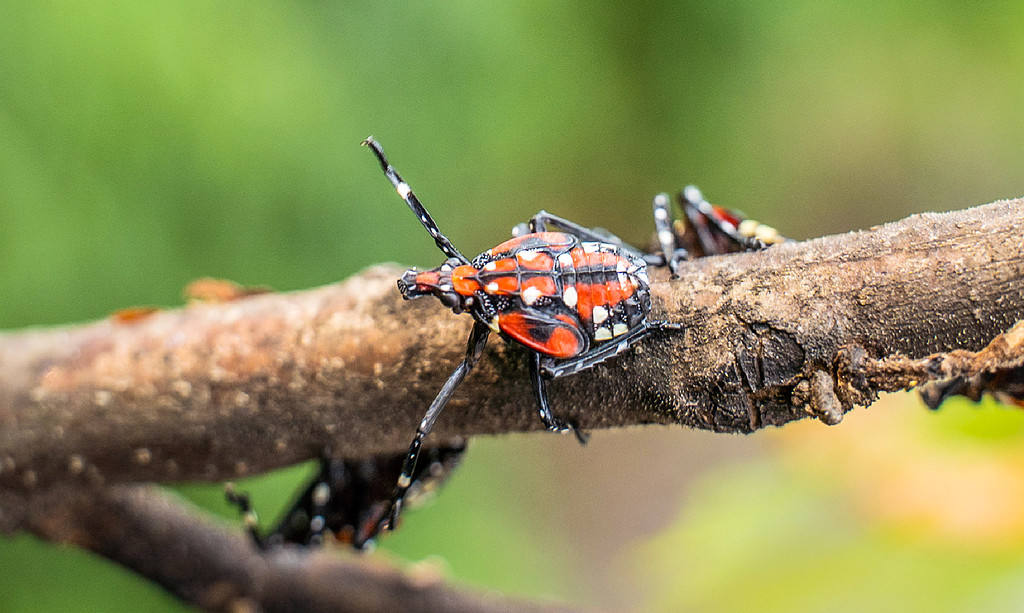
It’s fairly easy to identify spotted lanternfly nymphs.
©iStock.com/arlutz73
Immature lanternflies, known as nymphs, often feed in the tree canopy. If they are blown out by the wind, the still-flightless insects march up the trunks of trees to return to the upper branches. Several types of traps take advantage of this behavior by capturing nymphs on their upward climb.
One trap type is a sticky band placed horizontally around the tree trunk. This method is effective at halting the nymphs, but unfortunately, it can also capture other insects and even small reptiles and birds. A metal mesh can be placed around the band that allows the nymphs to pass through while keeping larger creatures out. This trap style is generally not recommended.
The second type of trap is known as a circle weevil trap. It is so named because it was originally designed to catch pecan weevils, which also walk up trees. Circle traps consist of a tunnel of insect screening that the insects walk into and a collection container that creates a dead-end. These types of traps can be purchased commercially, or you can easily make your own. It is considered the best option for trapping lanternflies.
Next, we’ll consider the materials needed and the steps involved in creating a lanternfly circle trap.
How to Build a Spotted Lanternfly Trap
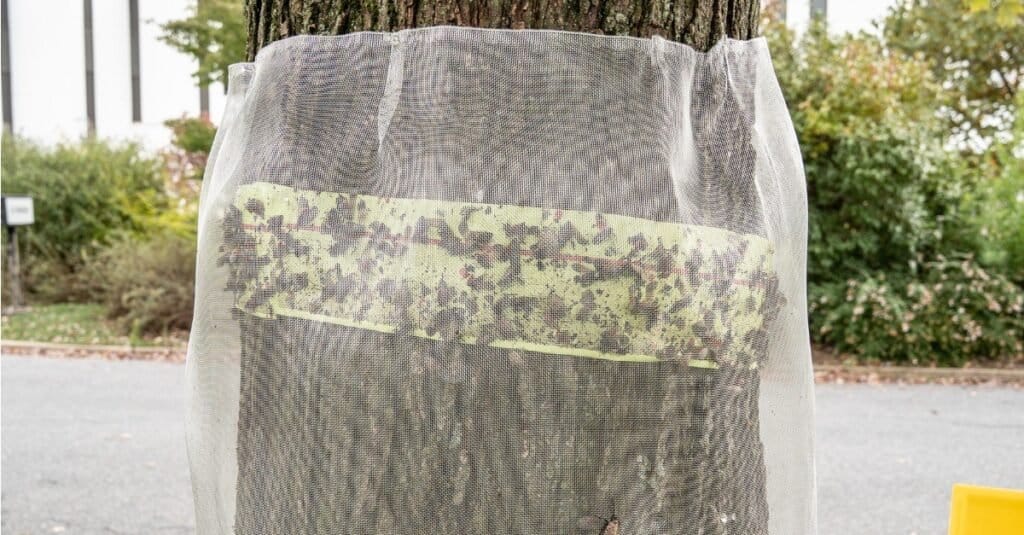
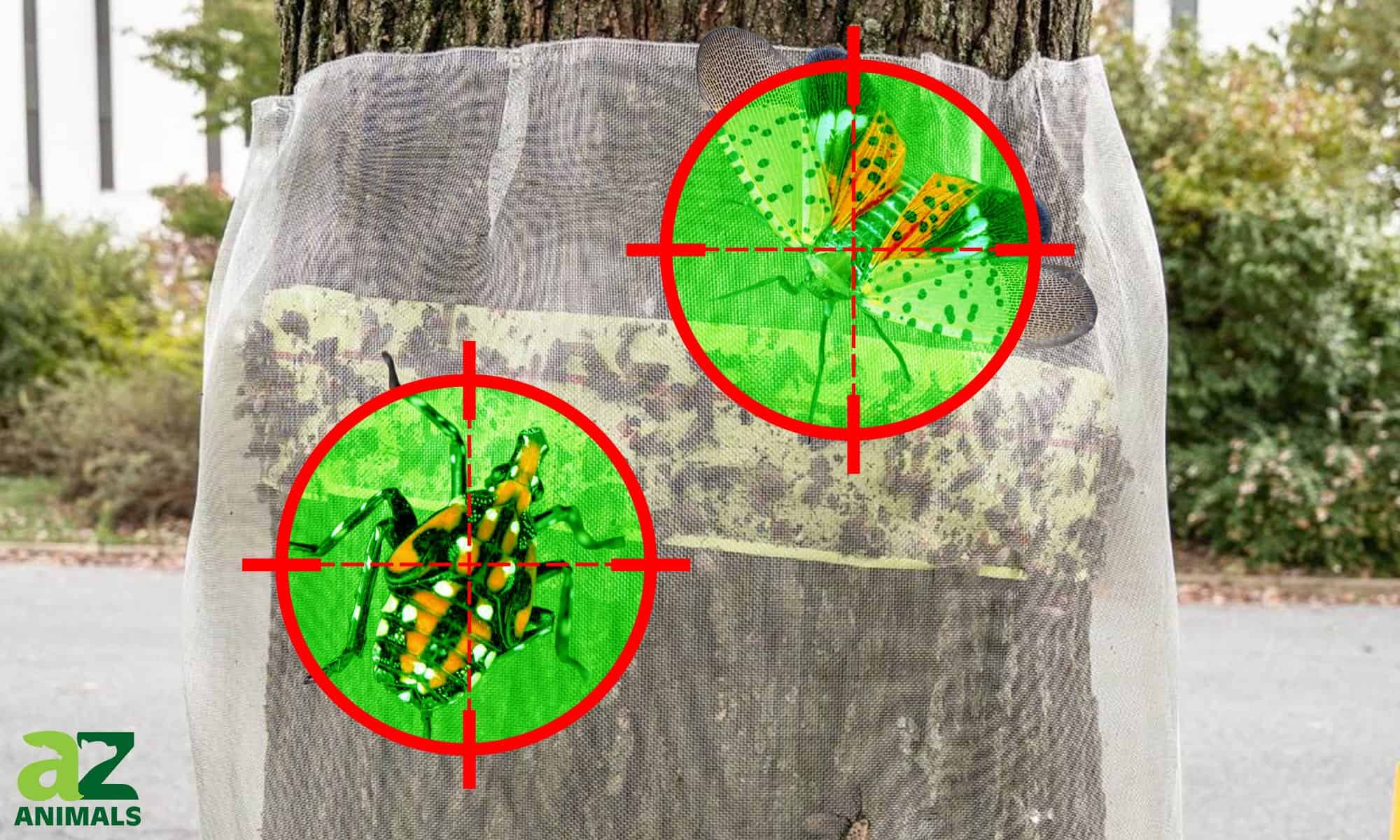
Sticky tape is used to trap lanternflies. This is covered in netting to prevent birds from getting harmed.
©iStock.com/arlutz73
Lanternfly traps can be purchased commercially, or you can build your own. Here’s what you’ll need for DIY.
Spotted Lanternfly Trap Materials: What You’ll Need to Build the Best Spotted Lanternfly Trap
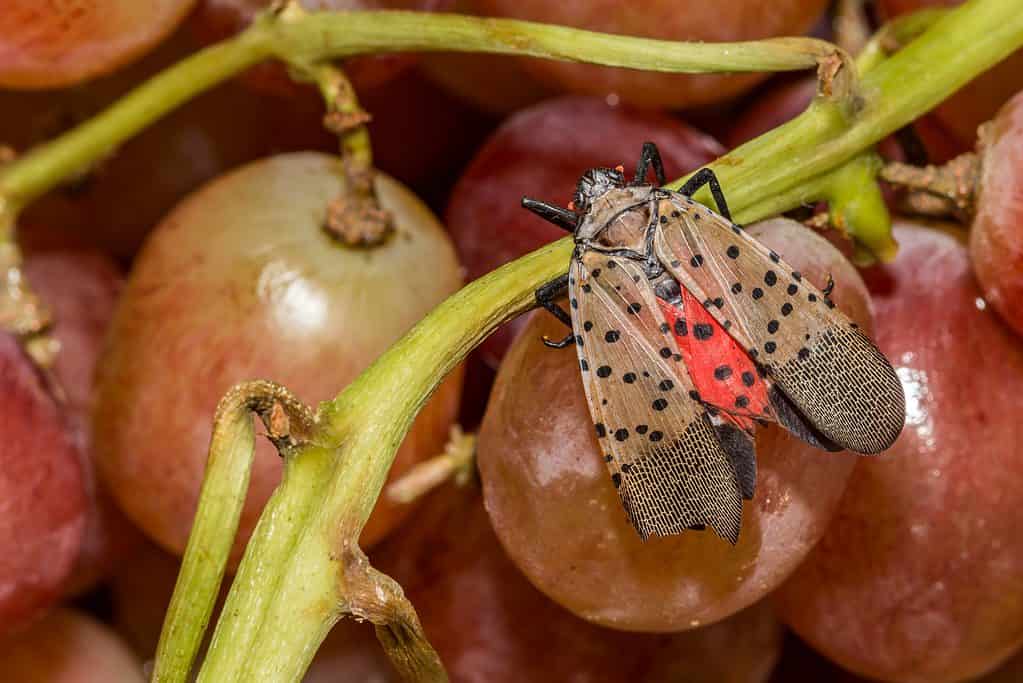
Don’t let spotted lanternflies destroy your garden and landscaping!
©Jay Ondreicka/Shutterstock.com
For the collection container, you can use a clean peanut butter or mayonnaise jar, or a large plastic Ziploc-style bag. The bag option makes for easier cleanup, as you can seal it and toss it, rather than emptying dead, stinky bugs from a jar into a trash receptacle. It also bends, allowing the captured insects to fall into a corner. This keeps the entryway of the trap from becoming clogged.
Make sure that the jar or bag you choose is clear and not tinted, as the insects tend to move upward, toward the light. Dirty or opaque containers will stifle this behavior.
You will also need a window screen, wood, wire, plastic milk jugs, duct tape, hot glue, staples, zip ties, and twine or a similar cord. The screen should be a rectangle around 2 to 3 ft. If placing your trap on a very large tree, you may need more. Some people report that a plastic-coated screen works better than a bare-wire screen. For the wood, you may use readily available materials, such as yardsticks or paint stirrers.
Step 1: Make a Funnel
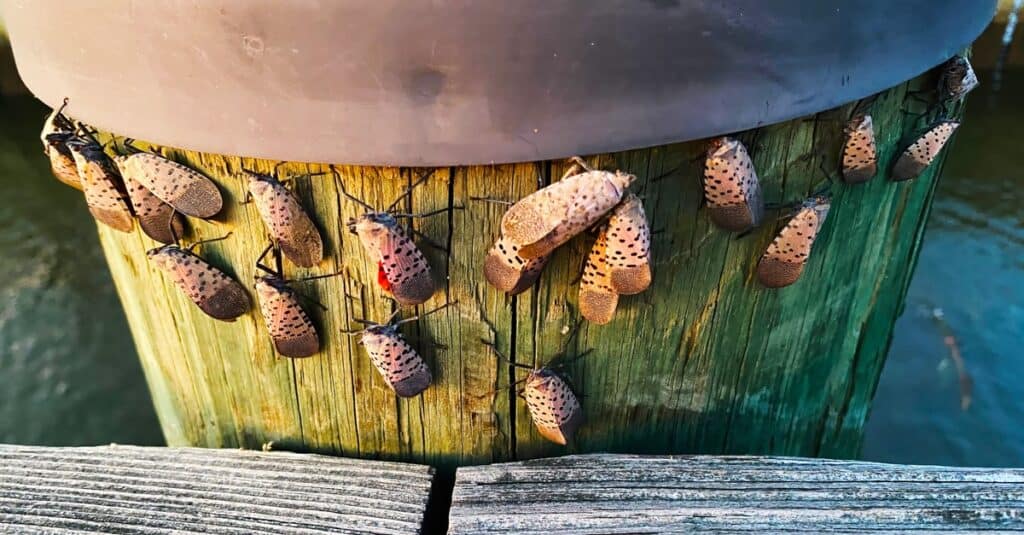
Spotted lanternflies gather together on trees and plants.
©iStock.com/BrianEKushner
Cut the tops from the plastic milk jugs and attach them to one another, with the spouts facing inward and the cut edges facing outward. Put a bead of hot glue around the joint and then secure it with duct tape. The result should be a double-sided funnel.
Step 2: Attach the Screen
Cut a small half-circle-shaped notch from the top edge of the window or insect screening. This semicircle should be about 1 inch long. Then, attach the screening to one opening of your funnel. Use the notch to work the material around until it covers the inside of the funnel and overlaps on the edges. Secure it with hot glue. Be patient — allow the glue to dry as you work. Then, attach it to the bottom edge of the funnel using hot glue.
Step 3: Build the Supports
Cut one piece of wood to a length of 18 inches. Staple it to the bottom of the funnel, within the mesh. Then, staple the mesh to the wood.
Draw the ends of the mesh together to create the “tunnel.” Secure the ends to a smaller piece of wood, about 12 inches in length.
Then, make a large “U” shape with the wire. Attach it to the bottom of the mesh, centering the shorter piece of wood above it and opposite the longer piece of wood. Depending on the wire, you might weave it through the mesh or secure it with staples.
Step 4: Set the Trap
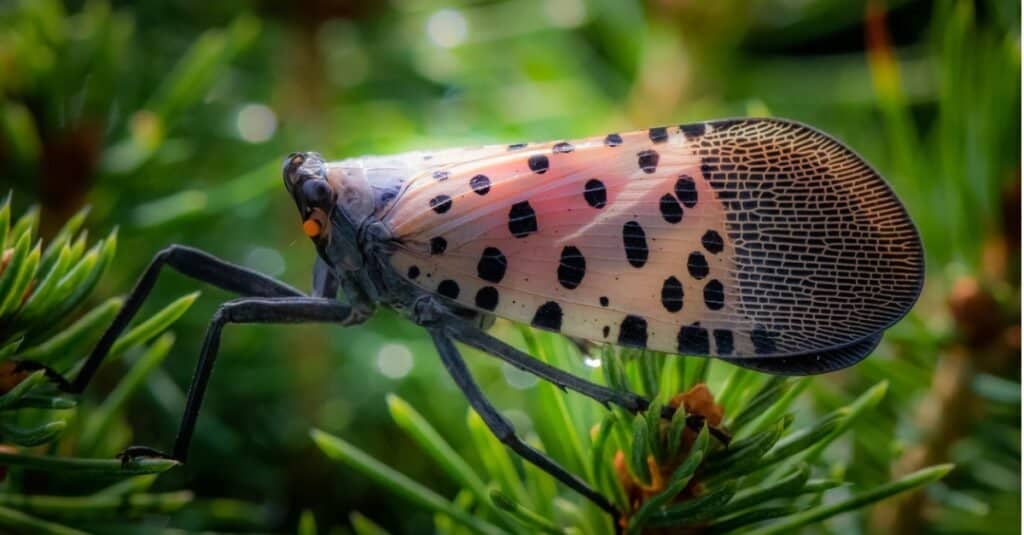
It’s easy to DIY a spotted lanternfly trap.
©cwieders/Shutterstock.com
Attach your trap to the tree. Tie the funnel of the trap to the tree using twine or cord. Avoid using nails or screws, as these will damage the tissue of the tree.
Secure the non-wired half of the screen to the trunk, with the longer piece of wood braced against the trunk. You can use cord or push pins to do this. The mesh should be flat against the tree so that the insects may crawl onto it and not under it.
Arrange the wire so that it pushes the side of the trap with the short piece of wood away from the tree, forming the tunnel.
Step 5: Assemble the Collection Container
Set up a collection container on the top of the funnel. If using a jar, deform the funnel so that it slides inside the mouth of the jar, then seal the opening with tape.
If using a plastic bag, slit one corner so that it will fit over the funnel. Cinch it tight using a zip tie. Make sure the zippered side is firmly closed.
Step 6: Check Your Trap
Remember to check and empty your trap often, even daily. Why? A full trap will become clogged and you will not catch any additional spotted lanternflies. Also, the dead insects will soon begin to rot and stink if the trap is not emptied.
Where Should I Place My Trap?
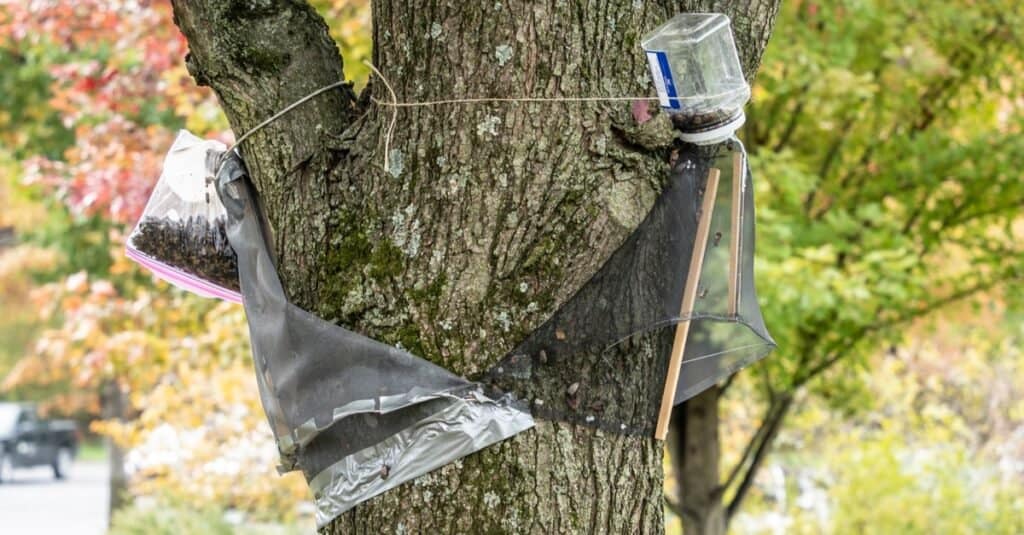
A completed spotted lanternfly trap should look something like this.
©iStock.com/arlutz73
You can attach the trap to any tree infested with spotted lanternflies. Walnut, willow, and tree of heaven are often hosts to these insects. Try to select trees with smooth bark. Trees with rough or deeply grooved bark are not good candidates, as the nymphs will walk through the bark furrows under the trap!
Do Spotted Lanternfly Traps Work?
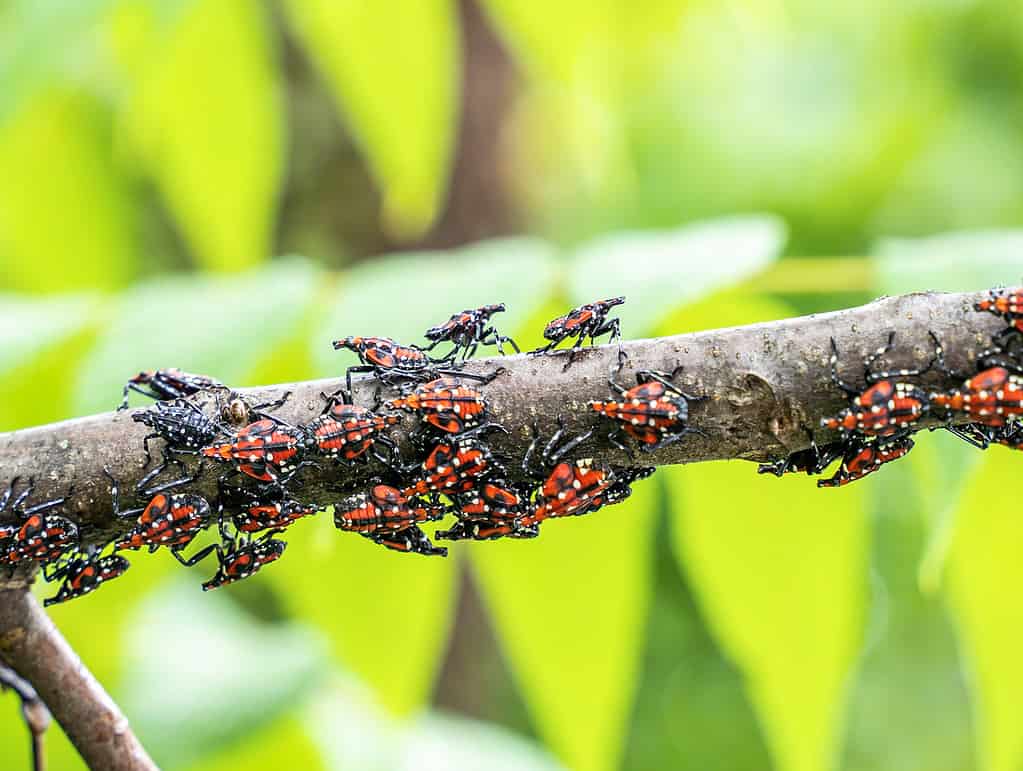
Black nymphs can be seen as early as April and up to July while red nymphs can be seen from July until September.
©iStock.com/arlutz73
The two most commonly used traps to catch spotted lantern flies are very effective, not only against adult flies but more specifically against the nymphs as they move up and down and between plants. However, the trap preferred is the circle trap as it can greatly reduce the chances of capturing other creatures. The circle trap acts like a tunnel that the lantern flies walk into and will end up in a collection container where they will be unable to escape, eventually dying.
It is recommended that trapping should be done on host trees that are used during the early season, where nymphs are commonly found in large quantities, although they can also be found on other plants, from raspberry and rose bushes to apple, oak, and pine trees. Black nymphs can be seen as early as April and up to July; Red nymphs can be seen from July until September and adults begin to appear as early as July. Traps are effective for both nymphs and adults as well, but as adults do not move up and down trees and plants as much, they aren’t as effective.