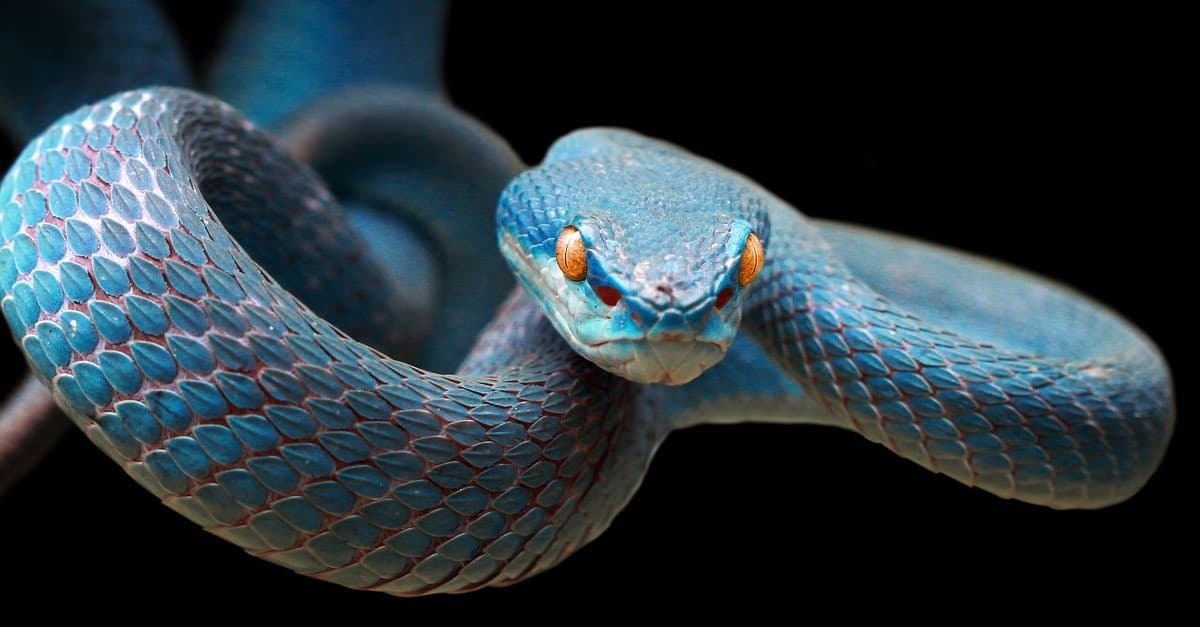

Quick Take
- One snake on this list is deadly enough to cause immediate paralysis, and yet its bite is completely painless. Meet the painless paralyzer →
- The rarest blue snake here isn't venomous at all, and its shocking color comes from something entirely unexpected. Discover the genetic blue rarity →
- One of these blue snakes lives where you'd least expect it: the same island famous for a very different kind of fearsome reptile. See the Komodo Island viper →
- Not all blue snakes are venomous killers. One giant on this list is so gentle it surprises even experts, despite reaching nearly 10 feet long. Meet the gentle giant →
Blue is a rare color for animals in the wild. In fact, it is one of the least common colors seen in the natural world. When blue does show up in nature, however, it always does so in a striking and beautiful way. Many snakes around the world display brilliant shades of blue, from the neon turquoise of the white-lipped island pit viper to the decorative patterns of the blue-striped garter Snake. Take a look at the beauty of these 13 blue snakes.
13. Blue-Lipped Sea Krait (Laticauda laticaudata)
The blue-lipped or blue-banded sea krait is an extremely venomous species of sea snake that lives in the western Pacific Ocean and Indian Ocean. This snake can grow between 3 and 3.5 feet in length, with uniform black banding along the length of its smooth blue body. The blue-lipped sea krait is semi-aquatic, returning to land to rest, mate, lay eggs, shed, and digest food. This snake often hunts along coral reefs and has a highly potent neurotoxic venom. However, it is non-aggressive and typically avoids humans.
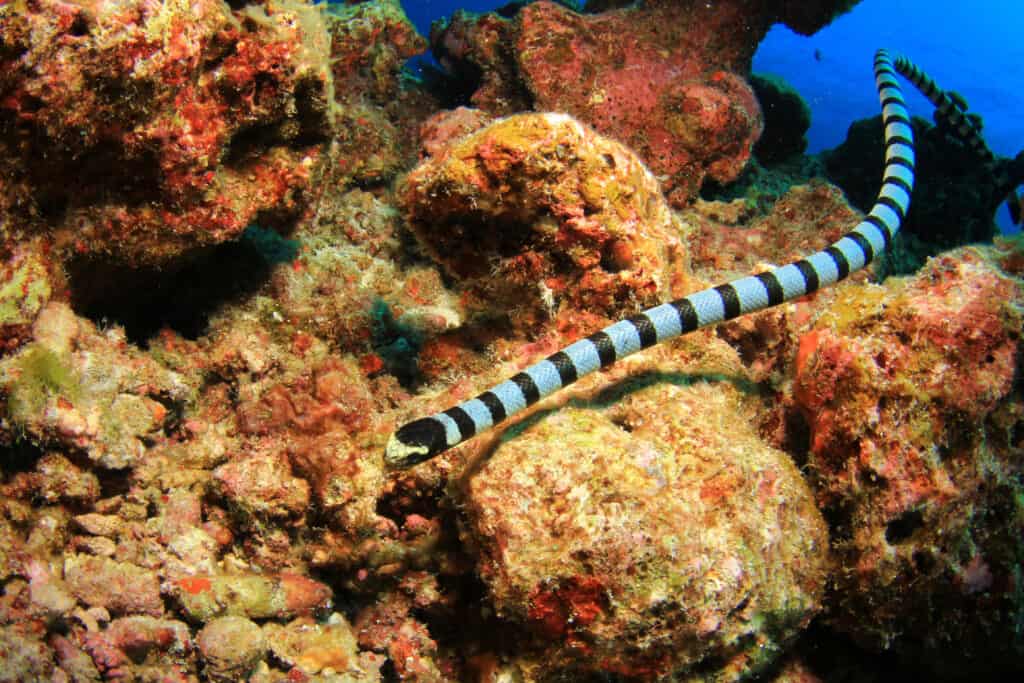
Blue-lipped sea kraits have tiny fangs so their bites are not painful, but they are deadly.
©Rich Carey/Shutterstock.com
12. Eyelash Viper (Bothriechis schlegelii)
The eyelash viper gets its name from the scales jutting out above its eyes, making it look like it has delicate eyelashes. This snake has many different color morphs, ranging from blue to green, brown, yellow, red, and pink. Some eyelash vipers may even have a combination of multiple colors, and some will also have dark speckling along their bodies as well. Eyelash vipers are arboreal and live in low elevation rainforests in Central and South America. These snakes are venomous and aggressive and will strike when threatened or harassed. They generally measure between 2 and 2.6 feet long.
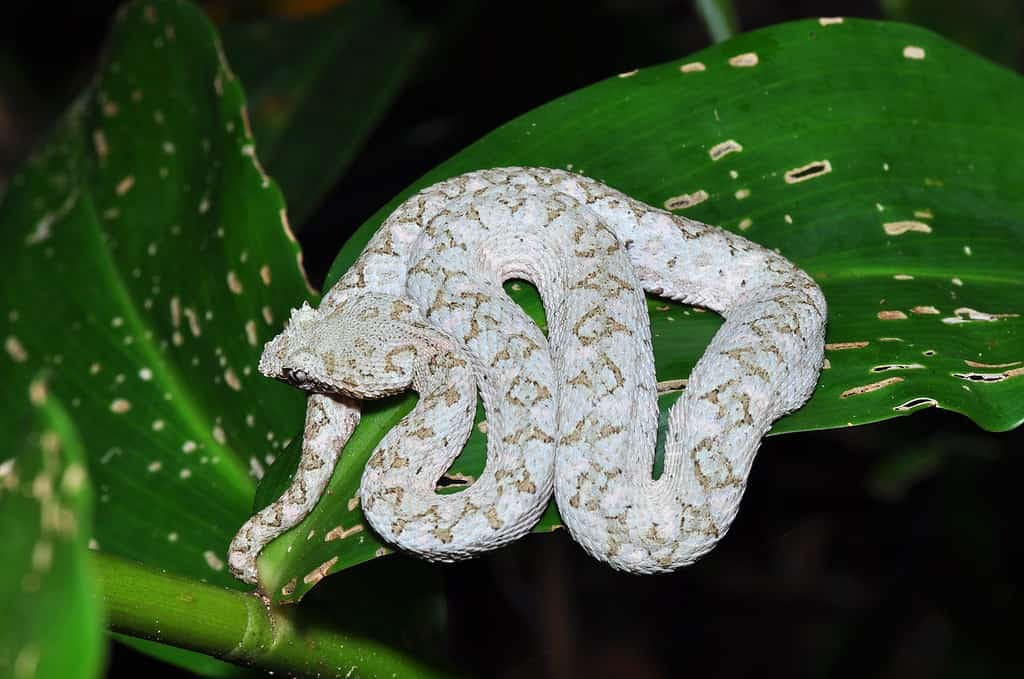
Eyelash vipers have modified scales above their eyes that look like eyelashes.
11. Blue Malayan Coral Snake (Calliophis bivirgatus)
The blue Malayan coral snake has a thin, dark blue or blue-black body that starkly contrasts with the vibrant red of its head, belly, and tail. A white or light-blue stripe runs along the length of each side of its body as well. These striking, colorful snakes live in the leaf litter and underbrush of tropical forests in Southeast Asia. They grow up to 5.9 feet in length. Blue Malayan coral snakes have very toxic venom that can cause immediate paralysis.
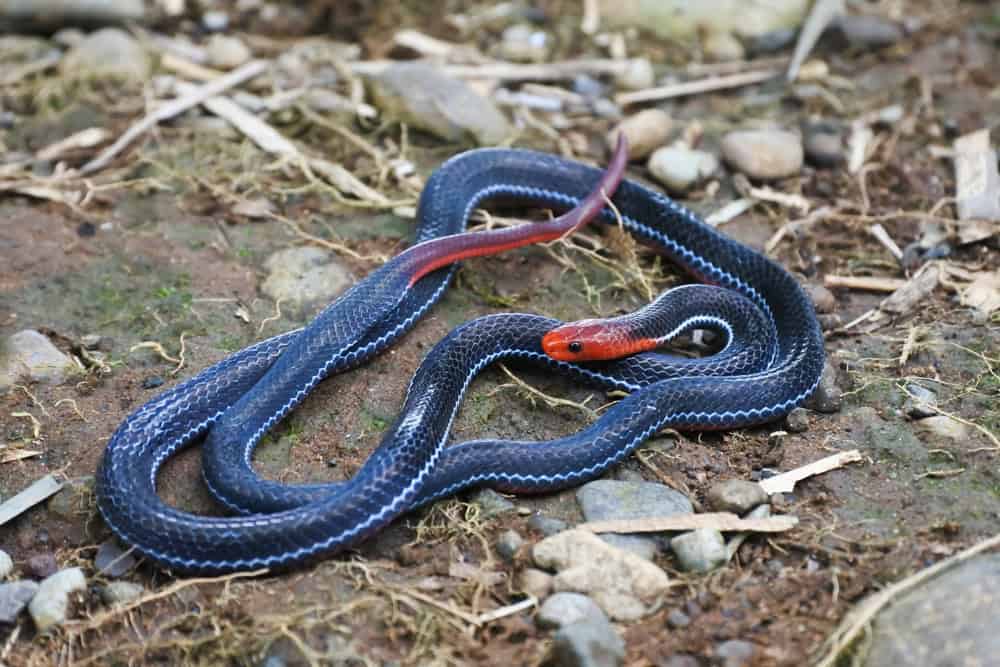
The blue Malayan coral snake is beautiful, but its venom can cause immediate paralysis.
©Pepew Fegley/Shutterstock.com
10. Eastern Indigo Snake (Drymarchon couperi)
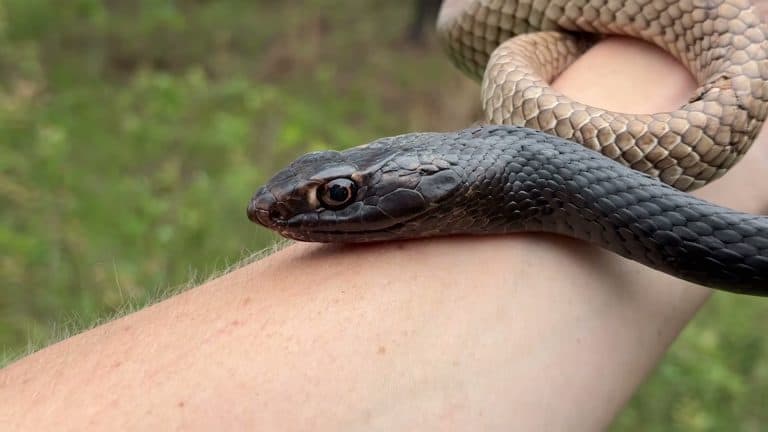
The Eastern indigo snake is a large, nonvenomous snake found in the southeastern United States. This snake has a deep blue-black body with smooth, polished scales that look iridescent in the sun. Some snakes may also have shades of red, orange, or tan on the chin, cheek, and throat. Eastern indigo snakes are very large, growing 5–7 feet long and weighing 2–10 pounds. The longest Eastern indigo snake recorded was over 9 feet long. Despite their large size, these snakes are extremely gentle and docile. The Eastern indigo snake is a federally threatened species. There are many ongoing efforts to reestablish the diminished populations of this charming snake.
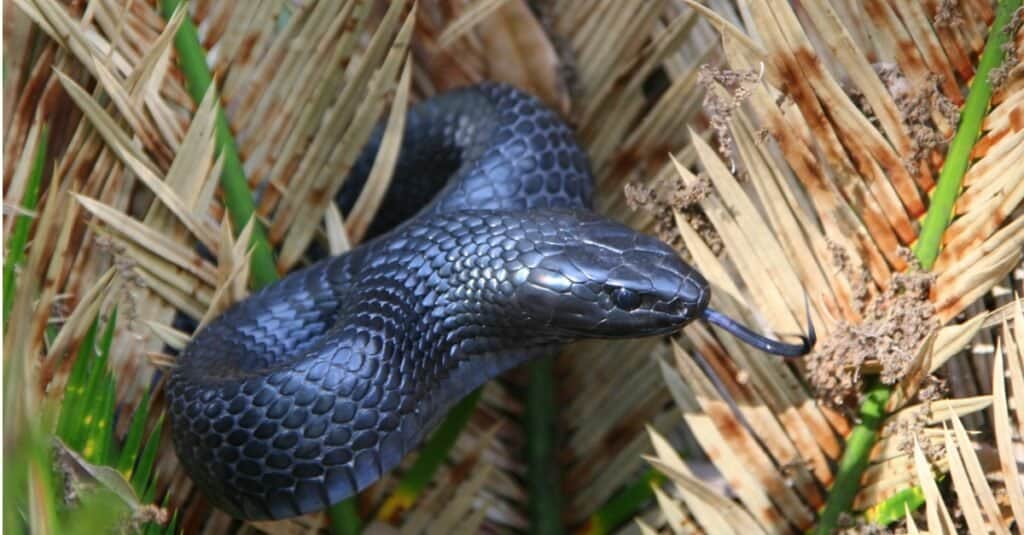
The Eastern indigo snake averages between 5 and 7 feet long.
©iStock.com/sstaton
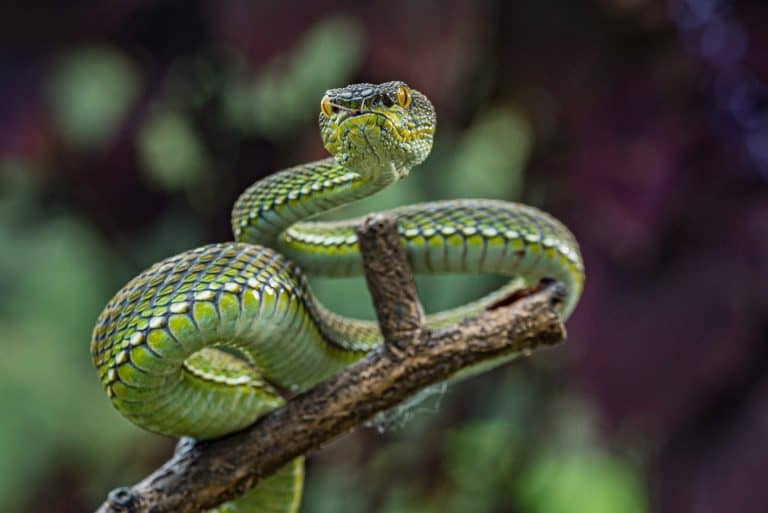
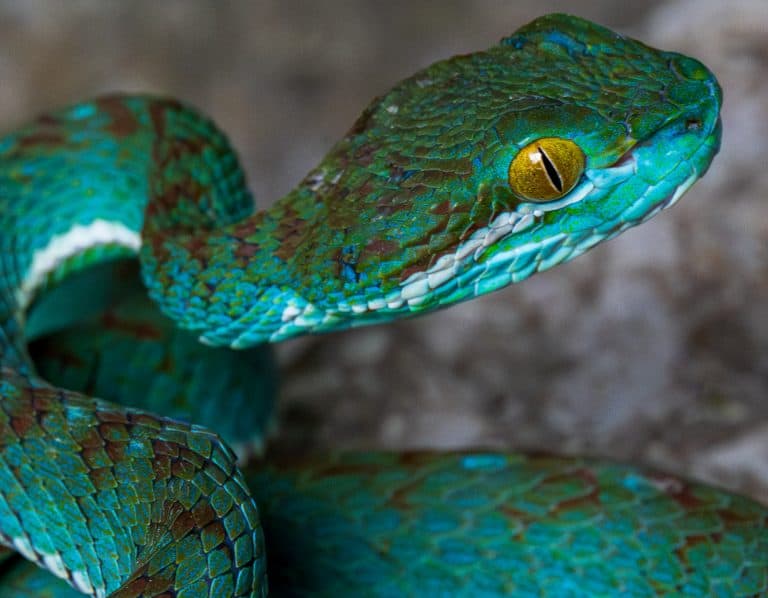
9. White-Lipped Island Pit Viper (Trimeresurus insularis)
The white-lipped island pit viper, or Sunda Island pit viper, is a venomous snake found on the Lesser Sunda Islands and in Eastern Java. These island-dwelling snakes have brilliant green, blue-green, or yellow bodies depending on where they live. Blue snakes, however, are quite rare and are primarily found on Komodo Island. White-lipped island pit vipers are arboreal snakes that live in trees. These snakes are very aggressive and have toxic venom, although it is not typically fatal to humans.
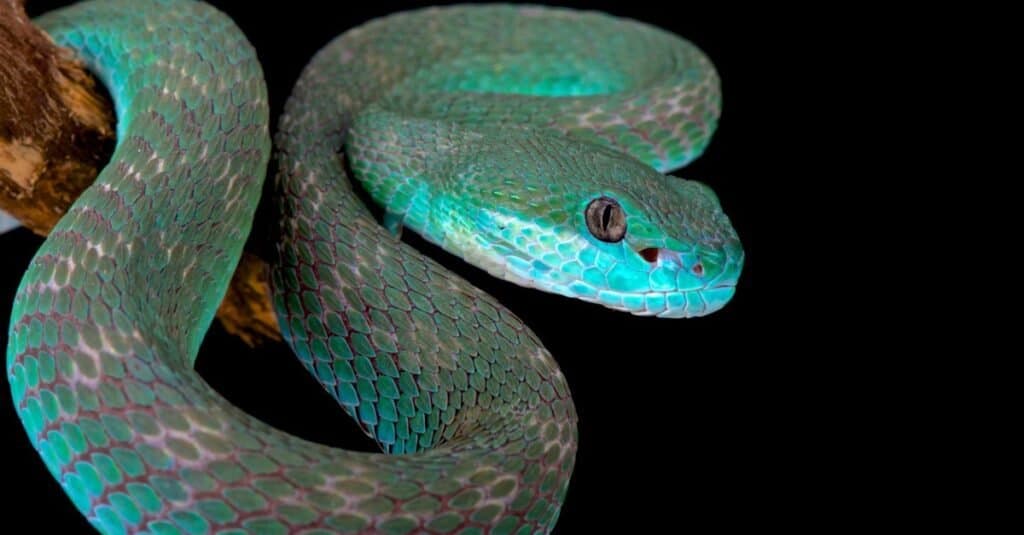
The blue white-lipped island pit viper primarily inhabits Komodo Island in Indonesia.
©iStock.com/reptiles4all
8. Vietnamese Blue Beauty Rat Snake (Orthriophis taeniurus callicyanous)
The Vietnamese blue beauty grows between 5 and 11 feet in length, with a slender blue or silver body. The head and neck are solid in color, with a thick dark stripe running from each eye to the back of its mouth. The rest of the snake’s body is covered with dark uniform geometric patterns. Near the tail these dark markings get closer together, fusing into uniform squares and rectangles. Its tail is often solid in color, occasionally marked with thin, light-colored stripes. The Vietnamese blue beauty rat snake is a subspecies of the beauty rat snake that lives in tropical rainforests in Vietnam, Cambodia, and Thailand. Some have docile temperaments, while others can be aggressive if they feel threatened. A bite from this snake is painful, though it is non-venomous.
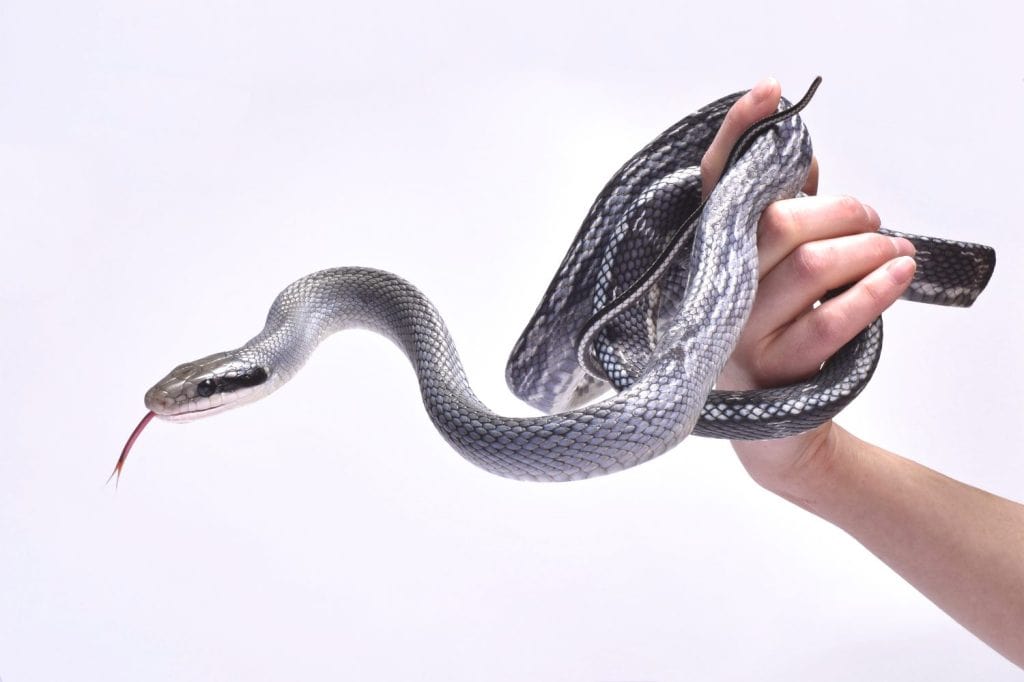
The Vietnamese blue beauty rat snake is a subspecies of the Beauty rat snake.
©reptiles4all/Shutterstock.com
7. Malabar Pit Viper (Craspedocephalus malabaricus)
The Malabar pit viper is a venomous snake that lives in southwestern India in the Western Ghats or Sahyadri Mountain Range. These snakes come in many different colors, like brown, yellow, green, and light blue. Some snakes also have brown and black jagged blotches or zigzag patterns along their backs, while others have faded markings or no markings at all. Adults can grow up to 3.41 feet in length. These beautiful snakes are most common during the monsoon season. While they typically move slowly, Malabar pit vipers are quick to strike. Their bites, however, are not fatal to humans, although they will cause pain and swelling for a few days.
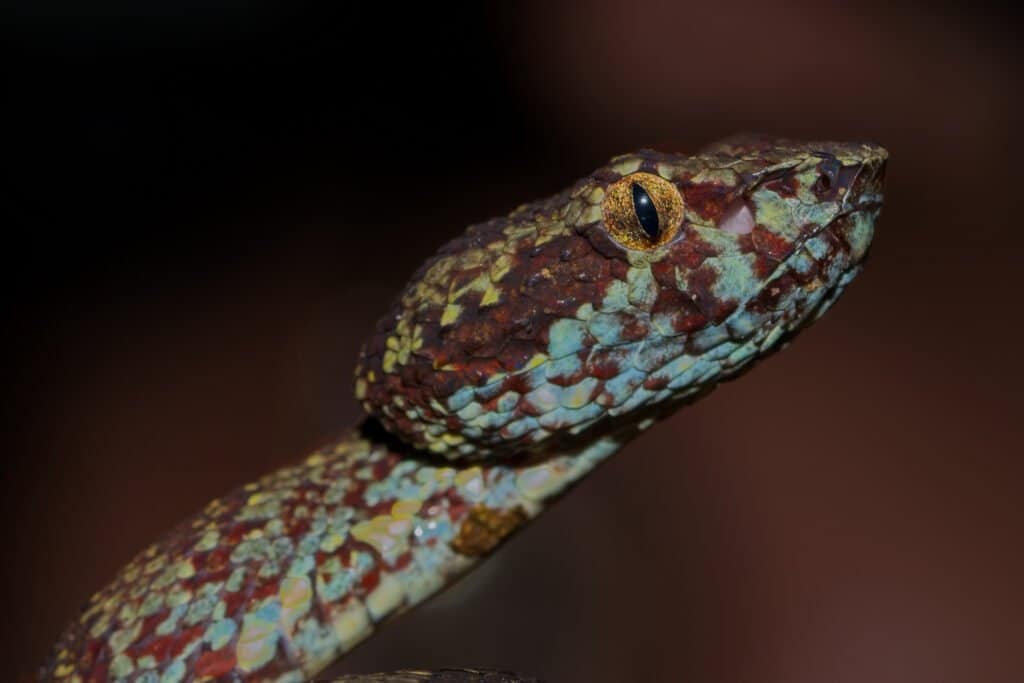
Malabar Pit Vipers are ambush predators that can strike quickly.
©ananth-tp/Shutterstock.com
6. Bluestripe Ribbon Snake (Thamnophis saurita nitae)
The bluestripe ribbon snake is a semi-aquatic subspecies of ribbon snake. They live in Florida along the Gulf Coast, preying on frogs, salamanders, earthworms, and small fish. Bluestripe ribbon snakes have dark, thin bodies with a light mid-dorsal stripe, a light blue stripe running along each side, and pale blue bellies. These snakes are 18-30 inches long. They are nonvenomous, relying on high speed to escape threats.
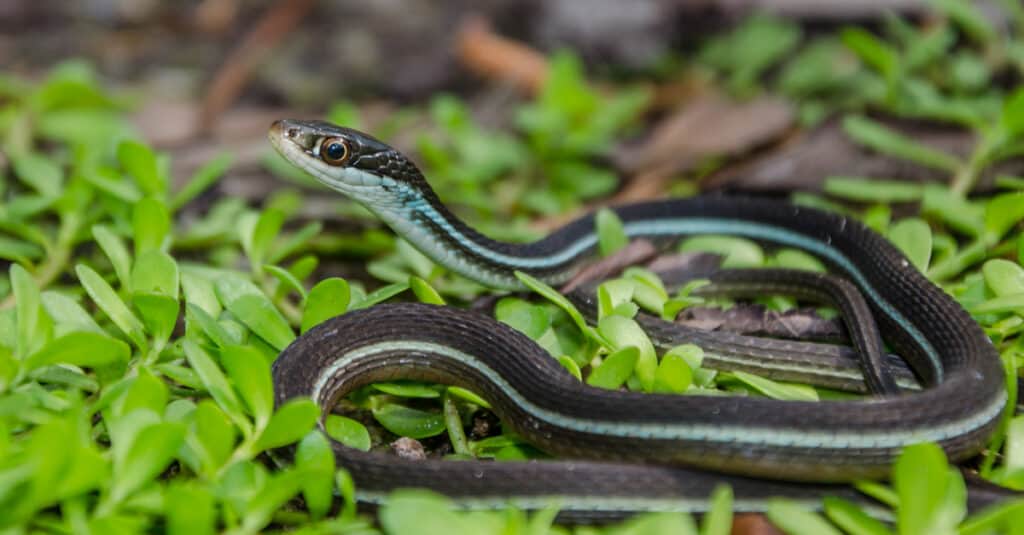
The bluestripe ribbon snake has a light blue ribbon-like stripe down the sides of its body.
©Jay Ondreicka/Shutterstock.com
5. Guatemalan Palm Pit Viper (Bothriechis bicolor)
The Guatemalan palm pit viper is a venomous, arboreal snake that lives in the mountain forests of Guatemala, Honduras, and southern Mexico. These snakes are green or blue-green in color and typically grow 24-28 inches in length. They often have blue skin between their scales, and some scales may have blue borders as well. The snakes in Mexico have additional black or blue markings in the form of patches, dots, or flecks along their bodies.
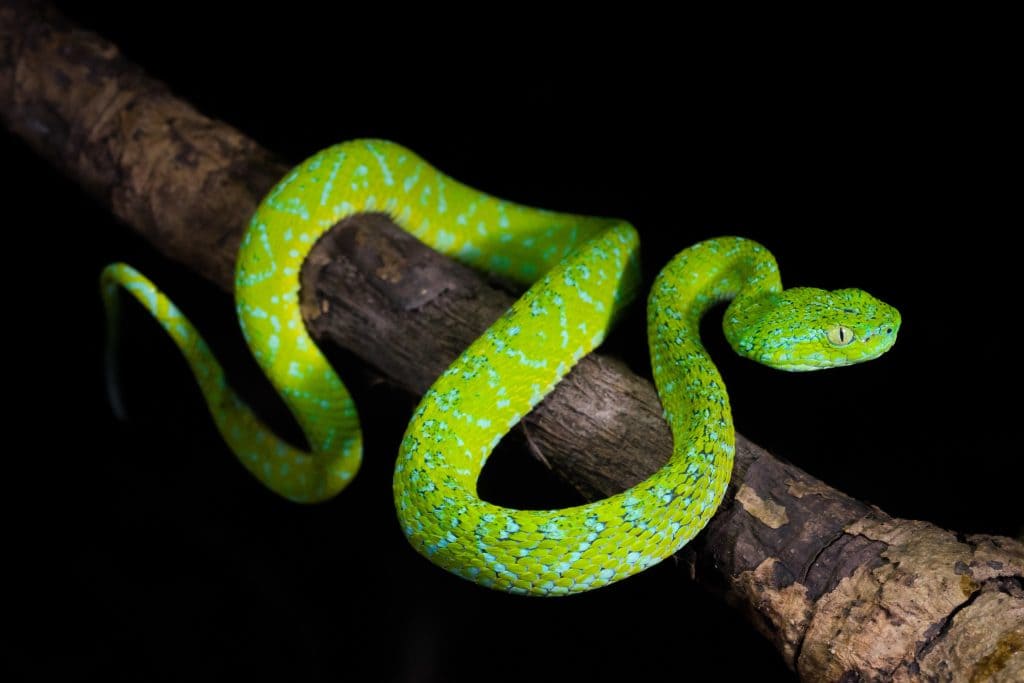
Guatemalan palm pit vipers inhabit mountain forests in southern Mexico, Guatemala, and Honduras.
4. Blue Phase Common Tree Snake (Dendrelaphis punctulatus)
The blue phase common tree snake is typically yellow, green, brown, or black. On rare occasions, however, these snakes are completely and beautifully blue. The entire body of a blue-phase common tree snake is blue, although the shade and vibrancy are different for each snake. Some are neon or bright blue, while others are dull or navy blue. Common tree snakes are completely harmless, nonvenomous snakes that can grow up to 6.5 feet long. These snakes live in Australia and primarily eat skinks and frogs.
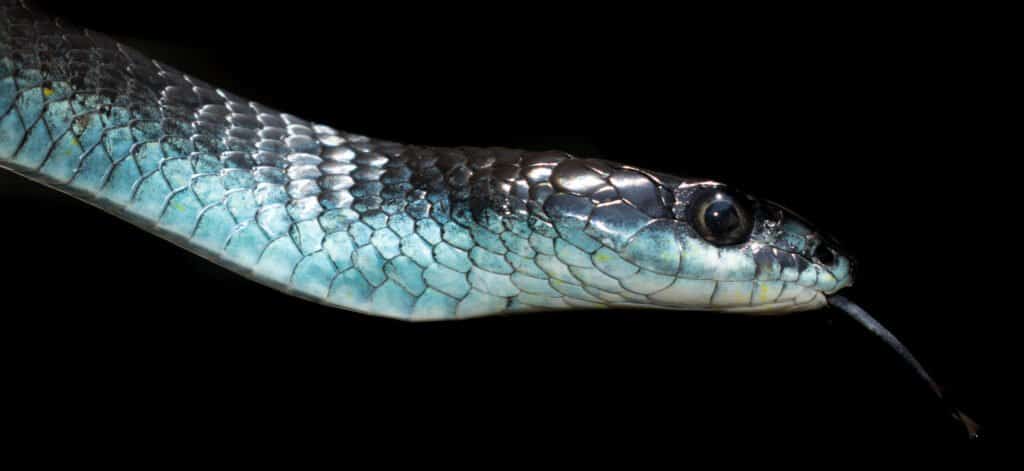
The blue phase common tree snake’s unique blue color is caused by a genetic variation.
©Jake Goldring/Shutterstock.com
3. Side-Striped Palm Pit Viper (Bothriechis lateralis)
The side-striped palm pit viper is an emerald-green or blue-green snake with a very thin yellow stripe running down either side of its slender body. Some snakes also have blue or black-tipped scales along their yellow stripes. Occasionally they may have a blue stripe behind their eyes as well. The side-striped palm pit viper is a venomous snake that is typically found in the lower mountain forests of western Panama and Costa Rica. It is a cathemeral snake, which means that it is active at irregular times throughout the day and night. They typically measure 24-31 inches, but larger individuals can reach as long as 3.25 feet.
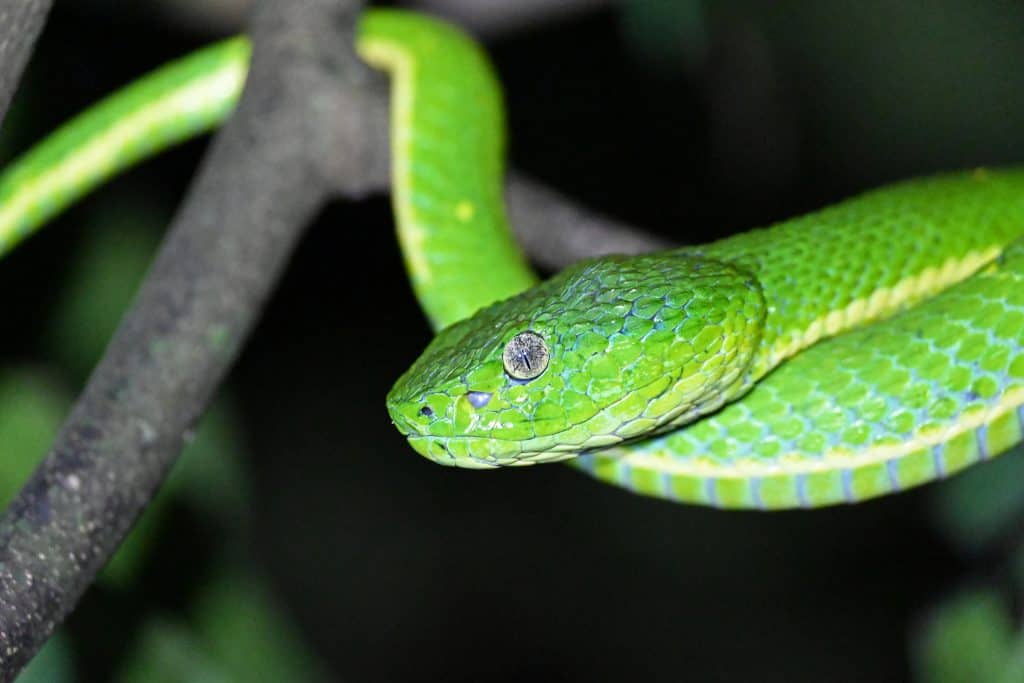
Blue coloring can occur naturally in side-striped palm pit vipers in the wild.
2. Blue-Striped Garter Snake (Thamnophis sirtalis similis)
The Blue-striped garter snake is a rare subspecies of garter snake that lives in northwestern Florida. Its slender body is gray, tan, greenish-brown, or black, with a yellow, white, brown, green, or blue stripe running down each side of its body. It also has a matching stripe running down the middle of its back. Blue-striped garter snakes are 18-26 inches long with slender bodies and large eyes. These snakes swallow their food whole while it is still alive. They eat salamanders, earthworms, freshwater fish, snails, slugs, leeches, and small mammals.
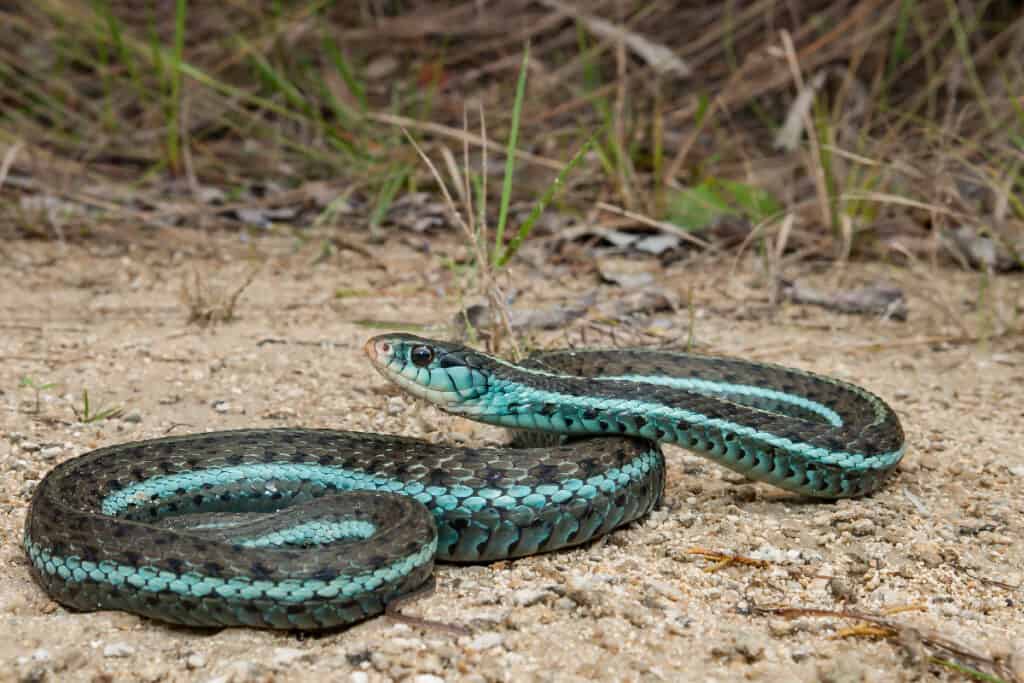
The blue-striped garter snake is found in northwestern Florida and can come in a striking shade of blue.
©Jay Ondreicka/Shutterstock.com
1. Blue Racer Snake (Coluber constrictor foxii)
The blue racer snake is a subspecies of the fast, nonvenomous eastern racer with a long, slim body measuring 3-5 feet in length. These snakes are various shades of blue, from sapphire blue to grey-blue and deep midnight blue. They have dark markings around their large eyes and along the sides of their faces. Their chins and necks are often white or cream, fading into a lighter shade of blue. Blue racer snakes live in the Midwest and have been observed in Ontario, Canada, where they are listed as a threatened species. These snakes prefer drier habitats that have plenty of cover as well as spots for sunning. They are often found in fields, open forests, pastures, and around marshes.
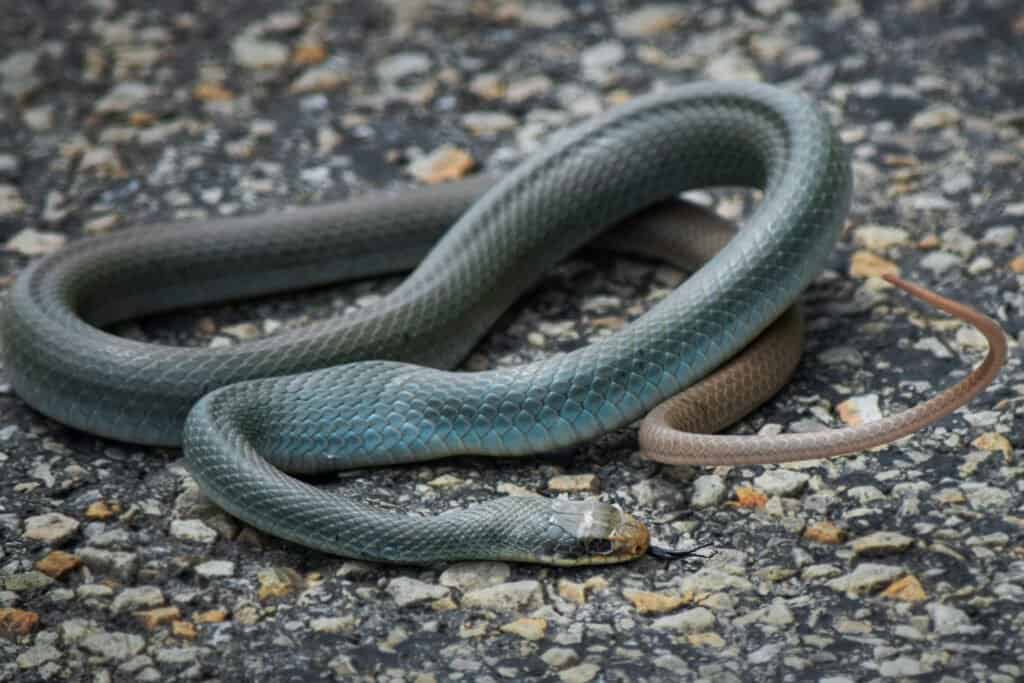
Blue racer snakes come in many different shades of blue, from light or dark tones to bright or dull hues.
©Teresa Considine/Shutterstock.com